lights FIAT DOBLO PANORAMA 2015 2.G Workshop Manual
[x] Cancel search | Manufacturer: FIAT, Model Year: 2015, Model line: DOBLO PANORAMA, Model: FIAT DOBLO PANORAMA 2015 2.GPages: 323, PDF Size: 47.13 MB
Page 140 of 323
STARTING THE
ENGINE
The vehicle is fitted with an
immobiliser: if the engine fails to
start, see the paragraph on “The
Fiat CODE system” in the
“Dashboard and controls” section.
The engine may be noisier during
the first few seconds of operation,
especially after a long period of
inactivity. This is due to the hydraulic
tappets, the timing system chosen
for petrol engine versions to reduce
the number of servicing
interventions, and affects neither
functionality nor reliability.
17) 18)
78)
PROCEDURE FOR
PETROL VERSIONS
Proceed as follows:
❒engage the handbrake;
❒put the gear lever into neutral;
❒fully depress the clutch pedal,
without touching the accelerator;
❒turn the ignition key to AVV and
release it as soon as the engine
starts.
If the engine does not start at the
first attempt, return the ignition key
to STOP before repeating the
starting procedure.
If, when the ignition key is on MAR,
the instrument panel warning light
remains on together with
warning light
, turn the key to
STOP and then back to MAR; if the
warning light remains on, try the
other keys provided with the vehicle.
If you are still unable to start the
engine, perform the emergency
starting procedure (see "Emergency
starting" in the "In an emergency"
chapter) and contact a Fiat
Dealership.
PROCEDURE FOR
DIESEL VERSIONS
Proceed as follows:
❒engage the handbrake;
❒put the gear lever into neutral;
❒turn the ignition key to MAR: the
warning lights
andon
the instrument panel will turn on;
❒wait for the warning lights
and
to switch off. The hotter the
engine is, the quicker this will
happen;❒fully depress the clutch pedal,
without touching the accelerator;
❒turn the ignition key to AVV as soon
as warning light
switches off.
Waiting too long will waste the
heating work carried out by the glow
plugs.
Release the key as soon as the
engine starts.
IMPORTANT With the engine cold,
the accelerator pedal must be
fully released when you turn the
ignition key to AVV.
If the engine does not start at the
first attempt, return the ignition key
to STOP before repeating the
starting procedure.
If, when the ignition key is at MAR
the
warning light remains lit, turn
the key to STOP and then back to
MAR; if the warning light remains lit,
try with the other keys provided
with the vehicle. If you still cannot
start the engine, contact a Fiat
Dealership.
19)
136
STARTING AND DRIVING
Page 155 of 323
ACOUSTIC SIGNAL
When reverse gear is engaged an
intermittent acoustic signal is
automatically activated.
The frequency of the acoustic signal:
❒increases as the distance between
the vehicle and the obstacle
decreases;
❒becomes continuous when the
distance between the vehicle and the
obstacle is less than 30 cm and
stops immediately if the distance
increases;
❒is constant if the distance between
the vehicle and the obstacle is
unchanged;
❒whereas, if this situation occurs for
the side sensors, the indication will
stop after about 3 seconds to avoid,
for example, warning indications in
the event of manoeuvres alongside
walls.
Detection distances
If several obstacles are detected by
the sensors, only the nearest one
is considered.FAULT INDICATIONS
Any parking sensor faults will be
indicated when reverse is engaged
by the warning light in the
instrument panel switching on
together with the message in the
multifunction display, for
versions/markets, where provided
(see chapter "Warning lights and
messages”).
97)
OPERATION WITH
TRAILER
Parking sensor operation is
automatically deactivated when the
electric cable plug of the trailer is
inserted into the vehicle tow hook
socket. The sensors are
automatically reactivated when the
trailer's cable plug is removed.
IMPORTANT
If you wish to leave the tow hook
fitted without towing a trailer, it
is advisable to contact a Fiat
Dealership for the relevant system
update operations because the tow
hook could be detected as an
obstacle by the central sensors.GENERAL WARNINGS
98)
❒When parking, take the utmost care
over obstacles that may be above or
under the sensor.
❒Sometimes, objects located very
near the rear of the vehicle are not
detected and could therefore
damage the vehicle or be damaged
themselves.
The following conditions may
influence the performance of the
parking assistance system:
❒Reduced sensor sensitivity and a
reduction in the parking assistance
system performance could be due to
the presence on the surface of the
sensor of: ice, snow, mud, thick
paint.
❒The sensor may detect a non-
existent obstacle (echo noise) due to
mechanical noises, for example
when washing the vehicle, in case of
rain, strong wind, hail.
❒The signals sent out by the sensors
can be altered by dirt, snow or ice
deposited on the sensors or by
ultrasound systems (e.g. truck
pneumatic brakes or pneumatic drills)
near the vehicle.
151
Page 158 of 323
IMPORTANT
22) For diesel engines, use only
diesel fuel for motor vehicles
in accordance with EN590
European specifications. The use
of other products or mixtures
may damage the engine beyond
repair and consequently invalidate
the warranty, due to the damage
caused. If you accidentally refuel
with another type of fuel, do not
start the engine, and drain the
tank. If the engine has run, even
for a very short time, you will need
to have the entire fuel supply
system emptied in addition to the
tank.
23) Do not bring naked flames or lit
cigarettes near the fuel tank filler:
fire risk. Keep your face away
from the fuel filler to prevent
breathing in harmful vapours.
SAVING FUEL
Some useful tips are given below for
fuel saving and reducing harmful
emissions of CO2 and other
pollutants (nitrogen oxides, unburnt
hydrocarbons, Particulate Matter
(PM), etc.).
PRACTICAL ADVICE
FOR REDUCING FUEL
CONSUMPTION AND
HARMFUL EMISSIONS
Vehicle conditions
❒Have checks and adjustments for
vehicle maintenancecarried out
in accordance with the “Scheduled
servicing plan”.
❒Checktyrepressure regularly, at
least once every four weeks.
Excessively low pressures will
increase consumption because
rolling resistance will be higher. In
addition, this wears the tyre more
quickly and impairs performance.
❒Only usesnow tyreswhen
the weather conditions make them
absolutely necessary. They increase
consumption and noise.❒Do not travel witha heavy load: the
weight of the vehicle (especially when
driving in town) and its geometry
greatly affect fuel consumption and
stability.
❒Removeroof racks or ski racks
after use. These accessories reduce
the vehicle's aerodynamic
penetration and have a negative
effect on fuel consumption.
❒When transporting particularly large
objects, use atrailerif possible.
❒Use the vehicle's air vents if possible:
travelling with the windows open
impairs aerodynamics.
❒Use electrical devices only for the
amount of time needed. The vehicle’s
heated rear window, additional
headlights, screen wipers and heater
fan require a considerable amount
of energy; this increases fuel
consumption (by up to +25% in an
urban cycle).
❒Air conditioning leads to higher fuel
consumption (on average up to
+30%). If the temperature outside is
not too extreme, try and use the
air vents.
154
STARTING AND DRIVING
Page 159 of 323
Driving style
❒Afterstarting the engineyou
should drive away immediately and
slowly, avoiding high revs. Do not
warm up the engine at low or high
revs when the vehicle is stationary;
this causes the engine to warm
up more slowly, thereby increasing
fuel consumption, emissions and
mechanical component wear.
❒Avoidpointless actionssuch as
revving up when at traffic lights or
before stopping the engine. The latter
action, like double-declutching, is
unnecessary and causes increased
fuel consumption and pollution.
❒Gear selection:select a high gear
as soon as possible (taking into
account normal engine operation and
traffic conditions) without pushing
the engine to high revs during the
intermediate gears. Using low gears
at high revs to get lively acceleration
increases fuel consumption, harmful
emissions and engine wear.❒Vehicle speed:fuel consumption
increases exponentially as the speed
of the vehicle increases. Keep your
speed moderate and as even as
possible, avoiding unnecessary
braking and acceleration, which
cause excessive fuel consumption
and increased emissions. Keeping a
safe distance from the vehicle in
front helps to maintain a steady
speed.
❒Acceleration:accelerating violently
severely affects consumption and
emissions. Acceleration should
be gradual and should not exceed
the maximum engine torque rate.
CONDITIONS OF USE
Cold starting
Short journeys and frequent cold
starts do not allow the engine to
reach optimum operating
temperature.
This results in a significant increase
in consumption levels (from +15
to +30% on the urban cycle) and
emissions.Traffic and road
conditions
Rather high consumption levels are
linked to situations with heavy traffic,
for instance when travelling in
queues with frequent use of the
lower gears or in cities with many
traffic lights. Winding mountain
roads and rough road surfaces also
adversely affect consumption.
Stops in traffic
During prolonged hold-ups (e.g.
level crossings) the engine should
be switched off.
155
Page 163 of 323
IN AN EMERGENCY
A punctured tyre or a burnt-out
bulb?
At times, a problem may interfere
with our journey.
The pages on emergencies can help
you to deal with critical situations
independently and with calm.
In an emergency we recommend
that you call the freephone number
found in the Warranty Booklet.
It is also possible to call the 00 800
3428 0000 freephone number to
search the nearest Fiat Dealership.HAZARD WARNING LIGHTS...........160
REPLACING A BULB ......................160
REPLACING AN EXTERIOR BULB ..163
REPLACING AN INTERIOR BULB ...167
REPLACING FUSES........................168
CHANGING A WHEEL ....................175
FIX&GO AUTOMATIC QUICK TYRE
REPAIR KIT .....................................180
EMERGENCY STARTING ................183
FUEL CUT-OFF SYSTEM ................185
LIFTING THE VEHICLE....................185
TOWING THE VEHICLE ..................186
159
Page 164 of 323
HAZARD WARNING
LIGHTS
They are turned on by pressing
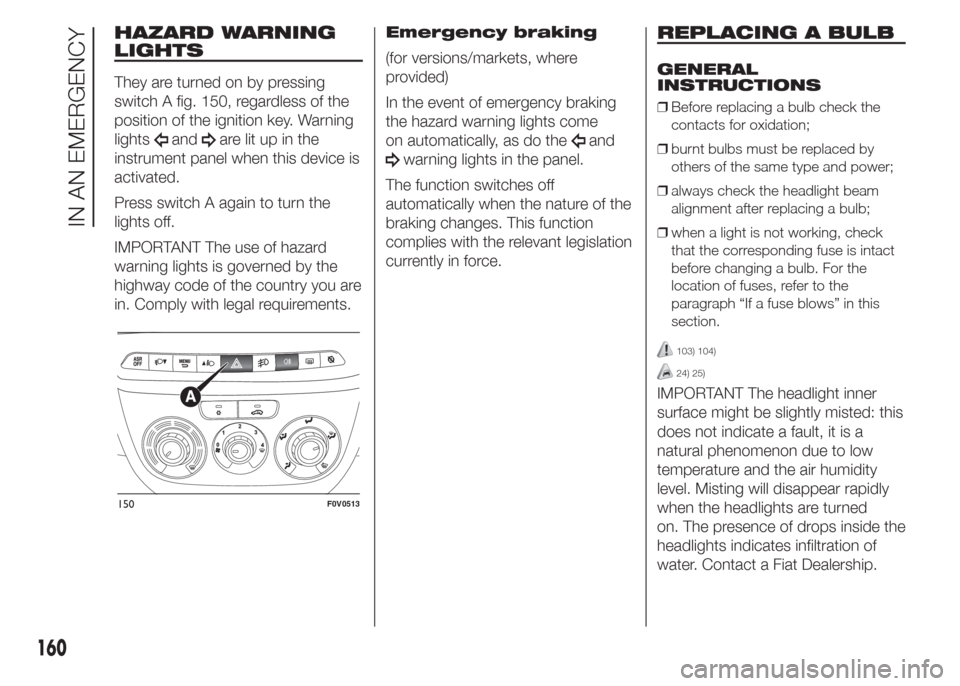
switch A fig. 150, regardless of the
position of the ignition key. Warning
lights
andare lit up in the
instrument panel when this device is
activated.
Press switch A again to turn the
lights off.
IMPORTANT The use of hazard
warning lights is governed by the
highway code of the country you are
in. Comply with legal requirements.Emergency braking
(for versions/markets, where
provided)
In the event of emergency braking
the hazard warning lights come
on automatically, as do theand
warning lights in the panel.
The function switches off
automatically when the nature of the
braking changes. This function
complies with the relevant legislation
currently in force.
REPLACING A BULB
GENERAL
INSTRUCTIONS
❒Before replacing a bulb check the
contacts for oxidation;
❒burnt bulbs must be replaced by
others of the same type and power;
❒always check the headlight beam
alignment after replacing a bulb;
❒when a light is not working, check
that the corresponding fuse is intact
before changing a bulb. For the
location of fuses, refer to the
paragraph “If a fuse blows” in this
section.
103) 104)
24) 25)
IMPORTANT The headlight inner
surface might be slightly misted: this
does not indicate a fault, it is a
natural phenomenon due to low
temperature and the air humidity
level. Misting will disappear rapidly
when the headlights are turned
on. The presence of drops inside the
headlights indicates infiltration of
water. Contact a Fiat Dealership.
150F0V0513
160
IN AN EMERGENCY
Page 165 of 323
TYPES OF BULBS
Various types of bulbs are fitted to
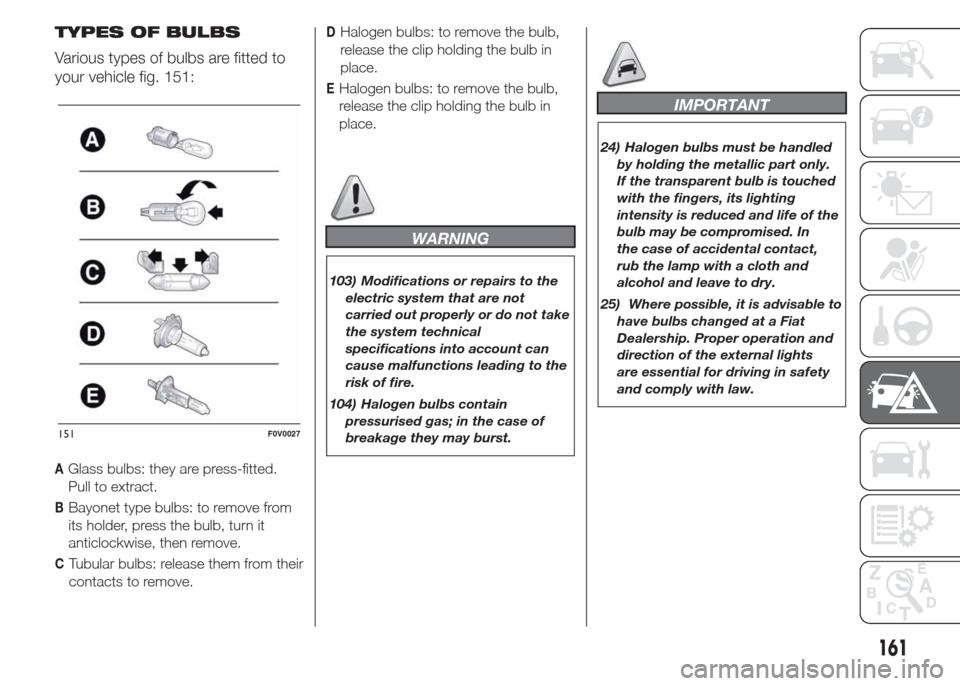
your vehicle fig. 151:
AGlass bulbs: they are press-fitted.
Pull to extract.
BBayonet type bulbs: to remove from
its holder, press the bulb, turn it
anticlockwise, then remove.
CTubular bulbs: release them from their
contacts to remove.
DHalogen bulbs: to remove the bulb,
release the clip holding the bulb in
place.
EHalogen bulbs: to remove the bulb,
release the clip holding the bulb in
place.
WARNING
103) Modifications or repairs to the
electric system that are not
carried out properly or do not take
the system technical
specifications into account can
cause malfunctions leading to the
risk of fire.
104) Halogen bulbs contain
pressurised gas; in the case of
breakage they may burst.
IMPORTANT
24) Halogen bulbs must be handled
by holding the metallic part only.
If the transparent bulb is touched
with the fingers, its lighting
intensity is reduced and life of the
bulb may be compromised. In
the case of accidental contact,
rub the lamp with a cloth and
alcohol and leave to dry.
25) Where possible, it is advisable to
have bulbs changed at a Fiat
Dealership. Proper operation and
direction of the external lights
are essential for driving in safety
and comply with law.
151F0V0027
161
Page 166 of 323
Bulbs
Use Type Power Ref. Figure
Main beam headlights H7 55 W E
Dipped headlights H7 55 W E
Daytime running lights / side lights W21W 13 W B
Front direction indicators WY21W 21 W B
Side direction indicators WY5W 5 W A
Rear direction indicators PY21W 21 W B
Rear fog light W16W 16 W A
Reverse W16W 16 W A
Rear side lights P21/5W 5 W B
Brake lights P21W 21 W B
3rd brake light wing W5W 5 W A
3rd brake light swinging W5W 5 W A
3rd brake light swinging (for privacy glass) Xenon 6 W 6 W A
Front fog lights (for versions/markets where
provided)H11 55 W E
162
IN AN EMERGENCY
Page 167 of 323
REPLACING AN
EXTERIOR BULB
For the type of bulb and relevant
power rating, see “Changing a
bulb”.
FRONT LIGHT
CLUSTERS
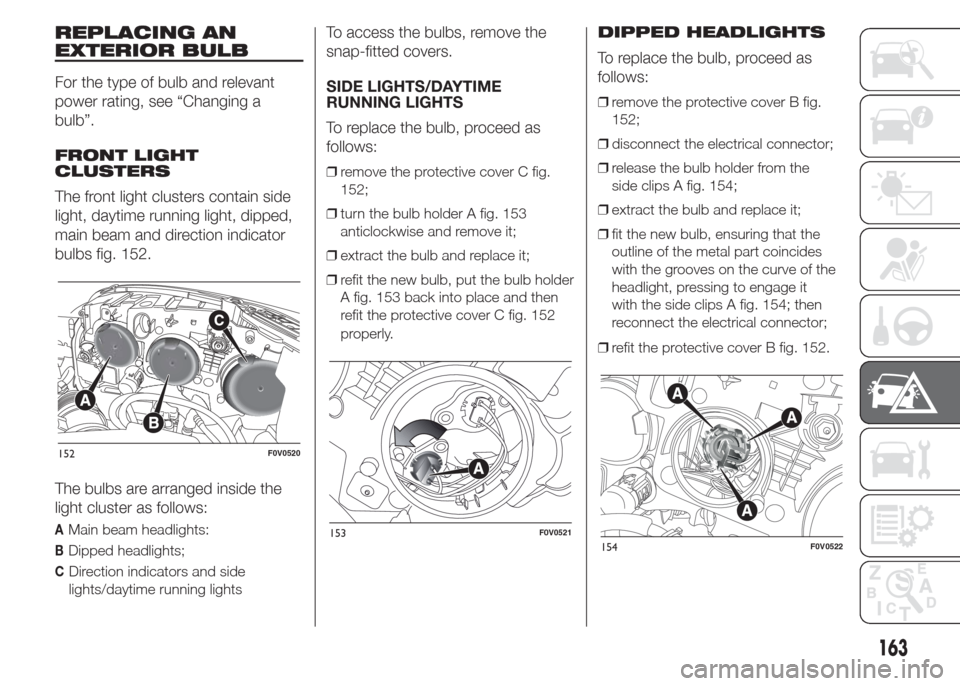
The front light clusters contain side
light, daytime running light, dipped,
main beam and direction indicator
bulbs fig. 152.
The bulbs are arranged inside the
light cluster as follows:
AMain beam headlights:
BDipped headlights;
CDirection indicators and side
lights/daytime running lights
To access the bulbs, remove the
snap-fitted covers.
SIDE LIGHTS/DAYTIME
RUNNING LIGHTS
To replace the bulb, proceed as
follows:
❒remove the protective cover C fig.
152;
❒turn the bulb holder A fig. 153
anticlockwise and remove it;
❒extract the bulb and replace it;
❒refit the new bulb, put the bulb holder
A fig. 153 back into place and then
refit the protective cover C fig. 152
properly.
DIPPED HEADLIGHTS
To replace the bulb, proceed as
follows:
❒remove the protective cover B fig.
152;
❒disconnect the electrical connector;
❒release the bulb holder from the
side clips A fig. 154;
❒extract the bulb and replace it;
❒fit the new bulb, ensuring that the
outline of the metal part coincides
with the grooves on the curve of the
headlight, pressing to engage it
with the side clips A fig. 154; then
reconnect the electrical connector;
❒refit the protective cover B fig. 152.
152F0V0520
153F0V0521154F0V0522
163
Page 168 of 323
DIRECTION
INDICATORS
Front
To replace the bulb, proceed as
follows:
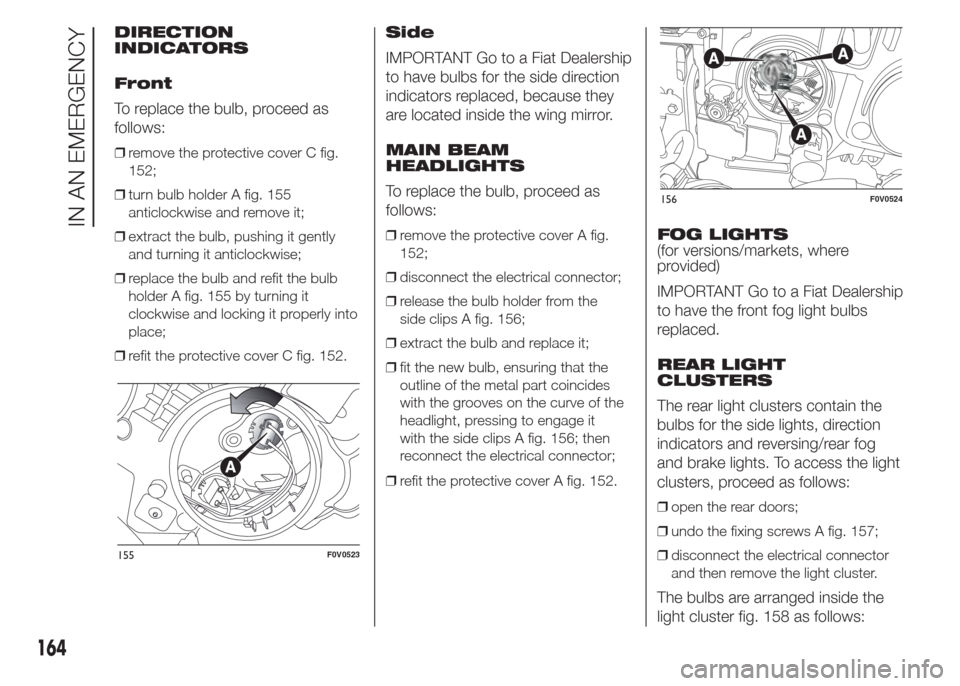
❒remove the protective cover C fig.
152;
❒turn bulb holder A fig. 155
anticlockwise and remove it;
❒extract the bulb, pushing it gently
and turning it anticlockwise;
❒replace the bulb and refit the bulb
holder A fig. 155 by turning it
clockwise and locking it properly into
place;
❒refit the protective cover C fig. 152.
Side
IMPORTANT Go to a Fiat Dealership
to have bulbs for the side direction
indicators replaced, because they
are located inside the wing mirror.
MAIN BEAM
HEADLIGHTS
To replace the bulb, proceed as
follows:
❒remove the protective cover A fig.
152;
❒disconnect the electrical connector;
❒release the bulb holder from the
side clips A fig. 156;
❒extract the bulb and replace it;
❒fit the new bulb, ensuring that the
outline of the metal part coincides
with the grooves on the curve of the
headlight, pressing to engage it
with the side clips A fig. 156; then
reconnect the electrical connector;
❒refit the protective cover A fig. 152.FOG LIGHTS
(for versions/markets, where
provided)
IMPORTANT Go to a Fiat Dealership
to have the front fog light bulbs
replaced.
REAR LIGHT
CLUSTERS
The rear light clusters contain the
bulbs for the side lights, direction
indicators and reversing/rear fog
and brake lights. To access the light
clusters, proceed as follows:
❒open the rear doors;
❒undo the fixing screws A fig. 157;
❒disconnect the electrical connector
and then remove the light cluster.
The bulbs are arranged inside the
light cluster fig. 158 as follows:
155F0V0523
156F0V0524
164
IN AN EMERGENCY