trailer FIAT DOBLO PANORAMA 2016 2.G Owners Manual
[x] Cancel search | Manufacturer: FIAT, Model Year: 2016, Model line: DOBLO PANORAMA, Model: FIAT DOBLO PANORAMA 2016 2.GPages: 323, PDF Size: 25.46 MB
Page 133 of 323
STARTING AND DRIVING
Let’s get to the "heart" of the vehicle:
seeing how you can exploit all of its
potential to the full.
We’ll look at how to drive it safely in any
situation, so that it can be a welcome
companion, with our comfort and
our wallets in mind.STARTING THE ENGINE .................130
HANDBRAKE ..................................132
USING THE GEARBOX ...................133
START&STOP SYSTEM ..................134
TPMS (TYRE PRESSURE
MONITORING SYSTEM) .................138
SPEED BLOCK ...............................141
CRUISE CONTROL .........................141
TRACTION PLUS SYSTEM .............143
PARKING SENSORS.......................144
REFUELLING THE VEHICLE ...........146
SAVING FUEL .................................147
TOWING TRAILERS ........................149
SNOW TYRES ................................149
SNOW CHAINS...............................150
129
Page 148 of 323
PARKING SENSORS
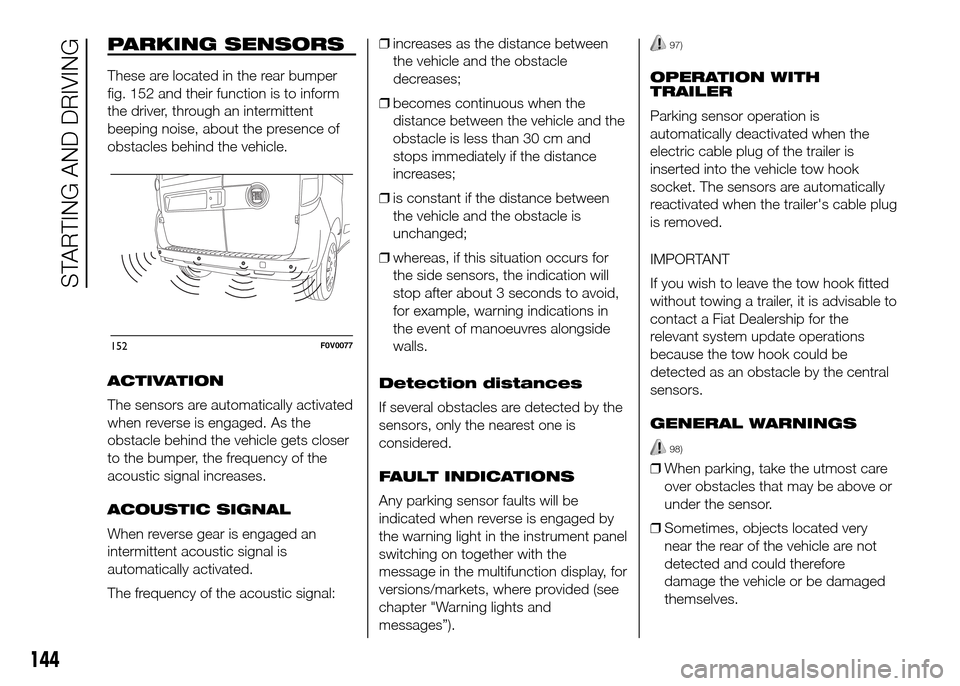
These are located in the rear bumper
fig. 152 and their function is to inform
the driver, through an intermittent
beeping noise, about the presence of
obstacles behind the vehicle.
ACTIVATION
The sensors are automatically activated
when reverse is engaged. As the
obstacle behind the vehicle gets closer
to the bumper, the frequency of the
acoustic signal increases.
ACOUSTIC SIGNAL
When reverse gear is engaged an
intermittent acoustic signal is
automatically activated.
The frequency of the acoustic signal:❒increases as the distance between
the vehicle and the obstacle
decreases;
❒becomes continuous when the
distance between the vehicle and the
obstacle is less than 30 cm and
stops immediately if the distance
increases;
❒is constant if the distance between
the vehicle and the obstacle is
unchanged;
❒whereas, if this situation occurs for
the side sensors, the indication will
stop after about 3 seconds to avoid,
for example, warning indications in
the event of manoeuvres alongside
walls.
Detection distances
If several obstacles are detected by the
sensors, only the nearest one is
considered.
FAULT INDICATIONS
Any parking sensor faults will be
indicated when reverse is engaged by
the warning light in the instrument panel
switching on together with the
message in the multifunction display, for
versions/markets, where provided (see
chapter "Warning lights and
messages”).
97)
OPERATION WITH
TRAILER
Parking sensor operation is
automatically deactivated when the
electric cable plug of the trailer is
inserted into the vehicle tow hook
socket. The sensors are automatically
reactivated when the trailer's cable plug
is removed.
IMPORTANT
If you wish to leave the tow hook fitted
without towing a trailer, it is advisable to
contact a Fiat Dealership for the
relevant system update operations
because the tow hook could be
detected as an obstacle by the central
sensors.
GENERAL WARNINGS
98)
❒When parking, take the utmost care
over obstacles that may be above or
under the sensor.
❒Sometimes, objects located very
near the rear of the vehicle are not
detected and could therefore
damage the vehicle or be damaged
themselves.
152F0V0077
144
STARTING AND DRIVING
Page 151 of 323
23)
IMPORTANT
22) For diesel engines, use only
diesel fuel for motor vehicles
in accordance with EN590
European specifications. The use
of other products or mixtures
may damage the engine beyond
repair and consequently invalidate
the warranty, due to the damage
caused. If you accidentally refuel
with another type of fuel, do not
start the engine, and drain the
tank. If the engine has run, even
for a very short time, you will need
to have the entire fuel supply
system emptied in addition to the
tank.
23) Do not bring naked flames or lit
cigarettes near the fuel tank filler:
fire risk. Keep your face away
from the fuel filler to prevent
breathing in harmful vapours.
SAVING FUEL
Some useful tips are given below for
fuel saving and reducing harmful
emissions of CO2 and other pollutants
(nitrogen oxides, unburnt
hydrocarbons, Particulate Matter (PM),
etc.).
PRACTICAL ADVICE FOR
REDUCING FUEL
CONSUMPTION AND
HARMFUL EMISSIONS
Vehicle conditions
❒Have checks and adjustments for
vehicle maintenancecarried out
in accordance with the “Scheduled
servicing plan”.
❒Checktyrepressure regularly, at
least once every four weeks.
Excessively low pressures will
increase consumption because
rolling resistance will be higher. In
addition, this wears the tyre more
quickly and impairs performance.
❒Only usesnow tyreswhen
the weather conditions make them
absolutely necessary. They increase
consumption and noise.❒Do not travel witha heavy load: the
weight of the vehicle (especially when
driving in town) and its geometry
greatly affect fuel consumption and
stability.
❒Removeroof racks or ski racks
after use. These accessories reduce
the vehicle's aerodynamic
penetration and have a negative
effect on fuel consumption.
❒When transporting particularly large
objects, use atrailerif possible.
❒Use the vehicle's air vents if possible:
travelling with the windows open
impairs aerodynamics.
❒Use electrical devices only for the
amount of time needed. The vehicle’s
heated rear window, additional
headlights, screen wipers and heater
fan require a considerable amount
of energy; this increases fuel
consumption (by up to +25% in an
urban cycle).
❒Air conditioning leads to higher fuel
consumption (on average up to
+30%). If the temperature outside is
not too extreme, try and use the
air vents.
147
Page 153 of 323
TOWING TRAILERS
IMPORTANT
The vehicle must be equipped with a
type-approved tow hook and adequate
electrical system to tow trailers.
Installation should be carried out by
specialised personnel who will issue the
required papers for travelling on roads.
Install any specific and/or additional
door mirrors as specified by the
Highway Code.
Remember that when towing a trailer,
steep hills are harder to climb, braking
spaces increase and overtaking takes
longer depending on the overall weight.
Engage a low gear when driving
downhill, rather than constantly using
the brake.
The weight of the trailer on the vehicle
tow hook will reduce the loading
capacity of the vehicle by the same
amount.
To make sure that the maximum
towable weight is not exceeded (given
in the vehicle registration document)
account should be taken of the fully
laden trailer, including accessories and
luggage.Do not exceed the speed limits specific
to each country you are driving in, in
the case of vehicles towing trailers.
In any case, the top speed must not
exceed 80 km/h.
99) 100)
WARNING
99) The ABS device with which the
vehicle is equipped will not
control the braking system of the
trailer. Particular caution is
required on slippery roads.
100) Never modify the braking
system of the vehicle to control
the trailer brake. The trailer
braking system must be fully
independent from the hydraulic
system of the vehicle.
SNOW TYRES
Fiat Dealerships will be happy to
provide advice concerning the most
suitable type of tyres for the customer's
requirements.
For the type of tyre to be used, inflation
pressures and the specifications of
snow tyres, follow the instructions given
in the "Wheels" paragraph of the
"Technical specifications" section.
The winter features of these tyres are
reduced considerably when the tread
depth is below 4 mm. Replace them in
this case.
Due to snow tyre characteristics, under
normal conditions of use or on long
motorway journeys, the performance of
these tyres is lower than that of
standard tyres. Limit performance
according to the use for which they
were approved.
IMPORTANT When using snow tyres
with a maximum speed index below the
one that can be reached by the vehicle
(increased by 5%), place a notice in
the passenger compartment, plainly in
view, which states the maximum speed
allowed by the snow tyres (as per EC
Directive).
149
Page 184 of 323
SCHEDULED
SERVICING
Correct servicing is essential for
ensuring long vehicle life under the best
conditions.
This is why Fiat has planned a series of
checks and services every 30,000/
35,000 km (depending on the version).
It is, however, important to remember
that scheduled servicing does not
completely cover all the vehicle's
requirements: even in the initial period
before 30,000/35,000 km, and then
subsequently between one service and
another, ordinary care is always
required such as routine checks
involving topping up fluid levels,
checking tyre pressures etc...
IMPORTANT Scheduled Servicing
Coupons are required by the
manufacturer. Failure to have them
carried out may invalidate the warranty.
Scheduled Servicing can be carried
out by any Fiat Dealership, at
pre-established times.
If during each operation, in addition to
the ones scheduled, the need arises for
further replacements or repairs, these
may only be carried out with the
express agreement of the Customer.IMPORTANT It is advisable to contact a
Fiat Dealership in the event of any
minor operating failure, without waiting
for the next service coupon.
If your vehicle is used frequently for
trailer towing, the interval between
scheduled maintenance services must
be reduced.
180
SERVICING AND MAINTENANCE
Page 192 of 323
PERIODIC CHECKS
Every 1,000 km or before long
journeys, check and, if necessary, top
up the following:
❒engine coolant level;
❒brake fluid level;
❒windscreen washer fluid level;
❒tyre inflation pressure and condition;
❒operation of lighting system
(headlights, direction indicators,
hazard warning lights, etc.);
❒operation of screen washer/wiper
system and positioning/wear of
windscreen/rear screen wiper blades
(for versions/markets where
provided);
Every 3,000 km check and top up if
required: engine oil level.
DEMANDING
VEHICLE USE
If the vehicle is mostly used in one of
the following conditions:
❒towing a trailer or motorhome;
❒dusty roads;
❒short, repeated journeys (less than
7-8 km) at sub-zero outside
temperatures;
❒engine often idling or driving long
distances at low speeds or long
periods of inactivity;
the following checks must be carried
out more often than indicated in the
Scheduled Servicing Plan:
❒check front disc brake pad condition
and wear;
❒check cleanliness of bonnet and
luggage compartment locks,
cleanliness and lubrication of linkage;
❒visually inspect condition of: engine,
gearbox, transmission, pipes and
hoses (exhaust - fuel system -
brakes) and rubber elements (boots -
sleeves - bushes - etc.);
❒check battery charge and battery
fluid level (electrolyte);
❒visually inspect conditions of the
auxiliary drive belts;❒check and, if necessary, change
engine oil and replace oil filter;
❒check and, if necessary, replace
pollen filter;
❒replacement of air cleaner cartridge
every 15,000 km.
188
SERVICING AND MAINTENANCE
Page 216 of 323
IDENTIFICATION
DATA
It is advisable to take note of the
identification codes. The following
identification codes are printed and
shown on the plates:
❒VIN plate.
❒Chassis marking.
❒Bodywork paint identification plate.
❒Engine marking.
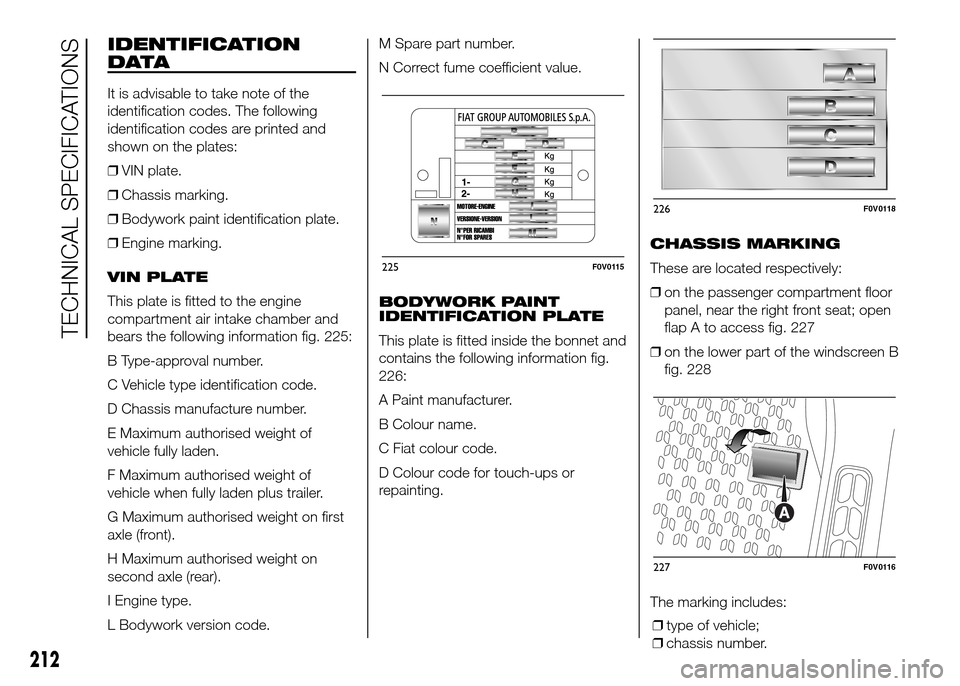
VIN PLATE
This plate is fitted to the engine
compartment air intake chamber and
bears the following information fig. 225:
B Type-approval number.
C Vehicle type identification code.
D Chassis manufacture number.
E Maximum authorised weight of
vehicle fully laden.
F Maximum authorised weight of
vehicle when fully laden plus trailer.
G Maximum authorised weight on first
axle (front).
H Maximum authorised weight on
second axle (rear).
I Engine type.
L Bodywork version code.M Spare part number.
N Correct fume coefficient value.
BODYWORK PAINT
IDENTIFICATION PLATE
This plate is fitted inside the bonnet and
contains the following information fig.
226:
A Paint manufacturer.
B Colour name.
C Fiat colour code.
D Colour code for touch-ups or
repainting.CHASSIS MARKING
These are located respectively:
❒on the passenger compartment floor
panel, near the right front seat; open
flap A to access fig. 227
❒on the lower part of the windscreen B
fig. 228
The marking includes:
❒type of vehicle;
225F0V0115
226F0V0118
227F0V0116
212
TECHNICAL SPECIFICATIONS
❒chassis number.
Page 219 of 323
There is an example of a bodywork
version code below by way of
explanation with a key which is valid for
all bodywork version codes.
Example:
263AXA1A00
263MODEL
AGVW
XAENGINE
1DRIVE AXLES/STEERING AXLES
ATRANSMISSION
00VERSION
BODYWORK / SEATS
ADoblò - 5/7-seater
ZCargo 700 kg
WCargo 1,000 kg / Combi 5-seater
YN1 Flatbed
HN1 Trailer truck
ENGINES
XA1.4 16v Euro 4 / Euro 5 / Euro 6
XC1.3 MultiJet 90 HP Euro4/Euro5/
Euro 5+
XD1.6 MultiJet 105 HP Euro4/Euro5
/ Euro 5+
XE1.6 MultiJet 100 HP Euro4/Euro5
/ Euro 5+XF2.0 MultiJet 135 HP Euro 5 / Euro
5+
XG1.4 T-JET 120 HP Euro5/Euro6
XH1.6 MultiJet 90 HP Euro5/Euro5+
XL1.6 MultiJet 90 HP (torque 200
Nm) Euro 5 / Euro 5+
XM1.3 MultiJet 75 HP Euro 5 / Euro
5+
XN1.6 Multijet 120HP Euro 6
XP1.6 Multijet 95HP Euro 6
DRIVE AXLES / STEERING
AXLES
1
TRANSMISSION
AManual gearbox (5 gears)
BManual gearbox (6 gears)
1MTA
215
Page 241 of 323
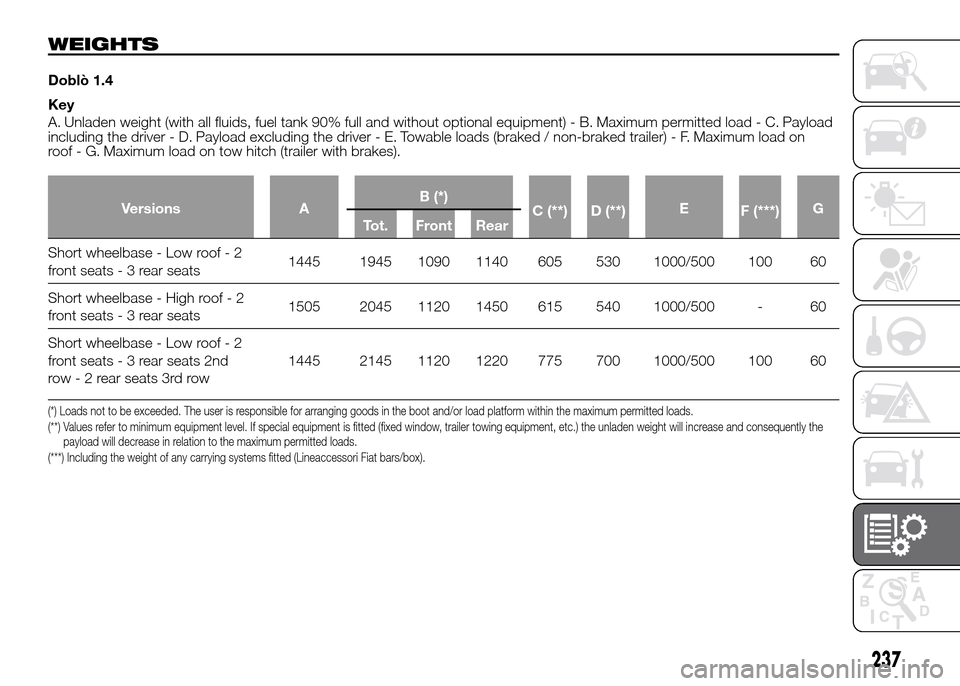
WEIGHTS
Doblò 1.4
Key
A. Unladen weight (with all fluids, fuel tank 90% full and without optional equipment) - B. Maximum permitted load - C. Payload
including the driver - D. Payload excluding the driver - E. Towable loads (braked / non-braked trailer) - F. Maximum load on
roof - G. Maximum load on tow hitch (trailer with brakes).
Versions AB (*)
C (**) D (**)E
F (***)G
Tot. Front Rear
Short wheelbase - Low roof - 2
front seats-3rearseats1445 1945 1090 1140 605 530 1000/500 100 60
Short wheelbase - High roof - 2
front seats-3rearseats1505 2045 1120 1450 615 540 1000/500 - 60
Short wheelbase - Low roof - 2
front seats-3rearseats 2nd
row-2rearseats 3rd row1445 2145 1120 1220 775 700 1000/500 100 60
(*) Loads not to be exceeded. The user is responsible for arranging goods in the boot and/or load platform within the maximum permitted loads.
(**) Values refer to minimum equipment level. If special equipment is fitted (fixed window, trailer towing equipment, etc.) the unladen weight will increase and consequently the
payload will decrease in relation to the maximum permitted loads.
(***) Including the weight of any carrying systems fitted (Lineaccessori Fiat bars/box).
237
Page 242 of 323
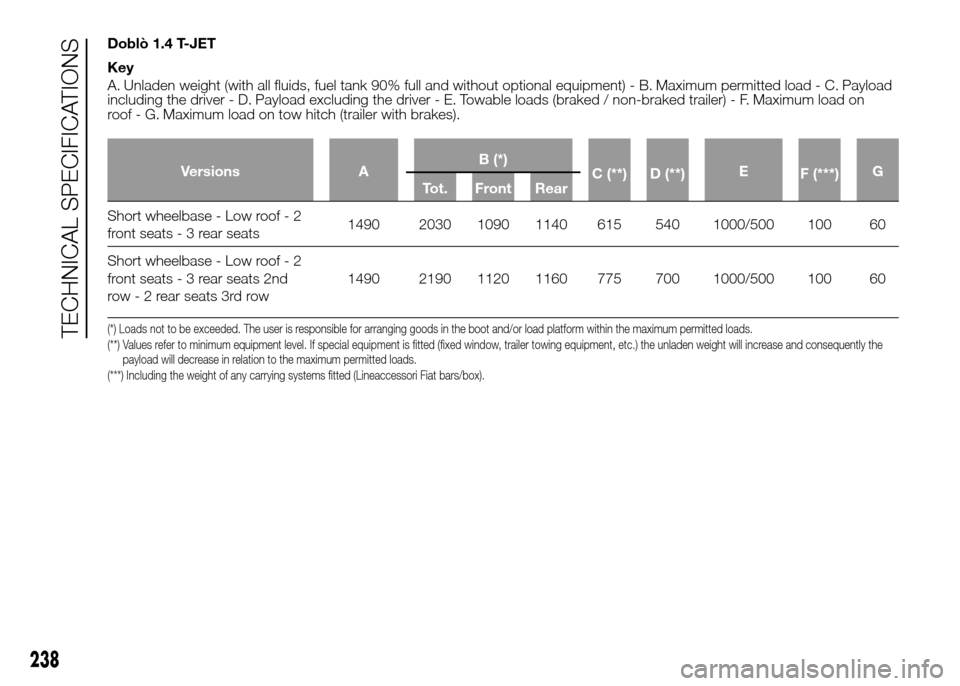
Doblò 1.4 T-JET
Key
A. Unladen weight (with all fluids, fuel tank 90% full and without optional equipment) - B. Maximum permitted load - C. Payload
including the driver - D. Payload excluding the driver - E. Towable loads (braked / non-braked trailer) - F. Maximum load on
roof - G. Maximum load on tow hitch (trailer with brakes).
Versions AB (*)
C (**) D (**)E
F (***)G
Tot. Front Rear
Short wheelbase - Low roof - 2
front seats-3rearseats1490 2030 1090 1140 615 540 1000/500 100 60
Short wheelbase - Low roof - 2
front seats-3rearseats 2nd
row-2rearseats 3rd row1490 2190 1120 1160 775 700 1000/500 100 60
(*) Loads not to be exceeded. The user is responsible for arranging goods in the boot and/or load platform within the maximum permitted loads.
(**) Values refer to minimum equipment level. If special equipment is fitted (fixed window, trailer towing equipment, etc.) the unladen weight will increase and consequently the
payload will decrease in relation to the maximum permitted loads.
(***) Including the weight of any carrying systems fitted (Lineaccessori Fiat bars/box).
238
TECHNICAL SPECIFICATIONS