Rear FIAT DUCATO 2008 3.G Repair Manual
[x] Cancel search | Manufacturer: FIAT, Model Year: 2008, Model line: DUCATO, Model: FIAT DUCATO 2008 3.GPages: 282, PDF Size: 4.55 MB
Page 192 of 282
191
WARNING
LIGHTS AND
MESSAGES
TECHNICAL
SPECIFICATIONS
INDEX
DASHBOARD
AND CONTROLS
SAFETY
DEVICES
CORRECT USE
OF THE VEHICLE
IN AN
EMERGENCY
VEHICLE
MAINTENANCE
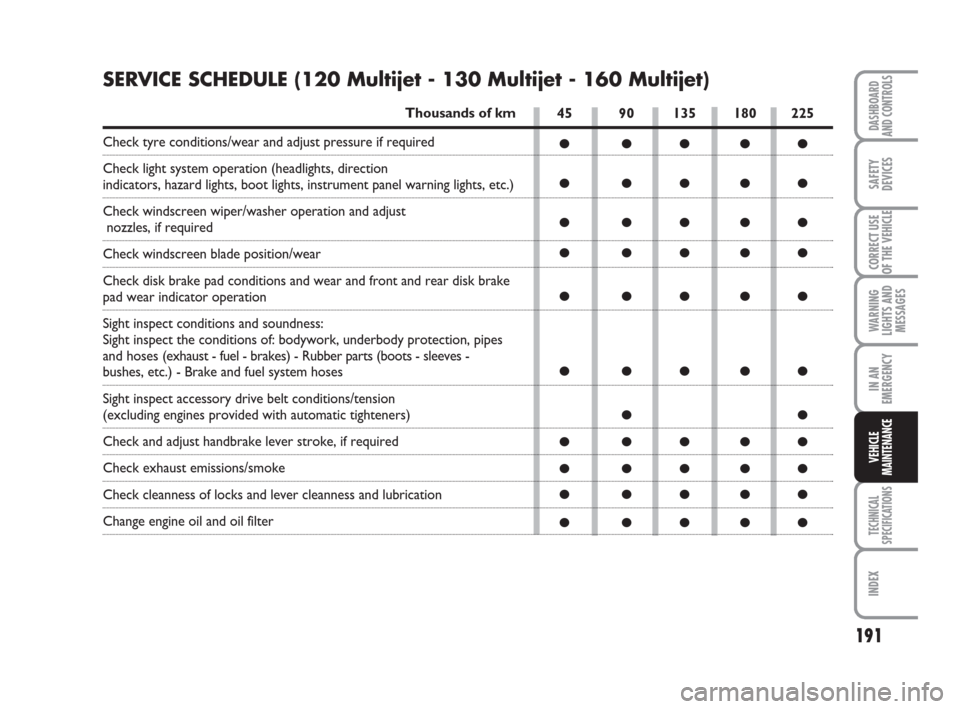
45 90 135 180 225
●●●●●
●●●●●
●●●●●
●●●●●
●●●●●
●●●●●
●●
●●●●●
●●●●●
●●●●●
●●●●●
SERVICE SCHEDULE (120 Multijet - 130 Multijet - 160 Multijet)
Thousands of km
Check tyre conditions/wear and adjust pressure if required
Check light system operation (headlights, direction
indicators, hazard lights, boot lights, instrument panel warning lights, etc.)
Check windscreen wiper/washer operation and adjust
nozzles, if required
Check windscreen blade position/wear
Check disk brake pad conditions and wear and front and rear disk brake
pad wear indicator operation
Sight inspect conditions and soundness:
Sight inspect the conditions of: bodywork, underbody protection, pipes
and hoses (exhaust - fuel - brakes) - Rubber parts (boots - sleeves -
bushes, etc.) - Brake and fuel system hoses
Sight inspect accessory drive belt conditions/tension
(excluding engines provided with automatic tighteners)
Check and adjust handbrake lever stroke, if required
Check exhaust emissions/smoke
Check cleanness of locks and lever cleanness and lubrication
Change engine oil and oil filter
Page 194 of 282
193
WARNING
LIGHTS AND
MESSAGES
TECHNICAL
SPECIFICATIONS
INDEX
DASHBOARD
AND CONTROLS
SAFETY
DEVICES
CORRECT USE
OF THE VEHICLE
IN AN
EMERGENCY
VEHICLE
MAINTENANCE
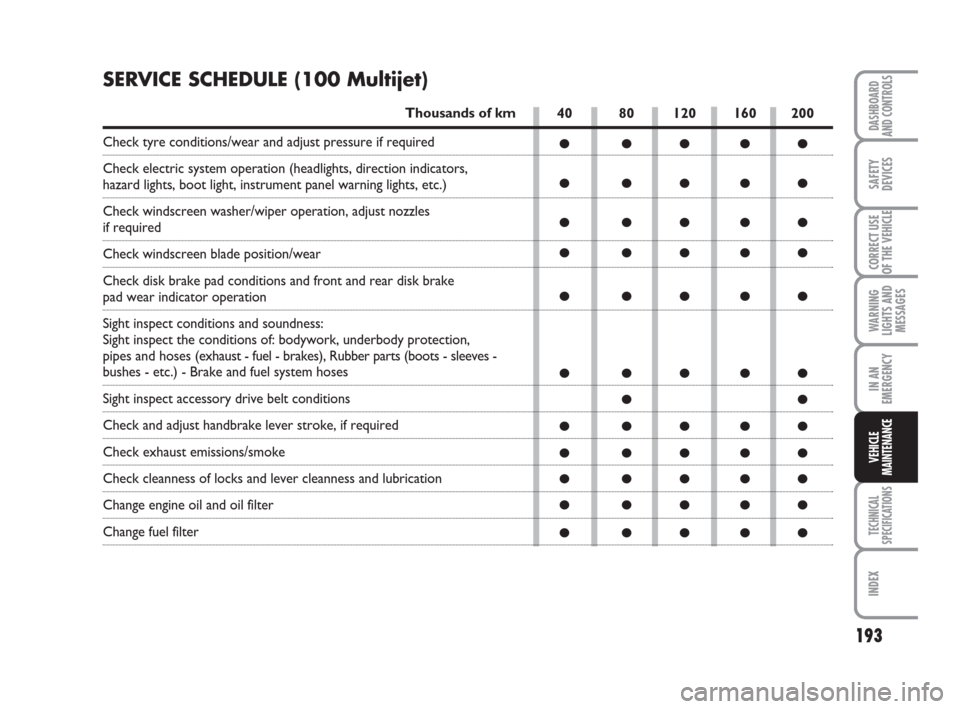
40 80 120 160 200
●●●●●
●●●●●
●●●●●
●●●●●
●●●●●
●●●●●
●●
●●●●●
●●●●●
●●●●●
●●●●●
●●●●●
SERVICE SCHEDULE (100 Multijet)
Thousands of km
Check tyre conditions/wear and adjust pressure if required
Check electric system operation (headlights, direction indicators,
hazard lights, boot light, instrument panel warning lights, etc.)
Check windscreen washer/wiper operation, adjust nozzles
if required
Check windscreen blade position/wear
Check disk brake pad conditions and front and rear disk brake
pad wear indicator operation
Sight inspect conditions and soundness:
Sight inspect the conditions of: bodywork, underbody protection,
pipes and hoses (exhaust - fuel - brakes), Rubber parts (boots - sleeves -
bushes - etc.) - Brake and fuel system hoses
Sight inspect accessory drive belt conditions
Check and adjust handbrake lever stroke, if required
Check exhaust emissions/smoke
Check cleanness of locks and lever cleanness and lubrication
Change engine oil and oil filter
Change fuel filter
Page 196 of 282
195
WARNING
LIGHTS AND
MESSAGES
TECHNICAL
SPECIFICATIONS
INDEX
DASHBOARD
AND CONTROLS
SAFETY
DEVICES
CORRECT USE
OF THE VEHICLE
IN AN
EMERGENCY
VEHICLE
MAINTENANCE
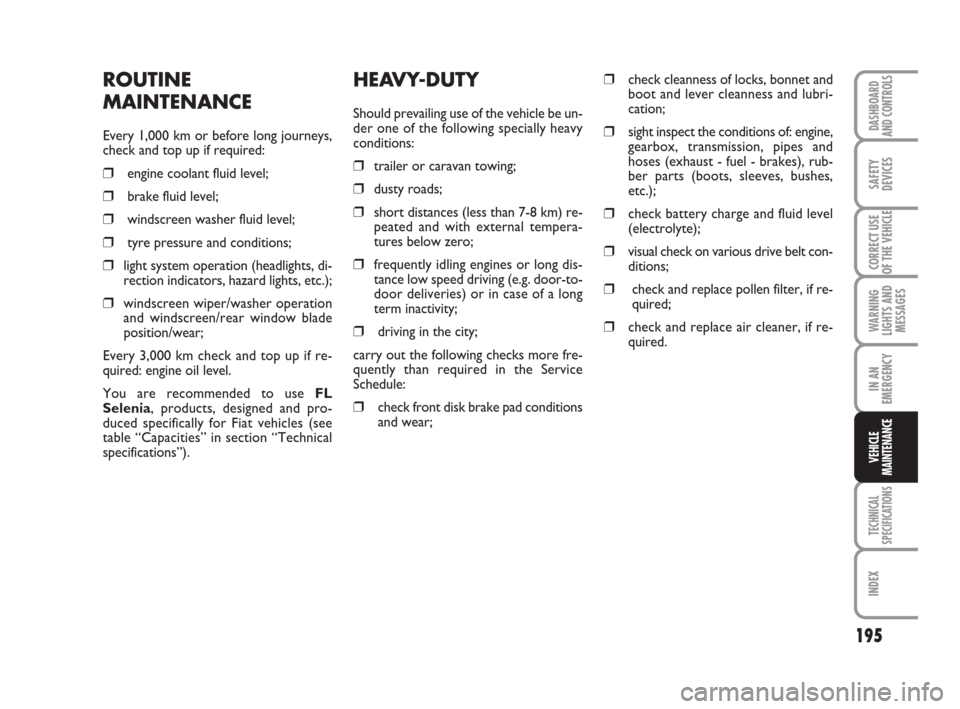
HEAVY-DUTY
Should prevailing use of the vehicle be un-
der one of the following specially heavy
conditions:
❒trailer or caravan towing;
❒dusty roads;
❒short distances (less than 7-8 km) re-
peated and with external tempera-
tures below zero;
❒frequently idling engines or long dis-
tance low speed driving (e.g. door-to-
door deliveries) or in case of a long
term inactivity;
❒driving in the city;
carry out the following checks more fre-
quently than required in the Service
Schedule:
❒check front disk brake pad conditions
and wear;
❒check cleanness of locks, bonnet and
boot and lever cleanness and lubri-
cation;
❒sight inspect the conditions of: engine,
gearbox, transmission, pipes and
hoses (exhaust - fuel - brakes), rub-
ber parts (boots, sleeves, bushes,
etc.);
❒check battery charge and fluid level
(electrolyte);
❒visual check on various drive belt con-
ditions;
❒check and replace pollen filter, if re-
quired;
❒check and replace air cleaner, if re-
quired.
ROUTINE
MAINTENANCE
Every 1,000 km or before long journeys,
check and top up if required:
❒engine coolant fluid level;
❒brake fluid level;
❒windscreen washer fluid level;
❒tyre pressure and conditions;
❒light system operation (headlights, di-
rection indicators, hazard lights, etc.);
❒windscreen wiper/washer operation
and windscreen/rear window blade
position/wear;
Every 3,000 km check and top up if re-
quired: engine oil level.
You are recommended to use FL
Selenia, products, designed and pro-
duced specifically for Fiat vehicles (see
table “Capacities” in section “Technical
specifications”).
Page 201 of 282
Prevent brake fluid, which is
highly corrosive, from coming
into contact with painted
parts. Should it happen, im-
mediately wash with water.
200
WARNING
LIGHTS AND
MESSAGES
TECHNICAL
SPECIFICATIONS
INDEX
DASHBOARD
AND CONTROLS
SAFETY
DEVICES
CORRECT USE
OF THE VEHICLE
IN AN
EMERGENCY
VEICHLE
MAINTENANCE
At plug opening, pay maximum attention
in order to prevent any impurities from
entering the tank.
For topping up, always use a funnel with
integrated filter with mesh equal to or
lower than 0.12 mm.
IMPORTANT Brake fluid absorbs mois-
ture, for this reason, if the vehicle is main-
ly used in areas with a high degree of at-
mospheric humidity, the fluid should be
replaced at more frequent intervals than
specified in the “Service schedule”.
fig. 9F0N0107m
Do not travel with the wind-
screen washer reservoir emp-
ty: the windscreen washer is funda-
mental for improving visibility.
WARNING
Certain commercial addi-
tives for windscreen washers
are inflammable. The engine com-
partment contains hot components
which may set it on fire.
WARNING
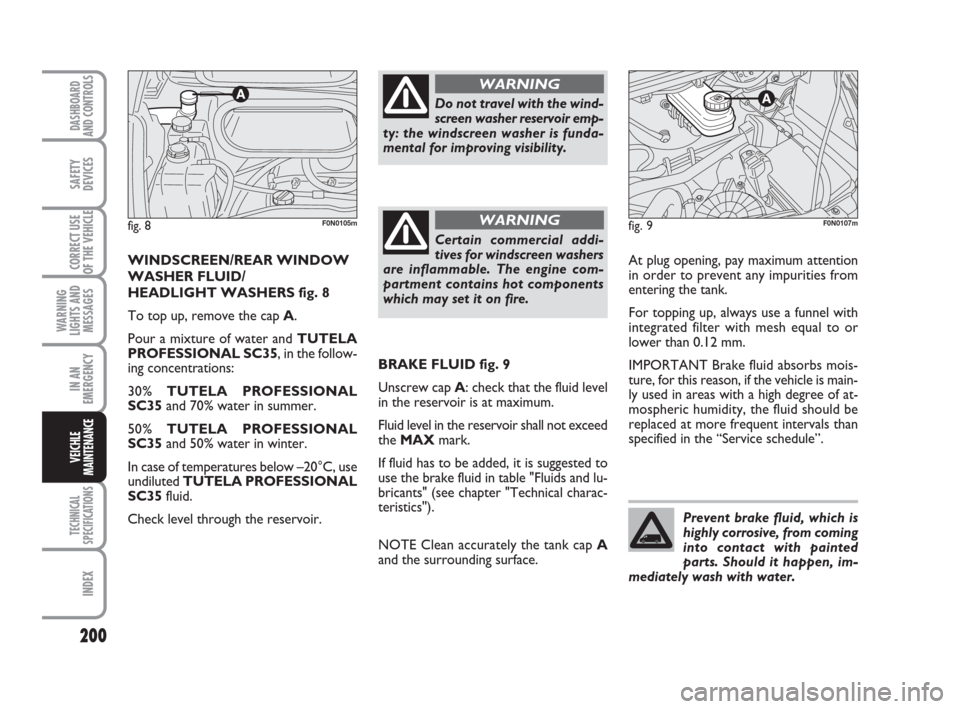
WINDSCREEN/REAR WINDOW
WASHER FLUID/
HEADLIGHT WASHERS fig. 8
To top up, remove the cap A.
Pour a mixture of water and TUTELA
PROFESSIONAL SC35, in the follow-
ing concentrations:
30% TUTELA PROFESSIONAL
SC35and 70% water in summer.
50% TUTELA PROFESSIONAL
SC35and 50% water in winter.
In case of temperatures below –20°C, use
undiluted TUTELA PROFESSIONAL
SC35fluid.
Check level through the reservoir.
fig. 8F0N0105m
BRAKE FLUID fig. 9
Unscrew cap A: check that the fluid level
in the reservoir is at maximum.
Fluid level in the reservoir shall not exceed
the MAXmark.
If fluid has to be added, it is suggested to
use the brake fluid in table "Fluids and lu-
bricants" (see chapter "Technical charac-
teristics").
NOTE Clean accurately the tank cap A
and the surrounding surface.
Page 206 of 282
205
WARNING
LIGHTS AND
MESSAGES
TECHNICAL
SPECIFICATIONS
INDEX
DASHBOARD
AND CONTROLS
SAFETY
DEVICES
CORRECT USE
OF THE VEHICLE
IN AN
EMERGENCY
VEHICLE
MAINTENANCE
WHEELS AND TYRES
Check the pressure of each tyre, includ-
ing the spare, every two weeks and before
long journeys. The pressure should be
checked with the tyre rested and cold.
It is normal for pressure to rise when you
are driving. For the correct tyre inflation
pressure, see “Wheels” in section “Tech-
nical specifications”.
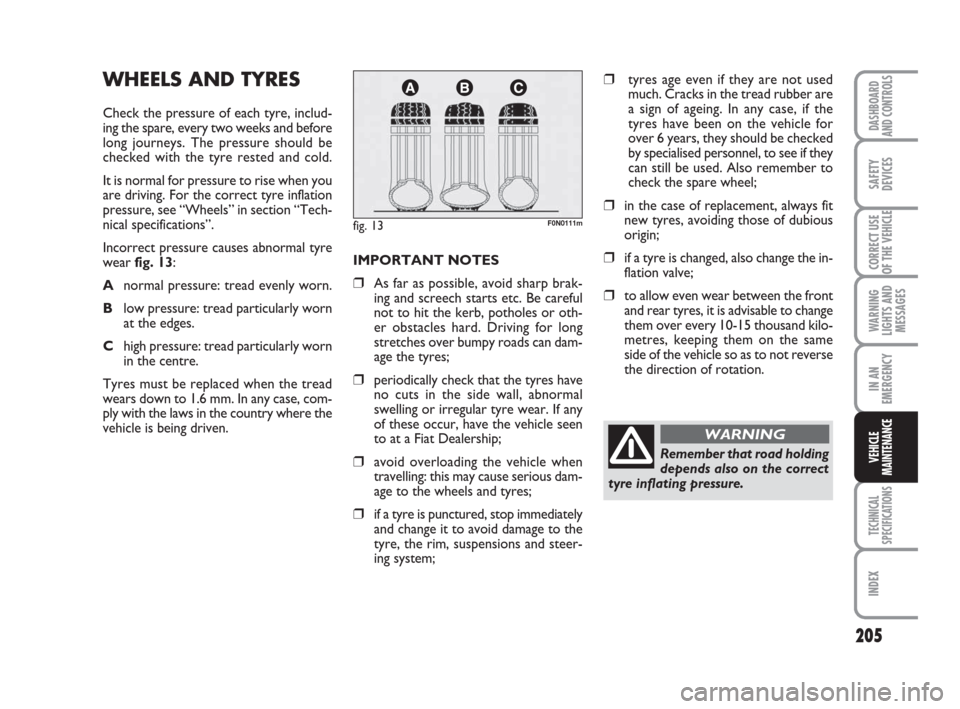
Incorrect pressure causes abnormal tyre
wearfig. 13:
Anormal pressure: tread evenly worn.
Blow pressure: tread particularly worn
at the edges.
Chigh pressure: tread particularly worn
in the centre.
Tyres must be replaced when the tread
wears down to 1.6 mm. In any case, com-
ply with the laws in the country where the
vehicle is being driven.
fig. 13F0N0111m
IMPORTANT NOTES
❒As far as possible, avoid sharp brak-
ing and screech starts etc. Be careful
not to hit the kerb, potholes or oth-
er obstacles hard. Driving for long
stretches over bumpy roads can dam-
age the tyres;
❒periodically check that the tyres have
no cuts in the side wall, abnormal
swelling or irregular tyre wear. If any
of these occur, have the vehicle seen
to at a Fiat Dealership;
❒avoid overloading the vehicle when
travelling: this may cause serious dam-
age to the wheels and tyres;
❒if a tyre is punctured, stop immediately
and change it to avoid damage to the
tyre, the rim, suspensions and steer-
ing system;
❒tyres age even if they are not used
much. Cracks in the tread rubber are
a sign of ageing. In any case, if the
tyres have been on the vehicle for
over 6 years, they should be checked
by specialised personnel, to see if they
can still be used. Also remember to
check the spare wheel;
❒in the case of replacement, always fit
new tyres, avoiding those of dubious
origin;
❒if a tyre is changed, also change the in-
flation valve;
❒to allow even wear between the front
and rear tyres, it is advisable to change
them over every 10-15 thousand kilo-
metres, keeping them on the same
side of the vehicle so as to not reverse
the direction of rotation.
Remember that road holding
depends also on the correct
tyre inflating pressure.
WARNING
Page 210 of 282
209
WARNING
LIGHTS AND
MESSAGES
TECHNICAL
SPECIFICATIONS
INDEX
DASHBOARD
AND CONTROLS
SAFETY
DEVICES
CORRECT USE
OF THE VEHICLE
IN AN
EMERGENCY
VEHICLE
MAINTENANCE
To correctly wash the vehicle:
❒remove the aerial from the roof to
prevent damage to it if the vehicle is
washed in an automatic system;
❒wash the body using a low pressure jet
of water;
❒wipe a sponge with a slightly soapy so-
lution over the bodywork, frequently
rinsing with the sponge;
❒rinse well with water and dry with a
jet of air or a chamois leather.
When drying, take particular care with the
less visible parts like door surrounds, bon-
net and around the headlights where wa-
ter may stagnate. The vehicle should not
be taken to a closed area immediately, but
left in the open so that residual water can
evaporate.Do not wash the vehicle after it has been
left in the sun or with the bonnet hot: this
may alter the shine of the paintwork.
Exterior plastic parts must be cleaned in
the same way as the rest of the vehicle.
Where possible, do not park under trees;
the resinous substance many species re-
lease give the paint a dull appearance and
increase the possibility of triggering rust
processes.
For best paint protection, from time to
time polish the bodywork with special
waxes; when paint becomes mat due to
smog, polish the bodywork with polish
waxes that have also a light abrasive effect.
IMPORTANT Bird droppings must be
washed off immediately and thoroughly as
the acid they contain is particularly ag-
gressive.
Detergents cause water pollu-
tion. Therefore the engine
compartment should be
washed in areas equipped for
collecting and purifying the liquid used
in the washing process.
Windows
Use specific window cleaner products.
Use also clean cloths to avoid scratching
the glass or damaging the transparency.
IMPORTANT The inside of the rearscreen
should be wiped gently with a cloth in the
direction of the filaments to avoid damag-
ing the heating device.
Engine compartment
At the end of the winter the engine com-
partment should be carefully washed,
without directing the jet against electron-
ic control units. Contact a specialised
workshop to have this done.
IMPORTANT The vehicle should be
washed with the engine cold and the ig-
nition key at STOP. After washing make
sure that the various protections (e.g. rub-
ber caps and various covers) have not
been damaged or removed.
Front headlights
IMPORTANT Never use aromatic sub-
stances (e.g.: petrol) or ketones (e.g.: ace-
tone) for cleaning front headlight plastic
lens.
Page 213 of 282
212
WARNING
LIGHTS AND
MESSAGES
INDEX
DASHBOARD
AND CONTROLS
SAFETY
DEVICES
CORRECT USE
OF THE
VEHICLE
IN AN
EMERGENCY
VEHICLE
MAINTENANCE
TECHNICAL
SPECIFICATIONS
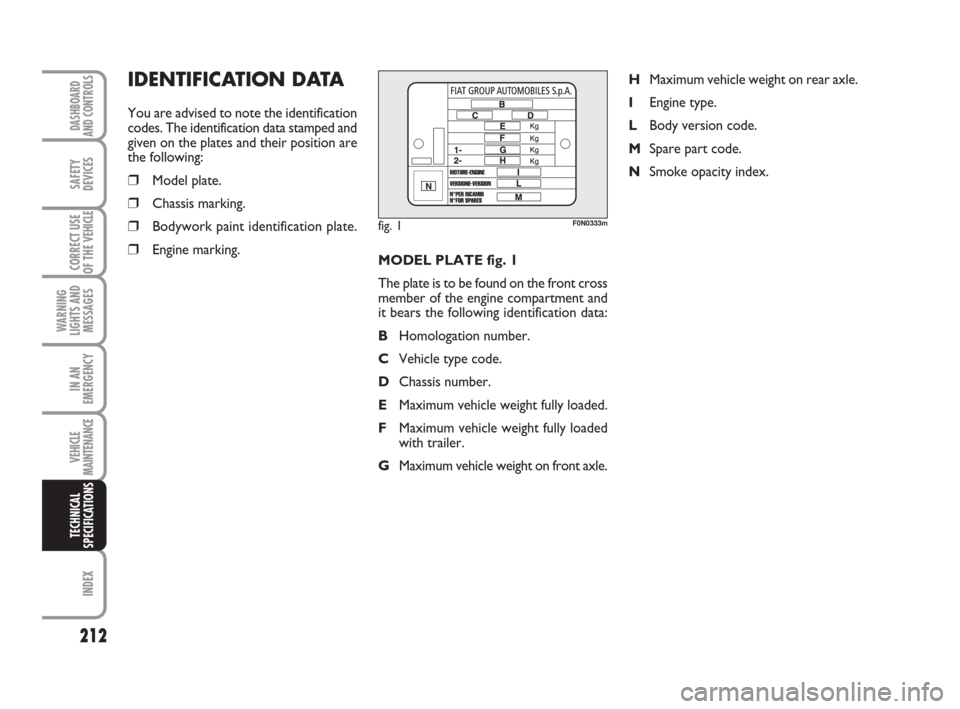
MODEL PLATE fig. 1
The plate is to be found on the front cross
member of the engine compartment and
it bears the following identification data:
BHomologation number.
CVehicle type code.
DChassis number.
EMaximum vehicle weight fully loaded.
FMaximum vehicle weight fully loaded
with trailer.
GMaximum vehicle weight on front axle.HMaximum vehicle weight on rear axle.
IEngine type.
LBody version code.
MSpare part code.
NSmoke opacity index.
IDENTIFICATION DATA
You are advised to note the identification
codes. The identification data stamped and
given on the plates and their position are
the following:
❒Model plate.
❒Chassis marking.
❒Bodywork paint identification plate.
❒Engine marking.
fig. 1F0N0333m
Page 219 of 282
218
WARNING
LIGHTS AND
MESSAGES
INDEX
DASHBOARD
AND CONTROLS
SAFETY
DEVICES
CORRECT USE
OF THE
VEHICLE
IN AN
EMERGENCY
VEHICLE
MAINTENANCE
TECHNICAL
SPECIFICATIONS
SUSPENSIONS
Front
Rear
BRAKES
Service brakes:
– front
– rear
Parking brake
IMPORTANT Water, ice and antifreeze salt on roads may deposit on the brake discs thus reducing braking efficiency
at first braking.
Mc Pherson independent wheels
rigid tubular axle type; lengthways single blade controlled by hand lever, it works on rear brakesdisc self-ventilating disc
rack and pinion with hydraulic power steering
STEERING
Short Medium Medium long Long wheelbase wheelbase wheelbase wheelbase
Type
Minimum
steering cycle m 11.06 12.46 13.54 14.28
Page 223 of 282
222
WARNING
LIGHTS AND
MESSAGES
INDEX
DASHBOARD
AND CONTROLS
SAFETY
DEVICES
CORRECT USE
OF THE
VEHICLE
IN AN
EMERGENCY
VEHICLE
MAINTENANCE
TECHNICAL
SPECIFICATIONS
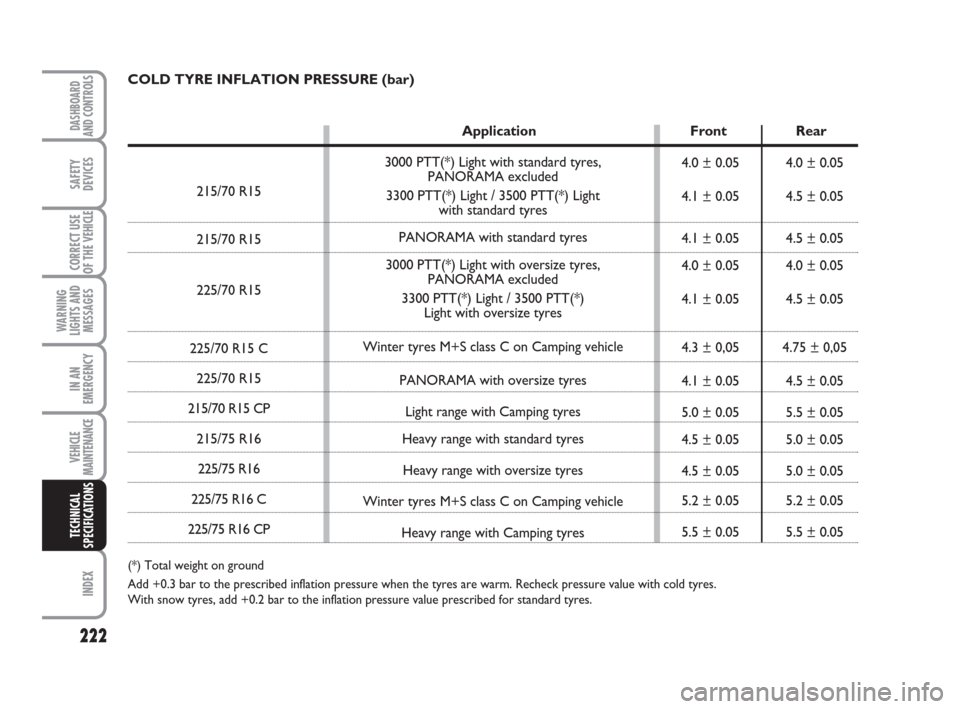
3000 PTT(*) Light with standard tyres,
PANORAMA excluded
3300 PTT(*) Light / 3500 PTT(*) Light
with standard tyres
PANORAMA with standard tyres
3000 PTT(*) Light with oversize tyres,
PANORAMA excluded
3300 PTT(*) Light / 3500 PTT(*)
Light with oversize tyres
Winter tyres M+S class C on Camping vehicle
PANORAMA with oversize tyres
Light range with Camping tyres
Heavy range with standard tyres
Heavy range with oversize tyres
Winter tyres M+S class C on Camping vehicle
Heavy range with Camping tyres COLD TYRE INFLATION PRESSURE (bar)
Application Front Rear
215/70 R15
215/70 R15
225/70 R15
225/70 R15 C
225/70 R15
215/70 R15 CP
215/75 R16
225/75 R16
225/75 R16 C
225/75 R16 CP
(*) Total weight on ground
Add +0.3 bar to the prescribed inflation pressure when the tyres are warm. Recheck pressure value with cold tyres.
With snow tyres, add +0.2 bar to the inflation pressure value prescribed for standard tyres.
4.0 ± 0.05 4.0 ± 0.05
4.1 ± 0.05 4.5 ± 0.05
4.1 ± 0.05 4.5 ± 0.05
4.0 ± 0.05 4.0 ± 0.05
4.1 ± 0.05 4.5 ± 0.05
4.3 ± 0,05 4.75 ± 0,05
4.1 ± 0.05 4.5 ± 0.05
5.0 ± 0.05 5.5 ± 0.05
4.5 ± 0.05 5.0 ± 0.05
4.5 ± 0.05 5.0 ± 0.05
5.2 ± 0.05 5.2 ± 0.05
5.5 ± 0.05 5.5 ± 0.05
Page 231 of 282
230
WARNING
LIGHTS AND
MESSAGES
INDEX
DASHBOARD
AND CONTROLS
SAFETY
DEVICES
CORRECT USE
OF THE
VEHICLE
IN AN
EMERGENCY
VEHICLE
MAINTENANCE
TECHNICAL
SPECIFICATIONS
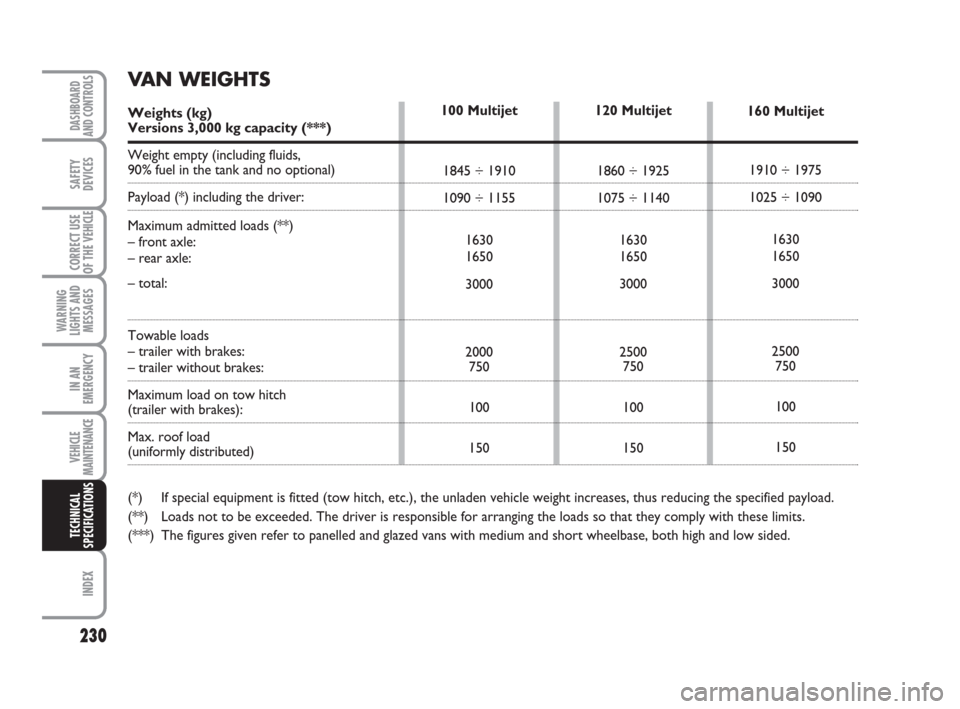
120 Multijet
1860 ÷ 1925
1075 ÷ 1140
1630
1650
3000
2500
750
100
150160 Multijet
1910 ÷ 1975
1025 ÷ 1090
1630
1650
3000
2500
750
100
150 100 Multijet
1845 ÷ 1910
1090 ÷ 1155
1630
1650
3000
2000
750
100
150
VAN WEIGHTS
Weights (kg)Versions 3,000 kg capacity (***)
Weight empty (including fluids,
90% fuel in the tank and no optional)
Payload (*) including the driver:
Maximum admitted loads (**)
– front axle:
– rear axle:
– total:
Towable loads
– trailer with brakes:
– trailer without brakes:
Maximum load on tow hitch
(trailer with brakes):
Max. roof load
(uniformly distributed)
(*) If special equipment is fitted (tow hitch, etc.), the unladen vehicle weight increases, thus reducing the specified payload.
(**) Loads not to be exceeded. The driver is responsible for arranging the loads so that they comply with these limits.
(***) The figures given refer to panelled and glazed vans with medium and short wheelbase, both high and low sided.