instrument panel FIAT DUCATO 2011 Owner handbook (in English)
[x] Cancel search | Manufacturer: FIAT, Model Year: 2011, Model line: DUCATO, Model: FIAT DUCATO 2011Pages: 287, PDF Size: 4.42 MB
Page 121 of 287

117
KNOWING
YOUR CAR
SAFETY
STARTING
AND
DRIVING
WARNING
LIGHTS AND
MESSAGES
IN AN
EMERGENCY
MAINTENANCE
AND CARE
TECHNICAL
SPECIFICATIONS
INDEX
Detection distances
Central action range: 140 cm ±10 cm
Side action range: 60 cm ±20 cm
If several obstacles are detected by the sensors, only the
nearest one is considered.
FAILURE WARNING
Any parking sensor failures will be indicated when
engaging reverse by the
twarning light in the instrument
panel together with the message in the multifunction
display coming on for versions/markets where provided
(see “Warning lights and messages” section).OPERATION WITH TRAILER
Parking sensor operation is automatically disabled when
the electric cable plug of the trailer is fitted into the
vehicle tow hook socket.
The sensors are automatically enabled again when the
trailer cable plug is removed.
IMPORTANT If you wish to leave the tow hook fitted
without towing a trailer, it is advisable to contact a Fiat
Dealership for the relevant system update operations
because the tow hook could be detected as an obstacle
by the central sensors.
When using special washing equipment such as high
pressure jets or steam cleaning, clean the sensors very
quickly keeping the jet more than 10 cm away.
Page 130 of 287

S.B.R. SYSTEM
The vehicle is fitted with a Seat Belt Reminder system
(S.B.R.), consisting of a buzzer and a flashing warning
light
The buzzer can be deactivated (until the next engine
stop) as follows:
❒fasten the driver’s seat belt;
❒turn the ignition key to MAR-ON;
❒wait for over 20 seconds and then release one of the
seat belts.
For permanent deactivation, contact the Fiat Dealership.
With digital display, the S.B.R. system can only be reset
at Fiat Dealership.
With multifunction display, the S.B.R. system can also be
reset through the set-up menu.
126
KNOWING
YOUR CAR
SAFETY
STARTING
AND
DRIVING
WARNING
LIGHTS AND
MESSAGES
IN AN
EMERGENCY
MAINTENANCE
AND CARE
TECHNICAL
SPECIFICATIONS
INDEX
F0N0070mfig. 138F0N0156mfig. 139
Seat belt with reel for front central position on
bench seat fig. 139
The two-seater front bench is equipped with an on-
board seat belt (reel on seat) with three anchorage
points for the central position. Correct regulation is obtained when the belt passes
approximately half way between the shoulder and the
neck.
After adjustment, always check that the
cursor to which the ring is fastened is
locked in one of the set positions. Push
downwards to enable the locking device to click
if the grip has not been released in one of the
possible positions.
WARNING
Page 134 of 287
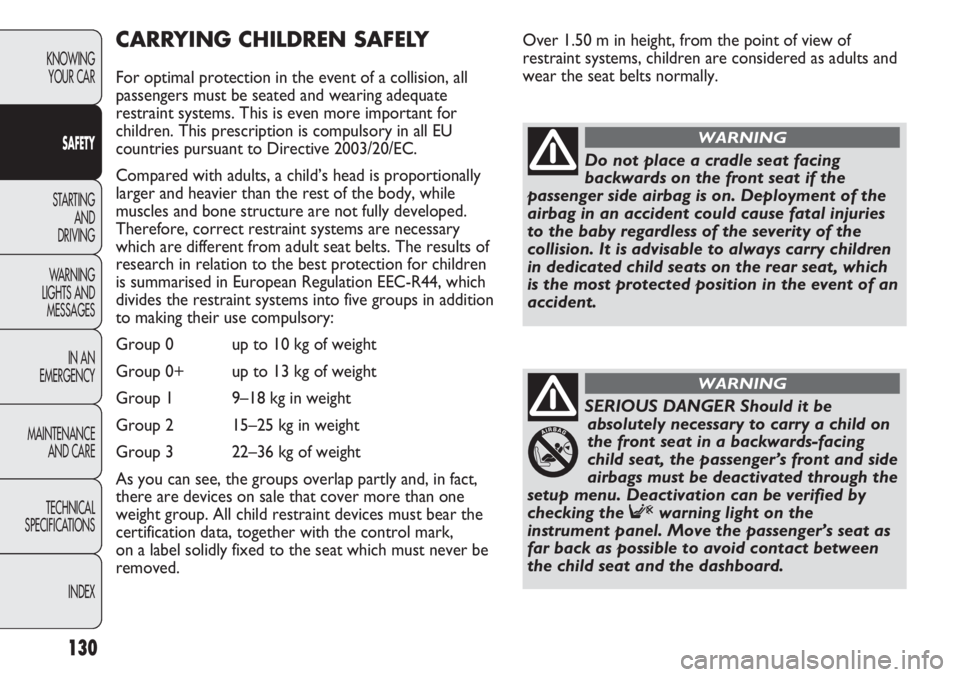
Over 1.50 m in height, from the point of view of
restraint systems, children are considered as adults and
wear the seat belts normally.
130
KNOWING
YOUR CAR
SAFETY
STARTING
AND
DRIVING
WARNING
LIGHTS AND
MESSAGES
IN AN
EMERGENCY
MAINTENANCE
AND CARE
TECHNICAL
SPECIFICATIONS
INDEX
CARRYING CHILDREN SAFELY
For optimal protection in the event of a collision, all
passengers must be seated and wearing adequate
restraint systems. This is even more important for
children. This prescription is compulsory in all EU
countries pursuant to Directive 2003/20/EC.
Compared with adults, a child’s head is proportionally
larger and heavier than the rest of the body, while
muscles and bone structure are not fully developed.
Therefore, correct restraint systems are necessary
which are different from adult seat belts. The results of
research in relation to the best protection for children
is summarised in European Regulation EEC-R44, which
divides the restraint systems into five groups in addition
to making their use compulsory:
Group 0 up to 10 kg of weight
Group 0+ up to 13 kg of weight
Group 1 9–18 kg in weight
Group 2 15–25 kg in weight
Group 3 22–36 kg of weight
As you can see, the groups overlap partly and, in fact,
there are devices on sale that cover more than one
weight group. All child restraint devices must bear the
certification data, together with the control mark,
on a label solidly fixed to the seat which must never be
removed.
Do not place a cradle seat facing
backwards on the front seat if the
passenger side airbag is on. Deployment of the
airbag in an accident could cause fatal injuries
to the baby regardless of the severity of the
collision. It is advisable to always carry children
in dedicated child seats on the rear seat, which
is the most protected position in the event of an
accident.
WARNING
SERIOUS DANGER Should it be
absolutely necessary to carry a child on
the front seat in a backwards-facing
child seat, the passenger’s front and side
airbags must be deactivated through the
setup menu. Deactivation can be verified by
checking the Fwarning light on the
instrument panel. Move the passenger’s seat as
far back as possible to avoid contact between
the child seat and the dashboard.
WARNING
Page 143 of 287

139
KNOWING
YOUR CAR
SAFETY
STARTING
AND
DRIVING
WARNING
LIGHTS AND
MESSAGES
IN AN
EMERGENCY
MAINTENANCE
AND CARE
TECHNICAL
SPECIFICATIONS
INDEX
SIDE BAGS
The vehicle is fitted with front side bags for driver and
passenger (for versions/markets where provided) for
protecting the chest and window bags (for versions/
markets where provided) for protecting front and rear
passengers’ heads.
Side bags (for versions/markets where provided) protect
occupants from side impacts of medium-high severity, by
placing the bag between the occupant and the internal
parts of the side structure of the vehicle. Non-activation
of side bags in other types of collisions (head-on
collisions, rear shunts, roll-overs, etc...) is not an
indication of system malfunction.
An electronic control unit causes the bags to inflate
in the event of a side impact. The bags inflate
instantaneously placing themselves between the
occupants’ bodies and the structures which could cause
injury. They deflate immediately afterwards.
Side bags (for versions/markets where provided) are not
a replacement of but complementary to the belts, which
you are recommended to always wear, as specified by
law in Europe and most non-European countries.
FRONT SIDE BAGS – CHEST AND PELVIS
ZONE fig. 152 (for versions/markets where provided)
Housed in the seats’ backrests, they consist of an
instantly-inflating bag designed to protect the occupants’
chest and pelvis zone in the event of a side impact of
medium-high severity. MANUAL DEACTIVATION OF PASSENGER’S
FRONT AIR BAG AND SIDE BAG CHEST
PROTECTION
(for versions/markets where provided)
Whenever a child needs to be carried on the front seat,
the passenger’s front airbag and the Side Bag chest
protection (for versions/markets where provided) must
be deactivated.
The instrument panel warning light
Fwill switch on
constantly until the passenger’s front air bag and Side
Bag (chest protection) are reactivated (for versions/
markets where provided).
To deactivate the passenger’s front air
bag and the side bag (chest protection)
(for versions/markets where provided), refer to
paragraphs “Digital display” and “Multifunction
display” in section “Dashboard and controls”.
WARNING
Page 147 of 287

143
KNOWING
YOUR CAR
SAFETY
STARTING
AND
DRIVING
WARNING
LIGHTS AND
MESSAGES
IN AN
EMERGENCY
MAINTENANCE
AND CARE
TECHNICAL
SPECIFICATIONS
INDEX
PROCEDURE FOR
Proceed as follows:
❒engage the handbrake;
❒put the gear lever into neutral;
❒turn the ignition key to MAR-ON: the warning lights
mand Yon the instrument panel will turn on;
❒wait for the warning lights Yand mto turn off.
The hotter the engine is, the quicker this will happen;
❒press the clutch pedal all the way down without
touching the accelerator;
❒turn the ignition key to AVVas soon as the warning
light
mturns off. Waiting too long will waste the
work done by the glow plugs. Release the key as
soon as the engine starts.
If the engine does not start at the first attempt, return
the ignition key to STOP before repeating starting.
STARTING THE ENGINE
The vehicle is fitted with an electronic engine lock
device: if the engine fails to start, see the paragraph
“The Fiat CODE system” in section “Dashboard and
controls”.
STARTING AND DRIVING
It is dangerous to let the engine run in
enclosed spaces. The engine consumes
the oxygen and discharges carbon dioxide,
carbon monoxide and other toxic gases.
WARNING
In the first period of use, we recommend
avoiding excessive stress on the car (for
instance excessive acceleration, extended
travel at maximum speed, sudden braking etc.).
When the engine is switched off never
leave the key into the ignition switch to
prevent useless current absorption from
draining the battery.
Remember that the brake servo and
power steering are not operational until
the engine has been started, therefore much
effort than usual is required on the brake pedal
and steering wheel.
WARNING
Page 148 of 287

144
KNOWING
YOUR CAR
SAFETY
STARTING
AND
DRIVING
WARNING
LIGHTS AND
MESSAGES
IN AN
EMERGENCY
MAINTENANCE
AND CARE
TECHNICAL
SPECIFICATIONS
INDEX
If, when the ignition key is at MAR-ON the warning light
Yremains on together with warning light m, turn
the key to STOP and then back to MAR-ON; if the
warning lights remain on, try with the other keys
provided with the car.
IMPORTANT If the instrument panel warning light
Ystays on constantly, contact a Fiat Dealership
immediately.
IMPORTANT Never leave the ignition key on MAR-ON
when the engine is off.
The warning light mwill flash for
60 seconds after starting or during
prolonged cranking to indicate a fault with
the glow plug preheating system. Use the vehicle
normally if the engine starts, but contact Fiat
Dealership as soon as possible.
Remember that the brake servo and
power steering are not operational until
the engine has been started, therefore
more effort than usual is required on the brake
pedal and steering wheel.
Avoid jump starting the engine by
pushing, towing or driving downhill.
This could cause a flow of fuel into the
catalytic converter and damage it beyond repair.
HOW TO WARM UP THE ENGINE
AFTER IT HAS JUST STARTED
Proceed as follows:
❒drive off slowly, letting the engine turn at medium
speed. Do not accelerate abruptly;
❒do not demand maximum performance for the first
few kilometres. Wait until the engine coolant gauge
starts moving.STOPPING THE ENGINE
Turn the ignition key to STOP while the engine is idling.
IMPORTANT After a taxing drive, you should allow the
engine to “catch its breath” before turning it off by
letting it idle to allow the temperature in the engine
compartment to fall.
A quick burst on the accelerator before
turning off the engine serves absolutely
no practical purpose, it wastes fuel and is
damaging especially to turbocharged engines.
In some cases, when the engine switches off,
the fan could start for max. 120 seconds.
Page 149 of 287

145
KNOWING
YOUR CAR
SAFETY
STARTING
AND
DRIVING
WARNING
LIGHTS AND
MESSAGES
IN AN
EMERGENCY
MAINTENANCE
AND CARE
TECHNICAL
SPECIFICATIONS
INDEX
F0N0073mfig. 154
HANDBRAKE fig. 154
The handbrake lever is located to the left side of the
driver’s seat. Pull the lever upwards to engage the
handbrake and ensure that the vehicle does not move.
Four or five notches are normally sufficient to brake the
vehicle on flat ground, while nine or ten may be
necessary on a steep slope with the vehicle loaded.
IMPORTANT If this is not the case, contact a Fiat
Dealership to have the handbrake adjusted.
When the handbrake lever is pulled up and the ignition
key is at
MAR-ON, the instrument panel warning light
xwill turn on. Proceed as follows to release the
handbrake:
❒slightly lift the handbrake and press the release
button
A;
❒keep button Apressed and lower the lever.
The warning light
xon the instrument panel will
turn off.
Press the brake pedal when carrying out this operation
to prevent the vehicle from moving accidentally.
IMPORTANT Apply the handbrake lever only when
the vehicle is at a standstill or with the vehicle in
motion only in the event of a fault in the hydraulic
system. If exceptional use is made of the handbrake
with the vehicle in motion, moderate traction is
advisable in order not to cause locking of the rear end
with consequent swerving of the vehicle.
PARKING THE VEHICLE
Proceed as follows:
❒stop the engine and engage the handbrake;
❒engage a gear (on a slope, engage first gear if the
vehicle is faced uphill or reverse if it is faced
downhill) and leave the wheels steered.
If the vehicle is parked on a steep slope, it is advisable
to block the wheels with a wedge or stone. Do not
leave the key in the ignition switch to prevent draining
the battery. Always remove the key when you leave
the vehicle.
Never leave children unattended in
the vehicle. Always remove the ignition
key when leaving the vehicle and take it out
with you.
WARNING
Page 161 of 287
157
KNOWING
YOUR CAR
SAFETY
STARTING
AND
DRIVING
WARNING
LIGHTS AND
MESSAGES
IN AN
EMERGENCY
MAINTENANCE
AND CARE
TECHNICAL
SPECIFICATIONS
INDEX
WARNING LIGHTS AND MESSAGES
GENERAL WARNINGS
The turning on of the warning light is accompanied by
a specific message and/or buzzer sound where provided
by instrument panel. These indications are brief and
precautionary and as such must not be considered as
exhaustive and/or an alternative to the information
contained in the Owner Handbook, which you are
recommended to read carefully in all cases. Always refer
to the information in this chapter in the event of
a failure indication.
IMPORTANT Failure indications displayed are divided
into two categories: very serious and less serious
failures.
Very serious failures prompt a prolonged cycle of
signals.
Less serious failures prompt a shorter cycle of signals.
Press MODE to stop the warning cycle in both cases.
The instrument panel warning light will stay on until the
cause of the failure is eliminated.
For messages relevant to the versions equipped with
Dualogic gearbox, see the attached Supplement.
WARNING LIGHTS AND MESSAGES
If the warning light xturns on when
travelling (on certain versions together
with the message on the display) stop the car
immediately and contact a Fiat Dealership.
WARNING
LOW BRAKE FLUID LEVEL (red)
HANDBRAKE ENGAGED (red)
When the key is turned to the MAR-ON
position the warning light comes on but should
go out after a few seconds.
Low brake fluid level
The warning light comes on when the level of the brake
fluid in the reservoir falls below the minimum level due
to a possible leak in the circuit.
On some versions the display shows the dedicated
message.
x
Handbrake engaged
The warning light turns on when the handbrake is
engaged.
On certain versions, if the vehicle is moving the buzzer
will also sound.
IMPORTANT If the warning light turns on when
travelling, check that the handbrake is not engaged.
Page 173 of 287
169
KNOWING
YOUR CAR
SAFETY
STARTING
AND
DRIVING
WARNING
LIGHTS AND
MESSAGES
IN AN
EMERGENCY
MAINTENANCE
AND CARE
TECHNICAL
SPECIFICATIONS
INDEX
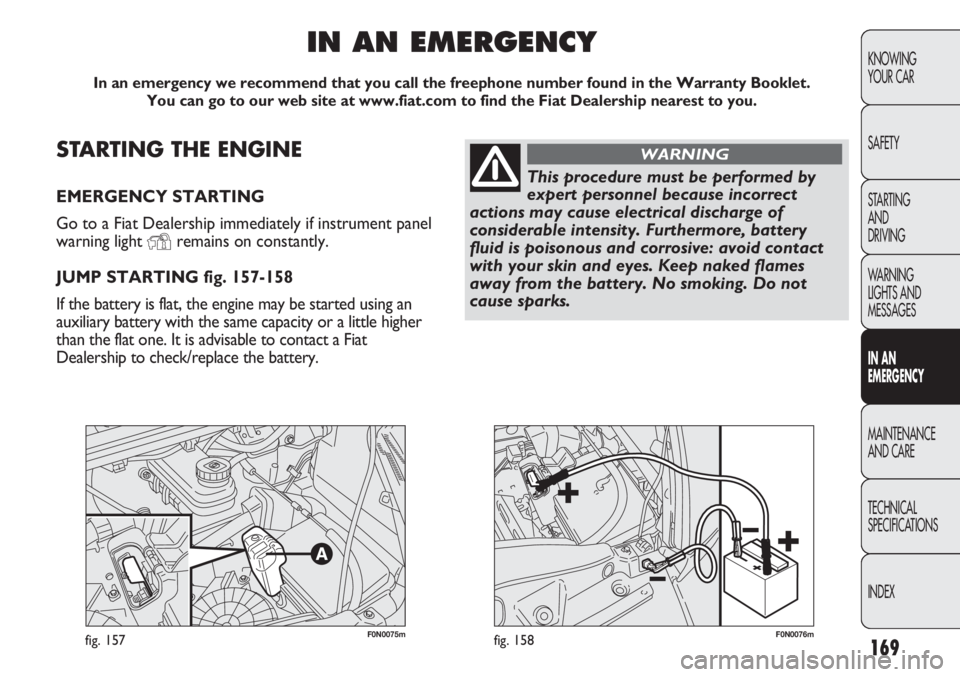
F0N0075mfig. 157F0N0076mfig. 158
STARTING THE ENGINE
EMERGENCY STARTING
Go to a Fiat Dealership immediately if instrument panel
warning light
Yremains on constantly.
JUMP STARTING fig. 157-158
If the battery is flat, the engine may be started using an
auxiliary battery with the same capacity or a little higher
than the flat one. It is advisable to contact a Fiat
Dealership to check/replace the battery.
IN AN EMERGENCY
In an emergency we recommend that you call the freephone number found in the Warranty Booklet.
You can go to our web site at www.fiat.com to find the Fiat Dealership nearest to you.
This procedure must be performed by
expert personnel because incorrect
actions may cause electrical discharge of
considerable intensity. Furthermore, battery
fluid is poisonous and corrosive: avoid contact
with your skin and eyes. Keep naked flames
away from the battery. No smoking. Do not
cause sparks.
WARNING
Page 202 of 287

198
KNOWING
YOUR CAR
SAFETY
STARTING
AND
DRIVING
WARNING
LIGHTS AND
MESSAGES
IN AN
EMERGENCY
MAINTENANCE
AND CARE
TECHNICAL
SPECIFICATIONS
INDEX
FUSE SUMMARY TABLE
Dashboard fuse box fig. 205-206
USERSFUSE AMPERE
Right dipped headlamp F12 7.5
Left dipped headlamp F13 7.5
Engine compartment control unit relay, instrument panel control unit relay (+key) F31 5
Lighting of roof lights in the passenger compartment (+battery) F32 7.5
Battery monitoring sensor for Start&Stop versions (+battery) F33 20
Minibus interior lights (emergency) F34 20
Radio, A/C control, alarm, tachograph, F36 10
Battery disconnecting unit, Webasto timer (+battery)
Brake light control (main), third brake light, instrument panel (+key) F37 7.5
Door lock (+battery) F38 20
ABS, ASR, ESP, brake light control (secondary) (+key) F42 5
Windscreen washer (+key) F43 20
Driver's side electric window F47 20
Passenger side electric window F48 20
Parking sensor control unit, radio, controls on the steering wheel, F49 5
centre dashboard, left dashboard, auxiliary dashboard,
battery disconnecting unit (+key)
Airbag (+key) F50 7.5
Climate control system, power steering control unit, reversing lights, F51 5
water in diesel filter sensor, flow meter, tachograph (+key)