brake fluid FIAT DUCATO 2012 Owner handbook (in English)
[x] Cancel search | Manufacturer: FIAT, Model Year: 2012, Model line: DUCATO, Model: FIAT DUCATO 2012Pages: 287, PDF Size: 4.5 MB
Page 113 of 287
109
KNOWING
YOUR CAR
SAFETY
STARTING
AND
DRIVING
WARNING
LIGHTS AND
MESSAGES
IN AN
EMERGENCY
MAINTENANCE
AND CARE
TECHNICAL
SPECIFICATIONS
INDEX
FAILURE WARNING
ABS failure
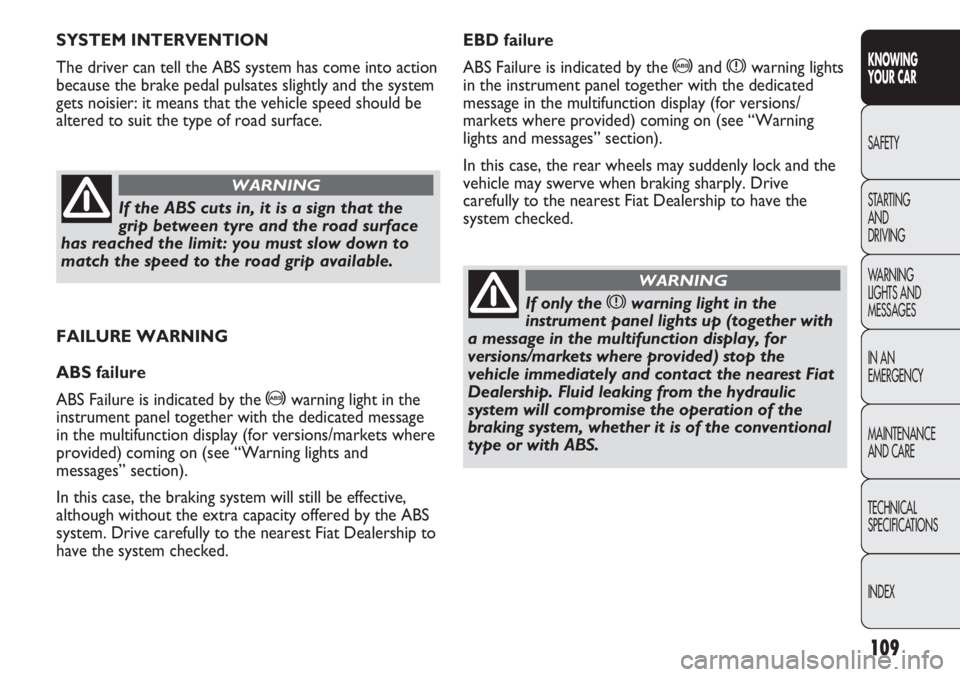
ABS Failure is indicated by the
>warning light in the
instrument panel together with the dedicated message
in the multifunction display (for versions/markets where
provided) coming on (see “Warning lights and
messages” section).
In this case, the braking system will still be effective,
although without the extra capacity offered by the ABS
system. Drive carefully to the nearest Fiat Dealership to
have the system checked. SYSTEM INTERVENTION
The driver can tell the ABS system has come into action
because the brake pedal pulsates slightly and the system
gets noisier: it means that the vehicle speed should be
altered to suit the type of road surface.
If the ABS cuts in, it is a sign that the
grip between tyre and the road surface
has reached the limit: you must slow down to
match the speed to the road grip available.
WARNING
EBD failure
ABS Failure is indicated by the
>and xwarning lights
in the instrument panel together with the dedicated
message in the multifunction display (for versions/
markets where provided) coming on (see “Warning
lights and messages” section).
In this case, the rear wheels may suddenly lock and the
vehicle may swerve when braking sharply. Drive
carefully to the nearest Fiat Dealership to have the
system checked.
If only the xwarning light in the
instrument panel lights up (together with
a message in the multifunction display, for
versions/markets where provided) stop the
vehicle immediately and contact the nearest Fiat
Dealership. Fluid leaking from the hydraulic
system will compromise the operation of the
braking system, whether it is of the conventional
type or with ABS.
WARNING
Page 161 of 287
157
KNOWING
YOUR CAR
SAFETY
STARTING
AND
DRIVING
WARNING
LIGHTS AND
MESSAGES
IN AN
EMERGENCY
MAINTENANCE
AND CARE
TECHNICAL
SPECIFICATIONS
INDEX
WARNING LIGHTS AND MESSAGES
GENERAL WARNINGS
The turning on of the warning light is accompanied by
a specific message and/or buzzer sound where provided
by instrument panel. These indications are brief and
precautionary and as such must not be considered as
exhaustive and/or an alternative to the information
contained in the Owner Handbook, which you are
recommended to read carefully in all cases. Always refer
to the information in this chapter in the event of
a failure indication.
IMPORTANT Failure indications displayed are divided
into two categories: very serious and less serious
failures.
Very serious failures prompt a prolonged cycle of
signals.
Less serious failures prompt a shorter cycle of signals.
Press MODE to stop the warning cycle in both cases.
The instrument panel warning light will stay on until the
cause of the failure is eliminated.
For messages relevant to the versions equipped with
Dualogic gearbox, see the attached Supplement.
WARNING LIGHTS AND MESSAGES
If the warning light xturns on when
travelling (on certain versions together
with the message on the display) stop the car
immediately and contact a Fiat Dealership.
WARNING
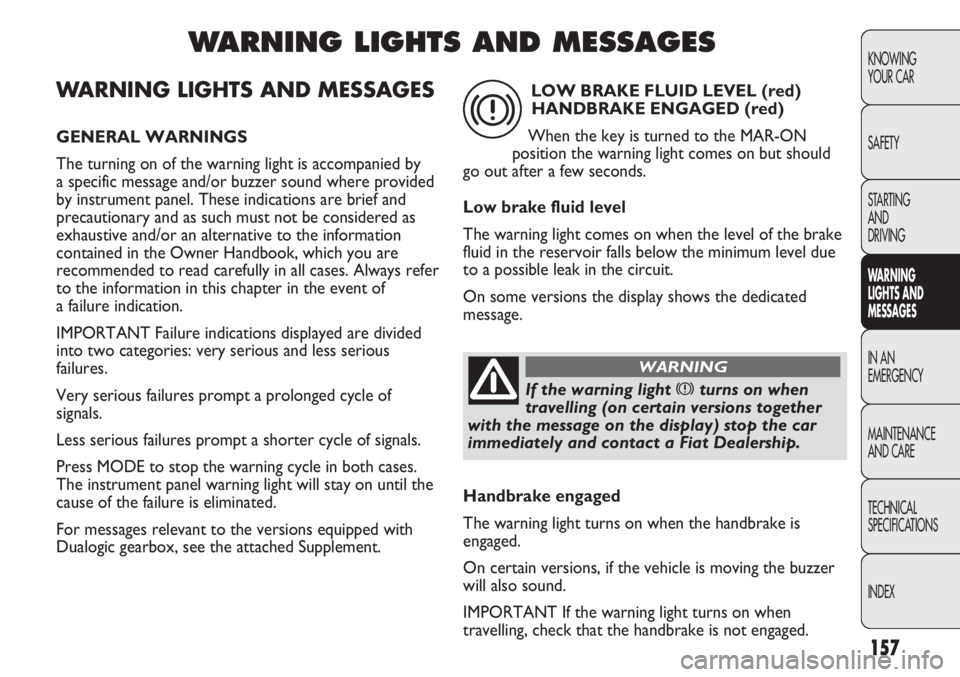
LOW BRAKE FLUID LEVEL (red)
HANDBRAKE ENGAGED (red)
When the key is turned to the MAR-ON
position the warning light comes on but should
go out after a few seconds.
Low brake fluid level
The warning light comes on when the level of the brake
fluid in the reservoir falls below the minimum level due
to a possible leak in the circuit.
On some versions the display shows the dedicated
message.
x
Handbrake engaged
The warning light turns on when the handbrake is
engaged.
On certain versions, if the vehicle is moving the buzzer
will also sound.
IMPORTANT If the warning light turns on when
travelling, check that the handbrake is not engaged.
Page 182 of 287
178
KNOWING
YOUR CAR
SAFETY
STARTING
AND
DRIVING
WARNING
LIGHTS AND
MESSAGES
IN AN
EMERGENCY
MAINTENANCE
AND CARE
TECHNICAL
SPECIFICATIONS
INDEX
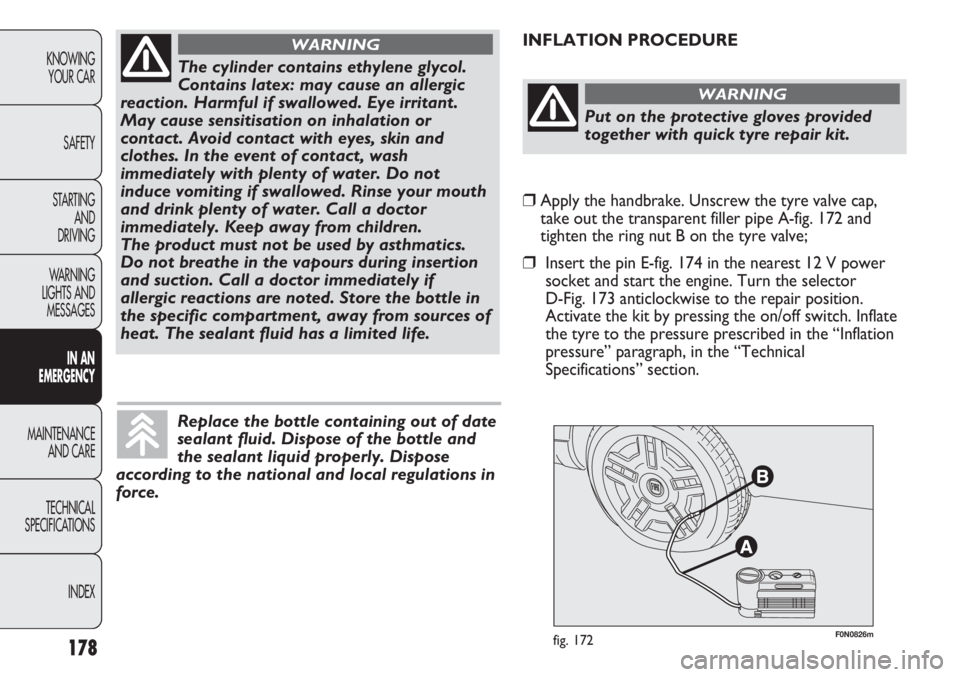
F0N0826mfig. 172
INFLATION PROCEDURE
The cylinder contains ethylene glycol.
Contains latex: may cause an allergic
reaction. Harmful if swallowed. Eye irritant.
May cause sensitisation on inhalation or
contact. Avoid contact with eyes, skin and
clothes. In the event of contact, wash
immediately with plenty of water. Do not
induce vomiting if swallowed. Rinse your mouth
and drink plenty of water. Call a doctor
immediately. Keep away from children.
The product must not be used by asthmatics.
Do not breathe in the vapours during insertion
and suction. Call a doctor immediately if
allergic reactions are noted. Store the bottle in
the specific compartment, away from sources of
heat. The sealant fluid has a limited life.
WARNING
Replace the bottle containing out of date
sealant fluid. Dispose of the bottle and
the sealant liquid properly. Dispose
according to the national and local regulations in
force.
Put on the protective gloves provided
together with quick tyre repair kit.
WARNING
❒Apply the handbrake. Unscrew the tyre valve cap,
take out the transparent filler pipe A-fig. 172 and
tighten the ring nut B on the tyre valve;
❒Insert the pin E-fig. 174 in the nearest 12 V power
socket and start the engine. Turn the selector
D-Fig. 173 anticlockwise to the repair position.
Activate the kit by pressing the on/off switch. Inflate
the tyre to the pressure prescribed in the “Inflation
pressure” paragraph, in the “Technical
Specifications” section.
Page 210 of 287
●● ● ● ●
●● ● ● ●
●● ● ● ●
●● ● ● ●
●● ● ● ●
●● ● ● ●
●● ● ● ●
●● ● ● ●
●● ● ● ●
●● ● ● ●
●●
●●
●●●
206
KNOWING
YOUR CAR
SAFETY
STARTING
AND
DRIVING
WARNING
LIGHTS AND
MESSAGES
IN AN
EMERGENCY
MAINTENANCE
AND CARE
TECHNICAL
SPECIFICATIONS
INDEX
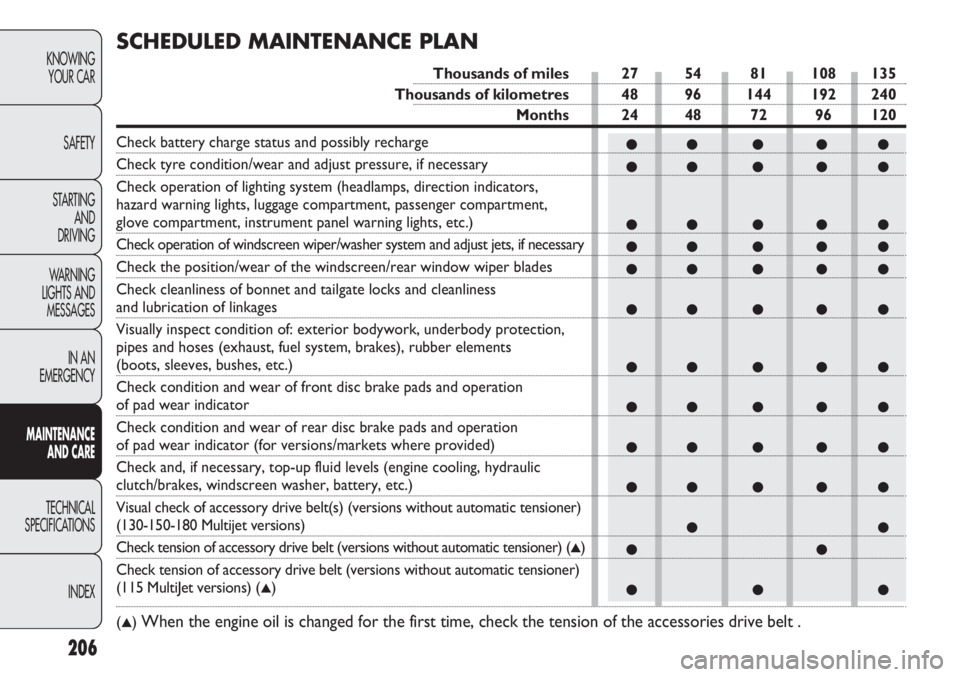
SCHEDULED MAINTENANCE PLAN
Thousands of miles 27 54 81 108 135
Thousands of kilometres 48 96 144 192 240
Months 24 48 72 96 120
Check battery charge status and possibly recharge
Check tyre condition/wear and adjust pressure, if necessary
Check operation of lighting system (headlamps, direction indicators,
hazard warning lights, luggage compartment, passenger compartment,
glove compartment, instrument panel warning lights, etc.)
Check operation of windscreen wiper/washer system and adjust jets, if necessary
Check the position/wear of the windscreen/rear window wiper blades
Check cleanliness of bonnet and tailgate locks and cleanliness
and lubrication of linkages
Visually inspect condition of: exterior bodywork, underbody protection,
pipes and hoses (exhaust, fuel system, brakes), rubber elements
(boots, sleeves, bushes, etc.)
Check condition and wear of front disc brake pads and operation
of pad wear indicator
Check condition and wear of rear disc brake pads and operation
of pad wear indicator (for versions/markets where provided)
Check and, if necessary, top-up fluid levels (engine cooling, hydraulic
clutch/brakes, windscreen washer, battery, etc.)
Visual check of accessory drive belt(s) (versions without automatic tensioner)
(130-150-180 Multijet versions)
Check tension of accessory drive belt (versions without automatic tensioner) (▲)
Check tension of accessory drive belt (versions without automatic tensioner)
(115 MultiJet versions) (▲)
(
▲)When the engine oil is changed for the first time, check the tension of the accessories drive belt .
Page 211 of 287
●
●● ● ● ●
●● ● ● ●
●● ● ● ●
●● ● ● ●
●● ● ● ●
●● ● ● ●
●
●●
●
●
●● ● ● ●
●●
●● ● ● ●
207
KNOWING
YOUR CAR
SAFETY
STARTING
AND
DRIVING
WARNING
LIGHTS AND
MESSAGES
IN AN
EMERGENCY
MAINTENANCE
AND CARE
TECHNICAL
SPECIFICATIONS
INDEX
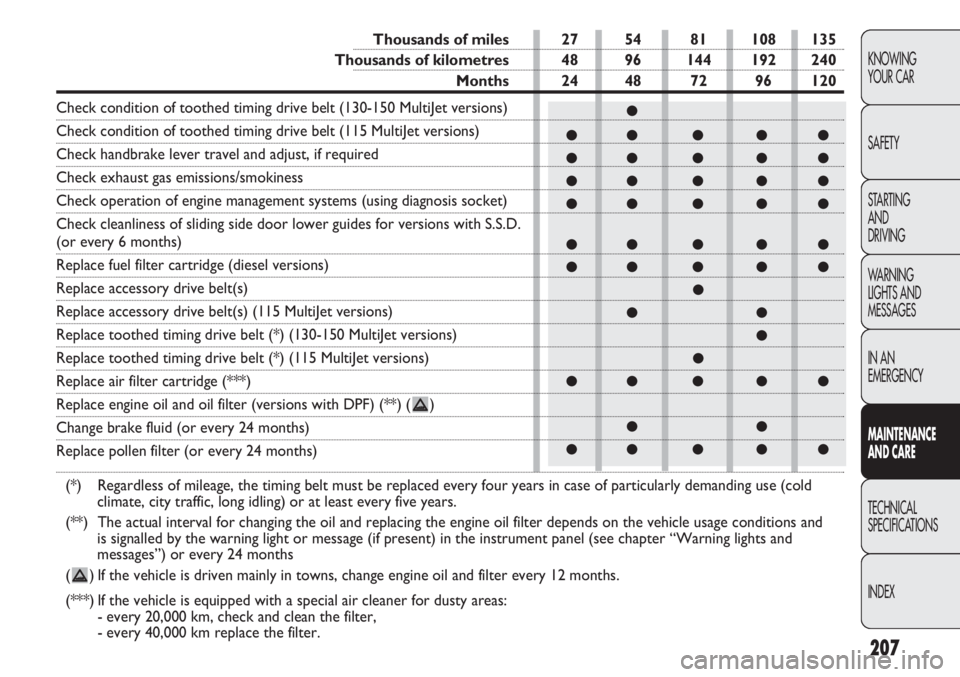
Thousands of miles 27 54 81 108 135
Thousands of kilometres 48 96 144 192 240
Months 24 48 72 96 120
Check condition of toothed timing drive belt (130-150 MultiJet versions)
Check condition of toothed timing drive belt (115 MultiJet versions)
Check handbrake lever travel and adjust, if required
Check exhaust gas emissions/smokiness
Check operation of engine management systems (using diagnosis socket)
Check cleanliness of sliding side door lower guides for versions with S.S.D.
(or every 6 months)
Replace fuel filter cartridge (diesel versions)
Replace accessory drive belt(s)
Replace accessory drive belt(s) (115 MultiJet versions)
Replace toothed timing drive belt (*) (130-150 MultiJet versions)
Replace toothed timing drive belt (*) (115 MultiJet versions)
Replace air filter cartridge (***)
Replace engine oil and oil filter (versions with DPF) (**) ( )
Change brake fluid (or every 24 months)
Replace pollen filter (or every 24 months)
(*) Regardless of mileage, the timing belt must be replaced every four years in case of particularly demanding use (cold
climate, city traffic, long idling) or at least every five years.
(**) The actual interval for changing the oil and replacing the engine oil filter depends on the vehicle usage conditions and
is signalled by the warning light or message (if present) in the instrument panel (see chapter “Warning lights and
messages”) or every 24 months
( ) If the vehicle is driven mainly in towns, change engine oil and filter every 12 months.
(***) If the vehicle is equipped with a special air cleaner for dusty areas:
- every 20,000 km, check and clean the filter,
- every 40,000 km replace the filter.
Page 212 of 287
208
KNOWING
YOUR CAR
SAFETY
STARTING
AND
DRIVING
WARNING
LIGHTS AND
MESSAGES
IN AN
EMERGENCY
MAINTENANCE
AND CARE
TECHNICAL
SPECIFICATIONS
INDEX
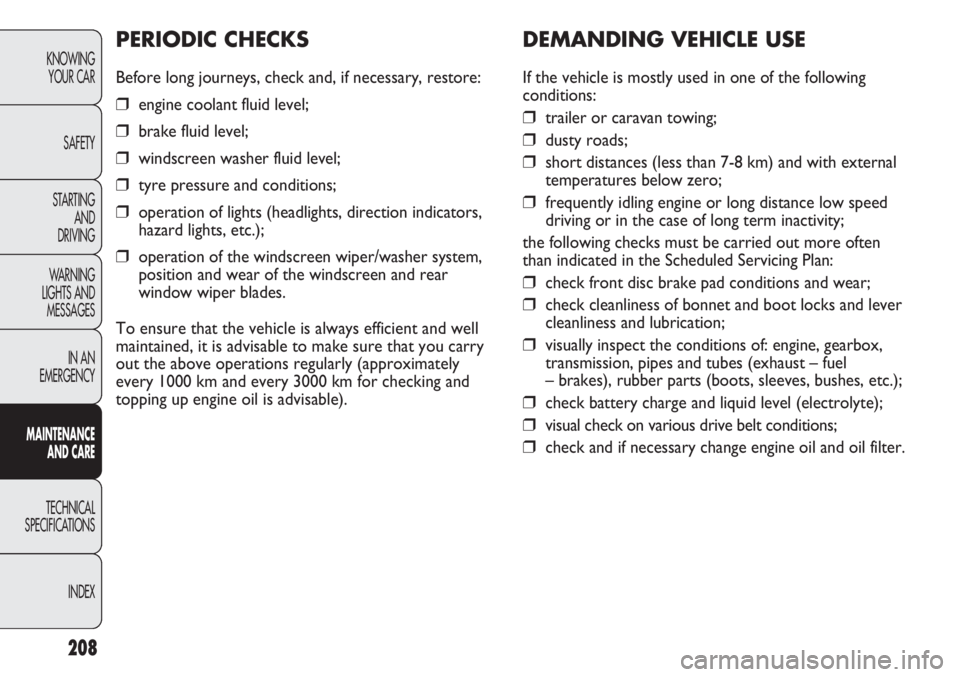
DEMANDING VEHICLE USE
If the vehicle is mostly used in one of the following
conditions:
❒trailer or caravan towing;
❒dusty roads;
❒short distances (less than 7-8 km) and with external
temperatures below zero;
❒frequently idling engine or long distance low speed
driving or in the case of long term inactivity;
the following checks must be carried out more often
than indicated in the Scheduled Servicing Plan:
❒check front disc brake pad conditions and wear;
❒check cleanliness of bonnet and boot locks and lever
cleanliness and lubrication;
❒visually inspect the conditions of: engine, gearbox,
transmission, pipes and tubes (exhaust – fuel
– brakes), rubber parts (boots, sleeves, bushes, etc.);
❒check battery charge and liquid level (electrolyte);
❒visual check on various drive belt conditions;
❒check and if necessary change engine oil and oil filter.
PERIODIC CHECKS
Before long journeys, check and, if necessary, restore:
❒engine coolant fluid level;
❒brake fluid level;
❒windscreen washer fluid level;
❒tyre pressure and conditions;
❒operation of lights (headlights, direction indicators,
hazard lights, etc.);
❒operation of the windscreen wiper/washer system,
position and wear of the windscreen and rear
window wiper blades.
To ensure that the vehicle is always efficient and well
maintained, it is advisable to make sure that you carry
out the above operations regularly (approximately
every 1000 km and every 3000 km for checking and
topping up engine oil is advisable).
Page 213 of 287
209
KNOWING
YOUR CAR
SAFETY
STARTING
AND
DRIVING
WARNING
LIGHTS AND
MESSAGES
IN AN
EMERGENCY
MAINTENANCE
AND CARE
TECHNICAL
SPECIFICATIONS
INDEX
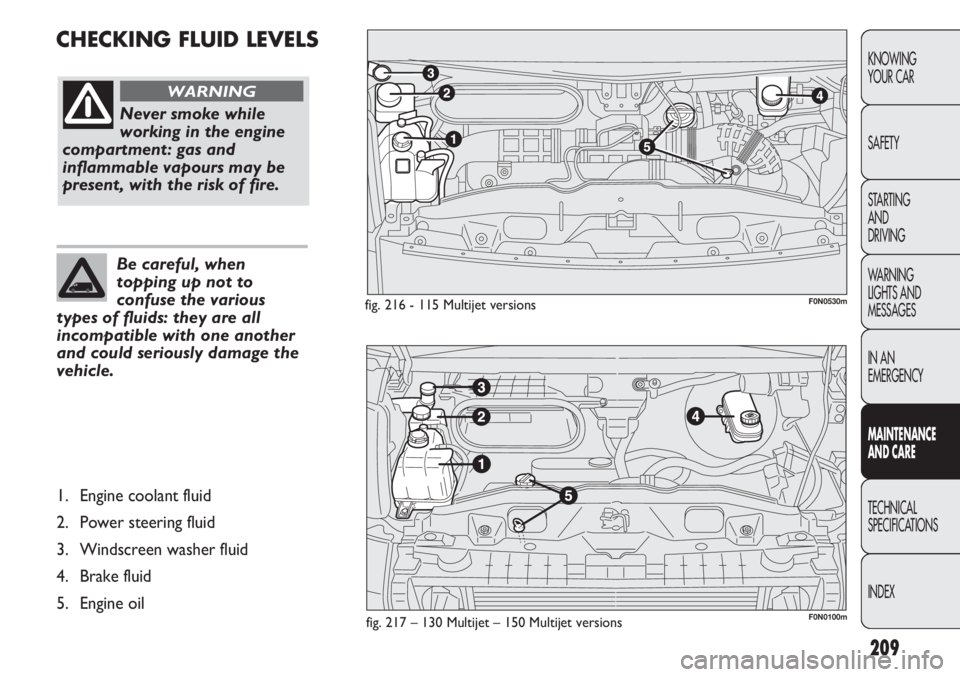
CHECKING FLUID LEVELS
fig. 217 – 130 Multijet – 150 Multijet versions
Never smoke while
working in the engine
compartment: gas and
inflammable vapours may be
present, with the risk of fire.
WARNING
Be careful, when
topping up not to
confuse the various
types of fluids: they are all
incompatible with one another
and could seriously damage the
vehicle.
1. Engine coolant fluid
2. Power steering fluid
3. Windscreen washer fluid
4. Brake fluid
5. Engine oil
fig. 216 - 115 Multijet versionsF0N0530m
F0N0100m
Page 214 of 287
210
KNOWING
YOUR CAR
SAFETY
STARTING
AND
DRIVING
WARNING
LIGHTS AND
MESSAGES
IN AN
EMERGENCY
MAINTENANCE
AND CARE
TECHNICAL
SPECIFICATIONS
INDEX
Be careful, when
topping up not to
confuse the various
types of fluids: they are all
incompatible with one another
and could seriously damage the
vehicle.
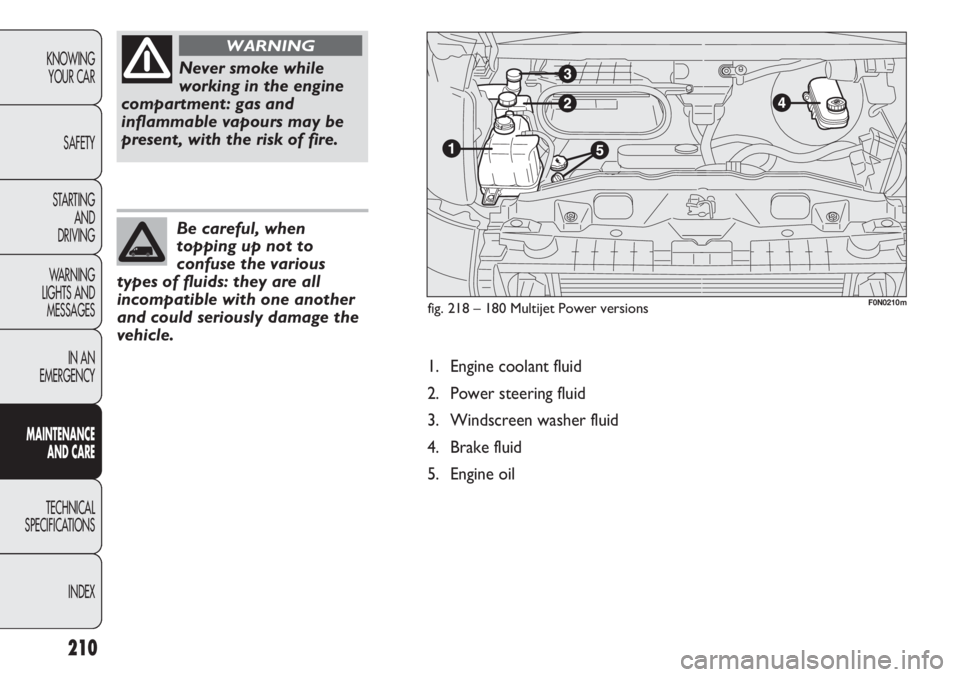
1. Engine coolant fluid
2. Power steering fluid
3. Windscreen washer fluid
4. Brake fluid
5. Engine oil
fig. 218 – 180 Multijet Power versions
Never smoke while
working in the engine
compartment: gas and
inflammable vapours may be
present, with the risk of fire.
WARNING
F0N0210m
Page 219 of 287
215
KNOWING
YOUR CAR
SAFETY
STARTING
AND
DRIVING
WARNING
LIGHTS AND
MESSAGES
IN AN
EMERGENCY
MAINTENANCE
AND CARE
TECHNICAL
SPECIFICATIONS
INDEX
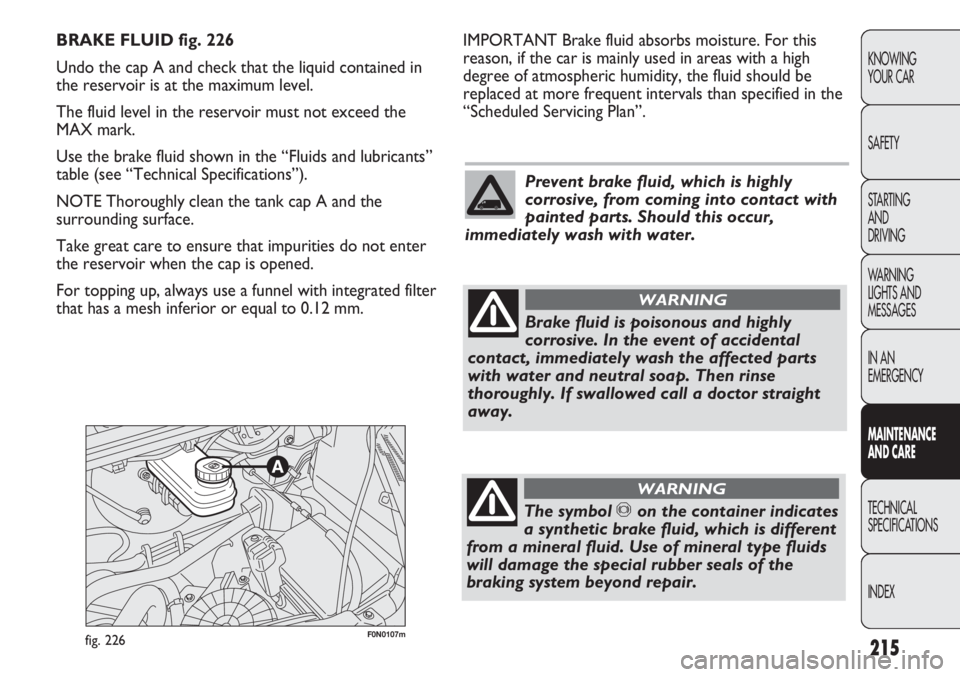
F0N0107mfig. 226
IMPORTANT Brake fluid absorbs moisture. For this
reason, if the car is mainly used in areas with a high
degree of atmospheric humidity, the fluid should be
replaced at more frequent intervals than specified in the
“Scheduled Servicing Plan”. BRAKE FLUID fig. 226
Undo the cap A and check that the liquid contained in
the reservoir is at the maximum level.
The fluid level in the reservoir must not exceed the
MAX mark.
Use the brake fluid shown in the “Fluids and lubricants”
table (see “Technical Specifications”).
NOTE Thoroughly clean the tank cap A and the
surrounding surface.
Take great care to ensure that impurities do not enter
the reservoir when the cap is opened.
For topping up, always use a funnel with integrated filter
that has a mesh inferior or equal to 0.12 mm.
Prevent brake fluid, which is highly
corrosive, from coming into contact with
painted parts. Should this occur,
immediately wash with water.
Brake fluid is poisonous and highly
corrosive. In the event of accidental
contact, immediately wash the affected parts
with water and neutral soap. Then rinse
thoroughly. If swallowed call a doctor straight
away.
WARNING
The symbol πon the container indicates
a synthetic brake fluid, which is different
from a mineral fluid. Use of mineral type fluids
will damage the special rubber seals of the
braking system beyond repair.
WARNING
Page 225 of 287
221
KNOWING
YOUR CAR
SAFETY
STARTING
AND
DRIVING
WARNING
LIGHTS AND
MESSAGES
IN AN
EMERGENCY
MAINTENANCE
AND CARE
TECHNICAL
SPECIFICATIONS
INDEX
RUBBER HOSES
As far as the brake system and fuel rubber hoses are
concerned, follow the “Scheduled Servicing Programme”
in this chapter carefully.
Ozone, high temperatures and prolonged lack of fluid in
the system may cause hardening and cracking of the
hoses, with possible leaks.
Careful inspections are therefore necessary.Remember that the road holding
qualities of your vehicle also depend on
the correct inflation pressure of the tyres.
WARNING
If the pressure is too low the tyre will get
overheated, with the risk of serious
damage.
WARNING
Avoid moving the tyres from the right
side of the vehicle to the left side and
vice versa.
WARNING
Never submit alloy rims to repainting
treatments requiring the use of
temperatures exceeding 150 °C. The mechanical
properties of the wheels could be impaired.
WARNING