High FIAT DUCATO 2014 3.G Owner's Guide
[x] Cancel search | Manufacturer: FIAT, Model Year: 2014, Model line: DUCATO, Model: FIAT DUCATO 2014 3.GPages: 367, PDF Size: 20.39 MB
Page 164 of 367
FRONT AIRBAGSThe vehicle is provided with front
airbags for the driver and the
passenger.
The front driver/passenger airbags have
been designed to protect the front
seat occupants in the event of frontal
impacts of medium-high severity, by
placing the bag between the occupant
and the steering wheel or dashboard.
Therefore, non-activation in other types
of collisions (side collisions, rear shunts,
roll-overs, etc.) is not a system
malfunction.
An electronic control unit will make the
bag inflate in the event of a frontal
impact.
The bag will inflate instantaneously
placing itself between the front
occupants body and the structures
which could cause injury. It will deflate
immediately afterwards.
Driver and passenger front airbags are
not a replacement of but
complementary to the belts, which you
are recommended to always wear, as
specified by law in Europe and most
non-European countries.The volume of the front airbags at
maximum inflation fills most of
the space between the steering wheel
and the driver and between the
dashboard and the passenger.
In the event of an impact, someone not
wearing a seat belt will move forward
and come into contact with the bag
which is still in the opening stage. The
protection offered by the bag is
compromised in these circumstances.
Front airbags may not activate in the
following situations:
❒frontal impacts against highly
deformable objects not involving the
front surface of the vehicle (e.g.
wing collision against guard rail, etc.);
❒jamming of the vehicle underneath
other vehicles or protective barriers
(e.g. underneath a truck or a guard
rail); in this case, the bags would offer
no additional protection with respect
to the seat belt and their deployment
is unnecessary. In these cases,
non-deployment does not indicate a
system malfunction.
110)
The airbags are not deployed in the
event of minor frontal collisions (for
which the restraining action of the seat
belts is sufficient). Safety belts must
always be worn. In the event of frontal
collisions they guarantee correct
positioning of the passenger.
DRIVER'S SIDE FRONT
AIRBAG
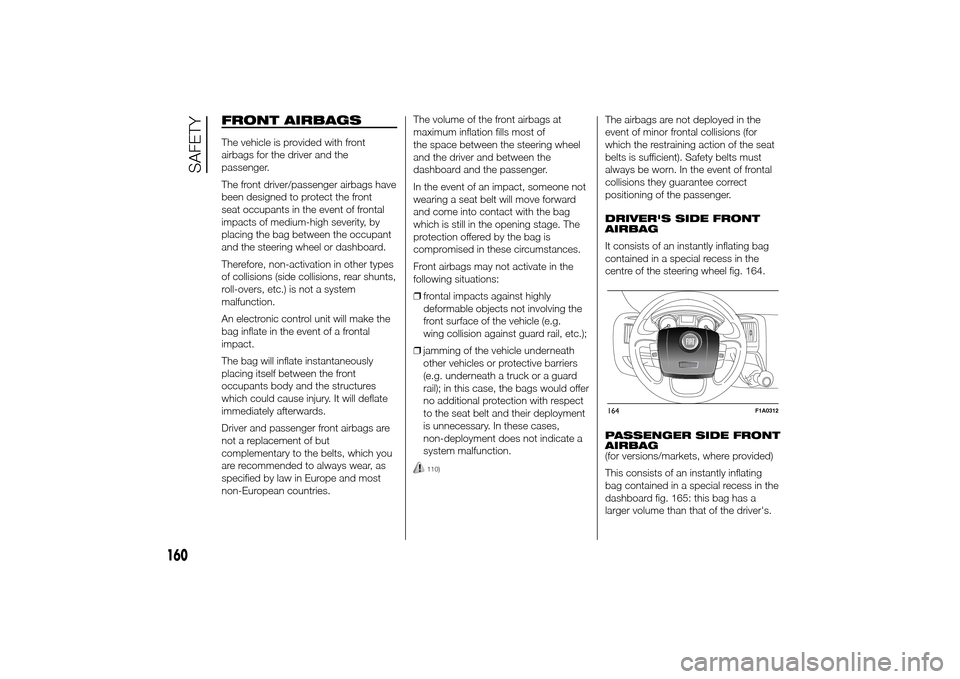
It consists of an instantly inflating bag
contained in a special recess in the
centre of the steering wheel fig. 164.
PASSENGER SIDE FRONT
AIRBAG
(for versions/markets, where provided)
This consists of an instantly inflating
bag contained in a special recess in the
dashboard fig. 165: this bag has a
larger volume than that of the driver's.164
F1A0312
160
SAFETY
Page 169 of 367
SIDE BAGS
112) 113) 114) 115) 116) 117) 118) 119) 120) 121)
122) 123) 124)
The vehicle is fitted with front side bags
for driver and passenger (for versions/
markets where provided) for protecting
the chest and window bags (for
versions/markets where provided) for
protecting front and rear passengers'
heads.
Side bags (for versions/markets where
provided) protect occupants from
side impacts of medium-high severity,
by placing the bag between the
occupant and the internal parts of the
side structure of the vehicle. Non-
activation of side bags in other types of
collisions (front collisions, rear shunts,
roll-overs, etc...) is not a system
malfunction.
An electronic control unit causes the
bags to inflate in the event of a side
impact. The bags inflate
instantaneously placing themselves
between the occupants' bodies and the
structures which could cause injury.
They deflate immediately afterwards.Side bags (for versions/markets where
provided) are not a replacement of
but complementary to the belts, which
you are recommended to always wear,
as specified by law in Europe and
most non-European countries.
FRONT SIDE BAGS FOR
CHEST PROTECTION
(for versions/markets, where provided)
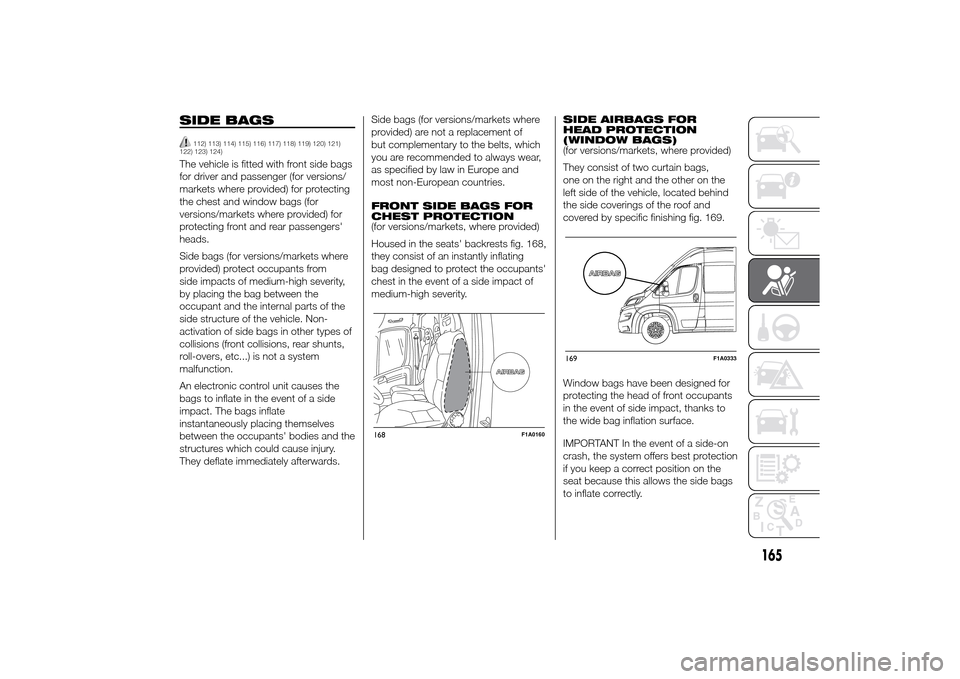
Housed in the seats' backrests fig. 168,
they consist of an instantly inflating
bag designed to protect the occupants'
chest in the event of a side impact of
medium-high severity.SIDE AIRBAGS FOR
HEAD PROTECTION
(WINDOW BAGS)
(for versions/markets, where provided)
They consist of two curtain bags,
one on the right and the other on the
left side of the vehicle, located behind
the side coverings of the roof and
covered by specific finishing fig. 169.
Window bags have been designed for
protecting the head of front occupants
in the event of side impact, thanks to
the wide bag inflation surface.
IMPORTANT In the event of a side-on
crash, the system offers best protection
if you keep a correct position on the
seat because this allows the side bags
to inflate correctly.
168
F1A0160
169
F1A0333
165
Page 175 of 367

STOPPING THE ENGINE
Turn the ignition key to STOP while the
engine is idling.
31) 32)
IMPORTANT
26) It is advisable not to demand
maximum performance from
your vehicle (e.g. excessive
acceleration, long distances at
high speeds, excessively intense
braking, etc.) during the initial
period of use.
27) When the engine is off, do not
leave the ignition key turned to
MAR-ON to prevent unnecessary
electrical consumption from
draining the battery.
28) If the
warning light flashes
for about 60 seconds after
starting or during prolonged
cranking, this indicates a fault in
the glow plug preheating system.
Use the vehicle normally if the
engine starts, but contact a Fiat
Dealership as soon as possible.29) Remember that the brake servo
and power steering are not
operational until the engine has
been started, so you need to apply
much more force than usual to
the brake pedal and steering
wheel.
30) Never start the engine by
pushing, towing or driving
downhill. This could cause fuel to
flow into the catalytic converter
and damage it beyond repair.
31) A quick burst on the accelerator
before turning off the engine
serves absolutely no practical
purpose; it wastes fuel and is
especially damaging to
turbocharged engines.
32) In some cases, when the engine
switches off, the fan could
activate for max. 120 seconds.
WARNING
125) It is dangerous to run the
engine in enclosed areas. The
engine takes in oxygen and
releases carbon dioxide, carbon
monoxide and other toxic gases.
171
Page 179 of 367

LOADING ADVICEThe Fiat Ducato version used by you
has been designed and type approved
on the basis of certain maximum
weights (see "Weights" table in the
"Technical Data" chapter): kerb weight,
payload, total weight, maximum weight
on front axle, maximum weight on
rear axle, towable weight.
IMPORTANT The maximum permitted
load on the floor fastenings is 500
kg; the maximum permitted load on the
side panel is 150 kg.
IMPORTANT For versions with right and
left side flaps, it is advisable to
reposition the release lever in the closed
position before lowering the sides.
35)128) 129) 130)
In addition to these general
precautions, some simple precautions
can improve driving safety, travelling
comfort and vehicle durability:
❒distribute the load evenly over the
platform: if it is necessary to
concentrate it in a single area,
choose an area mid-way between
both axles;❒lastly, remember that the vehicle’s
dynamic behaviour is affected by
the weight transported: in particular,
the stopping distances are longer,
especially at high speed.
IMPORTANT
35) Each of these must be strictly
observed and MUST NEVER BE
EXCEEDED in any case. In
particular, ensure that you never
exceed the maximum permitted
weights on the front and rear
axles when arranging the load on
the vehicle (particularly if the
vehicle is equipped with a specific
trim level).
WARNING
128) Irregular trajectories and abrupt
braking may cause sudden
movements of the load with
consequent situations of hazard
for the driver and passengers:
before setting off, secure the load
tightly using the appropriate
hooks on the floor and use steel
cables, ropes or chains strong
enough to hold the items to be
secured.
129) If a vehicle is parked on a very
steep gradient or with a side
gradient, opening the rear door or
side door could cause any
unsecured items to emerge
suddenly.
130) If you wish to carry a reserve of
petrol in a can, observe the legal
restrictions and only use a can
that is type-approved and
properly secured to the load
anchorage eyebolts. Anyway, by
doing so, you increase the risk
of fire in the event of an accident
with your vehicle.
175
Page 180 of 367
SAVING FUELSome useful tips are given below for
fuel saving and reducing harmful
emissions of CO2 and other pollutants
(nitrogen oxides, unburnt
hydrocarbons, Particulate Matter (PM),
etc.).
GENERAL
CONSIDERATIONS
The general factors that affect fuel
consumption are listed below.
Vehicle maintenance
Have checks and adjustments carried
out in accordance with the “Scheduled
Servicing Plan”.Tyres
Check the tyre pressures at least once
every four weeks: if the pressure is
too low, consumption levels increase as
resistance to rolling is higher.
Unnecessary loads
Do not travel with an overloaded
luggage compartment. The weight of
the vehicle (especially when driving
in town) and its geometry greatly affect
fuel consumption and stability.
Roof rack/ski rack
Remove the roof rack or the ski rack
from the roof after use. These
accessories decrease aerodynamic
penetration of the vehicle and have a
negative effect on fuel consumption.
When transporting particularly large
objects, use a trailer if possible.Electric devices
Use electrical devices only for the
amount of time needed. The heated
rear window, additional headlights,
windscreen/rear window wipers and
heater fan need a considerable amount
of energy, therefore increasing fuel
consumption (by up to 25% in
the urban cycle).
Climate control system
Air conditioning leads to higher fuel
consumption (on average up to +20%).
If the temperature outside permits, try
and use the ventilation only.
Devices for
aerodynamic control
The use of non-certified spoilers may
adversely affect air drag and fuel
consumption.
176
STARTING AND DRIVING
Page 181 of 367
DRIVING STYLE
The main driving styles that affect fuel
consumption are listed below.
Cranking
Do not warm up the engine at low or
high revs when the vehicle is stationary;
this causes the engine to warm up
more slowly, thereby increasing fuel
consumption and emissions. It is
therefore advisable to move off
immediately, slowly, avoiding high
speeds: in this way the engine will
warm up more quickly.Unnecessary actions
Avoid accelerating when stopped at
traffic lights or before switching off the
engine. This action and also double
declutching is absolutely pointless on
modern cars and also increases
consumption and pollution.
Gear selection
As soon as the conditions of the traffic
and road permit, use a higher gear.
Using a low gear for faster acceleration
will increase consumption.
In the same way improper use of a high
gear increases consumption, emissions
and engine wear.
Max. speed
Fuel consumption increases
considerably with speed. Maintain a
constant speed, avoiding unnecessary
braking and acceleration, which cost
in terms of both fuel consumption and
emissions.
Acceleration
Accelerating violently will greatly affect
consumption and emissions:
acceleration should be gradual.USAGE CONDITIONS
The main usage conditions that
negatively affect fuel consumption are
listed below.
Cold starting
Short journeys and frequent cold starts
do not allow the engine to reach
optimum operating temperature.
This results in a significant increase in
consumption levels (from +15 to +30%
on the urban cycle) and emissions.
Traffic and road
conditions
Rather high consumption levels are
linked to situations with heavy traffic, for
instance when travelling in queues
with frequent use of the lower gears or
in cities with many traffic lights. Winding
mountain roads and rough road
surfaces also adversely affect
consumption.
Stops in traffic
During prolonged hold-ups (e.g. level
crossings) the engine should be
switched off.
177
Page 182 of 367
TOWING TRAILERSIMPORTANT
INFORMATION
The vehicle must be provided with a
type-approved tow hook and adequate
electrical system to tow caravans or
trailers. Installation should be carried
out by specialised personnel who
will issue the required papers for
travelling on roads.
Install any specific and/or additional
door mirrors as specified by the
Highway Code.
Remember that when towing a trailer,
steep hills are harder to climb, the
braking spaces increase and overtaking
takes longer depending on the overall
weight.
Engage a low gear when driving
downhill, rather than constantly using
the brake.
The weight of the trailer on the vehicle
tow hook will reduce the loading
capacity of the vehicle by the same
amount. Consider the weight of the
trailer fully laden, including accessories
and luggage, to make sure you do
not exceed the maximum towable
weight (shown on the vehicle
registration document).Do not exceed the speed limits specific
to each country you are driving in, in
the case of vehicles towing trailers.
In any case, the top speed must not
exceed 100 km/h.
You are advised to fit a suitable
stabiliser to the trailer drawbar.
In the vehicles equipped with parking
sensors, after fitting the tow hook
malfunctioning warnings may be
displayed, as some parts (tow bar, ball
tow hook) may be within the sensor
detection range. In this case the
detection range must be adjusted or
the parking assistance function must be
deactivated.
131) 132)
INSTALLING THE TOW
HOOK
The towing device should be fastened
to the body by specialised personnel
according to any additional and/or
integrative information supplied by the
Manufacturer of the device.
The towing device must meet current
regulations with reference to Directive
94/20/EC and subsequent
amendments.
For any version the towing device used
must match the towable weight of the
vehicle on which it is to be installed.
For the electric connection a standard
connector should be used which is
generally placed on a special bracket
normally fastened to the towing device,
and a special ECU for external trailer
light control must be installed on the
vehicle. For the electrical connection, 7
or 13 pin 12 V DC connections are to
be used (CUNA/UNI and ISO/DIN
Standards). Follow the instructions
provided by the vehicle manufacturer
and/or the tow hitch manufacturer.
An electric brake (or electric winch)
should be supplied directly by the
battery through a cable with a cross
section of no less than 2.5 mm
2.
178
STARTING AND DRIVING
Page 189 of 367
IMPORTANT
36) The removable ball head bar can
be repaired and disassembled by
the manufacturer only.
37) The supplied plate must be
applied in a visible point on the
vehicle, close to the mounting
pipe or inside the luggage
compartment.
38) Regularly remove all dirt
deposits from the ball head bar
and from the mounting pipe to
ensure a correct system
operation. The mechanical
components must be serviced at
the specified intervals. The lock
must be treated with graphite
only.
39) Periodically lubricate the joints,
the sliding surfaces and the balls
with grease without resin or oil.
Lubrication is also a further
corrosion protection.
40) When the vehicle is cleaned with
high-pressure jets, previously
remove the ball head bar and
insert the suitable plug. The ball
head plug must never be treated
with high-pressure jets.41) Two keys are supplied together
with the removable ball tow bar.
Note down the key number on the
pawl for any following order and
keep it.
185
Page 190 of 367

SNOW TYRESA Fiat Dealership will be happy to
provide advice concerning the most
suitable type of tyre for the customer's
requirements.
The performance of these tyres is
considerably reduced when the tread
depth is less than 4 mm. Replace them
in this case.
Due to the specific characteristics of
snow tyres, in normal weather
conditions or on long motorway
journeys, the performance of these
tyres is lower than that of standard
tyres. Their usage should therefore be
restricted in accordance with their
type approval.IMPORTANT When using snow tyres
with a maximum speed index below the
one that can be reached by the vehicle
(increased by 5%), place a notice in
the passenger compartment, plainly in
view, which states the maximum speed
allowed by the snow tyres (as per EC
Directive).
All four tyres should be the same (brand
and track) to ensure greater safety
when driving and braking as well as a
good manoeuvrability.
Remember that you should not change
the rotation direction of the tyres.
135)
WARNING
135) The maximum speed for snow
tyres marked "Q" is 160 km/h,
while it is 190 km/h for "T" tyres
and 210 km/h for "H" tyres. You
should, however, always comply
with the speed limits of the
highway code.
186
STARTING AND DRIVING
Page 194 of 367
STARTING THE
ENGINEGo to a Fiat Dealership immediately if
warning light
stays on constantly on
the instrument panel.
JUMP STARTING
If the battery is flat, it is possible to start
the engine using an auxiliary battery
with the same capacity or a little higher
than the flat one.
It is advisable to contact a Fiat
Dealership to check/replace the battery.
136)
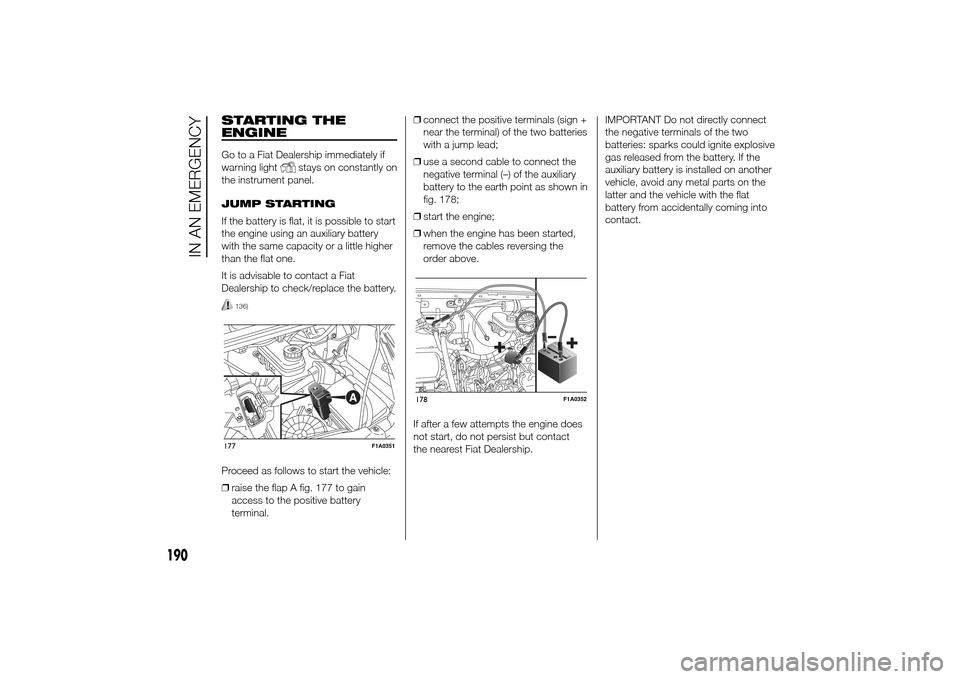
Proceed as follows to start the vehicle:
❒raise the flap A fig. 177 to gain
access to the positive battery
terminal.❒connect the positive terminals (sign +
near the terminal) of the two batteries
with a jump lead;
❒use a second cable to connect the
negative terminal (–) of the auxiliary
battery to the earth point as shown in
fig. 178;
❒start the engine;
❒when the engine has been started,
remove the cables reversing the
order above.
If after a few attempts the engine does
not start, do not persist but contact
the nearest Fiat Dealership.IMPORTANT Do not directly connect
the negative terminals of the two
batteries: sparks could ignite explosive
gas released from the battery. If the
auxiliary battery is installed on another
vehicle, avoid any metal parts on the
latter and the vehicle with the flat
battery from accidentally coming into
contact.177
F1A0351
178
F1A0352
190
IN AN EMERGENCY