High FIAT DUCATO 2014 3.G Workshop Manual
[x] Cancel search | Manufacturer: FIAT, Model Year: 2014, Model line: DUCATO, Model: FIAT DUCATO 2014 3.GPages: 367, PDF Size: 20.39 MB
Page 245 of 367
WARNING
188) Remember that the road
holding qualities of your vehicle
also depend on the correct
inflation pressure of the tyres.
189) If the pressure is too low, the
tyre will overheat and could be
seriously damaged.
190) Avoid switching the tyres from
the right side of the vehicle to the
left side and vice versa.
191) Never submit alloy rims to
repainting treatments requiring
the use of temperatures
exceeding 150°C. The mechanical
properties of the wheels could
be impaired.
RUBBER HOSESAs far as the brake system and fuel
supply system rubber hoses are
concerned, follow the "Scheduled
Servicing Plan" in this chapter carefully.
Ozone, high temperatures and
prolonged lack of fluid in the system
may cause hardening and cracking of
the hoses, with possible leaks. Careful
checking is therefore necessary.
WINDSCREEN
WIPERBLADES
Periodically clean the rubber part using
special products; TUTELA
PROFESSIONAL SC 35 is
recommended.
Replace the blades if the rubber edge is
deformed or worn. In any case, it is
advisable to replace them
approximately once a year.
A few simple precautions can reduce
the possibility of damage to the blades:
❒if the temperature falls below zero,
make sure that ice has not frozen
the rubber against the glass. Use a
de-icing product to release it if
required;
❒remove any snow from the glass: in
addition to protecting the blades,
this prevents effort on the motor and
overheating;
❒do not operate the windscreen and
rear window wipers on dry glass.
192)
241
Page 247 of 367

BODYWORKPROTECTION AGAINST
ATMOSPHERIC AGENTS
The main causes of corrosion are the
following:
❒atmospheric pollution;
❒salty air and humidity (coastal areas,
or hot humid climates);
❒seasonal environmental conditions.
The abrasive action of wind-borne
atmospheric dust and sand, as well as
mud and gravel raised by other vehicles
is also not to be underestimated.
On your vehicle, Fiat has implemented
the best manufacturing technologies
to effectively protect the bodywork
against corrosion.These include:
❒painting products and systems which
give the vehicle particular resistance
to corrosion and abrasion;
❒Use of galvanised (or pretreated)
steel sheets, with high resistance
to corrosion;
❒spraying the underbody, engine
compartment, wheelhouse internal
parts and other parts with highly
protective wax products;
❒spraying of plastic parts, with a
protective function in the more
exposed points: underdoor, inner
wing, edges, etc;
❒use of “open” boxed sections to
prevent condensation and pockets of
moisture from triggering rust inside.VEHICLE BODY AND
UNDERBODY WARRANTY
Your vehicle is covered by warranty
against perforation due to corrosion of
any original element of the structure
or body.
For the general terms of this warranty,
refer to the Warranty Booklet.
243
Page 248 of 367
ADVICE FOR
PRESERVING THE
BODYWORK
Paintwork
Paintwork does not only serve an
aesthetic purpose, but also protects the
underlying sheet metal.
Touch up abrasions and scratches
immediately to prevent rust formation.
Only use genuine spare paint products
for touch-ups (see “Bodywork paint
identification plate” in the “Technical
Specifications” section).
Normal maintenance of paintwork
consists in washing the car: the
frequency depends on the conditions
and environment where the car is used.
For example, it is advisable to wash
the vehicle more often in areas with
high levels of environmental pollution or
on roads spread with salt.To correctly wash the vehicle, proceed
as follows:
❒wash the bodywork using a low
pressure jet of water;
❒wipe a sponge with a slightly soapy
solution over the bodywork,
frequently rinsing the sponge;
❒rinse well with water and dry with a
jet of air or a chamois leather.
If you put the car through a car wash,
follow these recommendations:
❒remove the aerial from the roof so it
does not get damaged;
❒the vehicle should be washed with
water added to a soapy solution;
❒rinse thoroughly to avoid soap marks
remaining on the bodywork or less
visible parts.
54)
Dry the less visible parts, such as the
door frames, bonnet and the headlight
frames with special care, as in these
areas water may stagnate more easily.
It is a good idea to leave the vehicle
outdoors for a while after washing it to
give the water time to evaporate.
Do not wash the vehicle after it has
been left in the sun or with the bonnet
hot: this may alter the shine of the
paintwork.
Exterior plastic parts should be cleaned
in the same way as the rest of the
vehicle. Where possible, do not park
the vehicle under trees; the resinous
substances released by many species
give the paint a dull appearance and
increase the possibility of corrosion.
IMPORTANT Bird droppings must be
washed off immediately and thoroughly
as the acid they contain is particularly
aggressive.
5)
Windows
To clean glasses, use specific cleaning
products. Use clean cloths to avoid
scratching the glass or damaging the
transparency.
244
SERVICING AND MAINTENANCE
Page 280 of 367
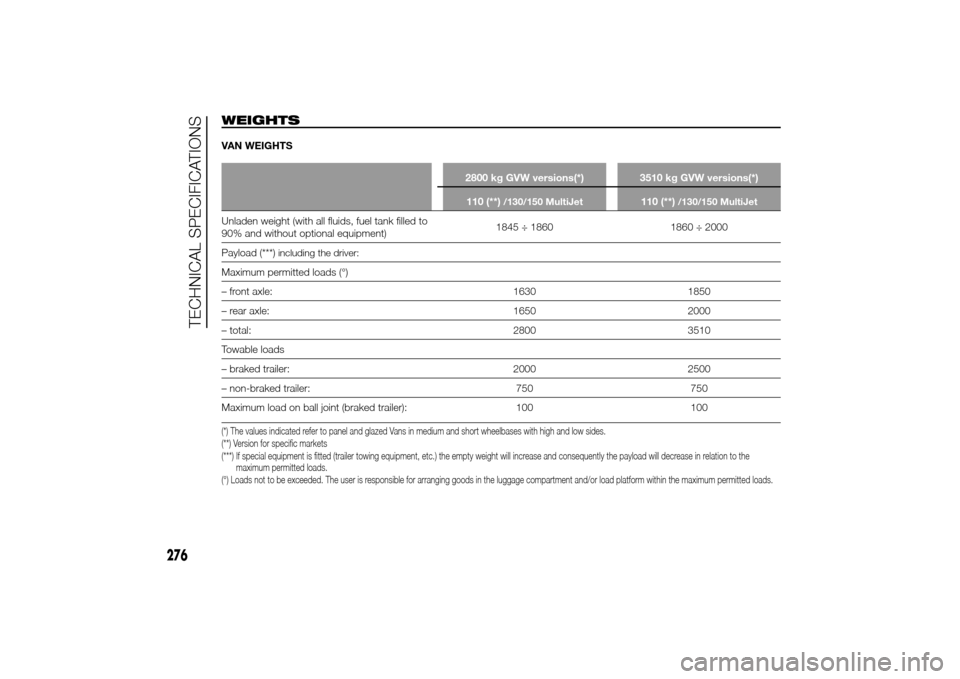
WEIGHTSVAN WEIGHTS
2800 kg GVW versions(*) 3510 kg GVW versions(*)
110 (**)
/130/150 MultiJet
110 (**)
/130/150 MultiJet
Unladen weight (with all fluids, fuel tank filled to
90% and without optional equipment)1845 ÷ 1860 1860 ÷ 2000
Payload (***)
including the driver:
Maximum permitted loads (°)
– front axle: 1630 1850
– rear axle: 1650 2000
– total: 2800 3510
Towable loads
– braked trailer: 2000 2500
– non-braked trailer: 750 750
Maximum load on ball joint (braked trailer): 100 100(*) The values indicated refer to panel and glazed Vans in medium and short wheelbases with high and low sides.
(**) Version for specific markets
(***) If special equipment is fitted (trailer towing equipment, etc.) the empty weight will increase and consequently the payload will decrease in relation to the
maximum permitted loads.
(°) Loads not to be exceeded. The user is responsible for arranging goods in the luggage compartment and/or load platform within the maximum permittedloads.
276
TECHNICAL SPECIFICATIONS
Page 281 of 367
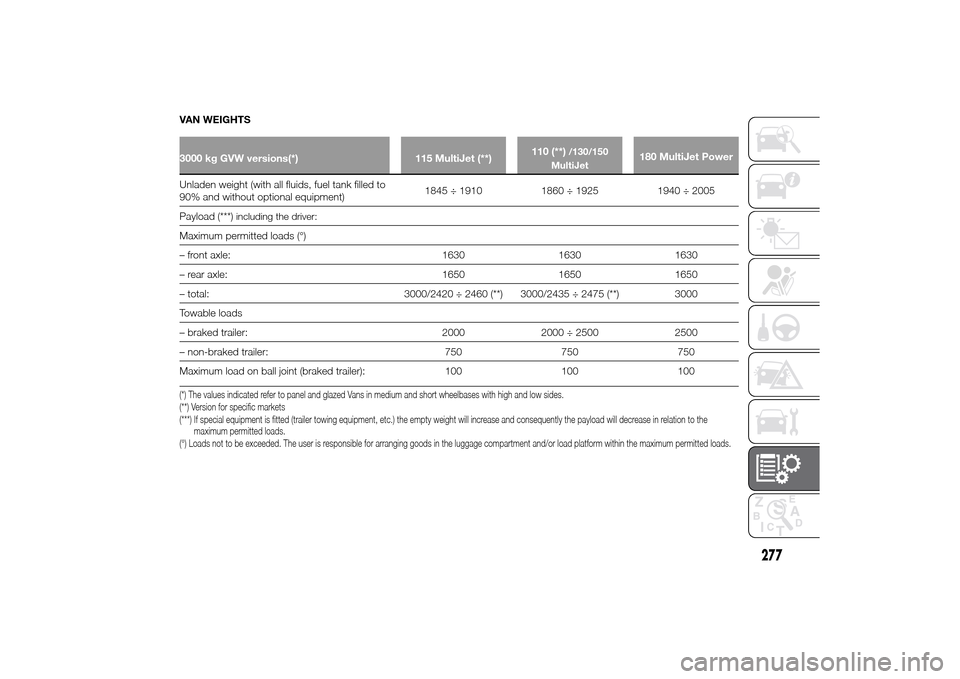
VAN WEIGHTS3000 kg GVW versions(*) 115 MultiJet (**)110 (**)
/130/150
MultiJet
180 MultiJet Power
Unladen weight (with all fluids, fuel tank filled to
90% and without optional equipment)1845 ÷ 1910 1860 ÷ 1925 1940 ÷ 2005
Payload (***)
including the driver:
Maximum permitted loads (°)
– front axle: 1630 1630 1630
– rear axle: 1650 1650 1650
– total: 3000/2420 ÷ 2460 (**) 3000/2435 ÷ 2475 (**) 3000
Towable loads
– braked trailer: 2000 2000 ÷ 2500 2500
– non-braked trailer: 750 750 750
Maximum load on ball joint (braked trailer): 100 100 100(*) The values indicated refer to panel and glazed Vans in medium and short wheelbases with high and low sides.
(**) Version for specific markets
(***) If special equipment is fitted (trailer towing equipment, etc.) the empty weight will increase and consequently the payload will decrease in relation to the
maximum permitted loads.
(°) Loads not to be exceeded. The user is responsible for arranging goods in the luggage compartment and/or load platform within the maximum permittedloads.
277
Page 282 of 367
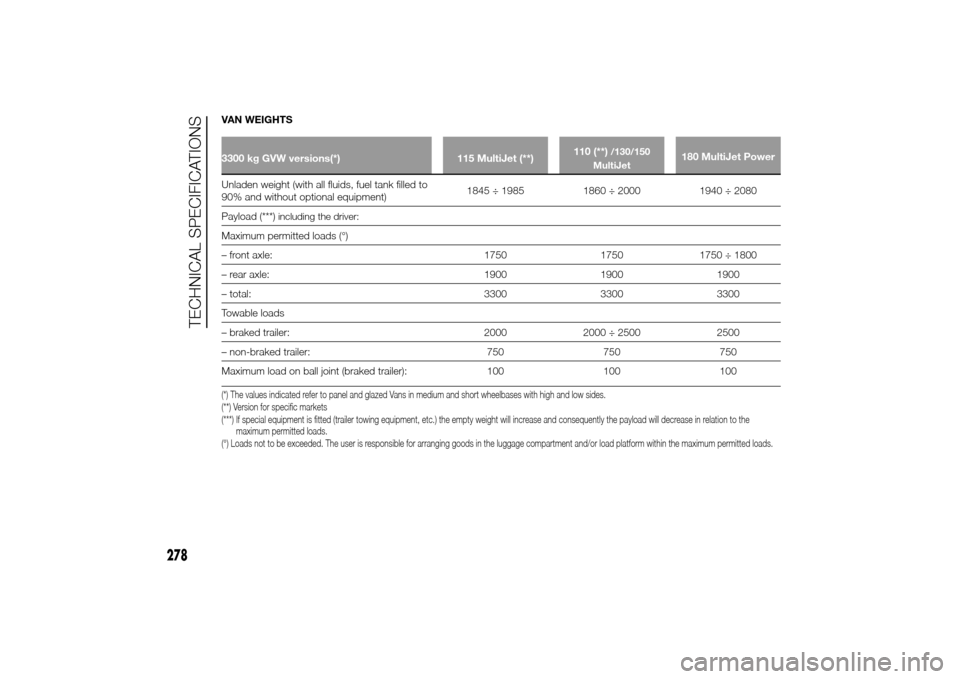
VAN WEIGHTS3300 kg GVW versions(*) 115 MultiJet (**)110 (**)
/130/150
MultiJet
180 MultiJet Power
Unladen weight (with all fluids, fuel tank filled to
90% and without optional equipment)1845 ÷ 1985 1860 ÷ 2000 1940 ÷ 2080
Payload (***)
including the driver:
Maximum permitted loads (°)
– front axle: 1750 1750 1750 ÷ 1800
– rear axle: 1900 1900 1900
– total: 3300 3300 3300
Towable loads
– braked trailer: 2000 2000 ÷ 2500 2500
– non-braked trailer: 750 750 750
Maximum load on ball joint (braked trailer): 100 100 100(*) The values indicated refer to panel and glazed Vans in medium and short wheelbases with high and low sides.
(**) Version for specific markets
(***) If special equipment is fitted (trailer towing equipment, etc.) the empty weight will increase and consequently the payload will decrease in relation to the
maximum permitted loads.
(°) Loads not to be exceeded. The user is responsible for arranging goods in the luggage compartment and/or load platform within the maximum permittedloads.
278
TECHNICAL SPECIFICATIONS
Page 283 of 367
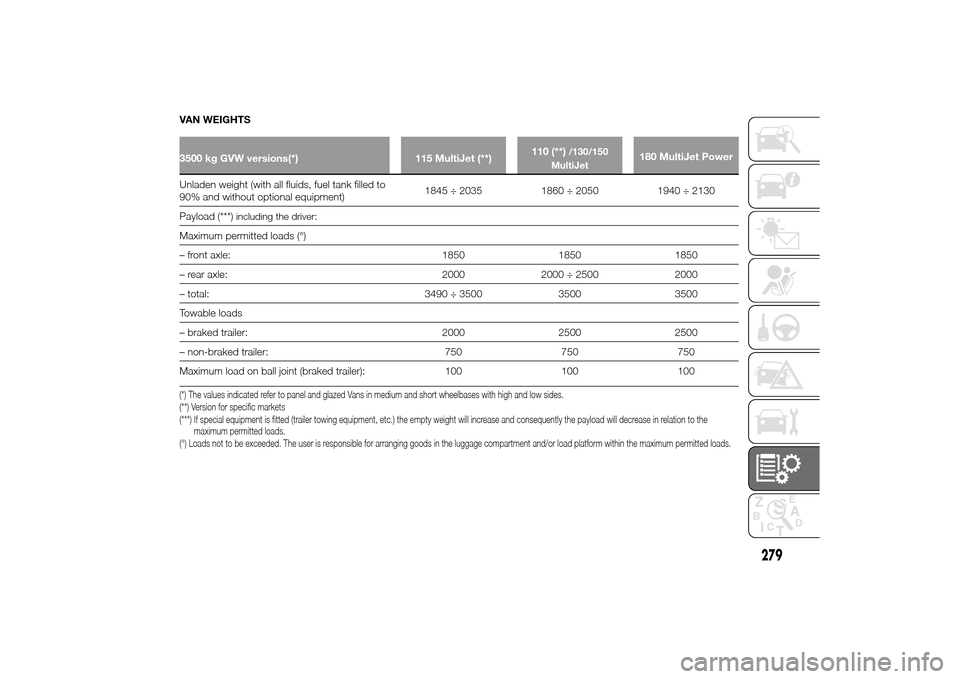
VAN WEIGHTS3500 kg GVW versions(*) 115 MultiJet (**)110 (**)
/130/150
MultiJet
180 MultiJet Power
Unladen weight (with all fluids, fuel tank filled to
90% and without optional equipment)1845 ÷ 2035 1860 ÷ 2050 1940 ÷ 2130
Payload (***)
including the driver:
Maximum permitted loads (°)
– front axle: 1850 1850 1850
– rear axle: 2000 2000 ÷ 2500 2000
– total: 3490 ÷ 3500 3500 3500
Towable loads
– braked trailer: 2000 2500 2500
– non-braked trailer: 750 750 750
Maximum load on ball joint (braked trailer): 100 100 100(*) The values indicated refer to panel and glazed Vans in medium and short wheelbases with high and low sides.
(**) Version for specific markets
(***) If special equipment is fitted (trailer towing equipment, etc.) the empty weight will increase and consequently the payload will decrease in relation to the
maximum permitted loads.
(°) Loads not to be exceeded. The user is responsible for arranging goods in the luggage compartment and/or load platform within the maximum permittedloads.
279
Page 284 of 367
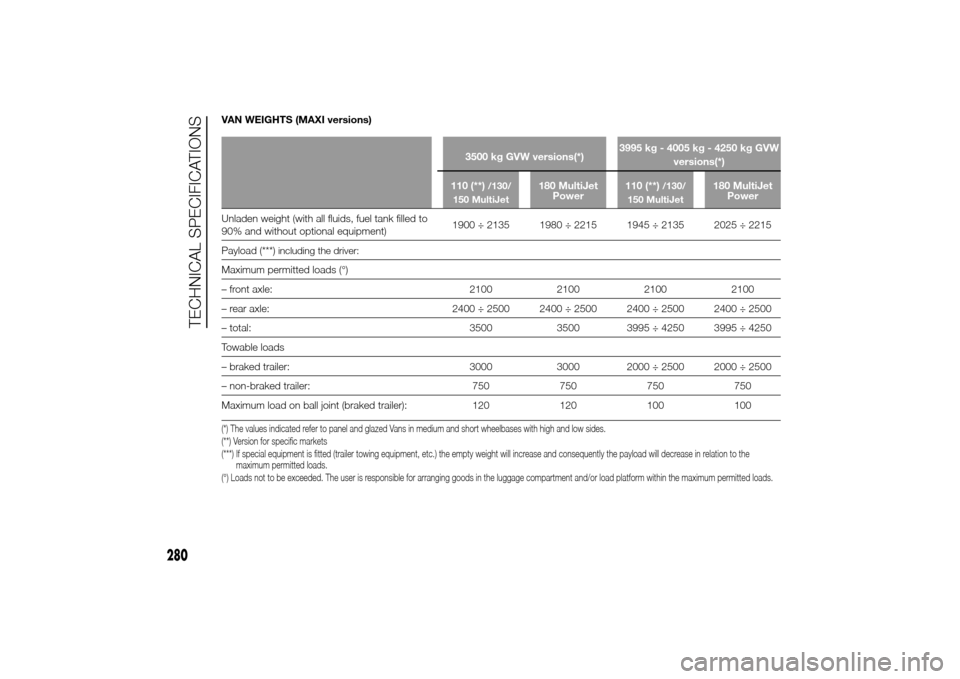
VAN WEIGHTS (MAXI versions)
3500 kg GVW versions(*)3995 kg - 4005 kg - 4250 kg GVW
versions(*)
110 (**)
/130/
150 MultiJet
180 MultiJet
Power110 (**)
/130/
150 MultiJet
180 MultiJet
Power
Unladen weight (with all fluids, fuel tank filled to
90% and without optional equipment)1900 ÷ 2135 1980 ÷ 2215 1945 ÷ 2135 2025 ÷ 2215
Payload (***)
including the driver:
Maximum permitted loads (°)
– front axle: 2100 2100 2100 2100
– rear axle: 2400 ÷ 2500 2400 ÷ 2500 2400 ÷ 2500 2400 ÷ 2500
– total: 3500 3500 3995 ÷ 4250 3995 ÷ 4250
Towable loads
– braked trailer: 3000 3000 2000 ÷ 2500 2000 ÷ 2500
– non-braked trailer: 750 750 750 750
Maximum load on ball joint (braked trailer): 120 120 100 100(*) The values indicated refer to panel and glazed Vans in medium and short wheelbases with high and low sides.
(**) Version for specific markets
(***) If special equipment is fitted (trailer towing equipment, etc.) the empty weight will increase and consequently the payload will decrease in relation to the
maximum permitted loads.
(°) Loads not to be exceeded. The user is responsible for arranging goods in the luggage compartment and/or load platform within the maximum permittedloads.
280
TECHNICAL SPECIFICATIONS
Page 285 of 367

VAN WEIGHTS (MAXI versions)3510 kg GVW versions(*) 110 (**)
/130/150 MultiJet
180 MultiJet Power
Unladen weight (with all fluids, fuel tank filled to
90% and without optional equipment)1900 ÷ 2090 2020 ÷ 2170
Payload (***)
including the driver:
Maximum permitted loads (°)
– front axle: 2100 2100
– rear axle: 2400 2400
– total: 3510 3510
Towable loads
– braked trailer: 3000 3000
– non-braked trailer: 750 750
Maximum load on ball joint (braked trailer): 120 120(*) The values indicated refer to panel and glazed Vans in medium and short wheelbases with high and low sides.
(**) Version for specific markets
(***) If special equipment is fitted (trailer towing equipment, etc.) the empty weight will increase and consequently the payload will decrease in relation to the
maximum permitted loads.
(°) Loads not to be exceeded. The user is responsible for arranging goods in the luggage compartment and/or load platform within the maximum permittedloads.
281
Page 323 of 367

UseFluid and lubricant features for a correct use
of the carGenuine fluids and
lubricantsApplicationsLubricants and
greases for drive
transmissionSAE 75W- 80 grade synthetic lubricant.
Classification FIAT 9.55550-MZ2..TUTELA
TRANSMISSION
EXPERYA
Contractual Technical
Reference No. F178.B06Manual gearbox and
differential
Synthetic base lubricant SAE 75W-85 grade
Classification FIAT 9.55550-MZ3TUTELA
TRANSMISSION
GEARTECH
Contractual Technical
Reference No. F704.C08Manual gearbox and
differential
Molybdenum disulphide grease, for use at high
temperatures.
FIAT 9.55580 classification. Consistency NLGI
1-2TUTELA ALL STAR
Contractual Technical
Reference No. F702.G07Wheel side constant
velocity joints
Grease for constant velocity joints with low friction
coefficient.
FIAT 9.55580 classification. Consistency NLGI
0-1TUTELA STAR 700
Contractual Technical
Reference No. F701.C07Differential-side
constant velocity joints
Lubricant for power steering
Exceeds "ATF DEXRON III" specifications
Classification FIAT 9.55550-AG2.TUTELA
TRANSMISSION GI/E
Contractual Technical
Reference No. F001.C94Hydraulic power
steering
Brake fluidSynthetic fluid for brake and clutch systems
Exceeds specifications: FMVSS no. 116 DOT 4,
ISO 4925, SAE J 1704
Classification FIAT 9.55597.TUTELA TOP 4
Contractual Technical
Reference No. F001.A93Hydraulic brakes and
clutch controls
319