Safety FIAT DUCATO 2016 3.G Owner's Manual
[x] Cancel search | Manufacturer: FIAT, Model Year: 2016, Model line: DUCATO, Model: FIAT DUCATO 2016 3.GPages: 296, PDF Size: 15.08 MB
Page 87 of 296
64)The HBA system is an aid for the driver,
who must always pay full attention while
driving. The responsibility always rests with
the driver. The features of the HBA system
must never be tested in imprudent or
dangerous ways, with the possibility of
putting the safety of the driver, occupants
or other road users at risk.
65)The performance of a vehicle with
ERM must never be tested in imprudent or
dangerous ways, with the possibility of
putting the safety of the driver or other
people at risk.
WARNING
12)Prolonged use of the system may
overheat the braking system. If the brakes
overheat, the HDC system, when active,
will be gradually deactivated after suitably
informing the driver (the LED on the button
turns off): it can be reactivated only when
the brakes have cooled sufficiently. The
distance you can travel depends on the
brake temperature and thus on the slope,
the load and the vehicle speed.
TRACTION PLUS
SYSTEM
(for versions/markets, where provided)
Traction Plus is a driving aid, useful
for setting off in poor grip conditions on
non-homogeneous road surfaces
(snow/asphalt, ice/asphalt, mud/
asphalt, etc.), which allows the drive
force to be distributed adequately
on the engine axle when one of the two
drive wheels slips.
Traction Plus acts by braking the wheel
with poor grip (or slipping more than
the others), thereby transferring the
drive force to that which has greater
grip on the ground.
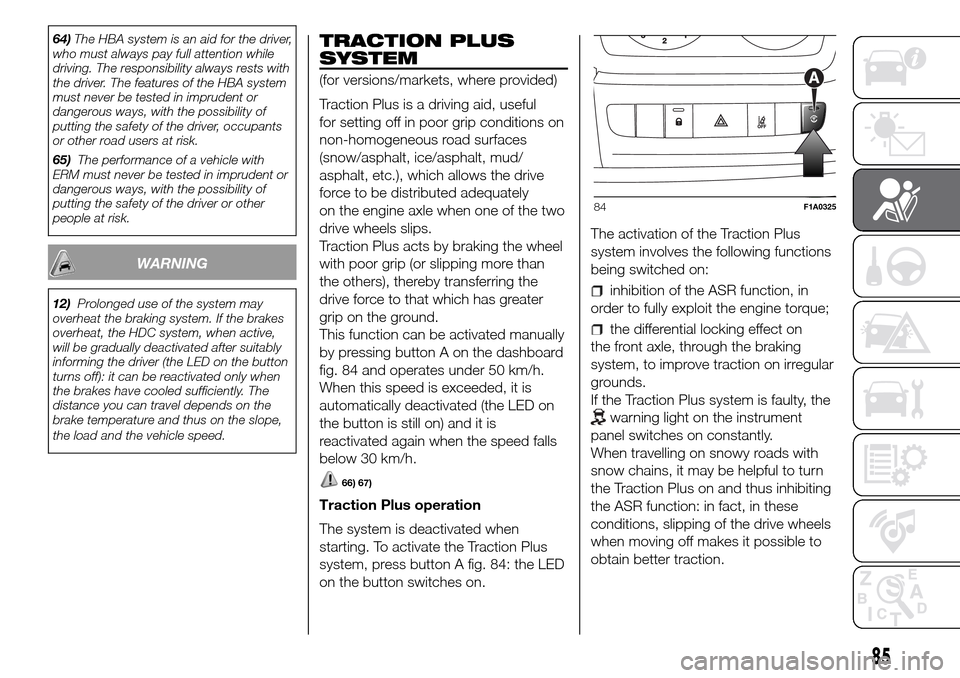
This function can be activated manually
by pressing button A on the dashboard
fig. 84 and operates under 50 km/h.
When this speed is exceeded, it is
automatically deactivated (the LED on
the button is still on) and it is
reactivated again when the speed falls
below 30 km/h.
66) 67)
Traction Plus operation
The system is deactivated when
starting. To activate the Traction Plus
system, press button A fig. 84: the LED
on the button switches on.The activation of the Traction Plus
system involves the following functions
being switched on:
inhibition of the ASR function, in
order to fully exploit the engine torque;
the differential locking effect on
the front axle, through the braking
system, to improve traction on irregular
grounds.
If the Traction Plus system is faulty, the
warning light on the instrument
panel switches on constantly.
When travelling on snowy roads with
snow chains, it may be helpful to turn
the Traction Plus on and thus inhibiting
the ASR function: in fact, in these
conditions, slipping of the drive wheels
when moving off makes it possible to
obtain better traction.
84F1A0325
85
Page 88 of 296
WARNING
66)The Traction Plus system acts
effectively only on road surfaces that are
not homogeneous and/or differentiated
between the two drive wheels.
67)Until the setting off manoeuvre is
terminated, fully depress the accelerator
pedal in order to transfer all the drive
torque to the wheel with the best grip.
TPMS (Tyre
Pressure
Monitoring System)
(for versions/markets, where provided)
68) 69) 70) 71) 72) 73) 74) 75) 76)
DESCRIPTION
The tyre pressure monitoring system
(TPMS) warns the driver of low tyre
pressure on the basis of the cold
inflation pressure prescribed for the
vehicle.
Changes in outside temperature may
cause tyre pressure to vary. This means
that a decrease in the outside
temperature corresponds to a decrease
in the tyre pressure.
Tyre pressure must always be adjusted
according to the cold inflation pressure.
Cold tyre inflation pressure is the tyre
pressure after letting the vehicle stand
for at least three hours or a travel
shorter than 1.6 km after an interval of
three hours.
The cold tyre inflation pressure must
not exceed the maximum inflation
pressure value printed on the side of
the tyre.
The tyre pressure also increases while
driving the vehicle: this is a normal
condition and does not require any
adjustment of the pressure.The TPMS continues to advise the
driver of the low tyre pressure condition
until this is corrected; the warning
continues until the pressure
corresponds or exceeds the pressure
prescribed for the cold tyres. When the
low tyre pressure check warning light
turns on continuously, the inflation
pressure must be adjusted until it
reaches the pressure prescribed for
cold tyres. After the automatic update
of the system, the tyre pressure control
warning light switches off. You may
need to drive the vehicle for about 20
minutes at a speed higher than 20
km/h to allow the TPMS to receive this
information.
NOTE
The TPMS does not replace the
normal tyre maintenance service and
does not indicate any fault in a tyre.
Therefore, the TPMS should not be
used as pressure switch while adjusting
the tyre inflation pressure.
Driving with insufficient tyre pressure
causes their overheating and can
result in tyre failure. The low inflation
pressure reduces fuel efficiency and
tyre tread life and may also affect
handling and braking performance of
the vehicle.
86
SAFETY
Page 90 of 296
WARNING
68)The TPMS is optimised for the original
tyres and wheels provided. TPMS
pressures and alerts have been defined
according to the size of the tyres mounted
on the vehicle. Using equipment with
different size, type or kind may cause
irregular system operation or sensor
damage. Non-original spare wheels can
damage the sensor. Do not use tyre
sealant or balancing weights if the vehicle
is equipped with TPMS as these may
damage the sensors.
69)If the system signals a pressure
decrease on a specific tyre, it is
recommended to check the pressure on all
four tyres.
70)The TPMS does not relieve the driver
from the obligation to check the tyre
pressure every month; it is not even to be
considered a replacing system for
maintenance or a safety system.
71)Tyre pressure must be checked with
tyres cold. Should it become necessary for
whatever reason to check pressure with
warm tyres, do not reduce pressure even
though it is higher than the prescribed
value, but repeat the check when tyres are
cold.
72)The TPMS cannot indicate sudden tyre
pressure drops (for example when a tyre
bursts). In this case, stop the vehicle,
braking with caution and avoiding abrupt
steering.73)The system only warns that the tyre
pressure is low: it is not able to inflate
them.
74)Insufficient tyre inflation increases fuel
consumption, reduces the tread duration
and may affect your ability to drive the
vehicle safely.
75)Always refit the valve stem cap after
inspecting or adjusting tyre pressure. This
prevents dampness or dirt from entering
the valve stem and thus the pressure
control sensor from being damaged.
76)The tyre repair kit (Fix&Go) provided
with the vehicle (for versions/markets,
where provided) is compatible with the
TPMS sensors; using sealants not
equivalent with that in the original kit may
adversely affect its operation. If sealants
not equivalent with the original one are
used, it is recommended to have the
TPMS sensors checked by a qualified
repair centre.
88
SAFETY
Page 91 of 296
DRIVING ADVISOR
(lane crossing warning)
(for versions/markets, where provided)
77) 78) 79)The Driving Advisor is a warning system
that notifies the driver if he/she crosses
the lane because he/she has been
distracted.
A video sensor, fitted on the windscreen
near the interior rear view mirror,
detects the lane demarcation lines and
the position of the vehicle in relation
to them.
IMPORTANT On cars with Driving
Advisor, it is advisable to contact a Fiat
Dealership should the windscreen
need to be replaced. If the repair is
carried out at a specialist window
replacement centre, it is still necessary
to go to a Fiat Dealership to have the
camera calibrated.
OPERATION
The system is always active when the
vehicle is started. It can be deactivated
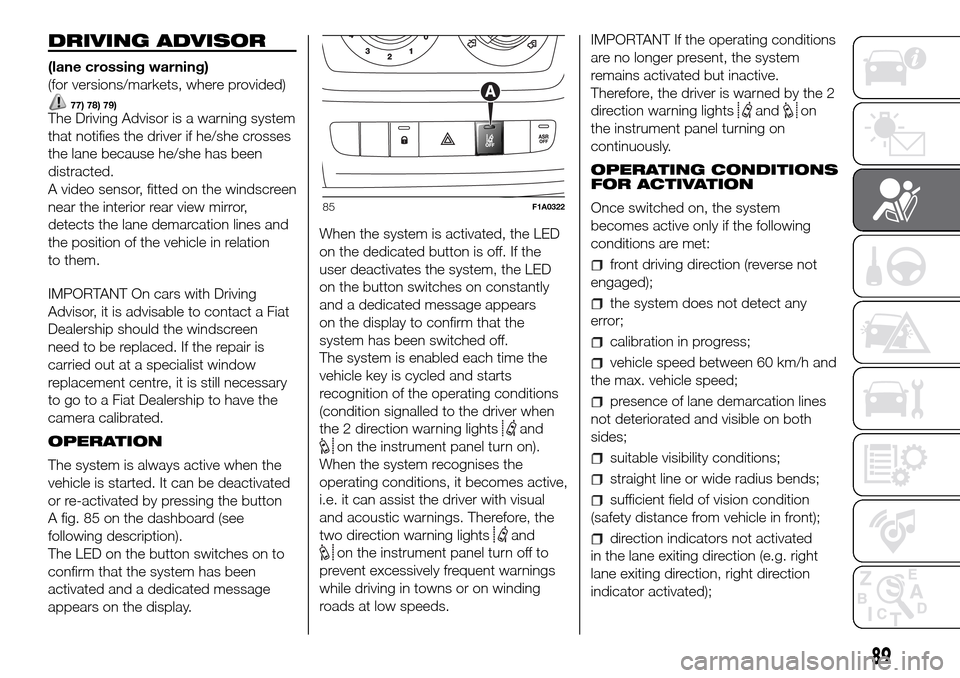
or re-activated by pressing the button
A fig. 85 on the dashboard (see
following description).
The LED on the button switches on to
confirm that the system has been
activated and a dedicated message
appears on the display.When the system is activated, the LED
on the dedicated button is off. If the
user deactivates the system, the LED
on the button switches on constantly
and a dedicated message appears
on the display to confirm that the
system has been switched off.
The system is enabled each time the
vehicle key is cycled and starts
recognition of the operating conditions
(condition signalled to the driver when
the 2 direction warning lights
and
on the instrument panel turn on).
When the system recognises the
operating conditions, it becomes active,
i.e. it can assist the driver with visual
and acoustic warnings. Therefore, the
two direction warning lights
and
on the instrument panel turn off to
prevent excessively frequent warnings
while driving in towns or on winding
roads at low speeds.IMPORTANT If the operating conditions
are no longer present, the system
remains activated but inactive.
Therefore, the driver is warned by the 2
direction warning lights
andon
the instrument panel turning on
continuously.
OPERATING CONDITIONS
FOR ACTIVATION
Once switched on, the system
becomes active only if the following
conditions are met:
front driving direction (reverse not
engaged);
the system does not detect any
error;
calibration in progress;
vehicle speed between 60 km/h and
the max. vehicle speed;
presence of lane demarcation lines
not deteriorated and visible on both
sides;
suitable visibility conditions;
straight line or wide radius bends;
sufficient field of vision condition
(safety distance from vehicle in front);
direction indicators not activated
in the lane exiting direction (e.g. right
lane exiting direction, right direction
indicator activated);
85F1A0322
89
Page 92 of 296
vehicle direction getting constantly
closer to the lane demarcation lines (the
vehicle trajectory is within the lane
demarcation lines);
vehicle not constantly next to the
lane demarcation line.
ACTIVATING/
DEACTIVATING THE
SYSTEM
When the system is active, if the vehicle
gets close to one of the side
demarcation lines or one of the two
lane demarcation lines, the driver is
warned with an acoustic signal (coming
from the crossed line side if the vehicle
is equipped with the radio navigation
system) along with the corresponding
direction warning light (
or) lighting
up.
If the driver turns on the direction
indicator in order to change lanes or for
overtaking, then the system will switch
off the driver warning.
If the driver keeps deliberately with the
lane change manoeuvre, the system
interrupts the warning, remaining
enabled if the operating conditions are
not satisfied or active if the operating
conditions are exceeded (see the
dedicated paragraph).SWITCHING OFF THE
SYSTEM
Manual mode
The system can be switched off by
pressing button A fig. 85 on the
dashboard.
The LED on the button switches on and
a message appears on the display to
confirm that the system has been
switched off.
Automatic mode
If the Start&Stop is active the system
deactivates automatically. The system
will reactivate and check its operating
conditions again after the vehicle has
been started.
SYSTEM FAILURE
In the event of malfunction, the system
signals the fault to the driver with a
message on the display, an acoustic
warning and by turning on the
icon
on the display (for versions/markets,
where provided).
IMPORTANT NOTES
The Driving Advisor cannot operate due
to a not perfectly balanced and
excessive load.The operation of the system can be
adversely affected in some cases
by the morphology of the territory/road
being driven on (e.g. driving over
humps), poor visibility conditions (e.g.
fog, rain, snow), extreme light
conditions (e.g. glare of the sun,
darkness), lack of cleanliness
or damage, even partial, to the
windscreen in the area in front of the
camera.
The Driving Advisor cannot operate
following a malfunction of the following
safety systems: ABS, ESC, ASR and
Traction Plus.
The operation of the system can be
adversely affected by poor visibility
conditions (e.g. fog, rain, snow),
extreme light conditions (glare of the
sun, darkness), lack of cleaning or
damage, even partial, to the
windscreen in the area in front the
camera.
The area of the windscreen by the
camera must not be partly or totally
obscured by objects (e.g. stickers,
protective film, etc.).
90
SAFETY
Page 94 of 296
TABLE SUMMARISING SIGNALS DURING THE USE OF THE DRIVING ADVISOR
Status of the LED on
the buttonMessage in the displayStatus of the symbol
on the displayAcoustic warning Meaning
Off –––system active (automatic
for each key cycle)
Off Driving Advisor active
and
warning lights on
continuously-system active without
operating conditions met
Off Driving Advisor active - -system active and
operating conditions met:
the system can provide
acoustic-visual warnings
Off -
warning light flashingYe sthe system is active and
recognises the operating
conditions: it warns about
deviation from the left line
Off -
warning light flashingYe sthe system is active and
recognises the operating
conditions: it warns about
deviation from the right
line
On Driving Advisor off - noThe system has been
switched off manually
OnDriving Advisor not
available - see handbook
failure warning lightYe sThe system is faulty: go to
a Fiat Dealership
OnDriving Advisor not
available - clean the front
camera
failure warning lightYe ssystem failure: clean the
windscreen
92
SAFETY
Page 96 of 296
WARNING
80)Never press button C fig. 86when
travelling.
81)The height of the seat belts must be
adjusted with the vehicle stationary.
82)After adjustment, always check that the
cursor to which the ring is fastened is
locked in one of the preset positions.
Release the grip and push downwards to
enable the locking device to click if the grip
has not been released in one of the
possible positions.
SBR SYSTEM
IN BRIEF
The vehicle is equipped with a
system called SBR. (Seat Belt
Reminder), composed of a buzzer
which, along with the flashing
warning light on the instrument
panel, warns the driver that their seat
belt or (for versions/markets, where
provided) the passenger's seat belt is
not correctly fastened.
For permanent deactivation, contact a
Fiat Dealership.
With multifunction display, the SBR
system can also be reactivated through
the set-up menu.
PRE-TENSIONERS
To increase the protective efficiency of
the front seat belts, the vehicle is fitted
with pretensioners. These devices, in
the event of a head-on crash or side
impact, rewind the seat belts a few
centimetres. In this way, they ensure
that the belts fit tightly to the wearer
before the restraining action begins.
It is evident that the pretensioners have
been activated when the belt withdraws
toward the retractor.
A slight discharge of smoke may be
produced during the activation of the
pretensioner which is not harmful and
does not involve any fire hazard.
The pretensioner does not require any
maintenance or lubrication. Any
changes to its original conditions will
invalidate its efficiency. If, due to
unusual natural events (floods, sea
storms, etc.), the device has been
affected by water or mud, contact a
Fiat Dealership to have it replaced.
83)
13)
IMPORTANT To obtain the highest
degree of protection from the action of
the pretensioner, wear the seat belt
tight to the chest and pelvis.
94
SAFETY
Page 97 of 296
LOAD LIMITERS
To increase passenger safety, the front
seat belt retractors contain a load
limiter which controls the force acting
on the chest and shoulders during
the belt restraining action in the event of
a head-on collision.
GENERAL WARNINGS
FOR USING THE SEAT
BELTS
Seat belts are also to be worn by
pregnant women: the risk of injury in
the case of accident is greatly reduced
for them and the unborn child if they
are wearing a seat belt. Pregnant
women must position the lower part of
the belt very low down so that it passes
over the pelvis and under the
abdomen (see fig. 89).While pregnancy progresses, the driver
must adjust both the seat and the
steering wheel to ensure full control of
the vehicle (pedals and steering wheel
must be easily accessible). The
maximum clearance should be kept
between the abdomen and the steering
wheel. The seat belt strap must not
be twisted. The upper part must pass
over the shoulder and cross the chest
diagonally. The lower part must adhere
to the pelvis fig. 90, not to the
abdomen of the occupant. Do not use
devices (clips, etc.) to hold the seat belt
away from your body.
84) 85) 86)
Each seat belt must be used by only
one person. Never travel with a child
sitting on the passenger's lap and
a single belt to protect them both fig.
91. In general, do not place any objects
between the person and the belt.SEAT BELTS
MAINTENANCE
For keeping the seat belts in efficient
conditions, carefully observe the
following warnings:always use the seat belt well
stretched and never twisted; make sure
that it is free to run without
obstructions;
check seat belt operation as follows:
attach the seat belt and pull it hard;
89F1A0148
90F1A0149
91F1A0150
95
Page 98 of 296
replace the belt after an accident of
a certain severity even if it does not
appear to be damaged. Always replace
the belt if the pretensioners were
deployed;
prevent the retractors from getting
wet: their correct operation is only
guaranteed if water does not get inside;
replace the seat belt when it shows
wear or cuts.
WARNING
83)The pretensioner may be used only
once. After it is triggered, have it replaced
at a Fiat Dealership.
84)For maximum safety, keep the backrest
upright, lean back into it and make sure
the seat belt fits closely across your chest
and pelvis. Always fasten the seat belts
on both the front and the rear seats!
Travelling without wearing seat belts will
increase the risk of serious injury and even
death in the event of an accident.
85)Removing or tampering with seat belt
and pretensioner components is strictly
prohibited. Any intervention on these
components must be performed by
qualified and authorised technicians.
Always go to a Fiat Dealership.86)If the belt has been sharply pulled, for
example as the result of an accident,
the seat belt, together with the anchoring
devices, the anchoring device fixing screws
and the pretensioner must be completely
replaced. Even if the belt does not present
any exterior signs of wear or damage, it
may have lost its restraining properties.
WARNING
13)Operations which lead to impacts,
vibrations or localised heating (over 100°C
for a maximum of six hours) in the area
around the pretensioners may damage or
deploy them. Contact a Fiat Dealership
should intervention be necessary on these
components.
CARRYING
CHILDREN SAFELY
For optimal protection in the event of an
impact, all occupants must be seated
and wearing adequate restraint
systems, including newborn and other
children! This prescription is
compulsory in all EC countries
according to EC Directive 2003/20/EC.
Children below the height of 1.50
metres and up to 12 years must be
protected with suitable restraint
systems and be seated on the rear
seats. Statistics on accidents indicate
that the rear seats offer greater safety
for children. Compared with adults,
a child's head is proportionally larger
and heavier than the rest of the body,
while muscles and bone structure
are not fully developed. Therefore,
correct restraint systems other than
adult seat belts are necessary, to
reduce as much as possible the risk of
injuries in the event of an accident,
braking or sudden manoeuvre. Children
must be seated safely and comfortably.
Depending on the characteristics of
the child restraint systems used, you
are advised to keep children in rearward
facing child restraint systems for as
long as possible (at least until 3-4 years
old), since this is the most protected
position in the event of an impact.
96
SAFETY
Page 100 of 296
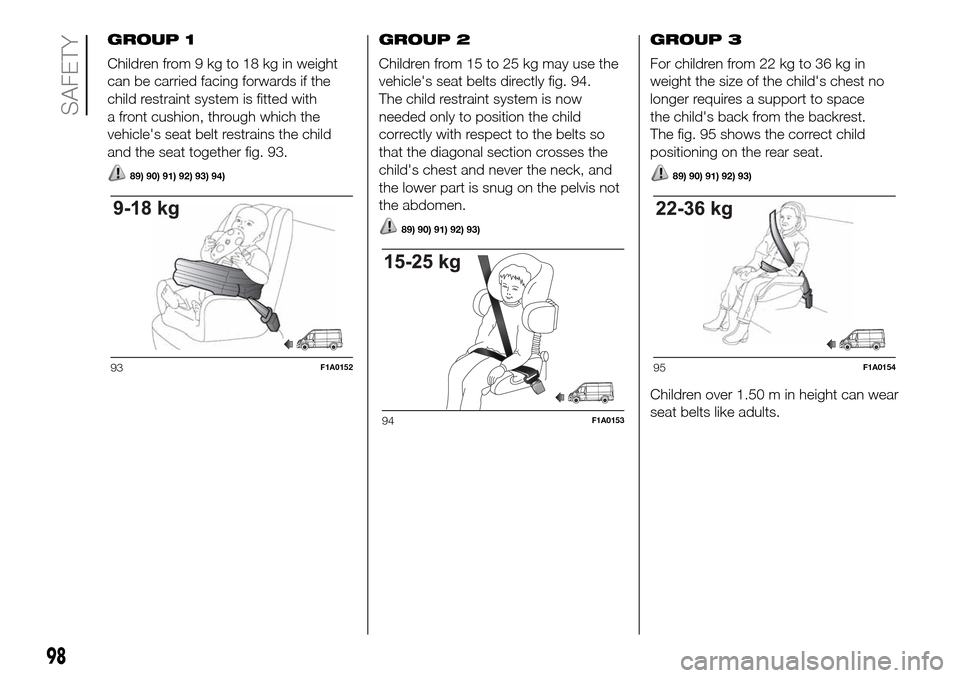
GROUP 1
Children from 9 kg to 18 kg in weight
can be carried facing forwards if the
child restraint system is fitted with
a front cushion, through which the
vehicle's seat belt restrains the child
and the seat together fig. 93.
89) 90) 91) 92) 93) 94)
GROUP 2
Children from 15 to 25 kg may use the
vehicle's seat belts directly fig. 94.
The child restraint system is now
needed only to position the child
correctly with respect to the belts so
that the diagonal section crosses the
child's chest and never the neck, and
the lower part is snug on the pelvis not
the abdomen.
89) 90) 91) 92) 93)
GROUP 3
For children from 22 kg to 36 kg in
weight the size of the child's chest no
longer requires a support to space
the child's back from the backrest.
The fig. 95 shows the correct child
positioning on the rear seat.
89) 90) 91) 92) 93)
Children over 1.50 m in height can wear
seat belts like adults.
93F1A0152
94F1A0153
95F1A0154
98
SAFETY