Safety FIAT DUCATO 2016 3.G User Guide
[x] Cancel search | Manufacturer: FIAT, Model Year: 2016, Model line: DUCATO, Model: FIAT DUCATO 2016 3.GPages: 296, PDF Size: 15.08 MB
Page 22 of 296
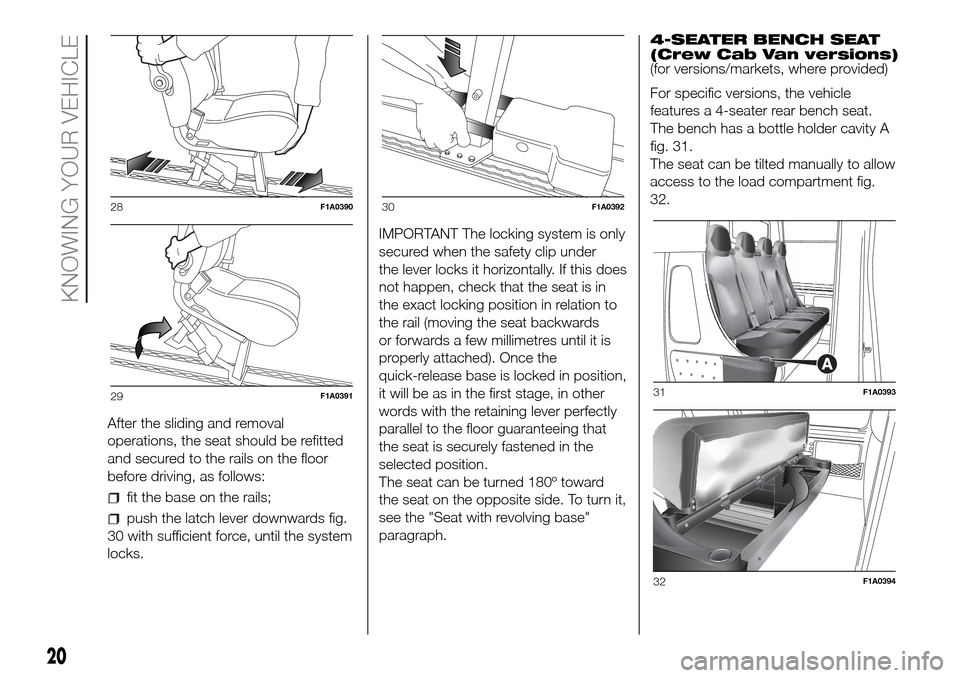
After the sliding and removal
operations, the seat should be refitted
and secured to the rails on the floor
before driving, as follows:
fit the base on the rails;
push the latch lever downwards fig.
30 with sufficient force, until the system
locks.IMPORTANT The locking system is only
secured when the safety clip under
the lever locks it horizontally. If this does
not happen, check that the seat is in
the exact locking position in relation to
the rail (moving the seat backwards
or forwards a few millimetres until it is
properly attached). Once the
quick-release base is locked in position,
it will be as in the first stage, in other
words with the retaining lever perfectly
parallel to the floor guaranteeing that
the seat is securely fastened in the
selected position.
The seat can be turned 180º toward
the seat on the opposite side. To turn it,
see the "Seat with revolving base"
paragraph.4-SEATER BENCH SEAT
(Crew Cab Van versions)
(for versions/markets, where provided)
For specific versions, the vehicle
features a 4-seater rear bench seat.
The bench has a bottle holder cavity A
fig. 31.
The seat can be tilted manually to allow
access to the load compartment fig.
32.
28F1A0390
29F1A0391
30F1A0392
31F1A0393
32F1A0394
20
KNOWING YOUR VEHICLE
Page 23 of 296
WARNING
16)All adjustments must be made with the
vehicle stationary.
17)After releasing the adjustment lever,
always check that the seat is locked on the
guides by trying to move it back and forth.
If it is not locked, the seat may move
unexpectedly and make you lose control of
the vehicle.
18)For maximum safety, keep the backrest
upright, lean back into it and make sure
the seat belt fits closely across your chest
and pelvis.
19)Before putting on the seatbelt, ensure
that the armrests are vertical (see
paragraph on "seat belts ”).
20)Before unfastening the belts and
getting out of the vehicle, ensure that the
outer armrest (door side) is fully raised.
21)All adjustments must be made with the
vehicle stationary. In particular, while
turning the seat, take care that it does not
interfere with the handbrake lever.
22)Ensure the seat is locked in driving
position before starting up the vehicle.
23)Do not place heavy loads on the flap
with the vehicle in motion because they
could be thrown against the vehicle
occupants in the event of sudden braking
or impacts, causing severe injury.24)Do not travel with passengers seated in
the 3rd row with the 2nd row bench folded
over. Do not place objects of any type on
the backrest of the 2nd row bench folded
over: in the event of impact or sharp
braking they could be thrown against the
occupants of the vehicle casing serious
injury. For more information, see the
contents of the adhesive plate located
under the bench.
25)When refitting the bench, ensure that it
is correctly locked to the floor guides.
WARNING
3)The fabric upholstery of your vehicle is
designed to withstand the normal wear
and tear of your vehicle for a long time.
You are however recommended to avoid
strong and/or continuous scratching
with clothing accessories such as metal
buckles, studs, Velcro fastenings and the
like, as these items cause stress of the
cover fabric that could lead to yarn
breaking and damage the upholstery.
STEERING WHEEL
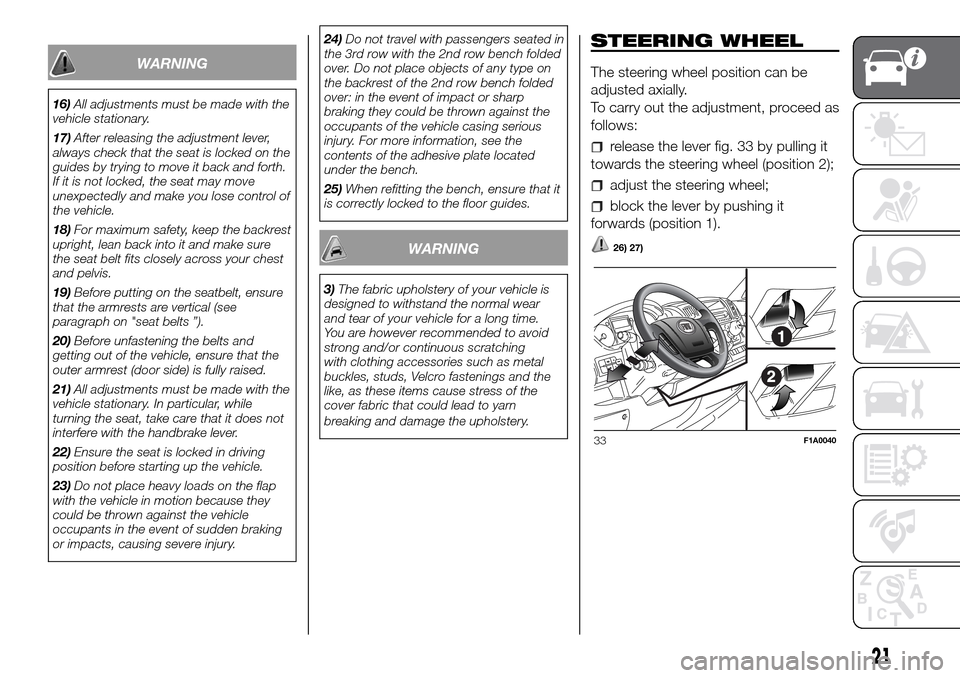
The steering wheel position can be
adjusted axially.
To carry out the adjustment, proceed as
follows:
release the lever fig. 33 by pulling it
towards the steering wheel (position 2);
adjust the steering wheel;
block the lever by pushing it
forwards (position 1).
26) 27)
33F1A0040
21
Page 24 of 296
WARNING
26)Any steering wheel position adjustment
should only be carried out with the vehicle
stationary and the engine turned off.
27)It is absolutely forbidden to carry out
any after-market operation involving
steering system or steering column
modifications (e.g.: installation of anti-theft
device). This could badly affect
performance and safety, invalidate the
warranty and also result in the non-
compliance of the vehicle with approval
requirements.
REAR VIEW
MIRRORS
INTERIOR MIRROR
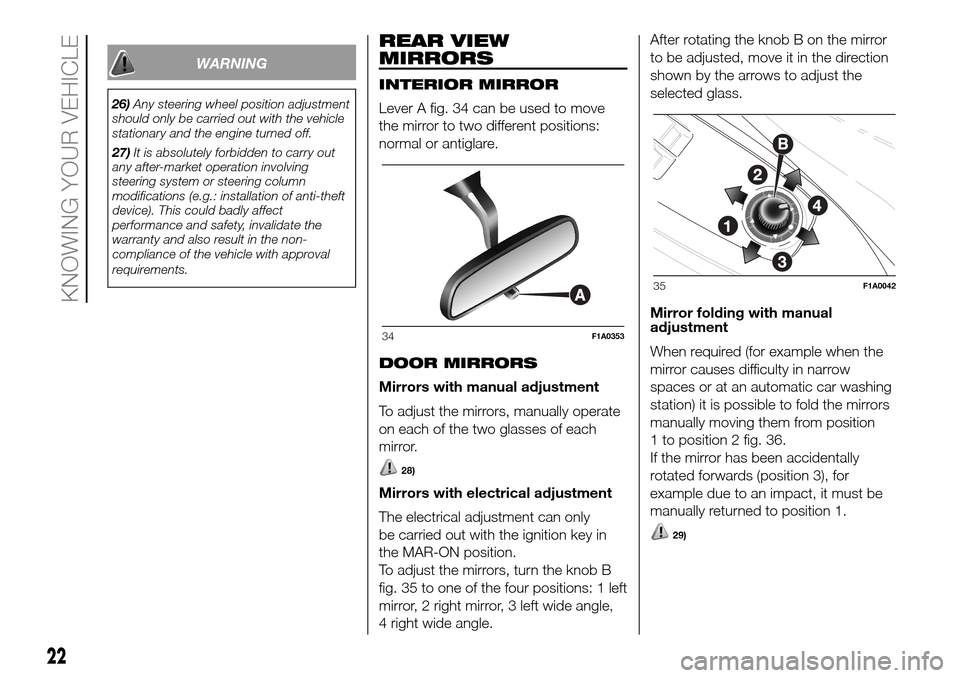
Lever A fig. 34 can be used to move
the mirror to two different positions:
normal or antiglare.
DOOR MIRRORS
Mirrors with manual adjustment
To adjust the mirrors, manually operate
on each of the two glasses of each
mirror.
28)
Mirrors with electrical adjustment
The electrical adjustment can only
be carried out with the ignition key in
the MAR-ON position.
To adjust the mirrors, turn the knob B
fig. 35 to one of the four positions: 1 left
mirror, 2 right mirror, 3 left wide angle,
4 right wide angle.After rotating the knob B on the mirror
to be adjusted, move it in the direction
shown by the arrows to adjust the
selected glass.
Mirror folding with manual
adjustment
When required (for example when the
mirror causes difficulty in narrow
spaces or at an automatic car washing
station) it is possible to fold the mirrors
manually moving them from position
1 to position 2 fig. 36.
If the mirror has been accidentally
rotated forwards (position 3), for
example due to an impact, it must be
manually returned to position 1.
29)
34F1A0353
35F1A0042
22
KNOWING YOUR VEHICLE
Page 29 of 296
Activation
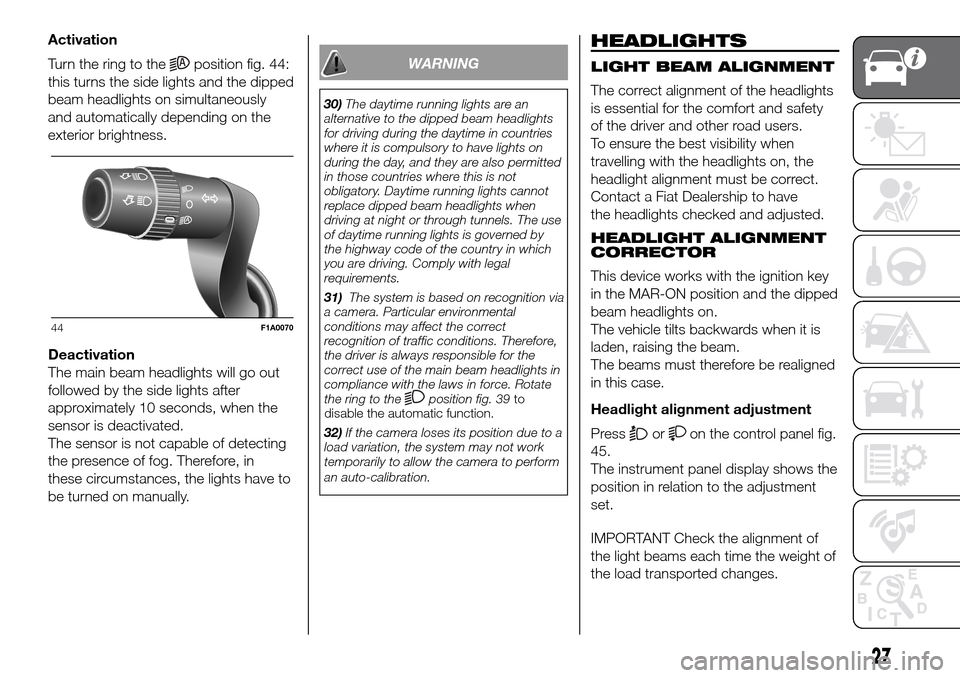
Turn the ring to the
position fig. 44:
this turns the side lights and the dipped
beam headlights on simultaneously
and automatically depending on the
exterior brightness.
Deactivation
The main beam headlights will go out
followed by the side lights after
approximately 10 seconds, when the
sensor is deactivated.
The sensor is not capable of detecting
the presence of fog. Therefore, in
these circumstances, the lights have to
be turned on manually.WARNING
30)The daytime running lights are an
alternative to the dipped beam headlights
for driving during the daytime in countries
where it is compulsory to have lights on
during the day, and they are also permitted
in those countries where this is not
obligatory. Daytime running lights cannot
replace dipped beam headlights when
driving at night or through tunnels. The use
of daytime running lights is governed by
the highway code of the country in which
you are driving. Comply with legal
requirements.
31)The system is based on recognition via
a camera. Particular environmental
conditions may affect the correct
recognition of traffic conditions. Therefore,
the driver is always responsible for the
correct use of the main beam headlights in
compliance with the laws in force. Rotate
the ring to the
position fig. 39to
disable the automatic function.
32)If the camera loses its position due to a
load variation, the system may not work
temporarily to allow the camera to perform
an auto-calibration.
HEADLIGHTS
LIGHT BEAM ALIGNMENT
The correct alignment of the headlights
is essential for the comfort and safety
of the driver and other road users.
To ensure the best visibility when
travelling with the headlights on, the
headlight alignment must be correct.
Contact a Fiat Dealership to have
the headlights checked and adjusted.
HEADLIGHT ALIGNMENT
CORRECTOR
This device works with the ignition key
in the MAR-ON position and the dipped
beam headlights on.
The vehicle tilts backwards when it is
laden, raising the beam.
The beams must therefore be realigned
in this case.
Headlight alignment adjustment
Press
oron the control panel fig.
45.
The instrument panel display shows the
position in relation to the adjustment
set.
IMPORTANT Check the alignment of
the light beams each time the weight of
the load transported changes.
44F1A0070
27
Page 41 of 296
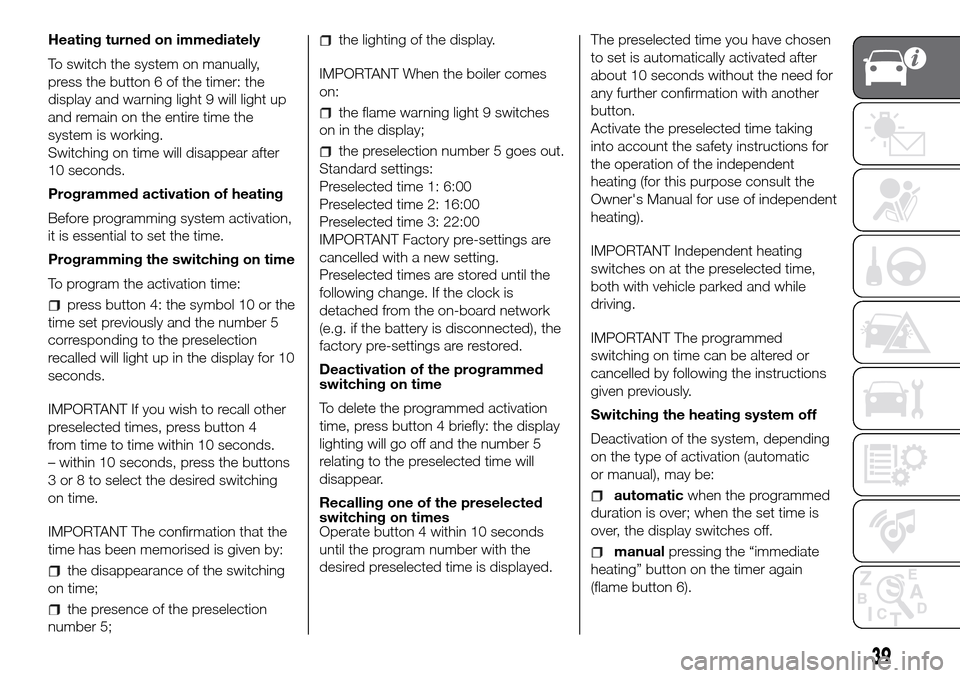
Heating turned on immediately
To switch the system on manually,
press the button 6 of the timer: the
display and warning light 9 will light up
and remain on the entire time the
system is working.
Switching on time will disappear after
10 seconds.
Programmed activation of heating
Before programming system activation,
it is essential to set the time.
Programming the switching on time
To program the activation time:
press button 4: the symbol 10 or the
time set previously and the number 5
corresponding to the preselection
recalled will light up in the display for 10
seconds.
IMPORTANT If you wish to recall other
preselected times, press button 4
from time to time within 10 seconds.
– within 10 seconds, press the buttons
3 or 8 to select the desired switching
on time.
IMPORTANT The confirmation that the
time has been memorised is given by:
the disappearance of the switching
on time;
the presence of the preselection
number 5;
the lighting of the display.
IMPORTANT When the boiler comes
on:
the flame warning light 9 switches
on in the display;
the preselection number 5 goes out.
Standard settings:
Preselected time 1: 6:00
Preselected time 2: 16:00
Preselected time 3: 22:00
IMPORTANT Factory pre-settings are
cancelled with a new setting.
Preselected times are stored until the
following change. If the clock is
detached from the on-board network
(e.g. if the battery is disconnected), the
factory pre-settings are restored.
Deactivation of the programmed
switching on time
To delete the programmed activation
time, press button 4 briefly: the display
lighting will go off and the number 5
relating to the preselected time will
disappear.
Recalling one of the preselected
switching on times
Operate button 4 within 10 seconds
until the program number with the
desired preselected time is displayed.The preselected time you have chosen
to set is automatically activated after
about 10 seconds without the need for
any further confirmation with another
button.
Activate the preselected time taking
into account the safety instructions for
the operation of the independent
heating (for this purpose consult the
Owner's Manual for use of independent
heating).
IMPORTANT Independent heating
switches on at the preselected time,
both with vehicle parked and while
driving.
IMPORTANT The programmed
switching on time can be altered or
cancelled by following the instructions
given previously.
Switching the heating system off
Deactivation of the system, depending
on the type of activation (automatic
or manual), may be:
automaticwhen the programmed
duration is over; when the set time is
over, the display switches off.
manualpressing the “immediate
heating” button on the timer again
(flame button 6).
39
Page 45 of 296
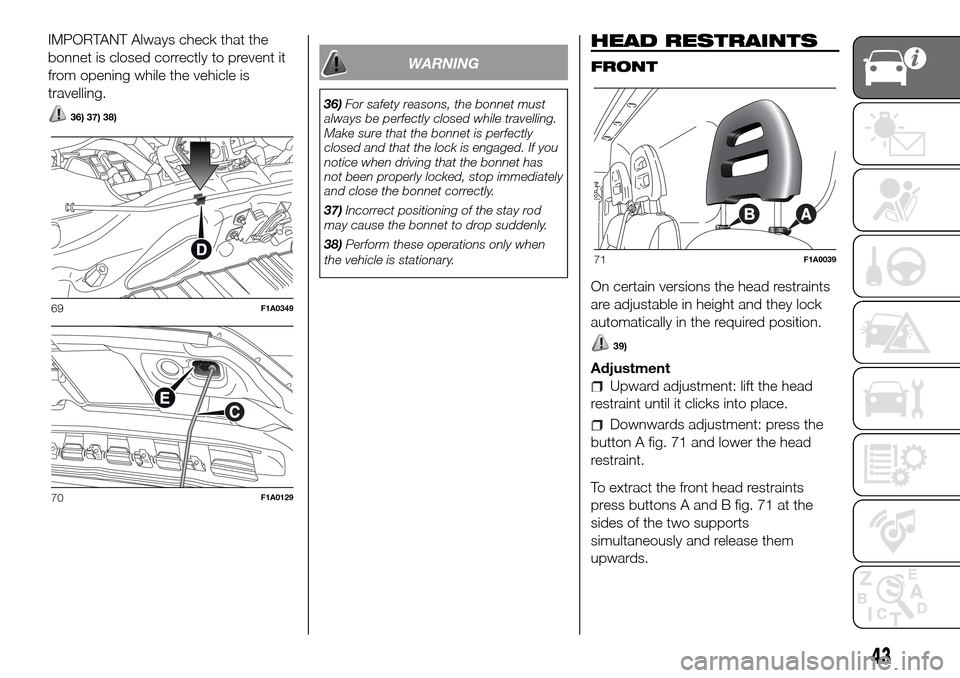
IMPORTANT Always check that the
bonnet is closed correctly to prevent it
from opening while the vehicle is
travelling.
36) 37) 38)
WARNING
36)For safety reasons, the bonnet must
always be perfectly closed while travelling.
Make sure that the bonnet is perfectly
closed and that the lock is engaged. If you
notice when driving that the bonnet has
not been properly locked, stop immediately
and close the bonnet correctly.
37)Incorrect positioning of the stay rod
may cause the bonnet to drop suddenly.
38)Perform these operations only when
the vehicle is stationary.
HEAD RESTRAINTS
FRONT
On certain versions the head restraints
are adjustable in height and they lock
automatically in the required position.
39)
Adjustment
Upward adjustment: lift the head
restraint until it clicks into place.
Downwards adjustment: press the
button A fig. 71 and lower the head
restraint.
To extract the front head restraints
press buttons A and B fig. 71 at the
sides of the two supports
simultaneously and release them
upwards.
69F1A0349
70F1A0129
71F1A0039
43
Page 82 of 296
SAFETY
The chapter that you are about to read
is very important: it describes the
safety systems with which the car is
equipped and provides instructions on
how to use them correctly.ABS SYSTEM ................................. 81
ESC (ELECTRONIC STABILITY
CONTROL) SYSTEM ....................... 82
TRACTION PLUS SYSTEM ............. 85
TPMS (TYRE PRESSURE
MONITORING SYSTEM) ................. 86
DRIVING ADVISOR ......................... 89
SEAT BELTS ................................... 93
SBR SYSTEM ................................. 94
PRE-TENSIONERS ......................... 94
CARRYING CHILDREN SAFELY ...... 96
SETUP FOR “UNIVERSAL ISOFIX”
CHILD RESTRAINT SYSTEM ..........101
SUPPLEMENTARY RESTRAINT
SYSTEM (SRS) - AIRBAG................107
80
SAFETY
Page 83 of 296
ABS SYSTEM
This is an integral part of the braking
system, which prevents one or more
wheels from locking and slipping
regardless of the road surface
conditions and braking intensity,
ensuring control of the vehicle even
during emergency braking.
The system intervenes during braking
when the wheels are about to lock,
typically in emergency braking or
low-grip conditions, when locking may
be more frequent.
The ABS ensures the direction of the
vehicle while braking and optimises the
braking distances at the same time.
The system also improves control and
stability of the vehicle when braking
on a surface on which the grip of the
left and right wheels differs, or when
braking while cornering.
The system is completed by EBD
(Electronic Braking Force Distribution),
which distributes the braking action
between the front and rear wheels.
IMPORTANT For maximum efficiency of
the braking system, a bedding-in
period of about 500 km is needed:
during this period it is better to avoid
sharp, repeated and prolonged braking.
49)
SYSTEM INTERVENTION
The driver can feel that the ABS has
come into action because the brake
pedal pulsates slightly and the system
gets noisier: it means that the vehicle
speed should be altered to suit the type
of road surface.
50) 51) 52) 53) 54) 55) 56)
MSR SYSTEM
(Motor Schleppmoment Regelung)
This is an integral part of the ABS
system and prevents the drive wheels
from locking, which could happen,
for example, if the accelerator pedal is
released suddenly or in the case of
shifting down suddenly in conditions of
poor grip. In these conditions, the
engine braking effect could cause the
drive wheels to slip, resulting in a loss
of vehicle stability. In these situations,
the system intervenes, restoring torque
to the engine in order to conserve
vehicle stability and increase safety.
WARNING
49)The ABS gets the most from the
available grip, but it cannot improve it; you
should therefore take every care when
driving on slippery surfaces and not take
unnecessary risks.50)When the ABS cuts in and you feel the
brake pedal pulsating, do not remove
your foot, but keep the pedal pushed
down; in doing so you, will stop in the
shortest distance possible under the road
conditions at the time.
51)If the ABS system intervenes, this
indicates that the traction of the tyres on
the road is nearing its limit. You must slow
down to a speed compatible with the
available traction.
52)The ABS cannot overrule the natural
laws of physics, and cannot increase
the grip available according to the
condition of the road.
53)The ABS system cannot prevent
accidents, including those due to excessive
speed on corners, driving on low-grip
surfaces or aquaplaning.
54)The capability of the ABS must never
be tested irresponsibly and dangerously, in
such a way as to compromise personal
safety and the safety of others.
55)For the correct operation of the ABS,
the tyres must of necessity be the same
make and type on all wheels, in perfect
condition and, above all, of the prescribed
type and dimensions.
56)If the space-saver wheel (for
versions/markets, where provided) is used,
the ABS keeps operating. Always
remember that the space-saver wheel,
being smaller than the original wheel,
provides less grip.
81
Page 84 of 296
ESC (Electronic
Stability Control)
SYSTEM
(for versions/markets, where provided)
The ESC system improves the
directional control and stability of the
vehicle in various driving conditions.
The ESC system corrects the vehicle’s
understeer and oversteer, distributing
the brake force on the appropriate
wheels. The torque supplied by the
engine can also be reduced in order to
maintain control of the vehicle.
The ESC system uses the sensors in
the vehicle to determine the trajectory
required by the driver through steering
and compares it with the real trajectory
of the vehicle. When the real trajectory
deviates from the desired trajectory, the
ESC system intervenes to counter the
car’s understeer or oversteer.
Oversteer: occurs when the vehicle
is turning more than it should according
to the angle of the steering wheel.
Understeer: occurs when the vehicle
is turning less than it should according
to the angle of the steering wheel.The ESC system also includes the
following subsystems:
Hill Holder
ASR
HBA
ERM
HDC
57) 58) 59)
SYSTEM INTERVENTION
This is signalled by the flashing of the
warning light in the instrument panel,
to inform the driver that the vehicle is
in critical stability and grip conditions.
SYSTEM ACTIVATION
The ESC system switches on
automatically when the engine is
started and cannot be switched off.
HILL HOLDER SYSTEM
This system is an integral part of the
ESC system and facilitates starting on
slopes.
It is automatically activated in the
following conditions:
uphill: vehicle stationary on a road
with a gradient higher than 5%, engine
running, brake pressed and gearbox
in neutral or gear (other than reverse)
engaged;
downhill: vehicle stationary on a road
with a gradient higher than 5%, engine
running, brake pressed and reverse
gear engaged.
When setting off, the ESC system
control unit maintains the braking
pressure on the wheels until the torque
necessary for starting is reached, or
in any case for a maximum of 2
seconds, allowing your right foot to be
moved easily from the brake pedal to
the accelerator.
When two seconds have elapsed,
without starting, the system is
automatically deactivated, gradually
releasing the braking pressure. During
this release stage, the typical brake
disengagement noise indicating that the
vehicle is going to move imminently
will be heard.
IMPORTANT The Hill Holder system is
not a parking brake; therefore, never
leave the vehicle without having
engaged the handbrake, turned the
engine off and engaged first gear,
so that it is parked in safe conditions
(for further information read the
"Parking" paragraph in the "Starting
and driving" chapter).
82
SAFETY
Page 86 of 296
HILL DESCENT CONTROL
(HDC) SYSTEM
It is an integral part of the ESC and is
aimed at keeping the vehicle at a
constant speed during a descent,
operating autonomously on the brakes
in various ways at the same time. In this
way the vehicle stability and completely
safe driving are guaranteed, above all
in poor grip conditions and/or steep
descents.
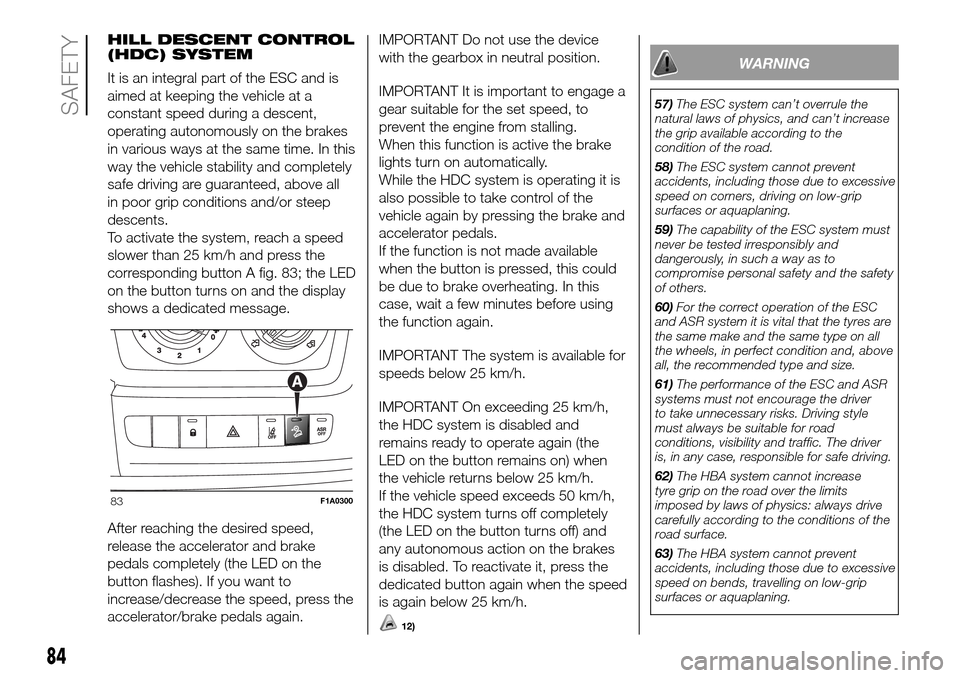
To activate the system, reach a speed
slower than 25 km/h and press the
corresponding button A fig. 83; the LED
on the button turns on and the display
shows a dedicated message.
After reaching the desired speed,
release the accelerator and brake
pedals completely (the LED on the
button flashes). If you want to
increase/decrease the speed, press the
accelerator/brake pedals again.IMPORTANT Do not use the device
with the gearbox in neutral position.
IMPORTANT It is important to engage a
gear suitable for the set speed, to
prevent the engine from stalling.
When this function is active the brake
lights turn on automatically.
While the HDC system is operating it is
also possible to take control of the
vehicle again by pressing the brake and
accelerator pedals.
If the function is not made available
when the button is pressed, this could
be due to brake overheating. In this
case, wait a few minutes before using
the function again.
IMPORTANT The system is available for
speeds below 25 km/h.
IMPORTANT On exceeding 25 km/h,
the HDC system is disabled and
remains ready to operate again (the
LED on the button remains on) when
the vehicle returns below 25 km/h.
If the vehicle speed exceeds 50 km/h,
the HDC system turns off completely
(the LED on the button turns off) and
any autonomous action on the brakes
is disabled. To reactivate it, press the
dedicated button again when the speed
is again below 25 km/h.
12)
WARNING
57)The ESC system can’t overrule the
natural laws of physics, and can’t increase
the grip available according to the
condition of the road.
58)The ESC system cannot prevent
accidents, including those due to excessive
speed on corners, driving on low-grip
surfaces or aquaplaning.
59)The capability of the ESC system must
never be tested irresponsibly and
dangerously, in such a way as to
compromise personal safety and the safety
of others.
60)For the correct operation of the ESC
and ASR system it is vital that the tyres are
the same make and the same type on all
the wheels, in perfect condition and, above
all, the recommended type and size.
61)The performance of the ESC and ASR
systems must not encourage the driver
to take unnecessary risks. Driving style
must always be suitable for road
conditions, visibility and traffic. The driver
is, in any case, responsible for safe driving.
62)The HBA system cannot increase
tyre grip on the road over the limits
imposed by laws of physics: always drive
carefully according to the conditions of the
road surface.
63)The HBA system cannot prevent
accidents, including those due to excessive
speed on bends, travelling on low-grip
surfaces or aquaplaning.
83F1A0300
84
SAFETY