Main FIAT DUCATO 2017 Owner handbook (in English)
[x] Cancel search | Manufacturer: FIAT, Model Year: 2017, Model line: DUCATO, Model: FIAT DUCATO 2017Pages: 296, PDF Size: 14.44 MB
Page 62 of 296
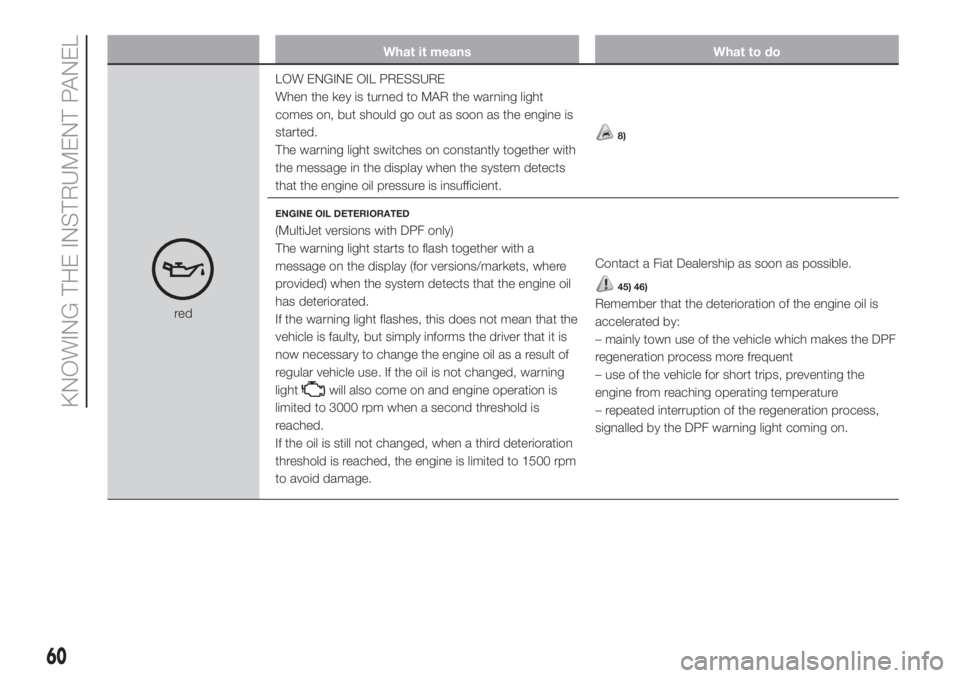
What it means What to do
redLOW ENGINE OIL PRESSURE
When the key is turned to MAR the warning light
comes on, but should go out as soon as the engine is
started.
The warning light switches on constantly together with
the message in the display when the system detects
that the engine oil pressure is insufficient.
8)
ENGINE OIL DETERIORATED
(MultiJet versions with DPF only)
The warning light starts to flash together with a
message on the display (for versions/markets, where
provided) when the system detects that the engine oil
has deteriorated.
If the warning light flashes, this does not mean that the
vehicle is faulty, but simply informs the driver that it is
now necessary to change the engine oil as a result of
regular vehicle use. If the oil is not changed, warning
light
will also come on and engine operation is
limited to 3000 rpm when a second threshold is
reached.
If the oil is still not changed, when a third deterioration
threshold is reached, the engine is limited to 1500 rpm
to avoid damage.Contact a Fiat Dealership as soon as possible.
45) 46)
Remember that the deterioration of the engine oil is
accelerated by:
– mainly town use of the vehicle which makes the DPF
regeneration process more frequent
– use of the vehicle for short trips, preventing the
engine from reaching operating temperature
– repeated interruption of the regeneration process,
signalled by the DPF warning light coming on.
60
KNOWING THE INSTRUMENT PANEL
Page 66 of 296
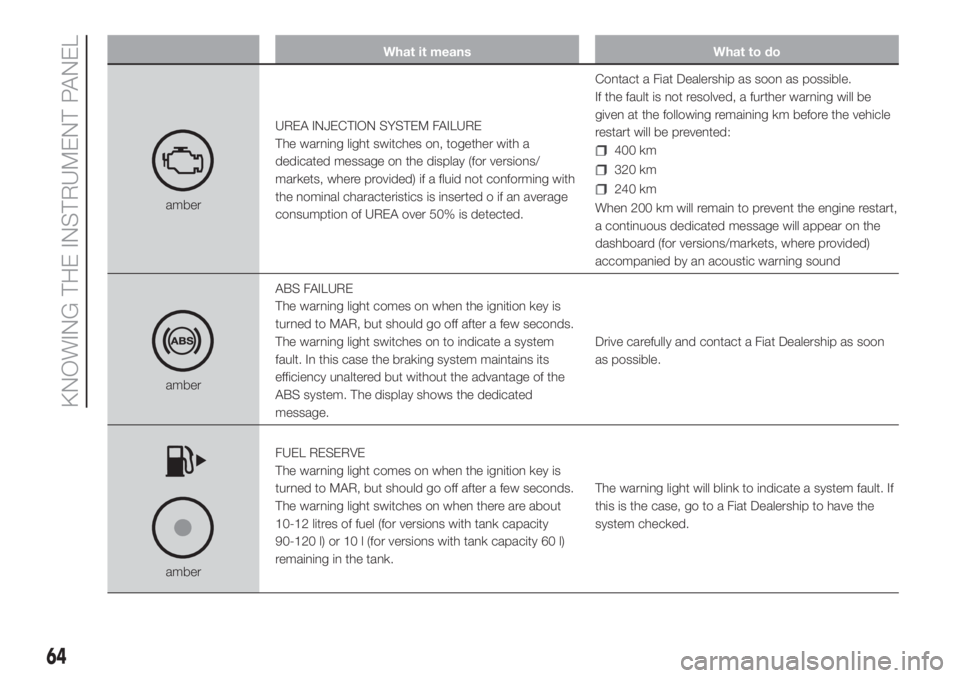
What it means What to do
amberUREA INJECTION SYSTEM FAILURE
The warning light switches on, together with a
dedicated message on the display (for versions/
markets, where provided) if a fluid not conforming with
the nominal characteristics is inserted o if an average
consumption of UREA over 50% is detected.Contact a Fiat Dealership as soon as possible.
If the fault is not resolved, a further warning will be
given at the following remaining km before the vehicle
restart will be prevented:
400 km
320 km
240 km
When 200 km will remain to prevent the engine restart,
a continuous dedicated message will appear on the
dashboard (for versions/markets, where provided)
accompanied by an acoustic warning sound
amberABS FAILURE
The warning light comes on when the ignition key is
turned to MAR, but should go off after a few seconds.
The warning light switches on to indicate a system
fault. In this case the braking system maintains its
efficiency unaltered but without the advantage of the
ABS system. The display shows the dedicated
message.Drive carefully and contact a Fiat Dealership as soon
as possible.
amberFUEL RESERVE
The warning light comes on when the ignition key is
turned to MAR, but should go off after a few seconds.
The warning light switches on when there are about
10-12 litres of fuel (for versions with tank capacity
90-120 l) or 10 l (for versions with tank capacity 60 l)
remaining in the tank.The warning light will blink to indicate a system fault. If
this is the case, go to a Fiat Dealership to have the
system checked.
64
KNOWING THE INSTRUMENT PANEL
Page 69 of 296
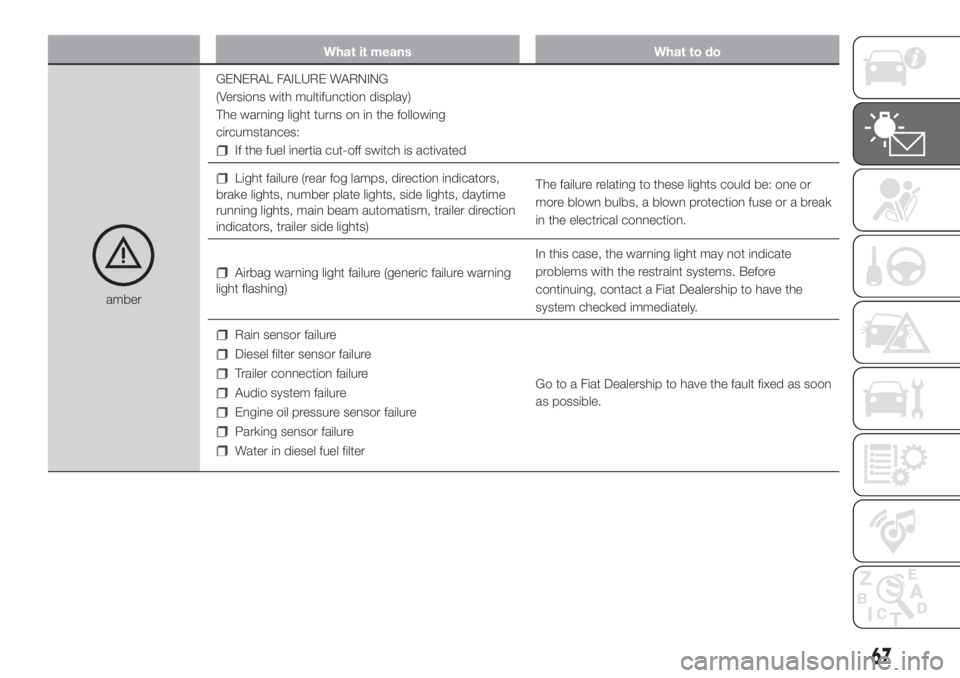
What it means What to do
amberGENERAL FAILURE WARNING
(Versions with multifunction display)
The warning light turns on in the following
circumstances:
If the fuel inertia cut-off switch is activated
Light failure (rear fog lamps, direction indicators,
brake lights, number plate lights, side lights, daytime
running lights, main beam automatism, trailer direction
indicators, trailer side lights)The failure relating to these lights could be: one or
more blown bulbs, a blown protection fuse or a break
in the electrical connection.
Airbag warning light failure (generic failure warning
light flashing)In this case, the warning light may not indicate
problems with the restraint systems. Before
continuing, contact a Fiat Dealership to have the
system checked immediately.
Rain sensor failure
Diesel filter sensor failure
Trailer connection failure
Audio system failure
Engine oil pressure sensor failure
Parking sensor failure
Water in diesel fuel filterGo to a Fiat Dealership to have the fault fixed as soon
as possible.
67
Page 74 of 296
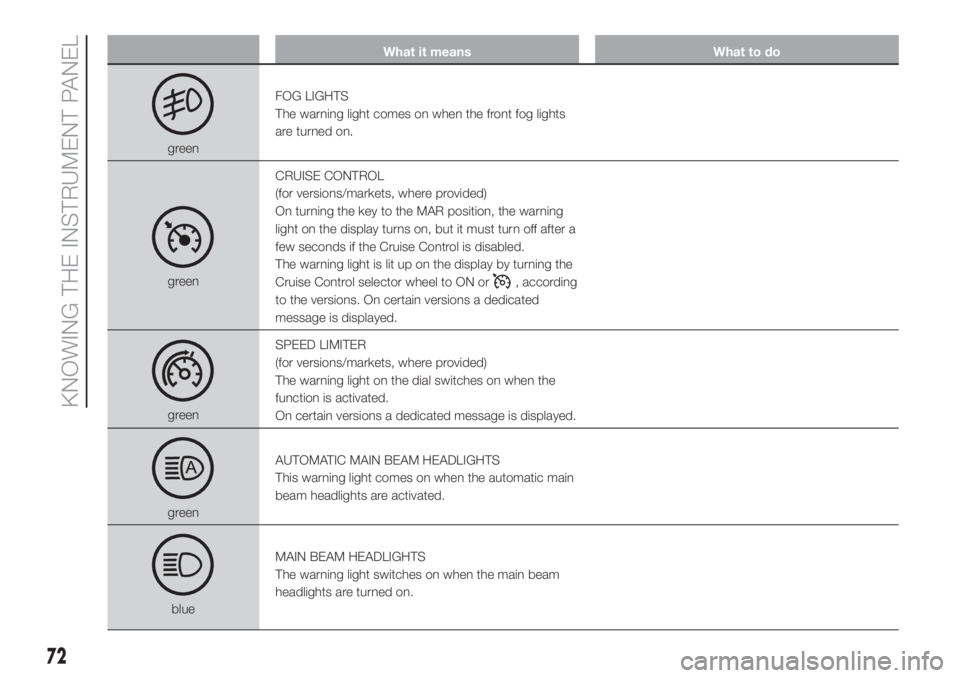
What it means What to do
greenFOG LIGHTS
The warning light comes on when the front fog lights
are turned on.
greenCRUISE CONTROL
(for versions/markets, where provided)
On turning the key to the MAR position, the warning
light on the display turns on, but it must turn off after a
few seconds if the Cruise Control is disabled.
The warning light is lit up on the display by turning the
Cruise Control selector wheel to ON or, according
to the versions. On certain versions a dedicated
message is displayed.
greenSPEED LIMITER
(for versions/markets, where provided)
The warning light on the dial switches on when the
function is activated.
On certain versions a dedicated message is displayed.
greenAUTOMATIC MAIN BEAM HEADLIGHTS
This warning light comes on when the automatic main
beam headlights are activated.
blueMAIN BEAM HEADLIGHTS
The warning light switches on when the main beam
headlights are turned on.
72
KNOWING THE INSTRUMENT PANEL
Page 76 of 296
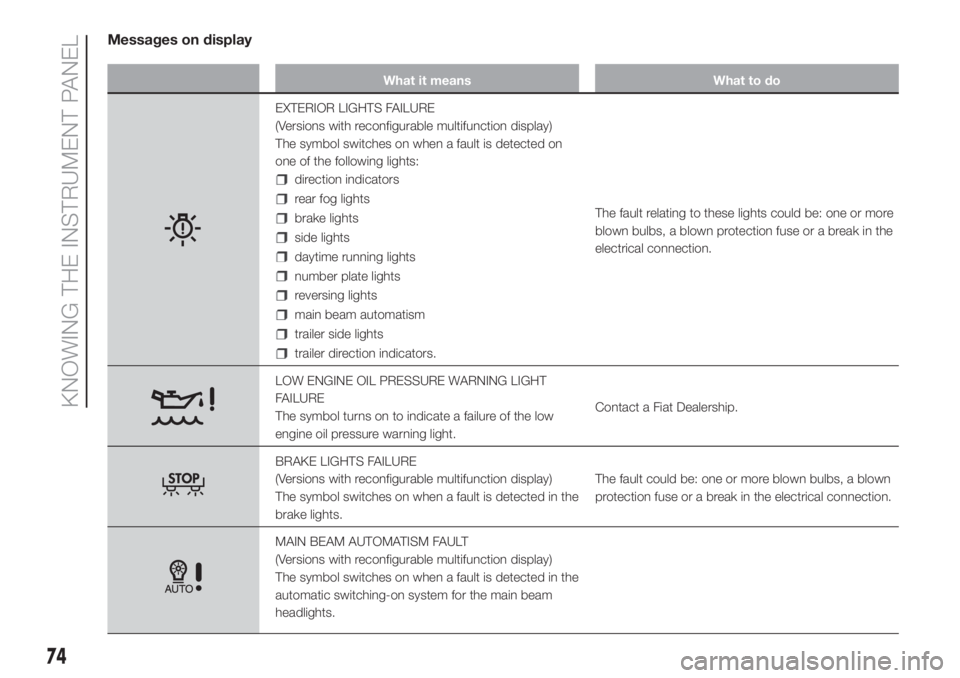
Messages on display
What it means What to do
EXTERIOR LIGHTS FAILURE
(Versions with reconfigurable multifunction display)
The symbol switches on when a fault is detected on
one of the following lights:
direction indicators
rear fog lights
brake lights
side lights
daytime running lights
number plate lights
reversing lights
main beam automatism
trailer side lights
trailer direction indicators.The fault relating to these lights could be: one or more
blown bulbs, a blown protection fuse or a break in the
electrical connection.
LOW ENGINE OIL PRESSURE WARNING LIGHT
FAILURE
The symbol turns on to indicate a failure of the low
engine oil pressure warning light.Contact a Fiat Dealership.
BRAKE LIGHTS FAILURE
(Versions with reconfigurable multifunction display)
The symbol switches on when a fault is detected in the
brake lights.The fault could be: one or more blown bulbs, a blown
protection fuse or a break in the electrical connection.
MAIN BEAM AUTOMATISM FAULT
(Versions with reconfigurable multifunction display)
The symbol switches on when a fault is detected in the
automatic switching-on system for the main beam
headlights.
74
KNOWING THE INSTRUMENT PANEL
Page 80 of 296
What it means What to do
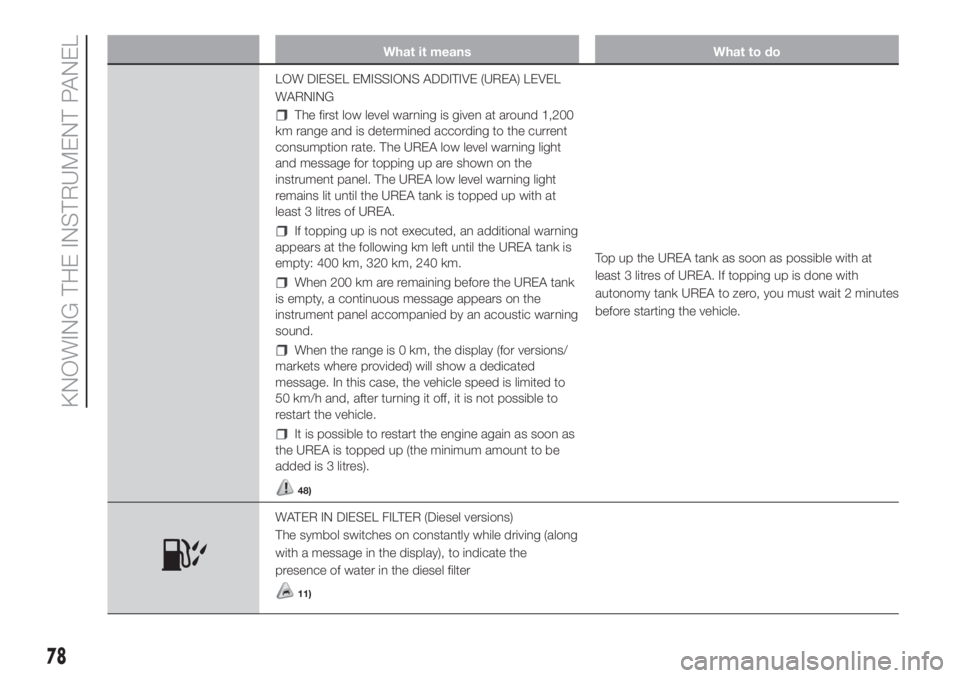
LOW DIESEL EMISSIONS ADDITIVE (UREA) LEVEL
WARNING
The first low level warning is given at around 1,200
km range and is determined according to the current
consumption rate. The UREA low level warning light
and message for topping up are shown on the
instrument panel. The UREA low level warning light
remains lit until the UREA tank is topped up with at
least 3 litres of UREA.
If topping up is not executed, an additional warning
appears at the following km left until the UREA tank is
empty: 400 km, 320 km, 240 km.
When 200 km are remaining before the UREA tank
is empty, a continuous message appears on the
instrument panel accompanied by an acoustic warning
sound.
When the range is 0 km, the display (for versions/
markets where provided) will show a dedicated
message. In this case, the vehicle speed is limited to
50 km/h and, after turning it off, it is not possible to
restart the vehicle.
It is possible to restart the engine again as soon as
the UREA is topped up (the minimum amount to be
added is 3 litres).
48)
Top up the UREA tank as soon as possible with at
least 3 litres of UREA. If topping up is done with
autonomy tank UREA to zero, you must wait 2 minutes
before starting the vehicle.
WATER IN DIESEL FILTER (Diesel versions)
The symbol switches on constantly while driving (along
with a message in the display), to indicate the
presence of water in the diesel filter
11)
78
KNOWING THE INSTRUMENT PANEL
Page 84 of 296
ESC (Electronic
Stability Control)
SYSTEM
(for versions/markets, where provided)
The ESC system improves the
directional control and stability of the
vehicle in various driving conditions.
The ESC system corrects the vehicle’s
understeer and oversteer, distributing
the brake force on the appropriate
wheels. The torque supplied by the
engine can also be reduced in order to
maintain control of the vehicle.
The ESC system uses the sensors in
the vehicle to determine the trajectory
required by the driver through steering
and compares it with the real trajectory
of the vehicle. When the real trajectory
deviates from the desired trajectory, the
ESC system intervenes to counter the
car’s understeer or oversteer.
Oversteer: occurs when the vehicle
is turning more than it should according
to the angle of the steering wheel.
Understeer: occurs when the vehicle
is turning less than it should according
to the angle of the steering wheel.The ESC system also includes the
following subsystems:
Hill Holder
ASR
HBA
ERM
HDC
57) 58) 59)
SYSTEM INTERVENTION
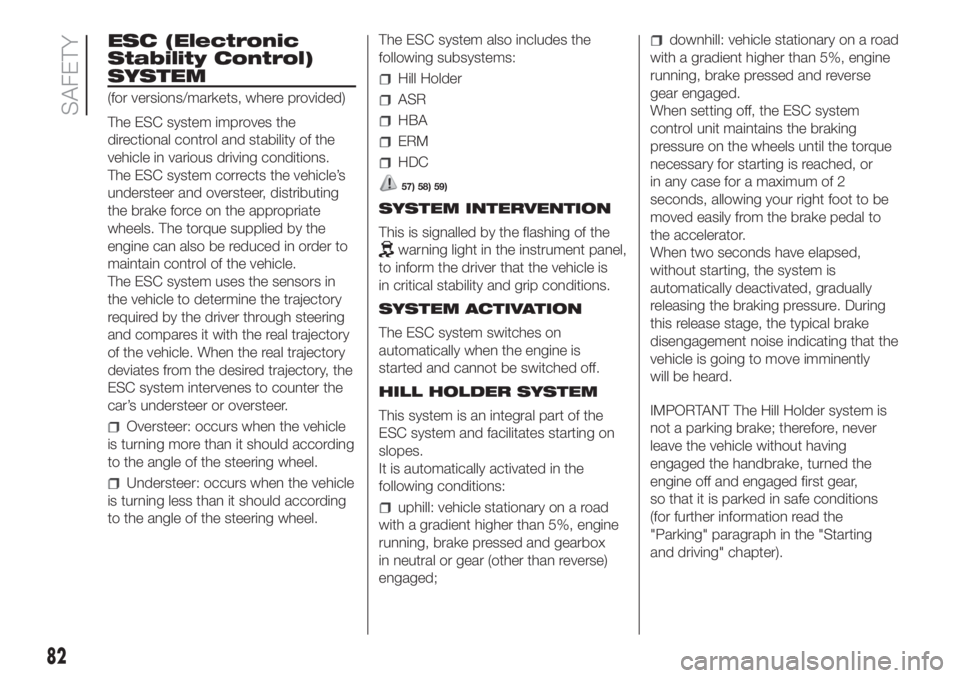
This is signalled by the flashing of the
warning light in the instrument panel,
to inform the driver that the vehicle is
in critical stability and grip conditions.
SYSTEM ACTIVATION
The ESC system switches on
automatically when the engine is
started and cannot be switched off.
HILL HOLDER SYSTEM
This system is an integral part of the
ESC system and facilitates starting on
slopes.
It is automatically activated in the
following conditions:
uphill: vehicle stationary on a road
with a gradient higher than 5%, engine
running, brake pressed and gearbox
in neutral or gear (other than reverse)
engaged;
downhill: vehicle stationary on a road
with a gradient higher than 5%, engine
running, brake pressed and reverse
gear engaged.
When setting off, the ESC system
control unit maintains the braking
pressure on the wheels until the torque
necessary for starting is reached, or
in any case for a maximum of 2
seconds, allowing your right foot to be
moved easily from the brake pedal to
the accelerator.
When two seconds have elapsed,
without starting, the system is
automatically deactivated, gradually
releasing the braking pressure. During
this release stage, the typical brake
disengagement noise indicating that the
vehicle is going to move imminently
will be heard.
IMPORTANT The Hill Holder system is
not a parking brake; therefore, never
leave the vehicle without having
engaged the handbrake, turned the
engine off and engaged first gear,
so that it is parked in safe conditions
(for further information read the
"Parking" paragraph in the "Starting
and driving" chapter).
82
SAFETY
Page 86 of 296
HILL DESCENT CONTROL
(HDC) SYSTEM
It is an integral part of the ESC and is
aimed at keeping the vehicle at a
constant speed during a descent,
operating autonomously on the brakes
in various ways at the same time. In this
way the vehicle stability and completely
safe driving are guaranteed, above all
in poor grip conditions and/or steep
descents.
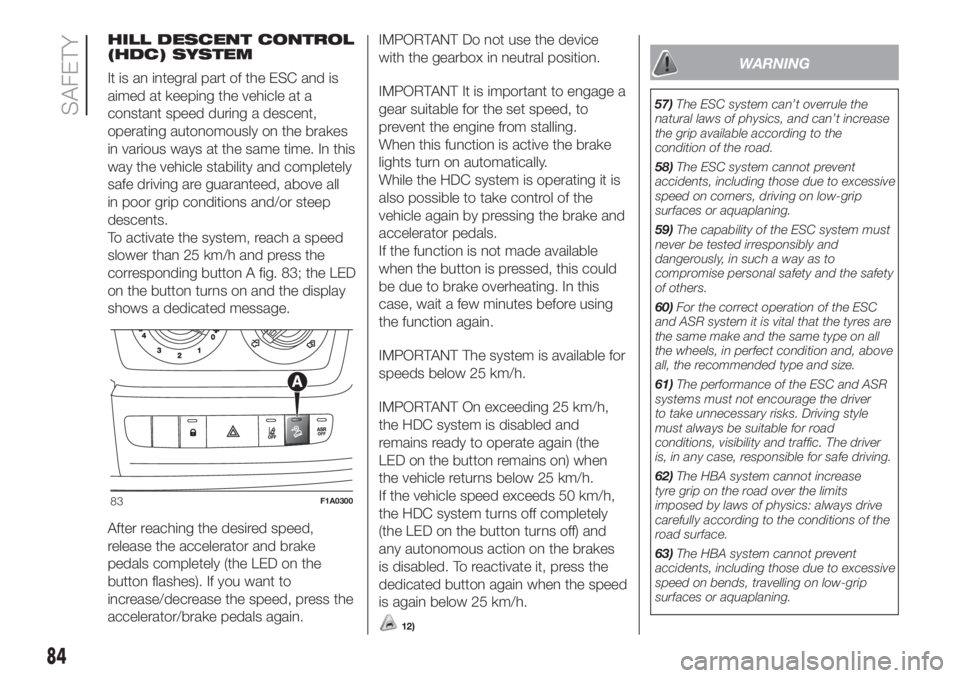
To activate the system, reach a speed
slower than 25 km/h and press the
corresponding button A fig. 83; the LED
on the button turns on and the display
shows a dedicated message.
After reaching the desired speed,
release the accelerator and brake
pedals completely (the LED on the
button flashes). If you want to
increase/decrease the speed, press the
accelerator/brake pedals again.IMPORTANT Do not use the device
with the gearbox in neutral position.
IMPORTANT It is important to engage a
gear suitable for the set speed, to
prevent the engine from stalling.
When this function is active the brake
lights turn on automatically.
While the HDC system is operating it is
also possible to take control of the
vehicle again by pressing the brake and
accelerator pedals.
If the function is not made available
when the button is pressed, this could
be due to brake overheating. In this
case, wait a few minutes before using
the function again.
IMPORTANT The system is available for
speeds below 25 km/h.
IMPORTANT On exceeding 25 km/h,
the HDC system is disabled and
remains ready to operate again (the
LED on the button remains on) when
the vehicle returns below 25 km/h.
If the vehicle speed exceeds 50 km/h,
the HDC system turns off completely
(the LED on the button turns off) and
any autonomous action on the brakes
is disabled. To reactivate it, press the
dedicated button again when the speed
is again below 25 km/h.
12)
WARNING
57)The ESC system can’t overrule the
natural laws of physics, and can’t increase
the grip available according to the
condition of the road.
58)The ESC system cannot prevent
accidents, including those due to excessive
speed on corners, driving on low-grip
surfaces or aquaplaning.
59)The capability of the ESC system must
never be tested irresponsibly and
dangerously, in such a way as to
compromise personal safety and the safety
of others.
60)For the correct operation of the ESC
and ASR system it is vital that the tyres are
the same make and the same type on all
the wheels, in perfect condition and, above
all, the recommended type and size.
61)The performance of the ESC and ASR
systems must not encourage the driver
to take unnecessary risks. Driving style
must always be suitable for road
conditions, visibility and traffic. The driver
is, in any case, responsible for safe driving.
62)The HBA system cannot increase
tyre grip on the road over the limits
imposed by laws of physics: always drive
carefully according to the conditions of the
road surface.
63)The HBA system cannot prevent
accidents, including those due to excessive
speed on bends, travelling on low-grip
surfaces or aquaplaning.
83F1A0300
84
SAFETY
Page 88 of 296
WARNING
66)The Traction Plus system acts
effectively only on road surfaces that are
not homogeneous and/or differentiated
between the two drive wheels.
67)Until the setting off manoeuvre is
terminated, fully depress the accelerator
pedal in order to transfer all the drive
torque to the wheel with the best grip.
TPMS (Tyre
Pressure
Monitoring System)
(for versions/markets, where provided)
68) 69) 70) 71) 72) 73) 74) 75) 76)
DESCRIPTION
The tyre pressure monitoring system
(TPMS) warns the driver of low tyre
pressure on the basis of the cold
inflation pressure prescribed for the
vehicle.
Changes in outside temperature may
cause tyre pressure to vary. This means
that a decrease in the outside
temperature corresponds to a decrease
in the tyre pressure.
Tyre pressure must always be adjusted
according to the cold inflation pressure.
Cold tyre inflation pressure is the tyre
pressure after letting the vehicle stand
for at least three hours or a travel
shorter than 1.6 km after an interval of
three hours.
The cold tyre inflation pressure must
not exceed the maximum inflation
pressure value printed on the side of
the tyre.
The tyre pressure also increases while
driving the vehicle: this is a normal
condition and does not require any
adjustment of the pressure.The TPMS continues to advise the
driver of the low tyre pressure condition
until this is corrected; the warning
continues until the pressure
corresponds or exceeds the pressure
prescribed for the cold tyres. When the
low tyre pressure check warning light
turns on continuously, the inflation
pressure must be adjusted until it
reaches the pressure prescribed for
cold tyres. After the automatic update
of the system, the tyre pressure control
warning light switches off. You may
need to drive the vehicle for about 20
minutes at a speed higher than 20
km/h to allow the TPMS to receive this
information.
NOTE
The TPMS does not replace the
normal tyre maintenance service and
does not indicate any fault in a tyre.
Therefore, the TPMS should not be
used as pressure switch while adjusting
the tyre inflation pressure.
Driving with insufficient tyre pressure
causes their overheating and can
result in tyre failure. The low inflation
pressure reduces fuel efficiency and
tyre tread life and may also affect
handling and braking performance of
the vehicle.
86
SAFETY
Page 89 of 296
The TPMS does not replace the
correct tyre maintenance. It is up to the
driver to maintain the correct tyre
pressure level measuring it with
a suitable pressure switch. This is
necessary even if the decrease in the
inflation pressure value does not cause
the tyre pressure control warning light
to switch on.
The TPMS warns the driver of any
condition of insufficient tyre pressure
If this drops below the insufficient
pressure limit for any reason including
low temperature and normal pressure
loss of the tyre.
The seasonal temperature changes
affect tyre pressure.
The TPMS uses wireless devices with
electronic sensors mounted on the
wheel rims to constantly monitor the
value of tyre pressure. The sensors
mounted on each wheel as part of the
valve stem transmit various information
of the tyres to the receiver module, in
order to calculate the pressure.
IMPORTANT Monitoring and
maintaining the correct pressure in all
four tyres are particularly important.Tyre pressure monitoring system
low pressure warnings
The system warns the driver if one or
more tyres are flat by turning on the
warning light on the instrument
panel (together with a warning message
and an acoustic signal).
In this case, stop the vehicle as soon as
possible, check the inflation pressure
of each tyre and inflate to the cold tyre
pressure value prescribed for the
vehicle. The system will automatically
update and after receiving the tyre
pressure update the tyre pressure
control warning light switches off. You
may need to drive the vehicle for about
20 minutes at a speed higher than 20
km/h to allow the system to receive this
information.
TPMS operation faults
The system fault is indicated by the
corresponding warning light
, which
first flashes for 75 seconds and then
stays on continuously. This can occur in
any of the following situations:
interference caused by electronic
devices or radio frequency emissions
similar to those of the TPM sensors.
Application of tinted films which
interfere with the signals of the radio
waves.
Presence of snow or ice on the
wheels or the wheel arches.
Use of snow chains.
Use of wheels/tyres not equipped
with TPM sensors.
The space-saver wheel is not
equipped with the tyre pressure control
sensor. Therefore, the tyre pressure is
not controlled by the system.
If the space-saver wheel replaces a
tyre with a pressure lower than the
insufficient pressure limit, an acoustic
signal will be emitted and the
warning light will turn on at the next
start-up.
When the original tyre is repaired or
replaced and it is mounted back on
the vehicle to replace the space-saver
wheel, the TPMS will update
automatically and the warning light will
switch off, provided that the pressure of
none of the four tyres is below the
insufficient pressure limit. You may need
to drive the vehicle for about 20
minutes at a speed higher than 20
km/h to allow the TPMS to receive this
information.
87