instrument panel FIAT FIORINO 2018 Owner handbook (in English)
[x] Cancel search | Manufacturer: FIAT, Model Year: 2018, Model line: FIORINO, Model: FIAT FIORINO 2018Pages: 196, PDF Size: 4.99 MB
Page 77 of 196
SBR SYSTEM
(for versions/markets, where provided)
The vehicle is equipped with a system
called S.B.R. (Seat Belt Reminder),
which warns the driver and front
passenger if their seat belt is not
fastened, as follows:
warning lightcomes on in the
instrument panel and the buzzer
sounds continuously for the first 6
seconds;
warning lightflashes in the
instrument panel and the buzzer
sounds intermittently for the following
90 seconds.
For permanent deactivation, contact a
Fiat Dealership.
The SBR system can also be
reactivated through the setup menu.
PRE-TENSIONERS
To increase the protective efficiency of
the front seat belts, the vehicle is fitted
with pretensioners. These devices, in
the event of a violent frontal collision or
side collision, rewind the seat belts a
few centimetres. In this way, they
ensure that the belts fit tightly to the
wearer before the restraining action
begins.
It is evident that the pretensioners have
been activated when the belt withdraws
toward the retractor.
IMPORTANT To obtain the highest
degree of protection from the action of
the pretensioner, wear the seat belt
tight to the chest and pelvis.
A slight discharge of smoke may be
produced during the activation of the
pretensioner which is not harmful and
does not involve any fire hazard.
The pretensioner does not require any
maintenance or lubrication. Any
changes to its original conditions will
invalidate its efficiency. If, due to
unusual natural events (floods, sea
storms, etc.), the device has been
affected by water and mud, it must
absolutely be replaced.
63) 64)
21)
LOAD LIMITERS
(for versions/markets, where provided)
To increase occupant safety in an
accident, the front seat belt reels on
driver side and passenger side (for
versions/markets, where provided)
contain a device which controls the
force acting on the chest and shoulders
during the restraining action of the
belts in the event of a frontal collision.
GENERAL
INSTRUCTIONS FOR
USING THE SEAT BELTS
The driver is responsible for respecting,
and ensuring that all the other
occupants of the vehicle also respect,
the local laws in force in relation to
the use of the seat belts. Always fasten
the seat belts before setting off.
Seat belts are also to be worn by
pregnant women: the risk of injury in
the case of impact is greatly reduced
for them and the unborn child if they
are wearing a seat belt. Pregnant
women must position the lower part of
the belt very low down so that it passes
over the pelvis and under the
abdomen (see fig. 85).
While pregnancy progresses, the driver
must adjust both the seat and the
steering wheel to ensure full control of
the vehicle (pedals and steering wheel
must be easily accessible).
75
Page 87 of 196

The airbags are not deployed in the
event of minor frontal impacts (for
which the restraining action of the seat
belts is sufficient). Seat belts must
always be worn. In the event of a frontal
collision, they ensure the correct
positioning of the occupant.
FRONT AIRBAG DRIVER'S
SIDE
It consists of an instantly inflating bag
contained in a special recess at the
centre of the steering wheel fig. 96.
PASSENGER SIDE FRONT
AIRBAG
(for versions/markets, where provided)
This consists of an instantly inflating
bag contained in a special recess in the
dashboard fig. 97 which has a larger
volume than that of the driver.
79)
FRONT PASSENGER SIDE
AIRBAG AND CHILD
RESTRAINT SYSTEMS
Rearward-facing child restraint systems
must NEVER be fitted on the front
seat with an active passenger's airbag
since in the event of an impact the
airbag activation may cause fatal
injuries to the transported child.
ALWAYScomply with the instructions
on the label fig. 98 stuck on the
passenger side sun visor.Manual deactivation of
front passenger airbag
and chest-pelvis side
bag
(for versions/markets, where provided)
If a child must necessarily be carried on
the front seat in a rear-facing child
restraint system, the front passenger
airbag and chest-pelvis side bag (for
versions/markets, where provided) can
be deactivated.
IMPORTANT To manually deactivate the
front passenger airbag and chest-pelvis
side bag (for versions/markets where
provided), refer to the "Display"
paragraph in the "Knowing the
instrument panel" chapter.
When the passenger front airbag and
chest-pelvis side bag (for versions/
markets where provided) are activated
again, the warning light switches off.
The warning light
on the central
dashboard fig. 99 shows the passenger
protection status.
When the vehicle is started (key in MAR
position), the warning light turns on
for approx. 8 seconds, provided that at
least 5 seconds have elapsed from
the previous switching off. If not,
contact a Fiat Dealership.
96F0T0052
97F0T0033
98F0T0950
85
Page 91 of 196
IMPORTANT NOTES
The front airbags and/or side bags (for
versions/markets, where provided)
may be deployed if the vehicle is
subject to heavy knocks or accidents
involving the underbody area, such
as for example violent shocks against
steps, kerbs or low obstacles, or the
vehicle falling into big potholes or
depressions in the road.
A small amount of dust will be released
when the airbags are deployed. The
dust is not harmful and does not
indicate the beginning of a fire.
Furthermore, the surface of the
deployed bag and the interior of the
vehicle may be covered in a dusty
residue: this may irritate your skin and
eyes. Wash with mild soap and water in
the event of exposure.
Should an accident occur in which any
of the safety devices are activated,
take the vehicle to a Fiat Dealership to
have the activated devices replaced
and to have the whole system checked.
Every control, repair and replacement
operation concerning the airbags must
be carried out only at Fiat Dealerships.If you are having the vehicle scrapped,
have the airbag system deactivated at a
Fiat Dealership first. If the vehicle
changes ownership, the new owner
must be informed of the method of use
of airbags and the above warnings
and also be given this "Owner
Handbook".
Pretensioners, front airbags and front
side bags are deployed differently
according to the type of collision.
Failure to activate one or more of the
devices does not indicate a system
malfunction.
80) 81) 82) 83) 84) 85) 86) 87) 88) 89)
WARNING
80)There may be an anomaly in the
restraint systems if the warning light
does not light up when the key is turn
to MAR or remains on while driving (on
some versions with a message on the
display). In this case, the airbags or the
pretensioners may not be activated in the
case of an accident or (in a lesser number
of cases) they may be activated incorrectly.
Contact a Fiat Dealership immediately to
have the system checked.
81)Always drive with your hands on the
rim of the steering wheel so that the airbag
can inflate freely if required. Do not drive
bent over the steering wheel, but rather sit
upright with your back firmly resting against
the seat back.82)In some versions, in the event of a LED
failure (located on the dashboard
panel), thewarning light on the
instrument panel turns on and the
passenger side airbags are deactivated.
83)On cars with side bags, do not cover
the front seat backrests with extra covers.
84)Do not travel carrying objects in your
lap, in front of your chest or between your
lips (pipe, pencils, etc.): they could cause
severe injury if the airbag is deployed.
85)If the ignition device is at MAR, even if
the engine is switched off, airbags may
be deployed when the vehicle is stationary
and hit by another vehicle. Therefore,
even if the car is stationary, when an active
front passenger airbag is fitted, DO NOT
install rear facing child restraint systems on
the front passenger seat. Deployment of
the airbag following an impact could cause
fatal injuries to the child. Therefore, always
deactivate the passenger side airbag
when a rearward facing child restraint
system is installed on the front passenger
seat. The front passenger seat must also
be positioned back as far as possible in
order to prevent the child restraint system
from coming into contact with the
dashboard. Immediately reactivate the
passenger airbag as soon as the child
restraint system has been removed. Also
remember that, if the ignition device is
set to STOP, none of the safety devices
(airbags or pretensioners) will be deployed
in the event of collision. Non-deployment
in such cases does not indicate a system
malfunction.
89
Page 94 of 196
STARTING THE
ENGINE
The vehicle is fitted with an electronic
engine lock device: if the engine fails to
start, see the paragraph “The Fiat
CODE system” in section “Know your
vehicle”.
90) 91)
22) 23) 27) 28)
PROCEDURE FOR
PETROL VERSIONS
Proceed as follows:
engage the handbrake;
put the gear lever into neutral;
fully depress the clutch pedal
without touching the accelerator;
turn the ignition key to AVV and
release it as soon as the engine starts.
PROCEDURE FOR DIESEL
VERSIONS
Proceed as follows:
engage the handbrake;
put the gear lever into neutral;
turn the ignition key to MAR
position: the
warning light will light
up on instrument panel;
wait for the warning lightsand
to turn off, which will happen faster
the warmer the engine is;
fully depress the clutch pedal
without touching the accelerator;
turn the ignition key to the AVV
position as soon as the warning light
turns off. Waiting too long will waste
the heating work carried out by the
plugs.
Release the key as soon as the engine
starts.
With cold engine, the accelerator must
be entirely released when turning the
ignition key to position AVV.
24)
PROCEDURE FOR
NATURAL POWER
VERSIONS
The engine always starts up on petrol
independently of the previously
selected mode.
25)
PROCEDURE FOR
VERSIONS WITH
COMFORT-MATIC
TRANSMISSION
The system allows the engine to be
started both with a gear engaged and
with the transmission in neutral (N).
Always press the brake pedal with the
gear engaged.It is advisable to place the gear lever in
neutral (N) before starting the engine.
26)
IMPORTANT If the engine does not
start at the first attempt, return the
ignition key to STOP before repeating
the starting procedure. If the warning
light remains on together with warning
light
when the ignition key is at
MAR, turn the key to STOP and then
back to MAR; if the warning light stays
on, try with the other keys provided
with the vehicle. If you still cannot start
the engine, perform an emergency
start (see “Emergency starting” in the
“In an emergency” section) and go to a
Fiat Dealership.
IMPORTANT If start-up is requested
with the gearbox faulty, carry out the
"Delayed start-up" procedure (see
associated messages): turn the key to
the AVV position for at least 7 seconds
with the brake depressed and the
engine will start. The system will be in
recovery mode (maximum permitted
gear: 3
rd, Automatic mode not
available). If the engine does not start,
contact a Fiat Dealership.
92
STARTING AND DRIVING
Page 95 of 196
WARNING
90)It is dangerous to run the engine in
enclosed areas. The engine consumes
oxygen and engine exhaust contains
carbon dioxide, carbon monoxide and
other toxic gasses.
91)Remember that the brake servo and
electrical power steering system are not
operational until the engine is started,
therefore a greater effort will be required to
press the brake pedal or turn the steering
wheel.
WARNING
22)It is advisable not to demand maximum
performance from your vehicle (e.g.
excessive acceleration, long distances at
high speeds, excessive intense braking,
etc.) during the initial period of use.
23)When the engine is switched off never
leave the key turned to MAR-ON to prevent
useless current absorption from draining
the battery.
24)If the warning light
flashes for 60
seconds after starting or during an
extended towing period, this indicates a
problem in the glow plug preheating
system. Use the vehicle normally if the
engine starts, but contact a Fiat Dealership
as soon as possible.25)There must therefore always be
enough petrol in the tank to protect the
petrol pump and to guarantee temporary
switching from methane to petrol
operation, if high performance is required.
26)If the engine fails to start with a gear
engaged, the potentially dangerous
situation due to the fact that the gearbox is
automatically placed in neutral will be
signalled by a buzzer.
27)Never, under any circumstances, jump
start the engine by pushing, towing or
coasting downhill. This could cause fuel to
flow into the catalytic converter and
damage it beyond repair.
28)A quick burst on the accelerator before
turning off the engine serves absolutely
no practical purpose, it wastes fuel and is
especially damaging to turbocharged
engines.
HANDBRAKE
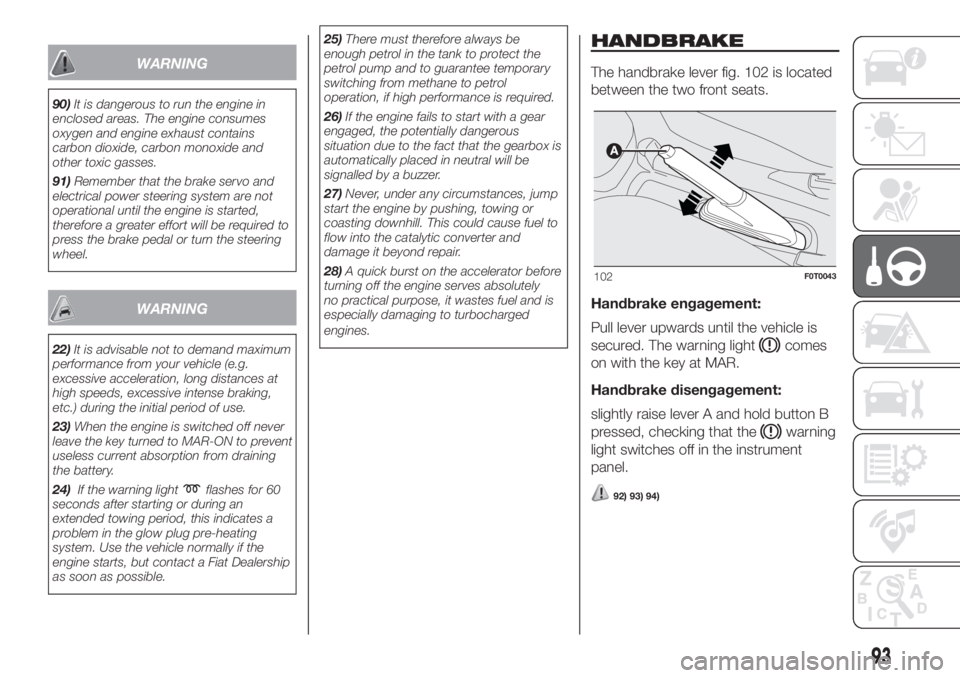
The handbrake lever fig. 102 is located
between the two front seats.
Handbrake engagement:
Pull lever upwards until the vehicle is
secured. The warning light
comes
on with the key at MAR.
Handbrake disengagement:
slightly raise lever A and hold button B
pressed, checking that the
warning
light switches off in the instrument
panel.
92) 93) 94)
102F0T0043
93
Page 99 of 196
NOTE The accelerator pedal does not
have to be released whilst changing
gear. If the gear change request may
adversely affect the correct operation of
the engine and the transmission, the
system will not allow it.
WARNING
30)Avoid keeping your hand placed on this
lever in between gear changes or
Auto/Manual mode.
CRUISE CONTROL
(constant speed
regulator)
(for versions/markets, where provided)
This is an electronic driving aid that
allows you to drive at a speed of above
30 km/h on long and straight dry roads
with few driving changes (e.g.
motorways) at a preset speed without
having to press the accelerator pedal. It
is therefore not recommended to use
this device on extra-urban roads with
traffic. Do not use the device in town.
Turning the device on
When the device is activated, light
comes on together with the relevant
message on the instrument panel (for
versions/markets, where provided).
The speed adjustment function cannot
be activated in 1
stor reverse gear; it
is advisable to activate the function in
4
thor higher gears.
When travelling downhill with the device
activated, the vehicle speed may
exceed the memorised one.
Storing vehicle speed
Proceed as follows:
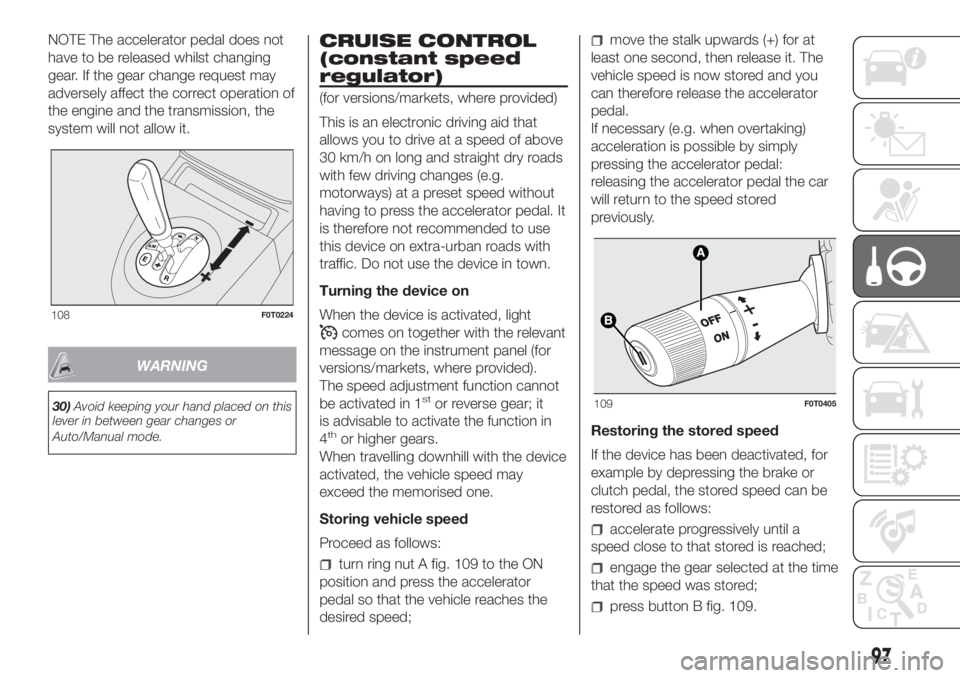
turn ring nut A fig. 109 to the ON
position and press the accelerator
pedal so that the vehicle reaches the
desired speed;
move the stalk upwards (+) for at
least one second, then release it. The
vehicle speed is now stored and you
can therefore release the accelerator
pedal.
If necessary (e.g. when overtaking)
acceleration is possible by simply
pressing the accelerator pedal:
releasing the accelerator pedal the car
will return to the speed stored
previously.
Restoring the stored speed
If the device has been deactivated, for
example by depressing the brake or
clutch pedal, the stored speed can be
restored as follows:
accelerate progressively until a
speed close to that stored is reached;
engage the gear selected at the time
that the speed was stored;
press button B fig. 109.
108F0T0224
109F0T0405
97
Page 103 of 196
Versions with Comfort-matic
transmission
With the vehicle stationary and the
brake pedal pressed, the engine stops
if the gear lever is in position other
thanR. In the event of stops uphill,
engine switching off is disabled to make
the "Hill Holder" function available
(works only with the engine running).
The warning light on the instrument
panel switches on to signal that the
engine has stopped.
Restarting the engine
Versions with manual transmission
Depress the clutch pedal to restart
the engine.
Versions with Comfort-matic
transmission
Releasing the brake pedal the engine
restarts automatically; the icon switches
off on the display. If the engine is
restarted with the “Hill Holder” function
off, move the lever towards (+), (-)or
Rand the engine restarts.MANUAL ACTIVATION
AND DEACTIVATION
The device can be turned on/off by
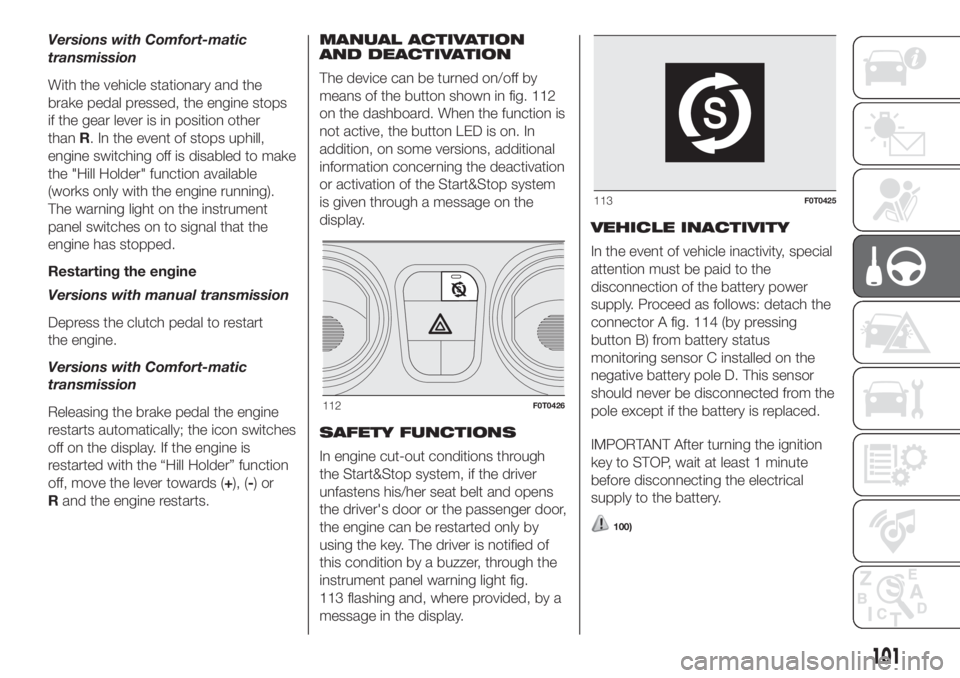
means of the button shown in fig. 112
on the dashboard. When the function is
not active, the button LED is on. In
addition, on some versions, additional
information concerning the deactivation
or activation of the Start&Stop system
is given through a message on the
display.
SAFETY FUNCTIONS
In engine cut-out conditions through
the Start&Stop system, if the driver
unfastens his/her seat belt and opens
the driver's door or the passenger door,
the engine can be restarted only by
using the key. The driver is notified of
this condition by a buzzer, through the
instrument panel warning light fig.
113 flashing and, where provided, by a
message in the display.VEHICLE INACTIVITY
In the event of vehicle inactivity, special
attention must be paid to the
disconnection of the battery power
supply. Proceed as follows: detach the
connector A fig. 114 (by pressing
button B) from battery status
monitoring sensor C installed on the
negative battery pole D. This sensor
should never be disconnected from the
pole except if the battery is replaced.
IMPORTANT After turning the ignition
key to STOP, wait at least 1 minute
before disconnecting the electrical
supply to the battery.
100)
112F0T0426
113F0T0425
101
Page 109 of 196
HAZARD WARNING
LIGHTS
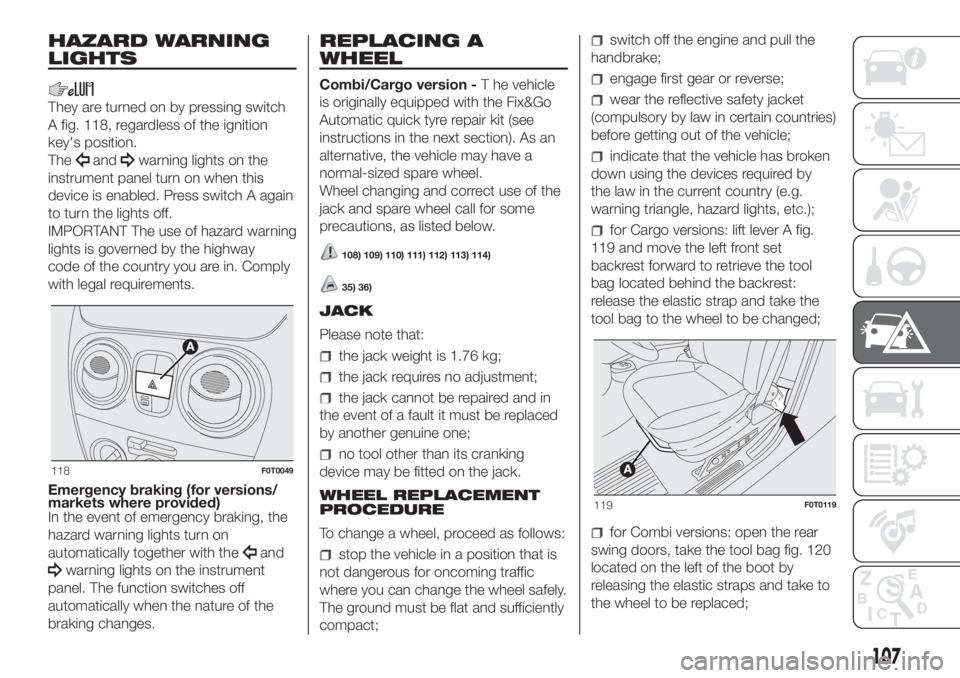
They are turned on by pressing switch
A fig. 118, regardless of the ignition
key's position.
The
andwarning lights on the
instrument panel turn on when this
device is enabled. Press switch A again
to turn the lights off.
IMPORTANT The use of hazard warning
lights is governed by the highway
code of the country you are in. Comply
with legal requirements.
Emergency braking (for versions/
markets where provided)
In the event of emergency braking, the
hazard warning lights turn on
automatically together with the
and
warning lights on the instrument
panel. The function switches off
automatically when the nature of the
braking changes.
REPLACING A
WHEEL
Combi/Cargo version -T he vehicle
is originally equipped with the Fix&Go
Automatic quick tyre repair kit (see
instructions in the next section). As an
alternative, the vehicle may have a
normal-sized spare wheel.
Wheel changing and correct use of the
jack and spare wheel call for some
precautions, as listed below.
108) 109) 110) 111) 112) 113) 114)
35) 36)
JACK
Please note that:
the jack weight is 1.76 kg;
the jack requires no adjustment;
the jack cannot be repaired and in
the event of a fault it must be replaced
by another genuine one;
no tool other than its cranking
device may be fitted on the jack.
WHEEL REPLACEMENT
PROCEDURE
To change a wheel, proceed as follows:
stop the vehicle in a position that is
not dangerous for oncoming traffic
where you can change the wheel safely.
The ground must be flat and sufficiently
compact;
switch off the engine and pull the
handbrake;
engage first gear or reverse;
wear the reflective safety jacket
(compulsory by law in certain countries)
before getting out of the vehicle;
indicate that the vehicle has broken
down using the devices required by
the law in the current country (e.g.
warning triangle, hazard lights, etc.);
for Cargo versions: lift lever A fig.
119 and move the left front set
backrest forward to retrieve the tool
bag located behind the backrest:
release the elastic strap and take the
tool bag to the wheel to be changed;
for Combi versions: open the rear
swing doors, take the tool bag fig. 120
located on the left of the boot by
releasing the elastic straps and take to
the wheel to be replaced;
118F0T0049
119F0T0119
107
Page 127 of 196
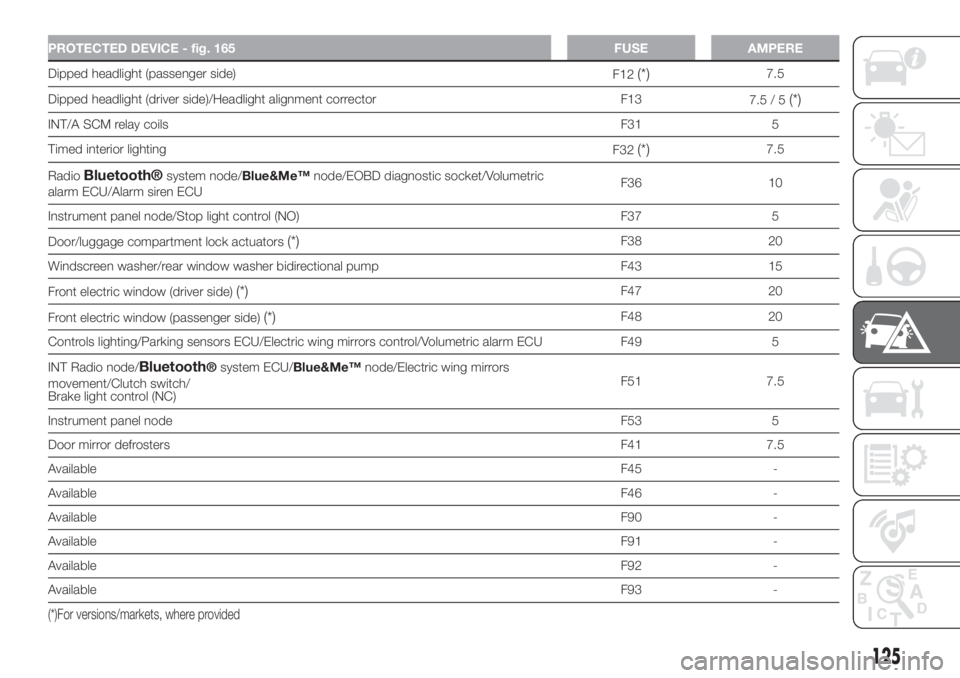
PROTECTED DEVICE - fig. 165 FUSE AMPERE
Dipped headlight (passenger side)
F12(*)7.5
Dipped headlight (driver side)/Headlight alignment corrector F13
7.5 / 5
(*)
INT/A SCM relay coilsF31 5
Timed interior lighting
F32
(*)7.5
Radio
Bluetooth®system node/Blue&Me™node/EOBD diagnostic socket/Volumetric
alarm ECU/Alarm siren ECUF36 10
Instrument panel node/Stop light control (NO) F37 5
Door/luggage compartment lock actuators
(*)F38 20
Windscreen washer/rear window washer bidirectional pump F43 15
Front electric window (driver side)
(*)F47 20
Front electric window (passenger side)
(*)F48 20
Controls lighting/Parking sensors ECU/Electric wing mirrors control/Volumetric alarm ECU F49 5
INT Radio node/
Bluetooth®system ECU/Blue&Me™node/Electric wing mirrors
movement/Clutch switch/
Brake light control (NC)F51 7.5
Instrument panel nodeF53 5
Door mirror defrostersF41 7.5
AvailableF45 -
AvailableF46 -
AvailableF90 -
AvailableF91 -
AvailableF92 -
AvailableF93 -
(*)For versions/markets, where provided
125
Page 129 of 196
JUMP STARTING
If the warning lightremains on
continuously on the instrument panel,
contact the Fiat Dealership immediately.
JUMP STARTING
If the battery is flat, it is possible to start
the engine using an auxiliary battery
with the same capacity or a little higher
than the flat one.
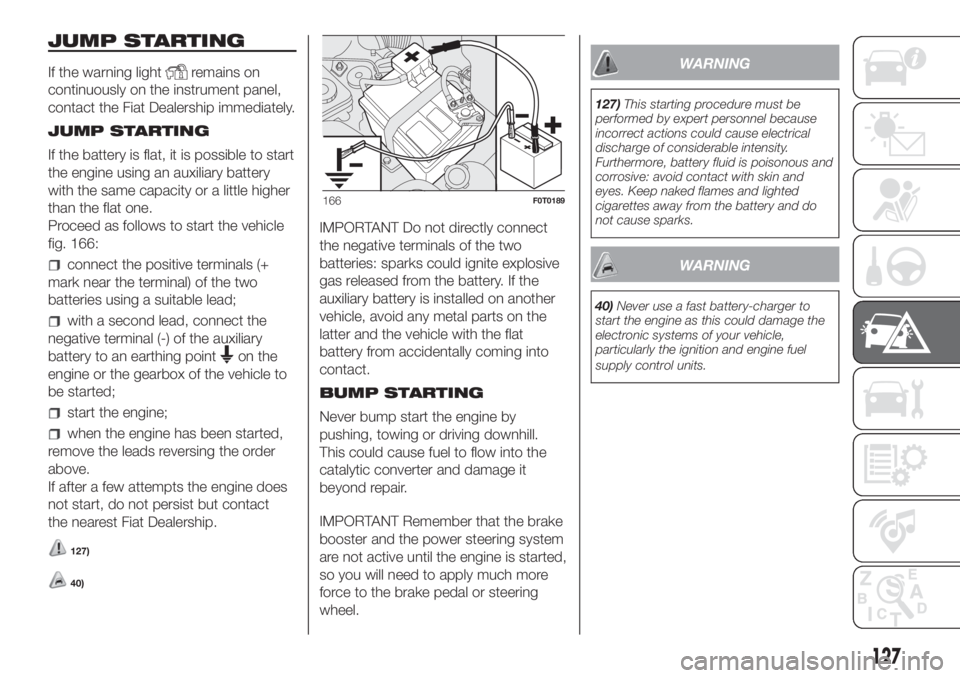
Proceed as follows to start the vehicle
fig. 166:
connect the positive terminals (+
mark near the terminal) of the two
batteries using a suitable lead;
with a second lead, connect the
negative terminal (-) of the auxiliary
battery to an earthing point
on the
engine or the gearbox of the vehicle to
be started;
start the engine;
when the engine has been started,
remove the leads reversing the order
above.
If after a few attempts the engine does
not start, do not persist but contact
the nearest Fiat Dealership.
127)
40)
IMPORTANT Do not directly connect
the negative terminals of the two
batteries: sparks could ignite explosive
gas released from the battery. If the
auxiliary battery is installed on another
vehicle, avoid any metal parts on the
latter and the vehicle with the flat
battery from accidentally coming into
contact.
BUMP STARTING
Never bump start the engine by
pushing, towing or driving downhill.
This could cause fuel to flow into the
catalytic converter and damage it
beyond repair.
IMPORTANT Remember that the brake
booster and the power steering system
are not active until the engine is started,
so you will need to apply much more
force to the brake pedal or steering
wheel.
WARNING
127)This starting procedure must be
performed by expert personnel because
incorrect actions could cause electrical
discharge of considerable intensity.
Furthermore, battery fluid is poisonous and
corrosive: avoid contact with skin and
eyes. Keep naked flames and lighted
cigarettes away from the battery and do
not cause sparks.
WARNING
40)Never use a fast battery-charger to
start the engine as this could damage the
electronic systems of your vehicle,
particularly the ignition and engine fuel
supply control units.
166F0T0189
127