suspension FIAT FREEMONT 2012 Owner handbook (in English)
[x] Cancel search | Manufacturer: FIAT, Model Year: 2012, Model line: FREEMONT, Model: FIAT FREEMONT 2012Pages: 332, PDF Size: 5.61 MB
Page 223 of 332
TOWING REQUIREMENTS
To promote proper break-in of your new vehicle drive-
train components the following guidelines are recom-mended:
Do not tow a trailer at all during the
first 805 km the new vehicle is driven.The
engine, axle or other parts could be dam-
aged.
Then, during the first 805 km that a trailer is
towed, do not drive over 80 km/h and do not make
starts at full throttle. This helps the engine and
other parts of the vehicle wear in at the heavier
loads.
Perform the maintenance listed in the Maintenance
Schedule. When towing a trailer, never exceed the
GAWR ratings.
WARNING!
Improper towing can lead to an injury
accident . Follow these guidelines to
make your trailer towing as safe as possible:
(Continued)(Continued)
Make certain that the load is secured in the
trailer and that it will not shift during travel.
When trailering cargo that is not fully secured,
dynamic load shifts can occur that may be diffi-
cult for the driver to control.You could lose con-
trol of your vehicle and have an accident .
All trailer hitches should be professionally in-
stalled on your vehicle.
When hauling cargo or towing a trailer, do not
overload your vehicle or trailer. Overloading can
cause a loss of control, poor performance, or
damage to brakes, axle, engine, transmission,
steering, suspension, chassis structure, or tires.
Safety chains must always be used between
your vehicle and trailer. Always connect the
chains to the frame or hook retainers of the
vehicle hitch. Cross the chains under the trailer
tongue and allow enough slack for turning cor-
ners.
Vehicles with trailers should not be parked on a
grade.When parking, apply the parking brake on
the tow vehicle. Always, block or "chock" the
trailer wheels.
GCWR must not be exceeded.
(Continued)
217
KNOWING
YOURVEHICLE SAFETYSTARTING ANDDRIVINGWARNING LIGHTSAND
MESSAGES
IN AN
EMERGENCY
SERVICING AND
CARETECHNICAL
SPECIFICATIONSCONTENTS
Page 268 of 332
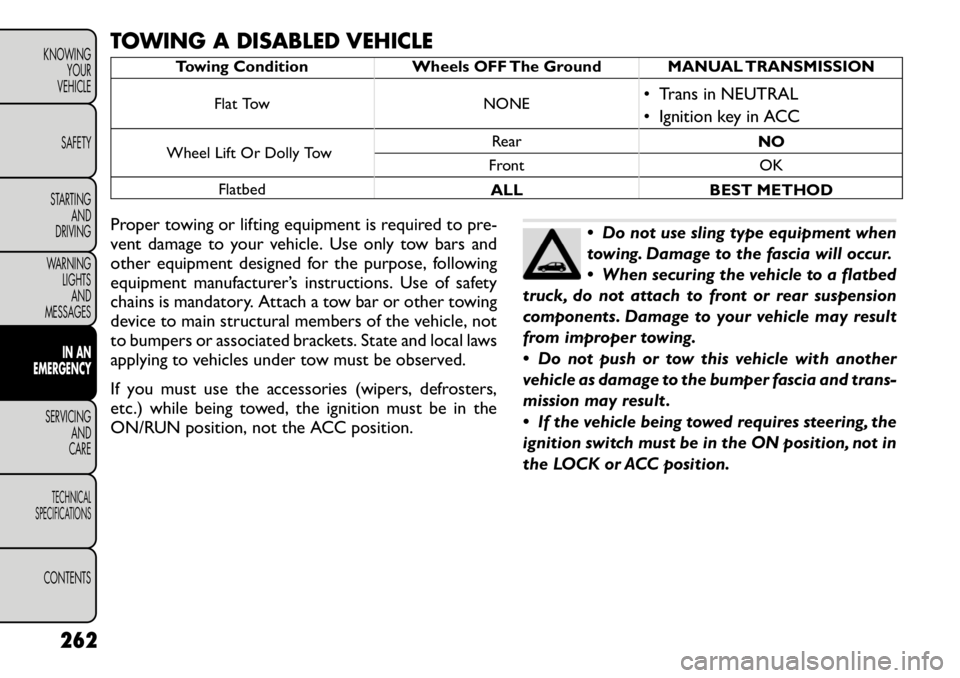
TOWING A DISABLED VEHICLE
Towing Condition Wheels OFF The Ground MANUAL TRANSMISSIONFlat Tow NONE • Trans in NEUTRAL
• Ignition key in ACC
Wheel Lift Or Dolly Tow Rear
NO
Front OK
Flatbed ALL BEST METHOD
Proper towing or lifting equipment is required to pre-
vent damage to your vehicle. Use only tow bars and
other equipment designed for the purpose, following
equipment manufacturer’s instructions. Use of safety
chains is mandatory. Attach a tow bar or other towing
device to main structural members of the vehicle, not
to bumpers or associated brackets. State and local laws
applying to vehicles under tow must be observed.
If you must use the accessories (wipers, defrosters,
etc.) while being towed, the ignition must be in the
ON/RUN position, not the ACC position.
Do not use sling type equipment when
towing. Damage to the fascia will occur.
When securing the vehicle to a flatbed
truck, do not attach to front or rear suspension
components. Damage to your vehicle may result
from improper towing.
Do not push or tow this vehicle with another
vehicle as damage to the bumper fascia and trans-
mission may result .
If the vehicle being towed requires steering, the
ignition switch must be in the ON position, not in
the LOCK or ACC position.
262
KNOWING YOUR
VEHICLE
SAFETY
STARTING AND
DRIVING
WARNING LIGHTSAND
MESSAGES
IN AN
EMERGENCY
SERVICING AND
CARETECHNICAL
SPECIFICATIONSCONTENTS
Page 273 of 332
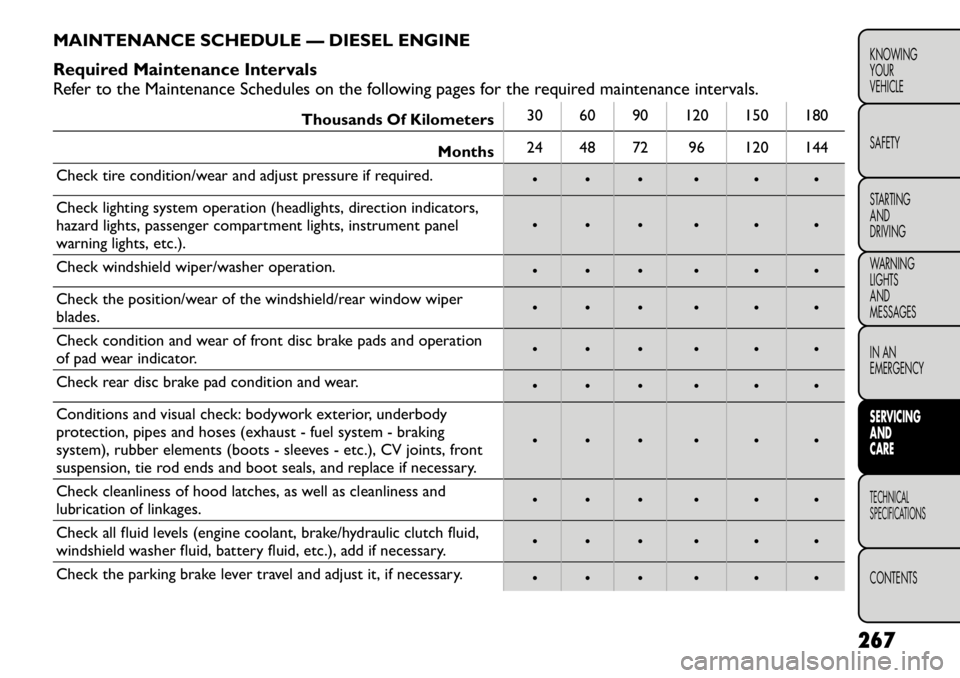
MAINTENANCE SCHEDULE — DIESEL ENGINE
Required Maintenance Intervals
Refer to the Maintenance Schedules on the following pages for the required maintenance intervals.
Thousands Of Kilometers30 60 90 120 150 180
Months 24 48 72 96 120 144
Check tire condition/wear and adjust pressure if required. • • • • • •
Check lighting system operation (headlights, direction indicators,
hazard lights, passenger compartment lights, instrument panel
warning lights, etc.). • • • • • •
Check windshield wiper/washer operation. • • • • • •
Check the position/wear of the windshield/rear window wiper
blades. • • • • • •
Check condition and wear of front disc brake pads and operation
of pad wear indicator. • • • • • •
Check rear disc brake pad condition and wear. • • • • • •
Conditions and visual check: bodywork exterior, underbody
protection, pipes and hoses (exhaust - fuel system - braking
system), rubber elements (boots - sleeves - etc.), CV joints, front
suspension, tie rod ends and boot seals, and replace if necessary. • • • • • •
Check cleanliness of hood latches, as well as cleanliness and
lubrication of linkages. • • • • • •
Check all fluid levels (engine coolant, brake/hydraulic clutch fluid,
windshield washer fluid, battery fluid, etc.), add if necessary. • • • • • •
Check the parking brake lever travel and adjust it, if necessary. • • • • • •
267
KNOWING
YOURVEHICLE SAFETY
STARTING ANDDRIVING
WARNING LIGHTSAND
MESSAGES
IN AN
EMERGENCYSERVICING AND
CARETECHNICAL
SPECIFICATIONSCONTENTS
Page 303 of 332
REPLACEMENT TIRES
The tires on your new vehicle provide a balance of
many characteristics. They should be inspected regu-
larly for wear and correct cold tire inflation pressure.
The manufacturer strongly recommends that you use
tires equivalent to the originals in size, quality and
performance when replacement is needed (refer to the
paragraph on “Tread Wear Indicators”). Refer to the
“Tire and Loading Information” placard for the size
designation of your tire. The Load Index and Speed
Symbol for your tire will be found on the original
equipment tire sidewall. See the Tire Sizing Chart
example found in the Tire Safety Information section of
this manual for more information relating to the Load
Index and Speed Symbol of a tire.
It is recommended to replace the two front tires or
two rear tires as a pair. Replacing just one tire can
seriously affect your vehicle’s handling. If you ever
replace a wheel, make sure that the wheel’s specifica-
tions match those of the original wheels.
It is recommended you contact your original equip-
ment or an authorized tire dealer with any questions
you may have on tire specifications or capability. Failure
to use equivalent replacement tires may adversely af-
fect the safety, handling, and ride of your vehicle.
WARNING!
Do not use a tire, wheel size or rating
other than that specified for your ve-
hicle. Some combinations of unapproved tires
and wheels may change suspension dimensions
and performance characteristics, resulting in
changes to steering, handling, and braking of your
vehicle. This can cause unpredictable handling
and stress to steering and suspension compo-
nents.You could lose control and have a collision
resulting in serious injury or death. Use only the
tire and wheel sizes with load ratings approved
for your vehicle.
Never use a tire with a smaller load index or
capacity, other than what was originally
equipped on your vehicle. Using a tire with a
smaller load index could result in tire overloading
and failure. You could lose control and have a
collision.
Failure to equip your vehicle with tires having
adequate speed capability can result in sudden
tire failure and loss of vehicle control.Replacing original tires with tires of a
different size may result in false speed-
ometer and odometer readings.
297
KNOWING
YOURVEHICLE SAFETY
STARTING ANDDRIVING
WARNING LIGHTSAND
MESSAGES
IN AN
EMERGENCY
SERVICING AND
CARETECHNICAL
SPECIFICATIONSCONTENTS