check engine FIAT FREEMONT 2014 1.G Owner's Manual
[x] Cancel search | Manufacturer: FIAT, Model Year: 2014, Model line: FREEMONT, Model: FIAT FREEMONT 2014 1.GPages: 388, PDF Size: 4.13 MB
Page 321 of 388
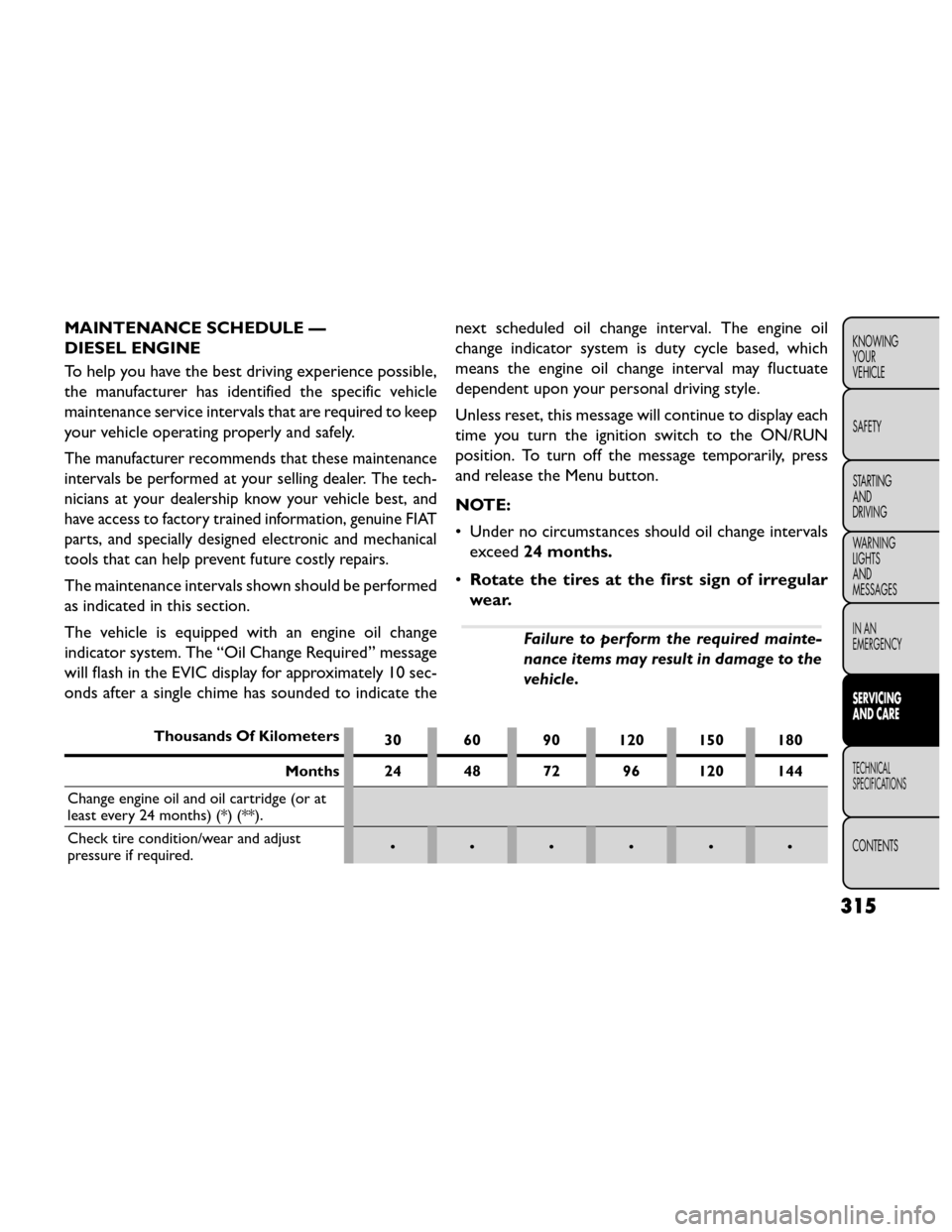
MAINTENANCE SCHEDULE —
DIESEL ENGINE
To help you have the best driving experience possible,
the manufacturer has identified the specific vehicle
maintenance service intervals that are required to keep
your vehicle operating properly and safely.
The manufacturer recommends that these maintenance
intervals be performed at your selling dealer. The tech-
nicians at your dealership know your vehicle best, and
have access to factory trained information, genuine FIAT
parts, and specially designed electronic and mechanical
tools that can help prevent future costly repairs.
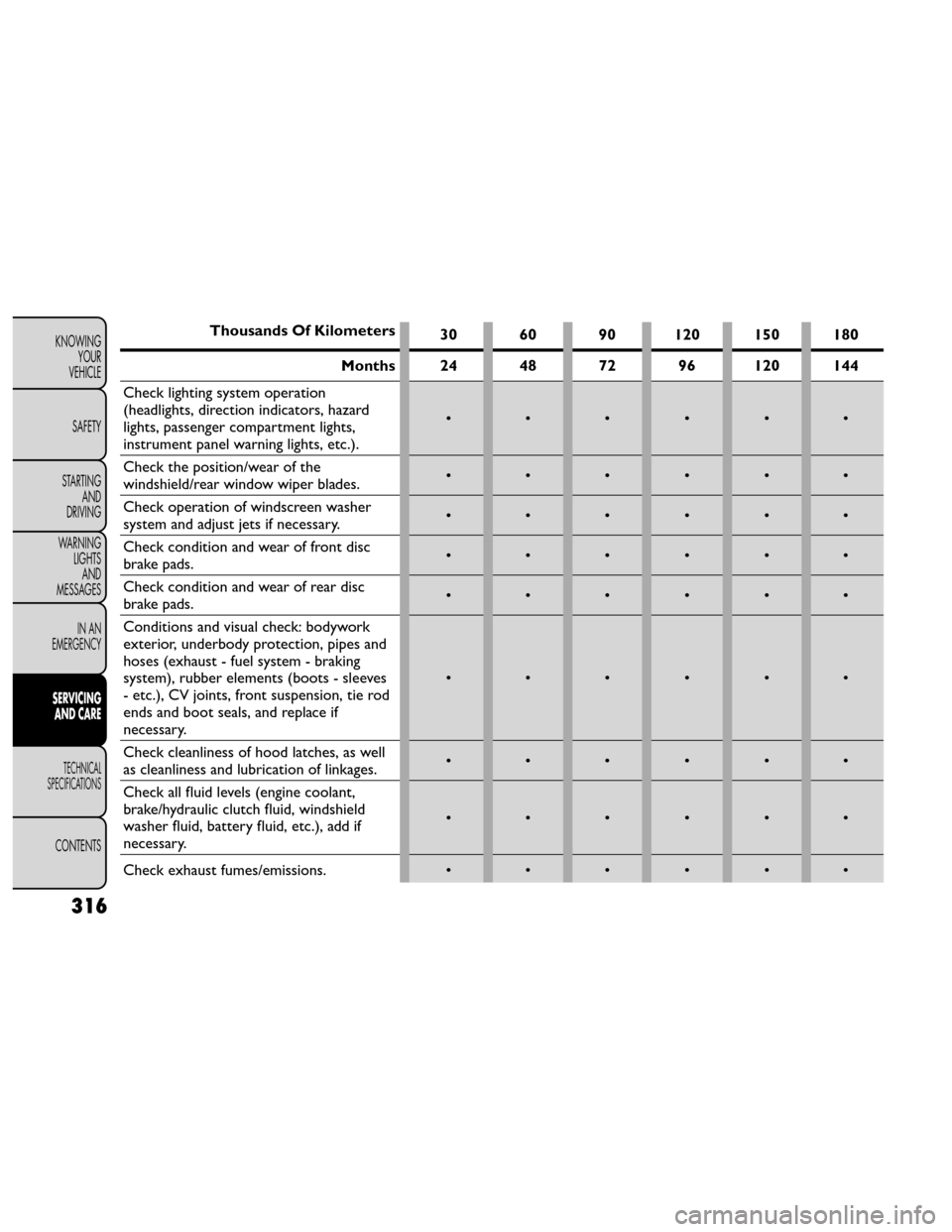
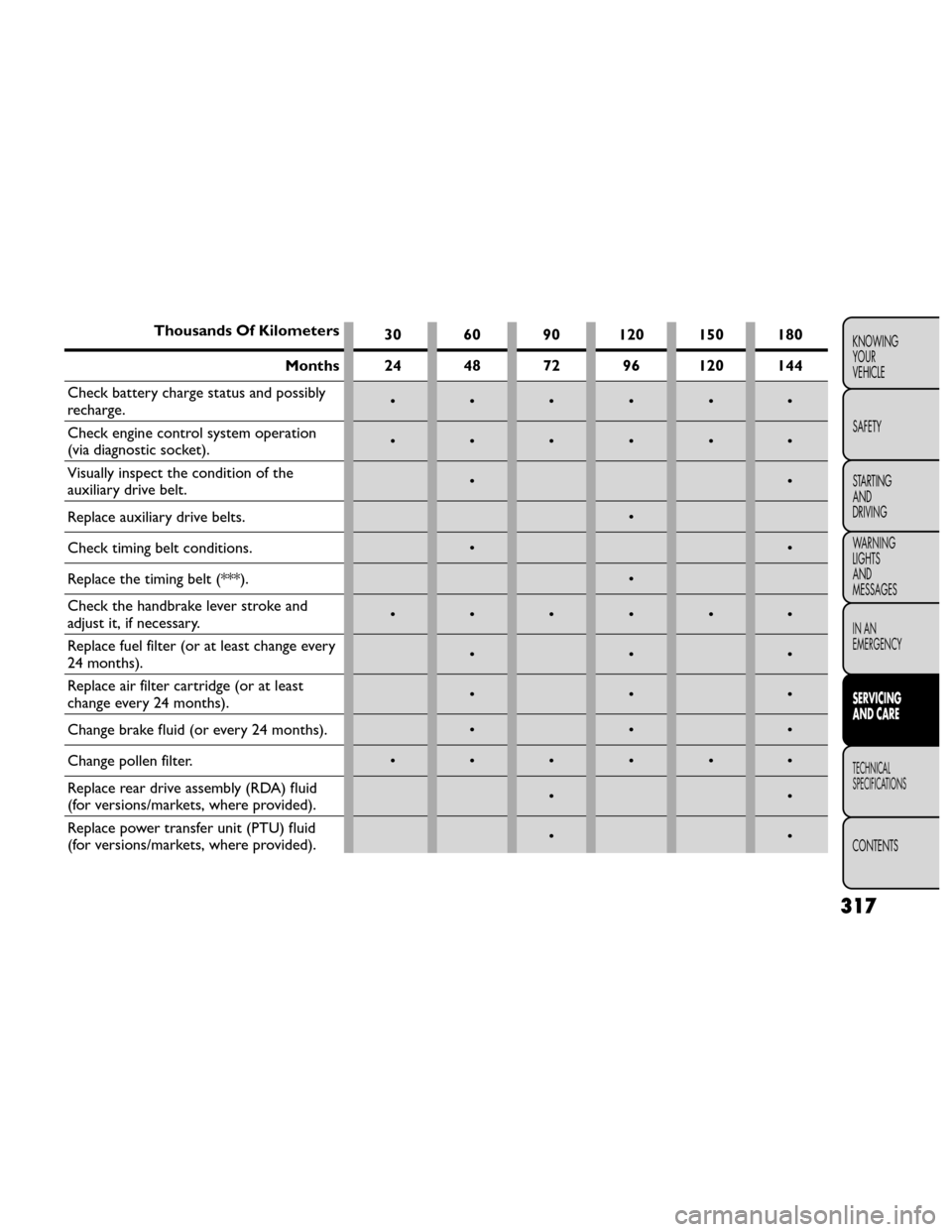
The maintenance intervals shown should be performed
as indicated in this section.
The vehicle is equipped with an engine oil change
indicator system. The “Oil Change Required” message
will flash in the EVIC display for approximately 10 sec-
onds after a single chime has sounded to indicate thenext scheduled oil change interval. The engine oil
change indicator system is duty cycle based, which
means the engine oil change interval may fluctuate
dependent upon your personal driving style.
Unless reset, this message will continue to display each
time you turn the ignition switch to the ON/RUN
position. To turn off the message temporarily, press
and release the Menu button.
NOTE:
• Under no circumstances should oil change intervals
exceed 24 months.
• Rotate the tires at the first sign of irregular
wear.
Failure to perform the required mainte-
nance items may result in damage to the
vehicle.
Thousands Of Kilometers
30 60 90 120 150 180
Months 24 48 72 96 120 144
Change engine oil and oil cartridge (or at
least every 24 months) (*) (**).
Check tire condition/wear and adjust
pressure if required. ••••••
315
KNOWING
YOUR
VEHICLE
SAFETY
STARTING
AND
DRIVING
WARNING
LIGHTS
AND
MESSAGES
IN AN
EMERGENCY
SERVICING
AND CARE
TECHNICAL
SPECIFICATIONS
CONTENTS
Page 322 of 388
Thousands Of Kilometers30 60 90 120 150 180
Months 24 48 72 96 120 144
Check lighting system operation
(headlights, direction indicators, hazard
lights, passenger compartment lights,
instrument panel warning lights, etc.). ••••••
Check the position/wear of the
windshield/rear window wiper blades. ••••••
Check operation of windscreen washer
system and adjust jets if necessary. ••••••
Check condition and wear of front disc
brake pads. ••••••
Check condition and wear of rear disc
brake pads. ••••••
Conditions and visual check: bodywork
exterior, underbody protection, pipes and
hoses (exhaust - fuel system - braking
system), rubber elements (boots - sleeves
- etc.), CV joints, front suspension, tie rod
ends and boot seals, and replace if
necessary. ••••••
Check cleanliness of hood latches, as well
as cleanliness and lubrication of linkages. ••••••
Check all fluid levels (engine coolant,
brake/hydraulic clutch fluid, windshield
washer fluid, battery fluid, etc.), add if
necessary. ••••••
Check exhaust fumes/emissions. • • • • • •
316
KNOWING
YOUR
VEHICLE
SAFETY
STARTING AND
DRIVING
WARNING LIGHTSAND
MESSAGES
IN AN
EMERGENCY
SERVICING AND CARE
TECHNICAL
SPECIFICATIONS
CONTENTS
Page 323 of 388
Thousands Of Kilometers30 60 90 120 150 180
Months 24 48 72 96 120 144
Check battery charge status and possibly
recharge. ••••••
Check engine control system operation
(via diagnostic socket). ••••••
Visually inspect the condition of the
auxiliary drive belt. ••
Replace auxiliary drive belts. •
Check timing belt conditions. ••
Replace the timing belt (***). •
Check the handbrake lever stroke and
adjust it, if necessary. ••••••
Replace fuel filter (or at least change every
24 months). •••
Replace air filter cartridge (or at least
change every 24 months). •••
Change brake fluid (or every 24 months). •••
Change pollen filter. • • • • • •
Replace rear drive assembly (RDA) fluid
(for versions/markets, where provided). ••
Replace power transfer unit (PTU) fluid
(for versions/markets, where provided). ••
317
KNOWING
YOUR
VEHICLE
SAFETY
STARTING
AND
DRIVING
WARNING
LIGHTS
AND
MESSAGES
IN AN
EMERGENCY
SERVICING
AND CARE
TECHNICAL
SPECIFICATIONS
CONTENTS
Page 324 of 388
Thousands Of Kilometers30 60 90 120 150 180
Months 24 48 72 96 120 144
Change the automatic transmission fluid
and filter (for versions/markets, where
provided) (#). •
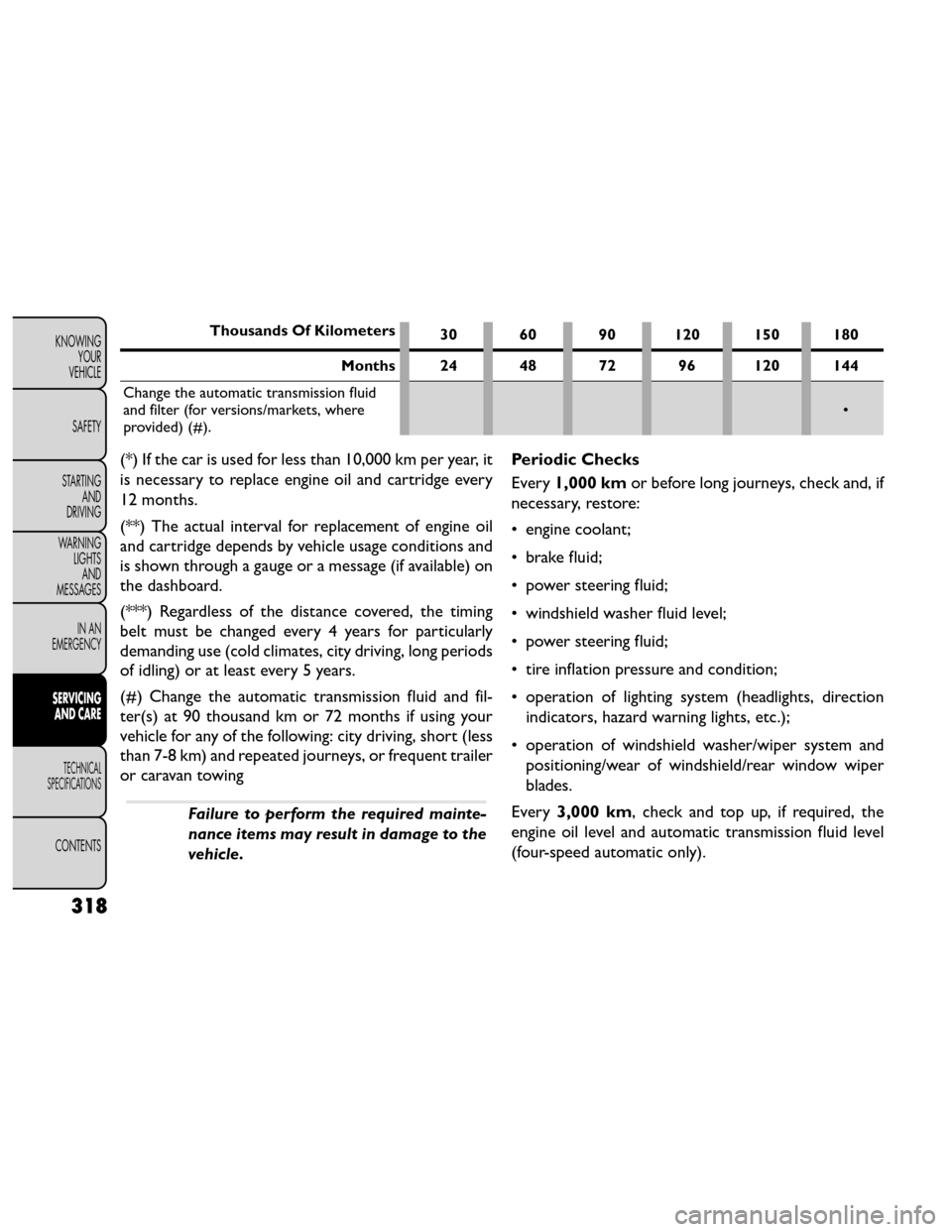
(*) If the car is used for less than 10,000 km per year, it
is necessary to replace engine oil and cartridge every
12 months.
(**) The actual interval for replacement of engine oil
and cartridge depends by vehicle usage conditions and
is shown through a gauge or a message (if available) on
the dashboard.
(***) Regardless of the distance covered, the timing
belt must be changed every 4 years for particularly
demanding use (cold climates, city driving, long periods
of idling) or at least every 5 years.
(#) Change the automatic transmission fluid and fil-
ter(s) at 90 thousand km or 72 months if using your
vehicle for any of the following: city driving, short (less
than 7-8 km) and repeated journeys, or frequent trailer
or caravan towing
Failure to perform the required mainte-
nance items may result in damage to the
vehicle.Periodic Checks
Every
1,000 km or before long journeys, check and, if
necessary, restore:
• engine coolant;
• brake fluid;
• power steering fluid;
• windshield washer fluid level;
• power steering fluid;
• tire inflation pressure and condition;
• operation of lighting system (headlights, direction indicators, hazard warning lights, etc.);
• operation of windshield washer/wiper system and positioning/wear of windshield/rear window wiper
blades.
Every 3,000 km, check and top up, if required, the
engine oil level and automatic transmission fluid level
(four-speed automatic only).
318
KNOWING YOUR
VEHICLE
SAFETY
STARTING AND
DRIVING
WARNING LIGHTSAND
MESSAGES
IN AN
EMERGENCY
SERVICING AND CARE
TECHNICAL
SPECIFICATIONS
CONTENTS
Page 325 of 388
Heavy-Duty Use Of The Car
If the car is used mainly under one of the following
conditions:
• towing a trailer or caravan;
• dusty roads;
• short, repeated journeys (less than 7-8 km) at sub-zero outside temperatures;
• engine often idling or driving long distances at low speeds or long periods of idleness.
You should perform the following inspections more
frequently than shown on the Scheduled Servicing Plan:
• check front disc brake pad conditions and wear;
• check cleanliness of hood and trunk locks, cleanli- ness and lubrication of linkage; • visually inspect conditions of: engine, transmission,
pipes and hoses (exhaust - fuel system - brakes) and
rubber elements (boots - sleeves - bushes - etc.);
• check battery charge and battery fluid level (electro- lyte);
• visually inspect condition of the accessory drive belts;
• check and, if necessary, change engine oil and replace oil filter;
• check and, if necessary, replace pollen filter;
• check and, if necessary, replace air cleaner.
319
KNOWING
YOUR
VEHICLE
SAFETY
STARTING
AND
DRIVING
WARNING
LIGHTS
AND
MESSAGES
IN AN
EMERGENCY
SERVICING
AND CARE
TECHNICAL
SPECIFICATIONS
CONTENTS
Page 330 of 388
ENGINE OIL
Checking Oil Level – Gasoline Engine
To assure proper engine lubrication, the engine oil
must be maintained at the correct level. Check the oil
level at regular intervals, such as every fuel stop.
The best time to check the engine oil level is about five
minutes after a fully warmed engine is shut off. Do not
check oil level before starting the engine after it has sat
overnight. Checking engine oil level when the engine is
cold will give you an incorrect reading.
Checking the oil while the vehicle is on level ground
and only when the engine is hot, will improve the
accuracy of the oil level readings. Maintain the oil level
between the range markings on the dipstick. Either the
range markings consist of a crosshatch zone marked
SAFE or a crosshatch zone marked with MIN at the low
end of the range and MAX at the high end of the range.
Adding 1 Quart or 1 Liter of oil when the reading is at
the low end of the range marking will raise the oil level
to the high end of the range marking.Do not overfill the engine. Overfilling the
engine will cause oil aeration, which can
lead to loss of oil pressure and an in-
crease in oil temperature.This could damage your
engine.Also, be sure the oil fill cap is replaced and
tightened after adding oil.
Checking Oil Level – Diesel Engine
To assure proper engine lubrication, the engine oil
must be maintained at the correct level. Check the oil
level at regular intervals, such as every fuel stop.
The best time to check the engine oil level is about five
minutes after a fully warmed engine is shut off or
before starting the engine after it has sat overnight.
Checking the oil while the vehicle is on level ground will
improve the accuracy of the oil level readings. Maintain
the oil level between the MIN and MAX markings on
the dipstick. Adding 1 Quart or 1 Liter of oil when the
reading is at the MIN mark will result in a MAX reading
on these engines.
324
KNOWING YOUR
VEHICLE
SAFETY
STARTING AND
DRIVING
WARNING LIGHTSAND
MESSAGES
IN AN
EMERGENCY
SERVICING AND CARE
TECHNICAL
SPECIFICATIONS
CONTENTS
Page 337 of 388
2. Lift the rear wiper arm upward to raise the wiperblade off of the liftgate glass.
3. Grab the bottom of the wiper blade and rotate it forward to unsnap the blade pivot pin from the
wiper blade holder. (fig. 197)
4. Install the wiper blade pivot pin into the wiper blade holder at the end of the wiper arm, and firmly press
the wiper blade until it snaps into place.
5. Lower the wiper blade and snap the pivot cap into place. ADDING WASHER FLUID
The windshield washer and the rear window washer
share the same fluid reservoir. The fluid reservoir is
located in the engine compartment. Be sure to check
the fluid level in the reservoir at regular intervals. Fill
the reservoir with windshield washer solvent (not
radiator antifreeze) and operate the system for a few
seconds to flush out the residual water.
When refilling the washer fluid reservoir, apply some
washer fluid to a cloth or towel and wipe the wiper
blades clean. This will help blade performance.
To prevent freeze-up of your windshield washer system
in cold weather, select a solution or mixture that meets
or exceeds the temperature range of your climate. This
rating information can be found on most washer fluid
containers.
The fluid reservoir will hold nearly 4 Liters of washer
fluid when the “Washer Fluid Low” message appears in
the EVIC display.
WARNING!
Commercially available windshield washer
solvents are flammable. They could ignite
and burn you. Care must be exercised when filling or
working around the washer solution.
(fig. 197)
1 — Wiper Blade
2 — Blade Pivot Pin
3 — Wiper Arm
4 — Wiper Blade Holder
331
KNOWING
YOUR
VEHICLE
SAFETY
STARTING
AND
DRIVING
WARNING
LIGHTS
AND
MESSAGES
IN AN
EMERGENCY
SERVICING
AND CARE
TECHNICAL
SPECIFICATIONS
CONTENTS
Page 340 of 388
Coolant Checks
Check engine coolant (antifreeze) protection every
12 months (before the onset of freezing weather,
where applicable). If coolant is dirty or rusty in appear-
ance, the system should be drained, flushed, and re-
filled with fresh coolant. Check the front of the A/C
condenser for any accumulation of bugs, leaves, etc.
If dirty, clean by gently spraying water from a garden
hose vertically down the face of the condenser.
Check the coolant recovery bottle tubing for brittle
rubber, cracking, tears, cuts, and tightness of the con-
nection at the bottle and radiator. Inspect the entire
system for leaks.
Cooling System – Drain, Flush, And Refill
Refer to the “Maintenance Schedule” for the proper
maintenance intervals.
If the solution is dirty or contains a considerable
amount of sediment, clean and flush with a reliable
cooling system cleaner. Follow with a thorough rinsing
to remove all deposits and chemicals. Properly dispose
of the old engine coolant (antifreeze) solution.Selection Of Coolant – Gasoline Engine
Use only the manufacturer's recommended coolant.
Refer to “Fluids, Lubricants, and Genuine Parts” in
“Technical Specifications” for further information.
•
Mixing of engine coolant (antifreeze)
other than specified engine coolant (an-
tifreeze), may result in engine damage
and may decrease corrosion protection. If a non-
specified engine coolant (antifreeze) is intro-
duced into the cooling system in an emergency, it
should be replaced with the specified engine cool-
ant (antifreeze) as soon as possible.
• Do not use plain water alone or alcohol-based
engine coolant (antifreeze) products. Do not use
additional rust inhibitors or antirust products, as
they may not be compatible with the radiator
engine coolant (antifreeze) and may plug the
radiator.
• This vehicle has not been designed for use with
Propylene Glycol based engine coolant (anti-
freeze). Use of Propylene Glycol based engine
coolant (antifreeze) is not recommended.
334
KNOWING YOUR
VEHICLE
SAFETY
STARTING AND
DRIVING
WARNING LIGHTSAND
MESSAGES
IN AN
EMERGENCY
SERVICING AND CARE
TECHNICAL
SPECIFICATIONS
CONTENTS
Page 342 of 388
Cooling System Pressure Cap
The cap must be fully tightened to prevent loss of
engine coolant (antifreeze), and to ensure that engine
coolant (antifreeze) will return to the radiator from the
coolant recovery tank.
The cap should be inspected and cleaned if there is any
accumulation of foreign material on the sealing sur-
faces.
WARNING!
• The warning words “DO NOT OPEN
HO T
” on the cooling system pressure
cap are a safety precaution. Never add engine
coolant (antifreeze) when the engine is over-
heated. Do not loosen or remove the cap to cool
an overheated engine. Heat causes pressure to
build up in the cooling system.To prevent scalding
or injury, do not remove the pressure cap while
the system is hot or under pressure.
• Do not use a pressure cap other than the one
specified for your vehicle. Personal injury or en-
gine damage may result . Disposal Of Used Coolant
Used ethylene glycol-based engine coolant is a regu-
lated substance requiring proper disposal. Check with
your local authorities to determine the disposal rules
for your community. To prevent ingestion by animals or
children, do not store ethylene glycol-based engine
coolant in open containers or allow it to remain in
puddles on the ground. If ingested by a child, contact a
physician immediately. Clean up any ground spills im-
mediately.
Coolant Level
The radiator normally remains completely full, so there
is no need to remove the radiator cap unless checking
for coolant freeze point or replacing coolant. Advise
your service attendant of this. As long as the engine
operating temperature is satisfactory, the coolant
bottle need only be checked once a month. When
additional coolant is needed to maintain the proper
level, it should be added to the coolant bottle. Do not
overfill.
336
KNOWING
YOUR
VEHICLE
SAFETY
STARTING AND
DRIVING
WARNING LIGHTSAND
MESSAGES
IN AN
EMERGENCY
SERVICING AND CARE
TECHNICAL
SPECIFICATIONS
CONTENTS
Page 343 of 388
Points To Remember
NOTE:When the vehicle is stopped after a few
kilometers of operation, you may observe vapor com-
ing from the front of the engine compartment. This is
normally a result of moisture from rain, snow, or high
humidity accumulating on the radiator and being vapor-
ized when the thermostat opens, allowing hot coolant
to enter the radiator.
If an examination of your engine compartment shows
no evidence of radiator or hose leaks, the vehicle may
be safely driven. The vapor will soon dissipate.
• Do not overfill the coolant recovery bottle.
• Check coolant freeze point in the radiator and in the coolant recovery bottle. If antifreeze needs to be
added, contents of coolant recovery bottle must also
be protected against freezing.
• If frequent coolant additions are required, or if the level in the coolant recovery bottle does not drop
when the engine cools, the cooling system should be
pressure tested for leaks.
• Make sure that the radiator and coolant recovery bottle overflow hoses are not kinked or obstructed.
• Keep the front of the radiator clean. If your vehicle is equipped with air conditioning, keep the front of the
condenser clean. • Do not change the thermostat for Summer or Win-
ter operation. If replacement is ever necessary, install
ONLY the correct type thermostat. Other designs
may result in unsatisfactory coolant performance,
poor gas mileage, and increased emissions.
BRAKE SYSTEM
In order to assure brake system performance, all brake
system components should be inspected periodically.
Refer to the “Maintenance Schedule” for the proper
maintenance intervals.
WARNING!
Riding the brakes can lead to brake fail-
ure and possibly
an accident . Driving
with your foot resting or riding on the brake
pedal can result in abnormally high brake tem-
peratures, excessive lining wear, and possible
brake damage.You would not have your full brak-
ing capacity in an emergency.
Car maintenance should be done at a
FIAT Dealership. For routine and minor
maintenance operations you wish to
carry out yourself, we do recommend you have
the proper equipment , genuine FIAT spare parts
and the necessary fluids; do not however carry out
these operations if you have no experience.
337
KNOWING
YOUR
VEHICLE
SAFETY
STARTING
AND
DRIVING
WARNING
LIGHTS
AND
MESSAGES
IN AN
EMERGENCY
SERVICING
AND CARE
TECHNICAL
SPECIFICATIONS
CONTENTS