instrument panel FIAT FREEMONT 2014 1.G Owner's Manual
[x] Cancel search | Manufacturer: FIAT, Model Year: 2014, Model line: FREEMONT, Model: FIAT FREEMONT 2014 1.GPages: 388, PDF Size: 4.13 MB
Page 223 of 388
This vehicle is equipped with Supplemental Side Air Bag
Inflatable Curtains (SABIC) to protect the driver, front,
and rear passengers sitting next to a window. The
SABIC air bags are located above the side windows and
their covers are also labeled: SRS AIRBAG.
This vehicle is equipped with Supplemental Seat-
Mounted Side Air Bags (SAB). The Supplemental Seat-
Mounted Side Air Bags are marked with an air bag label
sewn into the outboard side of the front seats.
NOTE:
• Air Bag covers may not be obvious in the interiortrim, but they will open during air bag deployment.
• After any accident, the vehicle should be taken to an authorized dealer immediately.
Air Bag System Components
Your vehicle may be equipped with the following air bag
system components:
• Occupant Restraint Controller (ORC)
• Air Bag Warning Light
• Steering Wheel and Column • Instrument Panel
• Knee Impact Bolsters
• Driver Advanced Front Air Bag
• Passenger Advanced Front Air Bag
• Supplemental Seat-Mounted Side Air Bags (SAB)
• Supplemental Side Air Bag Inflatable Curtains
(SABIC)
• Front and Side Impact Sensors
• Front Seat Belt Pretensioners
• Seat Belt Buckle Switch
Advanced Front Air Bag Features
The Advanced Front Air Bag system has multistage
driver and front passenger air bags. This system pro-
vides output appropriate to the severity and type of
collision as determined by the Occupant Restraint
Controller (ORC), which may receive information
from the front impact sensors.
217
KNOWING
YOUR
VEHICLE
SAFETY
STARTING
AND
DRIVING
WARNING
LIGHTS
AND
MESSAGES
IN AN
EMERGENCY
SERVICING
AND CARE
TECHNICAL
SPECIFICATIONS
CONTENTS
Page 224 of 388
The first stage inflator is triggered immediately during
an impact that requires air bag deployment. This low
output is used in less severe collisions. A higher energy
output is used for more severe collisions.
WARNING!
• No objects should be placed over or
near t
he air bag on the instrument
panel, because any such objects could cause
harm if the vehicle is in a collision severe enough
to cause the air bag to inflate.
• Do not put anything on or around the air bag
covers or attempt to open them manually. You
may damage the air bags and you could be
injured because the air bags may no longer be
functional. The protective covers for the air bag
cushions are designed to open only when the air
bags are inflating.
• Do not drill, cut or tamper with the knee bol-
ster in any way.
• Do not mount any accessories to the knee
bolster such as alarm lights, stereos, citizen band
radios, etc . Supplemental Seat-Mounted Side Air Bags
(SAB)
SAB may provide enhanced protection to help protect
an occupant during a side impact. The SAB is marked
with an air bag label sewn into the outboard side of the
front seats.
(fig. 149)
When the air bag deploys, it opens the seam between
the front and side of the seat's trim cover. Each air bag
deploys independently; a left side impact deploys the
left air bag only and a right-side impact deploys the
right air bag only.
(fig. 149)
Seat Mounted Side Air Bag Label
218
KNOWINGYOUR
VEHICLE
SAFETY
STARTING AND
DRIVING
WARNING LIGHTSAND
MESSAGES
IN AN
EMERGENCY
SERVICING AND CARE
TECHNICAL
SPECIFICATIONS
CONTENTS
Page 227 of 388
of impact, Advanced Front Air Bags may deploy in
crashes with little vehicle front-end damage but that
produce a severe initial deceleration.
The side air bags will not deploy in all side collisions.
Side air bag deployment will depend on the severity and
type of collision.
Because air bag sensors measure vehicle deceleration
over time, vehicle speed and damage by themselves are
not good indicators of whether or not an air bag should
have deployed.
Seat belts are necessary for your protection in all
collisions, and also are needed to help keep you in
position, away from an inflating air bag.
The ORC monitors the readiness of the electronic
parts of the air bag system whenever the ignition is in
the ON/RUN position. If the ignition is in the OFF
position, or in the ACC position, the air bag system is
not on and the air bags will not inflate.
The ORC contains a backup power supply system that
may deploy the air bags even if the battery loses power
or it becomes disconnected prior to deployment.Also, the ORC turns on the Air Bag Warning
Light in the instrument panel for approxi-
mately four to eight seconds for a self-check
when the ignition is first turned on. After the self-
check, the Air Bag Warning Light will turn off. If the ORC detects a malfunction in any part of the system, it
turns on the Air Bag Warning Light, either momentarily
or continuously. A single chime will sound if the light
comes on again after initial startup.
It also includes diagnostics that will illuminate the
instrument cluster Air Bag Warning Light if a malfunc-
tion is noted that could affect the air bag system. The
diagnostics also record the nature of the malfunction.
WARNING!
Ignoring the Air Bag Warning Light in
your ins t
rument panel could mean you
won't have the air bags to protect you in a
collision. If the light does not come on as a bulb
check when the ignition is first turned on, stays
on after you start the vehicle, or if it comes on as
you drive, have an authorized dealer service the
air bag system immediately.
Driver And Passenger Advanced Front Air Bag
Inflator Units
The Driver and Passenger Advanced Front Air Bag Infla-
tor Units are located in the center of the steering wheel
and on the right side of the instrument panel. When the
ORC detects a collision requiring the Advanced Front
Air Bags, it signals the inflator units. A large quantity of
non-toxic gas is generated to inflate the Advanced Front
221
KNOWING
YOUR
VEHICLE
SAFETY
STARTING
AND
DRIVING
WARNING
LIGHTS
AND
MESSAGES
IN AN
EMERGENCY
SERVICING
AND CARE
TECHNICAL
SPECIFICATIONS
CONTENTS
Page 228 of 388
Air Bags. Different air bag inflation rates are possible,
based on several factors, including the collision type and
severity. The steering wheel hub trim cover and the
upper right side of the instrument panel separate and
fold out of the way as the air bags inflate to their full size.
The air bags fully inflate in about 50 to 70 milliseconds.
This is about half of the time it takes to blink your eyes.
The air bags then quickly deflate while helping to restrain
the driver and front passenger.
The Advanced Front Air Bag gas is vented through the
vent holes in the sides of the air bag. In this way, the air
bags do not interfere with your control of the vehicle.
Supplemental Seat-Mounted Side Air Bag
(SAB) Inflator Units
The Supplemental Seat-Mounted Side Air Bags (SAB)
are designed to activate only in certain side collisions.
The ORC determines if a side collision requires the
side air bags to inflate, based on the severity and type of
collision.
Based on the severity and type of collision, the side air
bag inflator on the crash side of the vehicle may be
triggered, releasing a large quantity of non-toxic gas.
The inflating SAB exits through the seat seam into the
space between the occupant and the door. The SAB
fully inflates in about 10 milliseconds. The side air bag
moves at a very high speed and with such a high force
that it could injure you if you are not seated properly,or if items are positioned in the area where the side air
bag inflates. This especially applies to children.
Supplemental Side Air Bag Inflatable Curtain
(SABIC) Inflator Units
During collisions where the impact is confined to a
particular area of the side of the vehicle, the ORC may
deploy the SABIC air bags, depending on the severity and
type of collision. In these events, the ORC will deploy
the SABIC only on the impact side of the vehicle.
A quantity of non-toxic gas is generated to inflate the
side curtain air bag. The inflating side curtain air bag
pushes the outside edge of the headliner out of the way
and covers the window. The air bag inflates in about 30
milliseconds (about one-quarter of the time that it takes
to blink your eyes) with enough force to injure you if you
are not belted and seated properly, or if items are
positioned in the area where the side curtain air bag
inflates. This especially applies to children. The side
curtain air bag is only about 9 cm thick when it is inflated.
Because air bag sensors estimate deceleration over
time, vehicle speed and damage are not good indicators
of whether or not an air bag should have deployed.
NOTE:
In a rollover the pretensioners and/or SAB and
SABIC air bags may deploy on both sides of the vehicle.
222
KNOWING YOUR
VEHICLE
SAFETY
STARTING AND
DRIVING
WARNING LIGHTSAND
MESSAGES
IN AN
EMERGENCY
SERVICING AND CARE
TECHNICAL
SPECIFICATIONS
CONTENTS
Page 241 of 388
Automatic Transmission
The foot operated parking brake is located below the
lower left corner of the instrument panel. To apply the
park brake, firmly push the park brake pedal fully. To
release the parking brake, press the park brake pedal a
second time and let your foot up as you feel the brake
disengage.
(fig. 152)
When the parking brake is applied with the ignition
switch ON, the “Brake Warning Light” in the instru-
ment cluster will illuminate.NOTE:
• When the parking brake is applied and the automatic
transmission is placed in gear, the “Brake Warning
Light” will flash. If vehicle speed is detected, a chime
will sound to alert the driver. Fully release the park-
ing brake before attempting to move the vehicle.
• This light only shows that the parking brake is ap- plied. It does not show the degree of brake applica-
tion.
When parking on a hill, it is important to turn the front
wheels toward the curb on a downhill grade and away
from the curb on an uphill grade. For vehicles equipped
with an automatic transmission, apply the parking
brake before placing the shift lever in PARK, otherwise
the load on the transmission locking mechanism may
make it difficult to move the shift lever out of PARK.
The parking brake should always be applied whenever
the driver is not in the vehicle.
WARNING!
• Never use PARK position on an auto-
mat i
c transmission as a substitute for
the parking brake. Always apply the parking
brake fully when parked to guard against vehicle
movement and possible injury or damage.
(Continued)
(fig. 152)Parking Brake
235
KNOWING
YOUR
VEHICLE
SAFETY
STARTING
AND
DRIVING
WARNING
LIGHTS
AND
MESSAGES
IN AN
EMERGENCY
SERVICING
AND CARE
TECHNICAL
SPECIFICATIONS
CONTENTS
Page 294 of 388
Check that the Mode Select Knob (5) is in the
Sealant Mode position and not Air Mode. Press the
Power Button (4) to turn On the TIREFIT kit.
2. Connect the Power Plug (8) to a different 12 Volt power outlet in your vehicle or another vehicle, if
available. Make sure the engine is running before
turning ON the TIREFIT kit.
3. The Sealant Bottle (1) may be empty due to previ- ous use. Call for assistance.
NOTE: If the Mode Select Knob (5) is on Air Mode
and the pump is operating, air will dispense from the
Air Pump Hose (7) only, not the Sealant Hose (6).
If the sealant (white fluid) does flow through the
Sealant Hose (6):
1. Continue to operate the pump until sealant is no longer flowing through hose (typically takes 30 -
70 seconds). As the sealant flows through the Seal-
ant Hose (6), the Pressure Gauge (3) can read as
high as 5 Bar. The Pressure Gauge (3) will decrease
quickly from approximately 5 Bar to the actual tire
pressure when the Sealant Bottle (1) is empty.
2. The pump will start to inject air into the tire immediately after the Sealant Bottle (1) is empty.
Continue to operate the pump and inflate the tire to the pressure indicated on the tire pressure label
on the driver-side latch pillar (recommended pres-
sure). Check the tire pressure by looking at the
Pressure Gauge (3).
If the tire does not inflate to at least 1.8 Bar
pressure within 15 minutes:
• The tire is too badly damaged. Do not attempt to drive the vehicle further. Call for assistance.
NOTE: If the tire becomes over-inflated, press the
Deflation Button to reduce the tire pressure to the
recommended inflation pressure before continuing.
If the tire inflates to the recommended pressure
or is at least 1.8 Bar pressure within 15 minutes:
1. Press the Power Button (4) to turn off the TIREFIT kit.
2. Remove the Speed Limit sticker from the top of the Sealant Bottle (1) and place the sticker on the
instrument panel.
3. Immediately disconnect the Sealant Hose (6) from the valve stem, reinstall the cap on the fitting at the
end of the hose, and place the TIREFIT kit in the
vehicle storage location. Quickly proceed to (D)
“Drive Vehicle”.
288
KNOWING YOUR
VEHICLE
SAFETY
STARTING AND
DRIVING
WARNING LIGHTSAND
MESSAGES
IN AN
EMERGENCY
SERVICING AND CARE
TECHNICAL
SPECIFICATIONS
CONTENTS
Page 304 of 388
FUSES
WARNING!
• When replacing a blown fuse, always
use a n
appropriate replacement fuse
with the same amp rating as the original fuse.
Never replace a fuse with another fuse of higher
amp rating. Never replace a blown fuse with
metal wires or any other material. Failure to use
proper fuses may result in serious personal in-
jury, fire and/or property damage.
• Before replacing a fuse, make sure that the
ignitionisoffandthatalltheotherservicesare
switched off and/or disengaged.
• If the replaced fuse blows again, contact an
authorized dealer.
• If a general protection fuse for safety systems
(air bag system, braking system), power unit sys-
tems (engine system, gearbox system) or steering
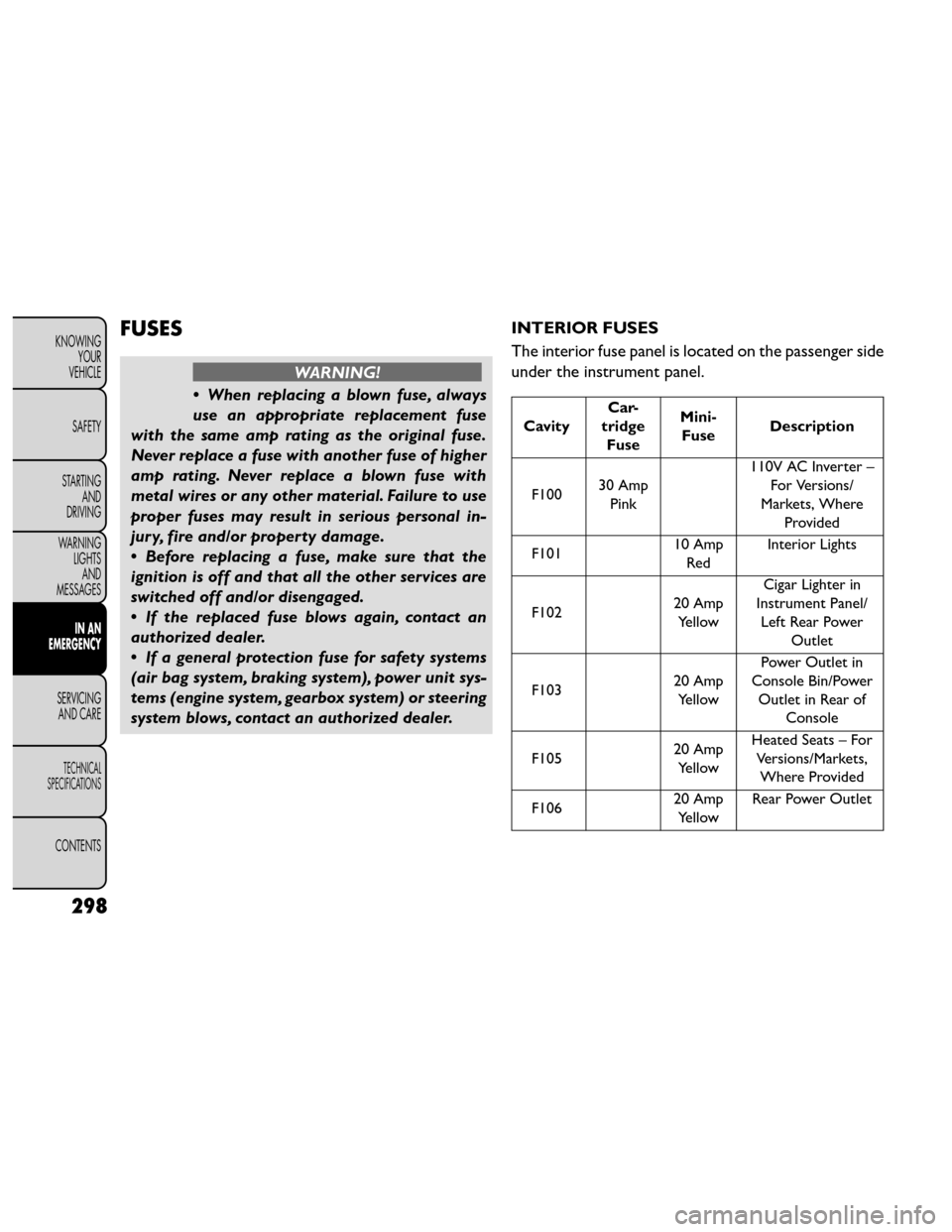
system blows, contact an authorized dealer. INTERIOR FUSES
The interior fuse panel is located on the passenger side
under the instrument panel.
Cavity
Car-
tridge Fuse Mini-
Fuse Description
F100 30 Amp
Pink 110V AC Inverter –
For Versions/
Markets, Where Provided
F101 10 Amp
Red Interior Lights
F102 20 Amp
Yellow Cigar Lighter in
Instrument Panel/ Left Rear Power Outlet
F103 20 Amp
Yellow Power Outlet in
Console Bin/Power Outlet in Rear of Console
F105 20 Amp
Yellow Heated Seats – For
Versions/Markets,Where Provided
F106 20 Amp
Yellow Rear Power Outlet
298
KNOWING
YOUR
VEHICLE
SAFETY
STARTING AND
DRIVING
WARNING LIGHTSAND
MESSAGES
IN AN
EMERGENCY
SERVICING AND CARE
TECHNICAL
SPECIFICATIONS
CONTENTS
Page 305 of 388
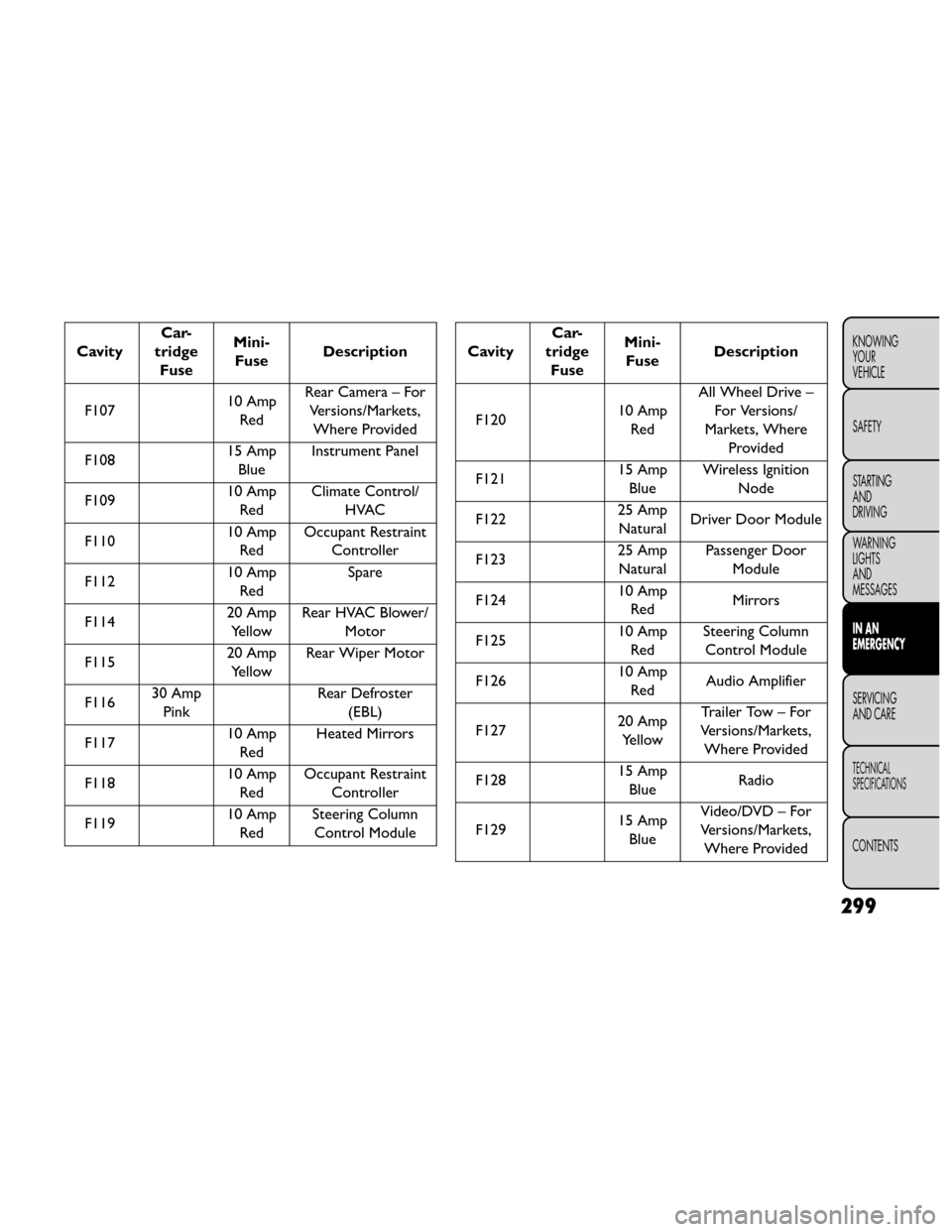
CavityCar-
tridge Fuse Mini-
Fuse Description
F107 10 Amp
Red Rear Camera – For
Versions/Markets,Where Provided
F108 15 Amp
Blue Instrument Panel
F109 10 Amp
Red Climate Control/
HVAC
F110 10 Amp
Red Occupant Restraint
Controller
F112 10 Amp
Red Spare
F114 20 Amp
Yellow Rear HVAC Blower/
Motor
F115 20 Amp
Yellow Rear Wiper Motor
F116 30 Amp
Pink Rear Defroster
(EBL)
F117 10 Amp
Red Heated Mirrors
F118 10 Amp
Red Occupant Restraint
Controller
F119 10 Amp
Red Steering Column
Control ModuleCavity Car-
tridge Fuse Mini-
Fuse Description
F120 10 Amp
Red All Wheel Drive –
For Versions/
Markets, Where Provided
F121 15 Amp
Blue Wireless Ignition
Node
F122 25 Amp
Natural Driver Door Module
F123 25 Amp
Natural Passenger Door
Module
F124 10 Amp
Red Mirrors
F125 10 Amp
Red Steering Column
Control Module
F126 10 Amp
Red Audio Amplifier
F127 20 Amp
Yellow Trailer Tow – For
Versions/Markets, Where Provided
F128 15 Amp
Blue Radio
F129 15 Amp
Blue Video/DVD – For
Versions/Markets, Where Provided
299
KNOWING
YOUR
VEHICLE
SAFETY
STARTING
AND
DRIVING
WARNING
LIGHTS
AND
MESSAGES
IN AN
EMERGENCY
SERVICING
AND CARE
TECHNICAL
SPECIFICATIONS
CONTENTS
Page 306 of 388
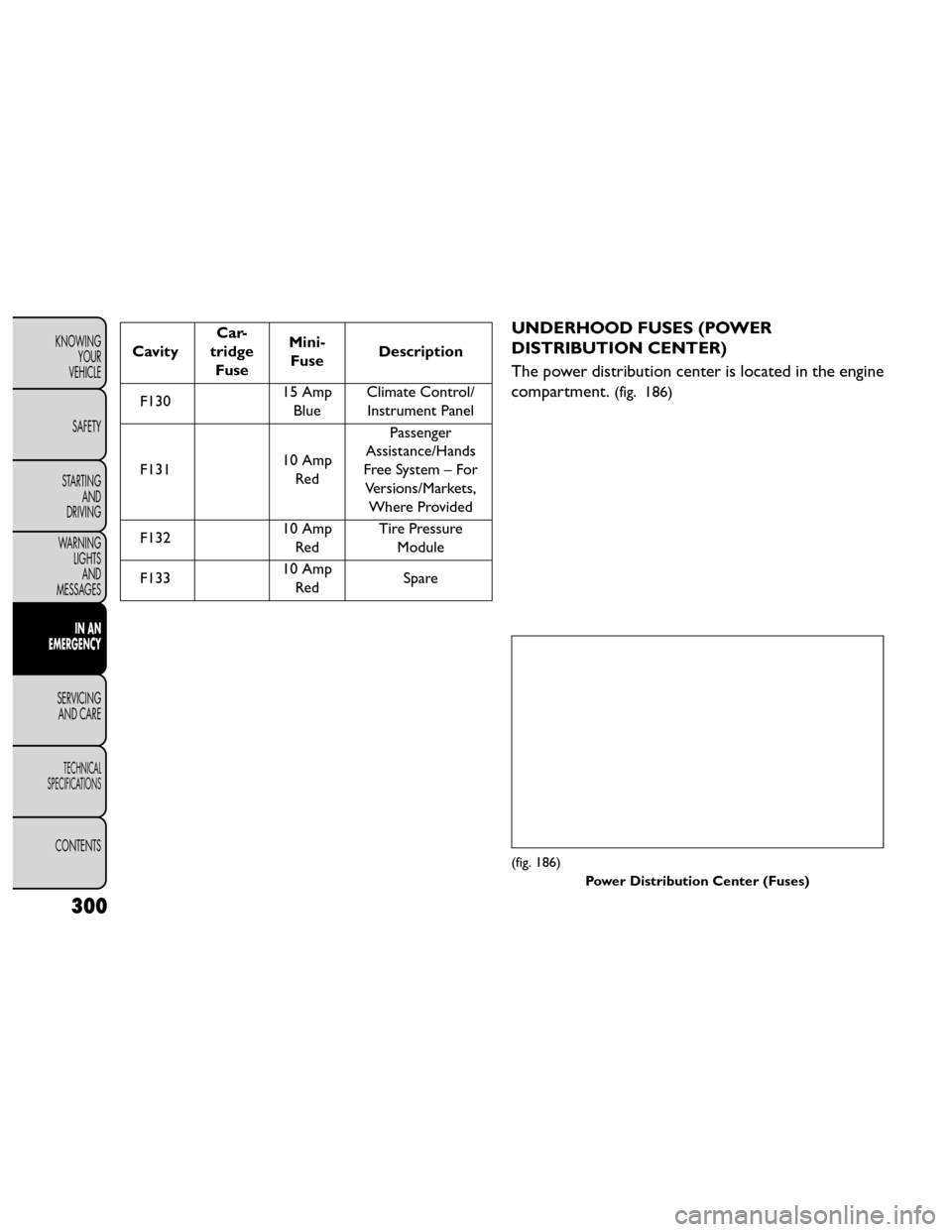
CavityCar-
tridge Fuse Mini-
Fuse Description
F130 15 Amp
Blue Climate Control/
Instrument Panel
F131 10 Amp
Red Passenger
Assistance/Hands
Free System – For Versions/Markets, Where Provided
F132 10 Amp
Red Tire Pressure
Module
F133 10 Amp
Red Spare
UNDERHOOD FUSES (POWER
DISTRIBUTION CENTER)
The power distribution center is located in the engine
compartment.
(fig. 186)
(fig. 186)
Power Distribution Center (Fuses)
300
KNOWINGYOUR
VEHICLE
SAFETY
STARTING AND
DRIVING
WARNING LIGHTSAND
MESSAGES
IN AN
EMERGENCY
SERVICING AND CARE
TECHNICAL
SPECIFICATIONS
CONTENTS
Page 318 of 388
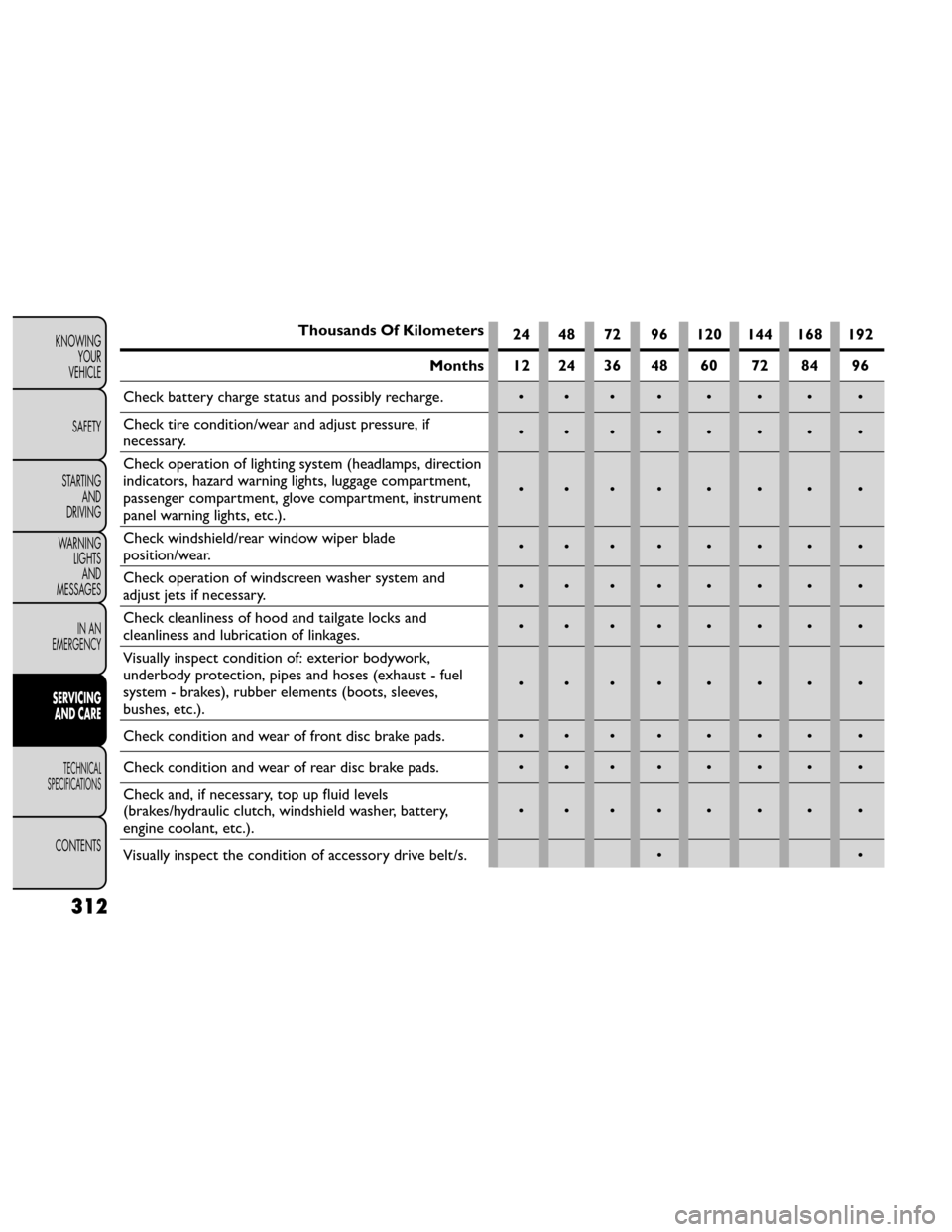
Thousands Of Kilometers24 48 72 96 120 144 168 192
Months 12 24 36 48 60 72 84 96
Check battery charge status and possibly recharge. • • • • ••••
Check tire condition/wear and adjust pressure, if
necessary. ••••••••
Check operation of lighting system (headlamps, direction
indicators, hazard warning lights, luggage compartment,
passenger compartment, glove compartment, instrument
panel warning lights, etc.). ••••••••
Check windshield/rear window wiper blade
position/wear. ••••••••
Check operation of windscreen washer system and
adjust jets if necessary. ••••••••
Check cleanliness of hood and tailgate locks and
cleanliness and lubrication of linkages. ••••••••
Visually inspect condition of: exterior bodywork,
underbody protection, pipes and hoses (exhaust - fuel
system - brakes), rubber elements (boots, sleeves,
bushes, etc.). ••••••••
Check condition and wear of front disc brake pads. • • • • ••••
Check condition and wear of rear disc brake pads. • • • •••••
Check and, if necessary, top up fluid levels
(brakes/hydraulic clutch, windshield washer, battery,
engine coolant, etc.). ••••••••
Visually inspect the condition of accessory drive belt/s. ••
312
KNOWING
YOUR
VEHICLE
SAFETY
STARTING AND
DRIVING
WARNING LIGHTSAND
MESSAGES
IN AN
EMERGENCY
SERVICING AND CARE
TECHNICAL
SPECIFICATIONS
CONTENTS