brake FIAT FREEMONT 2014 1.G Repair Manual
[x] Cancel search | Manufacturer: FIAT, Model Year: 2014, Model line: FREEMONT, Model: FIAT FREEMONT 2014 1.GPages: 388, PDF Size: 4.13 MB
Page 344 of 388
Master Cylinder – Brake Fluid Level Check
Check the fluid level in the master cylinder immediately
if the “Brake Warning Light” indicates system failure.
Check the fluid level in the master cylinder when
performing underhood services.
Clean the top of the master cylinder area before
removing the cap. If necessary, add fluid to bring the
fluid level up to the requirements described on the
brake fluid reservoir.
Overfilling of fluid is not recommended because it may
cause leaking in the system.
Fluid level can be expected to fall as the brake pads
wear. Brake fluid level should be checked when pads are
replaced. However, low fluid level may be caused by a
leak and a checkup may be needed.
NOTE:If your vehicle is equipped with a manual
transmission, the brake fluid reservoir supplies fluid
to both the brake system and the clutch release sys-
tem. The two systems are separated in the reservoir,
and a leak in one system will not affect the other
system. The manual transmission clutch release
system should not require fluid replacement during the
life of the vehicle. If the brake fluid reservoir is low and
the brake system does not indicate any leaks or other
problems, it may be a result of a leak in the hydraulic clutch release system. See your local authorized dealer
for service.
Use only manufacturer's recommended brake fluid.
Refer to “Fluids, Lubricants, and Genuine Parts” in
“Technical Specifications” for further information.
WARNING!
• Use only manufacturer's recom-
me n
ded brake fluid. Refer to “Fluids, Lu-
bricants, and Genuine Parts” in “Technical Speci-
fications” for further information. Using the
wrong type of brake fluid can severely damage
your brake system and/or impair its perfor-
mance. The proper type of brake fluid for your
vehicle is also identified on the original factory
installed hydraulic master cylinder reservoir.
• To avoid contamination from foreign matter or
moisture, use only new brake fluid or fluid that
has been in a tightly closed container. Keep the
master cylinder reservoir cap secured at all
times. Brake fluid in a open container absorbs
moisture from the air resulting in a lower boiling
point . This may cause it to boil unexpectedly
during hard or prolonged braking, resulting in
sudden brake failure. This could result in a acci-
dent .
(Continued)
338
KNOWINGYOUR
VEHICLE
SAFETY
STARTING AND
DRIVING
WARNING LIGHTSAND
MESSAGES
IN AN
EMERGENCY
SERVICING AND CARE
TECHNICAL
SPECIFICATIONS
CONTENTS
Page 345 of 388
(Continued)
• Overfilling the brake fluid reservoir can result
in spilling brake fluid on hot engine parts, causing
the brake fluid to catch fire. Brake fluid can also
damage painted and vinyl surfaces, care should
be taken to avoid its contact with these surfaces.
• Do not allow petroleum based fluid to con-
taminate the brake fluid. Brake seal components
could be damaged, causing partial or complete
brake failure.This could result in an accident .
AUTOMATIC TRANSMISSION
(for versions/markets, where provided)
Selection Of Lubricant
It is important to use the proper transmission fluid to
ensure optimum transmission performance and life.
Use only the manufacturer’s specified transmission
fluid. Refer to “Fluids, Lubricants, and Genuine Parts”
in “Technical Specifications” for fluid specifications. It is
important to maintain the transmission fluid at the
correct level using the recommended fluid. No chemi-
cal flushes should be used in any transmission; only the
approved lubricant should be used.Using a transmission fluid other than the
manufacturer ’s recommended fluid may
cause deterioration in transmission shift
quality and/or torque converter shudder, and will
require more frequent fluid and filter changes.
Refer to “Fluids, Lubricants, and Genuine Parts” in
"Technical Specifications" for fluid specifica-
tions.
Special Additives
The manufacturer strongly recommends against using
any special additives in the transmission. Automatic
Transmission Fluid (ATF) is an engineered product and
its performance may be impaired by supplemental ad-
ditives. Therefore, do not add any fluid additives to the
transmission. The only exception to this policy is the
use of special dyes for diagnosing fluid leaks. Avoid
using transmission sealers as they may adversely affect
seals.
Do not use chemical flushes in your
transmission as the chemicals can dam-
age your transmission components. Such
damage is not covered by the New Vehicle Limited
Wa r r a n t y .
339
KNOWING
YOUR
VEHICLE
SAFETY
STARTING
AND
DRIVING
WARNING
LIGHTS
AND
MESSAGES
IN AN
EMERGENCY
SERVICING
AND CARE
TECHNICAL
SPECIFICATIONS
CONTENTS
Page 346 of 388
Fluid Level Check - Six-Speed Transmission
The fluid level is preset at the factory and does not
require adjustment under normal operating conditions.
Routine fluid level checks are not required, therefore
the transmission filler tube is capped and no dipstick is
provided. Your authorized dealer can check your trans-
mission fluid level using a special service dipstick. If you
notice fluid leakage or transmission malfunction, visit
your authorized dealer immediately to have the trans-
mission fluid level checked. Operating the vehicle with
an improper fluid level can cause severe transmission
damage.
If a transmission fluid leak occurs, visit
your authorized dealer immediately.
Severe transmission damage may occur.
Your authorized dealer has the proper tools to
adjust the fluid level accurately.
Car maintenance should be done at a
FIAT Dealership. For routine and minor
maintenance operations you wish to
carry out yourself, we do recommend you have
the proper equipment , genuine FIAT spare parts
and the necessary fluids; do not however carry out
these operations if you have no experience. Fluid Level Check – Four-Speed Automatic
Use the following procedure to check the transmission
fluid level properly:
1. Park the vehicle on level ground.
2. Run the engine at normal idle speed for at least
60 seconds, and leave the engine running for the rest
of this procedure.
3. Fully apply the parking brake, and press the brake pedal.
4. Place the shift lever momentarily into each gear position (allowing time for the transmission to fully
engage in each position), ending with the transmis-
sion in PARK.
5. Wipe the area around the dipstick clean to prevent dirt from entering the transmission.
6. Remove the dipstick and determine if the fluid is hot or cold. Hot fluid is approximately 82° C, which
is the normal operating temperature after the ve-
hicle is driven at least 24 km. Hot fluid cannot be
held comfortably between the fingertips. Cold fluid
is at a temperature of approximately 27° C.
340
KNOWING YOUR
VEHICLE
SAFETY
STARTING AND
DRIVING
WARNING LIGHTSAND
MESSAGES
IN AN
EMERGENCY
SERVICING AND CARE
TECHNICAL
SPECIFICATIONS
CONTENTS
Page 347 of 388
7. Wipe the dipstick clean and reinsert it until seated.Then, remove the dipstick and note the fluid level
on both sides. The fluid level reading is only valid if
there is a solid coating of oil on both sides of the
dipstick. Note that the holes in the dipstick will be
full of fluid if the actual level is at or above the hole.
• If the fluid is hot, the fluid level should be in the crosshatched area marked “HOT” (between the up-
per two holes in the dipstick).
• If the fluid is cold, the fluid level should be between the lower two holes in the area marked “COLD.”
If the fluid level is low, add fluid through the dipstick
tube to bring it to the proper level. Do not overfill.
After adding any quantity of oil through the dipstick
tube, wait at least two minutes for the oil to fully
drain into the transmission before rechecking the
fluid level.
8. Check for leaks. Release the parking brake.
To prevent dirt and water from entering the transmis-
sion after checking or replenishing fluid, make sure that
the dipstick cap is properly re-seated.• Using a transmission fluid other than
the manufacturer ’s recommended fluid
may cause deterioration in transmission
shift quality and/or torque converter shudder, and
will require more frequent fluid and filter
changes. Refer to “Fluids, Lubricants, and Genuine
Parts” in "Technical Specifications" for fluid
specifications.
• Dirt and water in the transmission can cause
serious damage. To prevent dirt and water from
entering the transmission after checking or re-
plenishing fluid, make sure that the dipstick cap is
re-seated properly.
Fluid And Filter Changes
Refer to the “Maintenance Schedule” for the proper
maintenance intervals.
In addition, change the fluid and filter if the fluid
becomes contaminated (with water, etc.), or if the
transmission is disassembled for any reason.
341
KNOWING
YOUR
VEHICLE
SAFETY
STARTING
AND
DRIVING
WARNING
LIGHTS
AND
MESSAGES
IN AN
EMERGENCY
SERVICING
AND CARE
TECHNICAL
SPECIFICATIONS
CONTENTS
Page 350 of 388
• If your vehicle is damaged due to an accident orsimilar cause, which destroys the paint and protec-
tive coating, have your vehicle repaired as soon as
possible. The cost of such repairs is considered the
responsibility of the owner.
• If you carry special cargo such as chemicals, fertiliz- ers, de-icer salt, etc., be sure that such materials are
well packaged and sealed.
• If a lot of driving is done on gravel roads, consider mud or stone shields behind each wheel.
• Use Touch Up Paint or equivalent on scratches as soon as possible. Your authorized dealer has touch
up paint to match the color of your vehicle.
Wheel And Wheel Trim Care
All wheels and wheel trim, especially aluminum and
chrome-plated wheels should be cleaned regularly with
a mild soap and water to prevent corrosion. To remove
heavy soil and/or excessive brake dust, use a nonabra-
sive, non-acidic cleaner. Do not use scouring pads, steel
wool, a bristle brush, or metal polishes. Do not use
oven cleaner. Avoid automatic car washes that use
acidic solutions or harsh brushes that may damage the
wheels’ protective finish. Stain Repel Fabric Cleaning Procedure
(for versions/markets, where provided)
Stain Repel seats may be cleaned in the following
manner:
• Remove as much of the stain as possible by blotting
with a clean, dry towel.
• Blot any remaining stain with a clean, damp towel.
• For tough stains, apply a mild soap solution to a clean, damp cloth and remove the stain. Use a fresh,
damp towel to remove soap residue.
• For grease stains, apply a Multi-Purpose Cleaner or equivalent to a clean, damp cloth and remove the
stain. Use a fresh, damp towel to remove soap
residue.
• Do not use any harsh solvents or any other form of protectants on Stain Repel products.
344
KNOWING YOUR
VEHICLE
SAFETY
STARTING AND
DRIVING
WARNING LIGHTSAND
MESSAGES
IN AN
EMERGENCY
SERVICING AND CARE
TECHNICAL
SPECIFICATIONS
CONTENTS
Page 370 of 388
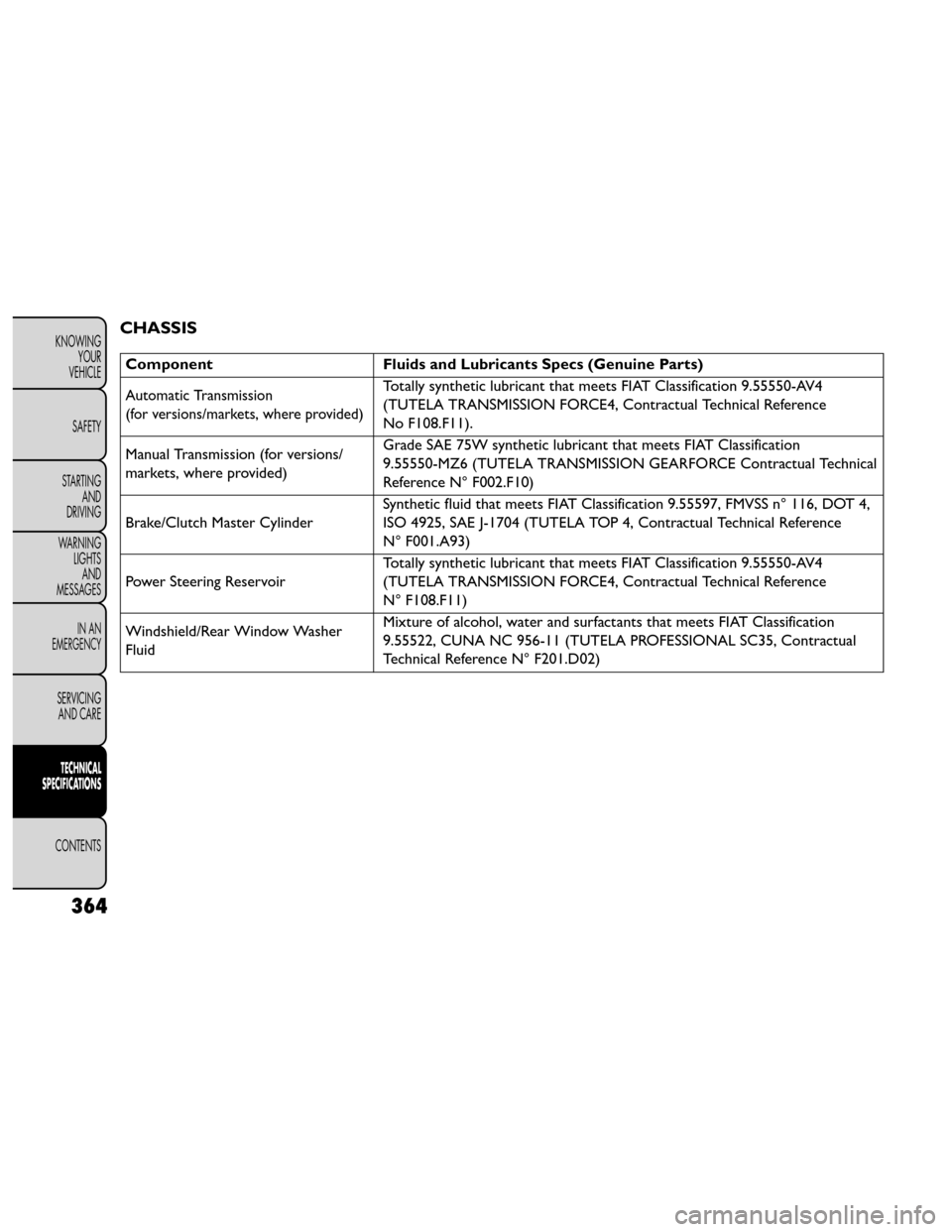
CHASSIS
ComponentFluids and Lubricants Specs (Genuine Parts)
Automatic Transmission
(for versions/markets, where provided)Totally synthetic lubricant that meets FIAT Classification 9.55550-AV4
(TUTELA TRANSMISSION FORCE4, Contractual Technical Reference
No F108.F11).
Manual Transmission (for versions/
markets, where provided) Grade SAE 75W synthetic lubricant that meets FIAT Classification
9.55550-MZ6 (TUTELA TRANSMISSION GEARFORCE Contractual Technical
Reference N° F002.F10)
Brake/Clutch Master Cylinder Synthetic fluid that meets FIAT Classification 9.55597, FMVSS n° 116, DOT 4,
ISO 4925, SAE J-1704 (TUTELA TOP 4, Contractual Technical Reference
N° F001.A93)
Power Steering Reservoir Totally synthetic lubricant that meets FIAT Classification 9.55550-AV4
(TUTELA TRANSMISSION FORCE4, Contractual Technical Reference
N° F108.F11)
Windshield/Rear Window Washer
Fluid Mixture of alcohol, water and surfactants that meets FIAT Classification
9.55522, CUNA NC 956-11 (TUTELA PROFESSIONAL SC35, Contractual
Technical Reference N° F201.D02)
364
KNOWING
YOUR
VEHICLE
SAFETY
STARTING AND
DRIVING
WARNING LIGHTSAND
MESSAGES
IN AN
EMERGENCY
SERVICING AND CARE
TECHNICAL
SPECIFICATIONS
CONTENTS
Page 374 of 388
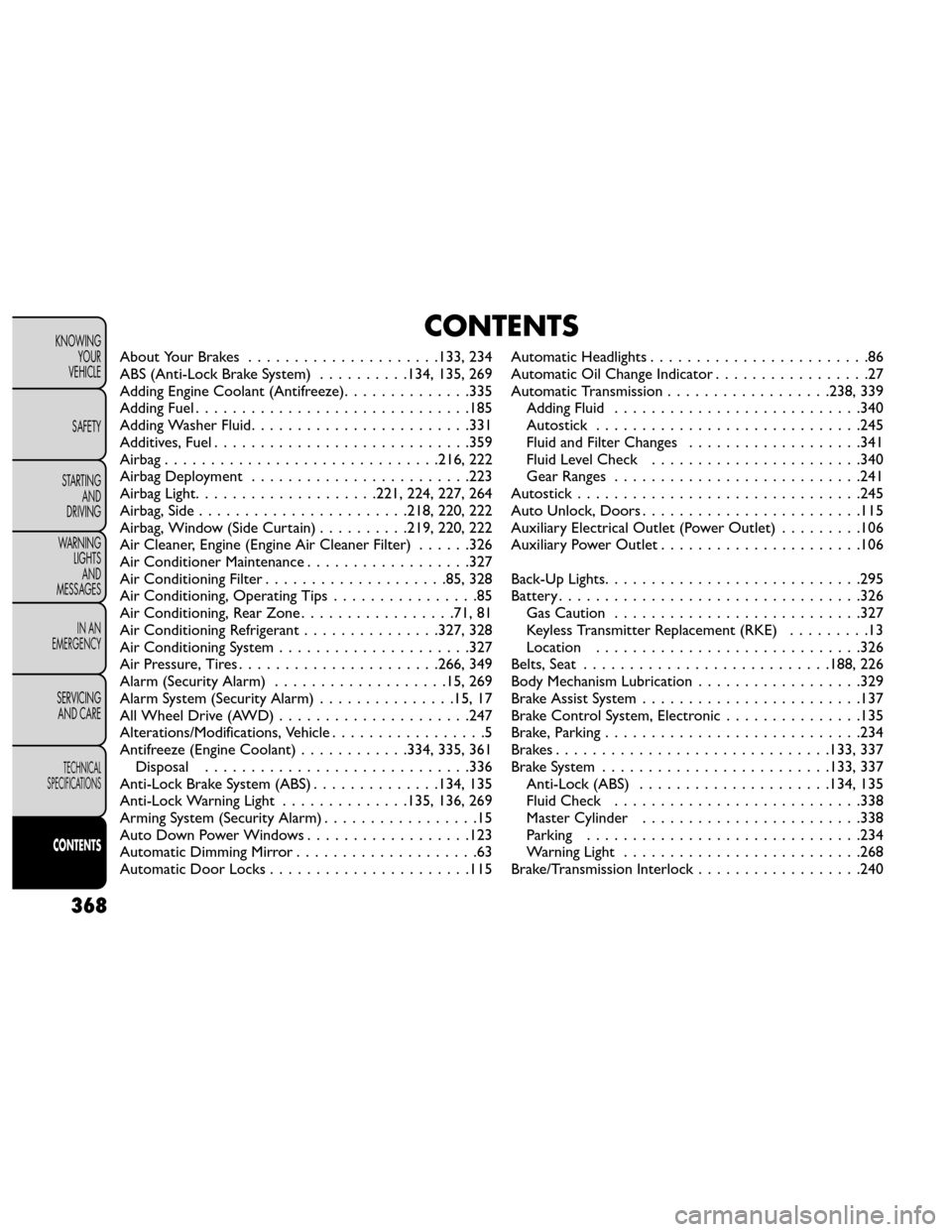
CONTENTS
About Your Brakes..................... 133, 234
ABS (Anti-Lock Brake System) ..........134, 135, 269
Adding Engine Coolant (Antifreeze) ..............335
Adding Fuel ..............................185
Adding Washer Fluid ........................331
Additives, Fuel ............................359
Airbag .............................. 216, 222
Airbag Deployment ........................223
Airbag Light ....................221, 224, 227, 264
Airbag, Side ....................... 218, 220, 222
Airbag, Window (Side Curtain) ..........219, 220, 222
Air Cleaner, Engine (Engine Air Cleaner Filter) ......326
Air Conditioner Maintenance ..................327
Air Conditioning Filter ....................85, 328
Air Conditioning, Operating Tips ................85
Air Conditioning, Rear Zone .................71,81
Air Conditioning Refrigerant ...............327, 328
Air Conditioning System .....................327
Air Pressure, Tires ......................266, 349
Alarm (Security Alarm) ...................15, 269
Alarm System (Security Alarm) ...............15, 17
All Wheel Drive (AWD) .....................247
Alterations/Modifications, Vehicle .................5
Antifreeze (Engine Coolant) ............334, 335, 361
Disposal .............................336
Anti-Lock Brake System (ABS) ..............134, 135
Anti-Lock Warning Light ..............135, 136, 269
Arming System (Security Alarm) .................15
Auto Down Power Windows ..................123
Automatic Dimming Mirror ....................63
Automatic Door Locks ......................115 Automatic Headlights
........................86
Automatic Oil Change Indicator .................27
Automatic Transmission .................. 238, 339
Adding Fluid ...........................340
Autostick .............................245
Fluid and Filter Changes ...................341
Fluid Level Check .......................340
Gear Ranges ...........................241
Autostick ..............................
.245
Auto Unlock, Doors ........................115
Auxiliary Electrical Outlet (Power Outlet) .........106
Auxiliary Power Outlet ......................106
Back-Up Lights ............................295
Battery .................................326
Gas Caution ...........................327
Keyless Transmitter Replacement (RKE) .........13
Location .............................326
Belts, Seat ........................... 188, 226
Body Mechanism Lubrication ..................329
Brake Assist System ........................137
Brake Control System, Electronic ...............135
Brake, Parking ............................234
Brakes ..............................133, 337
Brake System ......................... 133, 337
Anti-Lock (ABS) .....................134, 135
Fluid Check ...........................338
Master Cylinder ........................338
Parking ..............................234
Warning Light ..........................268
Brake/Transmission Interlock ..................240
368
KNOWING
YOUR
VEHICLE
SAFETY
STARTING AND
DRIVING
WARNING LIGHTSAND
MESSAGES
IN AN
EMERGENCY
SERVICING AND CARE
TECHNICAL
SPECIFICATIONS
CONTENTS
Page 376 of 388
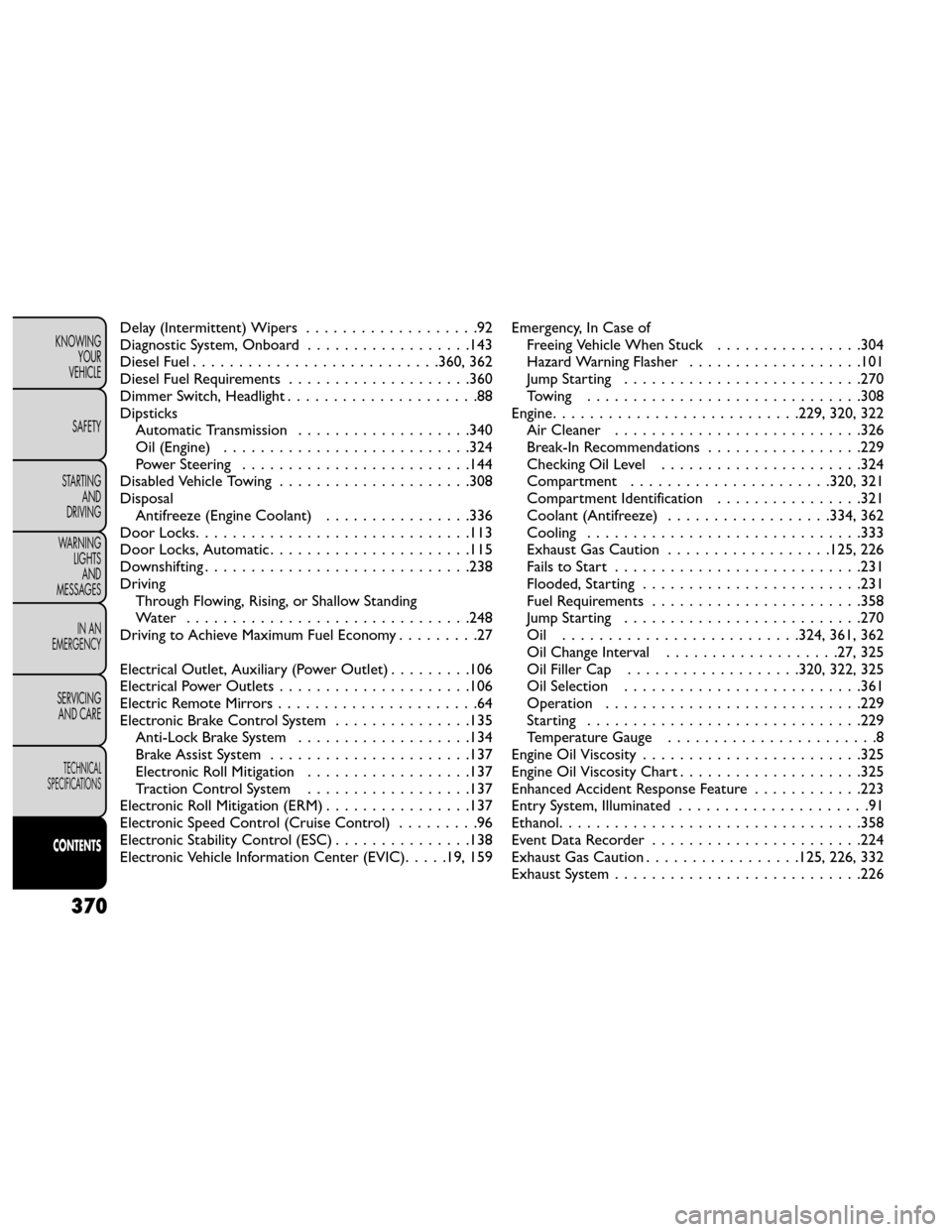
Delay (Intermittent) Wipers...................92
Diagnostic System, Onboard ..................143
Diesel Fuel ...........................360, 362
Diesel Fuel Requirements ....................360
Dimmer Switch, Headlight .....................88
Dipsticks Automatic Transmission ...................340
Oil (Engine) ...........................324
Power Steering .........................144
Disabled Vehicle Towing .....................308
Disposal Antifreeze (Engine Coolant) ................336
Door Locks ..............................113
Door Locks, Automatic ......................115
Downshifting .............................238
Driving Through Flowing, Rising, or Shallow Standing
Water ...............................248
Driving to Achieve Maximum Fuel Economy .........27
Electrical Outlet, Auxiliary (Power Outlet) .........106
Electrical Power Outlets .....................106
Electric Remote Mirrors ......................64
Electronic Brake Control System ...............135
Anti-Lock Brake System ...................134
Brake Assist System ......................137
Electronic Roll Mitigation ..................137
Traction Control System ..................137
Electronic Roll Mitigation (ERM) ................137
Electronic Speed Control (Cruise Control) .........96
Electronic Stability Control (ESC) ...............138
Electronic Vehicle Information Center (EVIC) .....19, 159Emergency, In Case of
Freeing Vehicle When Stuck ................304
Hazard Warning Flasher ...................101
Jump Starting ..........................270
Towing ..............................308
Engine ...........................229, 320, 322
Air Cleaner ...........................326
Break-In Recommendations .................229
Checking Oil Level ......................324
Compartment ......................320, 321
Compartment Identification ................321
Coolant (Antifreeze) .................. 334, 362
Cooling ..............................33 3
Exhaust
Gas Caution .................. 125, 226
Fails to Start ...........................231
Flooded, Starting ........................231
Fuel Requirements .......................358
Jump Starting ..........................270
Oil ..........................324, 361, 362
Oil Change Interval ...................27, 325
Oil Filler Cap ................... 320, 322, 325
Oil Selection ..........................361
Operation ............................229
Starting ..............................229
Temperature Gauge .......................8
Engine Oil Viscosity ........................325
Engine Oil Viscosity Chart ....................325
Enhanced Accident Response Feature ............223
Entry System, Illuminated .....................91
Ethanol .................................358
Event Data Recorder .......................224
Exhaust Gas Caution .................125, 226, 332
Exhaust System ...........................226
370
KNOWING
YOUR
VEHICLE
SAFETY
STARTING AND
DRIVING
WARNING LIGHTSAND
MESSAGES
IN AN
EMERGENCY
SERVICING AND CARE
TECHNICAL
SPECIFICATIONS
CONTENTS
Page 377 of 388
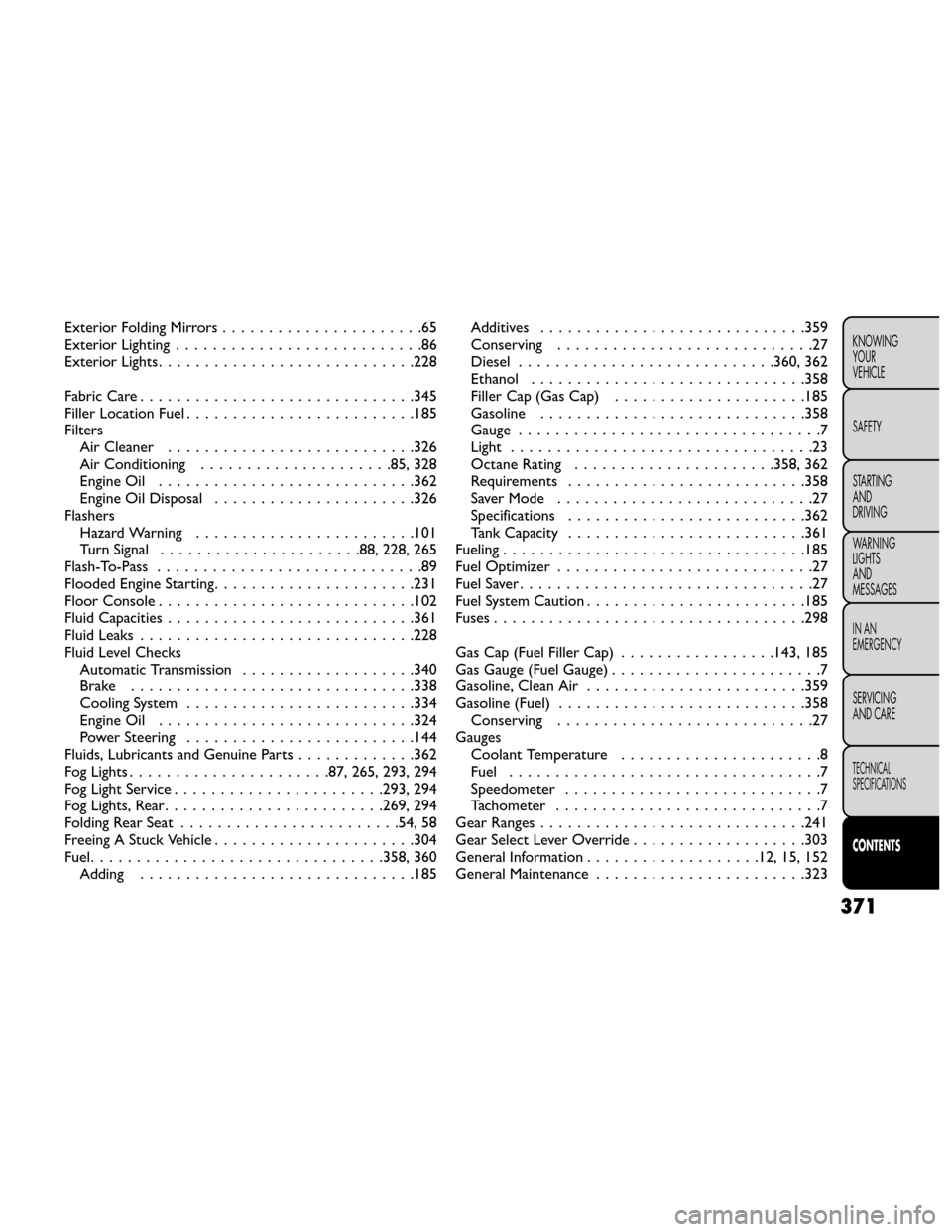
Exterior Folding Mirrors......................65
Exterior Lighting ...........................86
Exterior Lights ............................228
Fabric Care ..............................345
Filler Location Fuel .........................185
Filters Air Cleaner ...........................326
Air Conditioning .....................85, 328
Engine Oil ............................362
Engine Oil Disposal ......................326
Flashers Hazard Warning ........................101
Turn Signal ......................88, 228, 265
Flash-To-Pass .............................89
Flooded Engine Starting ......................231
Floor Console ............................102
Fluid Capacities ...........................361
Fluid Leaks ..............................228
Fluid Level Checks Automatic Transmission ...................340
Brake ...............................338
Cooling System .........................334
Engine Oil ............................324
Power Steering .........................144
Fluids, Lubricants and Genuine Parts .............362
Fog Lights ......................87, 265, 293, 294
Fog Light Service .......................293, 294
Fog Lights, Rear ........................269, 294
Folding Rear Seat ........................54, 58
Freeing A Stuck Vehicle ......................304
Fuel ................................ 358, 360
Adding ..............................185 Additives
.............................359
Conserving ............................27
Diesel ............................360, 362
Ethanol ..............................358
Filler Cap (Gas Cap) .....................185
Gasoline ............................ .358
Gauge .................................7
Light .................................23
Oct
ane Rating ......................358, 362
Requirements ..........................358
SaverMode ............................27
Specifications ..........................362
Tank Capacity ..........................361
Fueling .................................185
Fuel Optimizer ............................27
Fuel Saver ................................27
Fuel System Caution ........................185
Fuses ..................................298
Gas Cap (Fuel Filler Cap) .................143, 185
Gas Gauge (Fuel Gauge) .......................7
Gasoline, Clean Air ........................359
Gasoline (Fuel) ...........................358
Conserving ............................27
Gauges Coolant Temperature ......................8
Fuel ..................................7
Speedometer ............................7
Tachometer .............................7
Gear Ranges .............................241
Gear Select Lever Override ...................303
General Information ...................12, 15, 152
General Maintenance .......................323
371
KNOWING
YOUR
VEHICLE
SAFETY
STARTING
AND
DRIVING
WARNING
LIGHTS
AND
MESSAGES
IN AN
EMERGENCY
SERVICING
AND CARE
TECHNICAL
SPECIFICATIONS
CONTENTS
Page 379 of 388
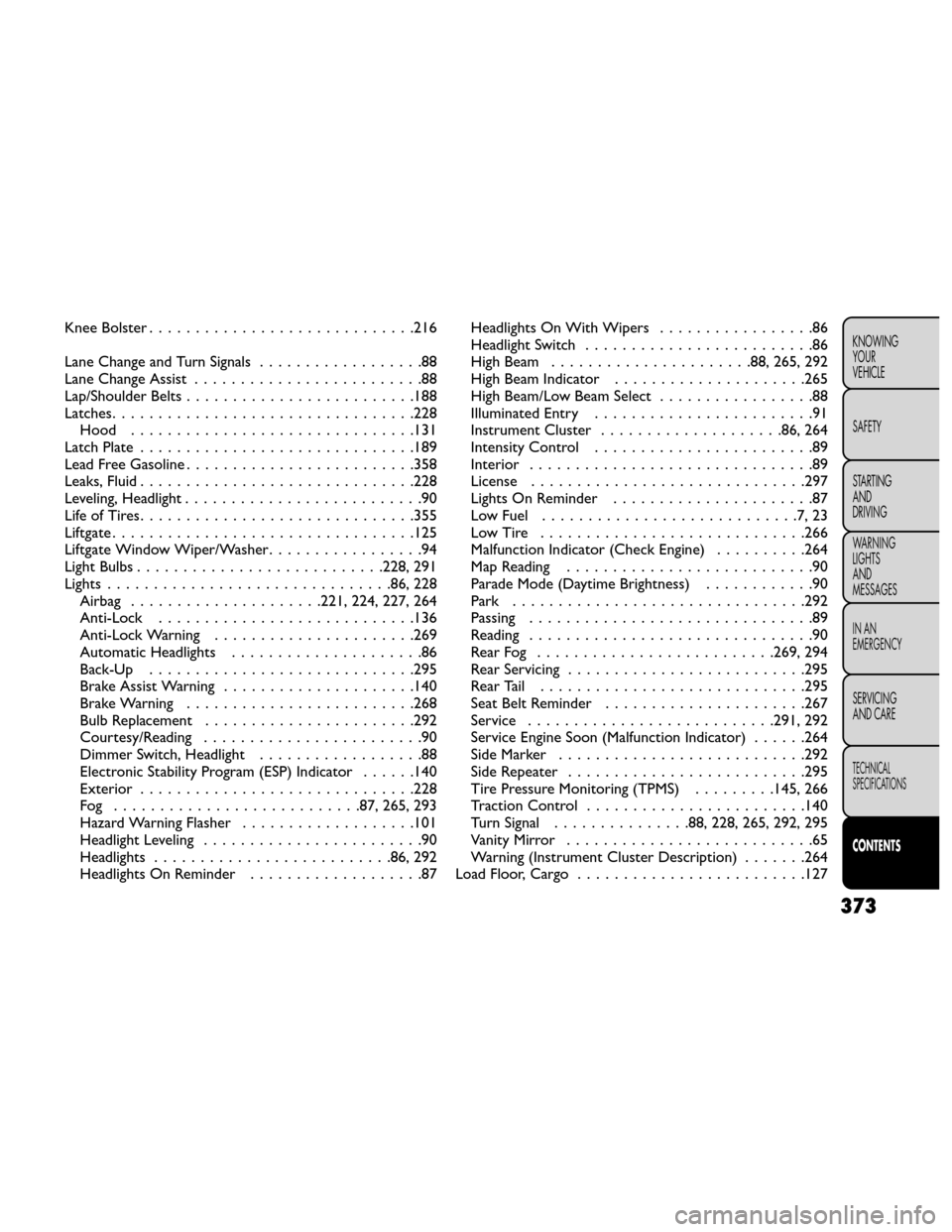
Knee Bolster.............................216
Lane Change and Turn Signals ..................88
Lane Change Assist .........................88
Lap/Shoulder Belts .........................188
Latches .................................228
Hood ...............................131
Latch Plate ..............................189
Lead Free Gasoline .........................358
Leaks, Fluid ..............................228
Leveling, Headlight ..........................90
LifeofTires..............................355
Liftgate.................................125
Liftgate Window Wiper/Washer .................94
Light Bulbs ...........................228, 291
Lights ...............................86, 228
Airbag .....................221, 224, 227, 264
Anti-Lock ............................136
Anti-Lock Warning ......................269
Automatic Headlights .....................86
Back-Up .............................295
Brake Assist Warning .....................140
Brake Warning .........................268
Bulb Replacement .......................292
Courtesy/Reading ........................90
Dimmer Switch, Headlight ..................88
Electronic Stability Program (ESP) Indicator ......140
Exterior ..............................228
Fog ...........................87, 265, 293
Hazard Warning Flasher ...................101
Headlight Leveling ........................90
Headlights ..........................86, 292
Headlights On Reminder ...................87 Headlights On With Wipers
.................86
Headlight Switch .........................86
High Beam ......................88, 265, 292
High Beam Indicator .....................265
High Beam/Low Beam Select .................88
Illuminated Entry ........................91
Instrument Cluster ....................86, 264
Intensity Control ........................89
Interior ...............................89
License ..............................297
Lights On Reminder ......................
87
Low Fuel ............................7,23
LowTire .............................266
Malfunction Indicator (Check Engine) ..........264
Map Reading ...........................90
Parade Mode (Daytime Brightness) ............90
Park ................................292
Passing ...............................89
Reading ...............................90
RearFog ..........................269, 294
Rear Servicing ..........................295
RearTail .............................295
Seat Belt Reminder ......................267
Service ...........................291, 292
Service Engine Soon (Malfunction Indicator) ......264
Side Marker ...........................292
Side Repeater ..........................295
Tire Pressure Monitoring (TPMS) .........145, 266
Traction Control ........................140
Turn Signal ...............88, 228, 265, 292, 295
Vanity Mirror ...........................65
Warning (Instrument Cluster Description) .......264
Load Floor, Cargo .........................127
373
KNOWING
YOUR
VEHICLE
SAFETY
STARTING
AND
DRIVING
WARNING
LIGHTS
AND
MESSAGES
IN AN
EMERGENCY
SERVICING
AND CARE
TECHNICAL
SPECIFICATIONS
CONTENTS