battery FIAT FREEMONT 2016 1.G Owner's Manual
[x] Cancel search | Manufacturer: FIAT, Model Year: 2016, Model line: FREEMONT, Model: FIAT FREEMONT 2016 1.GPages: 412, PDF Size: 3.36 MB
Page 287 of 412
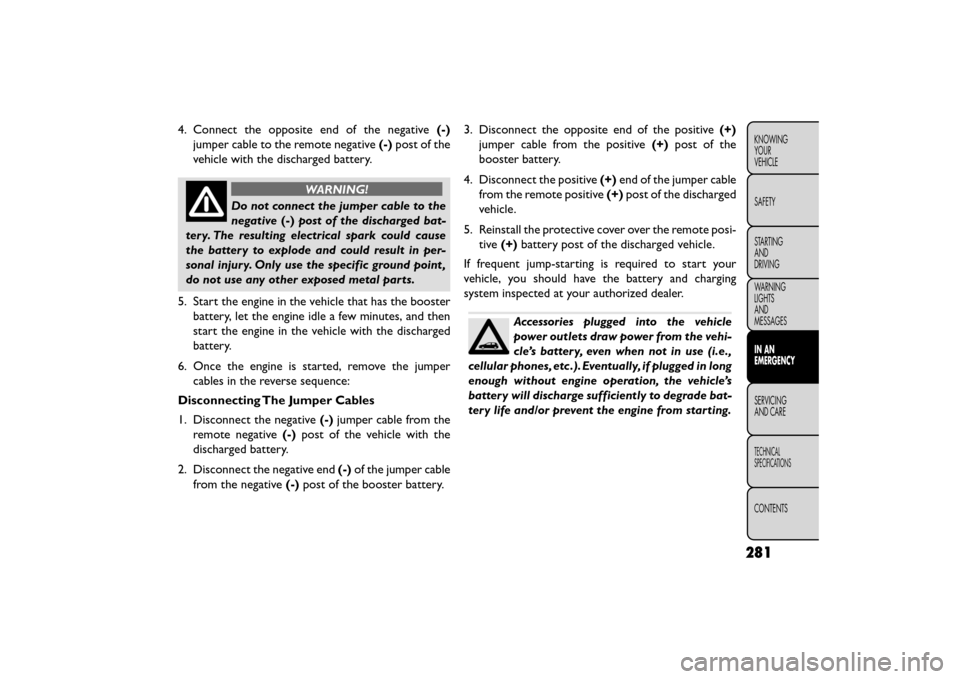
4. Connect the opposite end of the negative(-)
jumper cable to the remote negative (-)post of the
vehicle with the discharged battery.
WARNING!
Do not connect the jumper cable to the
nega t
ive(-)post of the discharged bat-
tery. The resulting electrical spark could cause
the battery to explode and could result in per-
sonal injury. Only use the specific ground point ,
do not use any other exposed metal parts.
5. Start the engine in the vehicle that has the booster battery, let the engine idle a few minutes, and then
start the engine in the vehicle with the discharged
battery.
6. Once the engine is started, remove the jumper cables in the reverse sequence:
Disconnecting The Jumper Cables
1. Disconnect the negative (-)jumper cable from the
remote negative (-)post of the vehicle with the
discharged battery.
2. Disconnect the negative end (-)of the jumper cable
from the negative (-)post of the booster battery. 3. Disconnect the opposite end of the positive
(+)
jumper cable from the positive (+)post of the
booster battery.
4. Disconnect the positive (+)end of the jumper cable
from the remote positive (+)post of the discharged
vehicle.
5. Reinstall the protective cover over the remote posi- tive (+)battery post of the discharged vehicle.
If frequent jump-starting is required to start your
vehicle, you should have the battery and charging
system inspected at your authorized dealer.
Accessories plugged into the vehicle
power outlets draw power from the vehi-
cle’s battery, even when not in use (i.e.,
cellular phones, etc .). Eventually, if plugged in long
enough without engine operation, the vehicle’s
battery will discharge sufficiently to degrade bat-
tery life and/or prevent the engine from starting.
281
KNOWING
YOUR
VEHICLE
SAFETY
STARTING
AND
DRIVING
WARNING
LIGHTS
AND
MESSAGES
IN AN
EMERGENCY
SER VICING
AND
CARE
TECHNICAL
SPECIFICATIONS
CONTENTS
Page 318 of 412
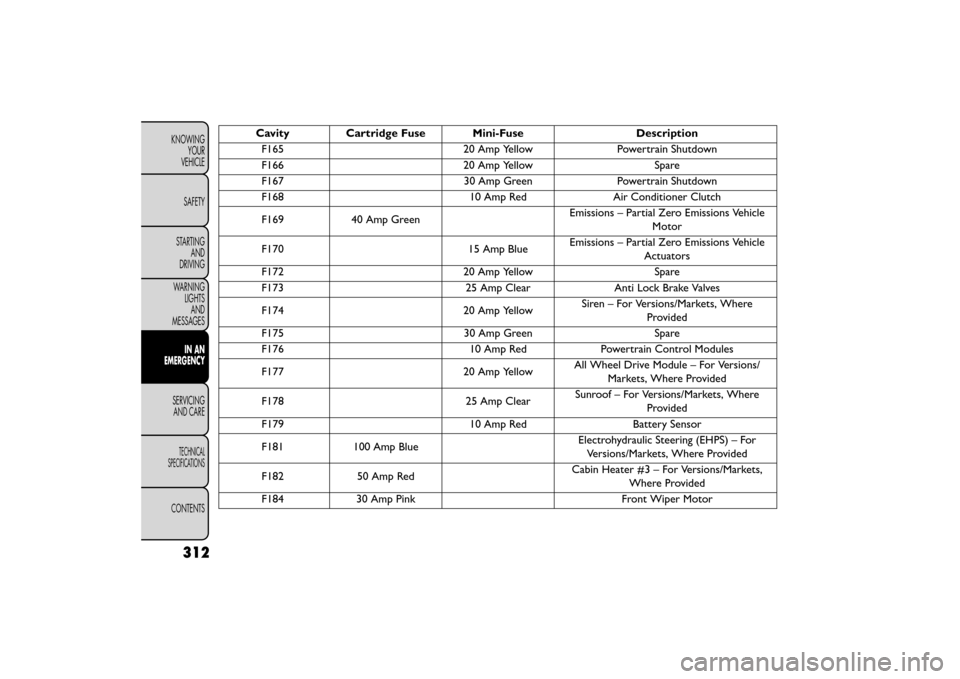
Cavity Cartridge Fuse Mini-FuseDescription
F165 20 Amp YellowPowertrain Shutdown
F166 20 Amp YellowSpare
F167 30 Amp GreenPowertrain Shutdown
F168 10 Amp RedAir Conditioner Clutch
F169 40 Amp Green Emissions – Partial Zero Emissions Vehicle
Motor
F170 15 Amp BlueEmissions – Partial Zero Emissions Vehicle
Actuators
F172 20 Amp YellowSpare
F173 25 Amp ClearAnti Lock Brake Valves
F174 20 Amp YellowSiren – For Versions/Markets, Where
Provided
F175 30 Amp GreenSpare
F176 10 Amp RedPowertrain Control Modules
F177 20 Amp YellowAll Wheel Drive Module – For Versions/
Markets, Where Provided
F178 25 Amp ClearSunroof – For Versions/Markets, Where
Provided
F179 10 Amp RedBattery Sensor
F181 100 Amp Blue Electrohydraulic Steering (EHPS) – For
Versions/Markets, Where Provided
F182 50 Amp Red Cabin Heater #3 – For Versions/Markets,
Where Provided
F184 30 Amp Pink Front Wiper Motor
312
KNOWING
YOUR
VEHICLE
SAFETY
STARTING AND
DRIVING
WARNING LIGHTSAND
MESSAGES
IN AN
EMERGENCY
SER VICING
AND
CARE
TECHNICAL
SPECIFICATIONS
CONTENTS
Page 324 of 412
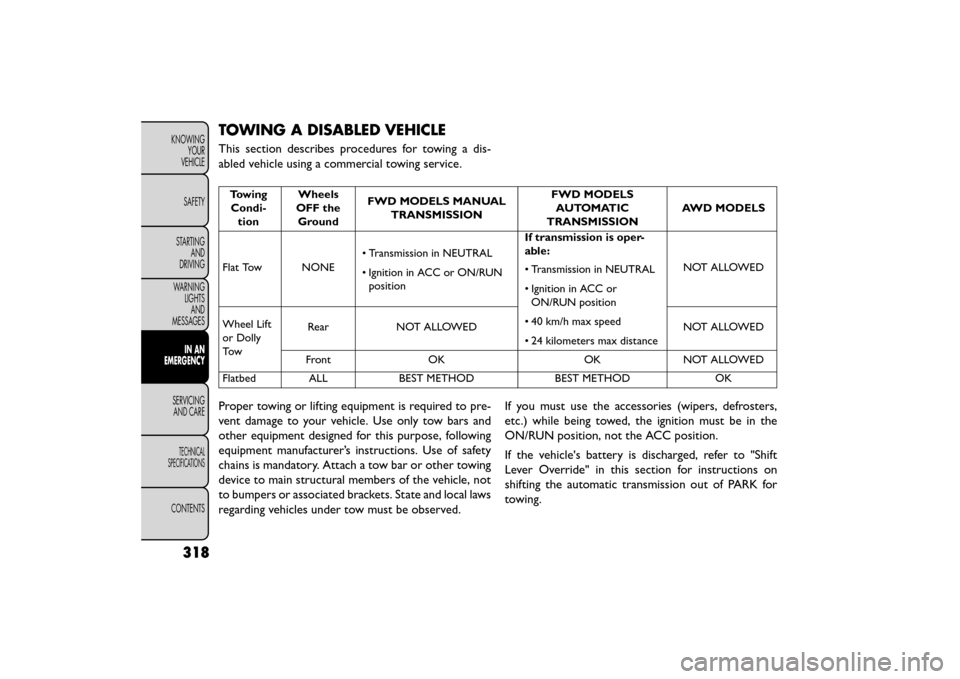
TOWING A DISABLED VEHICLE
This section describes procedures for towing a dis-
abled vehicle using a commercial towing service.
TowingCondi- tion Wheels
OFF the Ground FWD MODELS MANUAL
TRANSMISSION FWD MODELS
AUTOMATIC
TRANSMISSION AWD MODELS
Flat Tow NONE • Transmission in NEUTRAL
• Ignition in ACC or ON/RUN
position If transmission is oper-
able:
• Transmission in NEUTRAL
• Ignition in ACC or
ON/RUN position
• 40 km/h max speed
• 24 kilometers max distance NOT ALLOWED
Wheel Lift
or Dolly
To w Rear NOT ALLOWED NOT ALLOWED
Front OK OK NOT ALLOWED
Flatbed ALL BEST METHOD BEST METHOD OK
Proper towing or lifting equipment is required to pre-
vent damage to your vehicle. Use only tow bars and
other equipment designed for this purpose, following
equipment manufacturer’s instructions. Use of safety
chains is mandatory. Attach a tow bar or other towing
device to main structural members of the vehicle, not
to bumpers or associated brackets. State and local laws
regarding vehicles under tow must be observed. If you must use the accessories (wipers, defrosters,
etc.) while being towed, the ignition must be in the
ON/RUN position, not the ACC position.
If the vehicle's battery is discharged, refer to "Shift
Lever Override" in this section for instructions on
shifting the automatic transmission out of PARK for
towing.
318
KNOWING
YOUR
VEHICLE
SAFETY
STARTING AND
DRIVING
WARNING LIGHTSAND
MESSAGES
IN AN
EMERGENCY
SER VICING
AND
CARE
TECHNICAL
SPECIFICATIONS
CONTENTS
Page 328 of 412
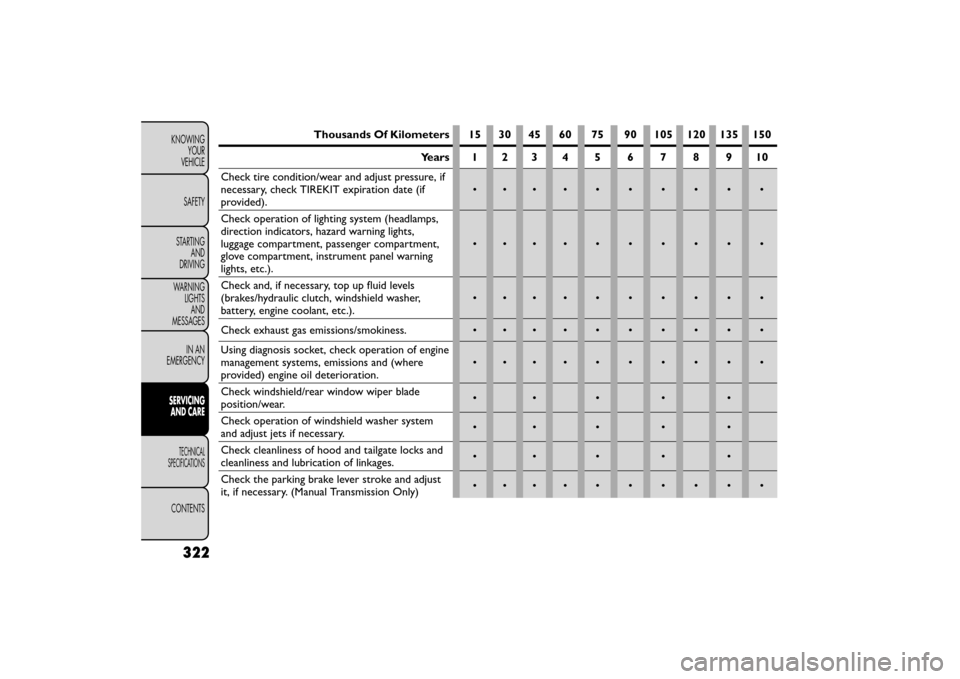
Thousands Of Kilometers 15 30 45 60 75 90 105 120 135 150Years 1 2 3 4 5678910
Check tire condition/wear and adjust pressure, if
necessary, check TIREKIT expiration date (if
provided). ••••••••••
Check operation of lighting system (headlamps,
direction indicators, hazard warning lights,
luggage compartment, passenger compartment,
glove compartment, instrument panel warning
lights, etc.). ••••••••••
Check and, if necessary, top up fluid levels
(brakes/hydraulic clutch, windshield washer,
battery, engine coolant, etc.). ••••••••••
Check exhaust gas emissions/smokiness. • • • • ••••••
Using diagnosis socket, check operation of engine
management systems, emissions and (where
provided) engine oil deterioration. ••••••••••
Check windshield/rear window wiper blade
position/wear. •••••
Check operation of windshield washer system
and adjust jets if necessary. •••••
Check cleanliness of hood and tailgate locks and
cleanliness and lubrication of linkages. •••••
Check the parking brake lever stroke and adjust
it, if necessary. (Manual Transmission Only) ••••••••••
322
KNOWING
YOUR
VEHICLE
SAFETY
STARTING AND
DRIVING
WARNING LIGHTSAND
MESSAGES
IN AN
EMERGENCY
SERVICINGAND C ARE
TECHNICAL
SPECIFICATIONS
CONTENTS
Page 331 of 412
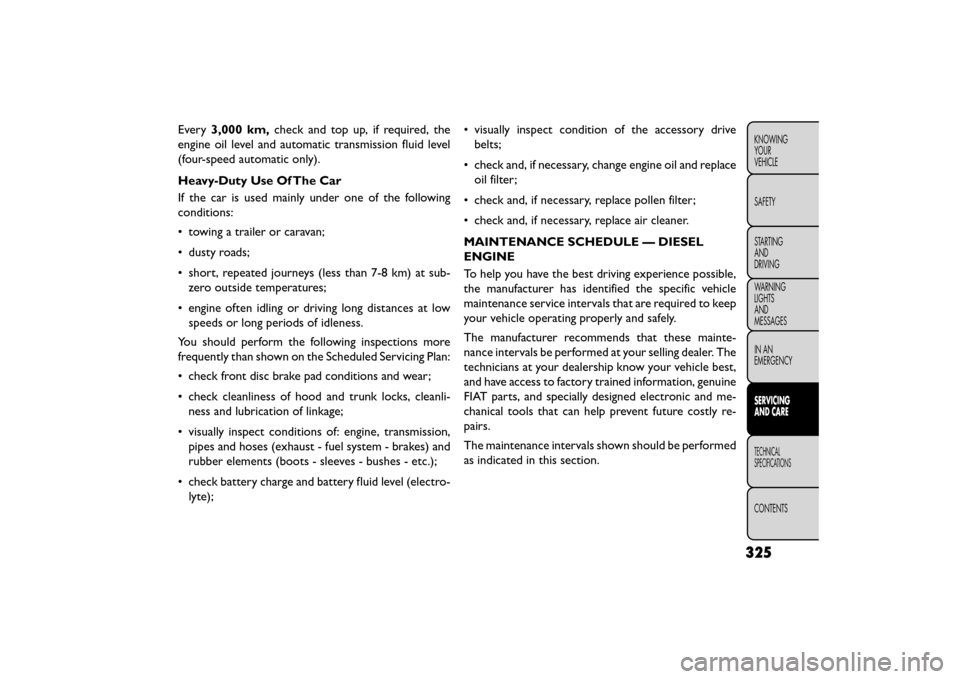
Every3,000 km, check and top up, if required, the
engine oil level and automatic transmission fluid level
(four-speed automatic only).
Heavy-Duty Use Of The Car
If the car is used mainly under one of the following
conditions:
• towing a trailer or caravan;
• dusty roads;
• short, repeated journeys (less than 7-8 km) at sub- zero outside temperatures;
• engine often idling or driving long distances at low speeds or long periods of idleness.
You should perform the following inspections more
frequently than shown on the Scheduled Servicing Plan:
• check front disc brake pad conditions and wear;
• check cleanliness of hood and trunk locks, cleanli- ness and lubrication of linkage;
• visually inspect conditions of: engine, transmission, pipes and hoses (exhaust - fuel system - brakes) and
rubber elements (boots - sleeves - bushes - etc.);
• check battery charge and battery fluid level (electro- lyte); • visually inspect condition of the accessory drive
belts;
• check and, if necessary, change engine oil and replace oil filter;
• check and, if necessary, replace pollen filter;
• check and, if necessary, replace air cleaner.
MAINTENANCE SCHEDULE — DIESEL
ENGINE
To help you have the best driving experience possible,
the manufacturer has identified the specific vehicle
maintenance service intervals that are required to keep
your vehicle operating properly and safely.
The manufacturer recommends that these mainte-
nance intervals be performed at your selling dealer. The
technicians at your dealership know your vehicle best,
and have access to factory trained information, genuine
FIAT parts, and specially designed electronic and me-
chanical tools that can help prevent future costly re-
pairs.
The maintenance intervals shown should be performed
as indicated in this section.
325
KNOWING
YOUR
VEHICLE
SAFETY
STARTING
AND
DRIVING
WARNING
LIGHTS
AND
MESSAGES
IN AN
EMERGENCY
SERVICING
AND C ARE
TECHNICAL
SPECIFICATIONS
CONTENTS
Page 333 of 412
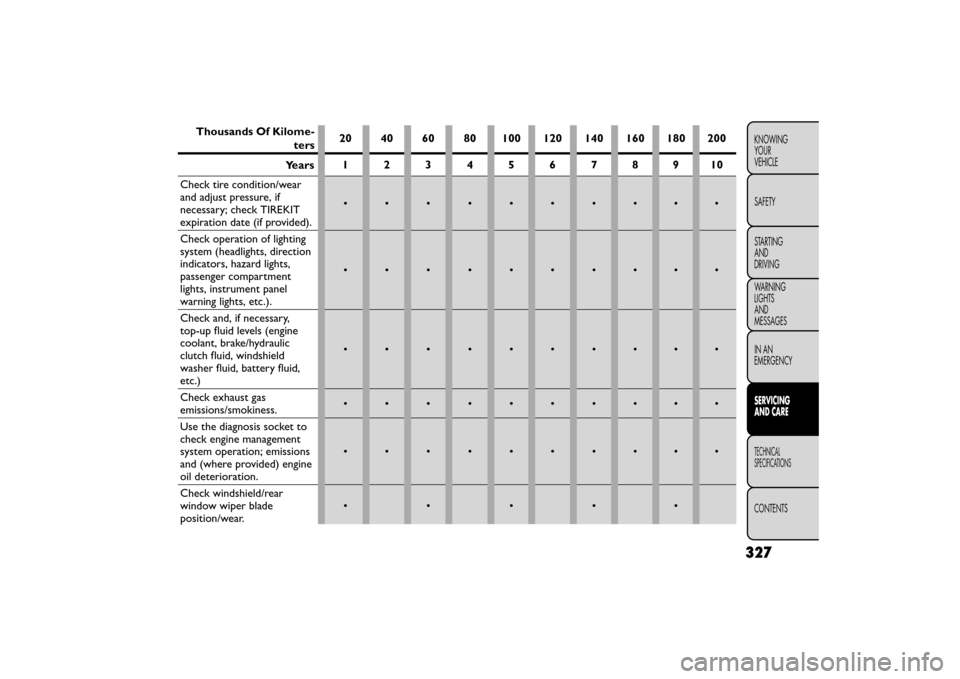
Thousands Of Kilome-
ters20 40 60 80 100 120 140 160 180 200
12345678910
Check tire condition/wear
and adjust pressure, if
necessary; check TIREKIT
expiration date (if provided).
••••••••••
Check operation of lighting
system (headlights, direction
indicators, hazard lights,
passenger compartment
lights, instrument panel
warning lights, etc.).
••••••••••
Check and, if necessary,
top-up fluid levels (engine
coolant, brake/hydraulic
clutch fluid, windshield
washer fluid, battery fluid,
etc.)
••••••••••
Check exhaust gas
emissions/smokiness.••••••••••
Use the diagnosis socket to
check engine management
system operation; emissions
and (where provided) engine
oil deterioration.
••••••••••
Check windshield/rear
window wiper blade
position/wear.
•••••
327
KNOWING YOURVEHICLE
SAFETY
STARTING ANDDRIVING
WARNING LIGHTSANDMESSAGES
IN AN EMERGENCY
SERVICING AND CARE
TECHNICALSPECIFICATIONS
CONTENTS
Years
Page 337 of 412
Failure to perform the required mainte-
nance items may result in damage to the
vehicle.
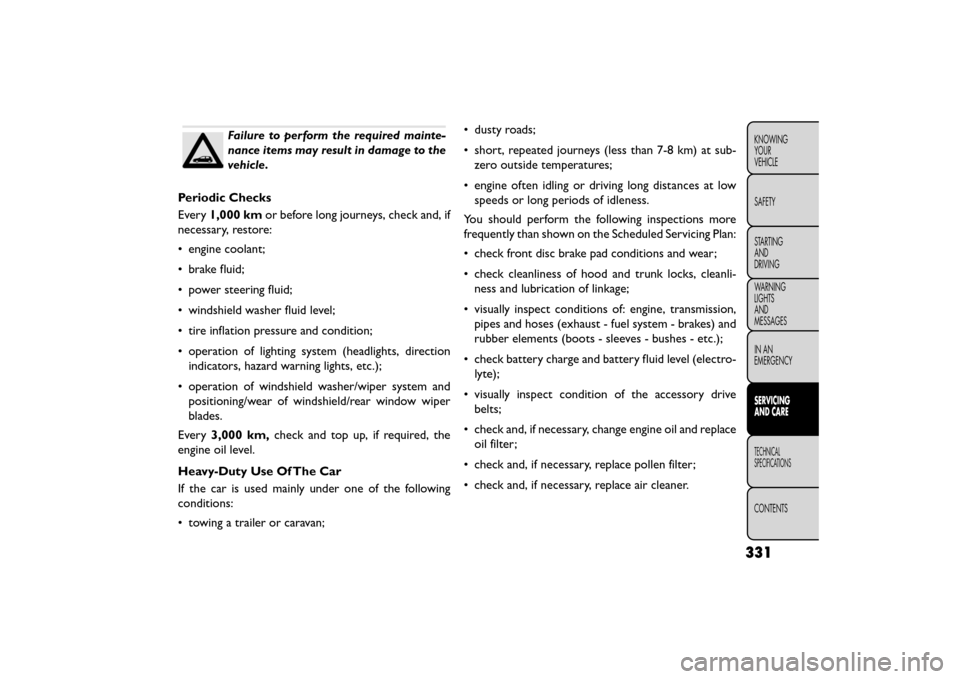
Periodic Checks
Every 1,000 km or before long journeys, check and, if
necessary, restore:
• engine coolant;
• brake fluid;
• power steering fluid;
• windshield washer fluid level;
• tire inflation pressure and condition;
• operation of lighting system (headlights, direction indicators, hazard warning lights, etc.);
• operation of windshield washer/wiper system and positioning/wear of windshield/rear window wiper
blades.
Every 3,000 km, check and top up, if required, the
engine oil level.
Heavy-Duty Use Of The Car
If the car is used mainly under one of the following
conditions:
• towing a trailer or caravan; • dusty roads;
• short, repeated journeys (less than 7-8 km) at sub-
zero outside temperatures;
• engine often idling or driving long distances at low speeds or long periods of idleness.
You should perform the following inspections more
frequently than shown on the Scheduled Servicing Plan:
• check front disc brake pad conditions and wear;
• check cleanliness of hood and trunk locks, cleanli- ness and lubrication of linkage;
• visually inspect conditions of: engine, transmission, pipes and hoses (exhaust - fuel system - brakes) and
rubber elements (boots - sleeves - bushes - etc.);
• check battery charge and battery fluid level (electro- lyte);
• visually inspect condition of the accessory drive belts;
• check and, if necessary, change engine oil and replace oil filter;
• check and, if necessary, replace pollen filter;
• check and, if necessary, replace air cleaner.
331
KNOWING
YOUR
VEHICLE
SAFETY
STARTING
AND
DRIVING
WARNING
LIGHTS
AND
MESSAGES
IN AN
EMERGENCY
SERVICING
AND C ARE
TECHNICAL
SPECIFICATIONS
CONTENTS
Page 338 of 412
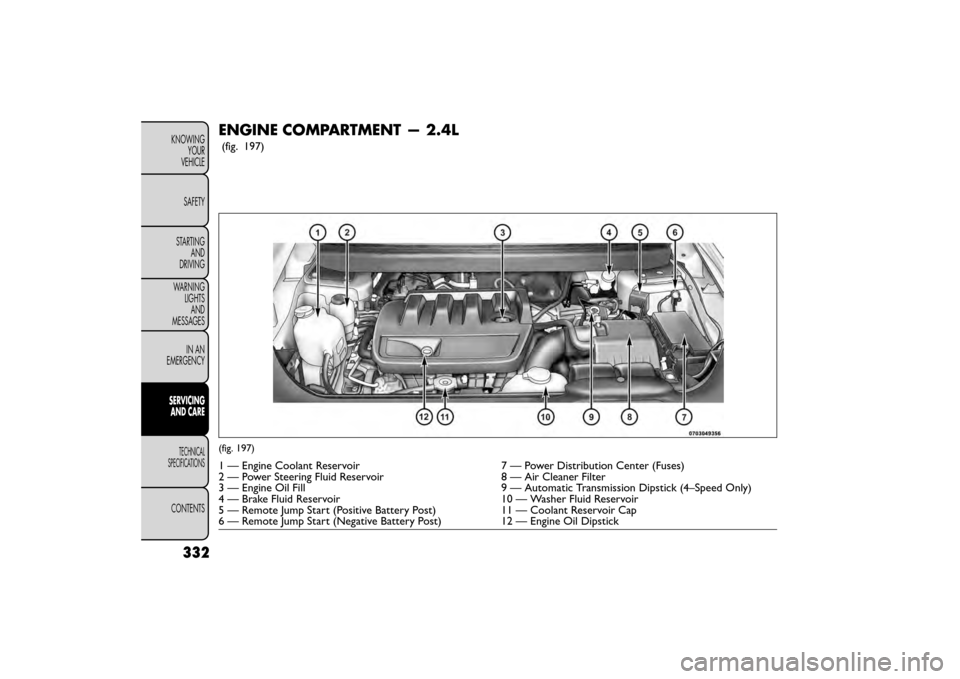
ENGINE COMPARTMENT — 2.4L
(fig. 197)
(fig. 197)
1 — Engine Coolant Reservoir7 — Power Distribution Center (Fuses)
2 — Power Steering Fluid Reservoir 8 — Air Cleaner Filter
3 — Engine Oil Fill 9 — Automatic Transmission Dipstick (4–Speed Only)
4 — Brake Fluid Reservoir 10 — Washer Fluid Reservoir
5 — Remote Jump Start (Positive Battery Post) 11 — Coolant Reservoir Cap
6 — Remote Jump Start (Negative Battery Post) 12 — Engine Oil Dipstick
332
KNOWING
YOUR
VEHICLE
SAFETY
STARTING AND
DRIVING
WARNING LIGHTSAND
MESSAGES
IN AN
EMERGENCY
SERVICINGAND C ARE
TECHNICAL
SPECIFICATIONS
CONTENTS
Page 344 of 412
Disposing Of Used Engine Oil And Oil Filters
Care should be taken in disposing of used engine oil and
oil filters from your vehicle. Used oil and oil filters,
indiscriminately discarded, can present a problem to
the environment. Contact your authorized dealer, ser-
vice station or governmental agency for advice on how
and where used oil and oil filters can be safely discarded
in your area.
ENGINE AIR CLEANER FILTER
Refer to the “Maintenance Schedule” for the proper
maintenance intervals.
WARNING!
The air induction system (air cleaner,
hoses ,
etc .) can provide a measure of
protection in the case of engine backfire. Do not
remove the air induction system (air cleaner,
hoses, etc .) unless such removal is necessary for
repair or maintenance. Make sure that no one is
near the engine compartment before starting the
vehicle with the air induction system (air cleaner,
hoses, etc .) removed. Failure to do so can result in
serious personal injury. Engine Air Cleaner Filter Selection
The quality of replacement engine air cleaner filters
varies considerably. Only high quality filters should be
used to assure most efficient service.
MAINTENANCE-FREE BATTERY
You will never have to add water, and periodic mainte-
nance is not required.
NOTE:
The battery is stored in a compartment that is
located behind the left front fender and is accessible
through the wheel well. The wheel and tire assemble
do not need to be removed to access the compart-
ment. Remote battery terminals are located in the
engine compartment for jump-starting.
To access the battery, turn the steering wheel fully to
the right and remove the access panel from the inner
fender shield.
WARNING!
• Battery fluid is a corrosive acid solu-
t i
on and can burn or even blind you. Do
not allow battery fluid to contact your eyes, skin,
or clothing. Do not lean over a battery when
attaching clamps. If acid splashes in eyes or on
skin, flush the area immediately with large
amounts of water.
(Continued)
338
KNOWINGYOUR
VEHICLE
SAFETY
STARTING AND
DRIVING
WARNING LIGHTSAND
MESSAGES
IN AN
EMERGENCY
SERVICINGAND C ARE
TECHNICAL
SPECIFICATIONS
CONTENTS
Page 345 of 412
WARNING! (Continued)
• Battery gas is flammable and explosive. Keep
flame or sparks away from the battery. Do not
use a booster battery or any other booster source
with an output greater than 12 Volts. Do not
allow cable clamps to touch each other.
• Battery posts, terminals, and related accesso-
ries contain lead and lead compounds. Wash
hands after handling.
• It is essential when replacing the cables
on the battery that the positive cable is
attached to the positive post and the
negative cable is attached to the negative post .
Battery posts are marked positive (+) and nega-
tive (-) and identified on the battery case. Cable
clamps should be tight on the terminal posts and
free of corrosion.
• If a “fast charger ” is used while the battery is in
the vehicle, disconnect both vehicle battery cables
before connecting the charger to the battery. Do
not use a “fast charger ” to provide star ting volt-
age as battery damage can result . AIR CONDITIONER MAINTENANCE
For best possible performance, your air conditioner
should be checked and serviced by an authorized
dealer at the start of each warm season. This service
should include cleaning of the condenser fins and a
performance test. Drive belt tension should also be
checked at this time.
Do not use chemical flushes in your air
conditioning system as the chemicals can
damage your air conditioning compo-
nents. Such damage is not covered by the New
Vehicle Limited Warranty.
WARNING!
• Use only refrigerants and compressor
lubr i
cants approved by the manufac-
turer for your air conditioning system. Some un-
approved refrigerants are flammable and can
explode, injuring you. Other unapproved refrig-
erants or lubricants can cause the system to fail,
requiring costly repairs.
•
The air conditioning system contains refrigerant
under high pressure. To avoid risk of personal
injury or damage to the system, adding refrigerant
or any repair requiring lines to be disconnected
should be done by an experienced technician.
339
KNOWING
YOUR
VEHICLE
SAFETY
STARTING
AND
DRIVING
WARNING
LIGHTS
AND
MESSAGES
IN AN
EMERGENCY
SERVICING
AND C ARE
TECHNICAL
SPECIFICATIONS
CONTENTS