service FIAT FREEMONT 2016 1.G Workshop Manual
[x] Cancel search | Manufacturer: FIAT, Model Year: 2016, Model line: FREEMONT, Model: FIAT FREEMONT 2016 1.GPages: 412, PDF Size: 3.36 MB
Page 313 of 412
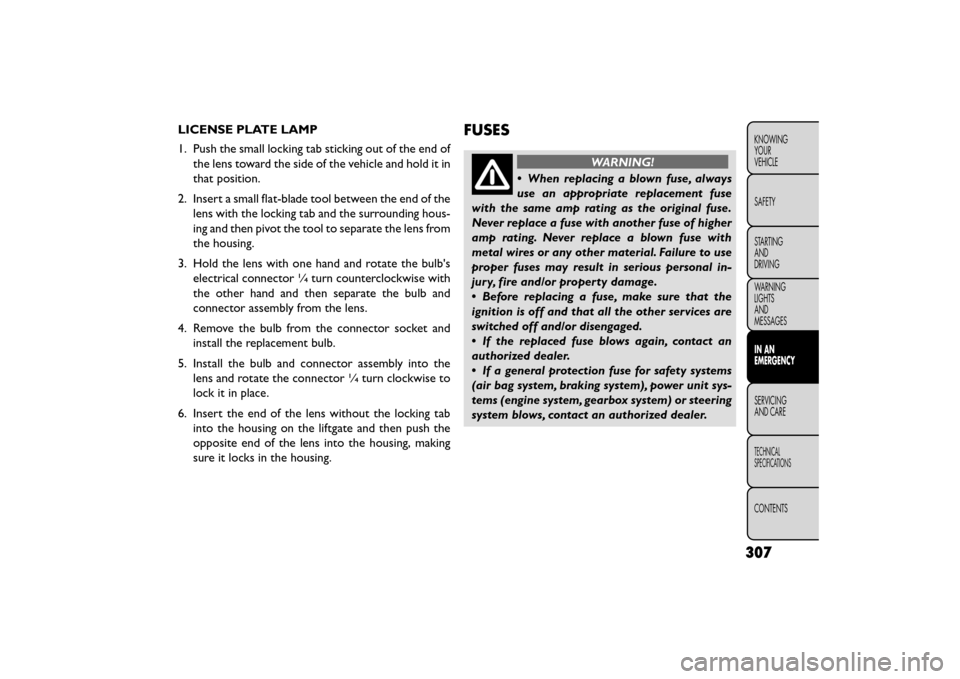
LICENSE PLATE LAMP
1. Push the small locking tab sticking out of the end ofthe lens toward the side of the vehicle and hold it in
that position.
2. Insert a small flat-blade tool between the end of the lens with the locking tab and the surrounding hous-
ing and then pivot the tool to separate the lens from
the housing.
3. Hold the lens with one hand and rotate the bulb's electrical connector ¼ turn counterclockwise with
the other hand and then separate the bulb and
connector assembly from the lens.
4. Remove the bulb from the connector socket and install the replacement bulb.
5. Install the bulb and connector assembly into the lens and rotate the connector ¼ turn clockwise to
lock it in place.
6. Insert the end of the lens without the locking tab into the housing on the liftgate and then push the
opposite end of the lens into the housing, making
sure it locks in the housing.FUSES
WARNING!
• When replacing a blown fuse, always
use an
appropriate replacement fuse
with the same amp rating as the original fuse.
Never replace a fuse with another fuse of higher
amp rating. Never replace a blown fuse with
metal wires or any other material. Failure to use
proper fuses may result in serious personal in-
jury, fire and/or property damage.
• Before replacing a fuse, make sure that the
ignition is off and that all the other services are
switched off and/or disengaged.
• If the replaced fuse blows again, contact an
authorized dealer.
• If a general protection fuse for safety systems
(air bag system, braking system), power unit sys-
tems (engine system, gearbox system) or steering
system blows, contact an authorized dealer.
307
KNOWING
YOUR
VEHICLE
SAFETY
STARTING
AND
DRIVING
WARNING
LIGHTS
AND
MESSAGES
IN AN
EMERGENCY
SER VICING
AND
CARE
TECHNICAL
SPECIFICATIONS
CONTENTS
Page 322 of 412
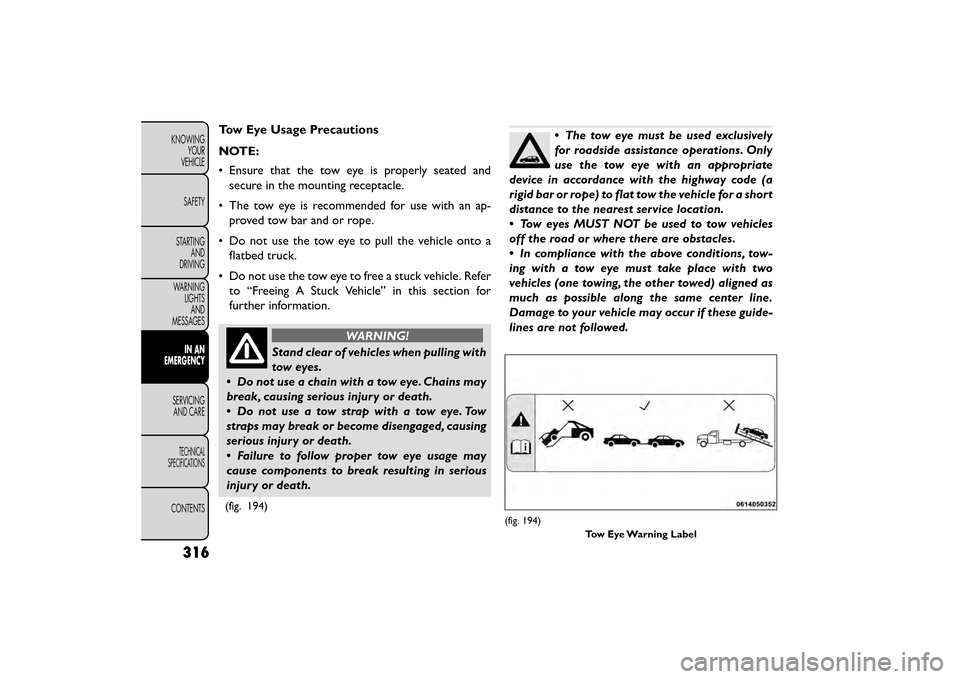
Tow Eye Usage Precautions
NOTE:
• Ensure that the tow eye is properly seated andsecure in the mounting receptacle.
• The tow eye is recommended for use with an ap- proved tow bar and or rope.
• Do not use the tow eye to pull the vehicle onto a flatbed truck.
• Do not use the tow eye to free a stuck vehicle. Refer to “Freeing A Stuck Vehicle” in this section for
further information.
WARNING!
Stand clear of vehicles when pulling with
tow e
yes.
• Do not use a chain with a tow eye. Chains may
break, causing serious injury or death.
• Donotuseatowstrapwithatoweye.Tow
straps may break or become disengaged, causing
serious injury or death.
• Failure to follow proper tow eye usage may
cause components to break resulting in serious
injury or death.
(fig. 194)
• The tow eye must be used exclusively
for roadside assistance operations. Only
use the tow eye with an appropriate
device in accordance with the highway code (a
rigid bar or rope) to flat tow the vehicle for a shor t
distance to the nearest service location.
• Tow eyes MUST NOT be used to tow vehicles
off the road or where there are obstacles.
• In compliance with the above conditions, tow-
ing with a tow eye must take place with two
vehicles (one towing, the other towed) aligned as
much as possible along the same center line.
Damage to your vehicle may occur if these guide-
lines are not followed.
(fig. 194)
Tow Eye Warning Label
316
KNOWINGYOUR
VEHICLE
SAFETY
STARTING AND
DRIVING
WARNING LIGHTSAND
MESSAGES
IN AN
EMERGENCY
SER VICING
AND
CARE
TECHNICAL
SPECIFICATIONS
CONTENTS
Page 324 of 412
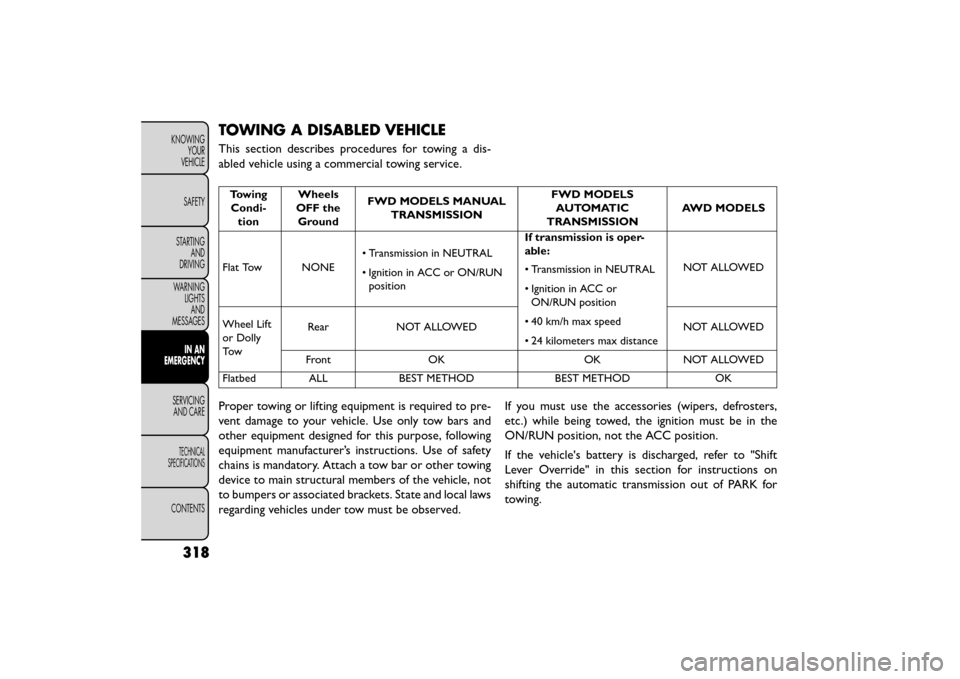
TOWING A DISABLED VEHICLE
This section describes procedures for towing a dis-
abled vehicle using a commercial towing service.
TowingCondi- tion Wheels
OFF the Ground FWD MODELS MANUAL
TRANSMISSION FWD MODELS
AUTOMATIC
TRANSMISSION AWD MODELS
Flat Tow NONE • Transmission in NEUTRAL
• Ignition in ACC or ON/RUN
position If transmission is oper-
able:
• Transmission in NEUTRAL
• Ignition in ACC or
ON/RUN position
• 40 km/h max speed
• 24 kilometers max distance NOT ALLOWED
Wheel Lift
or Dolly
To w Rear NOT ALLOWED NOT ALLOWED
Front OK OK NOT ALLOWED
Flatbed ALL BEST METHOD BEST METHOD OK
Proper towing or lifting equipment is required to pre-
vent damage to your vehicle. Use only tow bars and
other equipment designed for this purpose, following
equipment manufacturer’s instructions. Use of safety
chains is mandatory. Attach a tow bar or other towing
device to main structural members of the vehicle, not
to bumpers or associated brackets. State and local laws
regarding vehicles under tow must be observed. If you must use the accessories (wipers, defrosters,
etc.) while being towed, the ignition must be in the
ON/RUN position, not the ACC position.
If the vehicle's battery is discharged, refer to "Shift
Lever Override" in this section for instructions on
shifting the automatic transmission out of PARK for
towing.
318
KNOWING
YOUR
VEHICLE
SAFETY
STARTING AND
DRIVING
WARNING LIGHTSAND
MESSAGES
IN AN
EMERGENCY
SER VICING
AND
CARE
TECHNICAL
SPECIFICATIONS
CONTENTS
Page 327 of 412
SERVICING AND CARE
MAINTENANCE SCHEDULE
MAINTENANCE SCHEDULE – GASOLINE
ENGINE
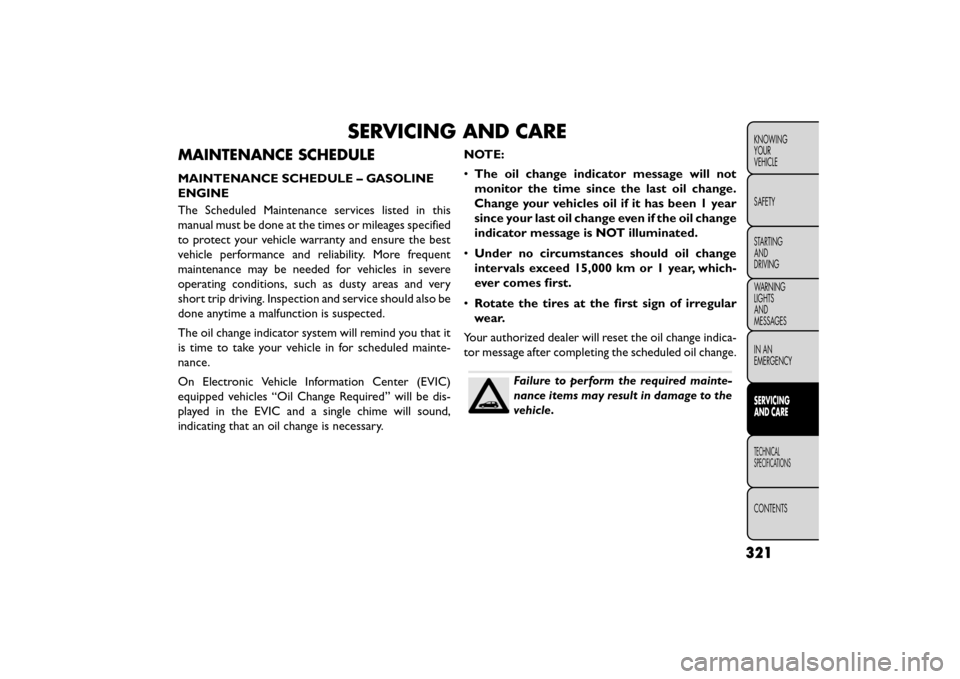
The Scheduled Maintenance services listed in this
manual must be done at the times or mileages specified
to protect your vehicle warranty and ensure the best
vehicle performance and reliability. More frequent
maintenance may be needed for vehicles in severe
operating conditions, such as dusty areas and very
short trip driving. Inspection and service should also be
done anytime a malfunction is suspected.
The oil change indicator system will remind you that it
is time to take your vehicle in for scheduled mainte-
nance.
On Electronic Vehicle Information Center (EVIC)
equipped vehicles “Oil Change Required” will be dis-
played in the EVIC and a single chime will sound,
indicating that an oil change is necessary.NOTE:
•
The oil change indicator message will not
monitor the time since the last oil change.
Change your vehicles oil if it has been 1 year
since your last oil change even if the oil change
indicator message is NOT illuminated.
• Under no circumstances should oil change
intervals exceed 15,000 km or 1 year, which-
ever comes first.
• Rotate the tires at the first sign of irregular
wear.
Your authorized dealer will reset the oil change indica-
tor message after completing the scheduled oil change.
Failure to perform the required mainte-
nance items may result in damage to the
vehicle.
321
KNOWING
YOUR
VEHICLE
SAFETY
STARTING
AND
DRIVING
WARNING
LIGHTS
AND
MESSAGES
IN AN
EMERGENCY
SERVICING
AND C ARE
TECHNICAL
SPECIFICATIONS
CONTENTS
Page 331 of 412
Every3,000 km, check and top up, if required, the
engine oil level and automatic transmission fluid level
(four-speed automatic only).
Heavy-Duty Use Of The Car
If the car is used mainly under one of the following
conditions:
• towing a trailer or caravan;
• dusty roads;
• short, repeated journeys (less than 7-8 km) at sub- zero outside temperatures;
• engine often idling or driving long distances at low speeds or long periods of idleness.
You should perform the following inspections more
frequently than shown on the Scheduled Servicing Plan:
• check front disc brake pad conditions and wear;
• check cleanliness of hood and trunk locks, cleanli- ness and lubrication of linkage;
• visually inspect conditions of: engine, transmission, pipes and hoses (exhaust - fuel system - brakes) and
rubber elements (boots - sleeves - bushes - etc.);
• check battery charge and battery fluid level (electro- lyte); • visually inspect condition of the accessory drive
belts;
• check and, if necessary, change engine oil and replace oil filter;
• check and, if necessary, replace pollen filter;
• check and, if necessary, replace air cleaner.
MAINTENANCE SCHEDULE — DIESEL
ENGINE
To help you have the best driving experience possible,
the manufacturer has identified the specific vehicle
maintenance service intervals that are required to keep
your vehicle operating properly and safely.
The manufacturer recommends that these mainte-
nance intervals be performed at your selling dealer. The
technicians at your dealership know your vehicle best,
and have access to factory trained information, genuine
FIAT parts, and specially designed electronic and me-
chanical tools that can help prevent future costly re-
pairs.
The maintenance intervals shown should be performed
as indicated in this section.
325
KNOWING
YOUR
VEHICLE
SAFETY
STARTING
AND
DRIVING
WARNING
LIGHTS
AND
MESSAGES
IN AN
EMERGENCY
SERVICING
AND C ARE
TECHNICAL
SPECIFICATIONS
CONTENTS
Page 341 of 412
MAINTENANCE PROCEDURES
The pages that follow contain therequiredmainte-
nance services determined by the engineers who de-
signed your vehicle.
Besides those maintenance items specified in the fixed
maintenance schedule, there are other components
which may require servicing or replacement in the
future.
• Failure to properly maintain your ve-
hicle or perform repairs and service when
necessary could result in more costly re-
pairs, damage to other components or negatively
impact vehicle performance. Immediately have
potential malfunctions examined by an autho-
rized dealership or qualified repair center.
• Car maintenance should be done at a FIAT
Dealership. For routine and minor maintenance
operations you wish to carry out yourself, we do
recommend you have the proper equipment ,
genuine FIAT parts and the necessary fluids; do
not however carry out these operations if you
have no experience.
• Your vehicle has been built with improved fluids
that protect the performance and durability of
your vehicle and also allow extended mainte-
nance intervals. Do not use chemical flushes in
these components as the chemicals can damage
your engine, transmission, power steering or air
conditioning. Such damage is not covered by the
New Vehicle Limited Warranty. If a flush is needed
because of component malfunction, use only the
specified fluid for the flushing procedure.
335
KNOWING
YOUR
VEHICLE
SAFETY
STARTING
AND
DRIVING
WARNING
LIGHTS
AND
MESSAGES
IN AN
EMERGENCY
SERVICING
AND C ARE
TECHNICAL
SPECIFICATIONS
CONTENTS
Page 344 of 412
Disposing Of Used Engine Oil And Oil Filters
Care should be taken in disposing of used engine oil and
oil filters from your vehicle. Used oil and oil filters,
indiscriminately discarded, can present a problem to
the environment. Contact your authorized dealer, ser-
vice station or governmental agency for advice on how
and where used oil and oil filters can be safely discarded
in your area.
ENGINE AIR CLEANER FILTER
Refer to the “Maintenance Schedule” for the proper
maintenance intervals.
WARNING!
The air induction system (air cleaner,
hoses ,
etc .) can provide a measure of
protection in the case of engine backfire. Do not
remove the air induction system (air cleaner,
hoses, etc .) unless such removal is necessary for
repair or maintenance. Make sure that no one is
near the engine compartment before starting the
vehicle with the air induction system (air cleaner,
hoses, etc .) removed. Failure to do so can result in
serious personal injury. Engine Air Cleaner Filter Selection
The quality of replacement engine air cleaner filters
varies considerably. Only high quality filters should be
used to assure most efficient service.
MAINTENANCE-FREE BATTERY
You will never have to add water, and periodic mainte-
nance is not required.
NOTE:
The battery is stored in a compartment that is
located behind the left front fender and is accessible
through the wheel well. The wheel and tire assemble
do not need to be removed to access the compart-
ment. Remote battery terminals are located in the
engine compartment for jump-starting.
To access the battery, turn the steering wheel fully to
the right and remove the access panel from the inner
fender shield.
WARNING!
• Battery fluid is a corrosive acid solu-
t i
on and can burn or even blind you. Do
not allow battery fluid to contact your eyes, skin,
or clothing. Do not lean over a battery when
attaching clamps. If acid splashes in eyes or on
skin, flush the area immediately with large
amounts of water.
(Continued)
338
KNOWINGYOUR
VEHICLE
SAFETY
STARTING AND
DRIVING
WARNING LIGHTSAND
MESSAGES
IN AN
EMERGENCY
SERVICINGAND C ARE
TECHNICAL
SPECIFICATIONS
CONTENTS
Page 345 of 412
WARNING! (Continued)
• Battery gas is flammable and explosive. Keep
flame or sparks away from the battery. Do not
use a booster battery or any other booster source
with an output greater than 12 Volts. Do not
allow cable clamps to touch each other.
• Battery posts, terminals, and related accesso-
ries contain lead and lead compounds. Wash
hands after handling.
• It is essential when replacing the cables
on the battery that the positive cable is
attached to the positive post and the
negative cable is attached to the negative post .
Battery posts are marked positive (+) and nega-
tive (-) and identified on the battery case. Cable
clamps should be tight on the terminal posts and
free of corrosion.
• If a “fast charger ” is used while the battery is in
the vehicle, disconnect both vehicle battery cables
before connecting the charger to the battery. Do
not use a “fast charger ” to provide star ting volt-
age as battery damage can result . AIR CONDITIONER MAINTENANCE
For best possible performance, your air conditioner
should be checked and serviced by an authorized
dealer at the start of each warm season. This service
should include cleaning of the condenser fins and a
performance test. Drive belt tension should also be
checked at this time.
Do not use chemical flushes in your air
conditioning system as the chemicals can
damage your air conditioning compo-
nents. Such damage is not covered by the New
Vehicle Limited Warranty.
WARNING!
• Use only refrigerants and compressor
lubr i
cants approved by the manufac-
turer for your air conditioning system. Some un-
approved refrigerants are flammable and can
explode, injuring you. Other unapproved refrig-
erants or lubricants can cause the system to fail,
requiring costly repairs.
•
The air conditioning system contains refrigerant
under high pressure. To avoid risk of personal
injury or damage to the system, adding refrigerant
or any repair requiring lines to be disconnected
should be done by an experienced technician.
339
KNOWING
YOUR
VEHICLE
SAFETY
STARTING
AND
DRIVING
WARNING
LIGHTS
AND
MESSAGES
IN AN
EMERGENCY
SERVICING
AND C ARE
TECHNICAL
SPECIFICATIONS
CONTENTS
Page 346 of 412
Refrigerant Recovery And Recycling
R-134a Air Conditioning Refrigerant is a hydrofluoro-
carbon (HFC) that is endorsed by the Environmental
Protection Agency and is an ozone-saving product.
However, the manufacturer recommends that air con-
ditioning service be performed by authorized dealer or
other service facilities using recovery and recycling
equipment.
NOTE:Use only manufacturer approved A/C system
PAG compressor oil and refrigerants.
A/C AIR FILTER
Refer to the “Maintenance Schedule” for the proper
maintenance intervals.
Car maintenance should be done at a
FIAT Dealership. For routine and minor
maintenance operations you wish to
carry out yourself, we do recommend you have
the proper equipment , genuine FIAT spare parts
and the necessary fluids; do not however carry out
these operations if you have no experience.
WARNING!
Do not remove the A/C air filter while
th e
blower is operating or personal in-
jury may result .
The A/C air filter is located in the fresh air inlet behind
the glove box. Perform the following steps to replace
the filter:
1. Open the glove box and remove all contents.
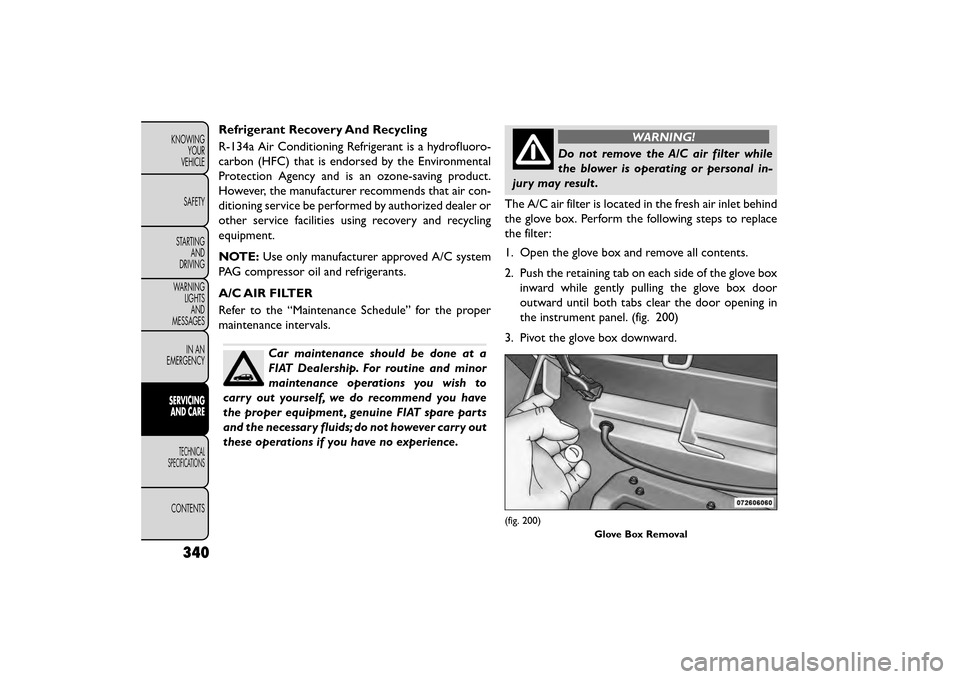
2. Push the retaining tab on each side of the glove box inward while gently pulling the glove box door
outward until both tabs clear the door opening in
the instrument panel. (fig. 200)
3. Pivot the glove box downward.
(fig. 200) Glove Box Removal
340
KNOWINGYOUR
VEHICLE
SAFETY
STARTING AND
DRIVING
WARNING LIGHTSAND
MESSAGES
IN AN
EMERGENCY
SERVICINGAND C ARE
TECHNICAL
SPECIFICATIONS
CONTENTS
Page 347 of 412
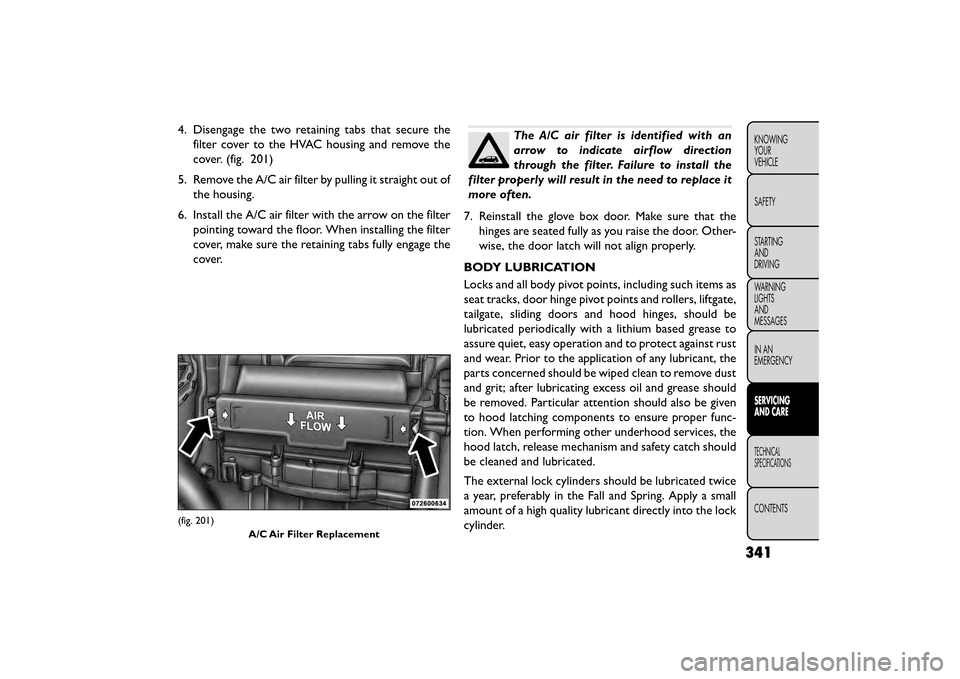
4. Disengage the two retaining tabs that secure thefilter cover to the HVAC housing and remove the
cover. (fig. 201)
5. Remove the A/C air filter by pulling it straight out of the housing.
6. Install the A/C air filter with the arrow on the filter pointing toward the floor. When installing the filter
cover, make sure the retaining tabs fully engage the
cover.The A/C air filter is identified with an
arrow to indicate airflow direction
through the filter. Failure to install the
filter properly will result in the need to replace it
more often.
7. Reinstall the glove box door. Make sure that the hinges are seated fully as you raise the door. Other-
wise, the door latch will not align properly.
BODY LUBRICATION
Locks and all body pivot points, including such items as
seat tracks, door hinge pivot points and rollers, liftgate,
tailgate, sliding doors and hood hinges, should be
lubricated periodically with a lithium based grease to
assure quiet, easy operation and to protect against rust
and wear. Prior to the application of any lubricant, the
parts concerned should be wiped clean to remove dust
and grit; after lubricating excess oil and grease should
be removed. Particular attention should also be given
to hood latching components to ensure proper func-
tion. When performing other underhood services, the
hood latch, release mechanism and safety catch should
be cleaned and lubricated.
The external lock cylinders should be lubricated twice
a year, preferably in the Fall and Spring. Apply a small
amount of a high quality lubricant directly into the lock
cylinder.
(fig. 201) A/C Air Filter Replacement
341
KNOWING
YOUR
VEHICLE
SAFETY
STARTING
AND
DRIVING
WARNING
LIGHTS
AND
MESSAGES
IN AN
EMERGENCY
SERVICING
AND CARE
TECHNICAL
SPECIFICATIONS
CONTENTS