Lights FIAT FULLBACK 2016 1.G User Guide
[x] Cancel search | Manufacturer: FIAT, Model Year: 2016, Model line: FULLBACK, Model: FIAT FULLBACK 2016 1.GPages: 312, PDF Size: 13.67 MB
Page 232 of 312
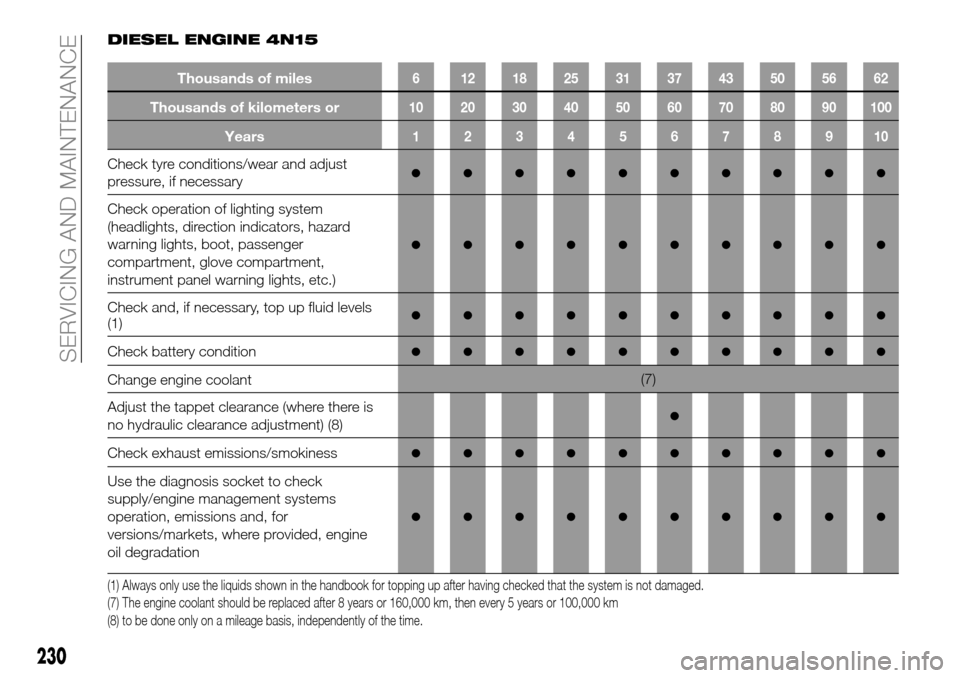
DIESEL ENGINE 4N15
Thousands of miles6 121825313743505662
Thousands of kilometers or10 20 30 40 50 60 70 80 90 100
Years12345678910
Check tyre conditions/wear and adjust
pressure, if necessary●●●●●●●●●●
Check operation of lighting system
(headlights, direction indicators, hazard
warning lights, boot, passenger
compartment, glove compartment,
instrument panel warning lights, etc.)
●●●●●●●●●●
Check and, if necessary, top up fluid levels
(1)●●●●●●●●●●
Check battery condition●●●●●●●●●●
Change engine coolant(7)
Adjust the tappet clearance (where there is
no hydraulic clearance adjustment) (8)
●
Check exhaust emissions/smokiness●●●●●●●●●●
Use the diagnosis socket to check
supply/engine management systems
operation, emissions and, for
versions/markets, where provided, engine
oil degradation
●●●●●●●●●●
(1) Always only use the liquids shown in the handbook for topping up after having checked that the system is not damaged.
(7) The engine coolant should be replaced after 8 years or 160,000 km, then every 5 years or 100,000 km
(8) to be done only on a mileage basis, independently of the time.
230
SERVICING AND MAINTENANCE
Page 237 of 312
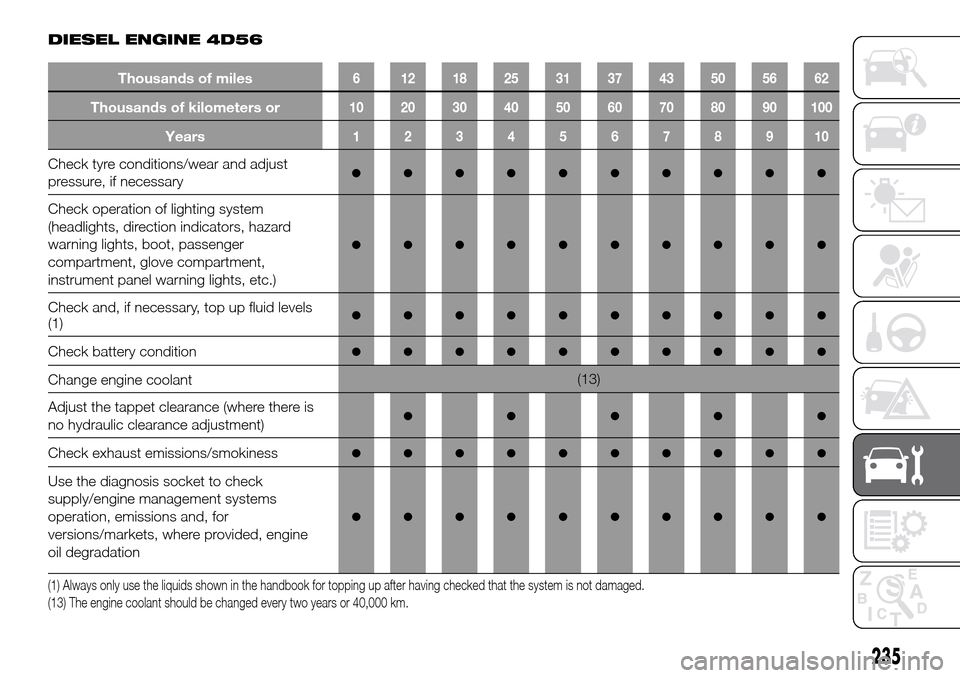
DIESEL ENGINE 4D56
Thousands of miles6 121825313743505662
Thousands of kilometers or10 20 30 40 50 60 70 80 90 100
Years12345678910
Check tyre conditions/wear and adjust
pressure, if necessary●●●●●●●●●●
Check operation of lighting system
(headlights, direction indicators, hazard
warning lights, boot, passenger
compartment, glove compartment,
instrument panel warning lights, etc.)
●●●●●●●●●●
Check and, if necessary, top up fluid levels
(1)●●●●●●●●●●
Check battery condition●●●●●●●●●●
Change engine coolant(13)
Adjust the tappet clearance (where there is
no hydraulic clearance adjustment)
●●●●●
Check exhaust emissions/smokiness●●●●●●●●●●
Use the diagnosis socket to check
supply/engine management systems
operation, emissions and, for
versions/markets, where provided, engine
oil degradation
●●●●●●●●●●
(1) Always only use the liquids shown in the handbook for topping up after having checked that the system is not damaged.
(13) The engine coolant should be changed every two years or 40,000 km.
235
Page 242 of 312
PERIODIC CHECKS
Before long journeys, check and, if
necessary, restore:
engine coolant level;
brake fluid level;
windscreen washer fluid level;
operation of lighting system
(headlamps, direction indicators, hazard
warning lights, etc.);
tyre inflation pressure and condition;
tyre alignment;
operation of screen washer/wiper
system and positioning/wear of
windscreen/rear window wiper blades.
To ensure that the vehicle is always
efficient and well maintained, it is
advisable to make sure that you carry
out the above operations regularly
(approximately every 1000 km and
every 3000 km for checking and
topping up engine oil is advisable).
DEMANDING
VEHICLE USE
If the vehicle is mostly used in one of
the following conditions:
towing a trailer or caravan;
dusty roads;
short, repeated journeys (less than
7-8 km) at sub-zero outside
temperatures;
engine often idling or driving long
distances at low speeds or long periods
of inactivity;
the following checks must be carried
out more often than indicated in the
Scheduled Servicing Plan:
check front disc brake pad
conditions and wear;
check cleanliness of bonnet and
boot locks, cleanliness and lubrication
of linkage;
visually inspect conditions of: engine,
gearbox, transmission, pipes and hoses
(exhaust - fuel system - brakes) and
rubber elements (boots - sleeves -
bushes - etc.);
check battery charge and battery
fluid level (electrolyte);
visually inspect condition of the
accessory drive belts;
check and, if necessary, change
engine oil and replace oil filter;
check and, if necessary, replace
pollen filter.
240
SERVICING AND MAINTENANCE
Page 251 of 312
WASHER FLUID
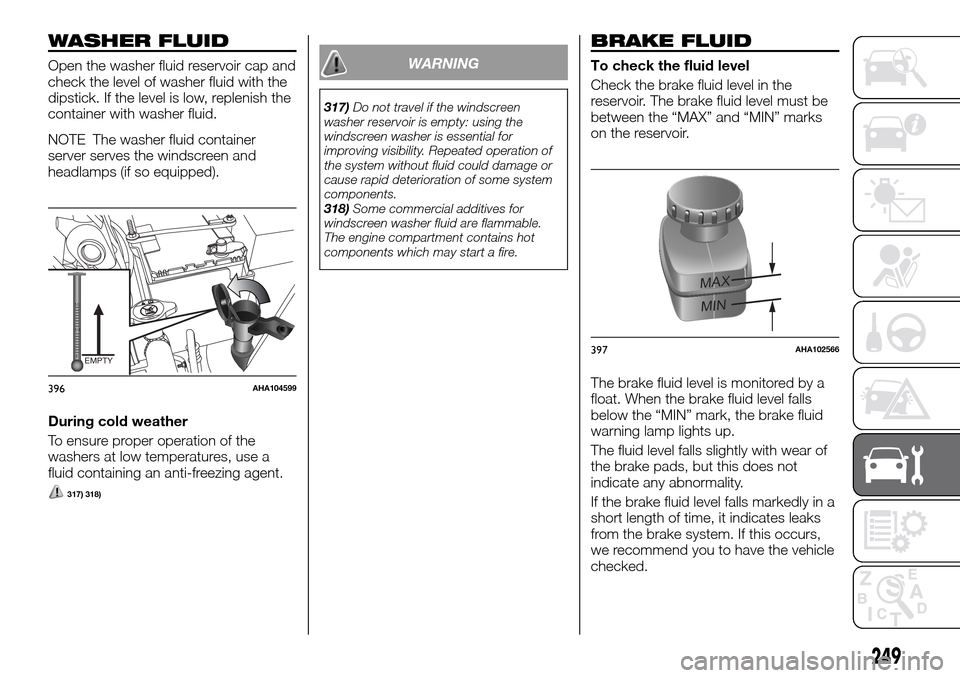
Open the washer fluid reservoir cap and
check the level of washer fluid with the
dipstick. If the level is low, replenish the
container with washer fluid.
NOTE The washer fluid container
server serves the windscreen and
headlamps (if so equipped).
During cold weather
To ensure proper operation of the
washers at low temperatures, use a
fluid containing an anti-freezing agent.
317) 318)
WARNING
317)Do not travel if the windscreen
washer reservoir is empty: using the
windscreen washer is essential for
improving visibility. Repeated operation of
the system without fluid could damage or
cause rapid deterioration of some system
components.
318)Some commercial additives for
windscreen washer fluid are flammable.
The engine compartment contains hot
components which may start a fire.
BRAKE FLUID
To check the fluid level
Check the brake fluid level in the
reservoir. The brake fluid level must be
between the “MAX” and “MIN” marks
on the reservoir.
The brake fluid level is monitored by a
float. When the brake fluid level falls
below the “MIN” mark, the brake fluid
warning lamp lights up.
The fluid level falls slightly with wear of
the brake pads, but this does not
indicate any abnormality.
If the brake fluid level falls markedly in a
short length of time, it indicates leaks
from the brake system. If this occurs,
we recommend you to have the vehicle
checked.
108kPa
EMPTYE 1/4 1/2
396AHA104599
MAX
MIN
397AHA102566
249
Page 309 of 312
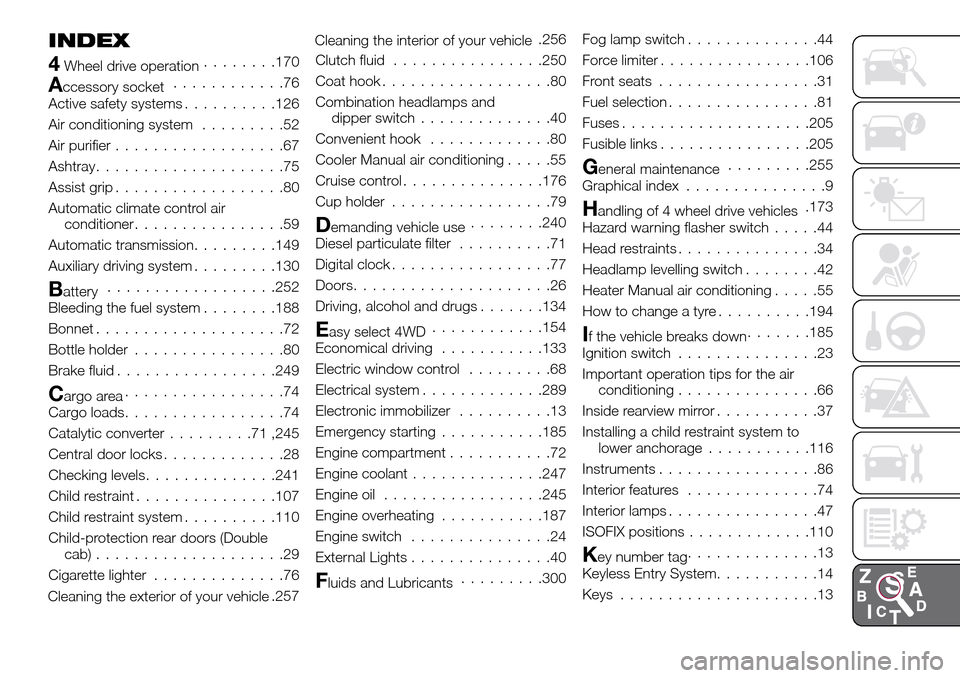
INDEX
4Wheel drive operation........170
Accessory socket............76
Active safety systems..........126
Air conditioning system.........52
Air purifier..................67
Ashtray....................75
Assist grip..................80
Automatic climate control air
conditioner................59
Automatic transmission.........149
Auxiliary driving system.........130
Battery..................252
Bleeding the fuel system........188
Bonnet....................72
Bottle holder................80
Brake fluid.................249
Cargo area.................74
Cargo loads.................74
Catalytic converter.........71,245
Central door locks.............28
Checking levels..............241
Child restraint...............107
Child restraint system..........110
Child-protection rear doors (Double
cab)....................29
Cigarette lighter..............76
.257.256
Clutch fluid................250
Coat hook..................80
Combination headlamps and
dipper switch..............40
Convenient hook.............80
Cooler Manual air conditioning.....55
Cruise control...............176
Cup holder.................79
Demanding vehicle use........240
Diesel particulate filter..........71
Digital clock.................77
Doors.....................26
Driving, alcohol and drugs.......134
Easy select 4WD............154
Economical driving...........133
Electric window control.........68
Electrical system.............289
Electronic immobilizer..........13
Emergency starting...........185
Engine compartment...........72
Engine coolant..............247
Engine oil.................245
Engine overheating...........187
Engine switch...............24
External Lights...............40
Fluids and Lubricants.........300Fog lamp switch..............44
Force limiter................106
Front seats.................31
Fuel selection................81
Fuses....................205
Fusible links................205
General maintenance.........255
Graphical index...............9
Handling of 4 wheel drive vehicles.173
Hazard warning flasher switch.....44
Head restraints...............34
Headlamp levelling switch........42
Heater Manual air conditioning.....55
How to change a tyre..........194
If the vehicle breaks down.......185
Ignition switch...............23
Important operation tips for the air
conditioning...............66
Inside rearview mirror...........37
Installing a child restraint system to
lower anchorage...........116
Instruments.................86
Interior features..............74
Interior lamps................47
ISOFIX positions.............110
Key number tag..............13
Keyless Entry System...........14
Keys.....................13
Cleaning the exterior of your vehicleCleaning the interior of your vehicle