airbag FIAT FULLBACK 2016 1.G User Guide
[x] Cancel search | Manufacturer: FIAT, Model Year: 2016, Model line: FULLBACK, Model: FIAT FULLBACK 2016 1.GPages: 312, PDF Size: 13.67 MB
Page 113 of 312
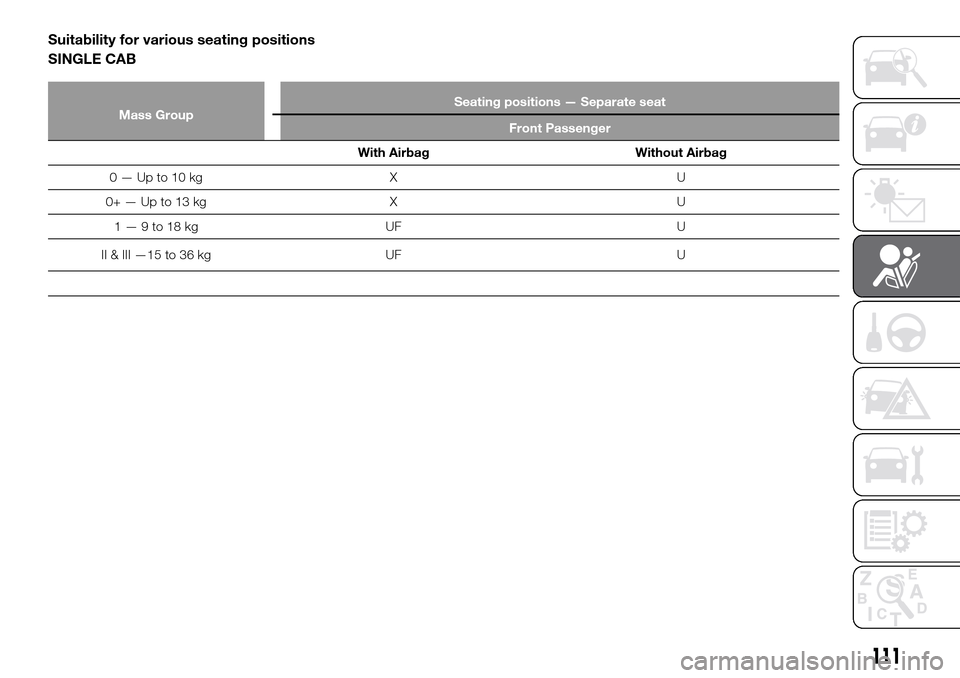
Suitability for various seating positions
SINGLE CAB
Mass GroupSeating positions — Separate seat
Front Passenger
With Airbag Without Airbag
0—Upto10kg X U
0+—Upto13kg X U
1—9to18kg UF U
II & III —15 to 36 kg UF U
111
Page 114 of 312
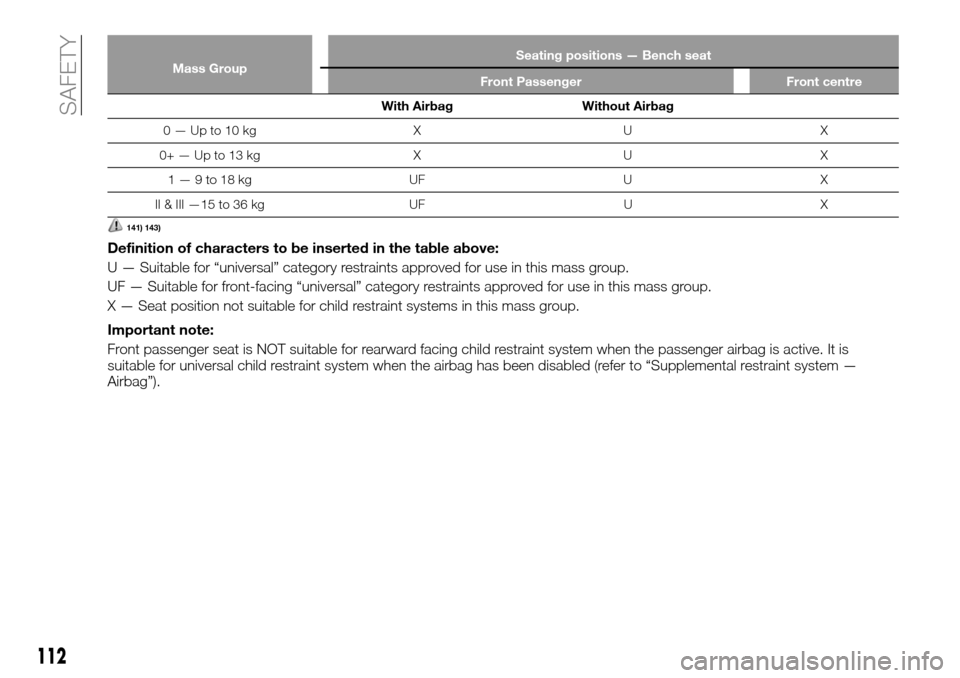
Mass GroupSeating positions — Bench seat
Front Passenger Front centre
With Airbag Without Airbag
0—Upto10kg X U X
0+—Upto13kg X U X
1—9to18kg UF U X
II & III —15 to 36 kg UF U X
141) 143)
Definition of characters to be inserted in the table above:
U — Suitable for “universal” category restraints approved for use in this mass group.
UF — Suitable for front-facing “universal” category restraints approved for use in this mass group.
X — Seat position not suitable for child restraint systems in this mass group.
Important note:
Front passenger seat is NOT suitable for rearward facing child restraint system when the passenger airbag is active. It is
suitable for universal child restraint system when the airbag has been disabled (refer to “Supplemental restraint system —
Airbag”).
112
SAFETY
Page 115 of 312
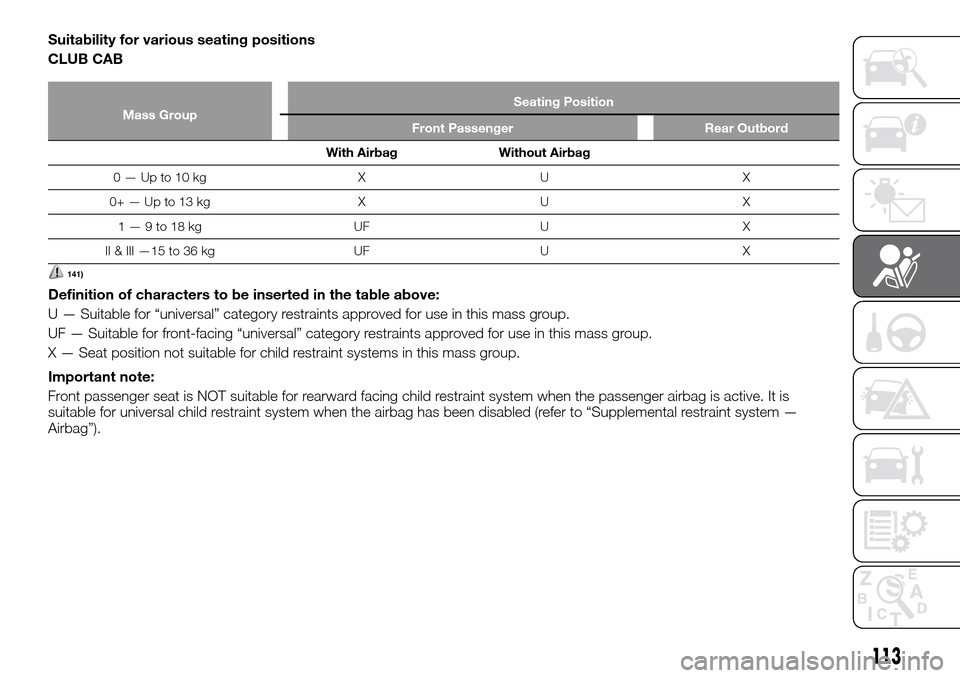
Suitability for various seating positions
CLUB CAB
Mass GroupSeating Position
Front Passenger Rear Outbord
With Airbag Without Airbag
0—Upto10kg X U X
0+—Upto13kg X U X
1—9to18kg UF U X
II & III —15 to 36 kg UF U X
141)
Definition of characters to be inserted in the table above:
U — Suitable for “universal” category restraints approved for use in this mass group.
UF — Suitable for front-facing “universal” category restraints approved for use in this mass group.
X — Seat position not suitable for child restraint systems in this mass group.
Important note:
Front passenger seat is NOT suitable for rearward facing child restraint system when the passenger airbag is active. It is
suitable for universal child restraint system when the airbag has been disabled (refer to “Supplemental restraint system —
Airbag”).
113
Page 116 of 312
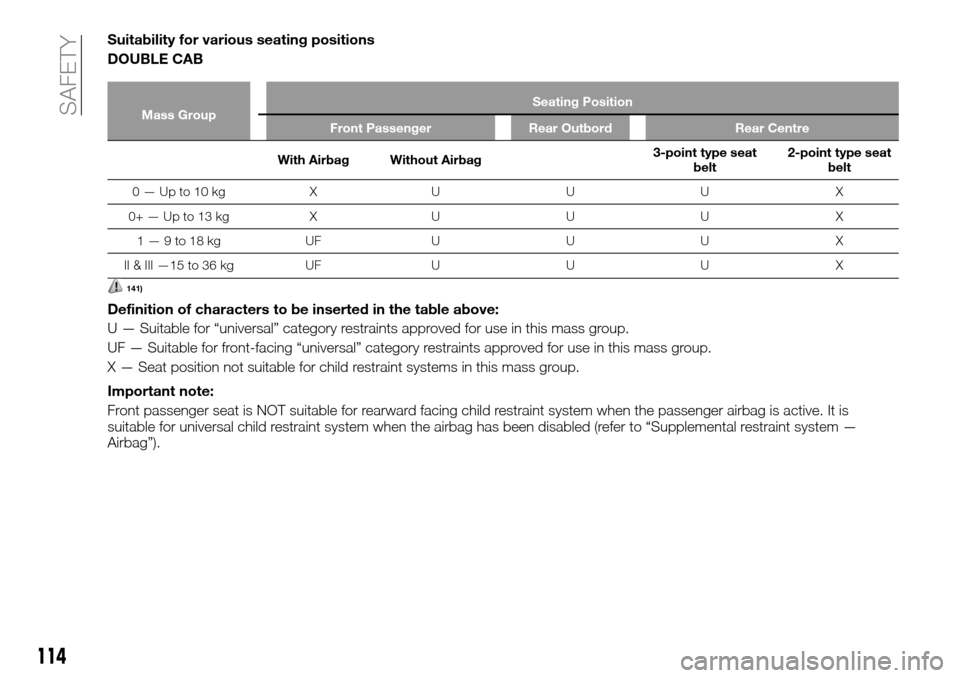
Suitability for various seating positions
DOUBLE CAB
Mass GroupSeating Position
Front Passenger Rear Outbord Rear Centre
With Airbag Without Airbag3-point type seat
belt2-point type seat
belt
0—Upto10kg X U U U X
0+—Upto13kg X U U U X
1—9to18kg UF U U U X
II & III —15 to 36 kg UF U U U X
141)
Definition of characters to be inserted in the table above:
U — Suitable for “universal” category restraints approved for use in this mass group.
UF — Suitable for front-facing “universal” category restraints approved for use in this mass group.
X — Seat position not suitable for child restraint systems in this mass group.
Important note:
Front passenger seat is NOT suitable for rearward facing child restraint system when the passenger airbag is active. It is
suitable for universal child restraint system when the airbag has been disabled (refer to “Supplemental restraint system —
Airbag”).
114
SAFETY
Page 120 of 312
SUPPLEMENTAL
RESTRAINT SYSTEM
AIRBAG
The information for SRS airbags
includes important information
concerning the driver’s and front
passenger’s airbags, the driver’s knee
airbag, the side airbags and the curtain
airbags.
The SRS driver’s and front passenger’s
airbags are designed to supplement the
primary protection of the driver and
front passenger side seat belt systems
by providing those occupants with
protection against head and chest
injuries in certain moderate-to-severe
frontal collisions.
The SRS driver airbag employ a dual
stage airbag system (if so equipped).
The SRS driver and front passenger
airbag is controlled by the impact
sensors (at the front of the vehicle) and
the control unit (near the centre of the
vehicle at floor level).
The SRS driver’s knee airbag (if so
equipped) is designed to supplement
the primary protection of the driver’s
seat belt system. It can reduce the
forward movement of the driver’s lower
legs and provide increased overall body
protection in certain moderate-to-
severe frontal collisions.
The SRS side airbags (if so equipped)
are designed to supplement properly
worn seat belts and provide the driver
and front passenger with protectionagainst chest injuries in certain
moderate-to-severe side impact
collisions.
The SRS curtain airbags (if so
equipped) are designed to supplement
properly worn seat belts and provide
the driver and passenger with
protection against head injuries in
certain moderate-to-severe side impact
collisions.
The SRS is NOT a substitute for the
seat belts. To ensure the maximum
protection during all types of collisions
and accidents, all occupants, including
the passengers as well as the driver,
must wear their seat belts.
How the supplemental restraint
system works
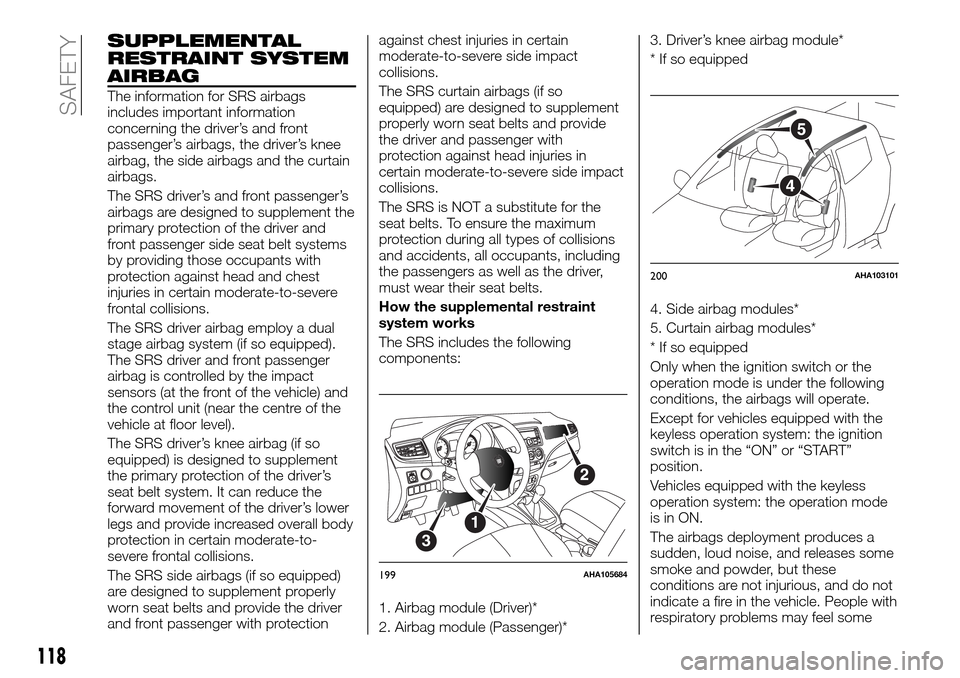
The SRS includes the following
components:
1. Airbag module (Driver)*
2. Airbag module (Passenger)*3. Driver’s knee airbag module*
* If so equipped
4. Side airbag modules*
5. Curtain airbag modules*
* If so equipped
Only when the ignition switch or the
operation mode is under the following
conditions, the airbags will operate.
Except for vehicles equipped with the
keyless operation system: the ignition
switch is in the “ON” or “START”
position.
Vehicles equipped with the keyless
operation system: the operation mode
is in ON.
The airbags deployment produces a
sudden, loud noise, and releases some
smoke and powder, but these
conditions are not injurious, and do not
indicate a fire in the vehicle. People with
respiratory problems may feel some
56
7
8120
140
160
180
200
LROFF3 2 14
3
2
1
199AHA105684
5
4
200AHA103101
118
SAFETY
Page 121 of 312
temporary irritation from chemicals
used to produce the deployment; open
the windows after airbag deployment, if
safe to do so.
The airbags deflate very rapidly after
deployment, so there is little danger of
obscured vision.
145) 146) 147) 148) 149) 150) 151) 152)
Caution for installing the child
restraint on vehicle with front
passenger’s airbag
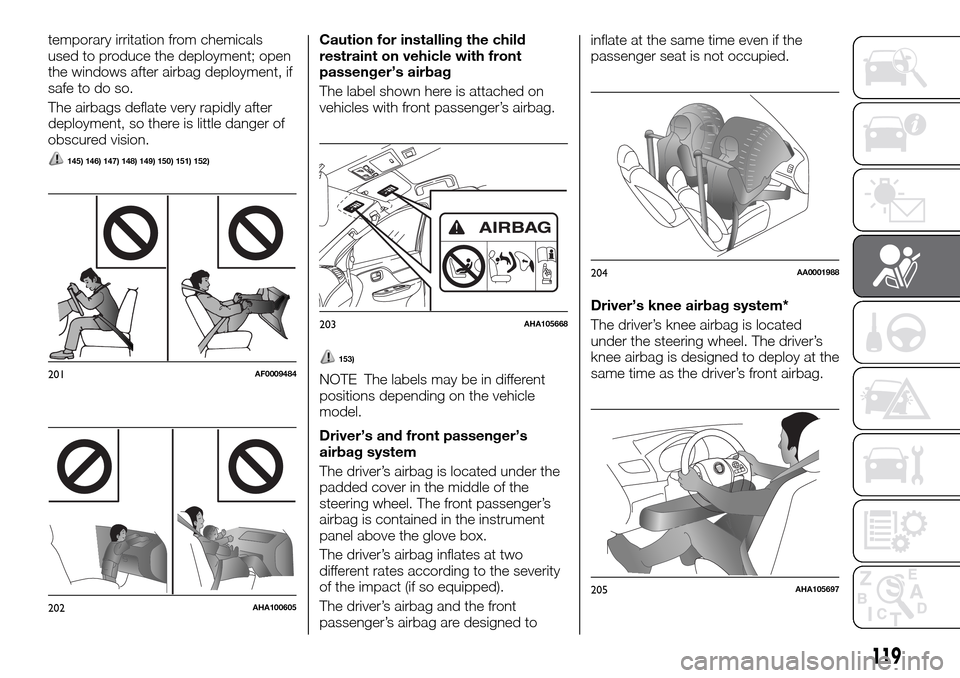
The label shown here is attached on
vehicles with front passenger’s airbag.
153)
NOTE The labels may be in different
positions depending on the vehicle
model.
Driver’s and front passenger’s
airbag system
The driver’s airbag is located under the
padded cover in the middle of the
steering wheel. The front passenger’s
airbag is contained in the instrument
panel above the glove box.
The driver’s airbag inflates at two
different rates according to the severity
of the impact (if so equipped).
The driver’s airbag and the front
passenger’s airbag are designed toinflate at the same time even if the
passenger seat is not occupied.
Driver’s knee airbag system*
The driver’s knee airbag is located
under the steering wheel. The driver’s
knee airbag is designed to deploy at the
same time as the driver’s front airbag.201AF0009484
202AHA100605
203AHA105668
204AA0001988
205AHA105697
119
Page 122 of 312
Deployment of front
airbags and driver’s
knee airbag
The front airbags and driver’s knee
airbag ARE DESIGNED TO DEPLOY
when…
The front airbags and driver’s knee
airbag are designed to deploy when the
vehicle suffers a moderate to severe
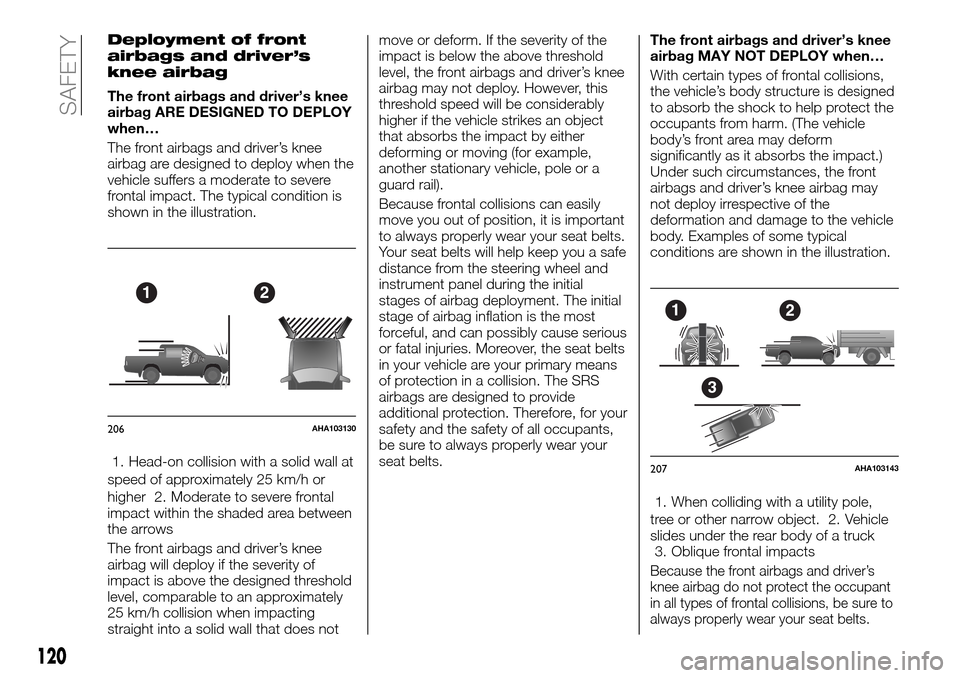
frontal impact. The typical condition is
shown in the illustration.
1. Head-on collision with a solid wall at
speed of approximately 25 km/h or
higher 2. Moderate to severe frontal
impact within the shaded area between
the arrows
The front airbags and driver’s knee
airbag will deploy if the severity of
impact is above the designed threshold
level, comparable to an approximately
25 km/h collision when impacting
straight into a solid wall that does notmove or deform. If the severity of the
impact is below the above threshold
level, the front airbags and driver’s knee
airbag may not deploy. However, this
threshold speed will be considerably
higher if the vehicle strikes an object
that absorbs the impact by either
deforming or moving (for example,
another stationary vehicle, pole or a
guard rail).
Because frontal collisions can easily
move you out of position, it is important
to always properly wear your seat belts.
Your seat belts will help keep you a safe
distance from the steering wheel and
instrument panel during the initial
stages of airbag deployment. The initial
stage of airbag inflation is the most
forceful, and can possibly cause serious
or fatal injuries. Moreover, the seat belts
in your vehicle are your primary means
of protection in a collision. The SRS
airbags are designed to provide
additional protection. Therefore, for your
safety and the safety of all occupants,
be sure to always properly wear your
seat belts.The front airbags and driver’s knee
airbag MAY NOT DEPLOY when…
With certain types of frontal collisions,
the vehicle’s body structure is designed
to absorb the shock to help protect the
occupants from harm. (The vehicle
body’s front area may deform
significantly as it absorbs the impact.)
Under such circumstances, the front
airbags and driver’s knee airbag may
not deploy irrespective of the
deformation and damage to the vehicle
body. Examples of some typical
conditions are shown in the illustration.
1. When colliding with a utility pole,
tree or other narrow object. 2. Vehicle
slides under the rear body of a truck
3. Oblique frontal impacts
Because the front airbags and driver’s
knee airbag do not protect the occupant
in all types of frontal collisions, be sure to
always properly wear your seat belts.
12
206AHA103130
2
3
1
207AHA103143
120
SAFETY
Page 123 of 312
The front airbags and driver’s knee
airbag ARE NOT DESIGNED TO
DEPLOY when…
The front airbags and driver’s knee
airbag are not designed to deploy in
conditions where they cannot typically
provide protection to the occupant.
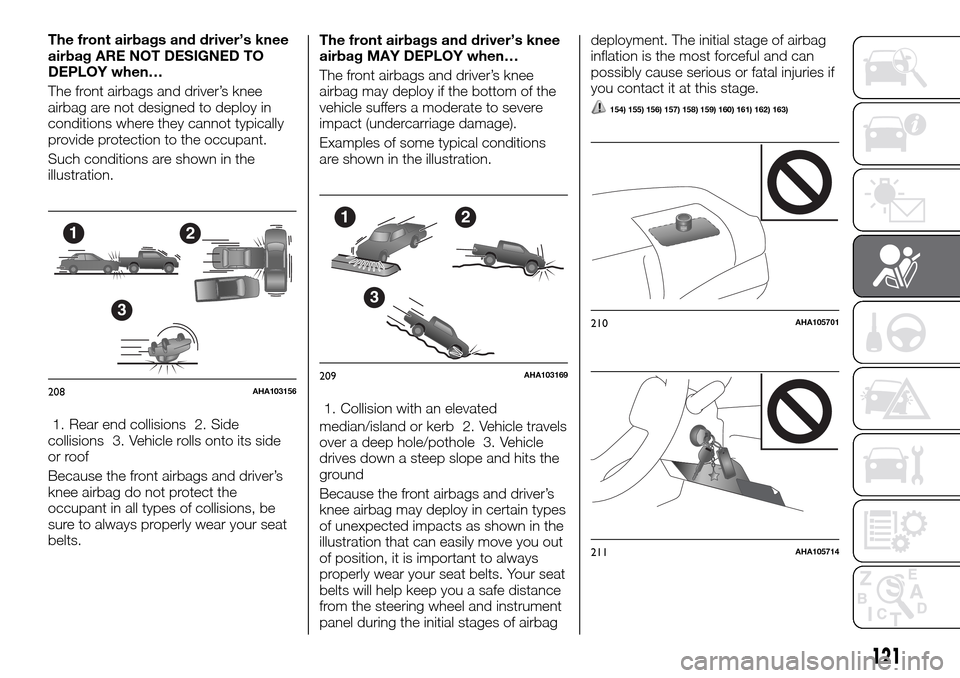
Such conditions are shown in the
illustration.
1. Rear end collisions 2. Side
collisions 3. Vehicle rolls onto its side
or roof
Because the front airbags and driver’s
knee airbag do not protect the
occupant in all types of collisions, be
sure to always properly wear your seat
belts.The front airbags and driver’s knee
airbag MAY DEPLOY when…
The front airbags and driver’s knee
airbag may deploy if the bottom of the
vehicle suffers a moderate to severe
impact (undercarriage damage).
Examples of some typical conditions
are shown in the illustration.
1. Collision with an elevated
median/island or kerb 2. Vehicle travels
over a deep hole/pothole 3. Vehicle
drives down a steep slope and hits the
ground
Because the front airbags and driver’s
knee airbag may deploy in certain types
of unexpected impacts as shown in the
illustration that can easily move you out
of position, it is important to always
properly wear your seat belts. Your seat
belts will help keep you a safe distance
from the steering wheel and instrument
panel during the initial stages of airbagdeployment. The initial stage of airbag
inflation is the most forceful and can
possibly cause serious or fatal injuries if
you contact it at this stage.
154) 155) 156) 157) 158) 159) 160) 161) 162) 163)
2
3
1
208AHA103156
2
3
1
209AHA103169
210AHA105701
211AHA105714
121
Page 124 of 312
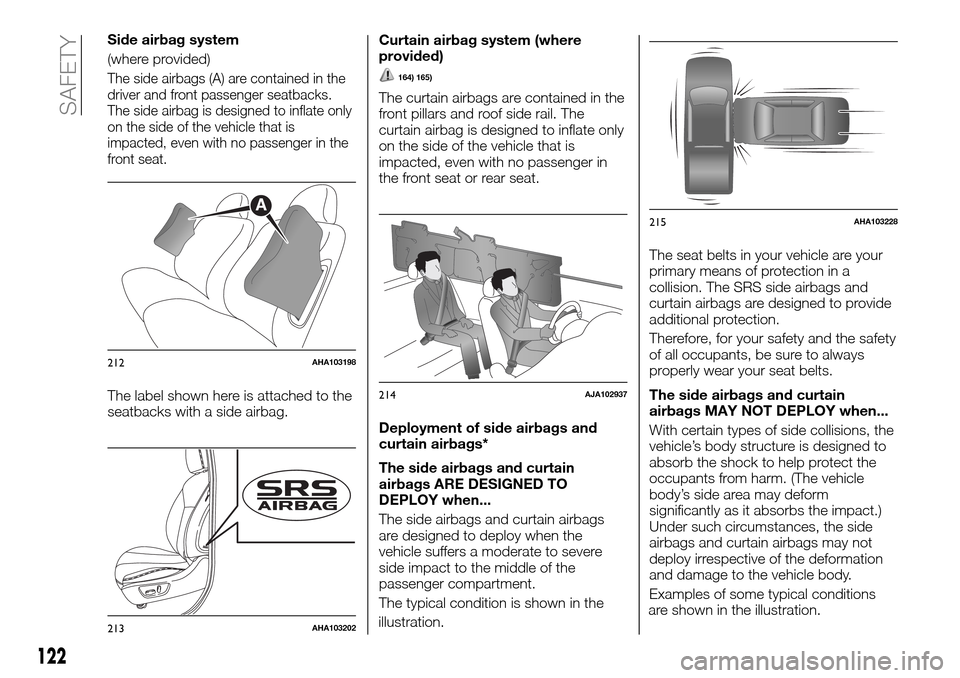
Side airbag system
(where provided)
The side airbags (A) are contained in the
driver and front passenger seatbacks.
The side airbag is designed to inflate only
on the side of the vehicle that is
impacted, even with no passenger in the
front seat.
The label shown here is attached to the
seatbacks with a side airbag.Curtain airbag system (where
provided)
164) 165)
The curtain airbags are contained in the
front pillars and roof side rail. The
curtain airbag is designed to inflate only
on the side of the vehicle that is
impacted, even with no passenger in
the front seat or rear seat.
Deployment of side airbags and
curtain airbags*
The side airbags and curtain
airbags ARE DESIGNED TO
DEPLOY when...
The side airbags and curtain airbags
are designed to deploy when the
vehicle suffers a moderate to severe
side impact to the middle of the
passenger compartment.
The typical condition is shown in the
illustration.The seat belts in your vehicle are your
primary means of protection in a
collision. The SRS side airbags and
curtain airbags are designed to provide
additional protection.
Therefore, for your safety and the safety
of all occupants, be sure to always
properly wear your seat belts.
The side airbags and curtain
airbags MAY NOT DEPLOY when...
With certain types of side collisions, the
vehicle’s body structure is designed to
absorb the shock to help protect the
occupants from harm. (The vehicle
body’s side area may deform
significantly as it absorbs the impact.)
Under such circumstances, the side
airbags and curtain airbags may not
deploy irrespective of the deformation
and damage to the vehicle body.
Examples of some typical conditions
A
212AHA103198
213AHA103202
214AJA102937
215AHA103228
122
SAFETY
are shown in the illustration.
Page 125 of 312
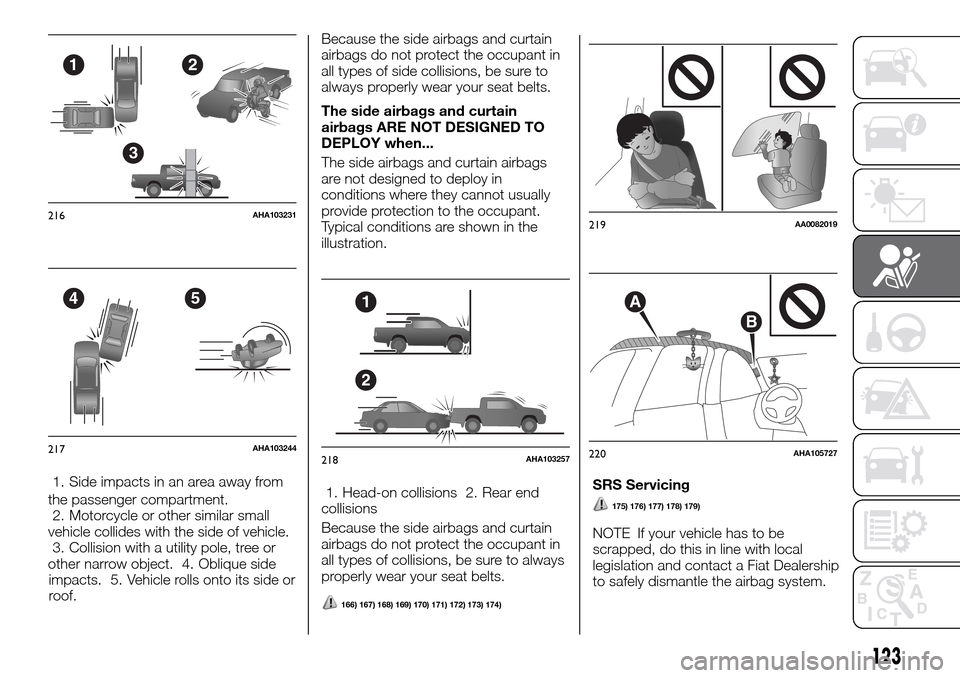
1. Side impacts in an area away from
the passenger compartment.
2. Motorcycle or other similar small
vehicle collides with the side of vehicle.
3. Collision with a utility pole, tree or
other narrow object. 4. Oblique side
impacts. 5. Vehicle rolls onto its side or
roof.Because the side airbags and curtain
airbags do not protect the occupant in
all types of side collisions, be sure to
always properly wear your seat belts.
The side airbags and curtain
airbags ARE NOT DESIGNED TO
DEPLOY when...
The side airbags and curtain airbags
are not designed to deploy in
conditions where they cannot usually
provide protection to the occupant.
Typical conditions are shown in the
illustration.
1. Head-on collisions 2. Rear end
collisions
Because the side airbags and curtain
airbags do not protect the occupant in
all types of collisions, be sure to always
properly wear your seat belts.
166) 167) 168) 169) 170) 171) 172) 173) 174)
3
12
216AHA103231
45
217AHA103244
2
1
218AHA103257
219AA0082019
A
B
220AHA105727
123
SRS Servicing
175) 176) 177) 178) 179)
NOTE If your vehicle has to be
scrapped, do this in line with local
legislation and contact a Fiat Dealership
to safely dismantle the airbag system.