manual transmission FIAT FULLBACK 2016 1.G User Guide
[x] Cancel search | Manufacturer: FIAT, Model Year: 2016, Model line: FULLBACK, Model: FIAT FULLBACK 2016 1.GPages: 312, PDF Size: 13.67 MB
Page 173 of 312
Driving on sandy or muddy roads
Set the drive mode-selector to “4H” or
“4L” position (Easy select 4WD), “4HLc”
or “4LLc” position (Super select 4WD II)
and then gradually depress the
accelerator pedal for a smooth start.
Keep the pressure on the accelerator
pedal as constant as possible, and
drive at low speed.
115) 116)
218)
Avoid sudden braking, acceleration,
and turning; such operations could
result in the vehicle becoming stuck.
If the vehicle becomes stuck in sandy
or muddy roads, it can often be moved
a rocking motion. Move the selector
lever rhythmically between the “D”
(DRIVE) and “R” (REVERSE) position
(with manual transmission, between 1st
and Reverse), while applying slight
pressure to the accelerator pedal.
It is recommended to start the vehicle
with parking brake partially, but not
completely, applied by slightly pulling
the parking brake lever. After the vehicle
has become free, do not forget to
release the parking brake.
If it is necessary to drive in extremely
muddy conditions, the use of tyre
chains is recommended. Because the
extent of muddy conditions is difficult to
judge and the vehicle could become
bogged down very deeply, operationshould be at a low speed. If possible,
get out of the vehicle and check the
conditions ahead before proceeding.
Driving over roads in coastal areas or
roads on which anti-skid preparations
have been spread can cause rust on
the vehicle; wash the vehicle thoroughly
as soon as possible after such use.
Climbing sharp grades
Set the drive mode-selector to “4L”
position (Easy select 4WD), “4LLc”
position (Super select 4WD II) to
maximize the engine torque.
219) 220)
Choose as smooth a slope as possible
with few stones or other obstacles.
Before attempting to drive up the slope,
walk up it to confirm that the vehicle
can handle the grade.Descending sharp grades
Set the drive mode-selector to “4L”
position (Easy select 4WD), “4LLc”
position (Super select 4WD II), use the
engine brake (downshifting) and
descend slowly.
221)
When descending a sharp grade, if the
brakes are applied suddenly because of
an obstacle encountered, control of the
vehicle could be lost. Before
descending the slope, walk down it and
confirm the path.
Before descending a grade, it is
necessary to choose the appropriate
gear. Avoid changing gears or
depressing the clutch while descending
the grade.
Fiat. is not responsible to the operator
for any damage or injury caused or
liability incurred by the improper and
negligent operation of a vehicle. All
techniques of vehicle operation
described herein depend on the skill
and experience of the operator and
other participating parties and any
deviation from the recommended
operation instructions above is at their
own risk.
171
Page 187 of 312
IF THE VEHICLE
BREAKS DOWN
If the vehicle breaks down on the road,
move it to the shoulder and use the
hazard warning flashers and/or the
warning triangle etc. Refer to “Hazard
warning flasher switch”.
If the engine stops/fails
Vehicle operation and control are
affected if the engine stops. Before
moving the vehicle to a safe area, be
aware of the following:
The brake booster becomes
inoperative and the pedal effort will
increase. Press down the brake pedal
harder than usual.
Since the power steering system is
no longer operative, the steering wheel
feels heavy when turning it.
EMERGENCY
STARTING
231) 232) 233) 234) 235) 236) 237) 238) 239) 240) 241) 242)
243) 244) 245) 246) 247)
If the engine cannot be started because
the battery is weak or dead, the battery
from another vehicle can be used with
jumper cables to start the engine.
1. Get the vehicles close enough so the
jumper cables can reach, but be sure
the vehicles aren’t touching each other.
2. Turn off all lamps, heater and other
electrical loads.
3. Set the parking brake firmly on each
vehicle. Put an automatic transmission
in “P” (PARK) or a manual transmission
in “N” (Neutral). Stop the engine.
4. Make sure battery electrolyte is at the
proper level. Refer to “Battery”.
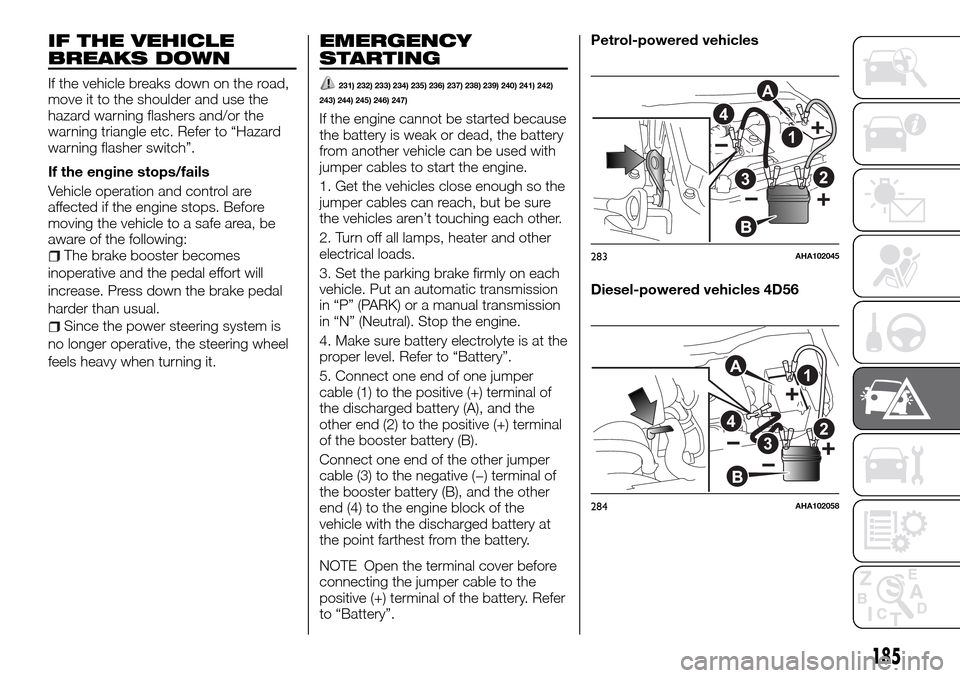
5. Connect one end of one jumper
cable (1) to the positive (+) terminal of
the discharged battery (A), and the
other end (2) to the positive (+) terminal
of the booster battery (B).
Connect one end of the other jumper
cable (3) to the negative (−) terminal of
the booster battery (B), and the other
end (4) to the engine block of the
vehicle with the discharged battery at
the point farthest from the battery.
NOTE Open the terminal cover before
connecting the jumper cable to the
positive (+) terminal of the battery. Refer
to “Battery”.Petrol-powered vehicles
Diesel-powered vehicles 4D56
A
B
1
4
23
283AHA102045
A
B
1
423
284AHA102058
185
Page 196 of 312
HOW TO CHANGE A
TYRE
132) 133)
Before changing a tyre, first stop your
vehicle in a safe, flat location.
1. Park the vehicle on level and stable
ground, free of loose pebbles, etc.
2. Set the parking brake firmly.
3. On vehicles with manual
transmission, turn the ignition switch to
the “LOCK” position or put the
operation mode in OFF, and move the
gearshift lever to the “R” (Reverse)
position. On vehicles with automatic
transmission, move the selector lever to
the “P” (PARK) position, and turn the
ignition switch to the “LOCK” position
or put the operation mode in OFF.
4. Turn on the hazard flashers and set
up a warning triangle, flashing signal
lamp, etc., at an adequate distance
from the vehicle, and have all your
passengers leave the vehicle.
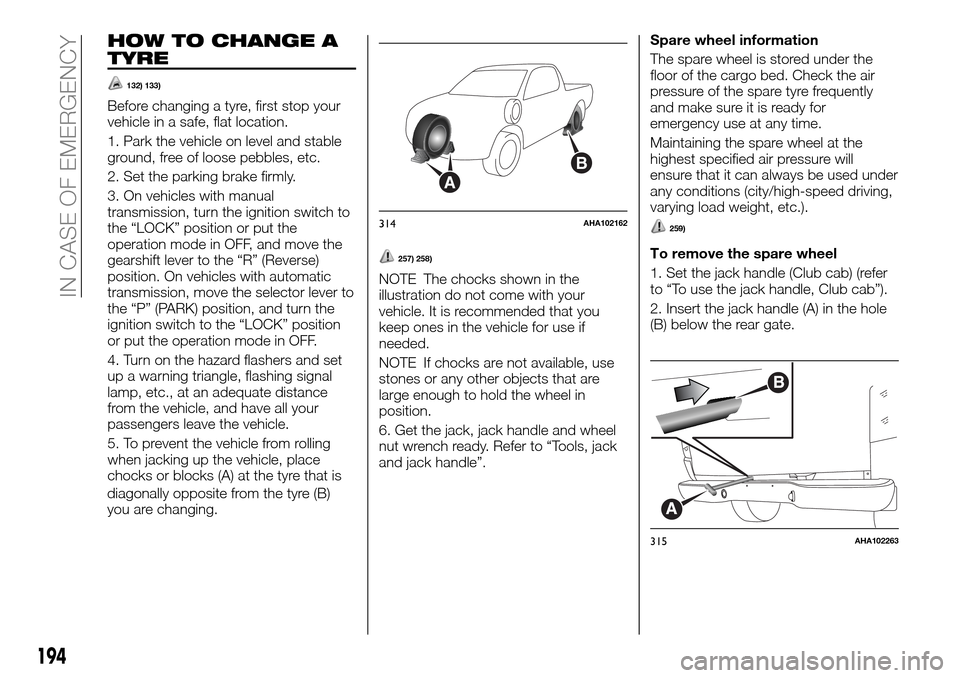
5. To prevent the vehicle from rolling
when jacking up the vehicle, place
chocks or blocks (A) at the tyre that is
diagonally opposite from the tyre (B)
you are changing.
257) 258)
NOTE The chocks shown in the
illustration do not come with your
vehicle. It is recommended that you
keep ones in the vehicle for use if
needed.
NOTE If chocks are not available, use
stones or any other objects that are
large enough to hold the wheel in
position.
6. Get the jack, jack handle and wheel
nut wrench ready. Refer to “Tools, jack
and jack handle”.Spare wheel information
The spare wheel is stored under the
floor of the cargo bed. Check the air
pressure of the spare tyre frequently
and make sure it is ready for
emergency use at any time.
Maintaining the spare wheel at the
highest specified air pressure will
ensure that it can always be used under
any conditions (city/high-speed driving,
varying load weight, etc.).
259)
To remove the spare wheel
1. Set the jack handle (Club cab) (refer
to “To use the jack handle, Club cab”).
2. Insert the jack handle (A) in the hole
(B) below the rear gate.
A
B
314AHA102162
A
B
315AHA102263
194
IN CASE OF EMERGENCY
Page 203 of 312
TOWING
If your vehicle needs to be towed
If towing is necessary, we recommend
you to have it done by your Fiat
Dealership or a commercial tow truck
service. In the following cases,
transport the vehicle using a tow truck.
The engine runs but the vehicle does
not move, or an abnormal noise is
produced.
Inspection of the vehicle’s underside
reveals that oil or some other fluid is
leaking.
If a wheel gets stuck in a ditch, do not
try to tow the vehicle. Please contact
your Fiat Dealership or a commercial
tow truck service for assistance.
Only when you cannot receive a towing
service from a Fiat Dealership or
commercial tow truck service, tow your
vehicle carefully in accordance with the
instructions given in “Emergency
towing” in this part. The regulations
concerning towing may differ from
country to country. It is recommended
that you obey the regulations of the
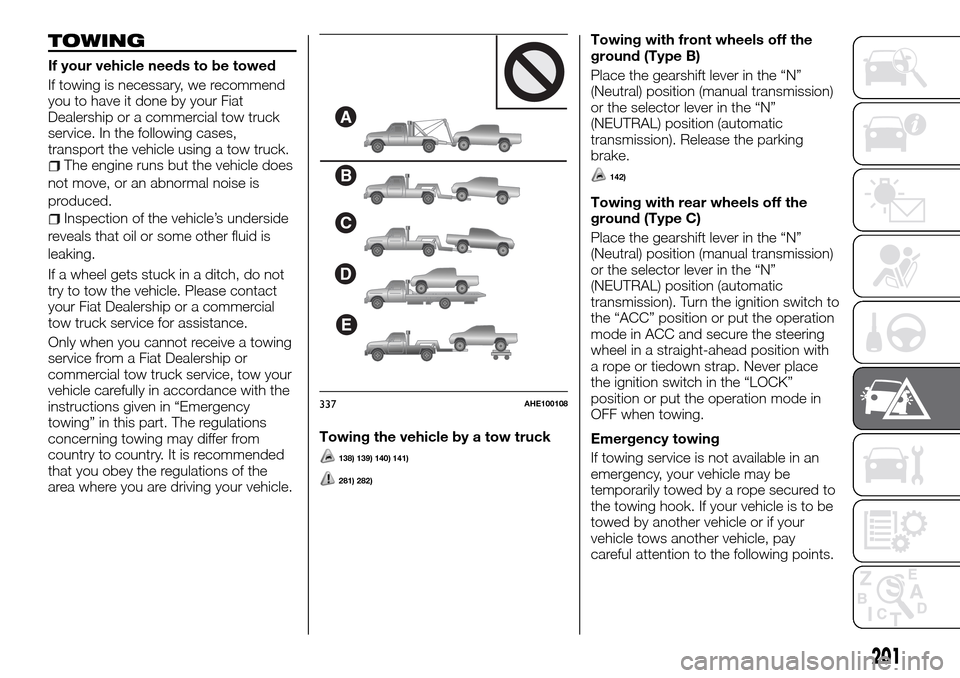
area where you are driving your vehicle.Towing the vehicle by a tow truck
138) 139) 140) 141)
281) 282)
Towing with front wheels off the
ground (Type B)
Place the gearshift lever in the “N”
(Neutral) position (manual transmission)
or the selector lever in the “N”
(NEUTRAL) position (automatic
transmission). Release the parking
brake.
142)
Towing with rear wheels off the
ground (Type C)
Place the gearshift lever in the “N”
(Neutral) position (manual transmission)
or the selector lever in the “N”
(NEUTRAL) position (automatic
transmission). Turn the ignition switch to
the “ACC” position or put the operation
mode in ACC and secure the steering
wheel in a straight-ahead position with
a rope or tiedown strap. Never place
the ignition switch in the “LOCK”
position or put the operation mode in
OFF when towing.
Emergency towing
If towing service is not available in an
emergency, your vehicle may be
temporarily towed by a rope secured to
the towing hook. If your vehicle is to be
towed by another vehicle or if your
vehicle tows another vehicle, pay
careful attention to the following points.
B
C
D
E
A
337AHE100108
201
Page 204 of 312
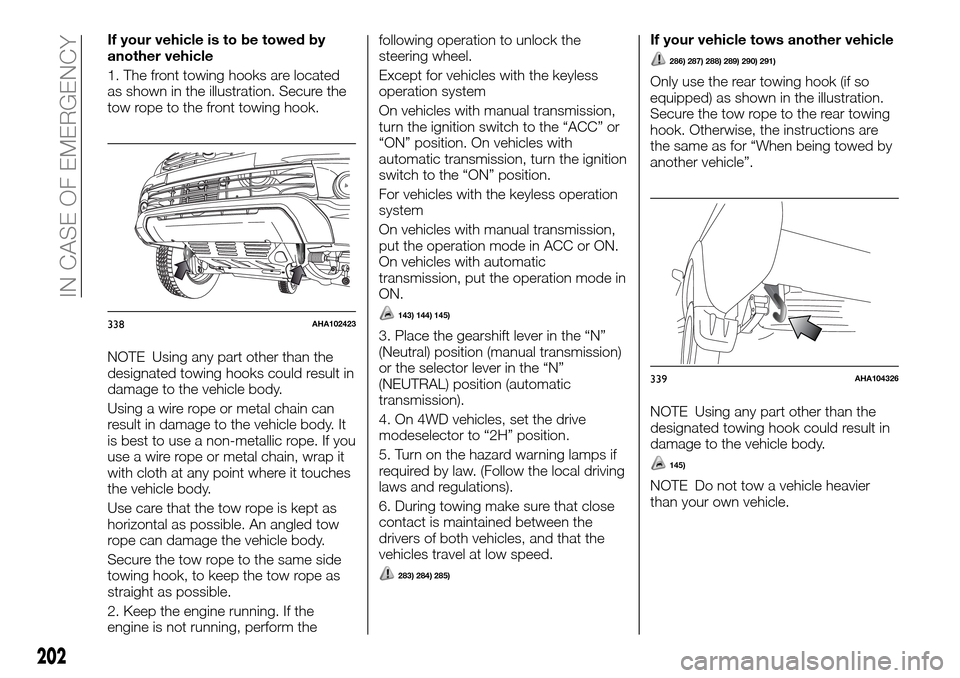
If your vehicle is to be towed by
another vehicle
1. The front towing hooks are located
as shown in the illustration. Secure the
tow rope to the front towing hook.
NOTE Using any part other than the
designated towing hooks could result in
damage to the vehicle body.
Using a wire rope or metal chain can
result in damage to the vehicle body. It
is best to use a non-metallic rope. If you
use a wire rope or metal chain, wrap it
with cloth at any point where it touches
the vehicle body.
Use care that the tow rope is kept as
horizontal as possible. An angled tow
rope can damage the vehicle body.
Secure the tow rope to the same side
towing hook, to keep the tow rope as
straight as possible.
2. Keep the engine running. If the
engine is not running, perform thefollowing operation to unlock the
steering wheel.
Except for vehicles with the keyless
operation system
On vehicles with manual transmission,
turn the ignition switch to the “ACC” or
“ON” position. On vehicles with
automatic transmission, turn the ignition
switch to the “ON” position.
For vehicles with the keyless operation
system
On vehicles with manual transmission,
put the operation mode in ACC or ON.
On vehicles with automatic
transmission, put the operation mode in
ON.
143) 144) 145)
3. Place the gearshift lever in the “N”
(Neutral) position (manual transmission)
or the selector lever in the “N”
(NEUTRAL) position (automatic
transmission).
4. On 4WD vehicles, set the drive
modeselector to “2H” position.
5. Turn on the hazard warning lamps if
required by law. (Follow the local driving
laws and regulations).
6. During towing make sure that close
contact is maintained between the
drivers of both vehicles, and that the
vehicles travel at low speed.
283) 284) 285)
If your vehicle tows another vehicle
286) 287) 288) 289) 290) 291)
Only use the rear towing hook (if so
equipped) as shown in the illustration.
Secure the tow rope to the rear towing
hook. Otherwise, the instructions are
the same as for “When being towed by
another vehicle”.
NOTE Using any part other than the
designated towing hook could result in
damage to the vehicle body.
145)
NOTE Do not tow a vehicle heavier
than your own vehicle.
338AHA102423
339AHA104326
202
IN CASE OF EMERGENCY
Page 229 of 312
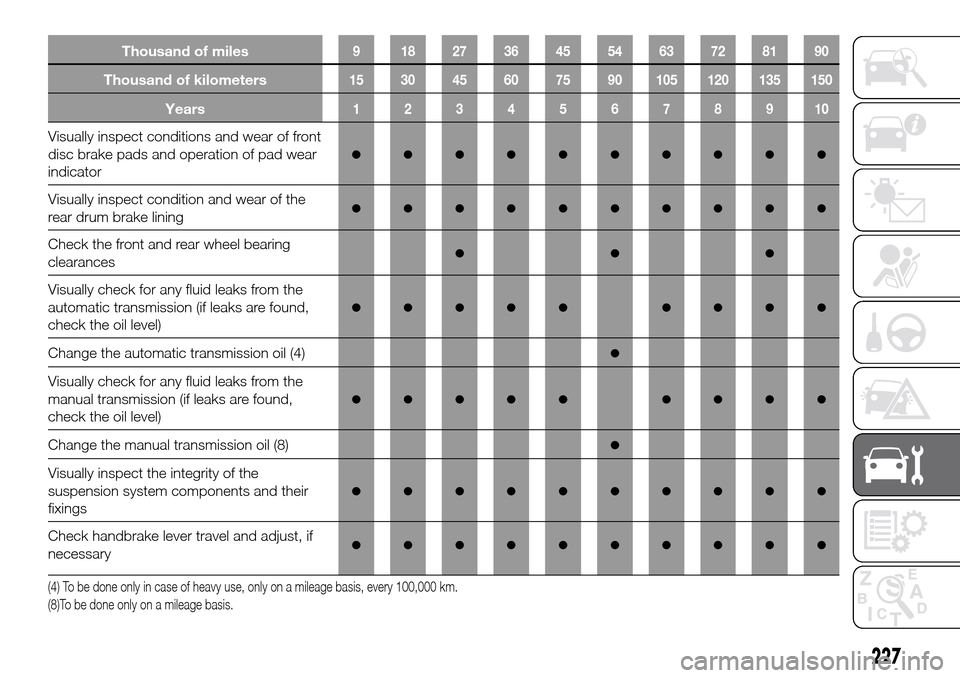
Thousand of miles9 182736455463728190
Thousand of kilometers15 30 45 60 75 90 105 120 135 150
Years12345678910
Visually inspect conditions and wear of front
disc brake pads and operation of pad wear
indicator
●●●●●●●●●●
Visually inspect condition and wear of the
rear drum brake lining●●●●●●●●●●
Check the front and rear wheel bearing
clearances●●●
Visually check for any fluid leaks from the
automatic transmission (if leaks are found,
check the oil level)
●●●●● ●●●●
Change the automatic transmission oil (4)●
Visually check for any fluid leaks from the
manual transmission (if leaks are found,
check the oil level)
●●●●● ●●●●
Change the manual transmission oil (8)●
Visually inspect the integrity of the
suspension system components and their
fixings
●●●●●●●●●●
Check handbrake lever travel and adjust, if
necessary●●●●●●●●●●
(4) To be done only in case of heavy use, only on a mileage basis, every 100,000 km.
(8)To be done only on a mileage basis.
227
Page 234 of 312
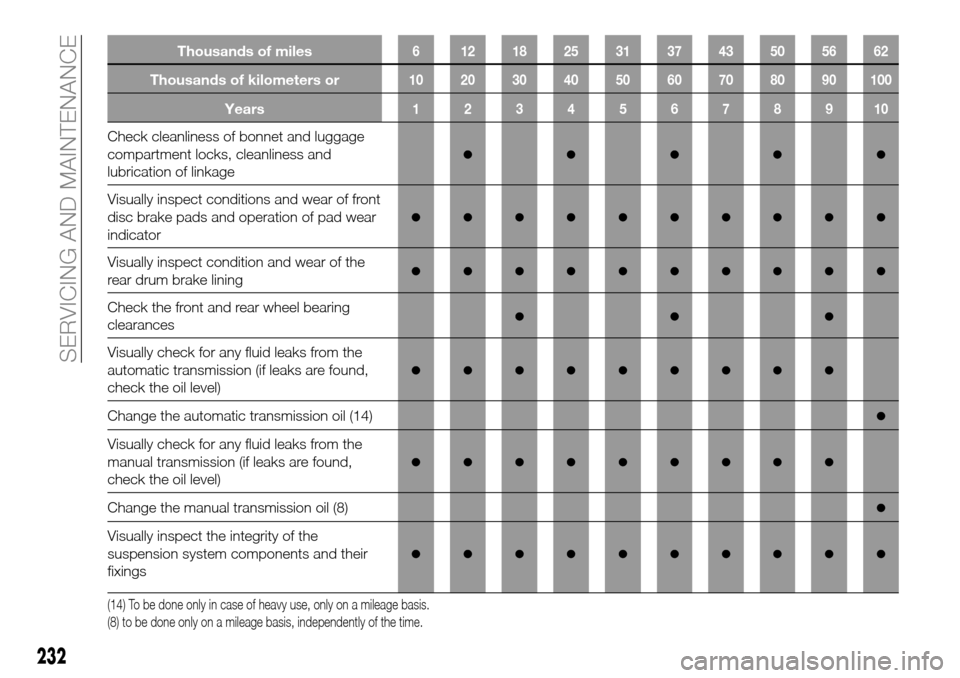
Thousands of miles6 121825313743505662
Thousands of kilometers or10 20 30 40 50 60 70 80 90 100
Years12345678910
Check cleanliness of bonnet and luggage
compartment locks, cleanliness and
lubrication of linkage
●●●●●
Visually inspect conditions and wear of front
disc brake pads and operation of pad wear
indicator
●●●●●●●●●●
Visually inspect condition and wear of the
rear drum brake lining●●●●●●●●●●
Check the front and rear wheel bearing
clearances●●●
Visually check for any fluid leaks from the
automatic transmission (if leaks are found,
check the oil level)
●●●●●●●●●
Change the automatic transmission oil (14)●
Visually check for any fluid leaks from the
manual transmission (if leaks are found,
check the oil level)
●●●●●●●●●
Change the manual transmission oil (8)●
Visually inspect the integrity of the
suspension system components and their
fixings
●●●●●●●●●●
(14) To be done only in case of heavy use, only on a mileage basis.
(8) to be done only on a mileage basis, independently of the time.
232
SERVICING AND MAINTENANCE
Page 239 of 312
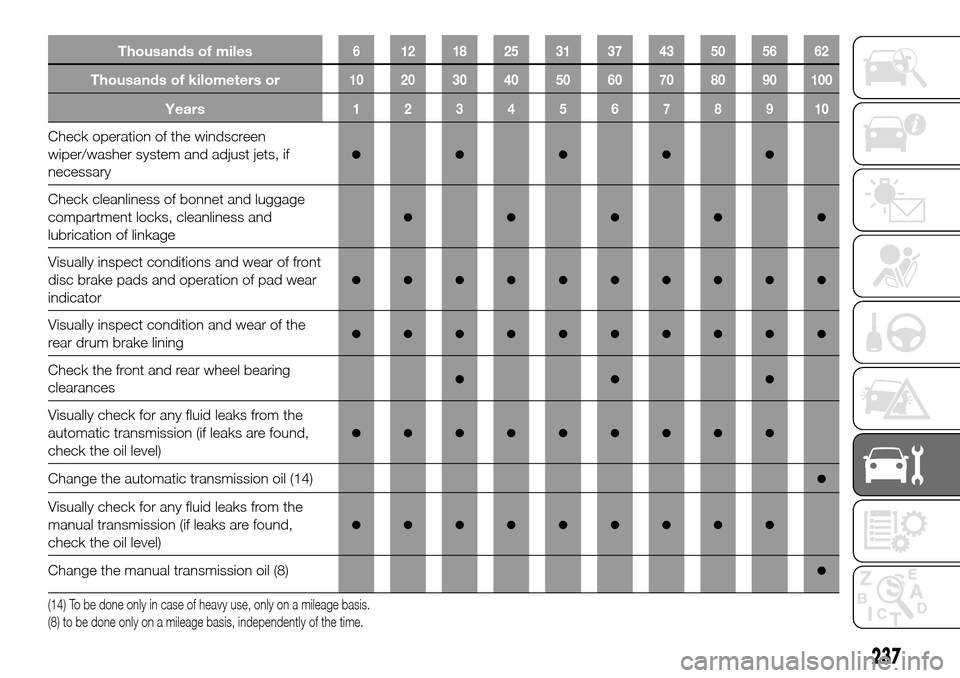
Thousands of miles6 121825313743505662
Thousands of kilometers or10 20 30 40 50 60 70 80 90 100
Years12345678910
Check operation of the windscreen
wiper/washer system and adjust jets, if
necessary
●●●●●
Check cleanliness of bonnet and luggage
compartment locks, cleanliness and
lubrication of linkage
●●●●●
Visually inspect conditions and wear of front
disc brake pads and operation of pad wear
indicator
●●●●●●●●●●
Visually inspect condition and wear of the
rear drum brake lining●●●●●●●●●●
Check the front and rear wheel bearing
clearances●●●
Visually check for any fluid leaks from the
automatic transmission (if leaks are found,
check the oil level)
●●●●●●●●●
Change the automatic transmission oil (14)●
Visually check for any fluid leaks from the
manual transmission (if leaks are found,
check the oil level)
●●●●●●●●●
Change the manual transmission oil (8)●
(14) To be done only in case of heavy use, only on a mileage basis.
(8) to be done only on a mileage basis, independently of the time.
237
Page 295 of 312
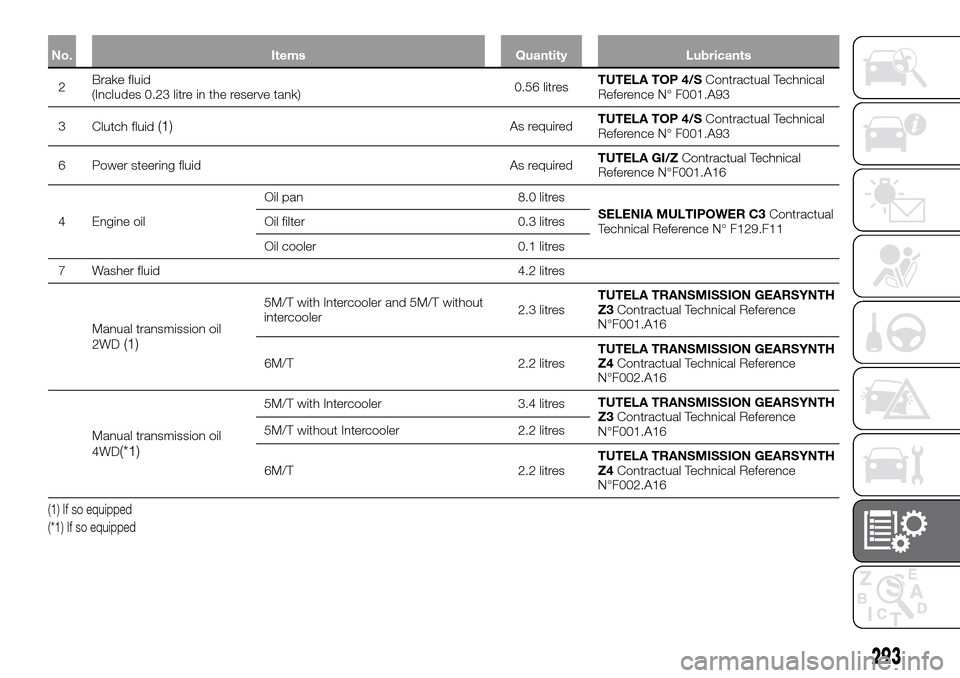
No. Items Quantity Lubricants
2Brake fluid
(Includes 0.23 litre in the reserve tank)0.56 litresTUTELA TOP 4/SContractual Technical
Reference N° F001.A93
3
Clutch fluid
(1)As requiredTUTELA TOP 4/SContractual Technical
Reference N° F001.A93
6 Power steering fluid As requiredTUTELA GI/ZContractual Technical
Reference N°F001.A16
4 Engine oilOil pan 8.0 litres
SELENIA MULTIPOWER C3Contractual
Technical Reference N° F129.F11 Oil filter 0.3 litres
Oil cooler 0.1 litres
7 Washer fluid 4.2 litres
Manual transmission oil
2WD
(1)
5M/T with Intercooler and 5M/T without
intercooler2.3 litresTUTELA TRANSMISSION GEARSYNTH
Z3Contractual Technical Reference
N°F001.A16
6M/T 2.2 litresTUTELA TRANSMISSION GEARSYNTH
Z4Contractual Technical Reference
N°F002.A16
Manual transmission oil
4WD
(*1)
5M/T with Intercooler 3.4 litresTUTELA TRANSMISSION GEARSYNTH
Z3Contractual Technical Reference
N°F001.A16 5M/T without Intercooler 2.2 litres
6M/T 2.2 litresTUTELA TRANSMISSION GEARSYNTH
Z4Contractual Technical Reference
N°F002.A16
(1) If so equipped
(*1) If so equipped
293
Page 298 of 312
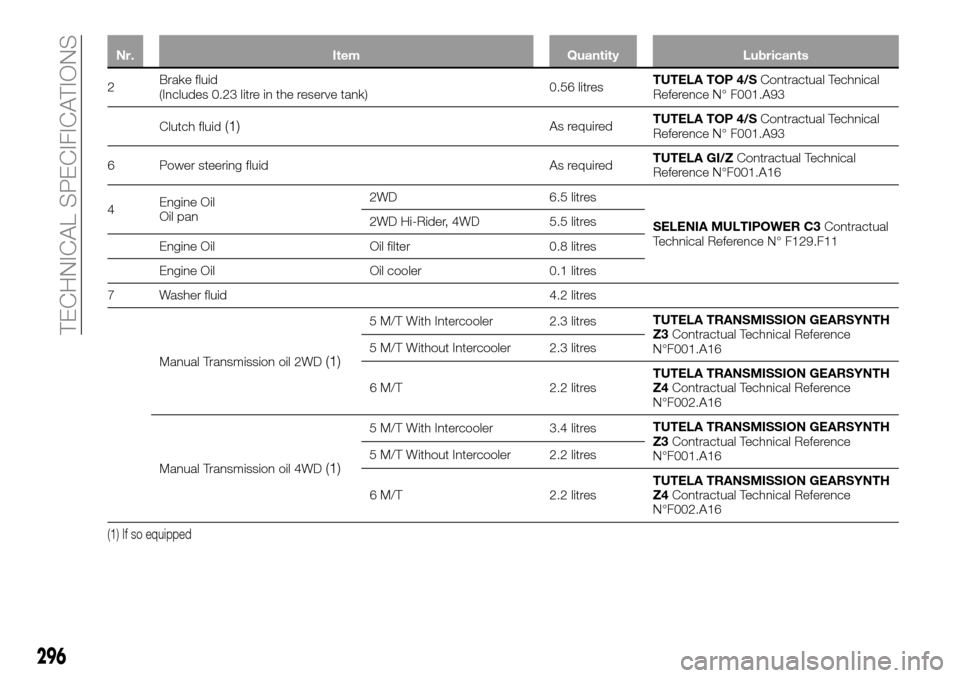
Nr. Item Quantity Lubricants
2Brake fluid
(Includes 0.23 litre in the reserve tank)0.56 litresTUTELA TOP 4/SContractual Technical
Reference N° F001.A93
Clutch fluid
(1)As requiredTUTELA TOP 4/SContractual Technical
Reference N° F001.A93
6 Power steering fluid As requiredTUTELA GI/ZContractual Technical
Reference N°F001.A16
4Engine Oil
Oil pan2WD 6.5 litres
SELENIA MULTIPOWER C3Contractual
Technical Reference N° F129.F11 2WD Hi-Rider, 4WD 5.5 litres
Engine Oil Oil filter 0.8 litres
Engine Oil Oil cooler 0.1 litres
7 Washer fluid 4.2 litres
Manual Transmission oil 2WD
(1)
5 M/T With Intercooler 2.3 litresTUTELA TRANSMISSION GEARSYNTH
Z3Contractual Technical Reference
N°F001.A16 5 M/T Without Intercooler 2.3 litres
6 M/T 2.2 litresTUTELA TRANSMISSION GEARSYNTH
Z4Contractual Technical Reference
N°F002.A16
Manual Transmission oil 4WD
(1)
5 M/T With Intercooler 3.4 litresTUTELA TRANSMISSION GEARSYNTH
Z3Contractual Technical Reference
N°F001.A16 5 M/T Without Intercooler 2.2 litres
6 M/T 2.2 litresTUTELA TRANSMISSION GEARSYNTH
Z4Contractual Technical Reference
N°F002.A16
(1) If so equipped
296
TECHNICAL SPECIFICATIONS