media FIAT FULLBACK 2016 1.G User Guide
[x] Cancel search | Manufacturer: FIAT, Model Year: 2016, Model line: FULLBACK, Model: FIAT FULLBACK 2016 1.GPages: 312, PDF Size: 13.67 MB
Page 123 of 312
The front airbags and driver’s knee
airbag ARE NOT DESIGNED TO
DEPLOY when…
The front airbags and driver’s knee
airbag are not designed to deploy in
conditions where they cannot typically
provide protection to the occupant.
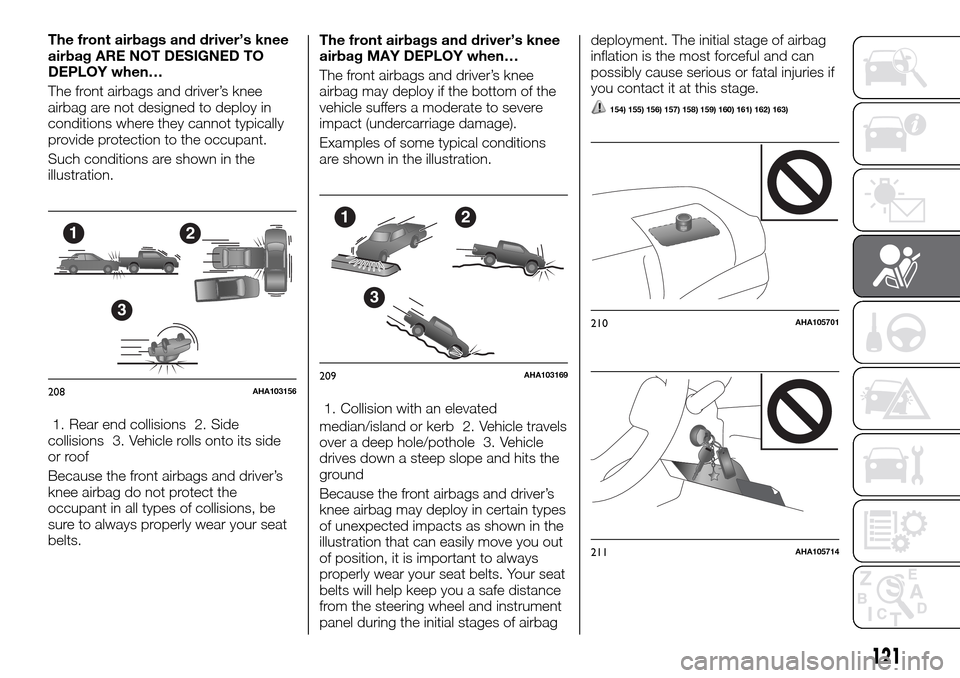
Such conditions are shown in the
illustration.
1. Rear end collisions 2. Side
collisions 3. Vehicle rolls onto its side
or roof
Because the front airbags and driver’s
knee airbag do not protect the
occupant in all types of collisions, be
sure to always properly wear your seat
belts.The front airbags and driver’s knee
airbag MAY DEPLOY when…
The front airbags and driver’s knee
airbag may deploy if the bottom of the
vehicle suffers a moderate to severe
impact (undercarriage damage).
Examples of some typical conditions
are shown in the illustration.
1. Collision with an elevated
median/island or kerb 2. Vehicle travels
over a deep hole/pothole 3. Vehicle
drives down a steep slope and hits the
ground
Because the front airbags and driver’s
knee airbag may deploy in certain types
of unexpected impacts as shown in the
illustration that can easily move you out
of position, it is important to always
properly wear your seat belts. Your seat
belts will help keep you a safe distance
from the steering wheel and instrument
panel during the initial stages of airbagdeployment. The initial stage of airbag
inflation is the most forceful and can
possibly cause serious or fatal injuries if
you contact it at this stage.
154) 155) 156) 157) 158) 159) 160) 161) 162) 163)
2
3
1
208AHA103156
2
3
1
209AHA103169
210AHA105701
211AHA105714
121
Page 126 of 312
WARNING
145)Airbags inflate at an extremely rapid
speed. In certain situations, contact with
inflating airbags can result in abrasions,
bruises, light cuts, and the like.
146)IT IS VERY IMPORTANT TO BE
PROPERLY SEATED. A driver or front
passenger too close to the steering wheel
or instrument panel during airbag
deployment can be killed or seriously
injured. Airbags inflate very fast, and with
great force. If the driver and front
passenger are not properly seated and
restrained, the airbags may not protect you
properly, and could cause serious or fatal
injuries when they inflate.
147)Do not sit on the edge of the seat, or
sit with your lower legs too close to the
instrument panel, or lean head or chest
close to the steering wheel or instrument
panel. Do not put feet or legs on or against
the instrument panel.
148)Always drive with your hands on the
rim of the steering wheel so that the airbag
can inflate freely if required. Do not drive
with your body bent forward. Keep your
back straight against the backrest.149)Place all infants and small children in
the rear seat and properly restrained using
an appropriate child restraint system. The
rear seat is the safest for infants and
children.
150)Infants and small children should
never be unrestrained, stand up against
the instrument panel or held in your arms
or on your lap. They could be seriously
injured or killed in a collision, including
when the airbag inflates. They should be
properly seated in an appropriate child
restraint system. See the “Child restraint”
section of this owner’s manual.
151)When there is an active passenger
airbag, DO NOT install rearward facing
child restraint systems on the front seat.
Deployment of the airbag in an accident
could cause fatal injuries to the child
regardless of the severity of the impact.
Therefore, always deactivate the passenger
side airbag when a rearward facing child
restraint system is installed on the front
passenger seat. The front passenger seat
must also be positioned back as far as
possible in order to prevent the child
restraint system from coming into contact
with the dashboard. Immediately reactivate
the passenger airbag as soon as the child
restraint system has been removed.
152)Older children should be seated,
properly wearing the seat belt, with an
appropriate booster seat if needed.
153)Extreme Hazard! NEVER use a
rearward facing child restraint on a seat
protected by an ACTIVE AIRBAG in front of
it, DEATH or SERIOUS INJURY to the
CHILD can occur.154)Do not fit any accessory that makes
the indicator impossible to see, and do not
cover the indicator with a sticker. You
would not be able to verify the status of the
passenger airbag system.
155)To reduce risk of serious or fatal
injury: always turn the ignition switch to the
“LOCK” position or put the operation mode
in OFF, before operating the front
passenger’s airbag ON-OFF switch. Failure
to do so could adversely affect the airbag
performance; Wait at least 60 seconds to
operate the front passenger’s airbag
ON-OFF switch after turning the ignition
switch to the “LOCK” position or putting
the operation mode in OFF. The SRS
airbag system is designed to retain enough
voltage to deploy the airbag; Always
remove the key from the front passenger’s
airbag ON-OFF switch after operating that
switch. Failure to do so could lead to
improper position of the front passenger’s
airbag ON-OFF switch; Do not turn OFF
the front passenger’s airbag ON-OFF
switch except when a child restraint
system is fitted to the front passenger seat;
If the OFF indicator does not come on
when the front passenger’s airbag ONOFF
switch is turned OFF, do not fit a child
restraint system to the front passenger
seat. We recommend you to have the
system inspected by a Fiat Dealership; if
the OFF indicator remains on when the
front passenger’s airbag ON-OFF switch is
turned ON, do not allow anyone to sit on
the front passenger seat. We recommend
you to have the system inspected by a Fiat
Dealership.
124
SAFETY
Page 129 of 312
An operation noise is emitted from the
engine compartment or feel a shock
from the brake pedal when start driving
immediately after starting the engine.
These are normal sound or operation
that the ABS makes when performing a
self-check. It does not indicate a
malfunction.
The ABS can be used after the vehicle
has reached a speed over
approximately 10 km/h. It stops
working when the vehicle slows below
7 km/h.
181) 182) 183) 184) 185) 186) 187) 188) 189)
After driving on icy roads
After driving on snow or icy roads,
remove any snow and ice which may
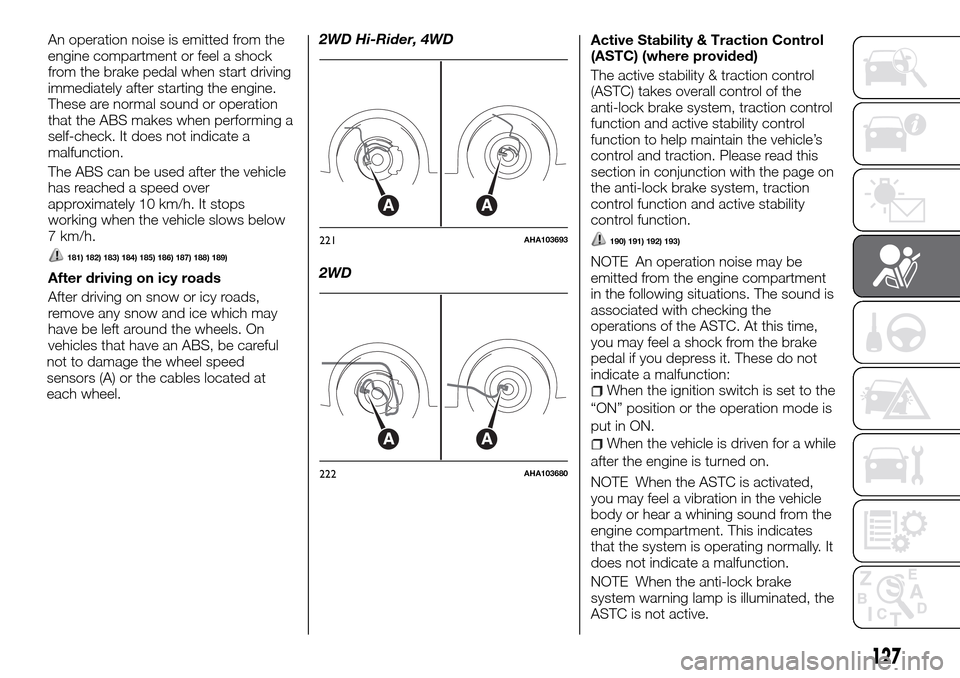
have be left around the wheels. On
vehicles that have an ABS, be careful
not to damage the wheel speed
sensors (A) or the cables located at
each wheel.2WD Hi-Rider, 4WD
2WDActive Stability & Traction Control
(ASTC) (where provided)
The active stability & traction control
(ASTC) takes overall control of the
anti-lock brake system, traction control
function and active stability control
function to help maintain the vehicle’s
control and traction. Please read this
section in conjunction with the page on
the anti-lock brake system, traction
control function and active stability
control function.
190) 191) 192) 193)
NOTE An operation noise may be
emitted from the engine compartment
in the following situations. The sound is
associated with checking the
operations of the ASTC. At this time,
you may feel a shock from the brake
pedal if you depress it. These do not
indicate a malfunction:
When the ignition switch is set to the
“ON” position or the operation mode is
put in ON.
When the vehicle is driven for a while
after the engine is turned on.
NOTE When the ASTC is activated,
you may feel a vibration in the vehicle
body or hear a whining sound from the
engine compartment. This indicates
that the system is operating normally. It
does not indicate a malfunction.
NOTE When the anti-lock brake
system warning lamp is illuminated, the
ASTC is not active.
AA
221AHA103693
AA
222AHA103680
127
Page 132 of 312
AUXILIARY DRIVING
SYSTEMS
Hill Start Assist (where provided)
The hill start assist makes it easy to
start off on a steep uphill slope by
preventing the vehicle from moving
backwards. It keeps the braking force
for about 2 seconds when you move
your foot from the brake pedal to the
accelerator pedal.
69) 70)
197) 198)
To operate
1. Stop the vehicle completely using the
brake pedal.
2. On vehicles equipped with M/T,
place the gearshift lever into the 1st
position. On vehicles equipped with
A/T, place the selector lever into the “D”
position.
NOTE When reversing on an uphill
slope, place the selector lever or
gearshift lever into the “R” position.
3. Release the brake pedal and the hill
start assist will maintain the braking
force applied while stopping for
approximately 2 seconds.
4. Depress the accelerator pedal and
the hill start assist gradually will
decrease the braking force as the
vehicle starts moving.NOTE The hill start assist is activated
when all of the following conditions are
met.
The engine is running (the hill start
assist will not be activated while the
engine is starting or immediately after
the engine is started).
On vehicles equipped with M/T, the
gearshift lever is in the following
position: When starting an uphill slope
forwards > The gearshift lever is in any
position other than “R” (the hill start
assist will operate, even if the gearshift
lever is in the “N” position). When
starting an uphill slope backwards >
The gearshift lever is in the “R” position
(the hill start assist will not operate
when the gearshift lever is in the “N”
position).
On vehicles equipped with A/T, the
selector lever is in any position other
than “P” or “N”.
The vehicle is completely stationary,
with the brake pedal depressed.
The parking brake is released.
NOTE The hill start assist will not
operate if the accelerator pedal is
depressed before the brake pedal is
released.
NOTE The hill start assist also operates
when reversing on an uphill slope.NOTE When the hill start assist is
activated, you may feel the operating
sound. This is a normal result of the hill
start assist operation, and does not
indicate a problem.
Warning indicator
If an abnormal condition occurs in the
system, the indicator lamp will turn on.
ASC indicator
71) 72)
Power Steering System
The power steering system operates
while the engine is running. It helps
reduce the effort needed to turn the
steering wheel.
The power steering system has
mechanical steering capability in case
the power assist is lost. If the power
assist is lost for some reason, you will
still be able to steer your vehicle, but
you will notice it takes much more effort
to steer. If this happens, have your
vehicle inspected at a Fiat Dealership.
73) 74)
WARNING
197)When facing uphill, do not rely on
using the hill start assist to maintain a
stopped position as an alternative to
depressing the brake pedal. Doing so
could cause an accident.
130
SAFETY
Page 133 of 312
198)Do not turn the ignition switch to the
“LOCK” or “ACC” position or the operation
mode in ACC or OFF while the hill start
assist is operating. The hill start assist
could stop operating, which could result in
an accident.
IMPORTANT
69)Do not over-rely on the hill start assist
to prevent backwards movement of the
vehicle. Under certain circumstances, even
when hill start assist is activated, the
vehicle may move backwards if the brake
pedal is not sufficiently depressed, if the
vehicle is heavily loaded, if the road is very
steep or slippery or if the vehicle tows a
trailer, etc.
70)The hill start assist is not designed to
keep the vehicle stopped in place on uphill
slopes for more than 2 seconds.
71)If the warning is turn on, the hill start
assist will not operate. Start off carefully.
72)Park your vehicle in a safe place and
stop the engine. Restart the engine and
check whether the warning indicator went
out, in which case the hill start assist is
again working normally. If they warning
remains displayed or reappear frequently, it
is not necessary to stop the vehicle
immediately, but the vehicle should be
inspected by a Fiat Dealership.
73)Do not stop the engine while the
vehicle is moving. Stopping the engine
would make the steering wheel extremely
hard to turn, possibly resulting in an
accident.74)Do not leave the steering wheel turned
all the way in one direction. This can cause
damage to the power steering system.
131
Page 141 of 312
PARKING BRAKE
To park the vehicle, first bring it to a
complete stop, fully apply the parking
brake sufficiently to hold the vehicle.
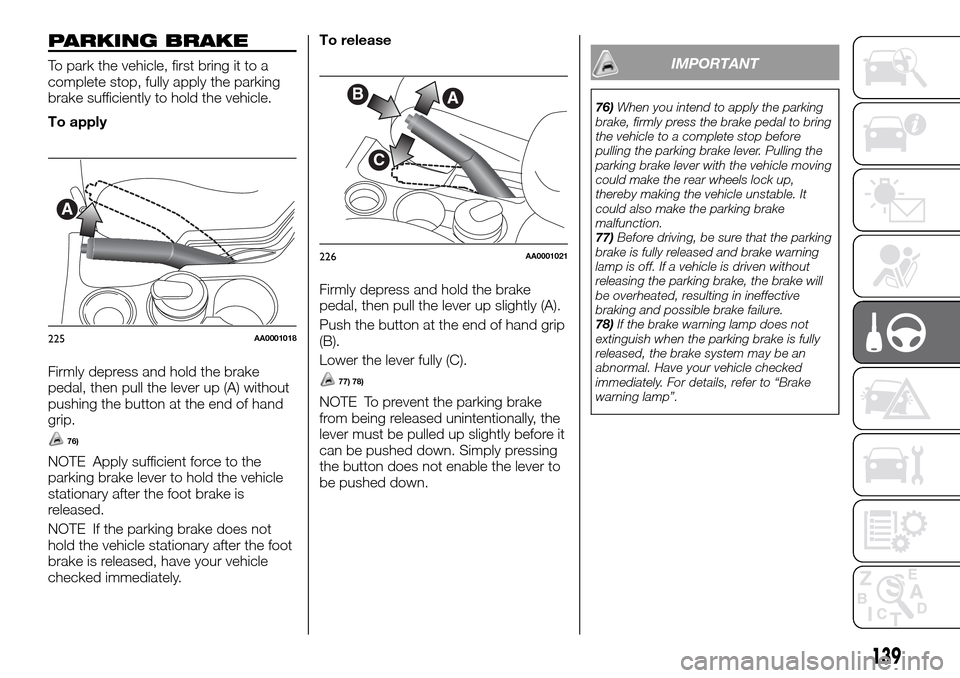
To apply
Firmly depress and hold the brake
pedal, then pull the lever up (A) without
pushing the button at the end of hand
grip.
76)
NOTE Apply sufficient force to the
parking brake lever to hold the vehicle
stationary after the foot brake is
released.
NOTE If the parking brake does not
hold the vehicle stationary after the foot
brake is released, have your vehicle
checked immediately.To release
Firmly depress and hold the brake
pedal, then pull the lever up slightly (A).
Push the button at the end of hand grip
(B).
Lower the lever fully (C).
77) 78)
NOTE To prevent the parking brake
from being released unintentionally, the
lever must be pulled up slightly before it
can be pushed down. Simply pressing
the button does not enable the lever to
be pushed down.
IMPORTANT
76)When you intend to apply the parking
brake, firmly press the brake pedal to bring
the vehicle to a complete stop before
pulling the parking brake lever. Pulling the
parking brake lever with the vehicle moving
could make the rear wheels lock up,
thereby making the vehicle unstable. It
could also make the parking brake
malfunction.
77)Before driving, be sure that the parking
brake is fully released and brake warning
lamp is off. If a vehicle is driven without
releasing the parking brake, the brake will
be overheated, resulting in ineffective
braking and possible brake failure.
78)If the brake warning lamp does not
extinguish when the parking brake is fully
released, the brake system may be an
abnormal. Have your vehicle checked
immediately. For details, refer to “Brake
warning lamp”.
A
225AA0001018
AB
C
226AA0001021
139
Page 143 of 312
STARTING AND
STOPPING THE
ENGINE
Tips for starting
Except for vehicles equipped with
the keyless operation system
Do not operate the starter motor
continuously longer than 10 seconds;
doing so could run down the battery. If
the engine does not start, turn the
ignition switch back to “LOCK”, wait a
few seconds, and then try again. Trying
repeatedly with the starter motor still
turning will damage the starter
mechanism.
203)
79) 80) 81) 82) 83) 84)
For vehicles equipped with the
keyless operation system
The operation mode can be in any
mode to start the engine.
The starter motor will be turning for up
to approximately 15 seconds if the
engine switch is released at once.
Pressing the engine switch again while
the starter motor is still turning will stop
the starter motor. The starter motor will
be turning for up to approximately
30 seconds while the engine switch is
pressed. If the engine does not start,
wait for a while and then attempt to
start the engine again. Trying repeatedly
with the starter motor still turning will
damage the starter mechanism.
203)
80) 81) 82)
Starting the engine (petrol-powered
vehicles)
Except for vehicles equipped with
the keyless operation system
Your vehicles equipped with an
electronically controlled fuel injection
system. When starting the engine, do
not depress the accelerator pedal.
The starting procedure is as follows:
Insert the ignition key and fasten the
seat belt.
Make sure the parking brake is
applied.
Depress and hold the brake pedal.
Depress the clutch pedal all the way
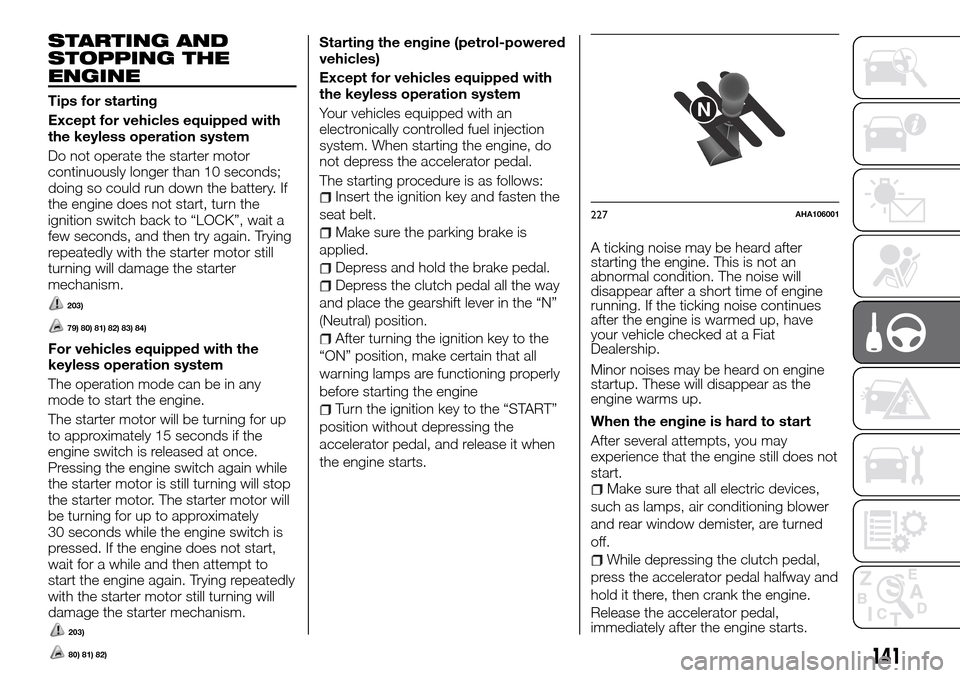
and place the gearshift lever in the “N”
(Neutral) position.
After turning the ignition key to the
“ON” position, make certain that all
warning lamps are functioning properly
before starting the engine
Turn the ignition key to the “START”
position without depressing the
accelerator pedal, and release it when
the engine starts.A ticking noise may be heard after
starting the engine. This is not an
abnormal condition. The noise will
disappear after a short time of engine
running. If the ticking noise continues
after the engine is warmed up, have
your vehicle checked at a Fiat
Dealership.
Minor noises may be heard on engine
startup. These will disappear as the
engine warms up.
When the engine is hard to start
After several attempts, you may
experience that the engine still does not
start.
Make sure that all electric devices,
such as lamps, air conditioning blower
and rear window demister, are turned
off.
While depressing the clutch pedal,
press the accelerator pedal halfway and
hold it there, then crank the engine.
Release the accelerator pedal,
N
227AHA106001
141
immediately after the engine starts.
Page 144 of 312
If the engine still will not start, the
engine could be flooded with too much
petrol. While depressing the clutch
pedal, push the accelerator pedal all the
way down and hold it there, then crank
the engine for 5 to 6 seconds. Return
the ignition switch to the “LOCK”
position and release the accelerator
pedal. Wait a few seconds, and then
crank the engine again for 5 to
6 seconds while depressing the clutch
pedal, but do not push the accelerator
pedal. Release the ignition key if the
engine starts. If the engine fails to start,
repeat these procedures. If the engine
still will not start, we recommend you to
have the vehicle checked.
To protect the engine, the high-speed
mode may not be selected while the
engine coolant temperature is low. In
such a case, the engine revolutions do
not rise to over 5,000 rpm even if the
accelerator pedal is depressed.For vehicles equipped with the
keyless operation system
Your vehicles equipped with an
electronically controlled fuel injection
system. When starting the engine, do
not depress the accelerator pedal.
The starting procedure is as follows:
Fasten the seat belt.
Make sure the parking brake is
applied.
Press and hold the brake pedal
down firmly with your right foot.
Depress the clutch pedal all the way
and place the gearshift lever in the “N”
(Neutral) position.
Press the engine switch.
Make certain that all warning lamps
are functioning properly.
When the engine is not started, it may
become hard to depress the brake
pedal and the vehicle may not be able
to detect the pedal operation. Therefore
the engine may not be started. In such
a case, depress the brake pedal more
firmly than usual.
A ticking noise may be heard after
starting the engine. This is not an
abnormal condition. The noise will
disappear after a short time of engine
running. If the ticking noise continues
after the engine is warmed up, have
your vehicle checked at a Fiat
Dealership.
Minor noises may be heard on engine
startup. These will disappear as the
engine warms up.When the engine is hard to start
After several attempts, you may
experience that the engine still does not
start.
Make sure that all electric devices,
such as lamps, air conditioning blower
and rear window demister, are turned
off.
While depressing the clutch pedal,
press the accelerator pedal halfway and
hold it there, then crank the engine.
Release the accelerator pedal,
immediately after the engine starts.
If the engine still will not start, the
engine could be flooded with too much
petrol. While depressing the clutch
pedal, push the accelerator pedal all the
way down and hold it there, then press
the engine switch to crank the engine. If
the engine does not start after 5 to
6 seconds, press the engine switch to
stop the engine, and release the
accelerator pedal. Put the operation
mode in OFF. Wait a few seconds, and
then press the engine switch to crank
the engine again while depressing the
brake pedal or the clutch pedal, but do
not push the accelerator pedal. If the
engine fails to start, repeat these
procedures. If the engine still will not
start, we recommend you to have the
vehicle checked.
To protect the engine, the high-speed
mode may not be selected while the
142
STARTING AND DRIVING
Page 147 of 312
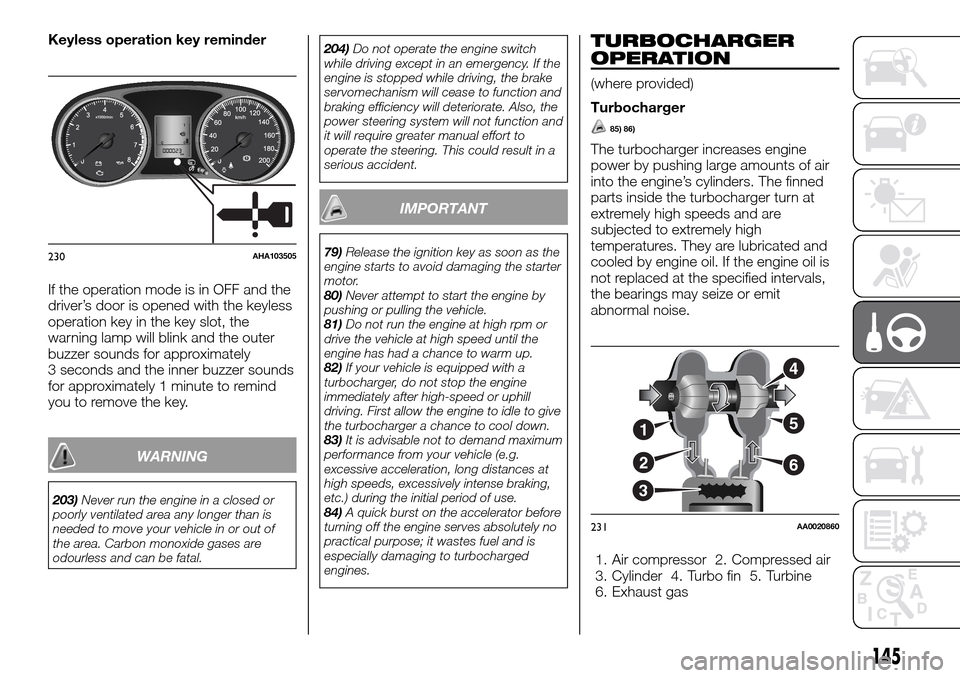
Keyless operation key reminder
If the operation mode is in OFF and the
driver’s door is opened with the keyless
operation key in the key slot, the
warning lamp will blink and the outer
buzzer sounds for approximately
3 seconds and the inner buzzer sounds
for approximately 1 minute to remind
you to remove the key.
WARNING
203)Never run the engine in a closed or
poorly ventilated area any longer than is
needed to move your vehicle in or out of
the area. Carbon monoxide gases are
odourless and can be fatal.204)Do not operate the engine switch
while driving except in an emergency. If the
engine is stopped while driving, the brake
servomechanism will cease to function and
braking efficiency will deteriorate. Also, the
power steering system will not function and
it will require greater manual effort to
operate the steering. This could result in a
serious accident.
IMPORTANT
79)Release the ignition key as soon as the
engine starts to avoid damaging the starter
motor.
80)Never attempt to start the engine by
pushing or pulling the vehicle.
81)Do not run the engine at high rpm or
drive the vehicle at high speed until the
engine has had a chance to warm up.
82)If your vehicle is equipped with a
turbocharger, do not stop the engine
immediately after high-speed or uphill
driving. First allow the engine to idle to give
the turbocharger a chance to cool down.
83)It is advisable not to demand maximum
performance from your vehicle (e.g.
excessive acceleration, long distances at
high speeds, excessively intense braking,
etc.) during the initial period of use.
84)A quick burst on the accelerator before
turning off the engine serves absolutely no
practical purpose; it wastes fuel and is
especially damaging to turbocharged
engines.
TURBOCHARGER
OPERATION
(where provided)
Turbocharger
85) 86)
The turbocharger increases engine
power by pushing large amounts of air
into the engine’s cylinders. The finned
parts inside the turbocharger turn at
extremely high speeds and are
subjected to extremely high
temperatures. They are lubricated and
cooled by engine oil. If the engine oil is
not replaced at the specified intervals,
the bearings may seize or emit
abnormal noise.
1. Air compressor 2. Compressed air
3. Cylinder 4. Turbo fin 5. Turbine
6. Exhaust gas
230AHA103505
4
5
6
1
2
3
231AA0020860
145
Page 148 of 312
IMPORTANT
85)Do not run the engine at high speeds
(for example, by revving it or by
accelerating rapidly) immediately after
starting it.
86)Do not stop the engine immediately
after high-speed or uphill driving. First allow
the engine to idle to give the turbocharger a
chance to cool down.
MANUAL
TRANSMISSION
The shift pattern is shown on the
gearshift lever knob. To start off,
depress the clutch pedal all the way
down and shift into 1st or “R” (Reverse)
position. Then gradually release the
clutch pedal while depressing the
accelerator pedal.
205)
87) 88) 89) 90)
During cold weather, shifting may be
difficult until the transmission lubricant
has warmed up. This is normal and not
harmful to the transmission.
If it is hard to shift into 1st, depress the
clutch pedal again; the shift will then be
easier to make.
On vehicles equipped with 6M/T, in
case of hot weather condition or long
time cruising with high speed, a speed
limitation function may work to restrict
the oil temperature rising of the manual
transmission. After the oil temperature
drops to the appropriate level, the
speed limitation function is cancelled.Moving the gearshift lever to the
“R” (Reverse) position
Vehicles equipped with 5M/T
To shift into the “R” (Reverse) position
from 5th gear, move the gearshift lever
to the “N” (Neutral) position, and then
move it to the “R” (Reverse) position.
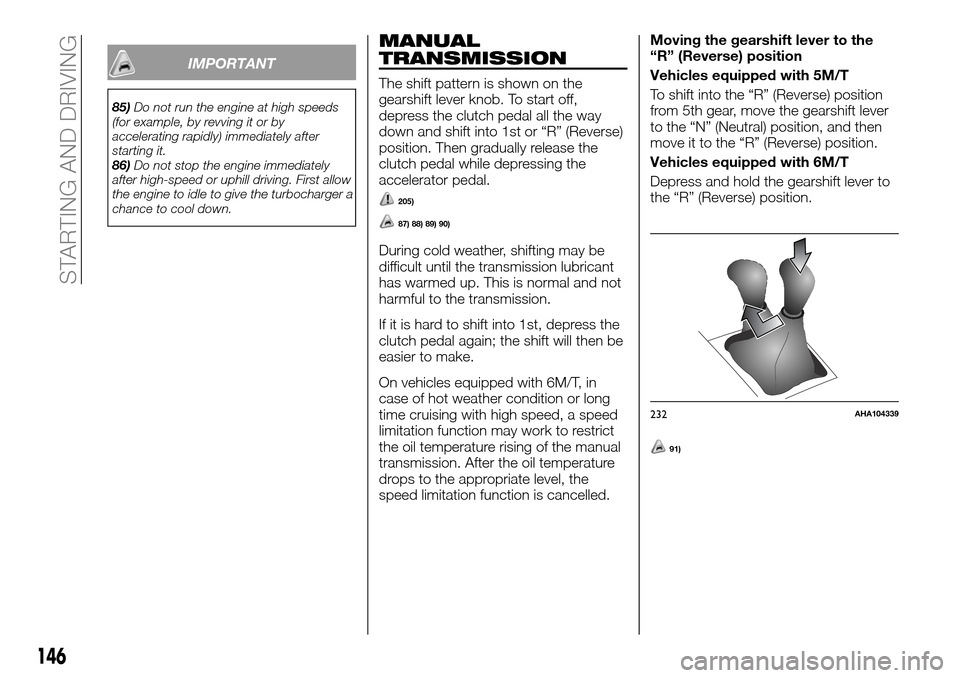
Vehicles equipped with 6M/T
Depress and hold the gearshift lever to
the “R” (Reverse) position.
91)
232AHA104339
146
STARTING AND DRIVING