warning light FIAT FULLBACK 2016 1.G User Guide
[x] Cancel search | Manufacturer: FIAT, Model Year: 2016, Model line: FULLBACK, Model: FIAT FULLBACK 2016 1.GPages: 312, PDF Size: 13.67 MB
Page 102 of 312
WARNING
102)In the following situations, brake
performance may be compromised or the
vehicle may become unstable if brakes are
applied suddenly; consequently, avoid
driving at high speeds or applying the
brakes suddenly. Furthermore, immediately
the vehicle should be brought to a stop in a
safe location and we recommend you to
have it checked. 1 – The brake warning
lamp does not illuminate when the parking
brake is applied or does not turn off when
the parking brake is released.2–The
brake warning lamp and the ABS warning
lamp illuminate at the same time. For
details, refer to “ABS warning lamp”. 3 –
The brake warning lamp remains
illuminated while driving.
103)The vehicle should be brought to a
halt in the following manner when brake
performance has deteriorated. 1 – Depress
the brake pedal harder than usual. Even if
the brake pedal moves down to the very
end of its possible stroke, keep it pressed
down hard. 2 – Should the brakes fail, use
engine braking to reduce your speed and
carefully pull the parking brake lever.
Depress the brake pedal to operate the
stop lamp to alert the vehicles behind you.
IMPORTANT
42)This warning lightwill flash after
starting or during prolonged cranking to
indicate a fault with the glow plug heating
system. If the engine starts, the vehicle can
be used as normal, but a Fiat Dealership
must be contacted as soon as possible.
43)If the diesel preheat indicator lamp
comes on after the engine is started, the
engine speed may not rise above the idling
speed because of fuel freezing. In this case,
keep the engine idling for about
10 minutes, then turn off the ignition switch
or put in OFF the operation mode, and
immediately turn it on or put in ON again to
confirm that the diesel preheat indicator
lamp is off.
44)When the ignition switch is turned to
the “ON” position or the operation mode is
put in ON, the warning lamp does not
come on or it remains on and does not go
off . The warning lamp comes on while
driving.
45)When this indicator lamp blinks, active
stability control function or active traction
control function is operating, which means
that the road is slippery or that your
vehicle’s wheels are beginning to slip. If this
happens, drive slower with less accelerator
input.46)If an abnormal condition occurs in the
system while driving, the
indicator lamp
will illuminate. In these cases, follow these
procedures:1–Ifthetemperature in the
braking system continues to increase due
to continuous brake control on a slippery
road surface, the
indicator lamp will
blink, and operation of the active traction
control function will be suspended to
protect the brake system (the engine
control of the traction control function and
normal brake operation will not be
affected.) Park your vehicle in a safe place.
When the temperature in the braking
system has come down, the indicator lamp
will go off and the active stability control
function and active traction control function
will start operating again.2–Ifthe
indicator lamp does not go out even
through the above procedure is followed,
there could be a problem in the system.
Stop the engine and start the engine again
and check whether the
indicator lamp
goes out. If the indicator lamp goes out,
there is no abnormal condition.3–Ifthe
indicator lamp illuminates even after
your vehicle is driven a short distance after
re-starting the engine, we recommend you
to have your vehicle checked as soon as
possible.
100
KNOWING THE INSTRUMENT PANEL
Page 126 of 312
WARNING
145)Airbags inflate at an extremely rapid
speed. In certain situations, contact with
inflating airbags can result in abrasions,
bruises, light cuts, and the like.
146)IT IS VERY IMPORTANT TO BE
PROPERLY SEATED. A driver or front
passenger too close to the steering wheel
or instrument panel during airbag
deployment can be killed or seriously
injured. Airbags inflate very fast, and with
great force. If the driver and front
passenger are not properly seated and
restrained, the airbags may not protect you
properly, and could cause serious or fatal
injuries when they inflate.
147)Do not sit on the edge of the seat, or
sit with your lower legs too close to the
instrument panel, or lean head or chest
close to the steering wheel or instrument
panel. Do not put feet or legs on or against
the instrument panel.
148)Always drive with your hands on the
rim of the steering wheel so that the airbag
can inflate freely if required. Do not drive
with your body bent forward. Keep your
back straight against the backrest.149)Place all infants and small children in
the rear seat and properly restrained using
an appropriate child restraint system. The
rear seat is the safest for infants and
children.
150)Infants and small children should
never be unrestrained, stand up against
the instrument panel or held in your arms
or on your lap. They could be seriously
injured or killed in a collision, including
when the airbag inflates. They should be
properly seated in an appropriate child
restraint system. See the “Child restraint”
section of this owner’s manual.
151)When there is an active passenger
airbag, DO NOT install rearward facing
child restraint systems on the front seat.
Deployment of the airbag in an accident
could cause fatal injuries to the child
regardless of the severity of the impact.
Therefore, always deactivate the passenger
side airbag when a rearward facing child
restraint system is installed on the front
passenger seat. The front passenger seat
must also be positioned back as far as
possible in order to prevent the child
restraint system from coming into contact
with the dashboard. Immediately reactivate
the passenger airbag as soon as the child
restraint system has been removed.
152)Older children should be seated,
properly wearing the seat belt, with an
appropriate booster seat if needed.
153)Extreme Hazard! NEVER use a
rearward facing child restraint on a seat
protected by an ACTIVE AIRBAG in front of
it, DEATH or SERIOUS INJURY to the
CHILD can occur.154)Do not fit any accessory that makes
the indicator impossible to see, and do not
cover the indicator with a sticker. You
would not be able to verify the status of the
passenger airbag system.
155)To reduce risk of serious or fatal
injury: always turn the ignition switch to the
“LOCK” position or put the operation mode
in OFF, before operating the front
passenger’s airbag ON-OFF switch. Failure
to do so could adversely affect the airbag
performance; Wait at least 60 seconds to
operate the front passenger’s airbag
ON-OFF switch after turning the ignition
switch to the “LOCK” position or putting
the operation mode in OFF. The SRS
airbag system is designed to retain enough
voltage to deploy the airbag; Always
remove the key from the front passenger’s
airbag ON-OFF switch after operating that
switch. Failure to do so could lead to
improper position of the front passenger’s
airbag ON-OFF switch; Do not turn OFF
the front passenger’s airbag ON-OFF
switch except when a child restraint
system is fitted to the front passenger seat;
If the OFF indicator does not come on
when the front passenger’s airbag ONOFF
switch is turned OFF, do not fit a child
restraint system to the front passenger
seat. We recommend you to have the
system inspected by a Fiat Dealership; if
the OFF indicator remains on when the
front passenger’s airbag ON-OFF switch is
turned ON, do not allow anyone to sit on
the front passenger seat. We recommend
you to have the system inspected by a Fiat
Dealership.
124
SAFETY
Page 141 of 312
PARKING BRAKE
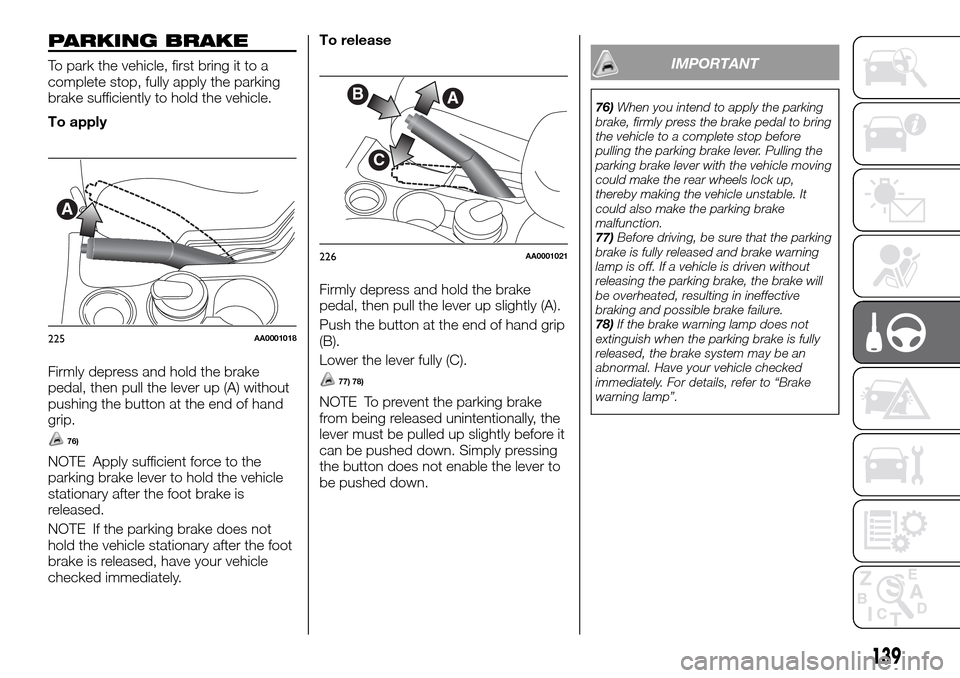
To park the vehicle, first bring it to a
complete stop, fully apply the parking
brake sufficiently to hold the vehicle.
To apply
Firmly depress and hold the brake
pedal, then pull the lever up (A) without
pushing the button at the end of hand
grip.
76)
NOTE Apply sufficient force to the
parking brake lever to hold the vehicle
stationary after the foot brake is
released.
NOTE If the parking brake does not
hold the vehicle stationary after the foot
brake is released, have your vehicle
checked immediately.To release
Firmly depress and hold the brake
pedal, then pull the lever up slightly (A).
Push the button at the end of hand grip
(B).
Lower the lever fully (C).
77) 78)
NOTE To prevent the parking brake
from being released unintentionally, the
lever must be pulled up slightly before it
can be pushed down. Simply pressing
the button does not enable the lever to
be pushed down.
IMPORTANT
76)When you intend to apply the parking
brake, firmly press the brake pedal to bring
the vehicle to a complete stop before
pulling the parking brake lever. Pulling the
parking brake lever with the vehicle moving
could make the rear wheels lock up,
thereby making the vehicle unstable. It
could also make the parking brake
malfunction.
77)Before driving, be sure that the parking
brake is fully released and brake warning
lamp is off. If a vehicle is driven without
releasing the parking brake, the brake will
be overheated, resulting in ineffective
braking and possible brake failure.
78)If the brake warning lamp does not
extinguish when the parking brake is fully
released, the brake system may be an
abnormal. Have your vehicle checked
immediately. For details, refer to “Brake
warning lamp”.
A
225AA0001018
AB
C
226AA0001021
139
Page 174 of 312
Turning sharp corners
When turning a sharp corner in “4H” or
“4L” position (Easy select 4WD), “4HLc”
or “4LLc” position (Super select 4WD II)
at low speed, a slight difference in
steering may be experienced similar to
as if the brakes were applied. This is
called tight corner braking and results
from each of the 4 tyres being at a
different distance from the corner.
Crossing a stream
4-wheel drive vehicles are not
necessarily waterproof. If the electrical
circuits become wet, further operation
of the vehicle will be impossible;
therefore, avoid crossing streams
unless absolutely necessary. If crossing
a stream is unavoidable, use the
following procedure:
Check depths of a stream and
geographical features before
attempting to cross a stream and
ford the stream where the water is
as shallow as practicable.Set the
drive mode-selector to “4L”
position (Easy select 4WD), “4LLc”
position (Super select 4WD II).Drive
slowly at a speed of approximately
5 km/h to avoid splashing too
much water.
117) 118)
Inspection and maintenance
following rough road operation
After operating the vehicle in rough road
conditions, be sure to perform the
following inspection and maintenance
procedures:
Check that the vehicle has not been
damaged by rocks, gravel, etc.
Carefully wash the vehicle with water.
Drive the vehicle slowly while lightly
depressing the brake pedal in order to
dry out the brakes. If the brakes still do
not function properly, we recommend
you to have the brakes checked as
soon as possible.
Remove the insects, dried grass, etc.
clogging the radiator core.
After crossing a stream, be sure to have
the following items inspected at a Fiat
Dealership and take the necessary
measures:
Check the brake system and, if
necessary, have it serviced.
Check the engine, transmission,
transfer, and differential oil or grease
level and turbidity. If the oil or grease is
milky, it indicates water contamination.
Replace it with new oil or grease.
Grease the propeller shaft.
Check the inside of the vehicle. If
water is found, dry the carpet etc.
Inspect the headlamps. If the
headlamp bulb is flooded with water,
have the headlamp drained off.
IMPORTANT
113)Selecting “4H” or “4L” position (Easy
select 4WD), “4HLc” or “4LLc” position
(Super select 4WD II) to drive on dry paved
road will increase the fuel consumption with
possible noise generation and early tyre
wear. It may also increase the differential oil
temperature, resulting in possible damage
to the driving system. Further, the drive
train will be subjected to excessive loading,
possibly leading to oil leakage, component
seizure, or other serious faults.
114)Avoid sudden braking, sudden
acceleration, and sharp turning; such
operations could cause skidding and
spinouts.
115)Do not force the vehicle or drive
recklessly on sandy surfaces. In
comparison with normal road surfaces, the
engine and other drive-system components
are put under excessive strain when driving
on such a surface, and this could lead to
accidents.
116)If any of following conditions occur
while the vehicle is being driven,
immediately park your vehicle in a safe
place and follow these procedures: the
needle in the temperature gauge
approaches the overheating zone. Refer to
“Engine overheating”; automatic
transmission fluid temperature warning
lamp comes on. Refer to “When the A/T
(automatic transmission) fluid temperature
warning lamp comes on”.
172
STARTING AND DRIVING
Page 175 of 312
117)Never cross a stream where the water
is deep. Do not change gears while
crossing the stream. Frequent crossing of
streams can adversely affect the life span
of the vehicle; we recommend you to take
the necessary measures to prepare,
inspect, and repair the vehicle.
118)After crossing a stream, apply the
brakes to be sure they are functioning
properly. If the brakes are wet and not
functioning properly, dry them out by
driving slowly while lightly depressing the
brake pedal. Inspect each part of the
vehicle carefully.
WARNING
218)When attempting to rock your vehicle
out of a stuck position, be sure that the
area around the vehicle is clear of people
and physical objects. The rocking motion
may cause the vehicle to suddenly launch
forward or backward, causing injury or
damage to nearby people or objects.
219)Go straight up. Do not try to traverse
across a steep slope.
220)If you begin to lose traction, ease off
the accelerator pedal and gently turn the
steering wheel alternatively left and right to
regain adequate traction again.
221)Avoid snaking down a sharp grade.
Descend the grade as straight as possible.
CAUTIONS ON
HANDLING OF
4 WHEEL DRIVE
VEHICLES
Tyres and wheels
Since the driving torque can be applied
to the 4 wheels, the performance of the
vehicle when operating in 4-wheel drive
is greatly affected by the condition of
the tyres.
Pay close attention to the tyres.
Install specified tyres on all wheels.
Refer to “Tyres and wheels”.
Be sure to the appropriate tyre
inflation pressure according to no cargo
or cargo. Refer to “Tyre inflation
pressures”.
Be sure to fit all 4 tyres and wheels of
the same size and type. When
replacement of any of the tyres or
wheels is necessary, replace all of them.
All tyres should be rotated whenever
the wear difference between the front
and rear tyres is recognizable.
Good vehicle performance cannot be
expected if there is a difference in wear
between tyres. Refer to “Tyre rotation”.
Check the tyre inflation pressure
regularly.
119)
Towing
If towing is necessary, we recommend
you to have it done by a Fiat Dealership
or a commercial tow truck service. In
the following cases, transport the
vehicle using a tow truck.
The engine runs but the vehicle does
not move or abnormal noise is
produced.
Inspection of the vehicle’s underside
reveals that oil or some other fluid is
leaking.
Only when you cannot receive a towing
service from a Fiat Dealership or
commercial tow truck service, tow your
vehicle carefully in accordance with the
instructions given in “Towing”.
173
Page 177 of 312
WARNING
222)Do not crank the engine while jacking
up the vehicle. The tyre on the ground may
turn and the vehicle may roll off the jack.
BRAKING SYSTEM
All the parts of the brake system are
critical to safety. We recommend you to
have the vehicle checked at regular
intervals.
123)
Brake system
The service brake is divided into two
brake circuits. And your vehicle is
equipped with power brakes. If one
brake circuit fails, the other is available
to stop the vehicle. If your vehicle
should lose the power assist for some
reason, the brakes will still work.
In these situations even if the brake
pedal moves down to the very end of
its possible stroke or resists being
depressed, keep depressing the brake
pedal down harder and further than
usual; stop driving as soon as possible
and have the brake system repaired.
223) 224)
Warning lamp
The brake warning lamp illuminates to
indicate a fault in the braking system.
Refer to “Brake warning lamp”.When brakes are wet
Check the brake system while driving at
a low speed immediately after starting,
especially when the brakes are wet, to
confirm they work normally.
A film of water can be formed on the
brake discs or brake drums and
prevent normal braking after driving in
heavy rain or through large puddles, or
after the vehicle is washed. If this
occurs, dry the brakes out by driving
slowly while lightly depressing the brake
pedal.
When driving downhill
It is important to take advantage of the
engine braking by shifting to a lower
shift position while driving on steep
downhill roads in order to prevent the
brakes from overheating.
225)
Brake pads and linings
Avoid hard braking situations. New
brakes need to be broken-in by
moderate use for the first 200 km.
The disc brakes are provided with a
warning device which emits a shrieking
metallic sound while braking if the brake
pads have reached their wear limit. If
you hear this sound, have the brake
pads replaced.
226)
175
Page 201 of 312
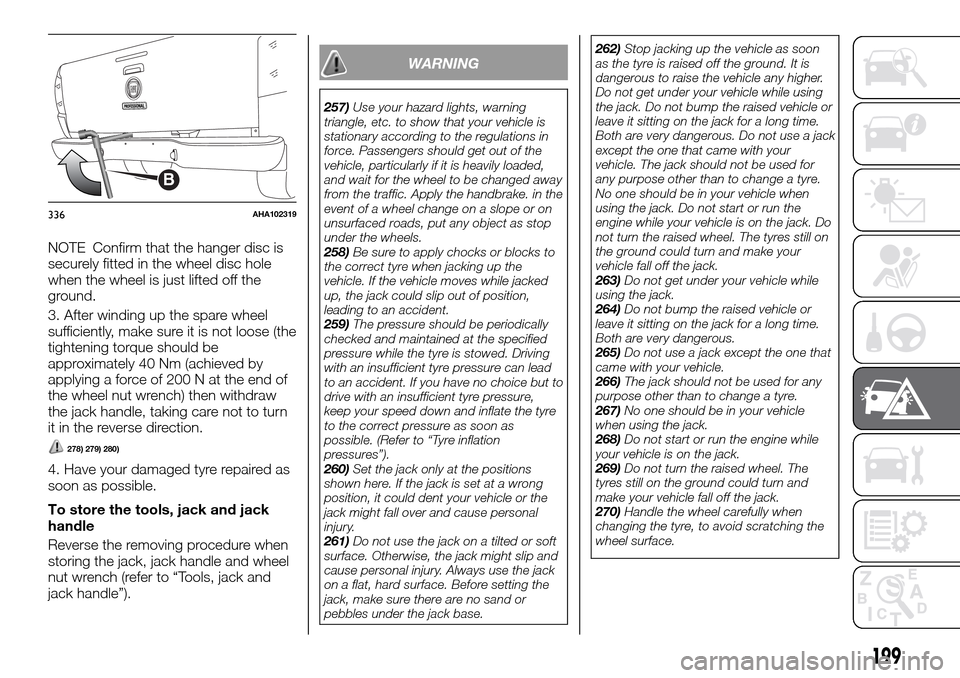
NOTE Confirm that the hanger disc is
securely fitted in the wheel disc hole
when the wheel is just lifted off the
ground.
3. After winding up the spare wheel
sufficiently, make sure it is not loose (the
tightening torque should be
approximately 40 Nm (achieved by
applying a force of 200 N at the end of
the wheel nut wrench) then withdraw
the jack handle, taking care not to turn
it in the reverse direction.
278) 279) 280)
4. Have your damaged tyre repaired as
soon as possible.
To store the tools, jack and jack
handle
Reverse the removing procedure when
storing the jack, jack handle and wheel
nut wrench (refer to “Tools, jack and
jack handle”).
WARNING
257)Use your hazard lights, warning
triangle, etc. to show that your vehicle is
stationary according to the regulations in
force. Passengers should get out of the
vehicle, particularly if it is heavily loaded,
and wait for the wheel to be changed away
from the traffic. Apply the handbrake. in the
event of a wheel change on a slope or on
unsurfaced roads, put any object as stop
under the wheels.
258)Be sure to apply chocks or blocks to
the correct tyre when jacking up the
vehicle. If the vehicle moves while jacked
up, the jack could slip out of position,
leading to an accident.
259)The pressure should be periodically
checked and maintained at the specified
pressure while the tyre is stowed. Driving
with an insufficient tyre pressure can lead
to an accident. If you have no choice but to
drive with an insufficient tyre pressure,
keep your speed down and inflate the tyre
to the correct pressure as soon as
possible. (Refer to “Tyre inflation
pressures”).
260)Set the jack only at the positions
shown here. If the jack is set at a wrong
position, it could dent your vehicle or the
jack might fall over and cause personal
injury.
261)Do not use the jack on a tilted or soft
surface. Otherwise, the jack might slip and
cause personal injury. Always use the jack
on a flat, hard surface. Before setting the
jack, make sure there are no sand or
pebbles under the jack base.262)Stop jacking up the vehicle as soon
as the tyre is raised off the ground. It is
dangerous to raise the vehicle any higher.
Do not get under your vehicle while using
the jack. Do not bump the raised vehicle or
leave it sitting on the jack for a long time.
Both are very dangerous. Do not use a jack
except the one that came with your
vehicle. The jack should not be used for
any purpose other than to change a tyre.
No one should be in your vehicle when
using the jack. Do not start or run the
engine while your vehicle is on the jack. Do
not turn the raised wheel. The tyres still on
the ground could turn and make your
vehicle fall off the jack.
263)Do not get under your vehicle while
using the jack.
264)Do not bump the raised vehicle or
leave it sitting on the jack for a long time.
Both are very dangerous.
265)Do not use a jack except the one that
came with your vehicle.
266)The jack should not be used for any
purpose other than to change a tyre.
267)No one should be in your vehicle
when using the jack.
268)Do not start or run the engine while
your vehicle is on the jack.
269)Do not turn the raised wheel. The
tyres still on the ground could turn and
make your vehicle fall off the jack.
270)Handle the wheel carefully when
changing the tyre, to avoid scratching the
wheel surface.
B
336AHA102319
199
Page 227 of 312
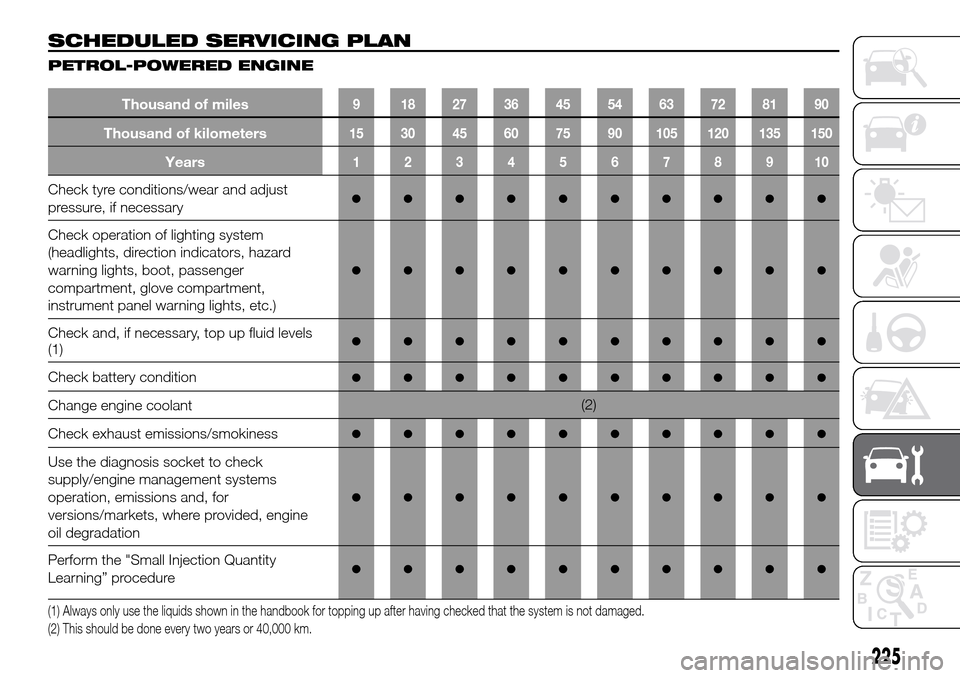
SCHEDULED SERVICING PLAN
PETROL-POWERED ENGINE
Thousand of miles9 182736455463728190
Thousand of kilometers15 30 45 60 75 90 105 120 135 150
Years12345678910
Check tyre conditions/wear and adjust
pressure, if necessary●●●●●●●●●●
Check operation of lighting system
(headlights, direction indicators, hazard
warning lights, boot, passenger
compartment, glove compartment,
instrument panel warning lights, etc.)
●●●●●●●●●●
Check and, if necessary, top up fluid levels
(1)●●●●●●●●●●
Check battery condition●●●●●●●●●●
Change engine coolant(2)
Check exhaust emissions/smokiness
●●●●●●●●●●
Use the diagnosis socket to check
supply/engine management systems
operation, emissions and, for
versions/markets, where provided, engine
oil degradation
●●●●●●●●●●
Perform the "Small Injection Quantity
Learning” procedure●●●●●●●●●●
(1) Always only use the liquids shown in the handbook for topping up after having checked that the system is not damaged.
(2) This should be done every two years or 40,000 km.
225
Page 232 of 312
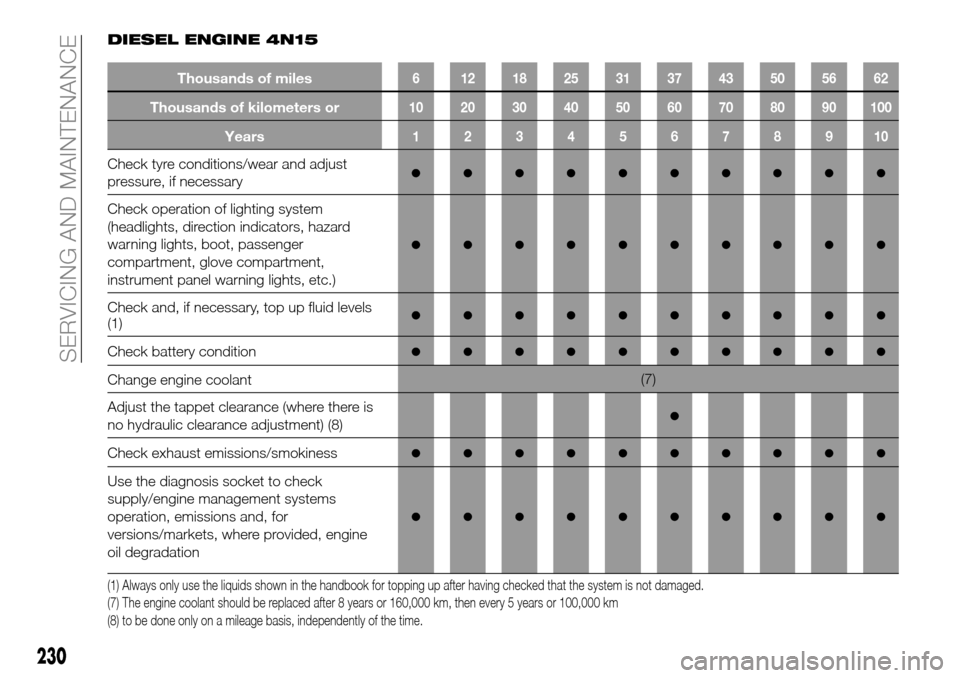
DIESEL ENGINE 4N15
Thousands of miles6 121825313743505662
Thousands of kilometers or10 20 30 40 50 60 70 80 90 100
Years12345678910
Check tyre conditions/wear and adjust
pressure, if necessary●●●●●●●●●●
Check operation of lighting system
(headlights, direction indicators, hazard
warning lights, boot, passenger
compartment, glove compartment,
instrument panel warning lights, etc.)
●●●●●●●●●●
Check and, if necessary, top up fluid levels
(1)●●●●●●●●●●
Check battery condition●●●●●●●●●●
Change engine coolant(7)
Adjust the tappet clearance (where there is
no hydraulic clearance adjustment) (8)
●
Check exhaust emissions/smokiness●●●●●●●●●●
Use the diagnosis socket to check
supply/engine management systems
operation, emissions and, for
versions/markets, where provided, engine
oil degradation
●●●●●●●●●●
(1) Always only use the liquids shown in the handbook for topping up after having checked that the system is not damaged.
(7) The engine coolant should be replaced after 8 years or 160,000 km, then every 5 years or 100,000 km
(8) to be done only on a mileage basis, independently of the time.
230
SERVICING AND MAINTENANCE
Page 237 of 312
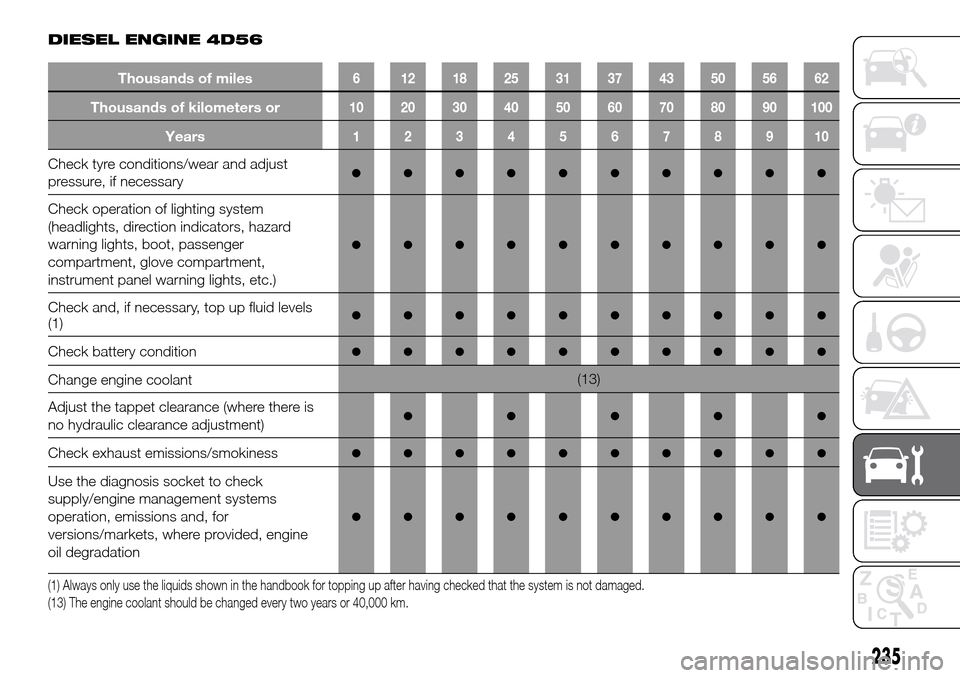
DIESEL ENGINE 4D56
Thousands of miles6 121825313743505662
Thousands of kilometers or10 20 30 40 50 60 70 80 90 100
Years12345678910
Check tyre conditions/wear and adjust
pressure, if necessary●●●●●●●●●●
Check operation of lighting system
(headlights, direction indicators, hazard
warning lights, boot, passenger
compartment, glove compartment,
instrument panel warning lights, etc.)
●●●●●●●●●●
Check and, if necessary, top up fluid levels
(1)●●●●●●●●●●
Check battery condition●●●●●●●●●●
Change engine coolant(13)
Adjust the tappet clearance (where there is
no hydraulic clearance adjustment)
●●●●●
Check exhaust emissions/smokiness●●●●●●●●●●
Use the diagnosis socket to check
supply/engine management systems
operation, emissions and, for
versions/markets, where provided, engine
oil degradation
●●●●●●●●●●
(1) Always only use the liquids shown in the handbook for topping up after having checked that the system is not damaged.
(13) The engine coolant should be changed every two years or 40,000 km.
235