change time FIAT FULLBACK 2016 1.G Owner's Manual
[x] Cancel search | Manufacturer: FIAT, Model Year: 2016, Model line: FULLBACK, Model: FIAT FULLBACK 2016 1.GPages: 312, PDF Size: 13.67 MB
Page 186 of 312
IN CASE OF EMERGENCY
A punctured tyre or a burnt-out bulb?
At times, a problem may interfere with
our journey.
The pages on emergencies can help
you to deal with critical situations
independently and with calm.
In an emergency we recommend that
you call the freephone number found in
the Warranty Booklet.
It is also possible to call the
00 800 3428 0000 freephone number
to search the nearest Fiat Dealership.IF THE VEHICLE BREAKS DOWN. .185
EMERGENCY STARTING.......185
ENGINE OVERHEATING........187
BLEEDING THE FUEL SYSTEM . . .188
REMOVAL OF WATER FROM THE
FUEL FILTER...............188
TOOLS, JACK AND JACK
HANDLE..................189
HOW TO CHANGE A TYRE.....194
TOWING..................201
OPERATION UNDER ADVERSE
DRIVING CONDITIONS........204
FUSIBLE LINKS.............205
FUSES...................205
REPLACEMENT OF LAMP
BULBS...................213
184
IN CASE OF EMERGENCY
Page 196 of 312
HOW TO CHANGE A
TYRE
132) 133)
Before changing a tyre, first stop your
vehicle in a safe, flat location.
1. Park the vehicle on level and stable
ground, free of loose pebbles, etc.
2. Set the parking brake firmly.
3. On vehicles with manual
transmission, turn the ignition switch to
the “LOCK” position or put the
operation mode in OFF, and move the
gearshift lever to the “R” (Reverse)
position. On vehicles with automatic
transmission, move the selector lever to
the “P” (PARK) position, and turn the
ignition switch to the “LOCK” position
or put the operation mode in OFF.
4. Turn on the hazard flashers and set
up a warning triangle, flashing signal
lamp, etc., at an adequate distance
from the vehicle, and have all your
passengers leave the vehicle.
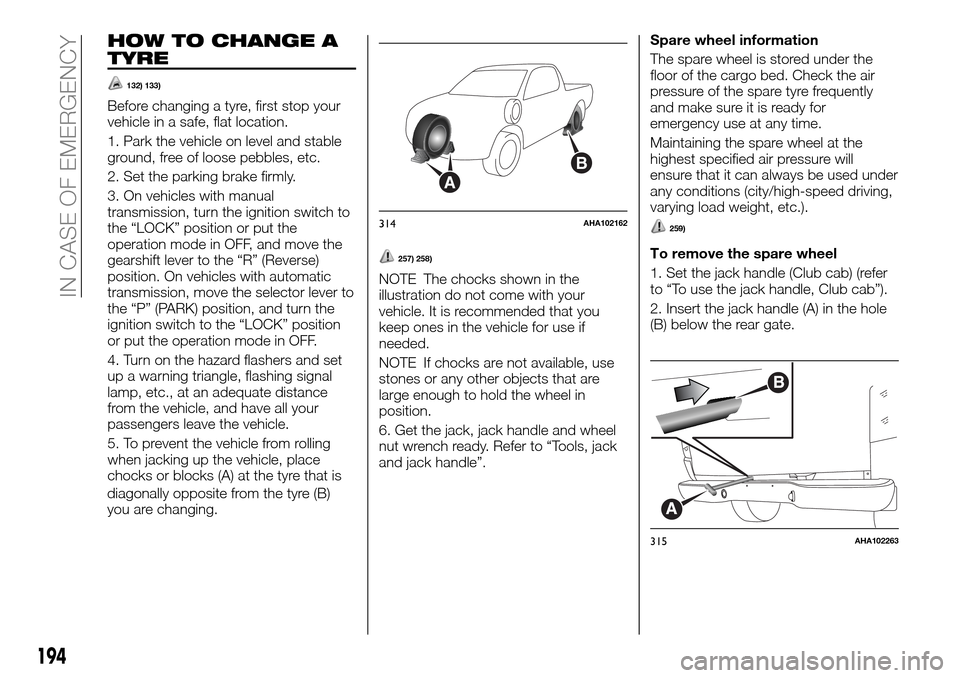
5. To prevent the vehicle from rolling
when jacking up the vehicle, place
chocks or blocks (A) at the tyre that is
diagonally opposite from the tyre (B)
you are changing.
257) 258)
NOTE The chocks shown in the
illustration do not come with your
vehicle. It is recommended that you
keep ones in the vehicle for use if
needed.
NOTE If chocks are not available, use
stones or any other objects that are
large enough to hold the wheel in
position.
6. Get the jack, jack handle and wheel
nut wrench ready. Refer to “Tools, jack
and jack handle”.Spare wheel information
The spare wheel is stored under the
floor of the cargo bed. Check the air
pressure of the spare tyre frequently
and make sure it is ready for
emergency use at any time.
Maintaining the spare wheel at the
highest specified air pressure will
ensure that it can always be used under
any conditions (city/high-speed driving,
varying load weight, etc.).
259)
To remove the spare wheel
1. Set the jack handle (Club cab) (refer
to “To use the jack handle, Club cab”).
2. Insert the jack handle (A) in the hole
(B) below the rear gate.
A
B
314AHA102162
A
B
315AHA102263
194
IN CASE OF EMERGENCY
Page 201 of 312
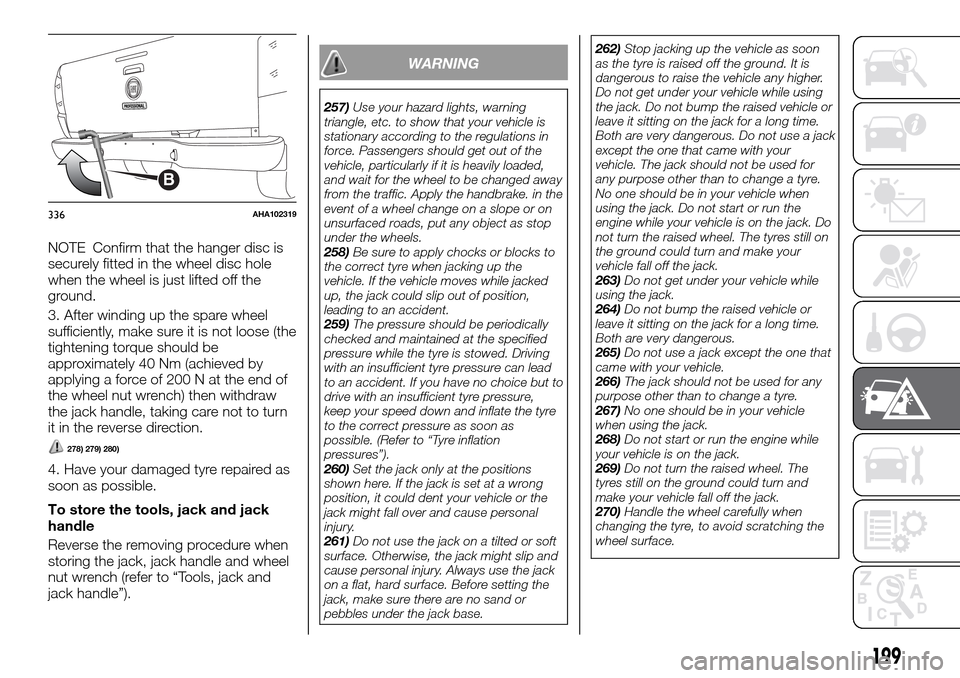
NOTE Confirm that the hanger disc is
securely fitted in the wheel disc hole
when the wheel is just lifted off the
ground.
3. After winding up the spare wheel
sufficiently, make sure it is not loose (the
tightening torque should be
approximately 40 Nm (achieved by
applying a force of 200 N at the end of
the wheel nut wrench) then withdraw
the jack handle, taking care not to turn
it in the reverse direction.
278) 279) 280)
4. Have your damaged tyre repaired as
soon as possible.
To store the tools, jack and jack
handle
Reverse the removing procedure when
storing the jack, jack handle and wheel
nut wrench (refer to “Tools, jack and
jack handle”).
WARNING
257)Use your hazard lights, warning
triangle, etc. to show that your vehicle is
stationary according to the regulations in
force. Passengers should get out of the
vehicle, particularly if it is heavily loaded,
and wait for the wheel to be changed away
from the traffic. Apply the handbrake. in the
event of a wheel change on a slope or on
unsurfaced roads, put any object as stop
under the wheels.
258)Be sure to apply chocks or blocks to
the correct tyre when jacking up the
vehicle. If the vehicle moves while jacked
up, the jack could slip out of position,
leading to an accident.
259)The pressure should be periodically
checked and maintained at the specified
pressure while the tyre is stowed. Driving
with an insufficient tyre pressure can lead
to an accident. If you have no choice but to
drive with an insufficient tyre pressure,
keep your speed down and inflate the tyre
to the correct pressure as soon as
possible. (Refer to “Tyre inflation
pressures”).
260)Set the jack only at the positions
shown here. If the jack is set at a wrong
position, it could dent your vehicle or the
jack might fall over and cause personal
injury.
261)Do not use the jack on a tilted or soft
surface. Otherwise, the jack might slip and
cause personal injury. Always use the jack
on a flat, hard surface. Before setting the
jack, make sure there are no sand or
pebbles under the jack base.262)Stop jacking up the vehicle as soon
as the tyre is raised off the ground. It is
dangerous to raise the vehicle any higher.
Do not get under your vehicle while using
the jack. Do not bump the raised vehicle or
leave it sitting on the jack for a long time.
Both are very dangerous. Do not use a jack
except the one that came with your
vehicle. The jack should not be used for
any purpose other than to change a tyre.
No one should be in your vehicle when
using the jack. Do not start or run the
engine while your vehicle is on the jack. Do
not turn the raised wheel. The tyres still on
the ground could turn and make your
vehicle fall off the jack.
263)Do not get under your vehicle while
using the jack.
264)Do not bump the raised vehicle or
leave it sitting on the jack for a long time.
Both are very dangerous.
265)Do not use a jack except the one that
came with your vehicle.
266)The jack should not be used for any
purpose other than to change a tyre.
267)No one should be in your vehicle
when using the jack.
268)Do not start or run the engine while
your vehicle is on the jack.
269)Do not turn the raised wheel. The
tyres still on the ground could turn and
make your vehicle fall off the jack.
270)Handle the wheel carefully when
changing the tyre, to avoid scratching the
wheel surface.
B
336AHA102319
199
Page 230 of 312
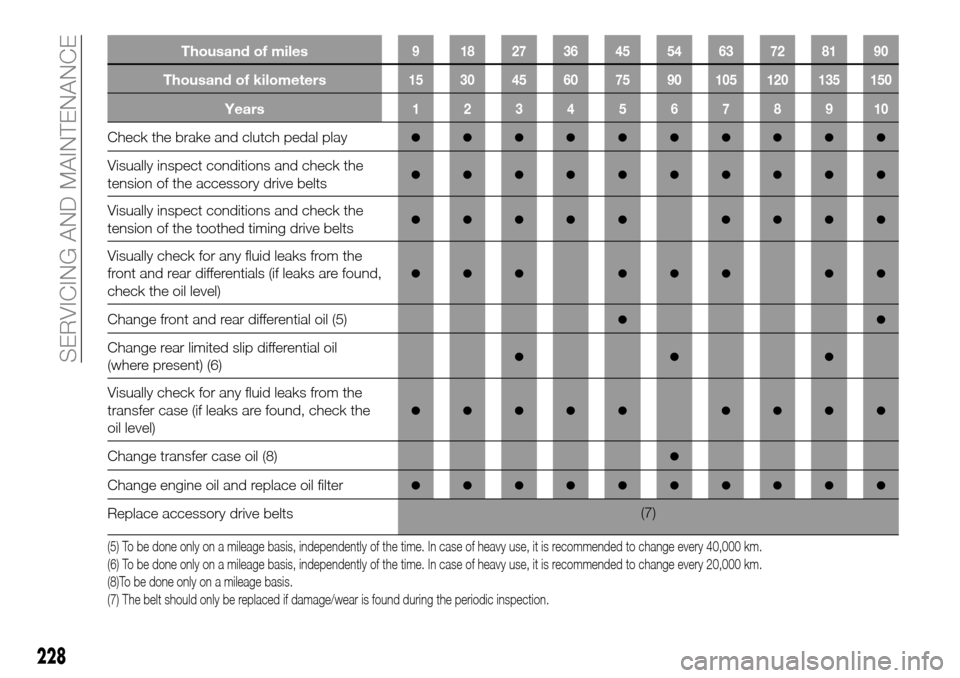
Thousand of miles9 182736455463728190
Thousand of kilometers15 30 45 60 75 90 105 120 135 150
Years12345678910
Check the brake and clutch pedal play●●●●●●●●●●
Visually inspect conditions and check the
tension of the accessory drive belts●●●●●●●●●●
Visually inspect conditions and check the
tension of the toothed timing drive belts●●●●● ●●●●
Visually check for any fluid leaks from the
front and rear differentials (if leaks are found,
check the oil level)
●●● ●●● ●●
Change front and rear differential oil (5)●●
Change rear limited slip differential oil
(where present) (6)●●●
Visually check for any fluid leaks from the
transfer case (if leaks are found, check the
oil level)
●●●●● ●●●●
Change transfer case oil (8)●
Change engine oil and replace oil filter●●●●●●●●●●
Replace accessory drive belts(7)
(5) To be done only on a mileage basis, independently of the time. In case of heavy use, it is recommended to change every 40,000 km.
(6) To be done only on a mileage basis, independently of the time. In case of heavy use, it is recommended to change every 20,000 km.
(8)To be done only on a mileage basis.
(7) The belt should only be replaced if damage/wear is found during the periodic inspection.
228
SERVICING AND MAINTENANCE
Page 232 of 312
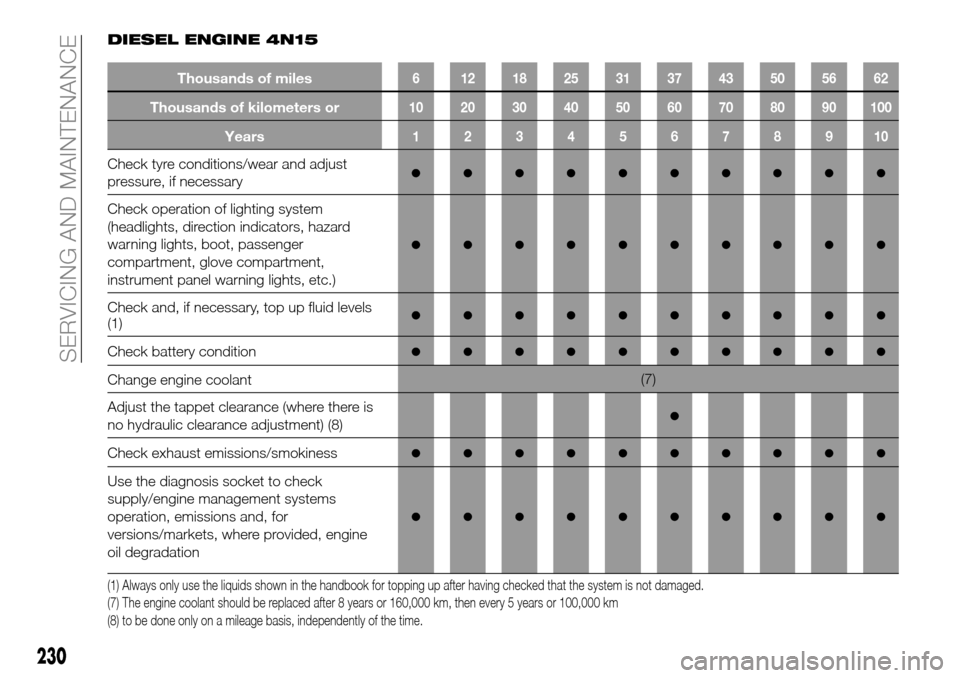
DIESEL ENGINE 4N15
Thousands of miles6 121825313743505662
Thousands of kilometers or10 20 30 40 50 60 70 80 90 100
Years12345678910
Check tyre conditions/wear and adjust
pressure, if necessary●●●●●●●●●●
Check operation of lighting system
(headlights, direction indicators, hazard
warning lights, boot, passenger
compartment, glove compartment,
instrument panel warning lights, etc.)
●●●●●●●●●●
Check and, if necessary, top up fluid levels
(1)●●●●●●●●●●
Check battery condition●●●●●●●●●●
Change engine coolant(7)
Adjust the tappet clearance (where there is
no hydraulic clearance adjustment) (8)
●
Check exhaust emissions/smokiness●●●●●●●●●●
Use the diagnosis socket to check
supply/engine management systems
operation, emissions and, for
versions/markets, where provided, engine
oil degradation
●●●●●●●●●●
(1) Always only use the liquids shown in the handbook for topping up after having checked that the system is not damaged.
(7) The engine coolant should be replaced after 8 years or 160,000 km, then every 5 years or 100,000 km
(8) to be done only on a mileage basis, independently of the time.
230
SERVICING AND MAINTENANCE
Page 234 of 312
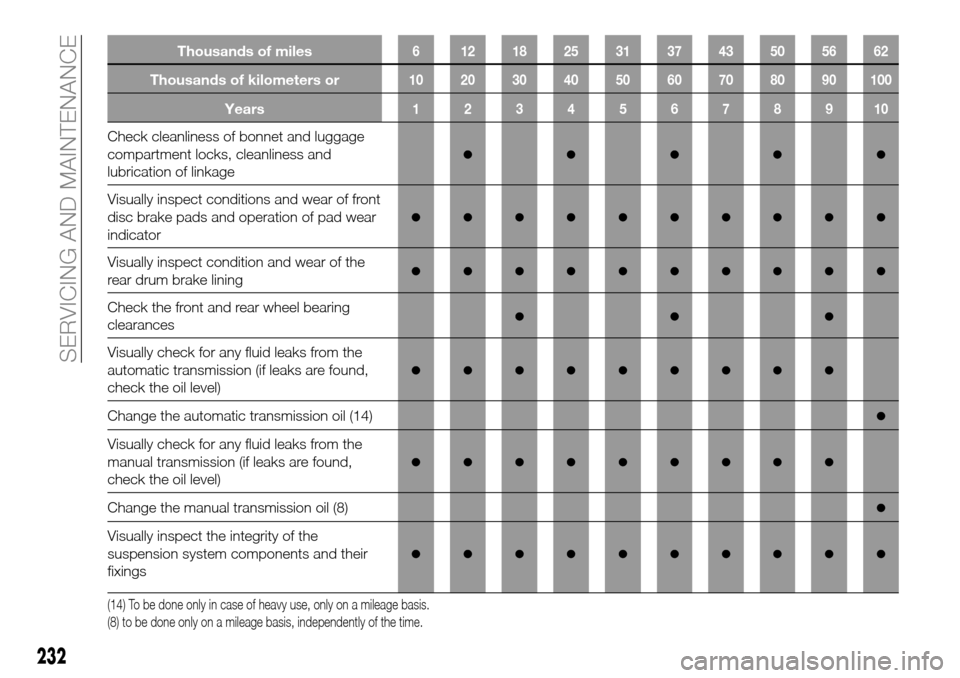
Thousands of miles6 121825313743505662
Thousands of kilometers or10 20 30 40 50 60 70 80 90 100
Years12345678910
Check cleanliness of bonnet and luggage
compartment locks, cleanliness and
lubrication of linkage
●●●●●
Visually inspect conditions and wear of front
disc brake pads and operation of pad wear
indicator
●●●●●●●●●●
Visually inspect condition and wear of the
rear drum brake lining●●●●●●●●●●
Check the front and rear wheel bearing
clearances●●●
Visually check for any fluid leaks from the
automatic transmission (if leaks are found,
check the oil level)
●●●●●●●●●
Change the automatic transmission oil (14)●
Visually check for any fluid leaks from the
manual transmission (if leaks are found,
check the oil level)
●●●●●●●●●
Change the manual transmission oil (8)●
Visually inspect the integrity of the
suspension system components and their
fixings
●●●●●●●●●●
(14) To be done only in case of heavy use, only on a mileage basis.
(8) to be done only on a mileage basis, independently of the time.
232
SERVICING AND MAINTENANCE
Page 235 of 312
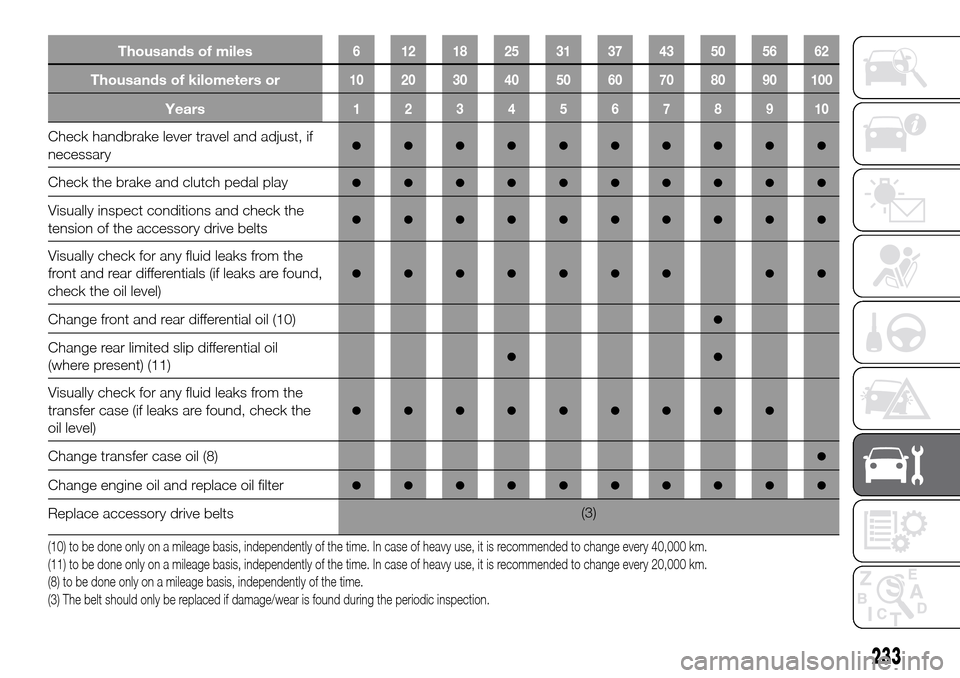
Thousands of miles6 121825313743505662
Thousands of kilometers or10 20 30 40 50 60 70 80 90 100
Years12345678910
Check handbrake lever travel and adjust, if
necessary●●●●●●●●●●
Check the brake and clutch pedal play●●●●●●●●●●
Visually inspect conditions and check the
tension of the accessory drive belts●●●●●●●●●●
Visually check for any fluid leaks from the
front and rear differentials (if leaks are found,
check the oil level)
●●●●●●● ●●
Change front and rear differential oil (10)●
Change rear limited slip differential oil
(where present) (11)●●
Visually check for any fluid leaks from the
transfer case (if leaks are found, check the
oil level)
●●●●●●●●●
Change transfer case oil (8)●
Change engine oil and replace oil filter●●●●●●●●●●
Replace accessory drive belts(3)
(10) to be done only on a mileage basis, independently of the time. In case of heavy use, it is recommended to change every 40,000 km.
(11) to be done only on a mileage basis, independently of the time. In case of heavy use, it is recommended to change every 20,000 km.
(8) to be done only on a mileage basis, independently of the time.
(3) The belt should only be replaced if damage/wear is found during the periodic inspection.
233
Page 239 of 312
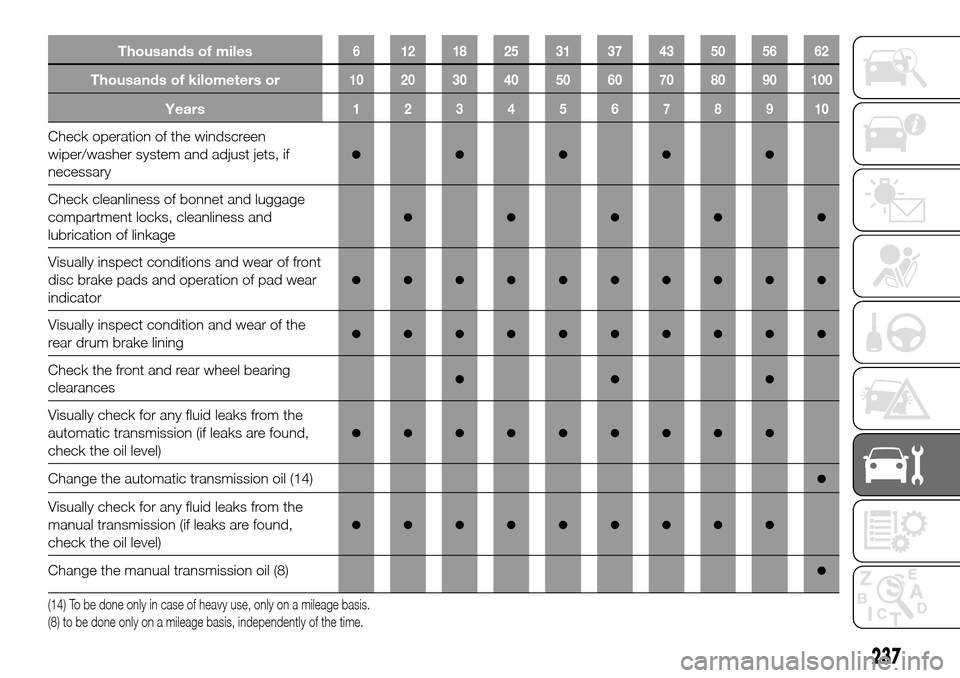
Thousands of miles6 121825313743505662
Thousands of kilometers or10 20 30 40 50 60 70 80 90 100
Years12345678910
Check operation of the windscreen
wiper/washer system and adjust jets, if
necessary
●●●●●
Check cleanliness of bonnet and luggage
compartment locks, cleanliness and
lubrication of linkage
●●●●●
Visually inspect conditions and wear of front
disc brake pads and operation of pad wear
indicator
●●●●●●●●●●
Visually inspect condition and wear of the
rear drum brake lining●●●●●●●●●●
Check the front and rear wheel bearing
clearances●●●
Visually check for any fluid leaks from the
automatic transmission (if leaks are found,
check the oil level)
●●●●●●●●●
Change the automatic transmission oil (14)●
Visually check for any fluid leaks from the
manual transmission (if leaks are found,
check the oil level)
●●●●●●●●●
Change the manual transmission oil (8)●
(14) To be done only in case of heavy use, only on a mileage basis.
(8) to be done only on a mileage basis, independently of the time.
237
Page 240 of 312
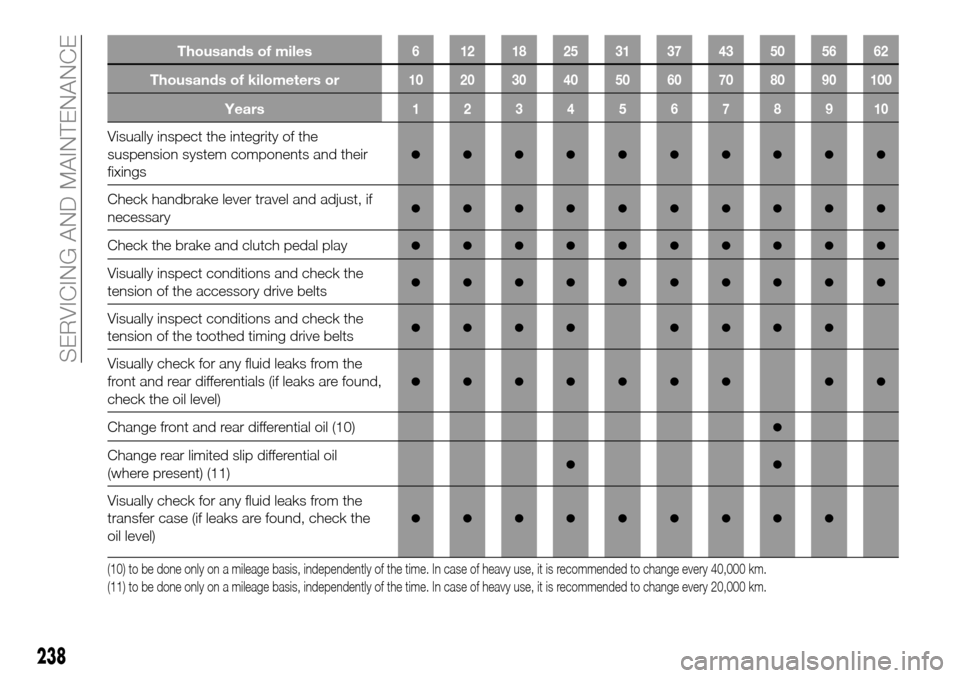
Thousands of miles6 121825313743505662
Thousands of kilometers or10 20 30 40 50 60 70 80 90 100
Years12345678910
Visually inspect the integrity of the
suspension system components and their
fixings
●●●●●●●●●●
Check handbrake lever travel and adjust, if
necessary●●●●●●●●●●
Check the brake and clutch pedal play●●●●●●●●●●
Visually inspect conditions and check the
tension of the accessory drive belts●●●●●●●●●●
Visually inspect conditions and check the
tension of the toothed timing drive belts●●●● ●●●●
Visually check for any fluid leaks from the
front and rear differentials (if leaks are found,
check the oil level)
●●●●●●● ●●
Change front and rear differential oil (10)●
Change rear limited slip differential oil
(where present) (11)●●
Visually check for any fluid leaks from the
transfer case (if leaks are found, check the
oil level)
●●●●●●●●●
(10) to be done only on a mileage basis, independently of the time. In case of heavy use, it is recommended to change every 40,000 km.
(11) to be done only on a mileage basis, independently of the time. In case of heavy use, it is recommended to change every 20,000 km.
238
SERVICING AND MAINTENANCE
Page 241 of 312
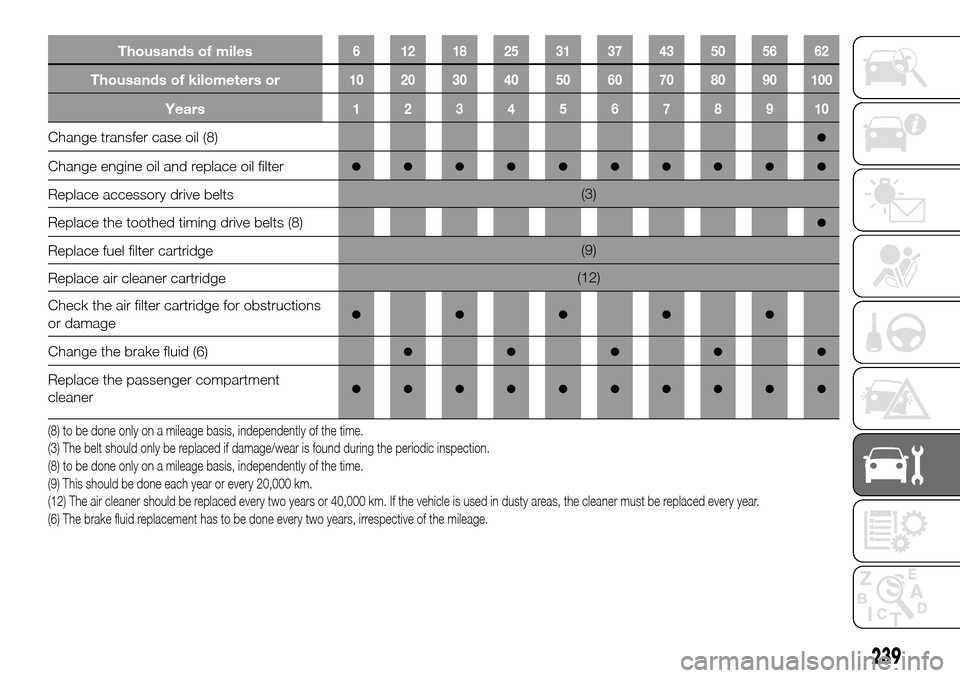
Thousands of miles6 121825313743505662
Thousands of kilometers or10 20 30 40 50 60 70 80 90 100
Years12345678910
Change transfer case oil (8)●
Change engine oil and replace oil filter●●●●●●●●●●
Replace accessory drive belts(3)
Replace the toothed timing drive belts (8)
●
Replace fuel filter cartridge(9)
Replace air cleaner cartridge(12)
Check the air filter cartridge for obstructions
or damage
●●●●●
Change the brake fluid (6)●●●●●
Replace the passenger compartment
cleaner●●●●●●●●●●
(8) to be done only on a mileage basis, independently of the time.
(3) The belt should only be replaced if damage/wear is found during the periodic inspection.
(8) to be done only on a mileage basis, independently of the time.
(9) This should be done each year or every 20,000 km.
(12) The air cleaner should be replaced every two years or 40,000 km. If the vehicle is used in dusty areas, the cleaner must be replaced every year.
(6) The brake fluid replacement has to be done every two years, irrespective of the mileage.
239