4WD FIAT FULLBACK 2016 1.G Owner's Guide
[x] Cancel search | Manufacturer: FIAT, Model Year: 2016, Model line: FULLBACK, Model: FIAT FULLBACK 2016 1.GPages: 312, PDF Size: 13.67 MB
Page 205 of 312
WARNING
281)If the vehicle is towed with the ignition
switch in the “ON” position or the operation
mode in ON and only the front wheels or
only the rear wheels raised off the ground,
the active traction control system may
operate, resulting in an accident.
282)If your vehicle equipped with the
Active Stability & Traction Control system
(ASTC), if the vehicle is towed with the
ignition switch in the “ON” position or the
operation mode in ON and only the front
wheels or only the rear wheels raised off
the ground, the active traction control
system may operate, resulting in an
accident.
283)Avoid sudden braking, acceleration
and steering wheel movements; such
driving operation could cause damage to
the towing hook or towing rope. People in
the vicinity could be injured as a result.284)When going down a long slope, the
brakes may overheat, reducing
effectiveness. Have your vehicle transport
by a tow truck.
285)The person in the vehicle being towed
must pay attention to the brake lamps of
the towing vehicle and make sure the rope
never becomes slack.
286)Do not use flexible cables for towing
and avoid jerking. During towing
operations, make sure that the fastened
joint does not damage adjoining
components.
287)When towing the vehicle comply with
the specific rules of the Highway Code
regarding the towing device and the
behaviour on the road.
288)Do not start the engine while towing
the vehicle.
289)Towing must be made exclusively on
roads/streets; the device must not be used
to recover the vehicle if it got off the road.
290)Towing must not be made for getting
past significant obstacles on the road (e.g.
heaps of snow or material on the road
surface).
291)Towing must take place with the two
vehicles (one towing, the other towed)
aligned as much as possible; towing by
roadside assistance vehicles, too, must
take place with the two vehicles aligned as
much as possible.
IMPORTANT
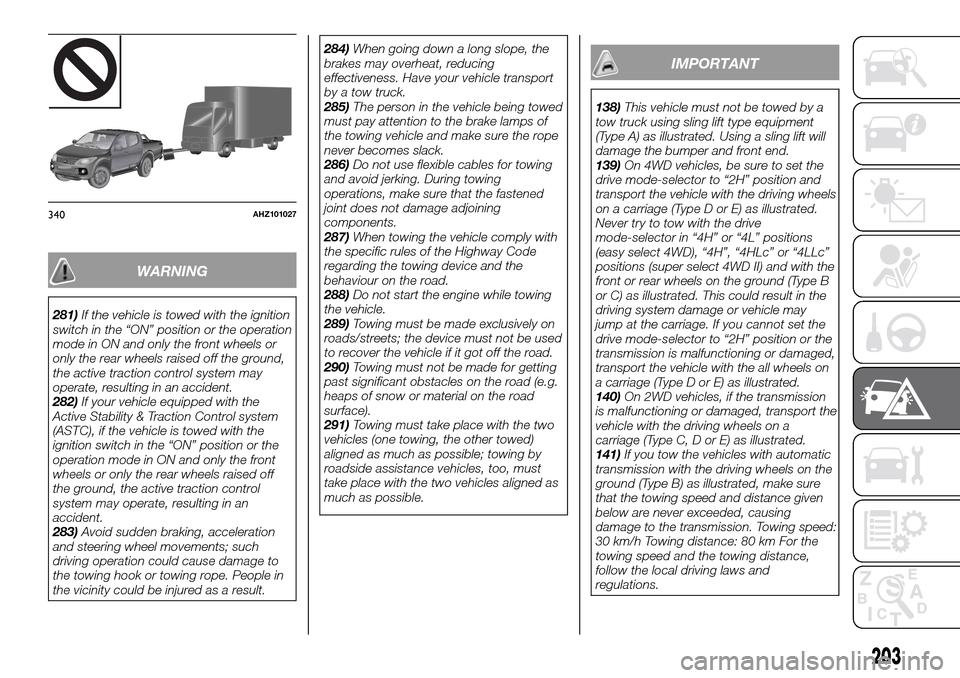
138)This vehicle must not be towed by a
tow truck using sling lift type equipment
(Type A) as illustrated. Using a sling lift will
damage the bumper and front end.
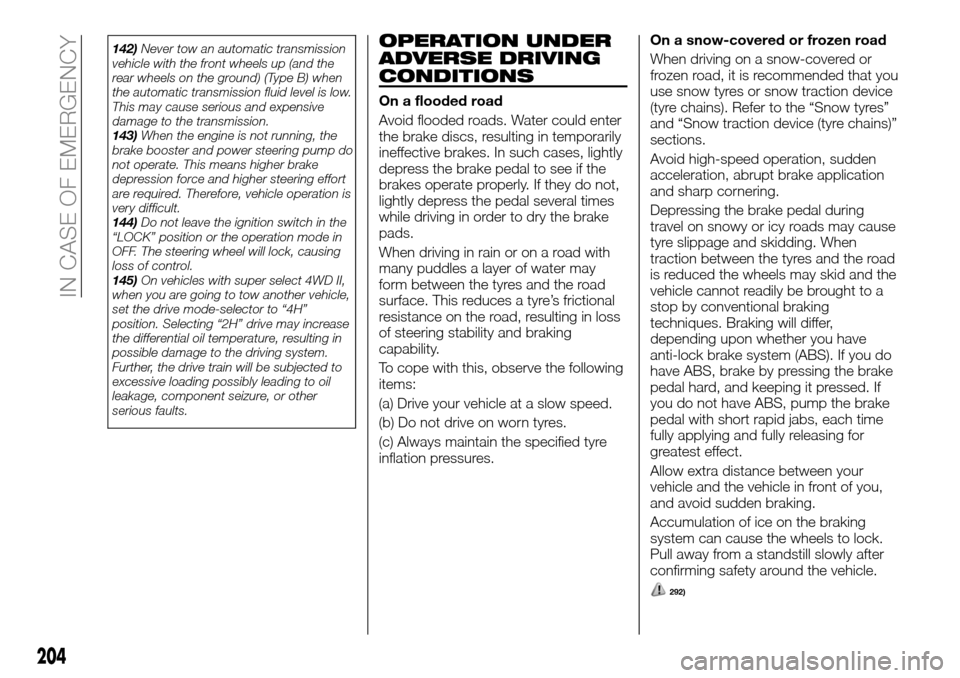
139)On 4WD vehicles, be sure to set the
drive mode-selector to “2H” position and
transport the vehicle with the driving wheels
on a carriage (Type D or E) as illustrated.
Never try to tow with the drive
mode-selector in “4H” or “4L” positions
(easy select 4WD), “4H”, “4HLc” or “4LLc”
positions (super select 4WD II) and with the
front or rear wheels on the ground (Type B
or C) as illustrated. This could result in the
driving system damage or vehicle may
jump at the carriage. If you cannot set the
drive mode-selector to “2H” position or the
transmission is malfunctioning or damaged,
transport the vehicle with the all wheels on
a carriage (Type D or E) as illustrated.
140)On 2WD vehicles, if the transmission
is malfunctioning or damaged, transport the
vehicle with the driving wheels on a
carriage (Type C, D or E) as illustrated.
141)If you tow the vehicles with automatic
transmission with the driving wheels on the
ground (Type B) as illustrated, make sure
that the towing speed and distance given
below are never exceeded, causing
damage to the transmission. Towing speed:
30 km/h Towing distance: 80 km For the
towing speed and the towing distance,
follow the local driving laws and
regulations.
340AHZ101027
203
Page 206 of 312
142)Never tow an automatic transmission
vehicle with the front wheels up (and the
rear wheels on the ground) (Type B) when
the automatic transmission fluid level is low.
This may cause serious and expensive
damage to the transmission.
143)When the engine is not running, the
brake booster and power steering pump do
not operate. This means higher brake
depression force and higher steering effort
are required. Therefore, vehicle operation is
very difficult.
144)Do not leave the ignition switch in the
“LOCK” position or the operation mode in
OFF. The steering wheel will lock, causing
loss of control.
145)On vehicles with super select 4WD II,
when you are going to tow another vehicle,
set the drive mode-selector to “4H”
position. Selecting “2H” drive may increase
the differential oil temperature, resulting in
possible damage to the driving system.
Further, the drive train will be subjected to
excessive loading possibly leading to oil
leakage, component seizure, or other
serious faults.OPERATION UNDER
ADVERSE DRIVING
CONDITIONS
On a flooded road
Avoid flooded roads. Water could enter
the brake discs, resulting in temporarily
ineffective brakes. In such cases, lightly
depress the brake pedal to see if the
brakes operate properly. If they do not,
lightly depress the pedal several times
while driving in order to dry the brake
pads.
When driving in rain or on a road with
many puddles a layer of water may
form between the tyres and the road
surface. This reduces a tyre’s frictional
resistance on the road, resulting in loss
of steering stability and braking
capability.
To cope with this, observe the following
items:
(a) Drive your vehicle at a slow speed.
(b) Do not drive on worn tyres.
(c) Always maintain the specified tyre
inflation pressures.On a snow-covered or frozen road
When driving on a snow-covered or
frozen road, it is recommended that you
use snow tyres or snow traction device
(tyre chains). Refer to the “Snow tyres”
and “Snow traction device (tyre chains)”
sections.
Avoid high-speed operation, sudden
acceleration, abrupt brake application
and sharp cornering.
Depressing the brake pedal during
travel on snowy or icy roads may cause
tyre slippage and skidding. When
traction between the tyres and the road
is reduced the wheels may skid and the
vehicle cannot readily be brought to a
stop by conventional braking
techniques. Braking will differ,
depending upon whether you have
anti-lock brake system (ABS). If you do
have ABS, brake by pressing the brake
pedal hard, and keeping it pressed. If
you do not have ABS, pump the brake
pedal with short rapid jabs, each time
fully applying and fully releasing for
greatest effect.
Allow extra distance between your
vehicle and the vehicle in front of you,
and avoid sudden braking.
Accumulation of ice on the braking
system can cause the wheels to lock.
Pull away from a standstill slowly after
confirming safety around the vehicle.
292)
204
IN CASE OF EMERGENCY
Page 265 of 312
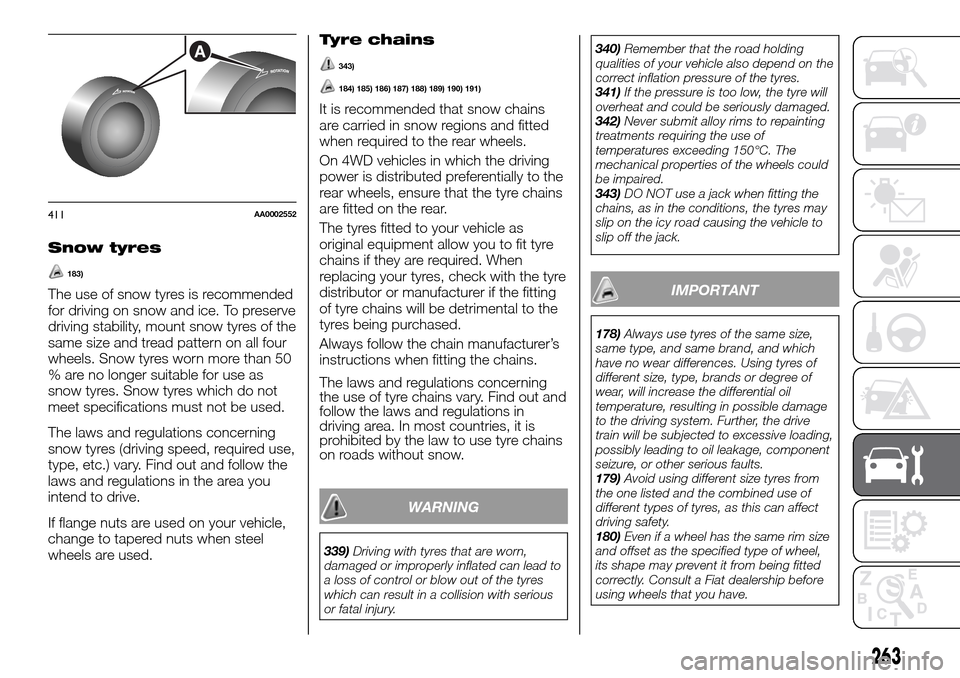
Snow tyres
183)
The use of snow tyres is recommended
for driving on snow and ice. To preserve
driving stability, mount snow tyres of the
same size and tread pattern on all four
wheels. Snow tyres worn more than 50
% are no longer suitable for use as
snow tyres. Snow tyres which do not
meet specifications must not be used.
The laws and regulations concerning
snow tyres (driving speed, required use,
type, etc.) vary. Find out and follow the
laws and regulations in the area you
intend to drive.
If flange nuts are used on your vehicle,
change to tapered nuts when steel
wheels are used.
Tyre chains
343)
184) 185) 186) 187) 188) 189) 190) 191)
It is recommended that snow chains
are carried in snow regions and fitted
when required to the rear wheels.
On 4WD vehicles in which the driving
power is distributed preferentially to the
rear wheels, ensure that the tyre chains
are fitted on the rear.
The tyres fitted to your vehicle as
original equipment allow you to fit tyre
chains if they are required. When
replacing your tyres, check with the tyre
distributor or manufacturer if the fitting
of tyre chains will be detrimental to the
tyres being purchased.
Always follow the chain manufacturer’s
instructions when fitting the chains.
The laws and regulations concerning
the use of tyre chains vary. Find out and
follow the laws and regulations in
driving area. In most countries, it is
prohibited by the law to use tyre chains
on roads without snow.
WARNING
339)Driving with tyres that are worn,
damaged or improperly inflated can lead to
a loss of control or blow out of the tyres
which can result in a collision with serious
or fatal injury.340)Remember that the road holding
qualities of your vehicle also depend on the
correct inflation pressure of the tyres.
341)If the pressure is too low, the tyre will
overheat and could be seriously damaged.
342)Never submit alloy rims to repainting
treatments requiring the use of
temperatures exceeding 150°C. The
mechanical properties of the wheels could
be impaired.
343)DO NOT use a jack when fitting the
chains, as in the conditions, the tyres may
slip on the icy road causing the vehicle to
slip off the jack.
IMPORTANT
178)Always use tyres of the same size,
same type, and same brand, and which
have no wear differences. Using tyres of
different size, type, brands or degree of
wear, will increase the differential oil
temperature, resulting in possible damage
to the driving system. Further, the drive
train will be subjected to excessive loading,
possibly leading to oil leakage, component
seizure, or other serious faults.
179)Avoid using different size tyres from
the one listed and the combined use of
different types of tyres, as this can affect
driving safety.
180)Even if a wheel has the same rim size
and offset as the specified type of wheel,
its shape may prevent it from being fitted
correctly. Consult a Fiat dealership before
using wheels that you have.
A
411AA0002552
263
Page 277 of 312
Item 2WD2WD Hi-Rider
Vehicles without wide
fender2WD Hi-Rider
Vehicles with wide fender
Minimum turning radiusBody 6.1 m 6.3 m
Wheel 5.7 m 5.9 m
Item4WD Hi-Rider
Vehicles without wide fender4WD Hi-Rider
Vehicles with wide fender
1 Front track1,520 mm
2 Overall width 1,785 mm 1,815 mm
3 Front overhang
860 mm, 865 mm
(1)
4 Wheel base 3,000 mm
5 Rear overhang Without rear bumper 1,340 mm
With chrome rear
bumper1,485 mm
With silver rear
bumper1,420 mm
6 Overall length Without rear bumper
5,200 mm, 5,205 mm
(1)
With chrome rear
bumper5,345 mm, 5,350 mm(1)
With silver rear
bumper5,280 mm, 5,285 mm(1)
7Ground clearance
(unladen)200 mm, 220 mm(2)205 mm, 220 mm(2)
8 Overall height (unladen)
1,775 mm, 1,795 mm(2)1,780 mm, 1,795 mm(2)
(1) Vehicles equipped with licence garnish
(2) Vehicles with 265/70 R16 size tyre or 245/75 R16 size tyre
275
Page 278 of 312
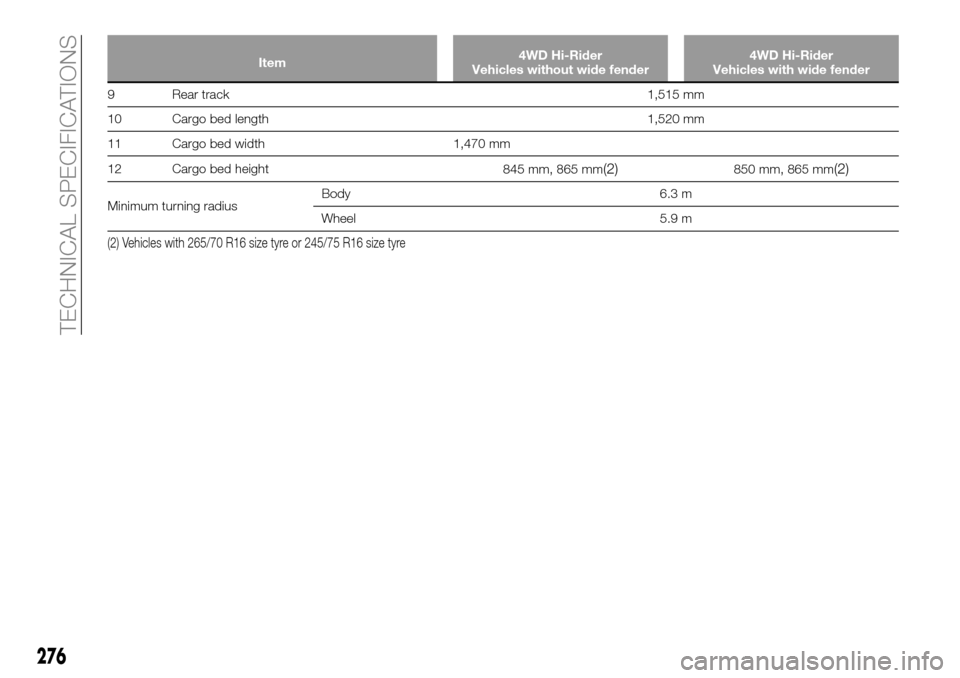
Item4WD Hi-Rider
Vehicles without wide fender4WD Hi-Rider
Vehicles with wide fender
9 Rear track1,515 mm
10 Cargo bed length 1,520 mm
11 Cargo bed width 1,470 mm
12 Cargo bed height
845 mm, 865 mm
(2)850 mm, 865 mm(2)
Minimum turning radiusBody 6.3 m
Wheel 5.9 m
(2) Vehicles with 265/70 R16 size tyre or 245/75 R16 size tyre
276
TECHNICAL SPECIFICATIONS
Page 280 of 312
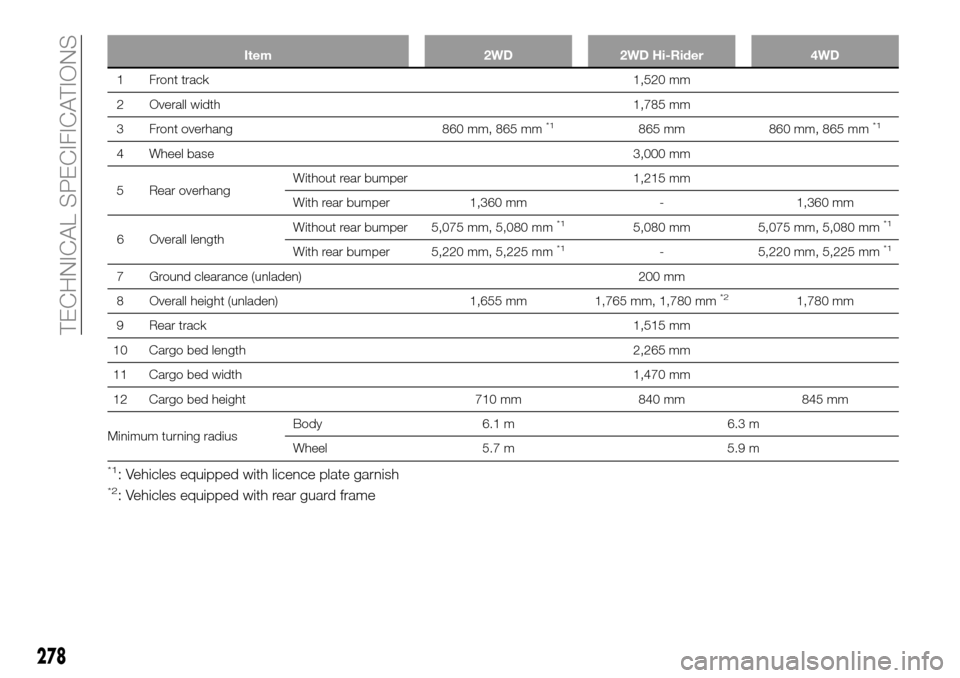
Item 2WD 2WD Hi-Rider 4WD
1 Front track1,520 mm
2 Overall width1,785 mm
3 Front overhang 860 mm, 865 mm
*1865 mm 860 mm, 865 mm*1
4 Wheel base3,000 mm
5 Rear overhangWithout rear bumper 1,215 mm
With rear bumper 1,360 mm - 1,360 mm
6 Overall lengthWithout rear bumper 5,075 mm, 5,080 mm
*15,080 mm 5,075 mm, 5,080 mm*1
With rear bumper 5,220 mm, 5,225 mm*1- 5,220 mm, 5,225 mm*1
7 Ground clearance (unladen) 200 mm
8 Overall height (unladen) 1,655 mm 1,765 mm, 1,780 mm
*21,780 mm
9 Rear track1,515 mm
10 Cargo bed length 2,265 mm
11 Cargo bed width 1,470 mm
12 Cargo bed height 710 mm 840 mm 845 mm
Minimum turning radiusBody 6.1 m 6.3 m
Wheel 5.7 m 5.9 m
*1: Vehicles equipped with licence plate garnish*2: Vehicles equipped with rear guard frame
278
TECHNICAL SPECIFICATIONS
Page 281 of 312
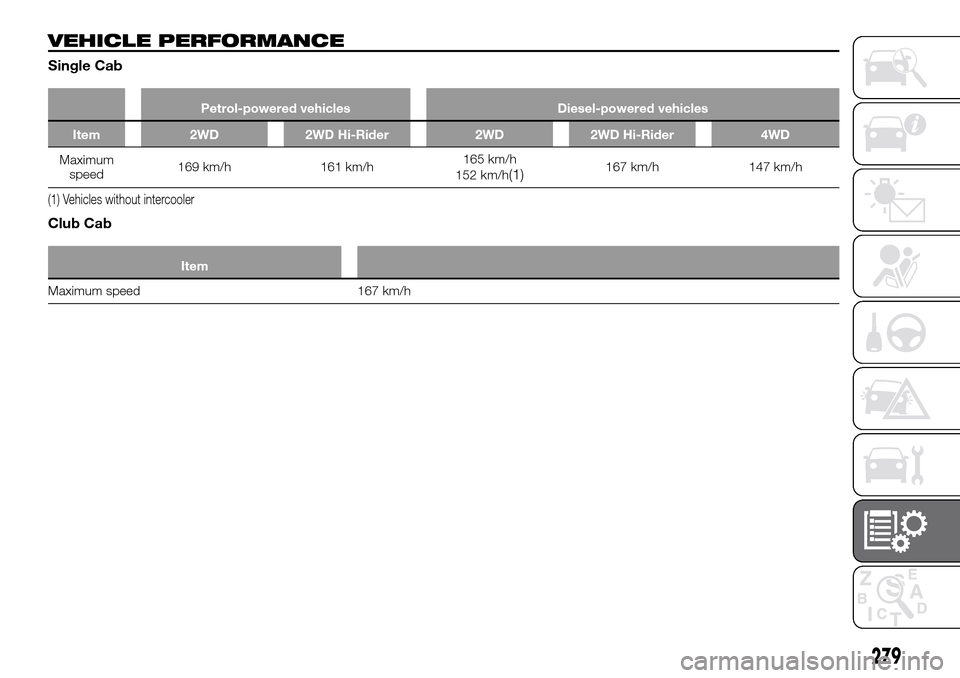
VEHICLE PERFORMANCE
Single Cab
Petrol-powered vehicles Diesel-powered vehicles
Item 2WD 2WD Hi-Rider 2WD 2WD Hi-Rider 4WD
Maximum
speed169 km/h 161 km/h165 km/h
152 km/h(1)167 km/h 147 km/h
(1) Vehicles without intercooler
Club Cab
Item
Maximum speed 167 km/h
279
Page 282 of 312
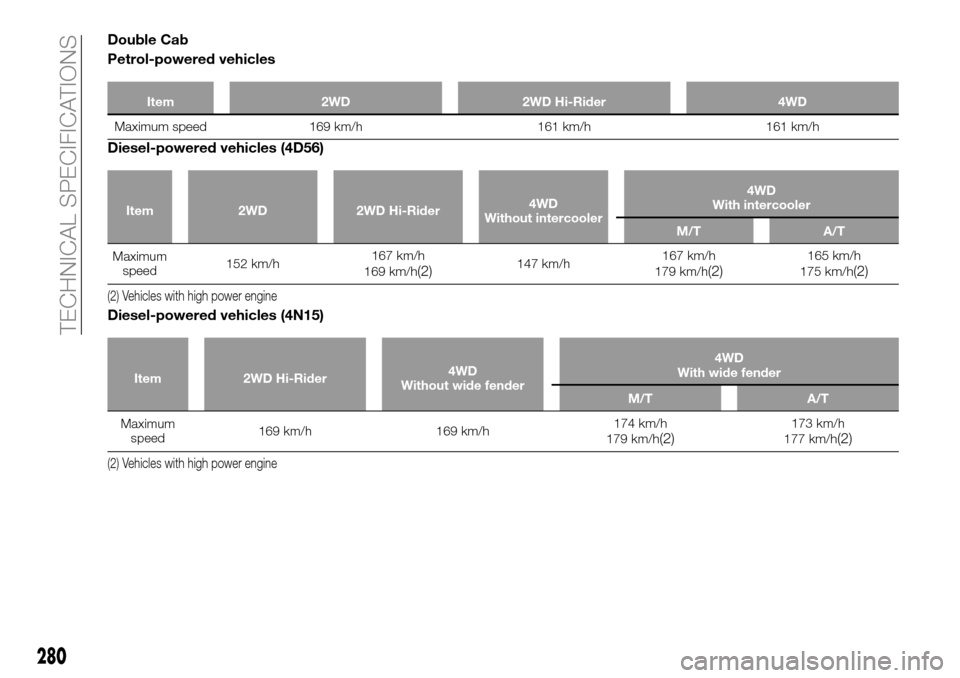
Double Cab
Petrol-powered vehicles
Item 2WD 2WD Hi-Rider 4WD
Maximum speed 169 km/h 161 km/h 161 km/h
Diesel-powered vehicles (4D56)
Item 2WD 2WD Hi-Rider4WD
Without intercooler4WD
With intercooler
M/T A/T
Maximum
speed152 km/h167 km/h
169 km/h(2)147 km/h167 km/h
179 km/h(2)165 km/h
175 km/h(2)
(2) Vehicles with high power engine
Diesel-powered vehicles (4N15)
Item 2WD Hi-Rider4WD
Without wide fender4WD
With wide fender
M/T A/T
Maximum
speed169 km/h 169 km/h174 km/h
179 km/h(2)173 km/h
177 km/h(2)
(2) Vehicles with high power engine
280
TECHNICAL SPECIFICATIONS
Page 284 of 312
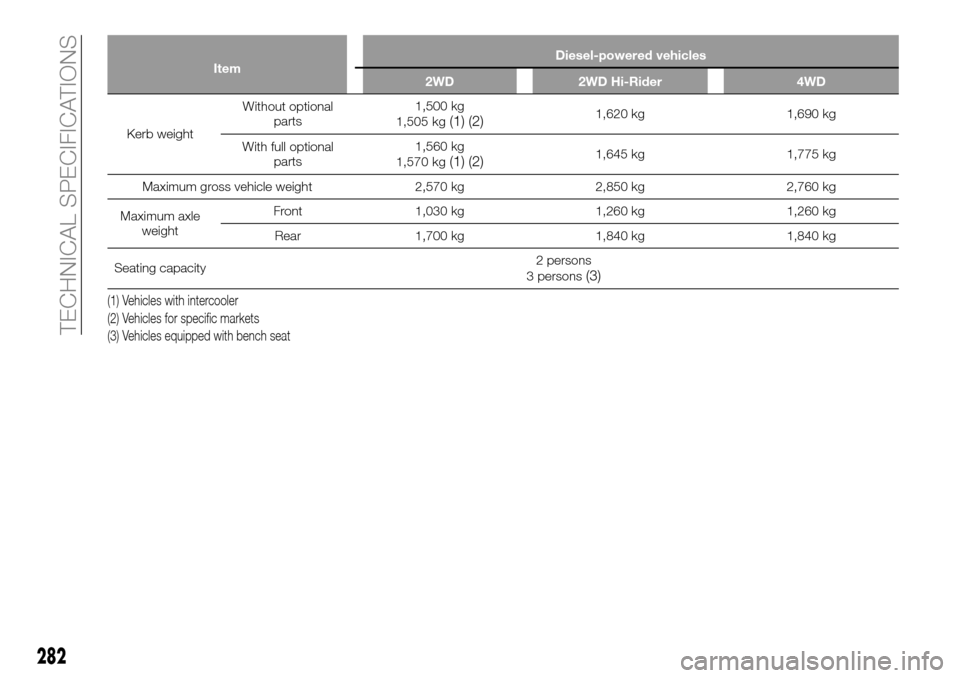
ItemDiesel-powered vehicles
2WD 2WD Hi-Rider 4WD
Kerb weightWithout optional
parts1,500 kg
1,505 kg(1) (2)1,620 kg 1,690 kg
With full optional
parts1,560 kg
1,570 kg
(1) (2)1,645 kg 1,775 kg
Maximum gross vehicle weight 2,570 kg 2,850 kg 2,760 kg
Maximum axle
weightFront 1,030 kg 1,260 kg 1,260 kg
Rear 1,700 kg 1,840 kg 1,840 kg
Seating capacity2 persons
3 persons
(3)
(1) Vehicles with intercooler
(2) Vehicles for specific markets
(3) Vehicles equipped with bench seat
282
TECHNICAL SPECIFICATIONS
Page 286 of 312
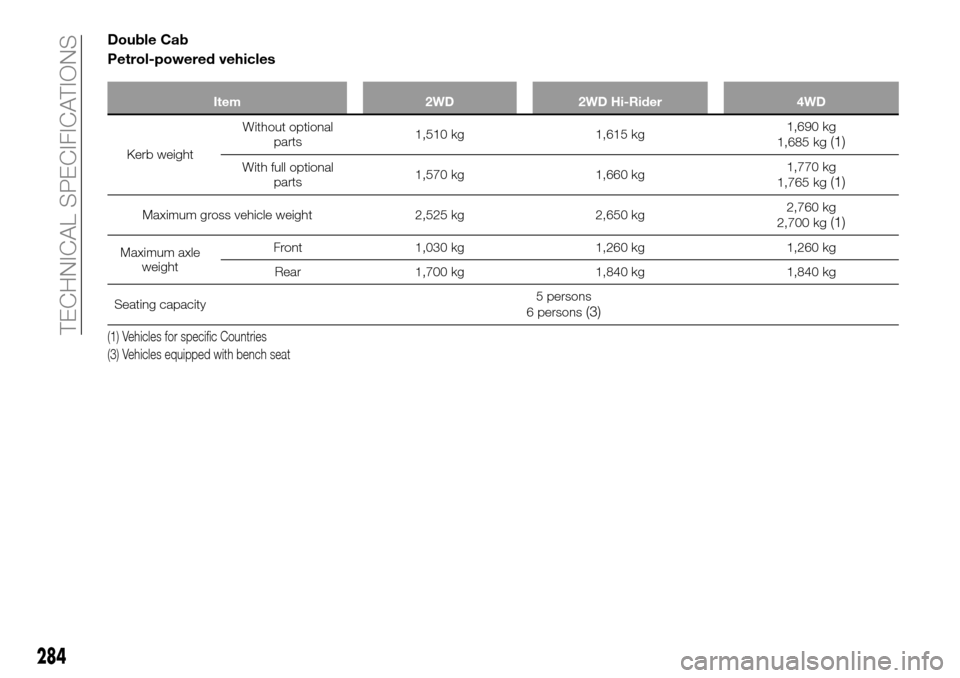
Double Cab
Petrol-powered vehicles
Item 2WD 2WD Hi-Rider 4WD
Kerb weightWithout optional
parts1,510 kg 1,615 kg1,690 kg
1,685 kg(1)
With full optional
parts1,570 kg 1,660 kg1,770 kg
1,765 kg(1)
Maximum gross vehicle weight 2,525 kg 2,650 kg2,760 kg
2,700 kg(1)
Maximum axle
weightFront 1,030 kg 1,260 kg 1,260 kg
Rear 1,700 kg 1,840 kg 1,840 kg
Seating capacity5 persons
6 persons
(3)
(1) Vehicles for specific Countries
(3) Vehicles equipped with bench seat
284
TECHNICAL SPECIFICATIONS