belt FIAT FULLBACK 2017 Owner handbook (in English)
[x] Cancel search | Manufacturer: FIAT, Model Year: 2017, Model line: FULLBACK, Model: FIAT FULLBACK 2017Pages: 312, PDF Size: 12.31 MB
Page 114 of 312
PRETENSIONERS
AND FORCE LIMITER
SYSTEM
(where provided)
132) 133) 134) 135) 136)
69) 70) 71) 72)
The front seat belts each have a
pre-tensioner system and force limiter
system (Single cab and Club cab).
The front seat belts and the rear outer
seat belts each have a pre-tensioner
system and force limiter system (Double
cab).
Pretensioner system
When the ignition switch or the
operation mode is under the following
conditions, if there is a frontal impact or
a side impact (vehicles equipped with
SRS side airbags and SRS curtain
airbags) severe enough to injure the
driver and/or front passenger, or when
a rollover or overturning of the vehicle is
detected (if so equipped), the
pretensioner system will retract their
respective seat belts instantaneously,
thus maximizing the seat belt’s
effectiveness.
Except for vehicles equipped with the
keyless operation system: the ignition
switch is in the “ON” or “START”
position.
Vehicles equipped with the keyless
operation system: the operation mode
is in ON.NOTE The pretensioner seat belts will
be activated if the vehicle suffers a
severe impact, even if the seat belts are
not worn.
NOTE The pretensioner seat belts are
designed to work only once. After the
pretensioner seat belts have been
activated, we recommend you to have
them replaced by a Fiat Dealership.
SRS warning lamp (where provided)
This warning lamp is shared by the SRS
airbags and the pre-tensioner seat
belts. Refer to “SRS warning lamp”.
Force limiter system
In the event of a collision, each force
limiter system will effectively absorb the
load applied to the seat belt so as to
minimize the impact to the passenger.
WARNING
132)Each seat belt must be used by only
one person. Never travel with a child sitting
on the passenger's lap and a single belt to
protect them both fig. 158. In general, do
not place any objects between the person
and the belt.
133)The pretensioner may be used only
once. After it is triggered, have it replaced
at a Fiat Dealership.
134)Removing or otherwise tampering
with pretensioner and seat belt
components is strictly prohibited. Any
intervention on these components must be
performed by qualified and authorised
technicians. Always go to a Fiat Dealership.135)For maximum safety, keep the
backrest upright, lean back into it and
make sure the seat belt fits closely across
your chest and pelvis. Always fasten the
seat belts for both the front and rear seats!
Travelling without wearing seat belts will
increase the risk of serious injury and even
death in the event of an accident.
136)If the belt has been subjected to high
levels of stress, for example after an
accident, it should be changed completely
together with the attachments, attachment
fixing screws and the pretensioner. In fact,
even if the belt has no visible defects, it
may have lost its resilience.
IMPORTANT
69)To obtain the best results from your
pretensioner seat belt, make sure you have
adjusted your seat correctly and wear your
seat belt properly.
70)Installation of audio equipment or
repairs in the vicinity of the pretensioner
seat belts or floor console must be
performed in line with FCA Italy S.p.A.
guidelines. It is important to do so because
the work could affect the pretensioner
systems.
71)If you need to scrap the vehicle, please
consult a Fiat Dealership. It is important to
do so because unexpected activation of
the pretensioner seat belts could cause
injuries.
112
SAFETY
Page 116 of 312
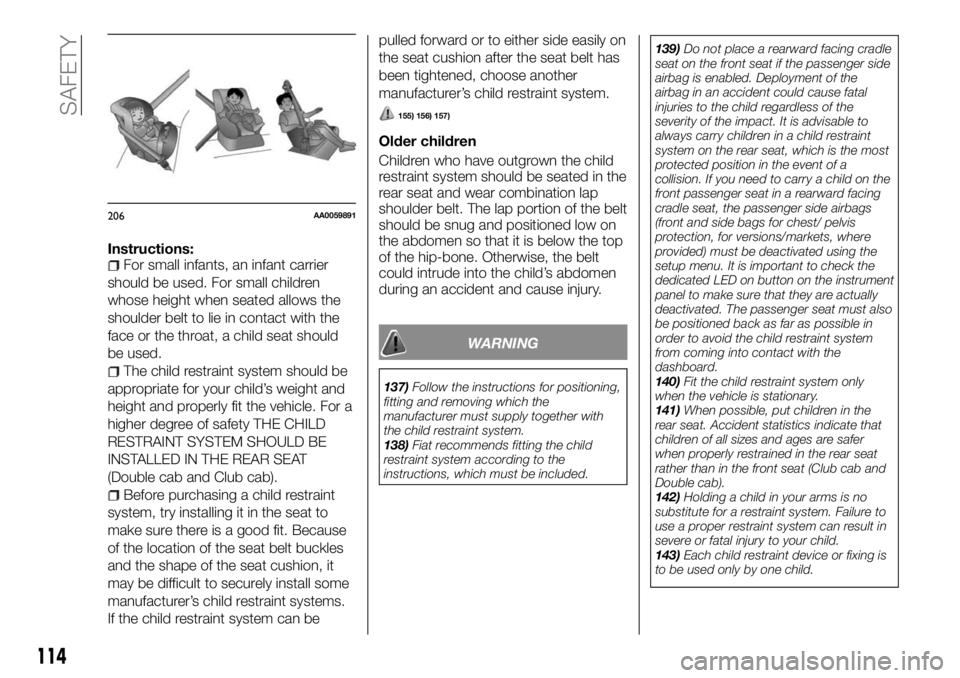
Instructions:For small infants, an infant carrier
should be used. For small children
whose height when seated allows the
shoulder belt to lie in contact with the
face or the throat, a child seat should
be used.
The child restraint system should be
appropriate for your child’s weight and
height and properly fit the vehicle. For a
higher degree of safety THE CHILD
RESTRAINT SYSTEM SHOULD BE
INSTALLED IN THE REAR SEAT
(Double cab and Club cab).
Before purchasing a child restraint
system, try installing it in the seat to
make sure there is a good fit. Because
of the location of the seat belt buckles
and the shape of the seat cushion, it
may be difficult to securely install some
manufacturer’s child restraint systems.
If the child restraint system can bepulled forward or to either side easily on
the seat cushion after the seat belt has
been tightened, choose another
manufacturer’s child restraint system.
155) 156) 157)
Older children
Children who have outgrown the child
restraint system should be seated in the
rear seat and wear combination lap
shoulder belt. The lap portion of the belt
should be snug and positioned low on
the abdomen so that it is below the top
of the hip-bone. Otherwise, the belt
could intrude into the child’s abdomen
during an accident and cause injury.
WARNING
137)Follow the instructions for positioning,
fitting and removing which the
manufacturer must supply together with
the child restraint system.
138)Fiat recommends fitting the child
restraint system according to the
instructions, which must be included.139)Do not place a rearward facing cradle
seat on the front seat if the passenger side
airbag is enabled. Deployment of the
airbag in an accident could cause fatal
injuries to the child regardless of the
severity of the impact. It is advisable to
always carry children in a child restraint
system on the rear seat, which is the most
protected position in the event of a
collision. If you need to carry a child on the
front passenger seat in a rearward facing
cradle seat, the passenger side airbags
(front and side bags for chest/ pelvis
protection, for versions/markets, where
provided) must be deactivated using the
setup menu. It is important to check the
dedicated LED on button on the instrument
panel to make sure that they are actually
deactivated. The passenger seat must also
be positioned back as far as possible in
order to avoid the child restraint system
from coming into contact with the
dashboard.
140)Fit the child restraint system only
when the vehicle is stationary.
141)When possible, put children in the
rear seat. Accident statistics indicate that
children of all sizes and ages are safer
when properly restrained in the rear seat
rather than in the front seat (Club cab and
Double cab).
142)Holding a child in your arms is no
substitute for a restraint system. Failure to
use a proper restraint system can result in
severe or fatal injury to your child.
143)Each child restraint device or fixing is
to be used only by one child.
206AA0059891
114
SAFETY
Page 117 of 312
144)Incorrect fitting of the child restraint
system may result in an inefficient
protection system. In the event of an
accident the child restraint system may
become loose and the child may be
injured, even fatally. When fitting a restraint
system for newborns or children, strictly
comply with the instructions provided by
the Manufacturer.
145)On the sun visor there is a label with
suitable symbols reminding the user that it
is compulsory to deactivate the airbag if a
rearward facing child restraint system is
fitted. Always comply with the instructions
on the passenger side sun visor (see the
"Supplementary Restraint System (SRS) -
Airbag" paragraph).
146)Extreme Hazard! NEVER use a
rearward facing child restraint on a seat
protected by an ACTIVE AIRBAG in front of
it, DEATH or SERIOUS INJURY to the
CHILD can occur.
147)When attaching a child restraint
system to the rear seat, prevent the front
seat from touching the child restraint
system. Otherwise, the child could be
seriously injured in the event of hard
braking or a collision (Club cab and Double
cab).
148)On vehicles with an airbag for the
front passenger, a REARWARD FACING
CHILD RESTRAINT must NOT be used in
the front passenger seat as it places an
infant too close to the passenger airbag.
The force of an inflating airbag could kill or
cause serious injuries to the child. A
rearward facing child restraint must only be
used in the rear seat. (Club cab and
Double cab).149)Do not move the front or rear seat if a
child is seated on it or on the dedicated
child restraint system.
150)A FORWARD FACING CHILD
RESTRAINT should be used in the rear
seat whenever possible; if it must be used
in the front passenger seat, adjust the seat
to the most rearward position. Failure to do
so could kill or cause serious injuries to the
child.
151)Always make sure that the diagonal
section of the seat belt does not pass
under the arms or behind the back of the
child. In the event of an accident the seat
belt will not be able to secure the child,
with the risk of injury, including fatal injury.
Therefore the child must always wear the
seat belt correctly.
152)Do not use the same lower
anchorage to install more than one child
restraint system.
153)If a Universal ISOFIX child seat system
is not fixed to all three anchorages, it will
not be able to protect the child correctly. In
a crash, the child could be seriously or
fatally injured. 86)
154)Fit the child restraint system when the
car is stationary. The child restraint system
is correctly fixed to the brackets when you
hear the click. Follow the instructions for
assembly, disassembly and positioning that
the Manufacturer must supply with the
child restraint system.
155)After installation, push and pull the
child restraint system back and forth, and
side to side, to see that it is positively
secured. If the child restraint system is not
installed securely, it may cause injury to the
child or other occupants in the case of
accident or sudden stops.156)When the child restraint system is not
in use, keep your child restraint system
secured with the seat belt or remove it
from the vehicle in order to prevent it from
being thrown around inside the vehicle
during an accident.
157)After installing a child restraint system,
do not move the seat: always remove the
child restraint system before making any
adjustment.
115
Page 126 of 312
Installing a child
restraint system to the
lower anchorage
(ISOFIX child restraint
mountings) and tether
anchorage (Double cab)
Lower anchorage location
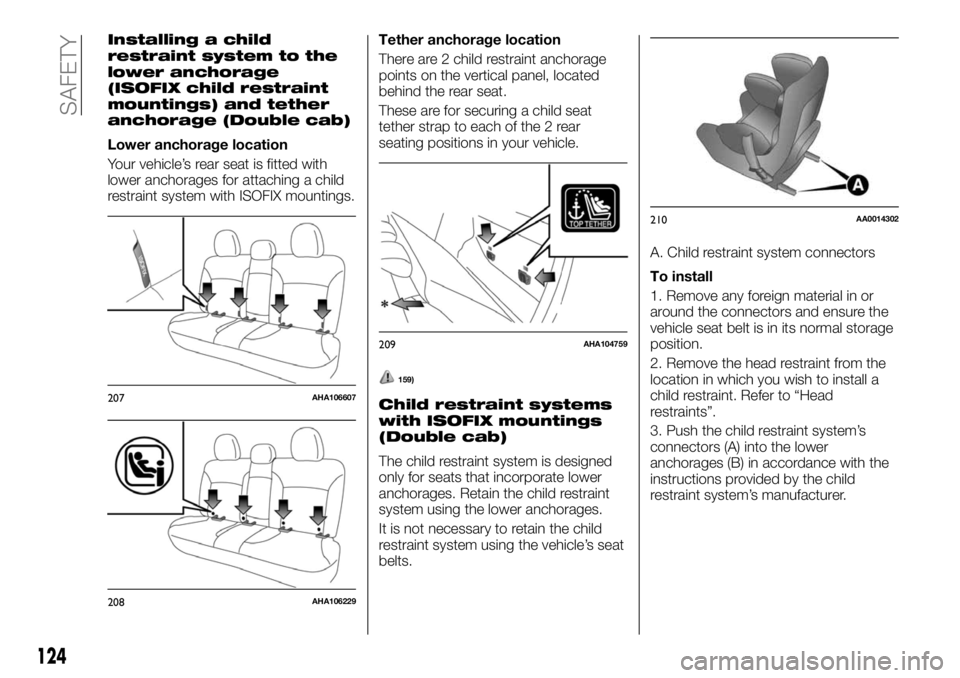
Your vehicle’s rear seat is fitted with
lower anchorages for attaching a child
restraint system with ISOFIX mountings.Tether anchorage location
There are 2 child restraint anchorage
points on the vertical panel, located
behind the rear seat.
These are for securing a child seat
tether strap to each of the 2 rear
seating positions in your vehicle.
159)
Child restraint systems
with ISOFIX mountings
(Double cab)
The child restraint system is designed
only for seats that incorporate lower
anchorages. Retain the child restraint
system using the lower anchorages.
It is not necessary to retain the child
restraint system using the vehicle’s seat
belts.A. Child restraint system connectors
To install
1. Remove any foreign material in or
around the connectors and ensure the
vehicle seat belt is in its normal storage
position.
2. Remove the head restraint from the
location in which you wish to install a
child restraint. Refer to “Head
restraints”.
3. Push the child restraint system’s
connectors (A) into the lower
anchorages (B) in accordance with the
instructions provided by the child
restraint system’s manufacturer.
207AHA106607
208AHA106229
209AHA104759
210AA0014302
124
SAFETY
Page 128 of 312
To remove
Remove the child restraint system in
accordance with the instructions
provided by the child restraint system’s
manufacturer.
Installing a child restraint system to
a 3-point type seat belt (with
emergency locking mechanism)
Installation
1. Put a child restraint system on the
seat in which you wish to install it and
remove the head restraint from the seat.
Refer to “Head restraints”.
2. When installing a child restraint
system in the front passenger seat,
adjust seat slide to its most rearward
position.
3. Route the belt through the child
restraint according to the child restraint
system manufacturer’s instructions,
then insert the latch plate into the
buckle.
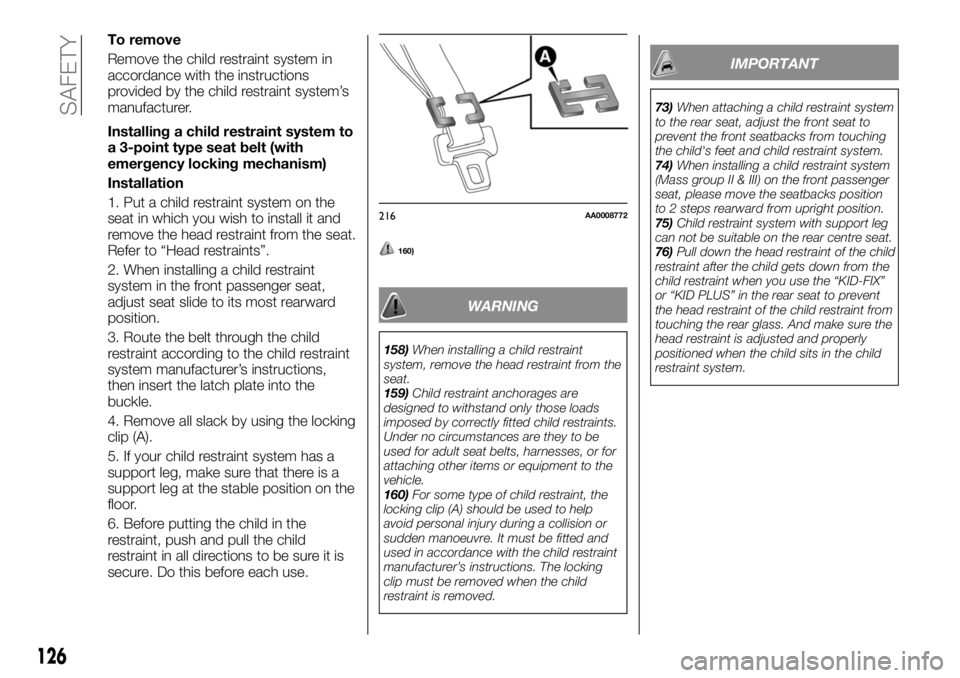
4. Remove all slack by using the locking
clip (A).
5. If your child restraint system has a
support leg, make sure that there is a
support leg at the stable position on the
floor.
6. Before putting the child in the
restraint, push and pull the child
restraint in all directions to be sure it is
secure. Do this before each use.
160)
WARNING
158)When installing a child restraint
system, remove the head restraint from the
seat.
159)Child restraint anchorages are
designed to withstand only those loads
imposed by correctly fitted child restraints.
Under no circumstances are they to be
used for adult seat belts, harnesses, or for
attaching other items or equipment to the
vehicle.
160)For some type of child restraint, the
locking clip (A) should be used to help
avoid personal injury during a collision or
sudden manoeuvre. It must be fitted and
used in accordance with the child restraint
manufacturer’s instructions. The locking
clip must be removed when the child
restraint is removed.
IMPORTANT
73)When attaching a child restraint system
to the rear seat, adjust the front seat to
prevent the front seatbacks from touching
the child's feet and child restraint system.
74)When installing a child restraint system
(Mass group II & III) on the front passenger
seat, please move the seatbacks position
to 2 steps rearward from upright position.
75)Child restraint system with support leg
can not be suitable on the rear centre seat.
76)Pull down the head restraint of the child
restraint after the child gets down from the
child restraint when you use the “KID-FIX”
or “KID PLUS” in the rear seat to prevent
the head restraint of the child restraint from
touching the rear glass. And make sure the
head restraint is adjusted and properly
positioned when the child sits in the child
restraint system.
216AA0008772
126
SAFETY
Page 129 of 312
SUPPLEMENTAL
RESTRAINT SYSTEM
AIRBAG
The information for SRS airbags
includes important information
concerning the driver’s and front
passenger’s airbags, the driver’s knee
airbag, the side airbags and the curtain
airbags.
The SRS driver’s and front passenger’s
airbags are designed to supplement the
primary protection of the driver and
front passenger side seat belt systems
by providing those occupants with
protection against head and chest
injuries in certain moderate-to-severe
frontal collisions.
The SRS driver airbag employ a dual
stage airbag system (if so equipped).
The SRS driver and front passenger
airbag is controlled by the impact
sensors (at the front of the vehicle) and
the control unit (near the centre of the
vehicle at floor level).
The SRS driver’s knee airbag (if so
equipped) is designed to supplement
the primary protection of the driver’s
seat belt system. It can reduce the
forward movement of the driver’s lower
legs and provide increased overall body
protection in certain moderate-to-
severe frontal collisions.The SRS side airbags (if so equipped)
are designed to supplement properly
worn seat belts and provide the driver
and front passenger with protection
against chest injuries in certain
moderate-to-severe side impact
collisions.
The SRS curtain airbags (if so
equipped) are designed to supplement
properly worn seat belts and provide
the driver and passenger on the front
seat and rear outboard seat with
protection against head injuries by
deploying the curtain airbag on the side
impacted in certain moderate-to-severe
side impact collisions.
The SRS is NOT a substitute for the
seat belts. To ensure the maximum
protection during all types of collisions
and accidents, all occupants, including
the passengers as well as the driver,
must wear their seat belts.
NOTE The ERA-GLONASS (if so
equipped) is designed to operate when
any of airbags deploy. Refer to
“ERA-GLONASS”.
How the supplemental restraint
system works
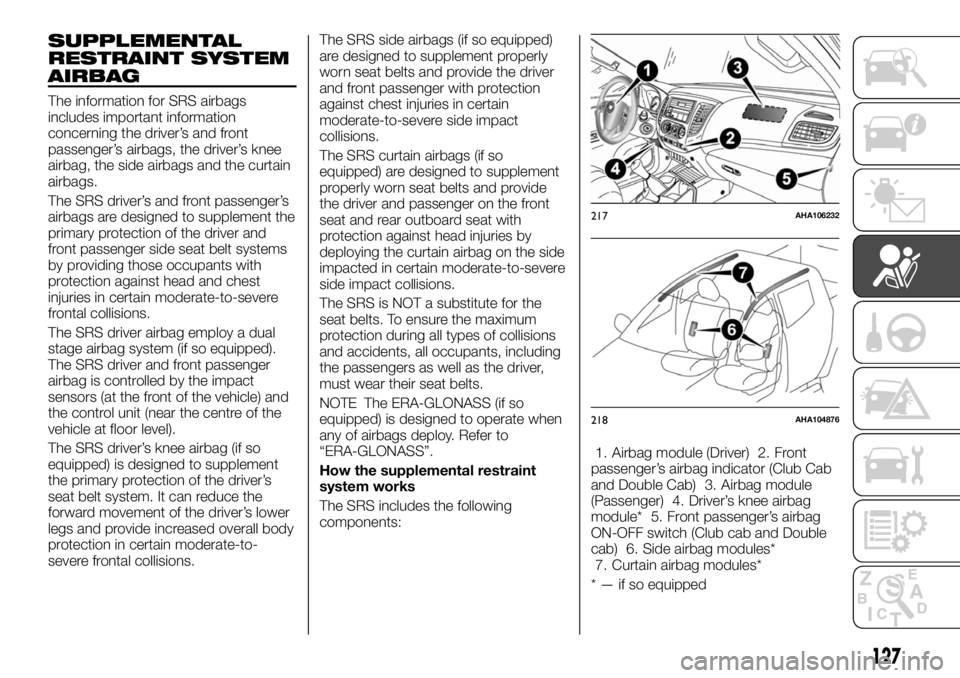
The SRS includes the following
components:1. Airbag module (Driver) 2. Front
passenger’s airbag indicator (Club Cab
and Double Cab) 3. Airbag module
(Passenger) 4. Driver’s knee airbag
module* 5. Front passenger’s airbag
ON-OFF switch (Club cab and Double
cab) 6. Side airbag modules*
7. Curtain airbag modules*
* — if so equipped
217AHA106232
218AHA104876
127
Page 132 of 312
Driver’s knee airbag system (where
provided)
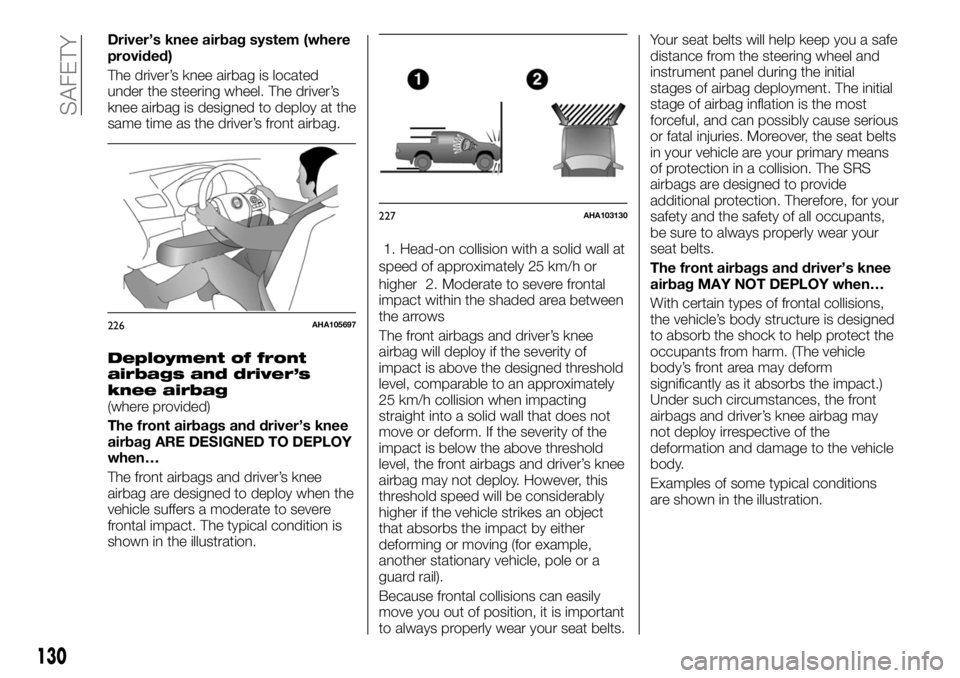
The driver’s knee airbag is located
under the steering wheel. The driver’s
knee airbag is designed to deploy at the
same time as the driver’s front airbag.
Deployment of front
airbags and driver’s
knee airbag
(where provided)
The front airbags and driver’s knee
airbag ARE DESIGNED TO DEPLOY
when…
The front airbags and driver’s knee
airbag are designed to deploy when the
vehicle suffers a moderate to severe
frontal impact. The typical condition is
shown in the illustration.1. Head-on collision with a solid wall at
speed of approximately 25 km/h or
higher 2. Moderate to severe frontal
impact within the shaded area between
the arrows
The front airbags and driver’s knee
airbag will deploy if the severity of
impact is above the designed threshold
level, comparable to an approximately
25 km/h collision when impacting
straight into a solid wall that does not
move or deform. If the severity of the
impact is below the above threshold
level, the front airbags and driver’s knee
airbag may not deploy. However, this
threshold speed will be considerably
higher if the vehicle strikes an object
that absorbs the impact by either
deforming or moving (for example,
another stationary vehicle, pole or a
guard rail).
Because frontal collisions can easily
move you out of position, it is important
to always properly wear your seat belts.Your seat belts will help keep you a safe
distance from the steering wheel and
instrument panel during the initial
stages of airbag deployment. The initial
stage of airbag inflation is the most
forceful, and can possibly cause serious
or fatal injuries. Moreover, the seat belts
in your vehicle are your primary means
of protection in a collision. The SRS
airbags are designed to provide
additional protection. Therefore, for your
safety and the safety of all occupants,
be sure to always properly wear your
seat belts.
The front airbags and driver’s knee
airbag MAY NOT DEPLOY when…
With certain types of frontal collisions,
the vehicle’s body structure is designed
to absorb the shock to help protect the
occupants from harm. (The vehicle
body’s front area may deform
significantly as it absorbs the impact.)
Under such circumstances, the front
airbags and driver’s knee airbag may
not deploy irrespective of the
deformation and damage to the vehicle
body.
Examples of some typical conditions
are shown in the illustration.
226AHA105697
227AHA103130
130
SAFETY
Page 133 of 312
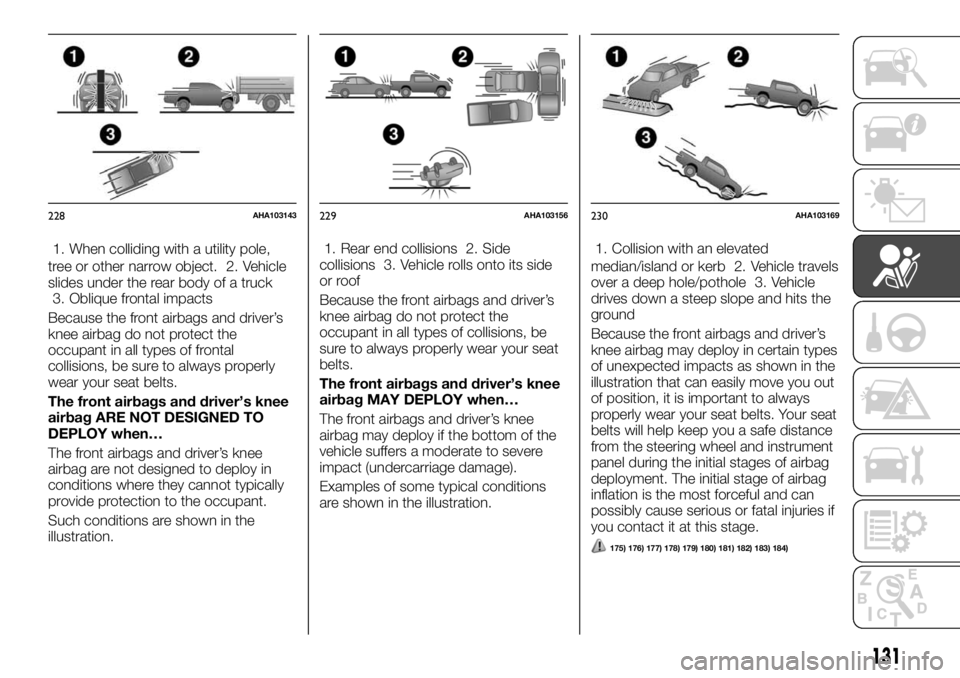
1. When colliding with a utility pole,
tree or other narrow object. 2. Vehicle
slides under the rear body of a truck
3. Oblique frontal impacts
Because the front airbags and driver’s
knee airbag do not protect the
occupant in all types of frontal
collisions, be sure to always properly
wear your seat belts.
The front airbags and driver’s knee
airbag ARE NOT DESIGNED TO
DEPLOY when…
The front airbags and driver’s knee
airbag are not designed to deploy in
conditions where they cannot typically
provide protection to the occupant.
Such conditions are shown in the
illustration.1. Rear end collisions 2. Side
collisions 3. Vehicle rolls onto its side
or roof
Because the front airbags and driver’s
knee airbag do not protect the
occupant in all types of collisions, be
sure to always properly wear your seat
belts.
The front airbags and driver’s knee
airbag MAY DEPLOY when…
The front airbags and driver’s knee
airbag may deploy if the bottom of the
vehicle suffers a moderate to severe
impact (undercarriage damage).
Examples of some typical conditions
are shown in the illustration.1. Collision with an elevated
median/island or kerb 2. Vehicle travels
over a deep hole/pothole 3. Vehicle
drives down a steep slope and hits the
ground
Because the front airbags and driver’s
knee airbag may deploy in certain types
of unexpected impacts as shown in the
illustration that can easily move you out
of position, it is important to always
properly wear your seat belts. Your seat
belts will help keep you a safe distance
from the steering wheel and instrument
panel during the initial stages of airbag
deployment. The initial stage of airbag
inflation is the most forceful and can
possibly cause serious or fatal injuries if
you contact it at this stage.
175) 176) 177) 178) 179) 180) 181) 182) 183) 184)
228AHA103143229AHA103156230AHA103169
131
Page 135 of 312
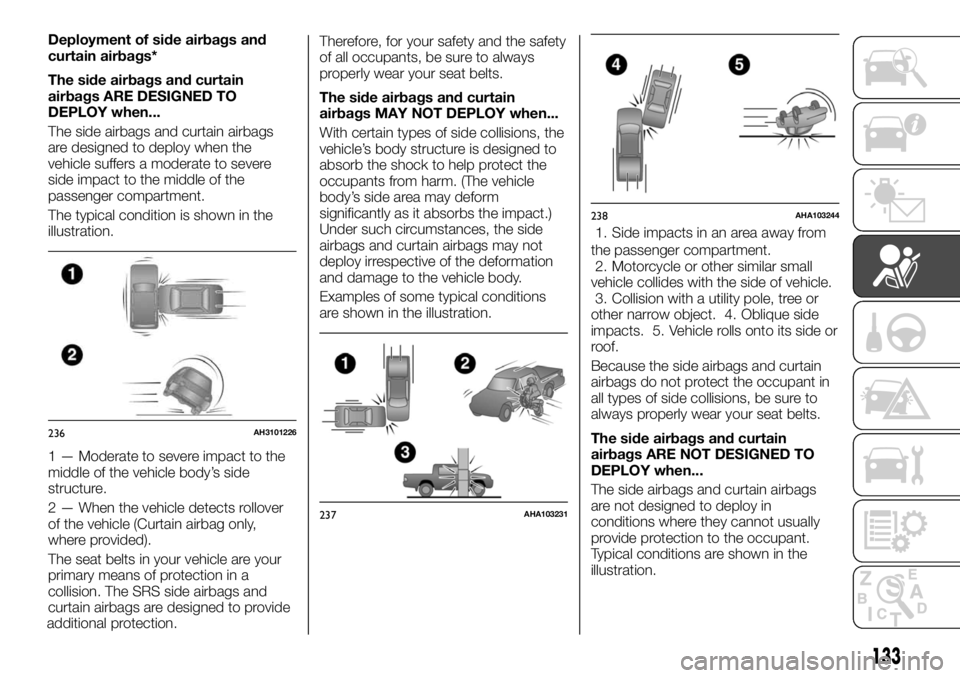
Deployment of side airbags and
curtain airbags*
The side airbags and curtain
airbags ARE DESIGNED TO
DEPLOY when...
The side airbags and curtain airbags
are designed to deploy when the
vehicle suffers a moderate to severe
side impact to the middle of the
passenger compartment.
The typical condition is shown in the
illustration.
1 — Moderate to severe impact to the
middle of the vehicle body’s side
structure.
2 — When the vehicle detects rollover
of the vehicle (Curtain airbag only,
where provided).
The seat belts in your vehicle are your
primary means of protection in a
collision. The SRS side airbags and
curtain airbags are designed to provide
additional protection.Therefore, for your safety and the safety
of all occupants, be sure to always
properly wear your seat belts.
The side airbags and curtain
airbags MAY NOT DEPLOY when...
With certain types of side collisions, the
vehicle’s body structure is designed to
absorb the shock to help protect the
occupants from harm. (The vehicle
body’s side area may deform
significantly as it absorbs the impact.)
Under such circumstances, the side
airbags and curtain airbags may not
deploy irrespective of the deformation
and damage to the vehicle body.
Examples of some typical conditions
are shown in the illustration.1. Side impacts in an area away from
the passenger compartment.
2. Motorcycle or other similar small
vehicle collides with the side of vehicle.
3. Collision with a utility pole, tree or
other narrow object. 4. Oblique side
impacts. 5. Vehicle rolls onto its side or
roof.
Because the side airbags and curtain
airbags do not protect the occupant in
all types of side collisions, be sure to
always properly wear your seat belts.
The side airbags and curtain
airbags ARE NOT DESIGNED TO
DEPLOY when...
The side airbags and curtain airbags
are not designed to deploy in
conditions where they cannot usually
provide protection to the occupant.
Typical conditions are shown in the
illustration.
236AH3101226
237AHA103231
238AHA103244
133
Page 136 of 312
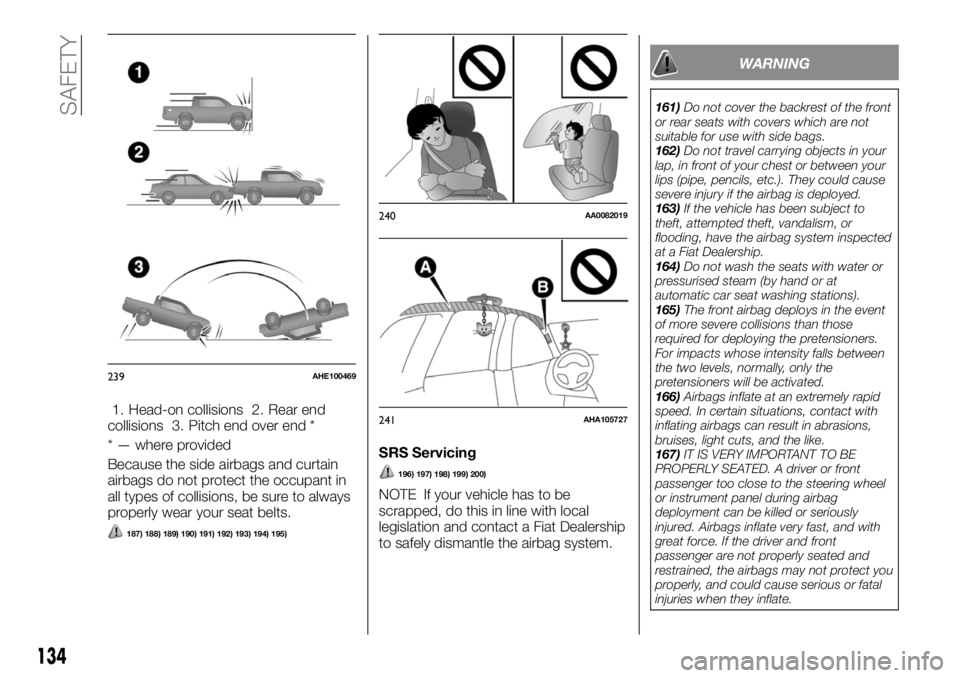
1. Head-on collisions 2. Rear end
collisions 3. Pitch end over end *
* — where provided
Because the side airbags and curtain
airbags do not protect the occupant in
all types of collisions, be sure to always
properly wear your seat belts.
187) 188) 189) 190) 191) 192) 193) 194) 195)
SRS Servicing
196) 197) 198) 199) 200)
NOTE If your vehicle has to be
scrapped, do this in line with local
legislation and contact a Fiat Dealership
to safely dismantle the airbag system.
WARNING
161)Do not cover the backrest of the front
or rear seats with covers which are not
suitable for use with side bags.
162)Do not travel carrying objects in your
lap, in front of your chest or between your
lips (pipe, pencils, etc.). They could cause
severe injury if the airbag is deployed.
163)If the vehicle has been subject to
theft, attempted theft, vandalism, or
flooding, have the airbag system inspected
at a Fiat Dealership.
164)Do not wash the seats with water or
pressurised steam (by hand or at
automatic car seat washing stations).
165)The front airbag deploys in the event
of more severe collisions than those
required for deploying the pretensioners.
For impacts whose intensity falls between
the two levels, normally, only the
pretensioners will be activated.
166)Airbags inflate at an extremely rapid
speed. In certain situations, contact with
inflating airbags can result in abrasions,
bruises, light cuts, and the like.
167)IT IS VERY IMPORTANT TO BE
PROPERLY SEATED. A driver or front
passenger too close to the steering wheel
or instrument panel during airbag
deployment can be killed or seriously
injured. Airbags inflate very fast, and with
great force. If the driver and front
passenger are not properly seated and
restrained, the airbags may not protect you
properly, and could cause serious or fatal
injuries when they inflate.
239AHE100469
240AA0082019
241AHA105727
134
SAFETY