engine oil FIAT FULLBACK 2017 Owner handbook (in English)
[x] Cancel search | Manufacturer: FIAT, Model Year: 2017, Model line: FULLBACK, Model: FIAT FULLBACK 2017Pages: 312, PDF Size: 12.31 MB
Page 252 of 312
PERIODIC CHECKS
Before long journeys, check and, if
necessary, restore:
engine coolant level;
brake fluid level;
windscreen washer fluid level;
operation of lighting system
(headlamps, direction indicators, hazard
warning lights, etc.);
tyre inflation pressure and condition;
tyre alignment;
operation of screen washer/wiper
system and positioning/wear of
windscreen/rear window wiper blades.
To ensure that the vehicle is always
efficient and well maintained, it is
advisable to make sure that you carry
out the above operations regularly
(approximately every 1000 km and
every 3000 km for checking and
topping up engine oil is advisable).
DEMANDING
VEHICLE USE
If the vehicle is mostly used in one of
the following conditions:
towing a trailer or caravan;
dusty roads;
short, repeated journeys (less than
7-8 km) at sub-zero outside
temperatures;
engine often idling or driving long
distances at low speeds or long periods
of inactivity;
the following checks must be carried
out more often than indicated in the
Scheduled Servicing Plan:
check front disc brake pad
conditions and wear;
check cleanliness of bonnet and
boot locks, cleanliness and lubrication
of linkage;
visually inspect conditions of: engine,
gearbox, transmission, pipes and hoses
(exhaust - fuel system - brakes) and
rubber elements (boots - sleeves -
bushes - etc.);
check battery charge and battery
fluid level (electrolyte);
visually inspect condition of the
accessory drive belts;
check and, if necessary, change
engine oil and replace oil filter;
check and, if necessary, replace
pollen filter.
250
SERVICING AND MAINTENANCE
Page 253 of 312
CHECKING LEVELS
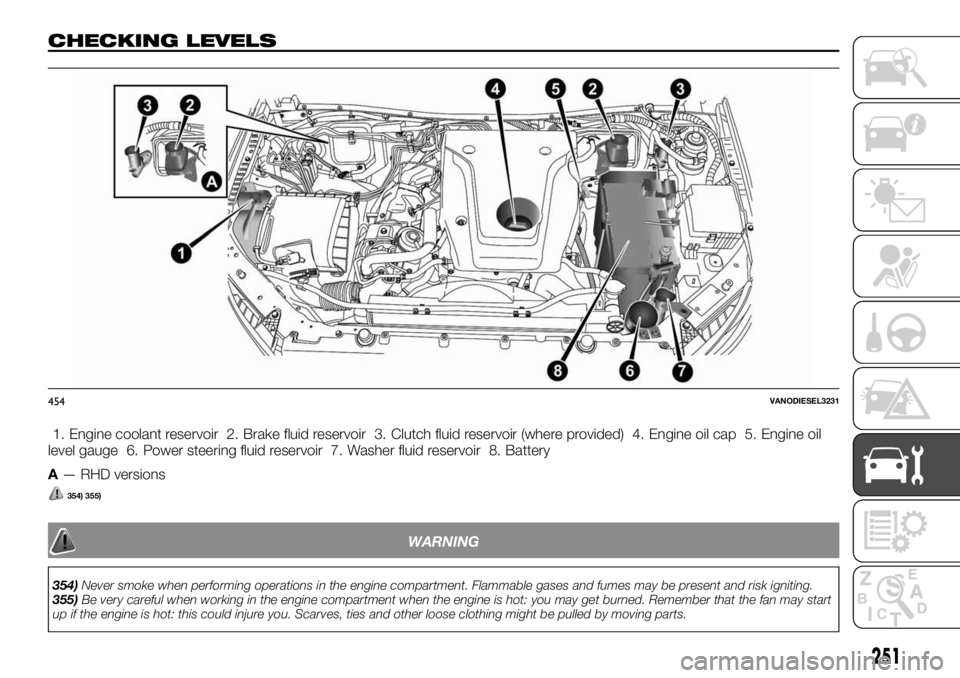
1. Engine coolant reservoir 2. Brake fluid reservoir 3. Clutch fluid reservoir (where provided) 4. Engine oil cap 5. Engine oil
level gauge 6. Power steering fluid reservoir 7. Washer fluid reservoir 8. Battery
A— RHD versions
354) 355)
WARNING
354)Never smoke when performing operations in the engine compartment. Flammable gases and fumes may be present and risk igniting.
355)Be very careful when working in the engine compartment when the engine is hot: you may get burned. Remember that the fan may start
up if the engine is hot: this could injure you. Scarves, ties and other loose clothing might be pulled by moving parts.
454VANODIESEL3231
251
Page 254 of 312
CATALYTIC
CONVERTER
356)
The exhaust gas scavenging devices
used with catalytic converter are
extremely efficient for the reduction of
noxious gases. The catalytic converter
is installed in the exhaust system.
It is important to keep the engine
properly tuned to ensure proper catalyst
operation and prevent possible catalyst
damage.
NOTE Use fuel of the type
recommended in “Fuel selection”.
WARNING
356)As with any vehicle, do not park or
operate this vehicle in areas where
combustible materials such as dry grass or
leaves can come in contact with a hot
exhaust since a fire could occur.
ENGINE OIL
To check and refill engine oil
357)
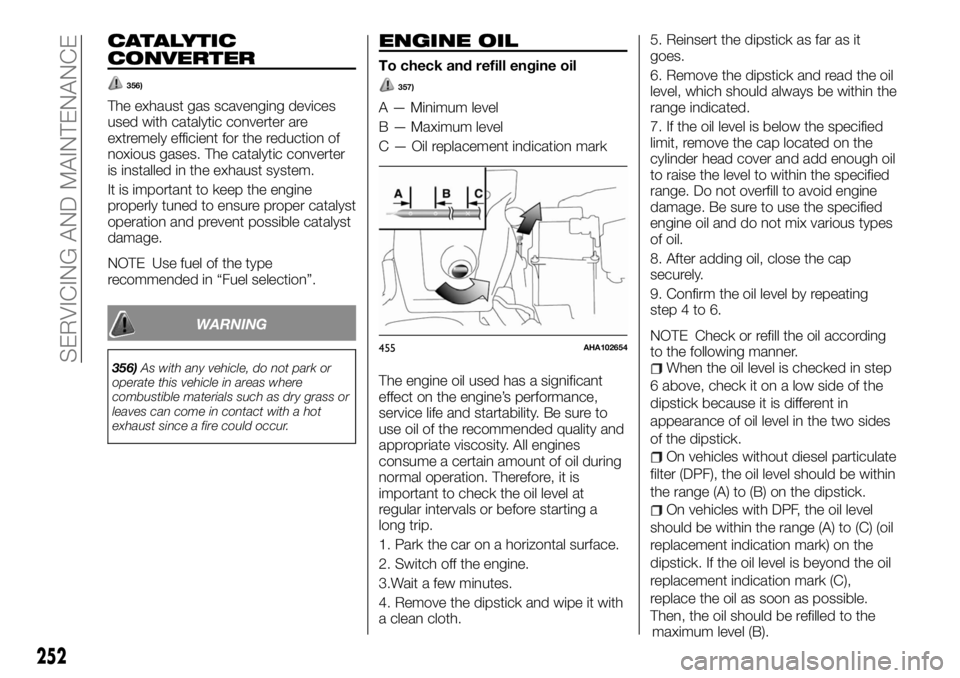
A — Minimum level
B — Maximum level
C — Oil replacement indication mark
The engine oil used has a significant
effect on the engine’s performance,
service life and startability. Be sure to
use oil of the recommended quality and
appropriate viscosity. All engines
consume a certain amount of oil during
normal operation. Therefore, it is
important to check the oil level at
regular intervals or before starting a
long trip.
1. Park the car on a horizontal surface.
2. Switch off the engine.
3.Wait a few minutes.
4. Remove the dipstick and wipe it with
a clean cloth.5. Reinsert the dipstick as far as it
goes.
6. Remove the dipstick and read the oil
level, which should always be within the
range indicated.
7. If the oil level is below the specified
limit, remove the cap located on the
cylinder head cover and add enough oil
to raise the level to within the specified
range. Do not overfill to avoid engine
damage. Be sure to use the specified
engine oil and do not mix various types
of oil.
8. After adding oil, close the cap
securely.
9. Confirm the oil level by repeating
step4to6.
NOTE Check or refill the oil according
to the following manner.
When the oil level is checked in step
6 above, check it on a low side of the
dipstick because it is different in
appearance of oil level in the two sides
of the dipstick.
On vehicles without diesel particulate
filter (DPF), the oil level should be within
the range (A) to (B) on the dipstick.
On vehicles with DPF, the oil level
should be within the range (A) to (C) (oil
replacement indication mark) on the
dipstick. If the oil level is beyond the oil
replacement indication mark (C),
replace the oil as soon as possible.
Then, the oil should be refilled to the
455AHA102654
252
SERVICING AND MAINTENANCE
maximum level (B).
Page 255 of 312
On vehicle with DPF, the engine oil
will be increased due to a few of the
fuel gets mixed in the engine oil when
the DPF regenerates to burn away the
PM (particulate matter). However, it
does not indicate a malfunction.
The engine oil level will be increased
due to an amount of the fuel being
mixed in the engine oil when the DPF
regenerates to burn away the PM
(particulate matter). It does not indicate
a malfunction. In the following
conditions, the engine oil level may
increase easily. We recommend you to
have it checked frequently.:
frequent driving at uphill and
downhill;
frequent driving at high altitudes;
frequent and extended idling;
frequent driving through a traffic jam.
NOTE The engine oil will deteriorate
rapidly if the vehicle is subjected to
severe conditions, requiring earlier oil
replacement. Please refer to the
maintenance schedule.
Selection of engine oil
Refer to “Refill Capacities” under
Technical Specifications.
Safety and disposal information for
used engine oil
358) 359) 360)
Protect the environment
It is illegal to pollute drains, water
courses and soil. Use authorized waste
collection facilities, including civic
amenity sites and garages providing
facilities for disposal of used oil and
used oil filters. If in doubt, contact your
local authority for advice on disposal.
WARNING
357)If the engine oil is being topped up,
wait for the engine to cool down before
loosening the filler cap, particularly for
vehicles with aluminium cap (where
provided). WARNING: risk of burns!
358)Prolonged and repeated contact may
cause serious skin diorders, including
dermatitis and cancer.
359)Avoid contact with the skin as far as
possible and wash thoroughly after any
contact.
360)Keep use engine olis out of reach of
children.
ENGINE COOLANT
To check the coolant level
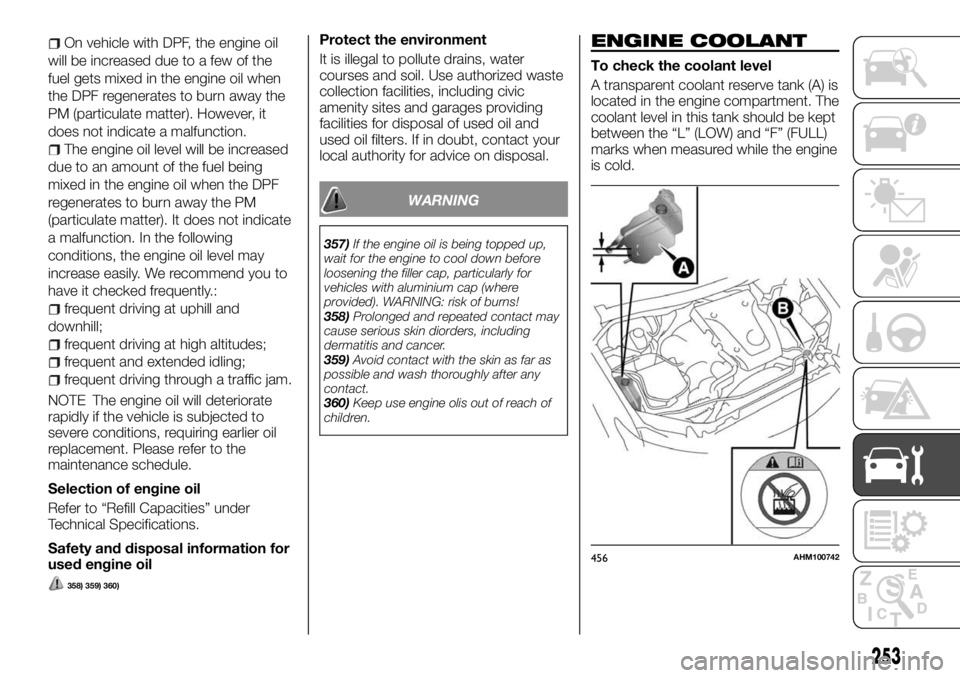
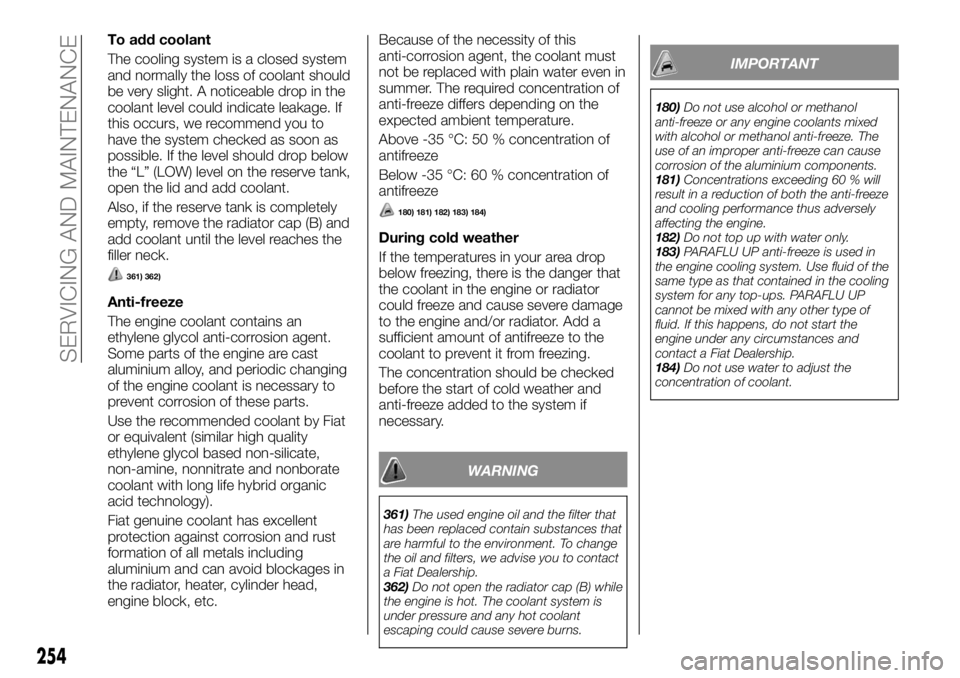
A transparent coolant reserve tank (A) is
located in the engine compartment. The
coolant level in this tank should be kept
between the “L” (LOW) and “F” (FULL)
marks when measured while the engine
is cold.
456AHM100742
253
Page 256 of 312
To add coolant
The cooling system is a closed system
and normally the loss of coolant should
be very slight. A noticeable drop in the
coolant level could indicate leakage. If
this occurs, we recommend you to
have the system checked as soon as
possible. If the level should drop below
the “L” (LOW) level on the reserve tank,
open the lid and add coolant.
Also, if the reserve tank is completely
empty, remove the radiator cap (B) and
add coolant until the level reaches the
filler neck.
361) 362)
Anti-freeze
The engine coolant contains an
ethylene glycol anti-corrosion agent.
Some parts of the engine are cast
aluminium alloy, and periodic changing
of the engine coolant is necessary to
prevent corrosion of these parts.
Use the recommended coolant by Fiat
or equivalent (similar high quality
ethylene glycol based non-silicate,
non-amine, nonnitrate and nonborate
coolant with long life hybrid organic
acid technology).
Fiat genuine coolant has excellent
protection against corrosion and rust
formation of all metals including
aluminium and can avoid blockages in
the radiator, heater, cylinder head,
engine block, etc.Because of the necessity of this
anti-corrosion agent, the coolant must
not be replaced with plain water even in
summer. The required concentration of
anti-freeze differs depending on the
expected ambient temperature.
Above -35 °C: 50 % concentration of
antifreeze
Below -35 °C: 60 % concentration of
antifreeze
180) 181) 182) 183) 184)
During cold weather
If the temperatures in your area drop
below freezing, there is the danger that
the coolant in the engine or radiator
could freeze and cause severe damage
to the engine and/or radiator. Add a
sufficient amount of antifreeze to the
coolant to prevent it from freezing.
The concentration should be checked
before the start of cold weather and
anti-freeze added to the system if
necessary.
WARNING
361)The used engine oil and the filter that
has been replaced contain substances that
are harmful to the environment. To change
the oil and filters, we advise you to contact
a Fiat Dealership.
362)Do not open the radiator cap (B) while
the engine is hot. The coolant system is
under pressure and any hot coolant
escaping could cause severe burns.
IMPORTANT
180)Do not use alcohol or methanol
anti-freeze or any engine coolants mixed
with alcohol or methanol anti-freeze. The
use of an improper anti-freeze can cause
corrosion of the aluminium components.
181)Concentrations exceeding 60 % will
result in a reduction of both the anti-freeze
and cooling performance thus adversely
affecting the engine.
182)Do not top up with water only.
183)PARAFLU UP anti-freeze is used in
the engine cooling system. Use fluid of the
same type as that contained in the cooling
system for any top-ups. PARAFLU UP
cannot be mixed with any other type of
fluid. If this happens, do not start the
engine under any circumstances and
contact a Fiat Dealership.
184)Do not use water to adjust the
concentration of coolant.
254
SERVICING AND MAINTENANCE
Page 263 of 312
GENERAL
MAINTENANCE
Fuel, engine coolant, oil and
exhaust gas leakage
Look under the body of your vehicle to
check for fuel, engine coolant, oil and
exhaust gas leaks.
Exterior and interior lamp operation
Operate the combination lamp switch
to check that all lamps are functioning
properly. If the lamps do not illuminate,
the probable cause is a blown fuse or
defective lamp bulb. Check the fuses
first. If there is no blown fuses, check
the lamp bulbs. For information
regarding the inspection and
replacement of the fuses and the bulbs,
refer to “Fuses” and “Replacement of
lamp bulbs”.
Meter, gauge and indicator/
warning lamps operation
Start the engine to check the operation
of all instruments, gauges, and indicator
and warning lamps. If there is anything
wrong, we recommend you to have
your vehicle inspected.
Hinges and latches lubrication
Check all latches and hinges, and, if
necessary, have them lubricated.
VEHICLE CARE
PRECAUTIONS
384)
197)
5)
In order to maintain the value of your
vehicle, it is necessary to perform
regular maintenance using the proper
procedures.
Always maintain your vehicle in
compliance with any environmental
pollution control regulations.
Carefully select the materials used for
washing, etc., to be sure that they do
not contain corrosives. If in doubt, we
recommend you to consult a specialist
for the selection of these materials.
WARNING
384)Cleaning products can be dangerous.
Always follow the instructions of the
cleaning product supplier.
IMPORTANT
197)To avoid damage, never use the
following to clean your vehicle: Petrol; Paint
Thinner; Benzine; Kerosene; Turpentine;
Naphtha; Lacquer Thinner; Carbon
Tetrachloride; Nail Polish Remover;
Acetone.
IMPORTANT
5)Detergents pollute the environment. Only
wash your vehicle in areas equipped to
collect and treat wastewater from this type
of activity.
261
Page 266 of 312
Polishing
The vehicle should only be polished if
the paintwork has become stained or
lost its lustre. Do not polish parts with a
mat coating and the plastic bumpers.
Doing so could cause stains or damage
the finish.
Cleaning plastic parts
Use a sponge or chamois leather. If a
car wax adheres on a grey or black
rough surface of the bumper, moulding
or lamps, the surface becomes white.
In such a case, wipe it off using
lukewarm water and soft cloth or
chamois leather.
208) 209)
Chrome parts
In order to prevent spots and corrosion
of chrome parts, wash with water, dry
thoroughly, and apply a special
protective coating. This should be done
more frequently in winter.
Aluminium wheels (if so equipped)
Remove dirt using a sponge while
sprinkling water on the wheel.Use
neutral detergent on any dirt that
cannot be removed easily with
water. Rinse off the neutral
detergent after washing the
wheel.Dry the wheel thoroughly
using a chamois leather or a soft
cloth.
210) 211) 212) 213)
Window glass
The window glass can normally be
cleaned using only a sponge and water.
Glass cleaner can be used to remove
oil, grease, insect carcasses, etc. After
washing the glass, wipe it dry with a
clean, dry, soft cloth. Never use a cloth
that is used for cleaning a painted
surface to clean a window. Wax from
the painted surface could get on the
glass and lower glass transparency and
visibility.
NOTE To clean the inside of the rear
window, always use a soft cloth and
wipe the window glass along the
demister heater element so as not to
cause damage.
NOTE Do not use pure windscreen
washer fluid for cleaning the front
windscreen and rear screen; dilute it by
at least 50% in water.
Wiper blades
Use a soft cloth and glass cleaner to
remove grease, insect carcasses, etc.,
from the wiper blades. Replace the
wiper blades when they no longer wipe
properly.
Engine compartment
Clean the engine compartment at the
beginning and end of winter. Pay
particular attention to flanges, crevices
and peripheral parts where dust
containing road chemicals and other
corrosive materials might collect.If salt and other chemicals are used on
the roads in your area, clean the engine
compartment at least every three
months.
Never spray or splash water on the
electrical components in the engine
compartment, as this may cause
damage.
Do not bring the nearby parts, the
plastic parts and so on into contact
with sulphuric acid (battery electrolyte)
which may crack, stain or discolour
them.
If they are in contact, wipe off with soft
cloth, chamois or the like and an
aqueous solution of neutral detergent
then immediately rinse the affected
parts with plenty of water.
Versions with tonneau cover
Hand washing is recommended for the
tonneau cover; modern automatic
washing systems equipped with soft
brushes which do not apply excessive
pressure with specific products may be
used.
Never use high-pressure washing
systems. If a water jet is used, direct
away from the edges of the fabric and
the rear window to prevent water
infiltration.
264
SERVICING AND MAINTENANCE
Page 268 of 312
203)Never spray or splash water on the
electrical components in the engine
compartment. Doing so could have an
adverse effect on the engine startability.
Exercise caution also when washing the
underbody; be careful not to spray water
into the engine compartment.
204)Some types of hot water washing
equipment apply high pressure and heat to
the vehicle. They may cause heat distortion
and damage to the vehicle resin parts and
may result in flooding of the vehicle interior.
Therefore maintain a good distance of
approx. 70 cm or more between the vehicle
body and the washing nozzle. Also, when
washing around the door glass, hold the
nozzle at a distance of more than 70 cm
and at right angles to the glass surface.
205)After washing the vehicle, drive the
vehicle slowly while lightly depressing the
brake pedal several times in order to dry
out the brakes. Leaving the brakes wet
could result in reduced braking
performance. Also, there is a possibility that
they could freeze up or become inoperative
due to rust, rendering the vehicle unable to
move.206)Using an automatic car wash, pay
attention to the following items, referring to
the operation manual or consulting a car
wash operator. If the following procedure is
not followed, it could result in damage to
your vehicle: 1 – the outside rear view
mirrors are retracted.2–Ifyour vehicle is
equipped with the pillar antenna, it can be
retracted. If your vehicle is equipped with
the roof antenna, it can be removed. 3 –
The wiper arms are secured in place with
tape.4–Ifyour vehicle has rain sensor
wipers, place the wiper switch lever in the
“OFF” position to deactivate the rain
sensor.
207)Waxes containing high abrasive
compounds should not be used.
208)Do not use a scrubbing brush or other
hard tools as they may damage the plastic
part surface.
209)Do not bring the plastic parts into
contact with petrol, light oil, brake fluids,
engine oils, greases, paint thinners and
sulphuric acid (battery electrolyte) which
may crack, stain or discolour the plastic
parts. If they touch the plastic parts, wipe
them off with soft cloth, chamois or the like
and an aqueous solution of neutral
detergent then immediately rinse the
affected parts with water.
210)Do not use a brush or other hard
implement on the wheels. Doing so could
scratch the wheels.
211)Do not use any cleaner that contains
an abrasive substance or is acidic or
alkaline. Doing so could cause the coating
on the wheels to peel or become
discoloured or stained.
212)Do not directly apply hot water using a
steam cleaner or by any other means.213)Contact with seawater and road
deicer can cause corrosion. Rinse off such
substances as soon as possible.
IMPORTANT
6)Detergents pollute the environment. Only
wash your vehicle in areas equipped to
collect and treat waste water from this type
of activity.
266
SERVICING AND MAINTENANCE
Page 293 of 312
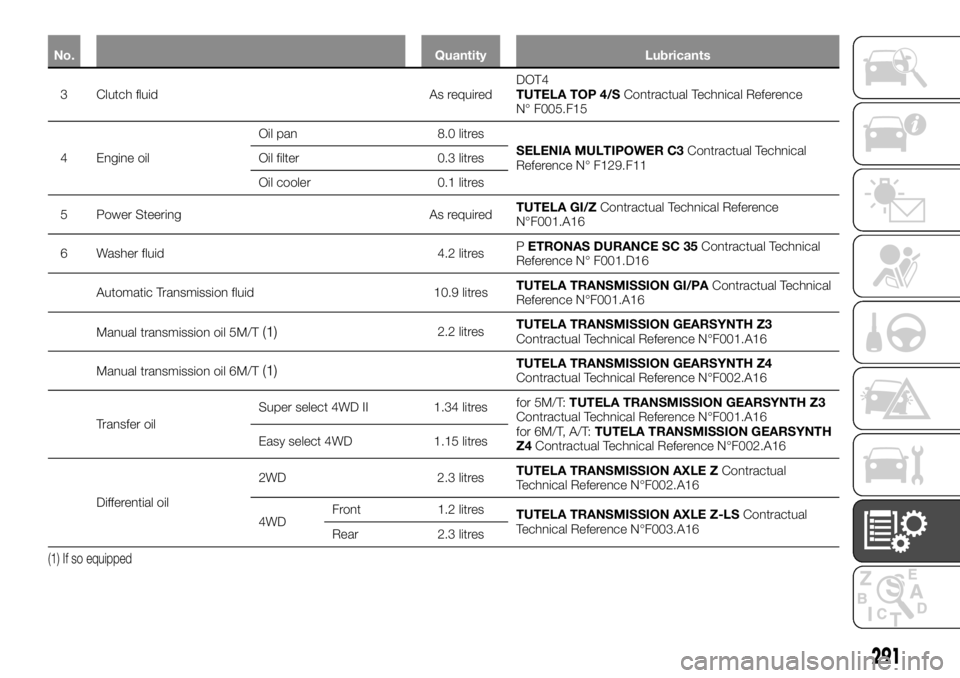
No. Quantity Lubricants
3 Clutch fluid As requiredDOT4
TUTELA TOP 4/SContractual Technical Reference
N° F005.F15
4 Engine oilOil pan 8.0 litres
SELENIA MULTIPOWER C3Contractual Technical
Reference N° F129.F11 Oil filter 0.3 litres
Oil cooler 0.1 litres
5 Power Steering As requiredTUTELA GI/ZContractual Technical Reference
N°F001.A16
6 Washer fluid 4.2 litresPETRONAS DURANCE SC 35Contractual Technical
Reference N° F001.D16
Automatic Transmission fluid 10.9 litresTUTELA TRANSMISSION GI/PAContractual Technical
Reference N°F001.A16
Manual transmission oil 5M/T
(1)2.2 litresTUTELA TRANSMISSION GEARSYNTH Z3
Contractual Technical Reference N°F001.A16
Manual transmission oil 6M/T
(1)TUTELA TRANSMISSION GEARSYNTH Z4
Contractual Technical Reference N°F002.A16
Transfer oilSuper select 4WD II 1.34 litresfor 5M/T:TUTELA TRANSMISSION GEARSYNTH Z3
Contractual Technical Reference N°F001.A16
for 6M/T, A/T:TUTELA TRANSMISSION GEARSYNTH
Z4Contractual Technical Reference N°F002.A16 Easy select 4WD 1.15 litres
Differential oil2WD 2.3 litresTUTELA TRANSMISSION AXLE ZContractual
Technical Reference N°F002.A16
4WDFront 1.2 litres
TUTELA TRANSMISSION AXLE Z-LSContractual
Technical Reference N°F003.A16
Rear 2.3 litres
(1) If so equipped
291
Page 295 of 312
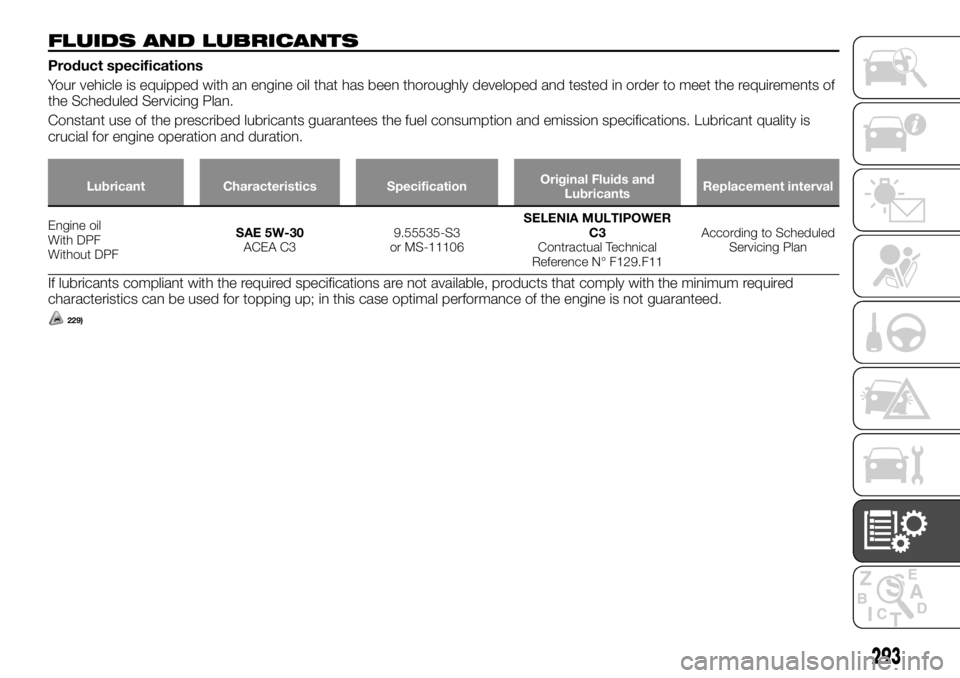
FLUIDS AND LUBRICANTS
Product specifications
Your vehicle is equipped with an engine oil that has been thoroughly developed and tested in order to meet the requirements of
the Scheduled Servicing Plan.
Constant use of the prescribed lubricants guarantees the fuel consumption and emission specifications. Lubricant quality is
crucial for engine operation and duration.
Lubricant Characteristics SpecificationOriginal Fluids and
LubricantsReplacement interval
Engine oil
With DPF
Without DPFSAE 5W-30
ACEA C39.55535-S3
or MS-11106SELENIA MULTIPOWER
C3
Contractual Technical
Reference N° F129.F11According to Scheduled
Servicing Plan
If lubricants compliant with the required specifications are not available, products that comply with the minimum required
characteristics can be used for topping up; in this case optimal performance of the engine is not guaranteed.
229)
293