engine oil FIAT FULLBACK 2017 Owner handbook (in English)
[x] Cancel search | Manufacturer: FIAT, Model Year: 2017, Model line: FULLBACK, Model: FIAT FULLBACK 2017Pages: 312, PDF Size: 12.31 MB
Page 184 of 312
147)
Jacking up a 4-wheel drive vehicles
236)
Clutch operation
Quick or slight clutch engagement
made while the engine is running at
high speed will cause damage to the
clutch and transmission because the
tractive force is very great. Operate the
pedal slowly and positively.
IMPORTANT
146)Always use tyres of the same size,
same type, and same brand which have no
wear differences. Using the tyres which
differ in size, type, brands or the degree of
wear or the inappropriate tyre inflation
pressure, will increase the differential oil
temperature, resulting in possible damage
to the driving system. Further, the drive
train will be subjected to excessive loading,
possibly leading to oil leakage, component
seizure, or other serious faults.
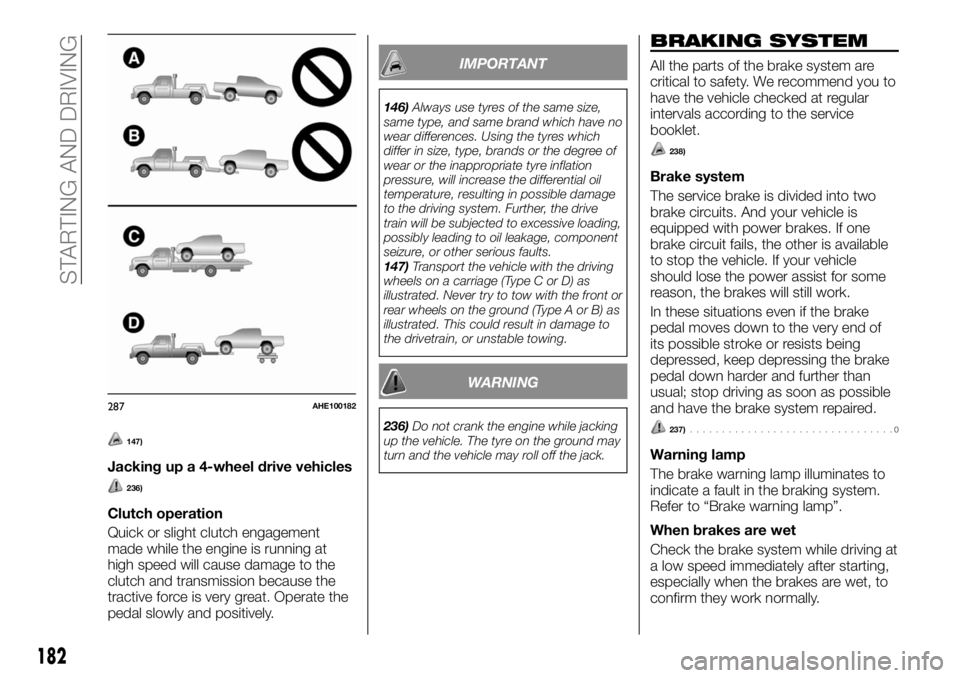
147)Transport the vehicle with the driving
wheels on a carriage (Type C or D) as
illustrated. Never try to tow with the front or
rear wheels on the ground (Type A or B) as
illustrated. This could result in damage to
the drivetrain, or unstable towing.
WARNING
236)Do not crank the engine while jacking
up the vehicle. The tyre on the ground may
turn and the vehicle may roll off the jack.
BRAKING SYSTEM
All the parts of the brake system are
critical to safety. We recommend you to
have the vehicle checked at regular
intervals according to the service
booklet.
238)
Brake system
The service brake is divided into two
brake circuits. And your vehicle is
equipped with power brakes. If one
brake circuit fails, the other is available
to stop the vehicle. If your vehicle
should lose the power assist for some
reason, the brakes will still work.
In these situations even if the brake
pedal moves down to the very end of
its possible stroke or resists being
depressed, keep depressing the brake
pedal down harder and further than
usual; stop driving as soon as possible
and have the brake system repaired.
237)................................0
Warning lamp
The brake warning lamp illuminates to
indicate a fault in the braking system.
Refer to “Brake warning lamp”.
When brakes are wet
Check the brake system while driving at
a low speed immediately after starting,
especially when the brakes are wet, to
confirm they work normally.
287AHE100182
182
STARTING AND DRIVING
Page 213 of 312
162)
6. Examine the radiator hoses for
coolant leakage and the drive belt for
looseness or damage. If there is
anything wrong with the cooling system
or drive belt, we recommend you to
have it checked and repaired.
WARNING
284)Do not open the bonnet while steam
is coming from the engine compartment. It
could cause steam or hot water to spurt
out, causing burns. Hot water could spurt
out even when there is no steam coming
out, and some parts will be very hot. Be
very careful when opening the bonnet.
285)Be careful of hot steam, which could
be blowing off the reserve tank cap.
286)Do not attempt to remove the radiator
cap while the engine is hot.
287)Be careful not to get your hands or
clothes caught in the cooling fan.
288)Make sure that the engine has cooled
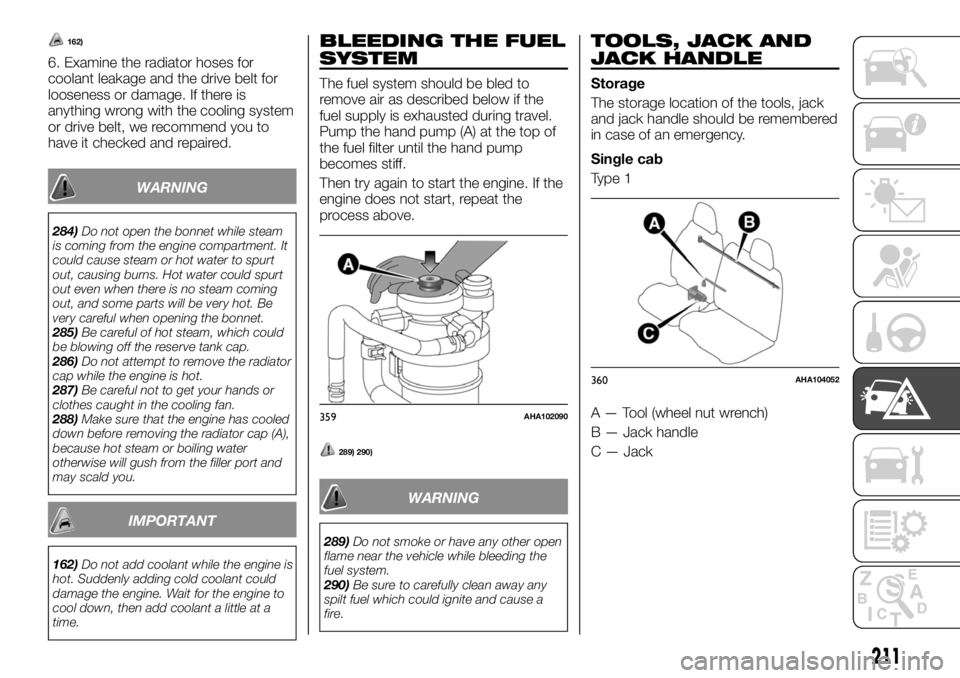
down before removing the radiator cap (A),
because hot steam or boiling water
otherwise will gush from the filler port and
may scald you.
IMPORTANT
162)Do not add coolant while the engine is
hot. Suddenly adding cold coolant could
damage the engine. Wait for the engine to
cool down, then add coolant a little at a
time.
BLEEDING THE FUEL
SYSTEM
The fuel system should be bled to
remove air as described below if the
fuel supply is exhausted during travel.
Pump the hand pump (A) at the top of
the fuel filter until the hand pump
becomes stiff.
Then try again to start the engine. If the
engine does not start, repeat the
process above.
289) 290)
WARNING
289)Do not smoke or have any other open
flame near the vehicle while bleeding the
fuel system.
290)Be sure to carefully clean away any
spilt fuel which could ignite and cause a
fire.
TOOLS, JACK AND
JACK HANDLE
Storage
The storage location of the tools, jack
and jack handle should be remembered
in case of an emergency.
Single cab
Type 1
A — Tool (wheel nut wrench)
B — Jack handle
C — Jack
359AHA102090
360AHA104052
211
Page 225 of 312
TOWING
If your vehicle needs to be towed
If towing is necessary, we recommend
you to have it done by a Fiat Dealership
or a commercial tow truck service. In
the following cases, transport the
vehicle using a tow truck.
The engine runs but the vehicle does
not move, or an abnormal noise is
produced.
Inspection of the vehicle’s underside
reveals that oil or some other fluid is
leaking.
If a wheel gets stuck in a ditch, do not
try to tow the vehicle. Please contact a
Fiat Dealership or a commercial tow
truck service for assistance.
Only when you cannot receive a towing
service from a Fiat Dealership or
commercial tow truck service, tow your
vehicle carefully in accordance with the
instructions given in “Emergency
towing” in this part. The regulations
concerning towing may differ from
country to country. It is recommended
that you obey the regulations of the
area where you are driving your vehicle.Towing the vehicle by a tow truck
169) 170) 171) 172) 173)
318) 319) 320)
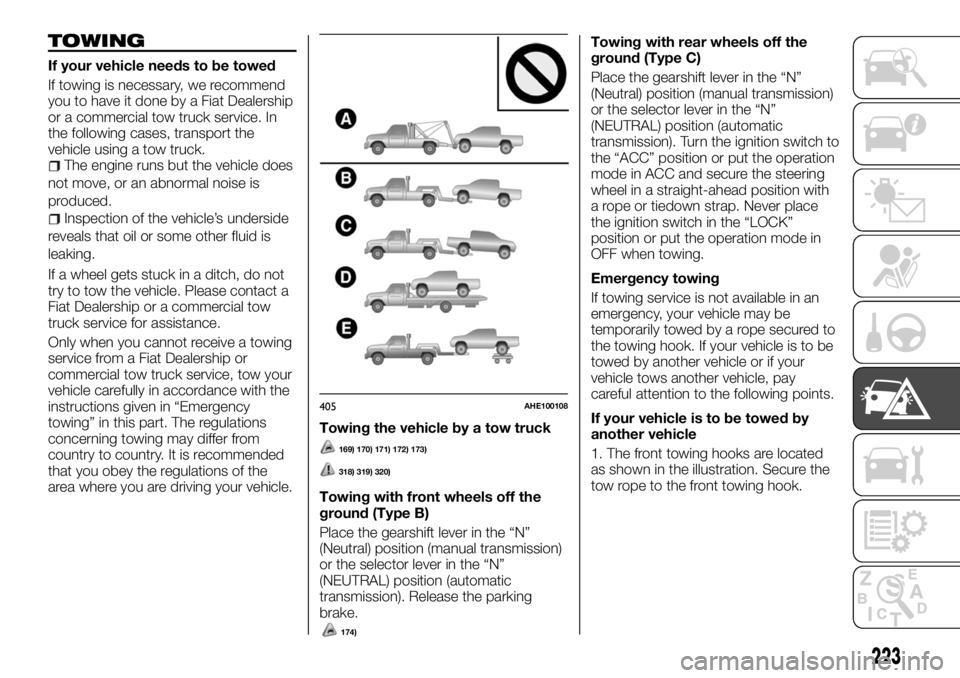
Towing with front wheels off the
ground (Type B)
Place the gearshift lever in the “N”
(Neutral) position (manual transmission)
or the selector lever in the “N”
(NEUTRAL) position (automatic
transmission). Release the parking
brake.
174)
Towing with rear wheels off the
ground (Type C)
Place the gearshift lever in the “N”
(Neutral) position (manual transmission)
or the selector lever in the “N”
(NEUTRAL) position (automatic
transmission). Turn the ignition switch to
the “ACC” position or put the operation
mode in ACC and secure the steering
wheel in a straight-ahead position with
a rope or tiedown strap. Never place
the ignition switch in the “LOCK”
position or put the operation mode in
OFF when towing.
Emergency towing
If towing service is not available in an
emergency, your vehicle may be
temporarily towed by a rope secured to
the towing hook. If your vehicle is to be
towed by another vehicle or if your
vehicle tows another vehicle, pay
careful attention to the following points.
If your vehicle is to be towed by
another vehicle
1. The front towing hooks are located
as shown in the illustration. Secure the
tow rope to the front towing hook.
405AHE100108
223
Page 228 of 312
174)Never tow an automatic transmission
vehicle with the front wheels up (and the
rear wheels on the ground) (Type B) when
the automatic transmission fluid level is low.
This may cause serious and expensive
damage to the transmission.
175)When the engine is not running, the
brake booster and power steering pump do
not operate. This means higher brake
depression force and higher steering effort
are required. Therefore, vehicle operation is
very difficult.
176)Do not leave the ignition switch in the
“LOCK” position or the operation mode in
OFF. The steering wheel will lock, causing
loss of control.
177)On vehicles with super select 4WD II,
when you are going to tow another vehicle,
set the drive mode-selector to “4H”
position. Selecting “2H” drive may increase
the differential oil temperature, resulting in
possible damage to the driving system.
Further, the drive train will be subjected to
excessive loading possibly leading to oil
leakage, component seizure, or other
serious faults.OPERATION UNDER
ADVERSE DRIVING
CONDITIONS
On a flooded road
Avoid flooded roads. In the event
driving flooded roads, doing so may
cause the following serious damage to
the vehicle.
Engine stalling
Short in electrical components
Engine damage caused by water
immersion
After driving flooded roads, be sure to
have an inspection at a Fiat Dealership
and take the necessary measures or
repair.
When driving in rain, or water-covered
roads, or through a car wash, water
could enter the brake discs, resulting in
temporarily ineffective brakes. In such
cases, lightly depress the brake pedal
to see if the brakes operate properly. If
they do not, lightly depress the pedal
several times while driving in order to
dry the brake pads.
On a wet road
When driving in rain or on a road with
many puddles a layer of water may
form between the tyres and the road
surface. This reduces a tyre’s frictional
resistance on the road, resulting in loss
of steering stability and braking
capability.To cope with this, observe the following
items:
(a) Drive your vehicle at a slow speed.
(b) Do not drive on worn tyres.
(c) Always maintain the specified tyre
inflation pressures.
On a snow-covered or frozen road
When driving on a snow-covered or
frozen road, it is recommended that you
use snow tyres or snow traction device
(tyre chains). Refer to the “Snow tyres”
and “Snow traction device (tyre chains)”
sections.
Avoid high-speed operation, sudden
acceleration, abrupt brake application
and sharp cornering.
Depressing the brake pedal during
travel on snowy or icy roads may cause
tyre slippage and skidding. When
traction between the tyres and the road
is reduced the wheels may skid and the
vehicle cannot readily be brought to a
stop by conventional braking
techniques. Braking will differ,
depending upon whether you have
anti-lock brake system (ABS). If you do
have ABS, brake by pressing the brake
pedal hard, and keeping it pressed. If
you do not have ABS, pump the brake
pedal with short rapid jabs, each time
fully applying and fully releasing for
greatest effect.
Allow extra distance between your
vehicle and the vehicle in front of you,
and avoid sudden braking.
226
IN AN EMERGENCY
Page 234 of 312
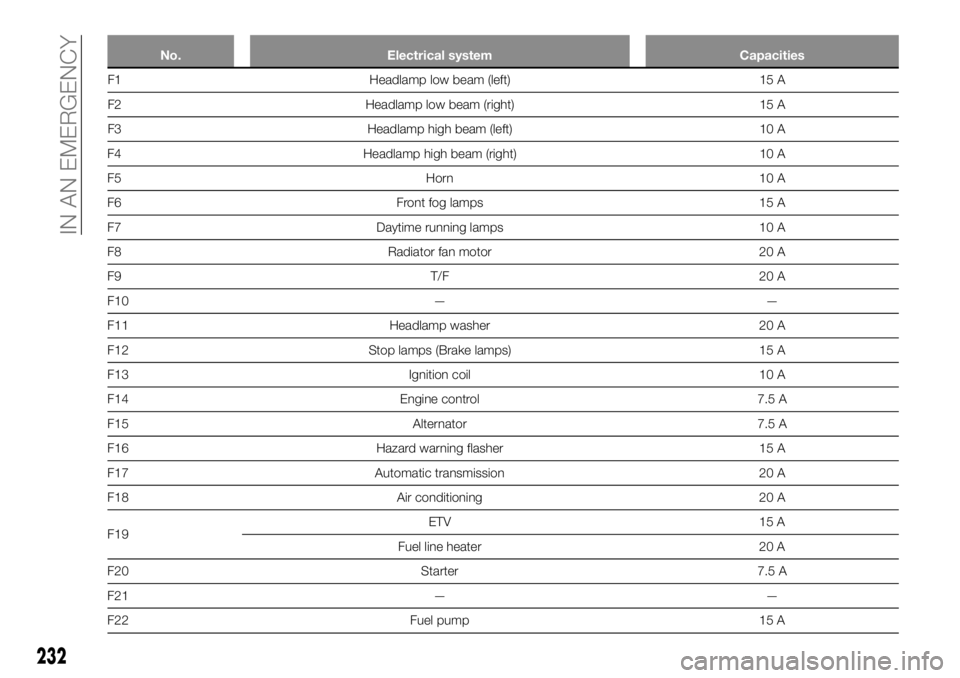
No. Electrical system Capacities
F1 Headlamp low beam (left) 15 A
F2 Headlamp low beam (right) 15 A
F3 Headlamp high beam (left) 10 A
F4 Headlamp high beam (right) 10 A
F5 Horn 10 A
F6 Front fog lamps 15 A
F7 Daytime running lamps 10 A
F8 Radiator fan motor 20 A
F9 T/F 20 A
F10 — —
F11 Headlamp washer 20 A
F12 Stop lamps (Brake lamps) 15 A
F13 Ignition coil 10 A
F14 Engine control 7.5 A
F15 Alternator 7.5 A
F16 Hazard warning flasher 15 A
F17 Automatic transmission 20 A
F18 Air conditioning 20 A
F19ETV 15 A
Fuel line heater 20 A
F20 Starter 7.5 A
F21 — —
F22 Fuel pump 15 A
232
IN AN EMERGENCY
Page 236 of 312
Fuse replacement
332) 333) 334) 335) 336) 337)
179)
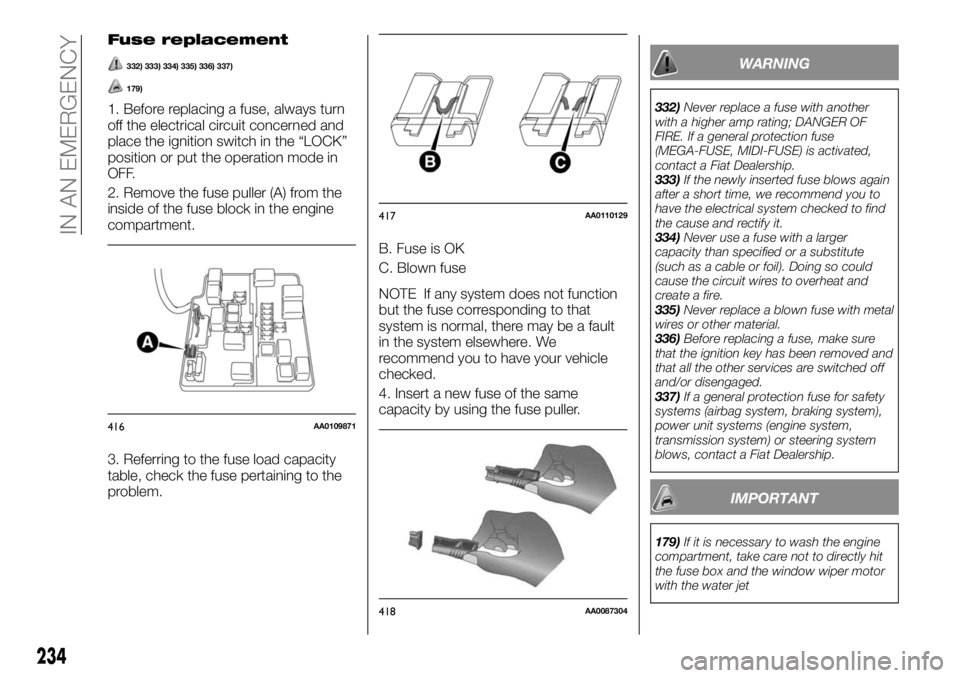
1. Before replacing a fuse, always turn
off the electrical circuit concerned and
place the ignition switch in the “LOCK”
position or put the operation mode in
OFF.
2. Remove the fuse puller (A) from the
inside of the fuse block in the engine
compartment.
3. Referring to the fuse load capacity
table, check the fuse pertaining to the
problem.B. Fuse is OK
C. Blown fuse
NOTE If any system does not function
but the fuse corresponding to that
system is normal, there may be a fault
in the system elsewhere. We
recommend you to have your vehicle
checked.
4. Insert a new fuse of the same
capacity by using the fuse puller.
WARNING
332)Never replace a fuse with another
with a higher amp rating; DANGER OF
FIRE. If a general protection fuse
(MEGA-FUSE, MIDI-FUSE) is activated,
contact a Fiat Dealership.
333)If the newly inserted fuse blows again
after a short time, we recommend you to
have the electrical system checked to find
the cause and rectify it.
334)Never use a fuse with a larger
capacity than specified or a substitute
(such as a cable or foil). Doing so could
cause the circuit wires to overheat and
create a fire.
335)Never replace a blown fuse with metal
wires or other material.
336)Before replacing a fuse, make sure
that the ignition key has been removed and
that all the other services are switched off
and/or disengaged.
337)If a general protection fuse for safety
systems (airbag system, braking system),
power unit systems (engine system,
transmission system) or steering system
blows, contact a Fiat Dealership.
IMPORTANT
179)If it is necessary to wash the engine
compartment, take care not to directly hit
the fuse box and the window wiper motor
with the water jet
416AA0109871
417AA0110129
418AA0087304
234
IN AN EMERGENCY
Page 244 of 312
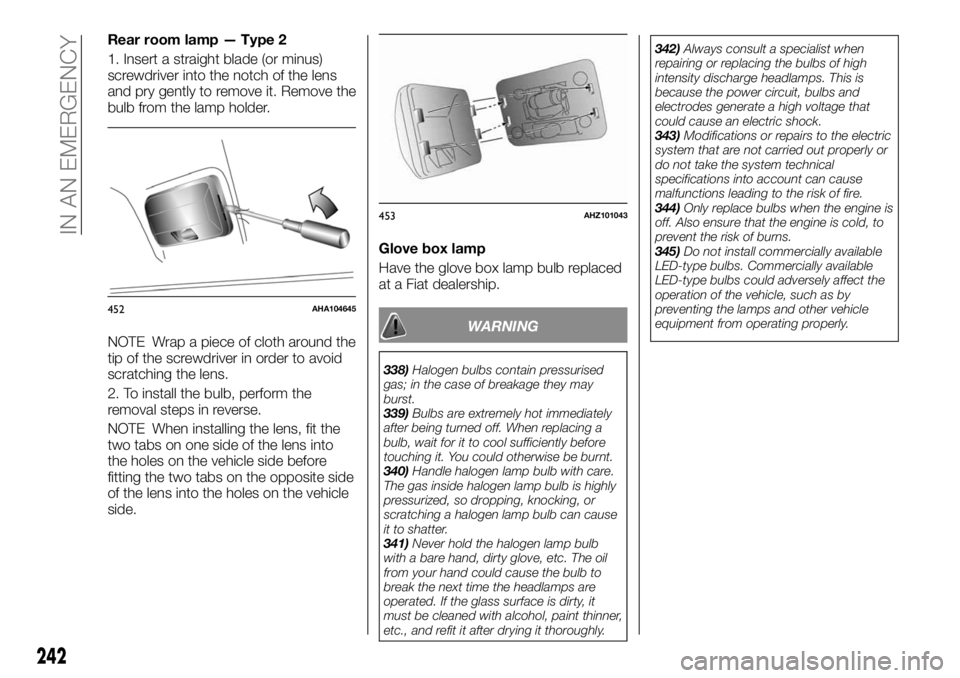
Rear room lamp — Type 2
1. Insert a straight blade (or minus)
screwdriver into the notch of the lens
and pry gently to remove it. Remove the
bulb from the lamp holder.
NOTE Wrap a piece of cloth around the
tip of the screwdriver in order to avoid
scratching the lens.
2. To install the bulb, perform the
removal steps in reverse.
NOTE When installing the lens, fit the
two tabs on one side of the lens into
the holes on the vehicle side before
fitting the two tabs on the opposite side
of the lens into the holes on the vehicle
side.Glove box lamp
Have the glove box lamp bulb replaced
at a Fiat dealership.
WARNING
338)Halogen bulbs contain pressurised
gas; in the case of breakage they may
burst.
339)Bulbs are extremely hot immediately
after being turned off. When replacing a
bulb, wait for it to cool sufficiently before
touching it. You could otherwise be burnt.
340)Handle halogen lamp bulb with care.
The gas inside halogen lamp bulb is highly
pressurized, so dropping, knocking, or
scratching a halogen lamp bulb can cause
it to shatter.
341)Never hold the halogen lamp bulb
with a bare hand, dirty glove, etc. The oil
from your hand could cause the bulb to
break the next time the headlamps are
operated. If the glass surface is dirty, it
must be cleaned with alcohol, paint thinner,
etc., and refit it after drying it thoroughly.342)Always consult a specialist when
repairing or replacing the bulbs of high
intensity discharge headlamps. This is
because the power circuit, bulbs and
electrodes generate a high voltage that
could cause an electric shock.
343)Modifications or repairs to the electric
system that are not carried out properly or
do not take the system technical
specifications into account can cause
malfunctions leading to the risk of fire.
344)Only replace bulbs when the engine is
off. Also ensure that the engine is cold, to
prevent the risk of burns.
345)Do not install commercially available
LED-type bulbs. Commercially available
LED-type bulbs could adversely affect the
operation of the vehicle, such as by
preventing the lamps and other vehicle
equipment from operating properly.
452AHA104645
453AHZ101043
242
IN AN EMERGENCY
Page 245 of 312
SERVICING AND MAINTENANCE
Correct maintenance permits the
performance of the car to be
maintained over time, as well as limited
running costs and safeguarding the
efficiency of the safety systems.
This chapter explains how.SERVICE PRECAUTIONS.......244
SCHEDULED SERVICING PLAN . .245
PERIODIC CHECKS..........250
DEMANDING VEHICLE USE.....250
CHECKING LEVELS..........251
CATALYTIC CONVERTER.......252
ENGINE OIL...............252
ENGINE COOLANT...........253
WASHER FLUID.............255
BRAKE FLUID..............255
CLUTCH FLUID.............256
POWER STEERING FLUID......257
BATTERY.................258
WIPER BLADE REPLACEMENT . . .260
GENERAL MAINTENANCE......261
VEHICLE CARE PRECAUTIONS. . .261
CLEANING THE INTERIOR OF
YOUR VEHICLE.............262
CLEANING THE EXTERIOR OF
YOUR VEHICLE.............263
TYRES...................267
243
Page 247 of 312
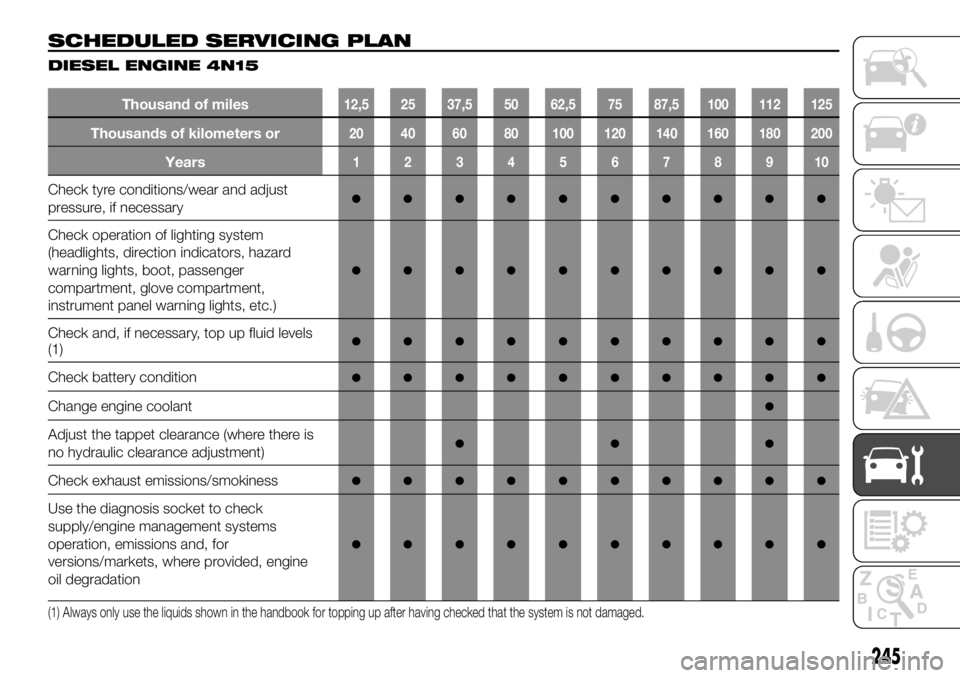
SCHEDULED SERVICING PLAN
DIESEL ENGINE 4N15
Thousand of miles12,5 25 37,5 50 62,5 75 87,5 100 112 125
Thousands of kilometers or20 40 60 80 100 120 140 160 180 200
Years12345678910
Check tyre conditions/wear and adjust
pressure, if necessary●●●●●●●●●●
Check operation of lighting system
(headlights, direction indicators, hazard
warning lights, boot, passenger
compartment, glove compartment,
instrument panel warning lights, etc.)
●●●●●●●●●●
Check and, if necessary, top up fluid levels
(1)●●●●●●●●●●
Check battery condition●●●●●●●●●●
Change engine coolant●
Adjust the tappet clearance (where there is
no hydraulic clearance adjustment)●●●
Check exhaust emissions/smokiness●●●●●●●●●●
Use the diagnosis socket to check
supply/engine management systems
operation, emissions and, for
versions/markets, where provided, engine
oil degradation
●●●●●●●●●●
(1) Always only use the liquids shown in the handbook for topping up after having checked that the system is not damaged.
245
Page 250 of 312
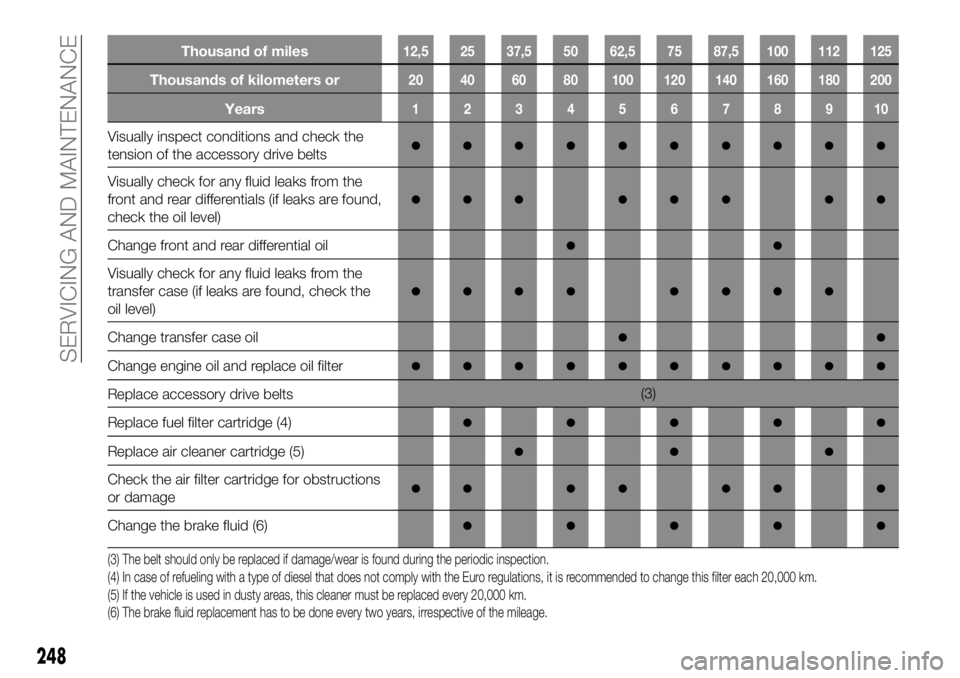
Thousand of miles12,5 25 37,5 50 62,5 75 87,5 100 112 125
Thousands of kilometers or20 40 60 80 100 120 140 160 180 200
Years12345678910
Visually inspect conditions and check the
tension of the accessory drive belts●●●●●●●●●●
Visually check for any fluid leaks from the
front and rear differentials (if leaks are found,
check the oil level)
●●● ●●● ●●
Change front and rear differential oil●●
Visually check for any fluid leaks from the
transfer case (if leaks are found, check the
oil level)
●●●● ●●●●
Change transfer case oil●●
Change engine oil and replace oil filter●●●●●●●●●●
Replace accessory drive belts(3)
Replace fuel filter cartridge (4)
●●●●●
Replace air cleaner cartridge (5)●●●
Check the air filter cartridge for obstructions
or damage●● ●● ●● ●
Change the brake fluid (6)●●●●●
(3) The belt should only be replaced if damage/wear is found during the periodic inspection.
(4) In case of refueling with a type of diesel that does not comply with the Euro regulations, it is recommended to change this filter each 20,000 km.
(5) If the vehicle is used in dusty areas, this cleaner must be replaced every 20,000 km.
(6) The brake fluid replacement has to be done every two years, irrespective of the mileage.
248
SERVICING AND MAINTENANCE