child lock FIAT FULLBACK 2017 Owner handbook (in English)
[x] Cancel search | Manufacturer: FIAT, Model Year: 2017, Model line: FULLBACK, Model: FIAT FULLBACK 2017Pages: 312, PDF Size: 12.31 MB
Page 28 of 312
When you open driver’s door or the
engine switch operate again, the power
is supplied again.
NOTE When ACC power supply
automatic stop, the steering wheel
can’t lock and you can’t lock and
unlock the doors by the keyless entry
key and keyless operation key.
NOTE It is possible to modify functions
as follows:
The time until the power cuts out can
be changed to about 60 minutes.
The ACC power auto-cutout function
can be deactivated. For details, we
recommend you to consult a Fiat
Dealership.
Operation mode OFF reminder
systemWhen the operation mode is in any
mode other than OFF, if you close all
the doors then try to lock the doors by
pressing the driver’s or front
passenger’s door lock/unlock switch, a
warning lamp will blink and the outer
buzzer will sounds and you cannot lock
the doors.
Operation mode ON reminder
system
If the driver’s door is opened with the
engine stopped and the operation
mode in any mode other than OFF, the
operation mode ON reminder inner
buzzer sounds intermittently to remind
you to put the operation mode in OFF.WARNING
6)Do not remove the ignition key from the
ignition switch while driving. The steering
wheel will be locked, causing loss of
control.
7)If the ignition device has been tampered
with (e.g. an attempted theft), have it
checked over by a Fiat Dealership before
driving again.
8)Always remove the key when you leave
your vehicle to prevent someone from
accidentally operating the controls.
Remember to engage the handbrake.
Engage first gear if the vehicle is parked
uphill or reverse gear if the vehicle is
parked downhill. Never leave children
unattended in the vehicle.9)Never extract the key while the vehicle is
moving. The steering wheel will lock as
soon as it is turned. This also applies to
cases in which the vehicle is towed.
10)Under no circumstances should
aftermarket operations be carried out
involving steering system or steering
column modifications (e.g. installation of
anti-theft device). This could negatively
affect performance and safety, invalidate
the warranty, cause serious safety
problems and also result in vehicle
non-compliance with type-approval
requirements.
IMPORTANT
1)If the engine is stopped while driving, the
brake servomechanism will cease to
function and braking efficiency will
deteriorate. Also, the power steering
system will not function and it will require
greater manual effort to operate the
steering.
2)Do not leave the key in the “ON” position
for a long time when the engine is not
running, doing so will cause the battery to
be discharged.
3)Do not turn the key to the “START”
position while the engine is running. Doing
so could damage the starter motor.
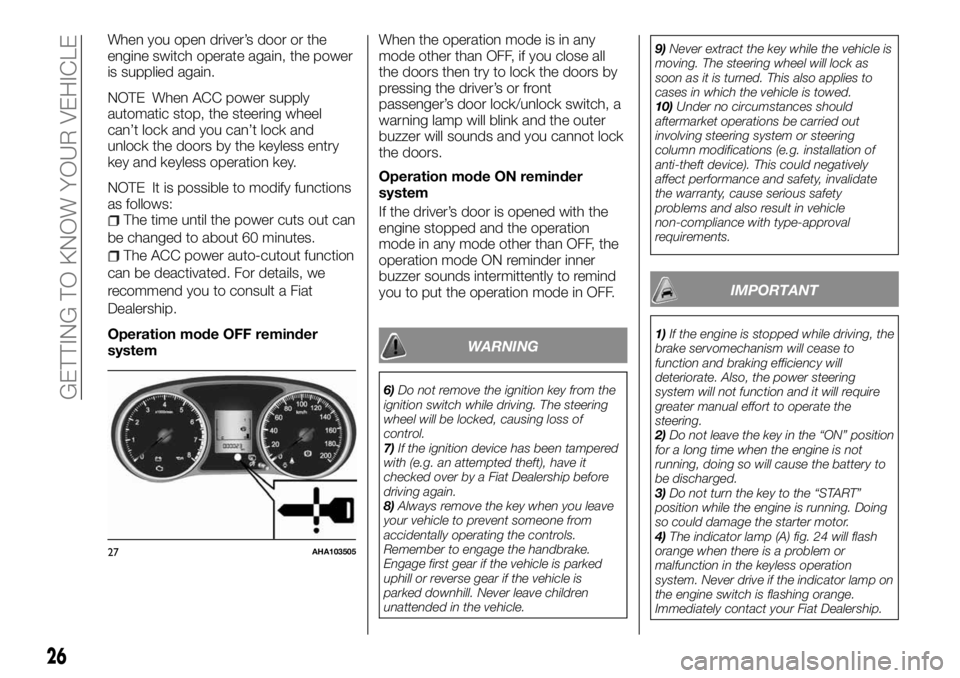
4)The indicator lamp (A) fig. 24 will flash
orange when there is a problem or
malfunction in the keyless operation
system. Never drive if the indicator lamp on
the engine switch is flashing orange.
Immediately contact your Fiat Dealership.
27AHA103505
26
GETTING TO KNOW YOUR VEHICLE
Page 32 of 312
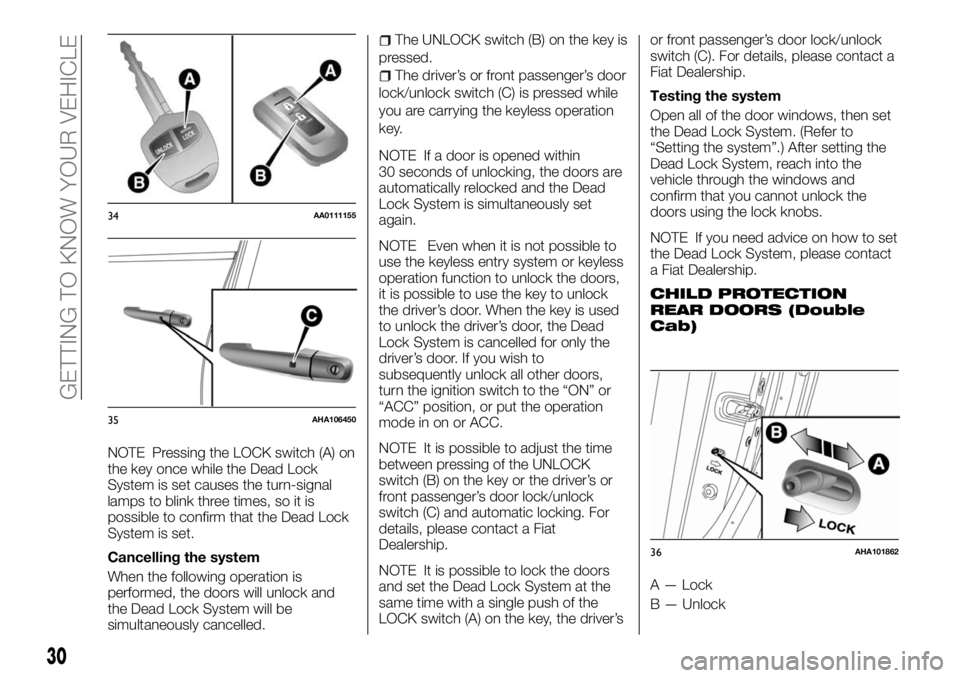
NOTE Pressing the LOCK switch (A) on
the key once while the Dead Lock
System is set causes the turn-signal
lamps to blink three times, so it is
possible to confirm that the Dead Lock
System is set.
Cancelling the system
When the following operation is
performed, the doors will unlock and
the Dead Lock System will be
simultaneously cancelled.
The UNLOCK switch (B) on the key is
pressed.
The driver’s or front passenger’s door
lock/unlock switch (C) is pressed while
you are carrying the keyless operation
key.
NOTE If a door is opened within
30 seconds of unlocking, the doors are
automatically relocked and the Dead
Lock System is simultaneously set
again.
NOTE Even when it is not possible to
use the keyless entry system or keyless
operation function to unlock the doors,
it is possible to use the key to unlock
the driver’s door. When the key is used
to unlock the driver’s door, the Dead
Lock System is cancelled for only the
driver’s door. If you wish to
subsequently unlock all other doors,
turn the ignition switch to the “ON” or
“ACC” position, or put the operation
mode in on or ACC.
NOTE It is possible to adjust the time
between pressing of the UNLOCK
switch (B) on the key or the driver’s or
front passenger’s door lock/unlock
switch (C) and automatic locking. For
details, please contact a Fiat
Dealership.
NOTE It is possible to lock the doors
and set the Dead Lock System at the
same time with a single push of the
LOCK switch (A) on the key, the driver’sor front passenger’s door lock/unlock
switch (C). For details, please contact a
Fiat Dealership.
Testing the system
Open all of the door windows, then set
the Dead Lock System. (Refer to
“Setting the system”.) After setting the
Dead Lock System, reach into the
vehicle through the windows and
confirm that you cannot unlock the
doors using the lock knobs.
NOTE If you need advice on how to set
the Dead Lock System, please contact
a Fiat Dealership.
CHILD PROTECTION
REAR DOORS (Double
Cab)
A — Lock
B — Unlock
34AA0111155
35AHA106450
36AHA101862
30
GETTING TO KNOW YOUR VEHICLE
Page 33 of 312
Child protection helps prevent doors
from being opened accidentally,
especially when small children are in the
rear seat.
A lever is provided on each rear door. If
the lever is set to the locked position,
the rear door cannot be opened using
the inside handle.
To open the rear door while the child
protection is in use, pull the outside
door handle. If the lever is set to the
“Unlock” position, the child protection
mechanism does not function.
21) 22) 23)
REAR GATE
To open
Lift up the handle and lower the rear
gate.To close
Raise the rear gate and close with
enough force to latch the assembly
securely into position.24) 25) 26) 27) 28) 29)
To swing down
30) 31)
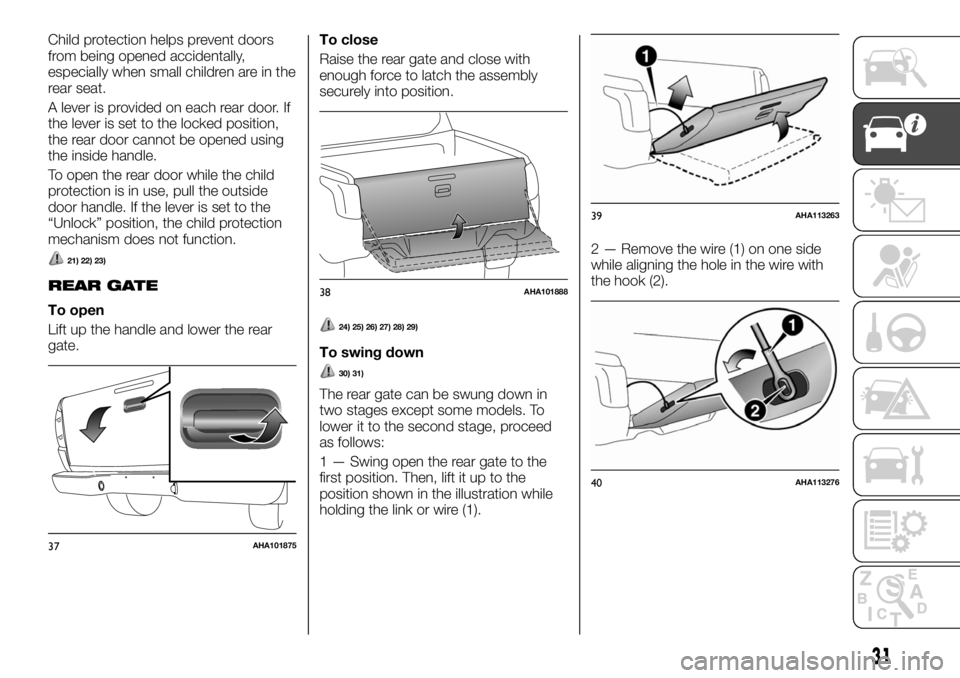
The rear gate can be swung down in
two stages except some models. To
lower it to the second stage, proceed
as follows:
1 — Swing open the rear gate to the
first position. Then, lift it up to the
position shown in the illustration while
holding the link or wire (1).2 — Remove the wire (1) on one side
while aligning the hole in the wire with
the hook (2).
37AHA101875
38AHA101888
39AHA113263
40AHA113276
31
Page 34 of 312
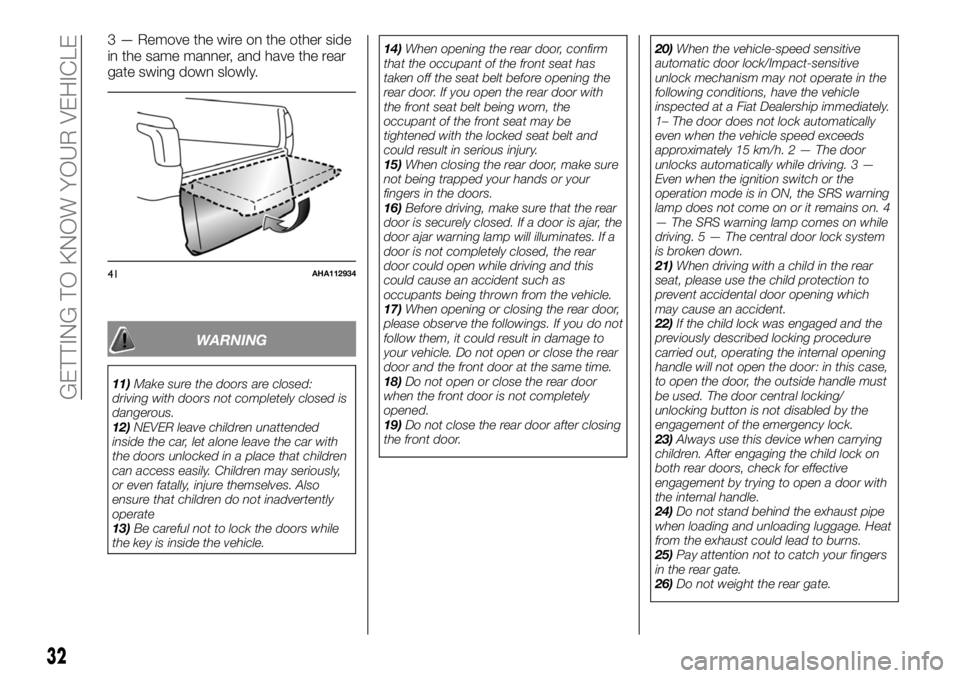
3 — Remove the wire on the other side
in the same manner, and have the rear
gate swing down slowly.
WARNING
11)Make sure the doors are closed:
driving with doors not completely closed is
dangerous.
12)NEVER leave children unattended
inside the car, let alone leave the car with
the doors unlocked in a place that children
can access easily. Children may seriously,
or even fatally, injure themselves. Also
ensure that children do not inadvertently
operate
13)Be careful not to lock the doors while
the key is inside the vehicle.14)When opening the rear door, confirm
that the occupant of the front seat has
taken off the seat belt before opening the
rear door. If you open the rear door with
the front seat belt being worn, the
occupant of the front seat may be
tightened with the locked seat belt and
could result in serious injury.
15)When closing the rear door, make sure
not being trapped your hands or your
fingers in the doors.
16)Before driving, make sure that the rear
door is securely closed. If a door is ajar, the
door ajar warning lamp will illuminates. If a
door is not completely closed, the rear
door could open while driving and this
could cause an accident such as
occupants being thrown from the vehicle.
17)When opening or closing the rear door,
please observe the followings. If you do not
follow them, it could result in damage to
your vehicle. Do not open or close the rear
door and the front door at the same time.
18)Do not open or close the rear door
when the front door is not completely
opened.
19)Do not close the rear door after closing
the front door.20)When the vehicle-speed sensitive
automatic door lock/Impact-sensitive
unlock mechanism may not operate in the
following conditions, have the vehicle
inspected at a Fiat Dealership immediately.
1– The door does not lock automatically
even when the vehicle speed exceeds
approximately 15 km/h. 2 — The door
unlocks automatically while driving. 3 —
Even when the ignition switch or the
operation mode is in ON, the SRS warning
lamp does not come on or it remains on. 4
— The SRS warning lamp comes on while
driving. 5 — The central door lock system
is broken down.
21)When driving with a child in the rear
seat, please use the child protection to
prevent accidental door opening which
may cause an accident.
22)If the child lock was engaged and the
previously described locking procedure
carried out, operating the internal opening
handle will not open the door: in this case,
to open the door, the outside handle must
be used. The door central locking/
unlocking button is not disabled by the
engagement of the emergency lock.
23)Always use this device when carrying
children. After engaging the child lock on
both rear doors, check for effective
engagement by trying to open a door with
the internal handle.
24)Do not stand behind the exhaust pipe
when loading and unloading luggage. Heat
from the exhaust could lead to burns.
25)Pay attention not to catch your fingers
in the rear gate.
26)Do not weight the rear gate.
41AHA112934
32
GETTING TO KNOW YOUR VEHICLE
Page 37 of 312
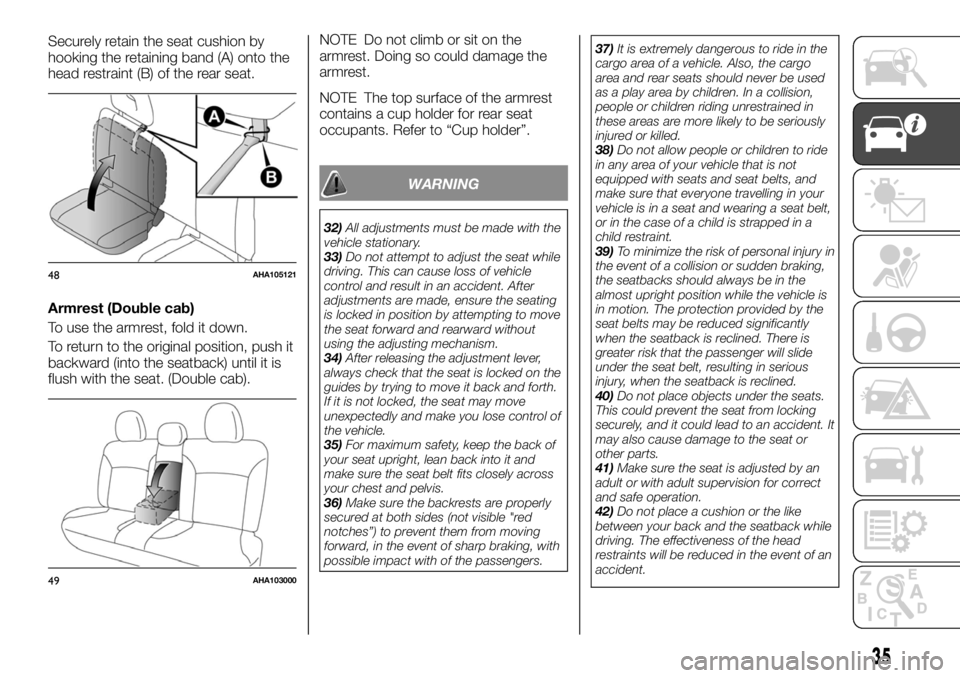
Securely retain the seat cushion by
hooking the retaining band (A) onto the
head restraint (B) of the rear seat.
Armrest (Double cab)
To use the armrest, fold it down.
To return to the original position, push it
backward (into the seatback) until it is
flush with the seat. (Double cab).NOTE Do not climb or sit on the
armrest. Doing so could damage the
armrest.
NOTE The top surface of the armrest
contains a cup holder for rear seat
occupants. Refer to “Cup holder”.
WARNING
32)All adjustments must be made with the
vehicle stationary.
33)Do not attempt to adjust the seat while
driving. This can cause loss of vehicle
control and result in an accident. After
adjustments are made, ensure the seating
is locked in position by attempting to move
the seat forward and rearward without
using the adjusting mechanism.
34)After releasing the adjustment lever,
always check that the seat is locked on the
guides by trying to move it back and forth.
If it is not locked, the seat may move
unexpectedly and make you lose control of
the vehicle.
35)For maximum safety, keep the back of
your seat upright, lean back into it and
make sure the seat belt fits closely across
your chest and pelvis.
36)Make sure the backrests are properly
secured at both sides (not visible "red
notches”) to prevent them from moving
forward, in the event of sharp braking, with
possible impact with of the passengers.37)It is extremely dangerous to ride in the
cargo area of a vehicle. Also, the cargo
area and rear seats should never be used
as a play area by children. In a collision,
people or children riding unrestrained in
these areas are more likely to be seriously
injured or killed.
38)Do not allow people or children to ride
in any area of your vehicle that is not
equipped with seats and seat belts, and
make sure that everyone travelling in your
vehicle is in a seat and wearing a seat belt,
or in the case of a child is strapped in a
child restraint.
39)To minimize the risk of personal injury in
the event of a collision or sudden braking,
the seatbacks should always be in the
almost upright position while the vehicle is
in motion. The protection provided by the
seat belts may be reduced significantly
when the seatback is reclined. There is
greater risk that the passenger will slide
under the seat belt, resulting in serious
injury, when the seatback is reclined.
40)Do not place objects under the seats.
This could prevent the seat from locking
securely, and it could lead to an accident. It
may also cause damage to the seat or
other parts.
41)Make sure the seat is adjusted by an
adult or with adult supervision for correct
and safe operation.
42)Do not place a cushion or the like
between your back and the seatback while
driving. The effectiveness of the head
restraints will be reduced in the event of an
accident.
48AHA105121
49AHA103000
35
Page 38 of 312
43)The reclining mechanism of the front
manual seat's seatback is spring loaded,
causing it to fold the seatback forward
when the lock lever is operated. When
using the lever, sit close to the seatback or
hold it with your hand to control its return
motion.
44)When sliding the seats, be careful not
to catch your hand or foot.
45)If your vehicle is equipped with the rear
seat, when sliding or reclining the seat
rearward, pay careful attention to the rear
seat passengers.
46)If the following types of persons use
the heated seats, they might become too
hot or receive minor burns (red skin, heat
blisters, etc.): children, elderly or ill people,
people with sensitive skin, excessively tired
people, people under the influence of
alcohol or sleep inducing medication (cold
medicine, etc.).
IMPORTANT
10)The fabric upholstery of the seats has
been designed to withstand long-term wear
deriving from normal use of the car. Some
precautions are however required. Avoid
prolonged and/or excessive rubbing
against clothing accessories such as metal
buckles and Velcro strips which, by
applying a high pressure on the fabric in a
small area, could cause it to break, thereby
damaging the upholstery.11)Operate in the “HI” position for quick
heating. Once the seat is warm, set the
heater switch to the “LO” position to keep it
warm. Slight variations in seat temperature
may be felt while using the heated seats.
This is caused by the operation of the
heater’s internal thermostat and does not
indicate a malfunction.
12)Do not place heavy objects on the seat
or stick pins, needles, or other pointed
objects into it.
13)Do not use a blanket, cushion, or other
material with high heat insulation properties
on the seat while using the heater; this
might cause the heater element to
overheat.
14)Do not use benzine, kerosene, petrol,
alcohol or other organic solvents when
cleaning the seats. Doing so could damage
not only the seat cover, but also the heater
element.
15)If water or any other liquid is spilled on
the seat, allow it to dry thoroughly before
attempting to use the heater.
16)Turn the heater off immediately if it
appears to be malfunctioning during use.
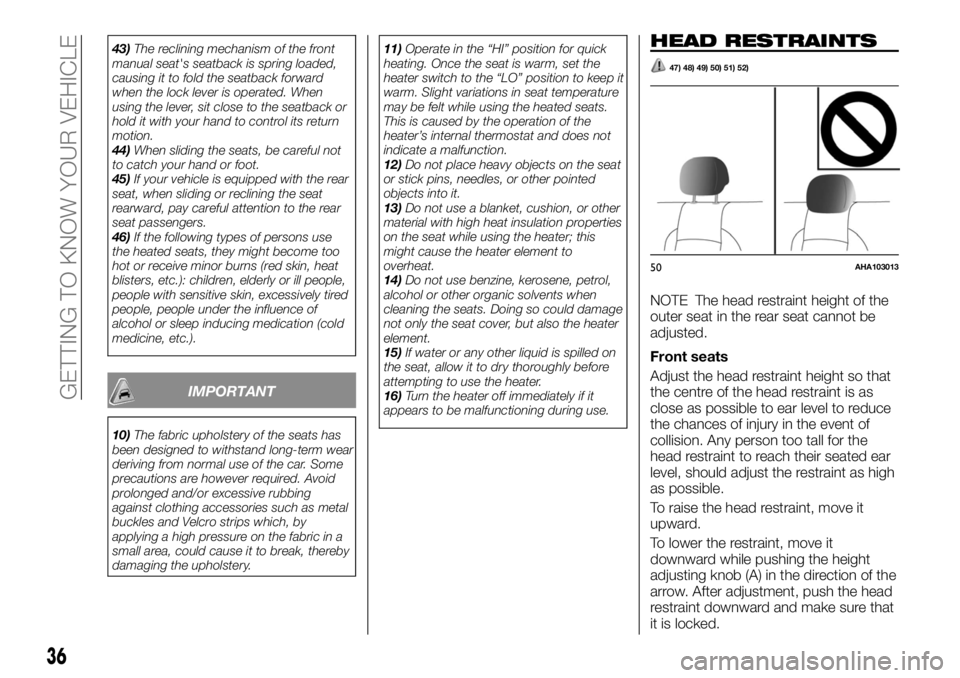
HEAD RESTRAINTS
47) 48) 49) 50) 51) 52)
NOTE The head restraint height of the
outer seat in the rear seat cannot be
adjusted.
Front seats
Adjust the head restraint height so that
the centre of the head restraint is as
close as possible to ear level to reduce
the chances of injury in the event of
collision. Any person too tall for the
head restraint to reach their seated ear
level, should adjust the restraint as high
as possible.
To raise the head restraint, move it
upward.
To lower the restraint, move it
downward while pushing the height
adjusting knob (A) in the direction of the
arrow. After adjustment, push the head
restraint downward and make sure that
it is locked.
50AHA103013
36
GETTING TO KNOW YOUR VEHICLE
Page 73 of 312
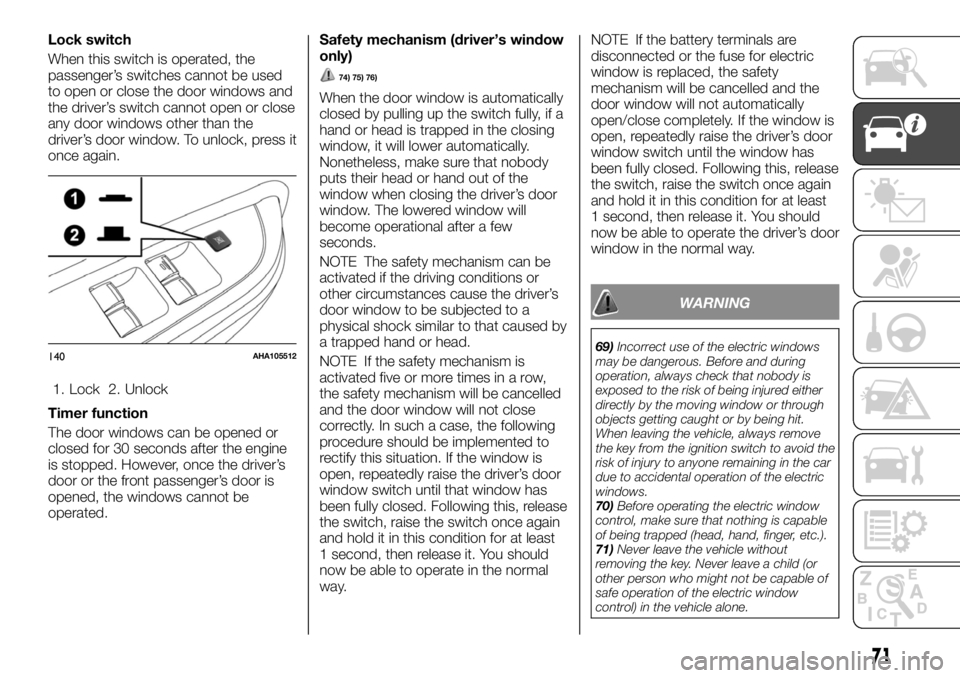
Lock switch
When this switch is operated, the
passenger’s switches cannot be used
to open or close the door windows and
the driver’s switch cannot open or close
any door windows other than the
driver’s door window. To unlock, press it
once again.
1. Lock 2. Unlock
Timer function
The door windows can be opened or
closed for 30 seconds after the engine
is stopped. However, once the driver’s
door or the front passenger’s door is
opened, the windows cannot be
operated.Safety mechanism (driver’s window
only)
74) 75) 76)
When the door window is automatically
closed by pulling up the switch fully, if a
hand or head is trapped in the closing
window, it will lower automatically.
Nonetheless, make sure that nobody
puts their head or hand out of the
window when closing the driver’s door
window. The lowered window will
become operational after a few
seconds.
NOTE The safety mechanism can be
activated if the driving conditions or
other circumstances cause the driver’s
door window to be subjected to a
physical shock similar to that caused by
a trapped hand or head.
NOTE If the safety mechanism is
activated five or more times in a row,
the safety mechanism will be cancelled
and the door window will not close
correctly. In such a case, the following
procedure should be implemented to
rectify this situation. If the window is
open, repeatedly raise the driver’s door
window switch until that window has
been fully closed. Following this, release
the switch, raise the switch once again
and hold it in this condition for at least
1 second, then release it. You should
now be able to operate in the normal
way.NOTE If the battery terminals are
disconnected or the fuse for electric
window is replaced, the safety
mechanism will be cancelled and the
door window will not automatically
open/close completely. If the window is
open, repeatedly raise the driver’s door
window switch until the window has
been fully closed. Following this, release
the switch, raise the switch once again
and hold it in this condition for at least
1 second, then release it. You should
now be able to operate the driver’s door
window in the normal way.
WARNING
69)Incorrect use of the electric windows
may be dangerous. Before and during
operation, always check that nobody is
exposed to the risk of being injured either
directly by the moving window or through
objects getting caught or by being hit.
When leaving the vehicle, always remove
the key from the ignition switch to avoid the
risk of injury to anyone remaining in the car
due to accidental operation of the electric
windows.
70)Before operating the electric window
control, make sure that nothing is capable
of being trapped (head, hand, finger, etc.).
71)Never leave the vehicle without
removing the key. Never leave a child (or
other person who might not be capable of
safe operation of the electric window
control) in the vehicle alone.140AHA105512
71
Page 74 of 312
72)A child may tamper with the switch at
the risk of its hands or head being trapped
in the window.
73)When driving with a child in the vehicle,
please press the window lock switch to
disable the passenger’s switches.
74)If the battery terminals are
disconnected or the fuse for electric
window is replaced, the safety mechanism
will be cancelled. If a hand or head got
trapped, a serious injury could result.
75)The safety mechanism is cancelled just
before the window is fully closed. This
allows the window to close completely.
Therefore be especially careful that no
fingers are trapped in the window.
76)The safety mechanism is deactivated
while the switch is pulled up. Therefore be
especially careful that fingers are not
trapped in the door window opening.CATALYTIC
CONVERTER
The exhaust gas scavenging devices
used with catalytic converter are
extremely efficient for the reduction of
noxious gases. The catalytic converter
is installed in the exhaust system.
It is important to keep the engine
properly tuned to ensure proper catalyst
operation and prevent possible catalyst
damage.
77)
NOTE Use fuel of the type
recommended in “Fuel selection”.
WARNING
77)As with any vehicle, do not park or
operate this vehicle in areas where
combustible materials such as dry grass or
leaves can come in contact with a hot
exhaust since a fire could occur.
DIESEL
PARTICULATE
FILTER (DPF)
(where provided)
The diesel particulate filter (DPF) is a
device that captures most of the
particulate matter (PM) in the exhaust
emissions of the diesel engine. The DPF
automatically burns away trapped PM
during vehicle operation. Under certain
driving conditions, however, the DPF is
not able to burn away all of the trapped
PM and, as a result, an excessive
amount of PM accumulates inside it.
78)
27)
NOTE To minimize the likelihood of
excessive accumulation of PM, try to
avoid driving for long periods at low
speeds and repeatedly driving short
distances and try to keep high engine
speed driving as much as possible.
NOTE The engine sounds slightly
different from usual while the DPF
automatically burns away trapped PM.
The change in the engine sound does
not indicate a fault.
DPF warning lamp
The DPF warning lamp comes on in the
event of an abnormality in the DPF
system.
72
GETTING TO KNOW YOUR VEHICLE
Page 128 of 312
To remove
Remove the child restraint system in
accordance with the instructions
provided by the child restraint system’s
manufacturer.
Installing a child restraint system to
a 3-point type seat belt (with
emergency locking mechanism)
Installation
1. Put a child restraint system on the
seat in which you wish to install it and
remove the head restraint from the seat.
Refer to “Head restraints”.
2. When installing a child restraint
system in the front passenger seat,
adjust seat slide to its most rearward
position.
3. Route the belt through the child
restraint according to the child restraint
system manufacturer’s instructions,
then insert the latch plate into the
buckle.
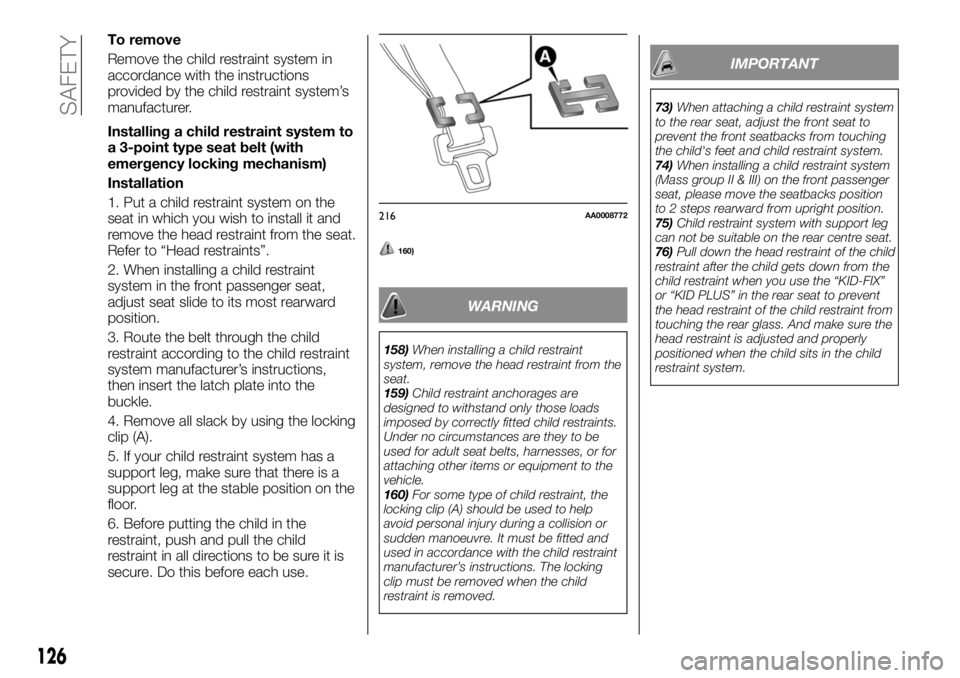
4. Remove all slack by using the locking
clip (A).
5. If your child restraint system has a
support leg, make sure that there is a
support leg at the stable position on the
floor.
6. Before putting the child in the
restraint, push and pull the child
restraint in all directions to be sure it is
secure. Do this before each use.
160)
WARNING
158)When installing a child restraint
system, remove the head restraint from the
seat.
159)Child restraint anchorages are
designed to withstand only those loads
imposed by correctly fitted child restraints.
Under no circumstances are they to be
used for adult seat belts, harnesses, or for
attaching other items or equipment to the
vehicle.
160)For some type of child restraint, the
locking clip (A) should be used to help
avoid personal injury during a collision or
sudden manoeuvre. It must be fitted and
used in accordance with the child restraint
manufacturer’s instructions. The locking
clip must be removed when the child
restraint is removed.
IMPORTANT
73)When attaching a child restraint system
to the rear seat, adjust the front seat to
prevent the front seatbacks from touching
the child's feet and child restraint system.
74)When installing a child restraint system
(Mass group II & III) on the front passenger
seat, please move the seatbacks position
to 2 steps rearward from upright position.
75)Child restraint system with support leg
can not be suitable on the rear centre seat.
76)Pull down the head restraint of the child
restraint after the child gets down from the
child restraint when you use the “KID-FIX”
or “KID PLUS” in the rear seat to prevent
the head restraint of the child restraint from
touching the rear glass. And make sure the
head restraint is adjusted and properly
positioned when the child sits in the child
restraint system.
216AA0008772
126
SAFETY
Page 137 of 312
168)Do not sit on the edge of the seat, or
sit with your lower legs too close to the
instrument panel, or lean head or chest
close to the steering wheel or instrument
panel. Do not put feet or legs on or against
the instrument panel.
169)Always drive with your hands on the
rim of the steering wheel so that the airbag
can inflate freely if required. Do not drive
with your body bent forward. Keep your
back straight against the backrest.
170)Place all infants and small children in
the rear seat and properly restrained using
an appropriate child restraint system. The
rear seat is the safest for infants and
children.
171)Infants and small children should
never be unrestrained, stand up against
the instrument panel or held in your arms
or on your lap. They could be seriously
injured or killed in a collision, including
when the airbag inflates. They should be
properly seated in an appropriate child
restraint system. See the “Child restraint”
section of this owner’s manual.
172)When there is an active passenger
airbag, DO NOT install rearward facing
child restraint systems on the front seat.
Deployment of the airbag in an accident
could cause fatal injuries to the child
regardless of the severity of the impact.
Therefore, always deactivate the passenger
side airbag when a rearward facing child
restraint system is installed on the front
passenger seat. The front passenger seat
must also be positioned back as far as
possible in order to prevent the child
restraint system from coming into contact
with the dashboard. Immediately reactivate
the passenger airbag as soon as the child
restraint system has been removed.173)Older children should be seated,
properly wearing the seat belt, with an
appropriate booster seat if needed.
174)Extreme Hazard! NEVER use a
rearward facing child restraint on a seat
protected by an ACTIVE AIRBAG in front of
it, DEATH or SERIOUS INJURY to the
CHILD can occur.
175)Do not fit any accessory that makes
the indicator impossible to see, and do not
cover the indicator with a sticker. You
would not be able to verify the status of the
passenger airbag system.176)To reduce risk of serious or fatal
injury: always turn the ignition switch to the
“LOCK” position or put the operation mode
in OFF, before operating the front
passenger’s airbag ON-OFF switch. Failure
to do so could adversely affect the airbag
performance; Wait at least 60 seconds to
operate the front passenger’s airbag
ON-OFF switch after turning the ignition
switch to the “LOCK” position or putting
the operation mode in OFF. The SRS
airbag system is designed to retain enough
voltage to deploy the airbag; Always
remove the key from the front passenger’s
airbag ON-OFF switch after operating that
switch. Failure to do so could lead to
improper position of the front passenger’s
airbag ON-OFF switch; Do not turn OFF
the front passenger’s airbag ON-OFF
switch except when a child restraint
system is fitted to the front passenger seat;
If the OFF indicator does not come on
when the front passenger’s airbag ONOFF
switch is turned OFF, do not fit a child
restraint system to the front passenger
seat. We recommend you to have the
system inspected by a Fiat Dealership; if
the OFF indicator remains on when the
front passenger’s airbag ON-OFF switch is
turned ON, do not allow anyone to sit on
the front passenger seat. We recommend
you to have the system inspected by a Fiat
Dealership.
177)Do not apply stickers or other objects
to the steering wheel, the dashboard in the
passenger side airbag area and the seats.
Never put objects (e.g. mobile phones) on
the passenger side of the dashboard since
they could interfere with correct inflation of
the passenger airbag and also cause
serious injury to the passengers.
135