low FIAT FULLBACK 2018 Owner handbook (in English)
[x] Cancel search | Manufacturer: FIAT, Model Year: 2018, Model line: FULLBACK, Model: FIAT FULLBACK 2018Pages: 316, PDF Size: 10.52 MB
Page 263 of 316
PETROLEUM- BASED FLUID TO
CONTACT, MIX WITH, OR OTHERWISE
CONTAMINATE THE BRAKE FLUID.
SEAL DAMAGE WILL RESULT.
388)
WARNING
388)Take care in handling brake fluid as it
is harmful to the eyes, may irritate your skin
and will damage to painted surfaces. Wipe
up spills immediately. If brake fluid gets on
your hands or in your eyes, flush
immediately with clean water. Follow up
with a doctor as necessary.
POWER STEERING
FLUID
389)
3)
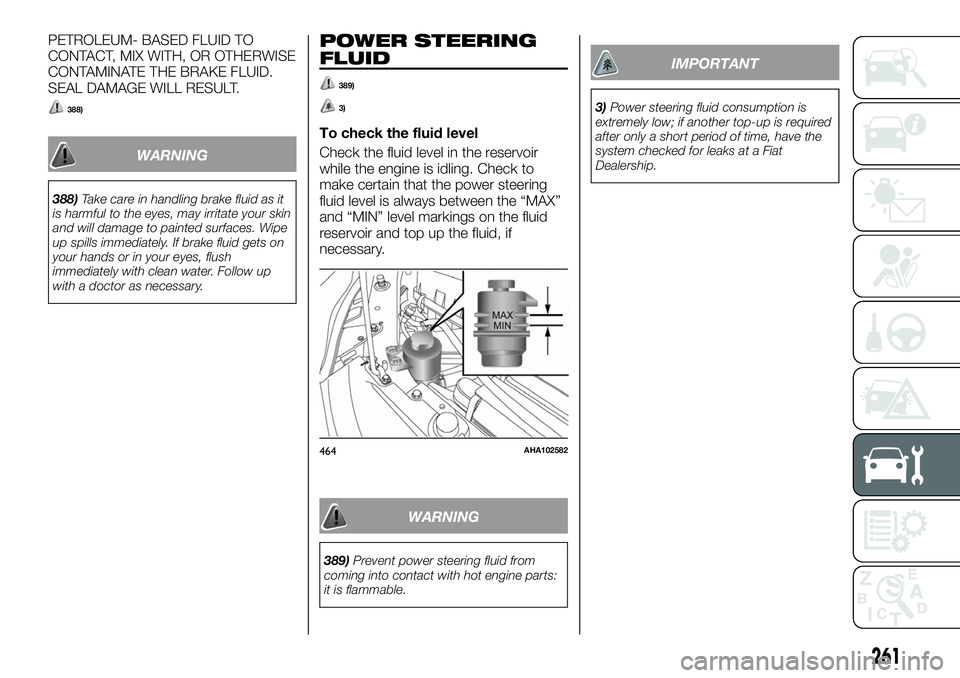
To check the fluid level
Check the fluid level in the reservoir
while the engine is idling. Check to
make certain that the power steering
fluid level is always between the “MAX”
and “MIN” level markings on the fluid
reservoir and top up the fluid, if
necessary.
WARNING
389)Prevent power steering fluid from
coming into contact with hot engine parts:
it is flammable.
IMPORTANT
3)Power steering fluid consumption is
extremely low; if another top-up is required
after only a short period of time, have the
system checked for leaks at a Fiat
Dealership.
464AHA102582
261
Page 264 of 316
BATTERY
4)
The condition of the battery is very
important for quick starting of the
engine and proper functioning of the
vehicle’s electrical system. Regular
inspection and care are especially
important in cold weather.
390) 391) 392) 393) 394) 395) 396) 397)
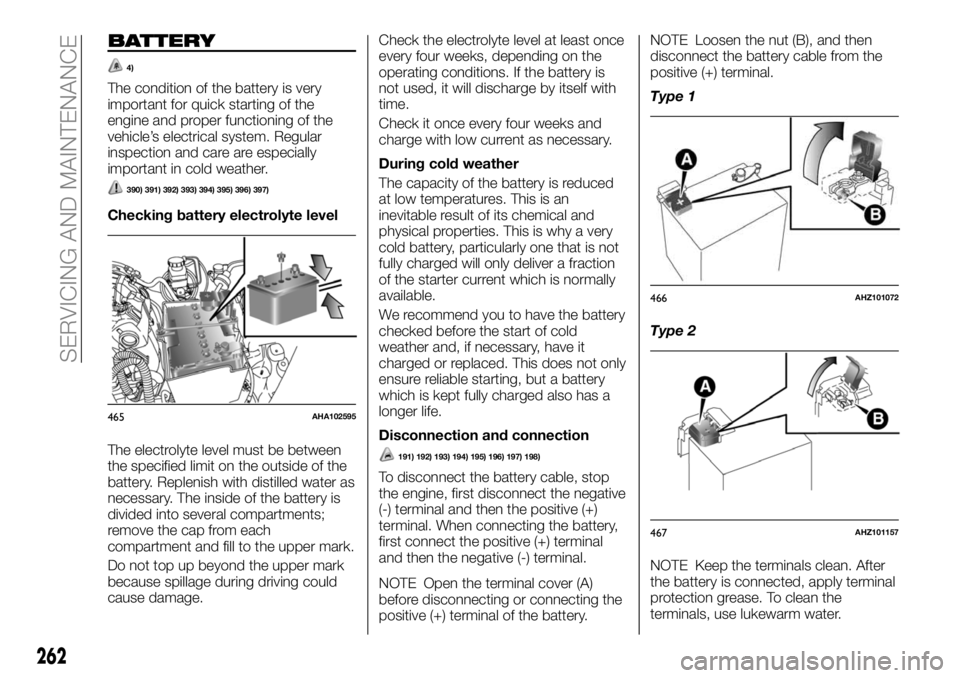
Checking battery electrolyte level
The electrolyte level must be between
the specified limit on the outside of the
battery. Replenish with distilled water as
necessary. The inside of the battery is
divided into several compartments;
remove the cap from each
compartment and fill to the upper mark.
Do not top up beyond the upper mark
because spillage during driving could
cause damage.Check the electrolyte level at least once
every four weeks, depending on the
operating conditions. If the battery is
not used, it will discharge by itself with
time.
Check it once every four weeks and
charge with low current as necessary.
During cold weather
The capacity of the battery is reduced
at low temperatures. This is an
inevitable result of its chemical and
physical properties. This is why a very
cold battery, particularly one that is not
fully charged will only deliver a fraction
of the starter current which is normally
available.
We recommend you to have the battery
checked before the start of cold
weather and, if necessary, have it
charged or replaced. This does not only
ensure reliable starting, but a battery
which is kept fully charged also has a
longer life.
Disconnection and connection
191) 192) 193) 194) 195) 196) 197) 198)
To disconnect the battery cable, stop
the engine, first disconnect the negative
(-) terminal and then the positive (+)
terminal. When connecting the battery,
first connect the positive (+) terminal
and then the negative (-) terminal.
NOTE Open the terminal cover (A)
before disconnecting or connecting the
positive (+) terminal of the battery.NOTE Loosen the nut (B), and then
disconnect the battery cable from the
positive (+) terminal.
Type 1
Type 2
NOTE Keep the terminals clean. After
the battery is connected, apply terminal
protection grease. To clean the
terminals, use lukewarm water.
465AHA102595
466AHZ101072
467AHZ101157
262
SERVICING AND MAINTENANCE
Page 265 of 316
NOTE Check to see if the battery is
securely installed and cannot be moved
during travel. Also check each terminal
for tightness.
NOTE When the vehicle is to be left
unused for a long period of time,
remove the battery and store it in a
place where the battery fluid will not
freeze. The battery should be stored
only in a fully charged condition.
WARNING
390)Battery liquid is poisonous and
corrosive. Avoid contact with skin and
eyes. Keep naked flames and sources of
sparks away from the battery: risk of
explosion and fire.
391)Before performing any operation on
the electrical system, disconnect the
negative battery cable through the suitable
terminal, after having waited at least one
minute from turning the ignition key to
STOP.
392)Keep sparks, cigarettes, and flames
away from the battery because the battery
could explode.
393)The battery electrolyte is extremely
caustic. Do not allow it to come in contact
with your eyes, skin, clothing, or the
painted surfaces of the vehicle. Spilt
electrolyte should be flushed immediately
with ample amounts of water. Irritation to
eyes or skin from contact with electrolyte
requires immediate medical attention.
394)Ventilate when charging or using the
battery in an enclosed space.395)Always wear protective eye goggles
when working near the battery.
396)Keep it out of reach of children.
397)Using the battery with insufficient fluid
irreparably damages the battery and may
cause an explosion.
IMPORTANT
191)Incorrect assembly of electrical and
electronic devices may cause severe
damage to your vehicle. Contact a Fiat
Dealership if you want to install accessories
after purchasing the vehicle (alarms,
radiophone, etc.): they will suggest the
most suitable devices and advise you
whether a higher capacity battery needs to
be installed.
192)If the vehicle needs to be off the road
for a long period under conditions of
intense cold, remove the battery and take it
to a heated location, otherwise it may
freeze.
193)Do not bring the nearby parts, the
plastic parts and so on into contact with
sulphuric acid (battery electrolyte) which
may crack, stain or discolour them. If they
are in contact, wipe off with soft cloth,
chamois or the like and an aqueous
solution of neutral detergent then
immediately rinse the affected parts with
plenty of water.
194)If the vehicle must remain unused for
a long time at a very low temperature,
remove the battery and take it to a warm
place, to avoid freezing.195)Never disconnect the battery when
the ignition switch or the operation mode is
in the “ON” position; doing so could
damage the vehicle’s electrical
components.
196)Never short-circuit the battery. This
could cause it to overheat and be
damaged.
197)If the battery is to be quick-charged,
first disconnect the battery cables.
198)In order to prevent a short circuit, be
sure to disconnect the negative (-) terminal
first.
IMPORTANT
4)Batteries contain substances which are
very dangerous for the environment. For
battery replacement, contact a Fiat
Dealership.
263
Page 266 of 316
WIPER BLADE
REPLACEMENT
398)
199)
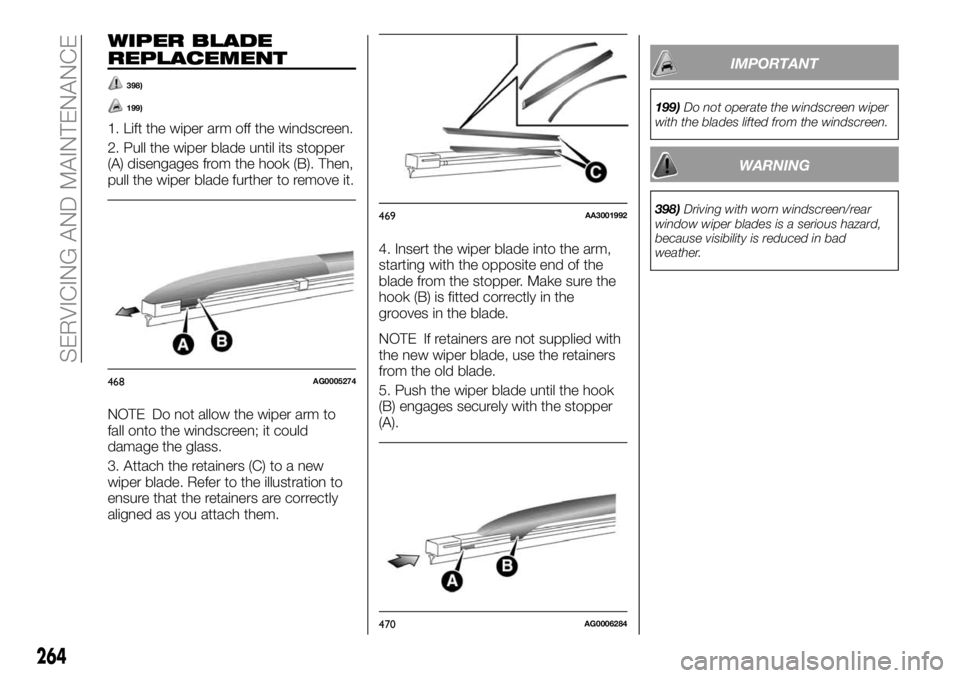
1. Lift the wiper arm off the windscreen.
2. Pull the wiper blade until its stopper
(A) disengages from the hook (B). Then,
pull the wiper blade further to remove it.
NOTE Do not allow the wiper arm to
fall onto the windscreen; it could
damage the glass.
3. Attach the retainers (C) to a new
wiper blade. Refer to the illustration to
ensure that the retainers are correctly
aligned as you attach them.4. Insert the wiper blade into the arm,
starting with the opposite end of the
blade from the stopper. Make sure the
hook (B) is fitted correctly in the
grooves in the blade.
NOTE If retainers are not supplied with
the new wiper blade, use the retainers
from the old blade.
5. Push the wiper blade until the hook
(B) engages securely with the stopper
(A).
IMPORTANT
199)Do not operate the windscreen wiper
with the blades lifted from the windscreen.
WARNING
398)Driving with worn windscreen/rear
window wiper blades is a serious hazard,
because visibility is reduced in bad
weather.
468AG0005274
469AA3001992
470AG0006284
264
SERVICING AND MAINTENANCE
Page 267 of 316
GENERAL
MAINTENANCE
Fuel, engine coolant, oil and
exhaust gas leakage
Look under the body of your vehicle to
check for fuel, engine coolant, oil and
exhaust gas leaks.
Exterior and interior lamp operation
Operate the combination lamp switch
to check that all lamps are functioning
properly. If the lamps do not illuminate,
the probable cause is a blown fuse or
defective lamp bulb. Check the fuses
first. If there is no blown fuses, check
the lamp bulbs. For information
regarding the inspection and
replacement of the fuses and the bulbs,
refer to “Fuses” and “Replacement of
lamp bulbs”.
Meter, gauge and indicator/
warning lamps operation
Start the engine to check the operation
of all instruments, gauges, and indicator
and warning lamps. If there is anything
wrong, we recommend you to have
your vehicle inspected.
Hinges and latches lubrication
Check all latches and hinges, and, if
necessary, have them lubricated.
VEHICLE CARE
PRECAUTIONS
399)
200)
5)
In order to maintain the value of your
vehicle, it is necessary to perform
regular maintenance using the proper
procedures.
Always maintain your vehicle in
compliance with any environmental
pollution control regulations.
Carefully select the materials used for
washing, etc., to be sure that they do
not contain corrosives. If in doubt, we
recommend you to consult a specialist
for the selection of these materials.
WARNING
399)Cleaning products can be dangerous.
Always follow the instructions of the
cleaning product supplier.
IMPORTANT
200)To avoid damage, never use the
following to clean your vehicle: Petrol; Paint
Thinner; Benzine; Kerosene; Turpentine;
Naphtha; Lacquer Thinner; Carbon
Tetrachloride; Nail Polish Remover;
Acetone.
IMPORTANT
5)Detergents pollute the environment. Only
wash your vehicle in areas equipped to
collect and treat wastewater from this type
of activity.
265
Page 269 of 316
IMPORTANT
201)Do not use organic substances
(solvents, benzine, kerosene, alcohol,
petrol, etc.) or alkaline or acidic solutions.
These chemicals can cause discolouring,
staining or cracking of the surface. If you
use cleaners or polishing agents, make
sure their ingredients do not include the
substances mentioned above.
CLEANING THE
EXTERIOR OF YOUR
VEHICLE
If the following is left on your vehicle, it
may cause corrosion, discolouration
and stains, wash the vehicle as soon as
possible.
Seawater, road deicing products.
Soot and dust, iron powder from
factories, chemical substance (acids,
alkalis, coaltar, etc.).
Droppings from birds, carcasses of
insects, tree sap, etc.
Washing
Chemicals contained in the dirt and
dust picked up from the road surface
can damage the paint coat and body of
your vehicle if left in prolonged contact.
Frequent washing and waxing is the
best way to protect your vehicle from
this damage. This will also be effective
in protecting it from environmental
elements such as rain, snow, salt air,
etc.
Using an ample amount of clean water
and a car washing brush or sponge,
wash the vehicle from top to bottom.
Use a mild car washing soap if
necessary. Rinse thoroughly and wipe
dry with a soft cloth. After washing the
vehicle, carefully clean the joints and
flanges of the doors, bonnet and other
sections where dirt is likely to remain.
202) 203) 204) 205) 206) 207) 208) 209) 210)
6)
During cold weather
The salt and other chemicals spread on
the roads in some areas in winter can
have a harmful effect on the vehicle
body. You should therefore wash the
vehicle as often as possible in
accordance with our care-instructions.
It is recommended to have a
preservative applied and the underfloor
protection checked before and after the
cold weather season.
After washing your vehicle, wipe off all
water drops from the rubber parts
around the doors to prevent the doors
from freezing.
Waxing
Waxing the vehicle will help prevent the
adherence of dust and road chemicals
to the paintwork. Apply a wax solution
after washing the vehicle, or at least
once every three months to assist
displacing of water.
Do not wax your vehicle in direct
sunlight. You should wax after the
surfaces have cooled.
For information on how to use wax refer
to the instruction manual of the wax.
211)
Polishing
The vehicle should only be polished if
the paintwork has become stained or
lost its lustre. Do not polish parts with a
mat coating and the plastic bumpers.
267
Page 270 of 316
Doing so could cause stains or damage
the finish.
Cleaning plastic parts
Use a sponge or chamois leather. If a
car wax adheres on a grey or black
rough surface of the bumper, moulding
or lamps, the surface becomes white.
In such a case, wipe it off using
lukewarm water and soft cloth or
chamois leather.
212) 213)
Chrome parts
In order to prevent spots and corrosion
of chrome parts, wash with water, dry
thoroughly, and apply a special
protective coating. This should be done
more frequently in winter.
Aluminium wheels (if so equipped)
Remove dirt using a sponge while
sprinkling water on the wheel.Use
neutral detergent on any dirt that
cannot be removed easily with
water. Rinse off the neutral
detergent after washing the
wheel.Dry the wheel thoroughly
using a chamois leather or a soft
cloth.
214) 215) 216) 217)
Window glass
The window glass can normally be
cleaned using only a sponge and water.
Glass cleaner can be used to removeoil, grease, insect carcasses, etc. After
washing the glass, wipe it dry with a
clean, dry, soft cloth. Never use a cloth
that is used for cleaning a painted
surface to clean a window. Wax from
the painted surface could get on the
glass and lower glass transparency and
visibility.
NOTE To clean the inside of the rear
window, always use a soft cloth and
wipe the window glass along the
demister heater element so as not to
cause damage.
Wiper blades
Use a soft cloth and glass cleaner to
remove grease, insect carcasses, etc.,
from the wiper blades. Replace the
wiper blades when they no longer wipe
properly.
Engine compartment
Clean the engine compartment at the
beginning and end of winter. Pay
particular attention to flanges, crevices
and peripheral parts where dust
containing road chemicals and other
corrosive materials might collect.
If salt and other chemicals are used on
the roads in your area, clean the engine
compartment at least every three
months.
Never spray or splash water on the
electrical components in the engine
compartment, as this may cause
damage.Do not bring the nearby parts, the
plastic parts and so on into contact
with sulphuric acid (battery electrolyte)
which may crack, stain or discolour
them.
If they are in contact, wipe off with soft
cloth, chamois or the like and an
aqueous solution of neutral detergent
then immediately rinse the affected
parts with plenty of water.
Versions with tonneau cover
Hand washing is recommended for the
tonneau cover; modern automatic
washing systems equipped with soft
brushes which do not apply excessive
pressure with specific products may be
used.
Never use high-pressure washing
systems. If a water jet is used, direct
away from the edges of the fabric and
the rear window to prevent water
infiltration.
Versions with stickers or wrapping
To correctly clean and wash the stickers
and/or wrapping parts, proceed as
follows:
Avoid washing with rollers and/or
brushes in washing stations. Then,
wash the vehicle, only by hand, using
pH-neutral detergents; dry it with a wet
chamois leather. Abrasive products
and/or polishes should not be used for
cleaning the vehicle.
If high pressure jets or cleaners are
used to wash the vehicle, hold at least
268
SERVICING AND MAINTENANCE
Page 271 of 316
40 cm away from the bodywork to
avoid damage or alteration. It should be
remembered that the build up of water
can damage the car over a period of
time.
Wash the bodywork using a low
pressure jet of water.
Use a sponge to wipe a slightly
soapy solution over the bodywork,
frequently rinsing the sponge.
Rinse with plenty of water and dry
with a jet of air or a chamois leather. Dry
the less visible parts with special care,
such as the door frames, bonnet and
the headlight frames, where water may
stagnate more easily. The car should
not be taken to a closed area
immediately, but left outside so that
residual water can evaporate.
Do not wash the car after it has been
parked in the sun.
Exterior plastic parts must be
cleaned in the same way as the rest of
the vehicle.
Where possible, do not park under
trees: the resinous substances that
many species release give the paint a
dull appearance and increase the
possibility of triggering rusting
processes.NOTE Any stains (caused by water) on
the stickers or wrapping can be
removed by dampening the area again
and drying it with a soft, nonabrasive
cloth.
NOTE Bird droppings must be washed
off immediately and thoroughly as the
acid they contain is particularly
aggressive.
NOTE Avoid (if at all possible) parking
the car under trees; remove vegetable
resins immediately as, when dried, it
may only be possible to remove them
with abrasive products and/or polishes,
which is highly inadvisable as they
could alter the paint, the stickers or the
wrapping.
IMPORTANT
202)Avoid washing with rollers and/or
brushes in washing stations. Wash the
vehicle only by hand using neutral pH
detergents; dry it with a wet chamois
leather. Abrasive products and/or polishes
should not be used for cleaning the car.
Bird droppings must be washed off
immediately and thoroughly as the acid
they contain is particularly aggressive.
Avoid (if at all possible) parking the vehicle
under trees; remove vegetable resins
immediately as, when dried, it may only be
possible to remove them with abrasive
products and/or polishes, which is highly
inadvisable as they could alter the typical
opaqueness of the paint. Do not use pure
windscreen washer fluid for cleaning the
front windscreen and rear window; dilute it
min. 50% with water. Only use pure screen
washer fluid when strictly necessary due to
outside temperature conditions.
203)When washing the under side of your
vehicle or wheel, be careful not to injure
your hands.
204)If your vehicle is equipped with the
rear gate spoiler, consult a car wash
operator before using the car wash.
205)If your vehicle has rain sensor wipers,
place the wiper switch lever in the “OFF”
position to deactivate the rain sensor
before washing the vehicle. Otherwise, the
wipers will operate in the presence of water
spray on the windscreen and may get
damaged as a result.
269
Page 272 of 316
206)Refrain from excessively using a car
wash as its brushes may scratch the paint
surface, causing it to lose its gloss.
Scratches will be especially visible on
darker coloured vehicles.
207)Never spray or splash water on the
electrical components in the engine
compartment. Doing so could have an
adverse effect on the engine startability.
Exercise caution also when washing the
underbody; be careful not to spray water
into the engine compartment.
208)Some types of hot water washing
equipment apply high pressure and heat to
the vehicle. They may cause heat distortion
and damage to the vehicle resin parts and
may result in flooding of the vehicle interior.
Therefore maintain a good distance of
approx. 70 cm or more between the vehicle
body and the washing nozzle. Also, when
washing around the door glass, hold the
nozzle at a distance of more than 70 cm
and at right angles to the glass surface.
209)After washing the vehicle, drive the
vehicle slowly while lightly depressing the
brake pedal several times in order to dry
out the brakes. Leaving the brakes wet
could result in reduced braking
performance. Also, there is a possibility that
they could freeze up or become inoperative
due to rust, rendering the vehicle unable to
move.210)Using an automatic car wash, pay
attention to the following items, referring to
the operation manual or consulting a car
wash operator. If the following procedure is
not followed, it could result in damage to
your vehicle: 1 – the outside rear view
mirrors are retracted.2–Ifyour vehicle is
equipped with the pillar antenna, it can be
retracted. If your vehicle is equipped with
the roof antenna, it can be removed. 3 –
The wiper arms are secured in place with
tape.4–Ifyour vehicle has rain sensor
wipers, place the wiper switch lever in the
“OFF” position to deactivate the rain
sensor.
211)Waxes containing high abrasive
compounds should not be used.
212)Do not use a scrubbing brush or other
hard tools as they may damage the plastic
part surface.
213)Do not bring the plastic parts into
contact with petrol, light oil, brake fluids,
engine oils, greases, paint thinners and
sulphuric acid (battery electrolyte) which
may crack, stain or discolour the plastic
parts. If they touch the plastic parts, wipe
them off with soft cloth, chamois or the like
and an aqueous solution of neutral
detergent then immediately rinse the
affected parts with water.
214)Do not use a brush or other hard
implement on the wheels. Doing so could
scratch the wheels.
215)Do not use any cleaner that contains
an abrasive substance or is acidic or
alkaline. Doing so could cause the coating
on the wheels to peel or become
discoloured or stained.
216)Do not directly apply hot water using a
steam cleaner or by any other means.217)Contact with seawater and road
deicer can cause corrosion. Rinse off such
substances as soon as possible.
IMPORTANT
6)Detergents pollute the environment. Only
wash your vehicle in areas equipped to
collect and treat waste water from this type
of activity.
270
SERVICING AND MAINTENANCE
Page 275 of 316
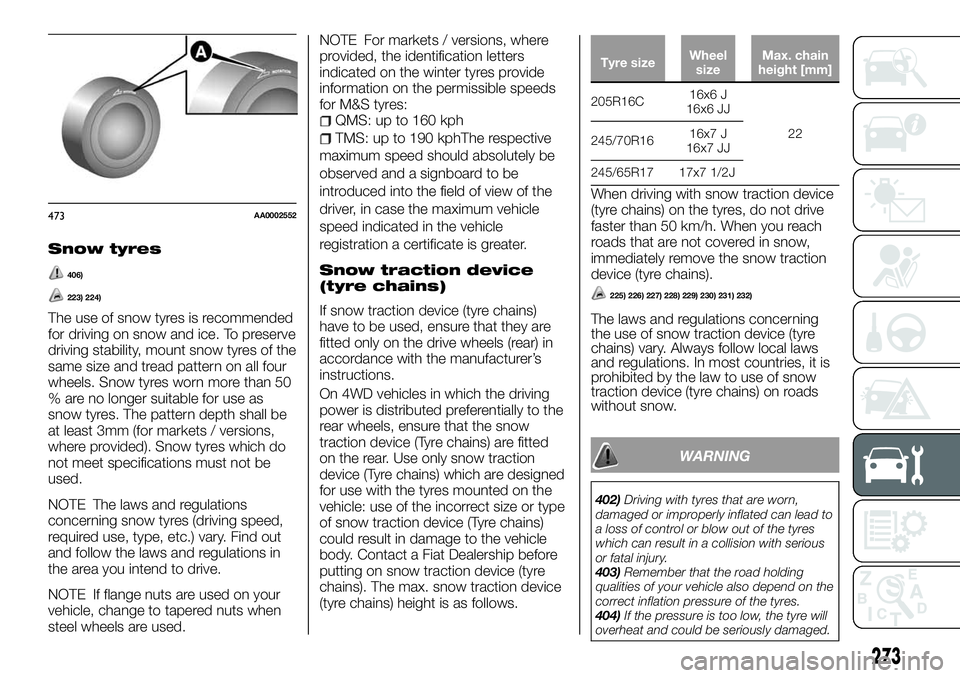
Snow tyres
406)
223) 224)
The use of snow tyres is recommended
for driving on snow and ice. To preserve
driving stability, mount snow tyres of the
same size and tread pattern on all four
wheels. Snow tyres worn more than 50
% are no longer suitable for use as
snow tyres. The pattern depth shall be
at least 3mm (for markets / versions,
where provided). Snow tyres which do
not meet specifications must not be
used.
NOTE The laws and regulations
concerning snow tyres (driving speed,
required use, type, etc.) vary. Find out
and follow the laws and regulations in
the area you intend to drive.
NOTE If flange nuts are used on your
vehicle, change to tapered nuts when
steel wheels are used.NOTE For markets / versions, where
provided, the identification letters
indicated on the winter tyres provide
information on the permissible speeds
for M&S tyres:
QMS: up to 160 kph
TMS: up to 190 kphThe respective
maximum speed should absolutely be
observed and a signboard to be
introduced into the field of view of the
driver, in case the maximum vehicle
speed indicated in the vehicle
registration a certificate is greater.
Snow traction device
(tyre chains)
If snow traction device (tyre chains)
have to be used, ensure that they are
fitted only on the drive wheels (rear) in
accordance with the manufacturer’s
instructions.
On 4WD vehicles in which the driving
power is distributed preferentially to the
rear wheels, ensure that the snow
traction device (Tyre chains) are fitted
on the rear. Use only snow traction
device (Tyre chains) which are designed
for use with the tyres mounted on the
vehicle: use of the incorrect size or type
of snow traction device (Tyre chains)
could result in damage to the vehicle
body. Contact a Fiat Dealership before
putting on snow traction device (tyre
chains). The max. snow traction device
(tyre chains) height is as follows.
Tyre sizeWheel
sizeMax. chain
height [mm]
205R16C16x6 J
16x6 JJ
22
245/70R1616x7 J
16x7 JJ
245/65R17 17x7 1/2J
When driving with snow traction device
(tyre chains) on the tyres, do not drive
faster than 50 km/h. When you reach
roads that are not covered in snow,
immediately remove the snow traction
device (tyre chains).
225) 226) 227) 228) 229) 230) 231) 232)
The laws and regulations concerning
the use of snow traction device (tyre
chains) vary. Always follow local laws
and regulations. In most countries, it is
prohibited by the law to use of snow
traction device (tyre chains) on roads
without snow.
WARNING
402)Driving with tyres that are worn,
damaged or improperly inflated can lead to
a loss of control or blow out of the tyres
which can result in a collision with serious
or fatal injury.
403)Remember that the road holding
qualities of your vehicle also depend on the
correct inflation pressure of the tyres.
404)If the pressure is too low, the tyre will
overheat and could be seriously damaged.
473AA0002552
273