power steering FIAT FULLBACK 2018 Owner handbook (in English)
[x] Cancel search | Manufacturer: FIAT, Model Year: 2018, Model line: FULLBACK, Model: FIAT FULLBACK 2018Pages: 316, PDF Size: 10.52 MB
Page 182 of 316
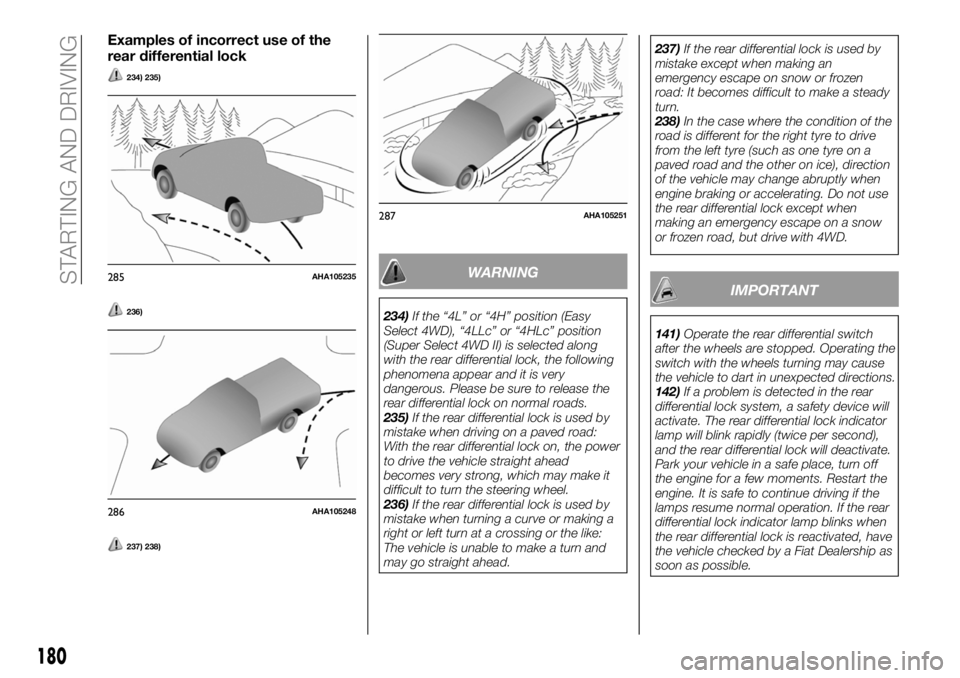
Examples of incorrect use of the
rear differential lock
234) 235)
236)
237) 238)
WARNING
234)If the “4L” or “4H” position (Easy
Select 4WD), “4LLc” or “4HLc” position
(Super Select 4WD II) is selected along
with the rear differential lock, the following
phenomena appear and it is very
dangerous. Please be sure to release the
rear differential lock on normal roads.
235)If the rear differential lock is used by
mistake when driving on a paved road:
With the rear differential lock on, the power
to drive the vehicle straight ahead
becomes very strong, which may make it
difficult to turn the steering wheel.
236)If the rear differential lock is used by
mistake when turning a curve or making a
right or left turn at a crossing or the like:
The vehicle is unable to make a turn and
may go straight ahead.237)If the rear differential lock is used by
mistake except when making an
emergency escape on snow or frozen
road: It becomes difficult to make a steady
turn.
238)In the case where the condition of the
road is different for the right tyre to drive
from the left tyre (such as one tyre on a
paved road and the other on ice), direction
of the vehicle may change abruptly when
engine braking or accelerating. Do not use
the rear differential lock except when
making an emergency escape on a snow
or frozen road, but drive with 4WD.
IMPORTANT
141)Operate the rear differential switch
after the wheels are stopped. Operating the
switch with the wheels turning may cause
the vehicle to dart in unexpected directions.
142)If a problem is detected in the rear
differential lock system, a safety device will
activate. The rear differential lock indicator
lamp will blink rapidly (twice per second),
and the rear differential lock will deactivate.
Park your vehicle in a safe place, turn off
the engine for a few moments. Restart the
engine. It is safe to continue driving if the
lamps resume normal operation. If the rear
differential lock indicator lamp blinks when
the rear differential lock is reactivated, have
the vehicle checked by a Fiat Dealership as
soon as possible.
285AHA105235
286AHA105248
287AHA105251
180
STARTING AND DRIVING
Page 194 of 316
SPEED LIMITER
The Speed Limiter is a driver assist
function to prevent from exceeding the
speed set by driver while engine power
control.
156)
NOTE If depressing the clutch pedal
(M/T), the Speed Limiter does not
activate.
If the vehicle speed exceeds the set
speed, control state “LIMIT” and the
Speed Limiter’s symbol will blink in the
combination meter.
If the vehicle speed exceeds the set
speed after indicated, control state
“LIMIT” and the beep alert will sound a
certain period of time.
While running without blinked control
state “LIMIT” and the Speed Limiter’s
symbol, if you decrease the set speed
and vehicle speed is more than set
speed, control state “LIMIT” and the
Speed Limiter’s symbol blinking starts
but beep alert is delayed.
In this case, when vehicle speed keeps
exceeding set speed for about
30 seconds after control state “LIMIT”
and the Speed Limiter’s symbol are
blinked, beep alert will sound a certain
period of time.
If the vehicle speeds decreases less
than set speeds, control state “LIMIT”
and the Speed Limiter’s symbol stop
blinking. When beep alert is sounding,
the beep alert also goes off.NOTE However, this gives priority to
audio and visual signal of safety
reasons or driver’s demand. If the set
speed is too lower based on current
shift position, the Speed Limiter may
not limit the vehicle speed to prevent
engine stall.
Speed Limiter control switches
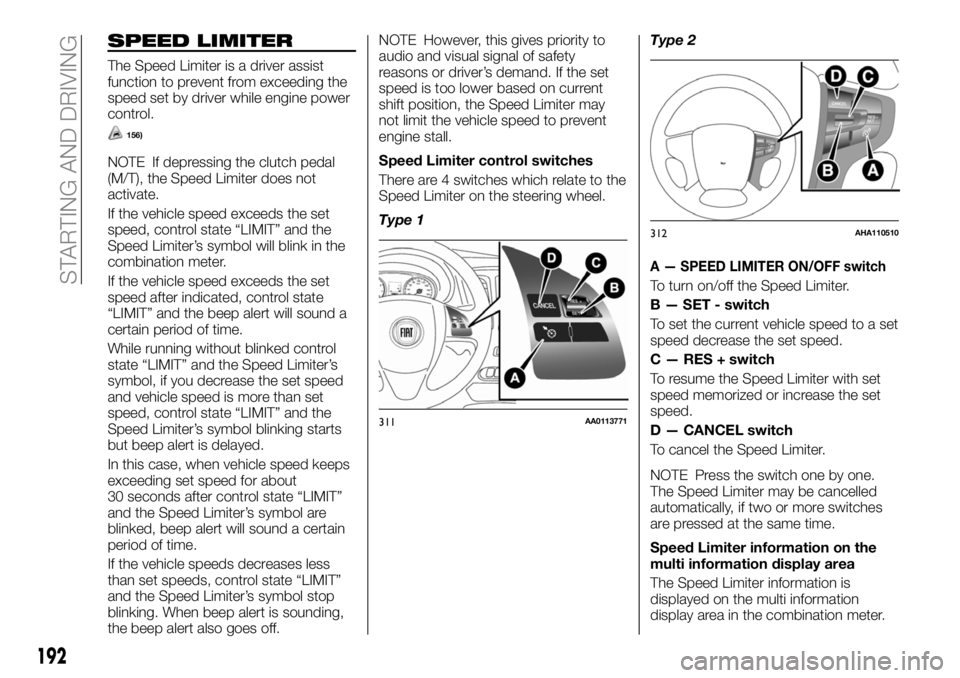
There are 4 switches which relate to the
Speed Limiter on the steering wheel.
Type 1Type 2
A — SPEED LIMITER ON/OFF switch
To turn on/off the Speed Limiter.
B — SET - switch
To set the current vehicle speed to a set
speed decrease the set speed.
C — RES + switch
To resume the Speed Limiter with set
speed memorized or increase the set
speed.
D — CANCEL switch
To cancel the Speed Limiter.
NOTE Press the switch one by one.
The Speed Limiter may be cancelled
automatically, if two or more switches
are pressed at the same time.
Speed Limiter information on the
multi information display area
The Speed Limiter information is
displayed on the multi information
display area in the combination meter.
311AA0113771
312AHA110510
192
STARTING AND DRIVING
Page 212 of 316
IF THE VEHICLE
BREAKS DOWN
If the vehicle breaks down on the road,
move it to the shoulder and use the
hazard warning flashers and/or the
warning triangle etc. Refer to “Hazard
warning flasher switch”.
If the engine stops/fails
Vehicle operation and control are
affected if the engine stops. Before
moving the vehicle to a safe area, be
aware of the following:
The brake booster becomes
inoperative and the pedal effort will
increase. Press down the brake pedal
harder than usual.
Since the power steering system is
no longer operative, the steering wheel
feels heavy when turning it.
First-aid kit and warning triangle
securing bands*
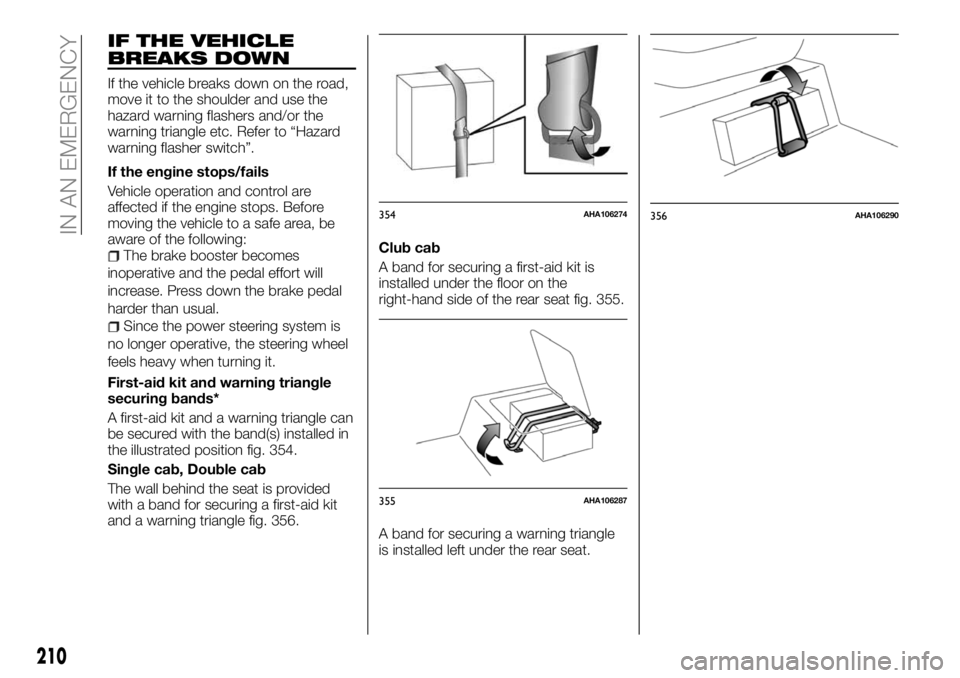
A first-aid kit and a warning triangle can
be secured with the band(s) installed in
the illustrated position fig. 354.
Single cab, Double cab
The wall behind the seat is provided
with a band for securing a first-aid kit
and a warning triangle fig. 356.Club cab
A band for securing a first-aid kit is
installed under the floor on the
right-hand side of the rear seat fig. 355.
A band for securing a warning triangle
is installed left under the rear seat.
.
354AHA106274
355AHA106287
356AHA106290
210
IN AN EMERGENCY
Page 227 of 316
311)Stop jacking up the vehicle as soon
as the tyre is raised off the ground. It is
dangerous to raise the vehicle any higher.
Do not get under your vehicle while using
the jack. Do not bump the raised vehicle or
leave it sitting on the jack for a long time.
Both are very dangerous. Do not use a jack
except the one that came with your
vehicle. The jack should not be used for
any purpose other than to change a tyre.
No one should be in your vehicle when
using the jack. Do not start or run the
engine while your vehicle is on the jack. Do
not turn the raised wheel. The tyres still on
the ground could turn and make your
vehicle fall off the jack.
312)Do not get under your vehicle while
using the jack.
313)Do not bump the raised vehicle or
leave it sitting on the jack for a long time.
Both are very dangerous.
314)Do not use a jack except the one that
came with your vehicle.
315)The jack should not be used for any
purpose other than to change a tyre.
316)No one should be in your vehicle
when using the jack.
317)Do not start or run the engine while
your vehicle is on the jack.
318)Do not turn the raised wheel. The
tyres still on the ground could turn and
make your vehicle fall off the jack.
319)Handle the wheel carefully when
changing the tyre, to avoid scratching the
wheel surface.
320)Mount the spare wheel with the valve
stem K) facing outboard fig. 0. If you
cannot see the valve stem (K), you have
installed the wheel backwards.Operating the vehicle with the spare wheel
installed backwards can cause vehicle
damage and result in an accident.
321)Be sure to open the release valve
slowly. If it is opened quickly, the vehicle will
drop abruptly and the jack may come out
of position, causing a serious accident.
322)Never use your foot or a pipe
extension for extra force in the wheel nut
wrench. If you do so, you will tighten the
nut too much.
323)The tyre pressure should be
periodically checked and maintained at the
specified pressure while the tyre is stowed.
324)After changing the tyre and driving the
vehicle about 1,000 km, retighten the wheel
nuts to make sure that they have not come
loose.
325)If the steering wheel vibrates when
driving after changing the tyre, we
recommend you to have the tyres checked
for balance.
326)Do not mix one type of tyre with
another or use a different size from the one
listed. This would cause early wear and
poor handling.
327)The spare wheel should always be
securely in position. If a flat tyre is changed,
put the flat tyre in the spare wheel
mounting position with the wheel outer
surface upward, and use the wheel nut
wrench to secure it firmly.
328)Never tamper with the inflation valve.
Never introduce tools of any kind between
rim and tyre. Check tyre and spare wheel
pressure regularly, referring to the values
shown in the "Technical specifications"
section.329)The moving components of the jack
(screw and joints) can also cause injuries:
do not touch them. If you come into
contact with lubricating grease, clean
yourself thoroughly.
IMPORTANT
166)Avoid using different size tyres from
the one listed and the combined use of
different types of tyres, as this can affect
driving safety.
167)Even if a wheel has the same rim size
and offset as the specified type of wheel,
its shape may prevent it from being fitted
correctly. Consult an authorised Fiat
Dealership before using wheels that you
have.
168)When installing or removing the spare
wheel, please observe the followings. If you
do not follow them, it could result in break
the spare wheel carrier. Do not use the
power tool. Use the wheel nut wrench
stowed on the vehicle. Do not apply a force
of 400 N or more at the end of the wheel
nut wrench.
169)Never apply oil to either the wheel
bolts or the nuts or they will tighten too
much.
170)If the release valve is loosened too
much (2 or more turns) in the anticlockwise
direction, the jack’s oil will leak and the jack
cannot be used.
171)Close the release valve slowly when
lowering the vehicle, or the valve may be
damaged.
225
Page 231 of 316
175)If you tow the vehicles with automatic
transmission with the driving wheels on the
ground (Type B) as illustrated, make sure
that the towing speed and distance given
below are never exceeded, causing
damage to the transmission. Towing speed:
30 km/h Towing distance: 80 km For the
towing speed and the towing distance,
follow the local driving laws and
regulations.
176)On vehicles with manual transmission,
do not tow the vehicle with the rear wheels
on the ground (Type B) as illustrated.
177)Never tow an automatic transmission
vehicle with the front wheels up (and the
rear wheels on the ground) (Type B) when
the automatic transmission fluid level is low.
This may cause serious and expensive
damage to the transmission.
178)When the engine is not running, the
brake booster and power steering pump do
not operate. This means higher brake
depression force and higher steering effort
are required. Therefore, vehicle operation is
very difficult.
179)Do not leave the ignition switch in the
“LOCK” position or the operation mode in
OFF. The steering wheel will lock, causing
loss of control.
180)On vehicles with Super Select 4WD II,
when you are going to tow another vehicle,
set the drive mode-selector to “4H”
position. Selecting “2H” drive may increase
the differential oil temperature, resulting in
possible damage to the driving system.
Further, the drive train will be subjected to
excessive loading possibly leading to oil
leakage, component seizure, or other
serious faults.OPERATION UNDER
ADVERSE DRIVING
CONDITIONS
On a flooded road
Avoid flooded roads. In the event
driving flooded roads, doing so may
cause the following serious damage to
the vehicle.
Engine stalling
Short in electrical components
Engine damage caused by water
immersion
After driving flooded roads, be sure to
have an inspection at a Fiat Dealership
and take the necessary measures or
repair.
On a wet road
When driving in rain or on a road with
many puddles a layer of water may
form between the tyres and the road
surface. This reduces a tyre’s frictional
resistance on the road, resulting in loss
of steering stability and braking
capability.
To cope with this, observe the following
items:
(a) Drive your vehicle at a slow speed.
(b) Do not drive on worn tyres.
(c) Always maintain the specified tyre
inflation pressures.On a snow-covered or frozen road
When driving on a snow-covered or
frozen road, it is recommended that you
use snow tyres or snow traction device
(tyre chains). Refer to the “Snow tyres”
and “Snow traction device (tyre chains)”
sections.
Avoid high-speed operation, sudden
acceleration, abrupt brake application
and sharp cornering.
Depressing the brake pedal during
travel on snowy or icy roads may cause
tyre slippage and skidding. When
traction between the tyres and the road
is reduced the wheels may skid and the
vehicle cannot readily be brought to a
stop by conventional braking
techniques. Braking will differ,
depending upon whether you have
anti-lock brake system (ABS). If you do
have ABS, brake by pressing the brake
pedal hard, and keeping it pressed. If
you do not have ABS, pump the brake
pedal with short rapid jabs, each time
fully applying and fully releasing for
greatest effect.
Allow extra distance between your
vehicle and the vehicle in front of you,
and avoid sudden braking.
Accumulation of ice on the braking
system can cause the wheels to lock.
Pull away from a standstill slowly after
confirming safety around the vehicle.
342)
229
Page 239 of 316
Fuse replacement
344) 345) 346) 347) 348) 349)
182)
1. Before replacing a fuse, always turn
off the electrical circuit concerned and
place the ignition switch in the “LOCK”
position or put the operation mode in
OFF.
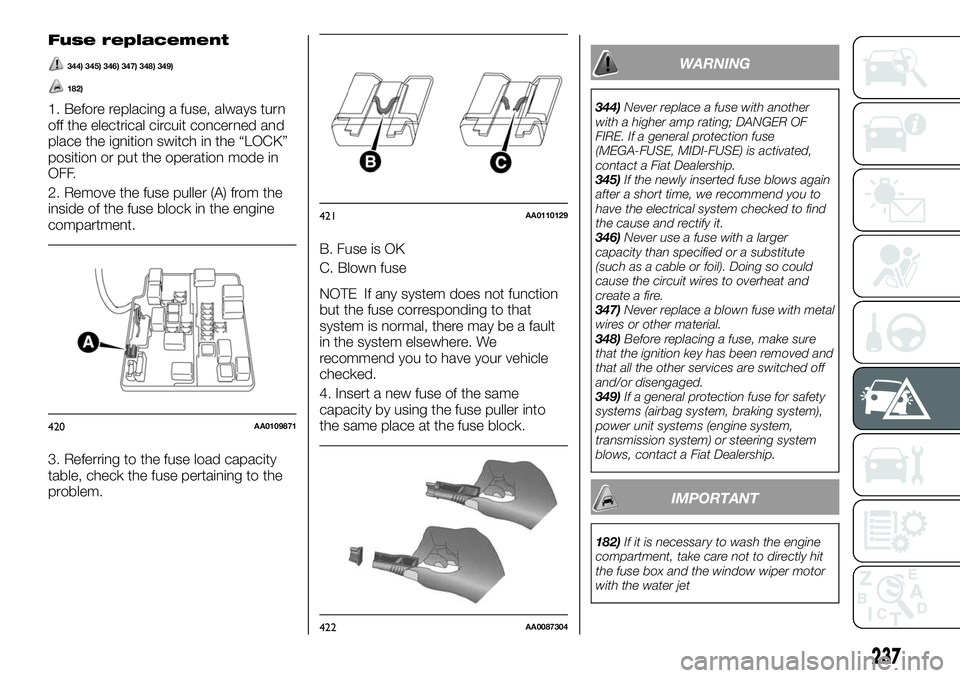
2. Remove the fuse puller (A) from the
inside of the fuse block in the engine
compartment.
3. Referring to the fuse load capacity
table, check the fuse pertaining to the
problem.B. Fuse is OK
C. Blown fuse
NOTE If any system does not function
but the fuse corresponding to that
system is normal, there may be a fault
in the system elsewhere. We
recommend you to have your vehicle
checked.
4. Insert a new fuse of the same
capacity by using the fuse puller into
the same place at the fuse block.
WARNING
344)Never replace a fuse with another
with a higher amp rating; DANGER OF
FIRE. If a general protection fuse
(MEGA-FUSE, MIDI-FUSE) is activated,
contact a Fiat Dealership.
345)If the newly inserted fuse blows again
after a short time, we recommend you to
have the electrical system checked to find
the cause and rectify it.
346)Never use a fuse with a larger
capacity than specified or a substitute
(such as a cable or foil). Doing so could
cause the circuit wires to overheat and
create a fire.
347)Never replace a blown fuse with metal
wires or other material.
348)Before replacing a fuse, make sure
that the ignition key has been removed and
that all the other services are switched off
and/or disengaged.
349)If a general protection fuse for safety
systems (airbag system, braking system),
power unit systems (engine system,
transmission system) or steering system
blows, contact a Fiat Dealership.
IMPORTANT
182)If it is necessary to wash the engine
compartment, take care not to directly hit
the fuse box and the window wiper motor
with the water jet
420AA0109871
421AA0110129
422AA0087304
237
Page 249 of 316
SERVICING AND MAINTENANCE
Correct maintenance permits the
performance of the car to be
maintained over time, as well as limited
running costs and safeguarding the
efficiency of the safety systems.
This chapter explains how.SERVICE PRECAUTIONS.......248
SCHEDULED SERVICING PLAN . .249
PERIODIC CHECKS..........254
DEMANDING VEHICLE USE.....254
CHECKING LEVELS..........255
CATALYTIC CONVERTER.......256
ENGINE OIL...............256
ENGINE COOLANT...........257
WASHER FLUID.............259
BRAKE FLUID..............259
CLUTCH FLUID.............260
POWER STEERING FLUID......261
BATTERY.................262
WIPER BLADE REPLACEMENT . . .264
GENERAL MAINTENANCE......265
VEHICLE CARE PRECAUTIONS. . .265
CLEANING THE INTERIOR OF YOUR
VEHICLE.................266
CLEANING THE EXTERIOR OF YOUR
VEHICLE.................267
TYRES...................271
247
Page 257 of 316
CHECKING LEVELS
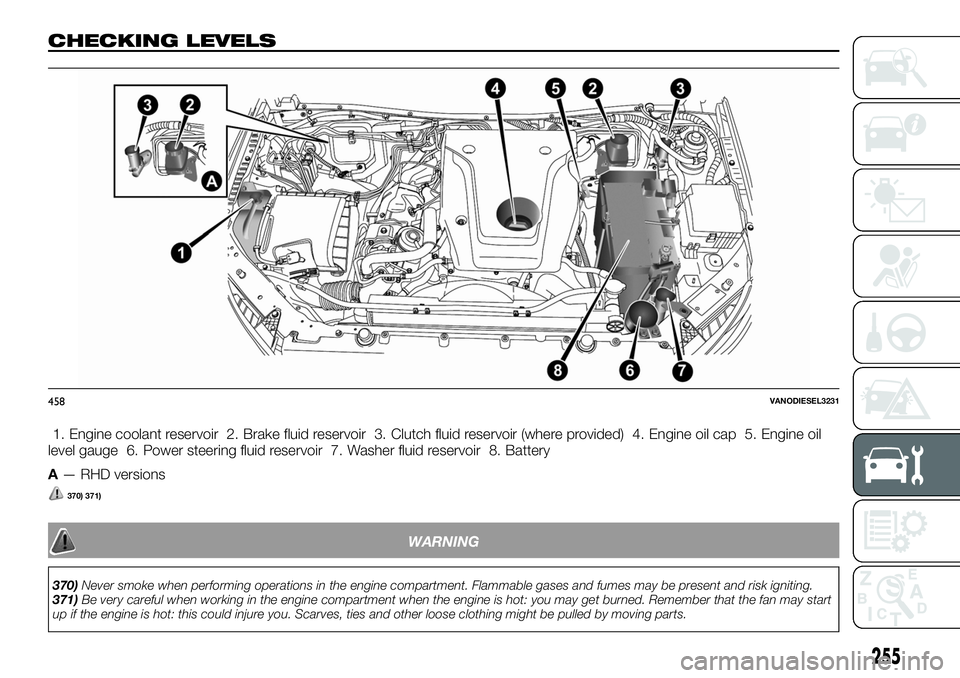
1. Engine coolant reservoir 2. Brake fluid reservoir 3. Clutch fluid reservoir (where provided) 4. Engine oil cap 5. Engine oil
level gauge 6. Power steering fluid reservoir 7. Washer fluid reservoir 8. Battery
A— RHD versions
370) 371)
WARNING
370)Never smoke when performing operations in the engine compartment. Flammable gases and fumes may be present and risk igniting.
371)Be very careful when working in the engine compartment when the engine is hot: you may get burned. Remember that the fan may start
up if the engine is hot: this could injure you. Scarves, ties and other loose clothing might be pulled by moving parts.
458VANODIESEL3231
255
Page 263 of 316
PETROLEUM- BASED FLUID TO
CONTACT, MIX WITH, OR OTHERWISE
CONTAMINATE THE BRAKE FLUID.
SEAL DAMAGE WILL RESULT.
388)
WARNING
388)Take care in handling brake fluid as it
is harmful to the eyes, may irritate your skin
and will damage to painted surfaces. Wipe
up spills immediately. If brake fluid gets on
your hands or in your eyes, flush
immediately with clean water. Follow up
with a doctor as necessary.
POWER STEERING
FLUID
389)
3)
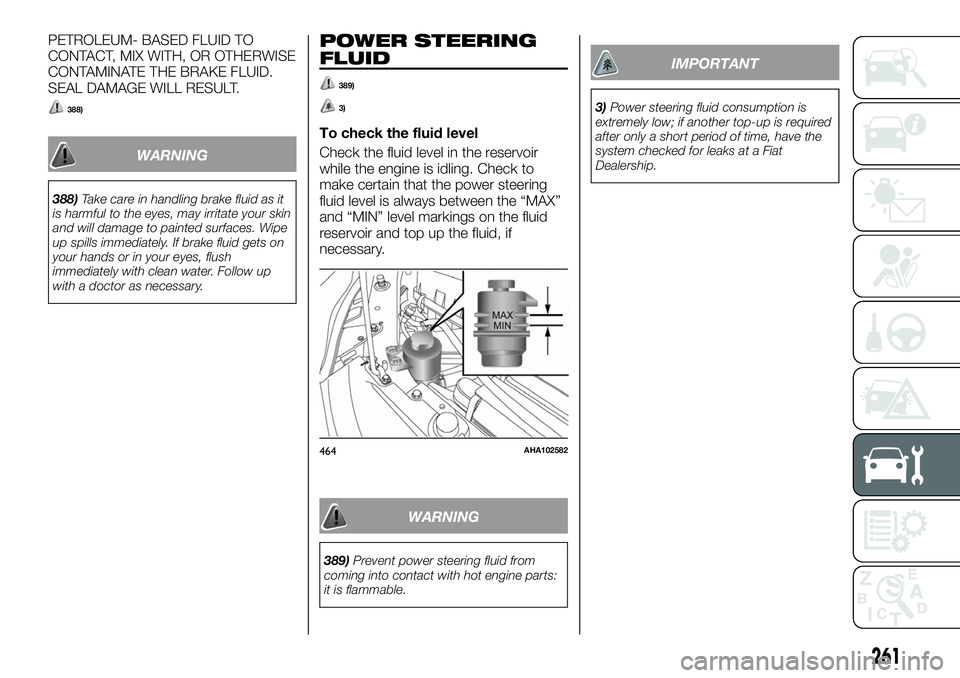
To check the fluid level
Check the fluid level in the reservoir
while the engine is idling. Check to
make certain that the power steering
fluid level is always between the “MAX”
and “MIN” level markings on the fluid
reservoir and top up the fluid, if
necessary.
WARNING
389)Prevent power steering fluid from
coming into contact with hot engine parts:
it is flammable.
IMPORTANT
3)Power steering fluid consumption is
extremely low; if another top-up is required
after only a short period of time, have the
system checked for leaks at a Fiat
Dealership.
464AHA102582
261
Page 297 of 316
No. Quantity Lubricants
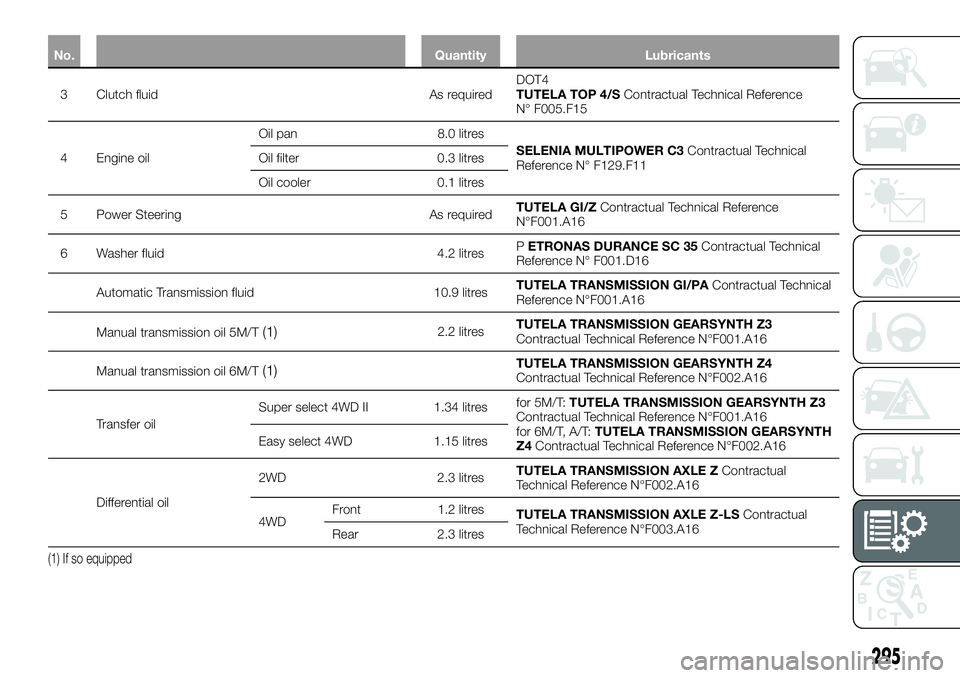
3 Clutch fluid As requiredDOT4
TUTELA TOP 4/SContractual Technical Reference
N° F005.F15
4 Engine oilOil pan 8.0 litres
SELENIA MULTIPOWER C3Contractual Technical
Reference N° F129.F11 Oil filter 0.3 litres
Oil cooler 0.1 litres
5 Power Steering As requiredTUTELA GI/ZContractual Technical Reference
N°F001.A16
6 Washer fluid 4.2 litresPETRONAS DURANCE SC 35Contractual Technical
Reference N° F001.D16
Automatic Transmission fluid 10.9 litresTUTELA TRANSMISSION GI/PAContractual Technical
Reference N°F001.A16
Manual transmission oil 5M/T
(1)2.2 litresTUTELA TRANSMISSION GEARSYNTH Z3
Contractual Technical Reference N°F001.A16
Manual transmission oil 6M/T
(1)TUTELA TRANSMISSION GEARSYNTH Z4
Contractual Technical Reference N°F002.A16
Transfer oilSuper select 4WD II 1.34 litresfor 5M/T:TUTELA TRANSMISSION GEARSYNTH Z3
Contractual Technical Reference N°F001.A16
for 6M/T, A/T:TUTELA TRANSMISSION GEARSYNTH
Z4Contractual Technical Reference N°F002.A16 Easy select 4WD 1.15 litres
Differential oil2WD 2.3 litresTUTELA TRANSMISSION AXLE ZContractual
Technical Reference N°F002.A16
4WDFront 1.2 litres
TUTELA TRANSMISSION AXLE Z-LSContractual
Technical Reference N°F003.A16
Rear 2.3 litres
(1) If so equipped
295