belt FIAT FULLBACK 2018 Owner handbook (in English)
[x] Cancel search | Manufacturer: FIAT, Model Year: 2018, Model line: FULLBACK, Model: FIAT FULLBACK 2018Pages: 316, PDF Size: 10.52 MB
Page 138 of 316
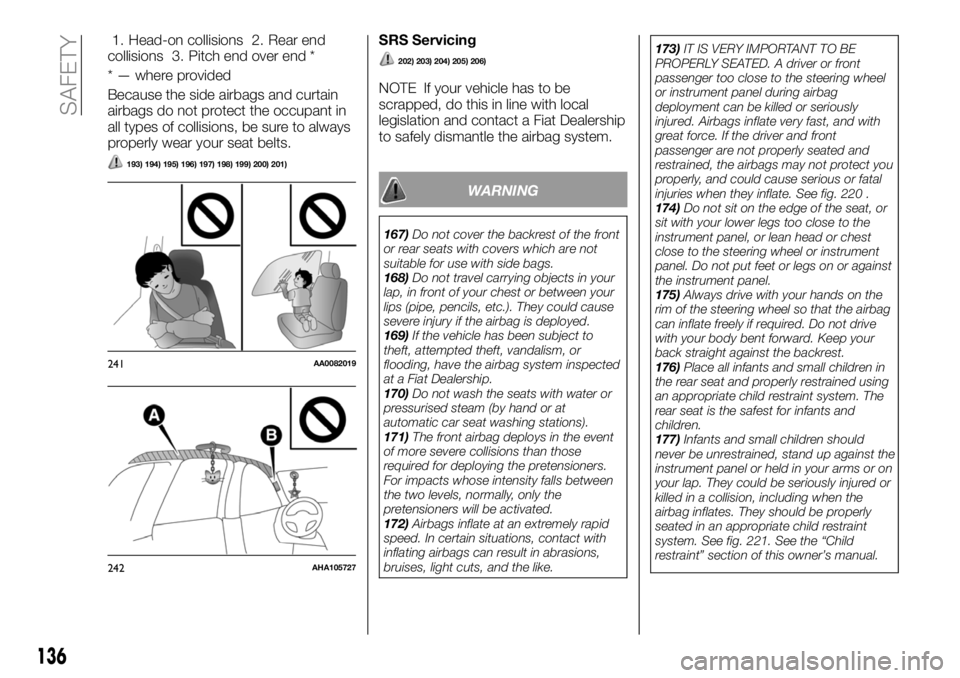
1. Head-on collisions 2. Rear end
collisions 3. Pitch end over end *
* — where provided
Because the side airbags and curtain
airbags do not protect the occupant in
all types of collisions, be sure to always
properly wear your seat belts.
193) 194) 195) 196) 197) 198) 199) 200) 201)
SRS Servicing
202) 203) 204) 205) 206)
NOTE If your vehicle has to be
scrapped, do this in line with local
legislation and contact a Fiat Dealership
to safely dismantle the airbag system.
WARNING
167)Do not cover the backrest of the front
or rear seats with covers which are not
suitable for use with side bags.
168)Do not travel carrying objects in your
lap, in front of your chest or between your
lips (pipe, pencils, etc.). They could cause
severe injury if the airbag is deployed.
169)If the vehicle has been subject to
theft, attempted theft, vandalism, or
flooding, have the airbag system inspected
at a Fiat Dealership.
170)Do not wash the seats with water or
pressurised steam (by hand or at
automatic car seat washing stations).
171)The front airbag deploys in the event
of more severe collisions than those
required for deploying the pretensioners.
For impacts whose intensity falls between
the two levels, normally, only the
pretensioners will be activated.
172)Airbags inflate at an extremely rapid
speed. In certain situations, contact with
inflating airbags can result in abrasions,
bruises, light cuts, and the like.173)IT IS VERY IMPORTANT TO BE
PROPERLY SEATED. A driver or front
passenger too close to the steering wheel
or instrument panel during airbag
deployment can be killed or seriously
injured. Airbags inflate very fast, and with
great force. If the driver and front
passenger are not properly seated and
restrained, the airbags may not protect you
properly, and could cause serious or fatal
injuries when they inflate. See fig. 220 .
174)Do not sit on the edge of the seat, or
sit with your lower legs too close to the
instrument panel, or lean head or chest
close to the steering wheel or instrument
panel. Do not put feet or legs on or against
the instrument panel.
175)Always drive with your hands on the
rim of the steering wheel so that the airbag
can inflate freely if required. Do not drive
with your body bent forward. Keep your
back straight against the backrest.
176)Place all infants and small children in
the rear seat and properly restrained using
an appropriate child restraint system. The
rear seat is the safest for infants and
children.
177)Infants and small children should
never be unrestrained, stand up against the
instrument panel or held in your arms or on
your lap. They could be seriously injured or
killed in a collision, including when the
airbag inflates. They should be properly
seated in an appropriate child restraint
system. See fig. 221. See the “Child
restraint” section of this owner’s manual.
241AA0082019
242AHA105727
136
SAFETY
Page 139 of 316
178)When there is an active passenger
airbag, DO NOT install rearward facing
child restraint systems on the front seat.
Deployment of the airbag in an accident
could cause fatal injuries to the child
regardless of the severity of the impact.
Therefore, always deactivate the passenger
side airbag when a rearward facing child
restraint system is installed on the front
passenger seat. The front passenger seat
must also be positioned back as far as
possible in order to prevent the child
restraint system from coming into contact
with the dashboard. Immediately reactivate
the passenger airbag as soon as the child
restraint system has been removed.
179)Older children should be seated,
properly wearing the seat belt, with an
appropriate booster seat if needed.
180)Extreme Hazard! NEVER use a
rearward facing child restraint on a seat
protected by an ACTIVE AIRBAG in front of
it, DEATH or SERIOUS INJURY to the
CHILD can occur.
181)Do not fit any accessory that makes
the indicator impossible to see, and do not
cover the indicator with a sticker. You would
not be able to verify the status of the
passenger airbag system.182)To reduce risk of serious or fatal injury:
always turn the ignition switch to the
“LOCK” position or put the operation mode
in OFF, before operating the front
passenger’s airbag ON-OFF switch. Failure
to do so could adversely affect the airbag
performance; Wait at least 60 seconds to
operate the front passenger’s airbag
ON-OFF switch after turning the ignition
switch to the “LOCK” position or putting
the operation mode in OFF. The SRS airbag
system is designed to retain enough
voltage to deploy the airbag; Always
remove the key from the front passenger’s
airbag ON-OFF switch after operating that
switch. Failure to do so could lead to
improper position of the front passenger’s
airbag ON-OFF switch; Do not turn OFF the
front passenger’s airbag ON-OFF switch
except when a child restraint system is
fitted to the front passenger seat; If the OFF
indicator does not come on when the front
passenger’s airbag ONOFF switch is turned
OFF, do not fit a child restraint system to
the front passenger seat. We recommend
you to have the system inspected by a Fiat
Dealership; if the OFF indicator remains on
when the front passenger’s airbag ON-OFF
switch is turned ON, do not allow anyone
to sit on the front passenger seat. We
recommend you to have the system
inspected by a Fiat Dealership.
183)Do not apply stickers or other objects
to the steering wheel, the dashboard in the
passenger side airbag area and the seats.
Never put objects (e.g. mobile phones) on
the passenger side of the dashboard since
they could interfere with correct inflation of
the passenger airbag and also cause
serious injury to the passengers.184)Do not set anything on, or attach
anything to, the instrument panel above the
glove box. It might strike and injure an
occupant if the airbag inflates.
185)Do not attach accessories to, or put
them in front of, the windscreen. These
objects could restrict the airbag inflation, or
strike and injure an occupant if the airbags
inflate.
186)Do not attach additional keys or
accessories (hard, pointed or heavy
objects) to the ignition key. Such objects
could prevent the driver’s knee airbag from
inflating normally or could be propelled to
cause serious injury if the airbag inflates.
See fig. 233.
187)Do not attach accessories to the
lower portion of the driver’s side instrument
panel. Such objects could prevent the
driver’s knee airbag from inflating normally
or could be propelled to cause serious
injury if the airbag inflates.
188)Do not put packages, pets or other
objects between the airbags and the driver
or front passenger. It could affect airbag
performance, or could cause injury when
the airbag inflates.
189)Right after the airbag inflation, several
airbag system components will be hot. Do
not touch these components. There is a
danger of being burnt.
190)The airbag system is designed to
work only once. Once the airbags have
deployed, they will not work again. They
must promptly be replaced and we
recommend you to have the entire airbag
system inspected by a Fiat Dealership.
191)Do not affix rigid objects to the
garment hooks or support handles.
137
Page 140 of 316
192)Do not rest your head, arms or
elbows on the door, windows or the area in
which the Window bag is located to avoid
possible injury during airbag inflation.
193)The airbag does not replace seat belts
but increases their efficiency. Furthermore,
since front airbags are not deployed in
low-speed frontal impacts, side impacts,
rear shunts or roll-overs, the passengers
are protected only by the seat belts which
must therefore be fastened at all times.
194)The side airbags and curtain airbags
are designed to supplement the driver and
passenger seat belts in certain side
impacts. Seat belts should always be worn
properly, and the driver and passenger
should sit well back and upright without
leaning against the window or door.
195)The side airbag and curtain airbag
inflate with great force. The driver and
passenger should not put their arms out
the window, and should not lean against
the door, in order to reduce risk of serious
or possible fatal injury from the deploying
side airbag and curtain airbag.
196)Do not allow any rear seat occupant
to hold onto the seatback of either front
seat, in order to reduce risk of injury from
the deploying side airbag. Special care
should be taken with children.
197)Do not place any objects near or in
front of the seatback of either front seat.
They could interfere with proper side airbag
inflation, and also could cause injury if
thrown free by side airbag deployment.
198)Do not install seat covers on seats
with side airbags. Do not re-cover seats
that have side airbags. This could interfere
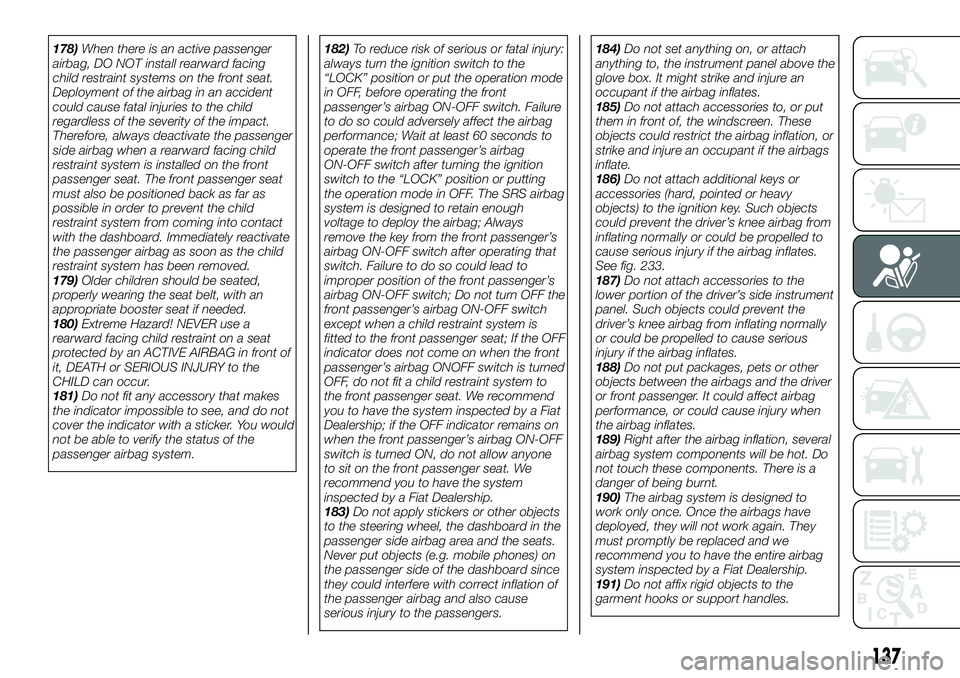
with proper side airbag inflation.199)Do not attach a microphone (A in
fig. 242 ) or any other device or object
around the part where the curtain airbags
(B in fig. 242 ) activate such as on the
windscreen, side door glass, front and rear
pillars and roof side or assist grips. When
the curtain airbags inflate, the microphone
or other device or object will be hurled with
great force or the curtain airbags may not
activate correctly, resulting in death or
serious injury.
200)Do not allow the child to lean against
or close to the front door even if the child is
seated in a child restraint system. The
child’s head should also not be leaned
against or be close to the area where the
side airbag and curtain airbag are located.
It is dangerous if the side airbag and curtain
airbag inflate. Failure to follow all of these
instructions could lead to serious or fatal
injury to the child.
201)We recommend work around and on
the side airbags and curtain airbags system
to be done by a Fiat Dealership.
202)We recommend any maintenance
performed on or near the components of
the SRS to be performed by a Fiat
Dealership. Improper work on the SRS
components or wiring could result in
inadvertent deployment of the airbags, or
could render the SRS inoperative; either
situation could result in serious injury.
203)Do not modify your steering wheel,
seat belt retractor or any other SRS
components. For example, replacement of
the steering wheel, or modifications to the
front bumper or body structure can
adversely affect SRS performance and lead
to possible injury.204)If your vehicle has received any
damage, we recommend you to have the
SRS inspected to ensure it is in proper
working order.
205)On vehicles with the side airbag, do
not modify your front seats, centre pillar
and centre console. It can adversely affect
SRS performance and lead to possible
injury.
206)If you found any tear, scratch, crack or
damage to the portion where the airbag is
stored, you should have the SRS inspected
by a Fiat Dealership.
138
SAFETY
Page 149 of 316
DRIVING, ALCOHOL
AND DRUGS
Drunk driving is one of the most
frequent causes of accidents.
Your driving ability can be seriously
impaired even with blood alcohol levels
far below the legal minimum. If you
have been drinking, don’t drive. Ride
with a designated non-drinking driver,
call a cab or a friend, or use public
transportation. Drinking coffee or taking
a cold shower will not make you sober.
Similarly, prescription and
non-prescription drugs affect your
alertness, perception and reaction time.
Consult with your doctor or pharmacist
before driving while under the influence
of any of these medications.
226)
WARNING
226)NEVER DRINK AND DRIVE. Your
perceptions are less accurate, your reflexes
are slower and your judgment is impaired.
SAFE DRIVING
TECHNIQUES
Driving safety and protection against
injury cannot be fully ensured. However,
we recommend that you pay extra
attention to the following:
Seat belts
Before starting the vehicle, make sure
that you and your passengers have
fastened your seat belts.
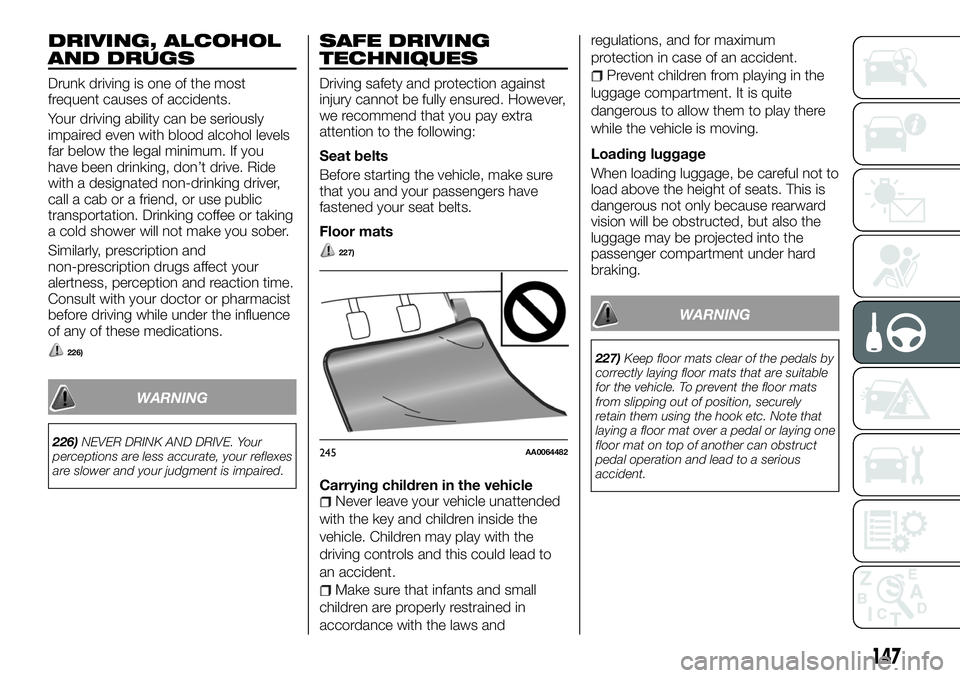
Floor mats
227)
Carrying children in the vehicleNever leave your vehicle unattended
with the key and children inside the
vehicle. Children may play with the
driving controls and this could lead to
an accident.
Make sure that infants and small
children are properly restrained in
accordance with the laws andregulations, and for maximum
protection in case of an accident.
Prevent children from playing in the
luggage compartment. It is quite
dangerous to allow them to play there
while the vehicle is moving.
Loading luggage
When loading luggage, be careful not to
load above the height of seats. This is
dangerous not only because rearward
vision will be obstructed, but also the
luggage may be projected into the
passenger compartment under hard
braking.
WARNING
227)Keep floor mats clear of the pedals by
correctly laying floor mats that are suitable
for the vehicle. To prevent the floor mats
from slipping out of position, securely
retain them using the hook etc. Note that
laying a floor mat over a pedal or laying one
floor mat on top of another can obstruct
pedal operation and lead to a serious
accident.
245AA0064482
147
Page 154 of 316
STARTING AND
STOPPING THE
ENGINE
231)
93) 94) 95) 96) 97) 98) 99) 100) 101) 102) 103)
Tips for starting
Except for vehicles equipped with
the keyless operation system
Do not operate the starter motor
continuously longer than 10 seconds;
doing so could run down the battery. If
the engine does not start, turn the
ignition switch back to “LOCK”, wait a
few seconds, and then try again. Trying
repeatedly with the starter motor still
turning will damage the starter
mechanism.
For vehicles equipped with the
keyless operation system
The operation mode can be in any
mode to start the engine.
The starter motor will be turning for up
to approximately 15 seconds if the
engine switch is released at once.
Pressing the engine switch again while
the starter motor is still turning will stop
the starter motor. The starter motor will
be turning for up to approximately
30 seconds while the engine switch is
pressed. If the engine does not start,
wait for a while and then attempt to
start the engine again. Trying repeatedly
with the starter motor still turning will
damage the starter mechanism.Starting the engine
Except for vehicles equipped with
the keyless operation system
1. Insert the ignition key and fasten the
seat belt.
2. Make sure the parking brake is
applied.
3. Press and hold the brake pedal
down firmly with your right foot.
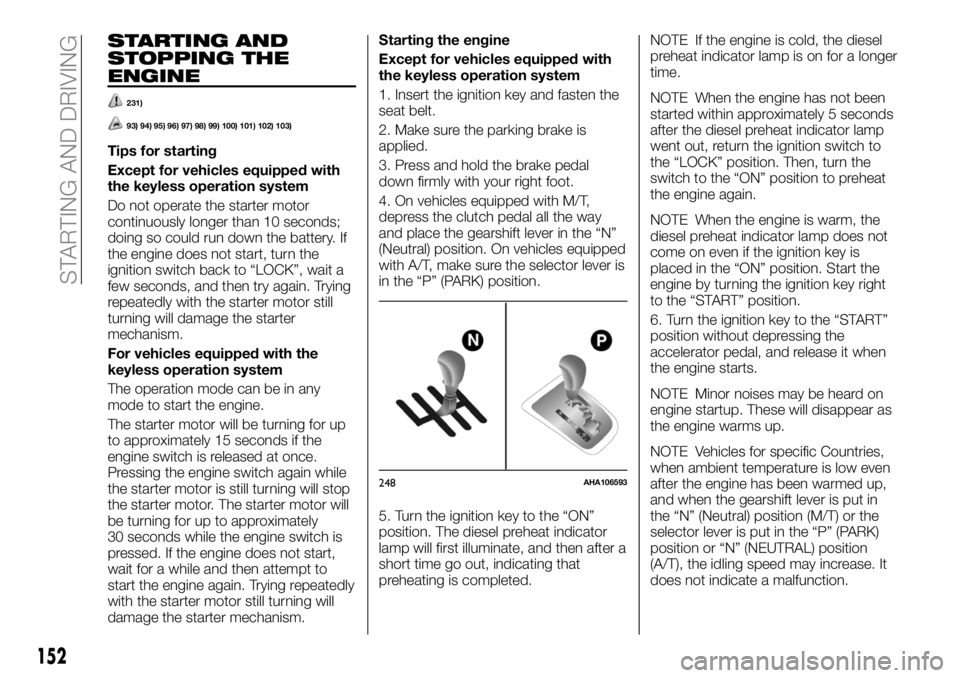
4. On vehicles equipped with M/T,
depress the clutch pedal all the way
and place the gearshift lever in the “N”
(Neutral) position. On vehicles equipped
with A/T, make sure the selector lever is
in the “P” (PARK) position.
5. Turn the ignition key to the “ON”
position. The diesel preheat indicator
lamp will first illuminate, and then after a
short time go out, indicating that
preheating is completed.NOTE If the engine is cold, the diesel
preheat indicator lamp is on for a longer
time.
NOTE When the engine has not been
started within approximately 5 seconds
after the diesel preheat indicator lamp
went out, return the ignition switch to
the “LOCK” position. Then, turn the
switch to the “ON” position to preheat
the engine again.
NOTE When the engine is warm, the
diesel preheat indicator lamp does not
come on even if the ignition key is
placed in the “ON” position. Start the
engine by turning the ignition key right
to the “START” position.
6. Turn the ignition key to the “START”
position without depressing the
accelerator pedal, and release it when
the engine starts.
NOTE Minor noises may be heard on
engine startup. These will disappear as
the engine warms up.
NOTE Vehicles for specific Countries,
when ambient temperature is low even
after the engine has been warmed up,
and when the gearshift lever is put in
the “N” (Neutral) position (M/T) or the
selector lever is put in the “P” (PARK)
position or “N” (NEUTRAL) position
(A/T), the idling speed may increase. It
does not indicate a malfunction.
248AHA106593
152
STARTING AND DRIVING
Page 155 of 316
For vehicles equipped with the
keyless operation system
1. Fasten the seat belt.
2. Make sure the parking brake is
applied.
3. Press and hold the brake pedal
down firmly with your right foot.
NOTE When the engine is not started,
it may become hard to depress the
brake pedal and the vehicle may not be
able to detect the pedal operation.
Therefore the engine may not be
started. In such a case, depress the
brake pedal more firmly than usual.
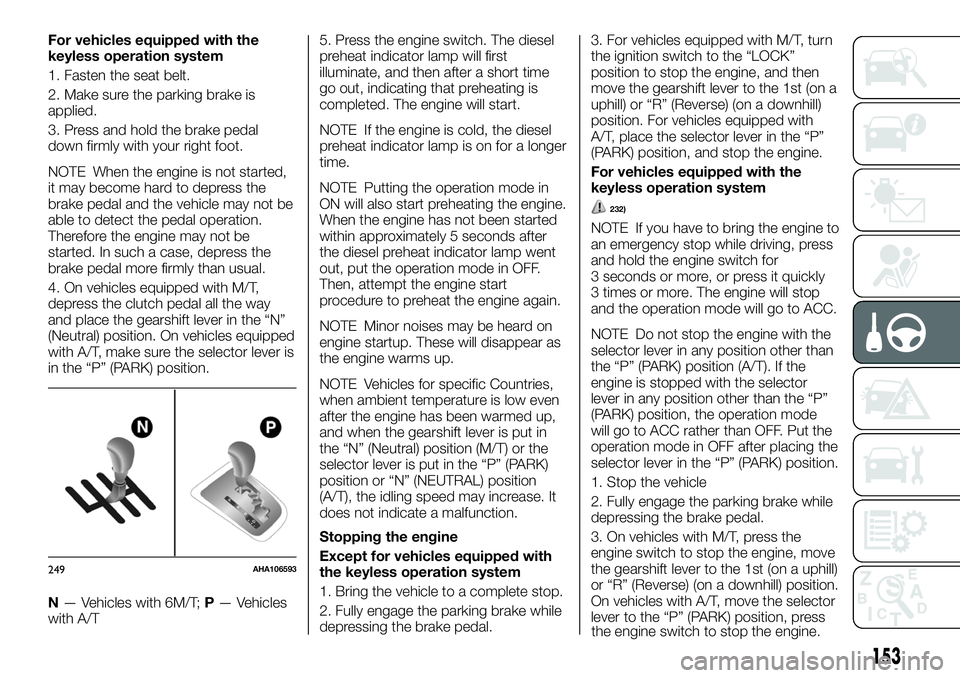
4. On vehicles equipped with M/T,
depress the clutch pedal all the way
and place the gearshift lever in the “N”
(Neutral) position. On vehicles equipped
with A/T, make sure the selector lever is
in the “P” (PARK) position.
N— Vehicles with 6M/T;P— Vehicles
with A/T5. Press the engine switch. The diesel
preheat indicator lamp will first
illuminate, and then after a short time
go out, indicating that preheating is
completed. The engine will start.
NOTE If the engine is cold, the diesel
preheat indicator lamp is on for a longer
time.
NOTE Putting the operation mode in
ON will also start preheating the engine.
When the engine has not been started
within approximately 5 seconds after
the diesel preheat indicator lamp went
out, put the operation mode in OFF.
Then, attempt the engine start
procedure to preheat the engine again.
NOTE Minor noises may be heard on
engine startup. These will disappear as
the engine warms up.
NOTE Vehicles for specific Countries,
when ambient temperature is low even
after the engine has been warmed up,
and when the gearshift lever is put in
the “N” (Neutral) position (M/T) or the
selector lever is put in the “P” (PARK)
position or “N” (NEUTRAL) position
(A/T), the idling speed may increase. It
does not indicate a malfunction.
Stopping the engine
Except for vehicles equipped with
the keyless operation system
1. Bring the vehicle to a complete stop.
2. Fully engage the parking brake while
depressing the brake pedal.3. For vehicles equipped with M/T, turn
the ignition switch to the “LOCK”
position to stop the engine, and then
move the gearshift lever to the 1st (on a
uphill) or “R” (Reverse) (on a downhill)
position. For vehicles equipped with
A/T, place the selector lever in the “P”
(PARK) position, and stop the engine.
For vehicles equipped with the
keyless operation system
232)
NOTE If you have to bring the engine to
an emergency stop while driving, press
and hold the engine switch for
3 seconds or more, or press it quickly
3 times or more. The engine will stop
and the operation mode will go to ACC.
NOTE Do not stop the engine with the
selector lever in any position other than
the “P” (PARK) position (A/T). If the
engine is stopped with the selector
lever in any position other than the “P”
(PARK) position, the operation mode
will go to ACC rather than OFF. Put the
operation mode in OFF after placing the
selector lever in the “P” (PARK) position.
1. Stop the vehicle
2. Fully engage the parking brake while
depressing the brake pedal.
3. On vehicles with M/T, press the
engine switch to stop the engine, move
the gearshift lever to the 1st (on a uphill)
or “R” (Reverse) (on a downhill) position.
On vehicles with A/T, move the selector
lever to the “P” (PARK) position, press
249AHA106593
153
the engine switch to stop the engine.
Page 158 of 316
START&STOP
SYSTEM
The Start&Stop system automatically
stops and restarts the engine without
operating the ignition switch or engine
switch when the vehicle is stopped,
such as at a traffic light or in a traffic
jam, to reduce exhaust gases, increase
fuel efficiency.
NOTE The accumulated time the
engine has been stopped by
Start&Stop system is displayed in the
multi information display. Refer to
“Start&Stop monitor”.
106)
Automatically stopping the engine
The Start&Stop system is automatically
activated when the ignition switch is
turned to the “ON” position or the
operation mode is put in ON.
You can deactivate the system by
pressing the “Start&Stop OFF” switch.
Refer to “To deactivate”.
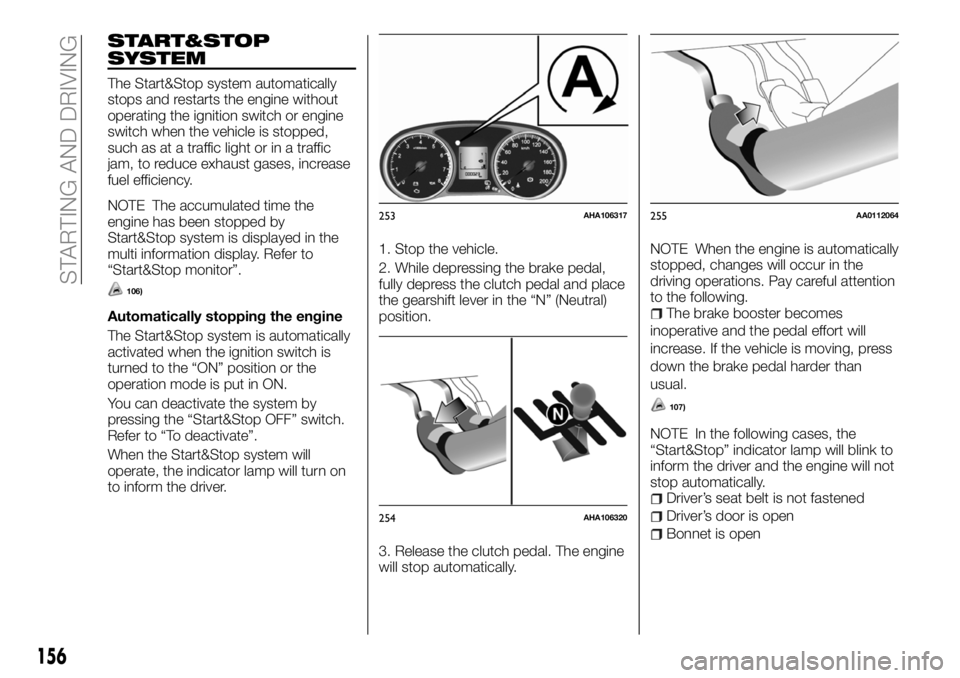
When the Start&Stop system will
operate, the indicator lamp will turn on
to inform the driver.1. Stop the vehicle.
2. While depressing the brake pedal,
fully depress the clutch pedal and place
the gearshift lever in the “N” (Neutral)
position.
3. Release the clutch pedal. The engine
will stop automatically.NOTE When the engine is automatically
stopped, changes will occur in the
driving operations. Pay careful attention
to the following.The brake booster becomes
inoperative and the pedal effort will
increase. If the vehicle is moving, press
down the brake pedal harder than
usual.
107)
NOTE In the following cases, the
“Start&Stop” indicator lamp will blink to
inform the driver and the engine will not
stop automatically.
Driver’s seat belt is not fastened
Driver’s door is open
Bonnet is open
253AHA106317
254AHA106320
255AA0112064
156
STARTING AND DRIVING
Page 160 of 316
108)
NOTE In the following cases, the
engine will not restart automatically.
While the engine is stopped
automatically, “Start&Stop OFF” switch
is pressed to deactivate the
“Start&Stop ” system.
Bonnet is open.
NOTE When the engine restarts
automatically, decrease in audio volume
may temporarily be experienced. This
does not indicate a malfunction.
NOTE While the engine is stopped
automatically, the air volume change of
the air conditioner may temporarily be
experienced. This does not indicate a
malfunction.
To deactivate
The Start&Stop system is automatically
activated when the ignition switch is
turned to the “ON” position or the
operation mode put in ON. You can
deactivate the system by pressing the
“Start&Stop OFF” switch.
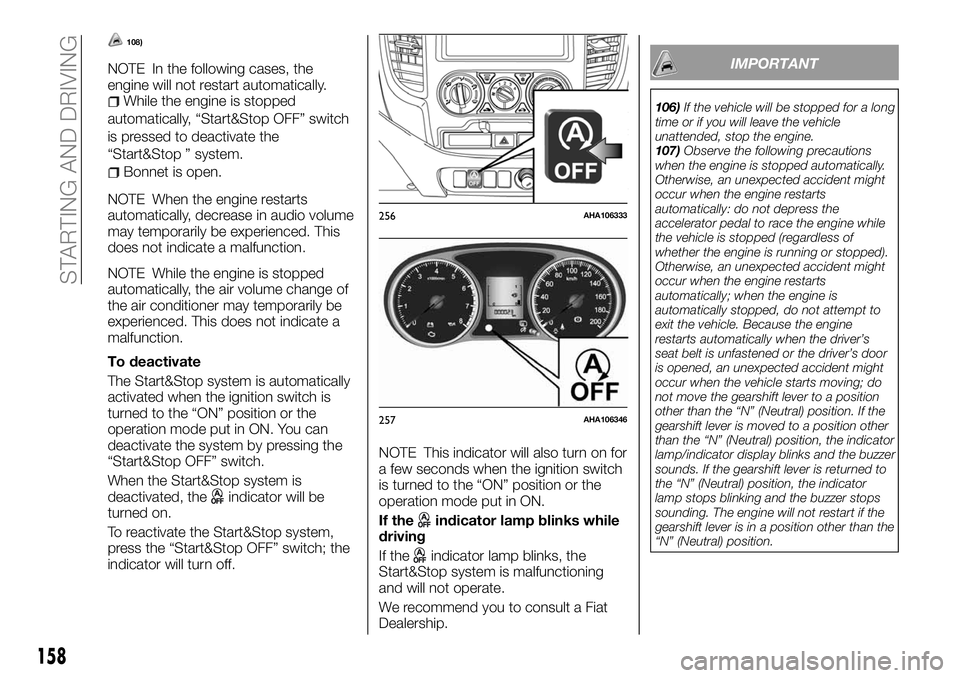
When the Start&Stop system is
deactivated, the
indicator will be
turned on.
To reactivate the Start&Stop system,
press the “Start&Stop OFF” switch; the
indicator will turn off.NOTE This indicator will also turn on for
a few seconds when the ignition switch
is turned to the “ON” position or the
operation mode put in ON.
If the
indicator lamp blinks while
driving
If the
indicator lamp blinks, the
Start&Stop system is malfunctioning
and will not operate.
We recommend you to consult a Fiat
Dealership.
IMPORTANT
106)If the vehicle will be stopped for a long
time or if you will leave the vehicle
unattended, stop the engine.
107)Observe the following precautions
when the engine is stopped automatically.
Otherwise, an unexpected accident might
occur when the engine restarts
automatically: do not depress the
accelerator pedal to race the engine while
the vehicle is stopped (regardless of
whether the engine is running or stopped).
Otherwise, an unexpected accident might
occur when the engine restarts
automatically; when the engine is
automatically stopped, do not attempt to
exit the vehicle. Because the engine
restarts automatically when the driver’s
seat belt is unfastened or the driver’s door
is opened, an unexpected accident might
occur when the vehicle starts moving; do
not move the gearshift lever to a position
other than the “N” (Neutral) position. If the
gearshift lever is moved to a position other
than the “N” (Neutral) position, the indicator
lamp/indicator display blinks and the buzzer
sounds. If the gearshift lever is returned to
the “N” (Neutral) position, the indicator
lamp stops blinking and the buzzer stops
sounding. The engine will not restart if the
gearshift lever is in a position other than the
“N” (Neutral) position.
256AHA106333
257AHA106346
158
STARTING AND DRIVING
Page 161 of 316
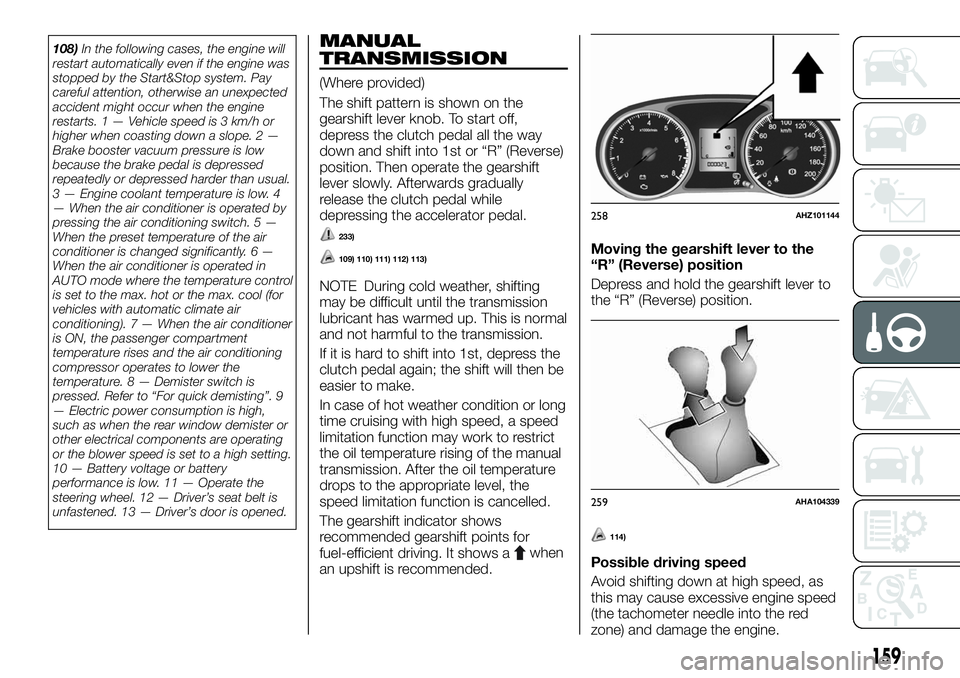
108)In the following cases, the engine will
restart automatically even if the engine was
stopped by the Start&Stop system. Pay
careful attention, otherwise an unexpected
accident might occur when the engine
restarts.1—Vehicle speed is 3 km/h or
higher when coasting down a slope. 2 —
Brake booster vacuum pressure is low
because the brake pedal is depressed
repeatedly or depressed harder than usual.
3 — Engine coolant temperature is low. 4
— When the air conditioner is operated by
pressing the air conditioning switch. 5 —
When the preset temperature of the air
conditioner is changed significantly. 6 —
When the air conditioner is operated in
AUTO mode where the temperature control
is set to the max. hot or the max. cool (for
vehicles with automatic climate air
conditioning). 7 — When the air conditioner
is ON, the passenger compartment
temperature rises and the air conditioning
compressor operates to lower the
temperature. 8 — Demister switch is
pressed. Refer to “For quick demisting”. 9
— Electric power consumption is high,
such as when the rear window demister or
other electrical components are operating
or the blower speed is set to a high setting.
10 — Battery voltage or battery
performance is low. 11 — Operate the
steering wheel. 12 — Driver’s seat belt is
unfastened. 13 — Driver’s door is opened.MANUAL
TRANSMISSION
(Where provided)
The shift pattern is shown on the
gearshift lever knob. To start off,
depress the clutch pedal all the way
down and shift into 1st or “R” (Reverse)
position. Then operate the gearshift
lever slowly. Afterwards gradually
release the clutch pedal while
depressing the accelerator pedal.
233)
109) 110) 111) 112) 113)
NOTE During cold weather, shifting
may be difficult until the transmission
lubricant has warmed up. This is normal
and not harmful to the transmission.
If it is hard to shift into 1st, depress the
clutch pedal again; the shift will then be
easier to make.
In case of hot weather condition or long
time cruising with high speed, a speed
limitation function may work to restrict
the oil temperature rising of the manual
transmission. After the oil temperature
drops to the appropriate level, the
speed limitation function is cancelled.
The gearshift indicator shows
recommended gearshift points for
fuel-efficient driving. It shows a
when
an upshift is recommended.Moving the gearshift lever to the
“R” (Reverse) position
Depress and hold the gearshift lever to
the “R” (Reverse) position.
114)
Possible driving speed
Avoid shifting down at high speed, as
this may cause excessive engine speed
(the tachometer needle into the red
zone) and damage the engine.
258AHZ101144
259AHA104339
159
Page 183 of 316
143)Use the rear differential lock only as an
emergency measure when the vehicle is
stuck and cannot be freed with the transfer
shift lever or the drive mode-selector in “4L”
or “4H” position (Easy Select 4WD) or in
“4LLc” or “4HLc” position (Super Select
4WD II). Deactivate the rear differential lock
immediately after using it.4 WHEEL DRIVE
OPERATION
By selecting 4-wheel drive, both axles
of the vehicle are rigidly connected with
each other. This improves the traction
characteristics. When turning sharp
corners or moving forward and
backward repeatedly, however, the
drive line is stressed, which is felt as a
braking effect. A 4-wheel drive vehicle
can accelerate more quickly and
smoothly.
However, note that the braking distance
is not shorter than that of a rear-wheel
drive vehicle.
When using 4-wheel drive on rough
roads (snow, mud, sand, etc.), it is
important to operate the vehicle
correctly.
NOTE The driving posture should be
more upright and closer to the wheel
than usual; adjust the seat to a good
position for easy steering and pedal
operation. Be sure to wear the seat
belt.
NOTE After driving on rough roads,
check each part of the vehicle and
wash it thoroughly with water. Refer to
“Vehicle care” and “Inspection and
maintenance following rough road
operation”.Driving on dry paved road and
highway
Select “2H” position (Easy Select 4WD),
“2H” or “4H” position (Super Select
4WD II) to drive on the dry paved road.
Especially on dry highway, never select
the “4H” or “4L” position (Easy Select
4WD), “4HLc” or “4LLc” position (Super
Select 4WD II).
144)
Driving on snowy or icy roads
Set the drive mode-selector to “4H”
position (Easy Select 4WD), “4H” or
“4HLc” position in accordance with the
road conditions (Super Select 4WD II)
and then gradually depress the
accelerator pedal for a smooth start.
Keep the pressure on the accelerator
pedal as constant as possible, and
drive at low speed.
NOTE The use of snow tyres and/or
tyre chains is recommended.
NOTE Maintain a safe distance
between vehicles, avoid sudden
braking, and use engine braking
(downshifting).
145)
Driving on sandy or muddy roads
Set the drive mode-selector to “4H” or
“4L” position (Easy Select 4WD),
“4HLc” or “4LLc” position (Super Select
4WD II) and then gradually depress the
accelerator pedal for a smooth start.
Keep the pressure on the accelerator
181