belt FIAT FULLBACK 2018 Owner handbook (in English)
[x] Cancel search | Manufacturer: FIAT, Model Year: 2018, Model line: FULLBACK, Model: FIAT FULLBACK 2018Pages: 316, PDF Size: 10.52 MB
Page 214 of 316
WARNING
276)To start the engine using jumper
cables from another vehicle, perform the
correct procedures according to the
instruction below. Incorrect procedures
could result in a fire or explosion or
damage to the vehicles.
277)Keep sparks, cigarettes and flames
away from the battery because the battery
may produce an explosion.
278)Do not attempt to start the engine by
pulling or pushing the vehicle. It could
damage your vehicle.
279)Check the other vehicle. It must have
a 12-volt battery. If the other system isn’t
12-volt, shorting can damage both
vehicles.
280)Use the proper cables suitable for the
battery size to prevent overheating of the
cables.
281)Check the jumper cables for damage
and corrosion before use.
282)Always wear protective eye goggles
when working near the battery.
283)Keep the battery out of the reach of
children.
284)Turn off the ignition on both vehicles
beforehand. Make sure that the cables or
your clothes cannot be caught by the fan
or drive belt. Personal injury could result.
285)If electrolyte fluid is not visible, or
appears to be frozen, Do Not Attempt
Jump Starting! A battery might rupture or
explode if the temperature is below the
freezing point or if it is not filled to the
proper level.286)Electrolyte is corrosive diluted
sulphuric acid. If electrolyte (battery acid)
comes into contact with your hands, eyes,
clothes or the painted surface of your
vehicle, it should be thoroughly flushed
with water. If electrolyte gets in your eyes,
flush them with water immediately and
thoroughly, and get prompt medical
attention.
287)Make sure that the connection is
made to the appointed position (shown in
the illustration). If the connection is made
directly to the negative (−) side of the
battery, the inflammable gases generated
from the battery might catch fire and
explode.
288)When connecting the jumper cables,
do not connect the positive (+) cable to the
negative (−) terminal. Otherwise sparks
might cause explosion of the battery.
289)Use care not to get the jumper cable
caught in the cooling fan or other rotating
part in the engine compartment.
290)Keep the engine of the vehicle giving
assistance running.
291)Battery fluid is poisonous and
corrosive: avoid contact with your skin and
eyes. The battery should be charged in a
well ventilated place, away from naked
flames or possible sources of sparks:
danger of explosion and fire.
292)Do not attempt to charge a frozen
battery: it must be thawed first, otherwise it
may explode. If freezing has occurred, the
battery should be checked by skilled
personnel to make sure that the internal
elements are not damaged and that the
body is not cracked, with the risk of leaking
poisonous and corrosive acid.
ENGINE
OVERHEATING
When the engine is overheating,will
blink. If this occurs, take the following
corrective measures:
1. Stop the vehicle in a safe place.
2. Check whether steam is coming from
the engine compartment.
If steam does not come from the engine
compartment: with the engine still
running, raise the bonnet to ventilate
the engine compartment.
NOTE For vehicles equipped with the
Start&Stop system, press the
“Start&Stop OFF” switch to deactivate
the system before stopping the vehicle.
If steam is coming from the engine
compartment: stop the engine, and
when the steam stops, raise the bonnet
to ventilate the engine compartment.
Restart the engine.
293) 294) 295)
3. Confirm that the cooling fan (B) is
turning.
If the cooling fan is turning: after the
high coolant temperature warning has
gone off, stop the engine
If the cooling fan is not turning: stop the
engine immediately and contact a Fiat
dealership for assistance.
212
IN AN EMERGENCY
Page 215 of 316
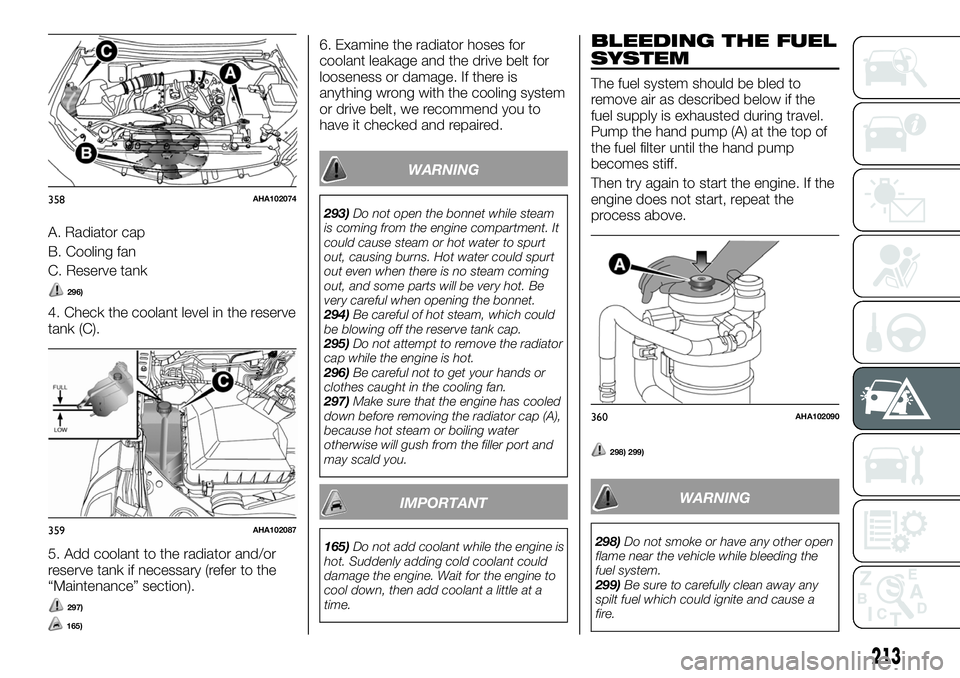
A. Radiator cap
B. Cooling fan
C. Reserve tank
296)
4. Check the coolant level in the reserve
tank (C).
5. Add coolant to the radiator and/or
reserve tank if necessary (refer to the
“Maintenance” section).
297)
165)
6. Examine the radiator hoses for
coolant leakage and the drive belt for
looseness or damage. If there is
anything wrong with the cooling system
or drive belt, we recommend you to
have it checked and repaired.
WARNING
293)Do not open the bonnet while steam
is coming from the engine compartment. It
could cause steam or hot water to spurt
out, causing burns. Hot water could spurt
out even when there is no steam coming
out, and some parts will be very hot. Be
very careful when opening the bonnet.
294)Be careful of hot steam, which could
be blowing off the reserve tank cap.
295)Do not attempt to remove the radiator
cap while the engine is hot.
296)Be careful not to get your hands or
clothes caught in the cooling fan.
297)Make sure that the engine has cooled
down before removing the radiator cap (A),
because hot steam or boiling water
otherwise will gush from the filler port and
may scald you.
IMPORTANT
165)Do not add coolant while the engine is
hot. Suddenly adding cold coolant could
damage the engine. Wait for the engine to
cool down, then add coolant a little at a
time.
BLEEDING THE FUEL
SYSTEM
The fuel system should be bled to
remove air as described below if the
fuel supply is exhausted during travel.
Pump the hand pump (A) at the top of
the fuel filter until the hand pump
becomes stiff.
Then try again to start the engine. If the
engine does not start, repeat the
process above.
298) 299)
WARNING
298)Do not smoke or have any other open
flame near the vehicle while bleeding the
fuel system.
299)Be sure to carefully clean away any
spilt fuel which could ignite and cause a
fire.
358AHA102074
359AHA102087
360AHA102090
213
Page 250 of 316
SERVICE
PRECAUTIONS
362) 363) 364) 365) 366) 367) 368) 369)
Adequate care of your vehicle at regular
intervals serves to preserve the value
and appearance as long as possible.
Maintenance items as described in this
owner’s manual can be performed by
the owner.
We recommend you to have the
periodic inspection and maintenance
performed by a Fiat Dealership.
In the event a malfunction or a problem
is discovered, we recommend you to
have it checked and repaired. This
section contains information on
inspection maintenance procedures
that you can do yourself. Follow the
instructions and cautions for each of
the various procedures.
IMPORTANT NOTE!
The customer can have servicing done
outside the authorised Fiat Dealership
without losing the warranty in force. The
warranty depends on carrying out the
scheduled servicing constantly, as
described in this Owner Handbook.
The customer can choose to have the
above mentioned servicing, and any
other repairs covered by the warranty,
carried out by any workshop (within or
outside the Fiat Dealership), as long as
it has suitable means and follows the
instructions described in this Owner
Handbook.
WARNING
362)When checking or servicing the inside
of the engine compartment, make sure the
engine is switched off and has had a
chance to cool down.
363)If it is necessary to do work in the
engine compartment with the engine
running, be especially careful that your
clothing, hair, etc., does not become
caught by the cooling fan, drive belts, or
other moving parts.
364)After performing the maintenance
work, make sure that no tools or cloths are
left behind in the engine compartment. If
they are left behind, a fire or damage to the
vehicle may occur.
365)The cooling fan can turn on
automatically even if the engine is not
running. Turn the ignition switch to “LOCK”
position or put the operation mode in OFF
to be safe while you work in the engine
compartment.
366)Do not smoke, cause sparks or allow
open flames around fuel or battery. The
fumes are flammable.
367)Be extremely cautious when working
around the battery. It contains poisonous
and corrosive sulphuric acid.
368)Do not get under your vehicle with
just the body jack supporting it. Always use
automotive jack stands.
369)Improper handling of components
and materials used in the vehicle can
endanger your personal safety. We
recommend you to consult a specialist for
necessary information.
248
SERVICING AND MAINTENANCE
Page 254 of 316
Thousand of miles12,5 25 37,5 50 62,5 75 87,5 100 112 125
Thousands of kilometers or20 40 60 80 100 120 140 160 180 200
Years12345678910
Visually inspect conditions and check the
tension of the accessory drive belts●●●●●●●●●●
Visually check for any fluid leaks from the
front and rear differentials (if leaks are found,
check the oil level)
●●● ●●● ●●
Change front and rear differential oil●●
Visually check for any fluid leaks from the
transfer case (if leaks are found, check the
oil level)
●●●● ●●●●
Change transfer case oil●●
Change engine oil and replace oil filter●●●●●●●●●●
Replace accessory drive belts(3)
Replace fuel filter cartridge (4)
●●●●●
Replace air cleaner cartridge (5)●●●
Check the air filter cartridge for obstructions
or damage●● ●● ●● ●
Change the brake fluid (6)●●●●●
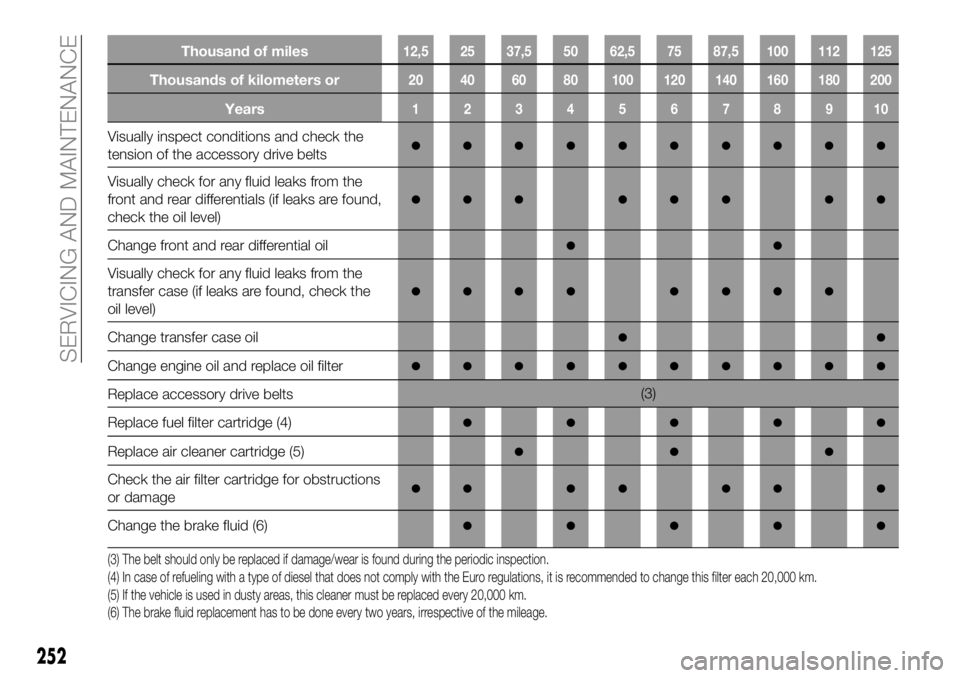
(3) The belt should only be replaced if damage/wear is found during the periodic inspection.
(4) In case of refueling with a type of diesel that does not comply with the Euro regulations, it is recommended to change this filter each 20,000 km.
(5) If the vehicle is used in dusty areas, this cleaner must be replaced every 20,000 km.
(6) The brake fluid replacement has to be done every two years, irrespective of the mileage.
252
SERVICING AND MAINTENANCE
Page 256 of 316
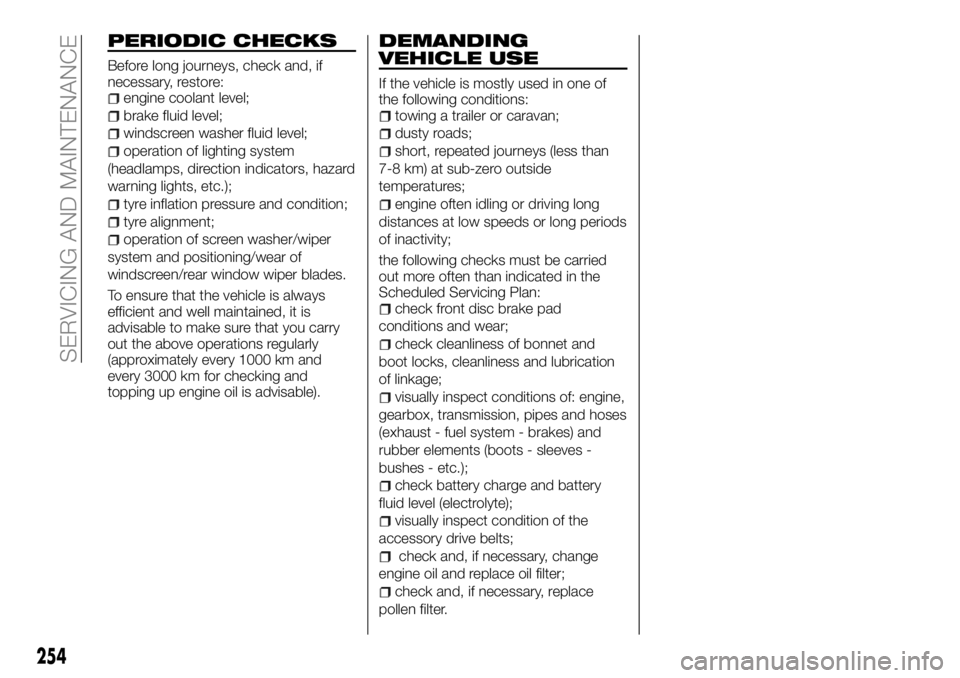
PERIODIC CHECKS
Before long journeys, check and, if
necessary, restore:
engine coolant level;
brake fluid level;
windscreen washer fluid level;
operation of lighting system
(headlamps, direction indicators, hazard
warning lights, etc.);
tyre inflation pressure and condition;
tyre alignment;
operation of screen washer/wiper
system and positioning/wear of
windscreen/rear window wiper blades.
To ensure that the vehicle is always
efficient and well maintained, it is
advisable to make sure that you carry
out the above operations regularly
(approximately every 1000 km and
every 3000 km for checking and
topping up engine oil is advisable).
DEMANDING
VEHICLE USE
If the vehicle is mostly used in one of
the following conditions:
towing a trailer or caravan;
dusty roads;
short, repeated journeys (less than
7-8 km) at sub-zero outside
temperatures;
engine often idling or driving long
distances at low speeds or long periods
of inactivity;
the following checks must be carried
out more often than indicated in the
Scheduled Servicing Plan:
check front disc brake pad
conditions and wear;
check cleanliness of bonnet and
boot locks, cleanliness and lubrication
of linkage;
visually inspect conditions of: engine,
gearbox, transmission, pipes and hoses
(exhaust - fuel system - brakes) and
rubber elements (boots - sleeves -
bushes - etc.);
check battery charge and battery
fluid level (electrolyte);
visually inspect condition of the
accessory drive belts;
check and, if necessary, change
engine oil and replace oil filter;
check and, if necessary, replace
pollen filter.
254
SERVICING AND MAINTENANCE
Page 314 of 316
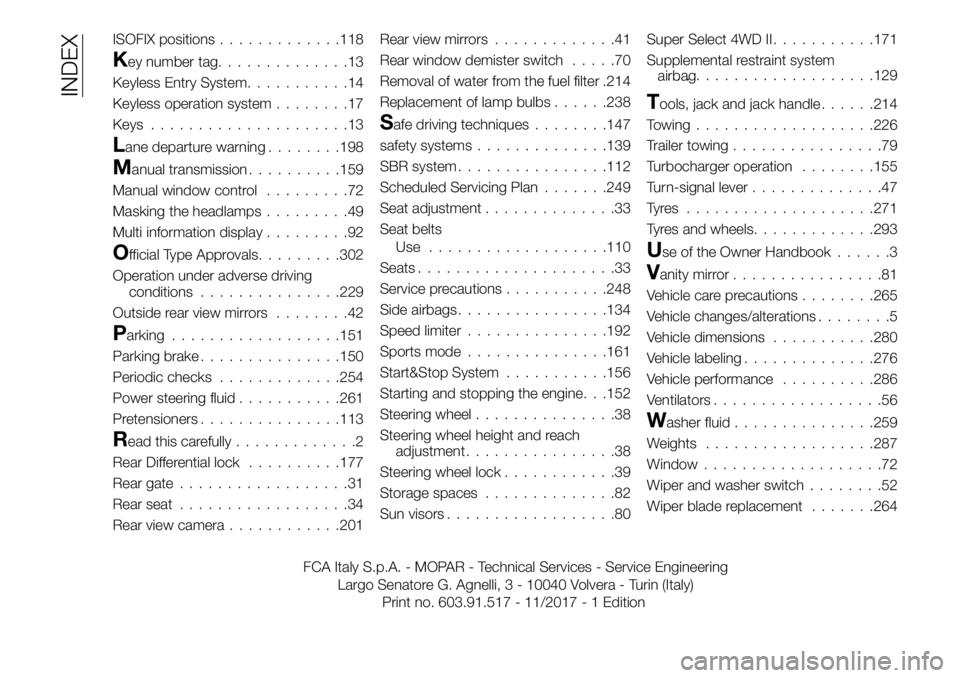
ISOFIX positions.............118
Key number tag..............13
Keyless Entry System...........14
Keyless operation system........17
Keys.....................13
Lane departure warning........198
Manual transmission..........159
Manual window control.........72
Masking the headlamps.........49
Multi information display.........92
Official Type Approvals.........302
Operation under adverse driving
conditions...............229
Outside rear view mirrors........42
Parking..................151
Parking brake...............150
Periodic checks.............254
Power steering fluid...........261
Pretensioners...............113
Read this carefully.............2
Rear Differential lock..........177
Rear gate..................31
Rear seat..................34
Rear view camera............201Rear view mirrors.............41
Rear window demister switch.....70
Removal of water from the fuel filter .214
Replacement of lamp bulbs......238
Safe driving techniques........147
safety systems..............139
SBR system................112
Scheduled Servicing Plan.......249
Seat adjustment..............33
Seat belts
Use ...................110
Seats.....................33
Service precautions...........248
Side airbags................134
Speed limiter...............192
Sports mode...............161
Start&Stop System...........156
Starting and stopping the engine. . .152
Steering wheel...............38
Steering wheel height and reach
adjustment................38
Steering wheel lock............39
Storage spaces..............82
Sun visors..................80Super Select 4WD II...........171
Supplemental restraint system
......................129
Tools, jack and jack handle......214
Towing...................226
Trailer towing................79
Turbocharger operation........155
Turn-signal lever..............47
Tyres ....................271
Tyres and wheels.............293
Use of the Owner Handbook......3
Vanity mirror................81
Vehicle care precautions........265
Vehicle changes/alterations........5
Vehicle dimensions...........280
Vehicle labeling..............276
Vehicle performance..........286
Ventilators..................56
Washer fluid...............259
Weights..................287
Window...................72
Wiper and washer switch........52
Wiper blade replacement.......264
FCA Italy S.p.A. - MOPAR - Technical Services - Service Engineering
Largo Senatore G. Agnelli, 3 - 10040 Volvera - Turin (Italy)
Print no. 603.91.517 -
INDEX
airbag
11/2017 - 1 Edition