steering wheel FIAT FULLBACK 2018 Owner handbook (in English)
[x] Cancel search | Manufacturer: FIAT, Model Year: 2018, Model line: FULLBACK, Model: FIAT FULLBACK 2018Pages: 316, PDF Size: 10.52 MB
Page 143 of 316
NOTE The electronic stability control
function does not operate when the
drive mode-selector is in the “4L”
position (Easy Select 4WD), “4LLc”
position (Super Select 4WD II). When
the active stability control function is
operating with the drive mode-selector
in the “2H” or “4H” position (Easy
Select 4WD), “2H”, “4H” or “4HLc”
position (Super Select 4WD II), setting
the drive modeselector to the “4L”
(Easy Select 4WD), “4LLc” position
(Super Select 4WD II) position makes
the active stability control function
deactivate automatically.
NOTE The electronic stability control
function operates at speeds of about
15 km/h or higher.
NOTE On vehicles with the rear
differential lock, the electronic stability
control function does not operate when
the rear differential lock is activated.
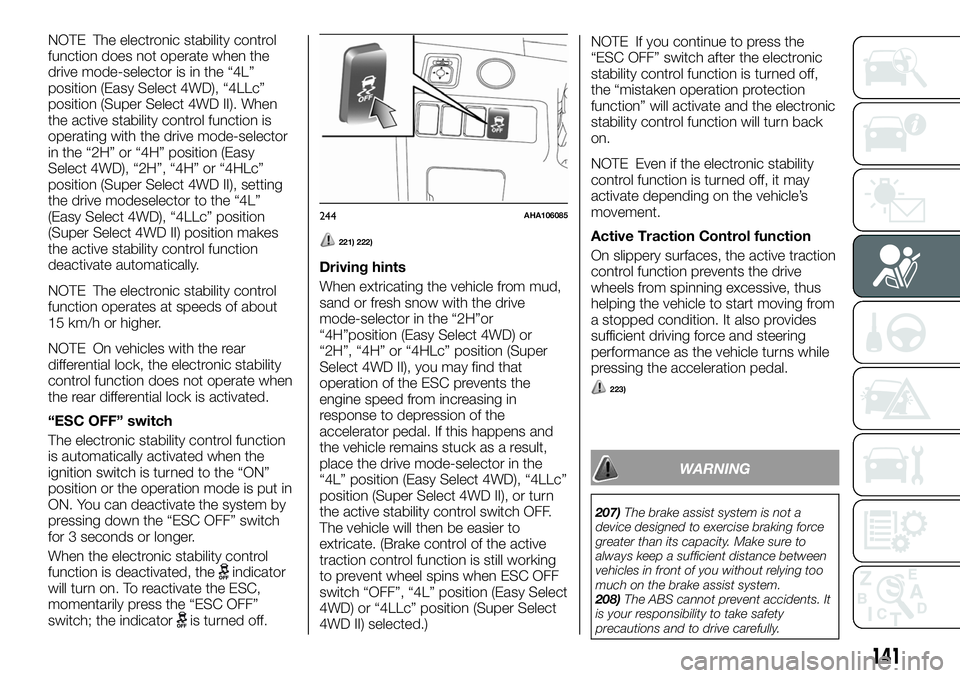
“ESC OFF” switch
The electronic stability control function
is automatically activated when the
ignition switch is turned to the “ON”
position or the operation mode is put in
ON. You can deactivate the system by
pressing down the “ESC OFF” switch
for 3 seconds or longer.
When the electronic stability control
function is deactivated, the
indicator
will turn on. To reactivate the ESC,
momentarily press the “ESC OFF”
switch; the indicator
is turned off.
221) 222)
Driving hints
When extricating the vehicle from mud,
sand or fresh snow with the drive
mode-selector in the “2H”or
“4H”position (Easy Select 4WD) or
“2H”, “4H” or “4HLc” position (Super
Select 4WD II), you may find that
operation of the ESC prevents the
engine speed from increasing in
response to depression of the
accelerator pedal. If this happens and
the vehicle remains stuck as a result,
place the drive mode-selector in the
“4L” position (Easy Select 4WD), “4LLc”
position (Super Select 4WD II), or turn
the active stability control switch OFF.
The vehicle will then be easier to
extricate. (Brake control of the active
traction control function is still working
to prevent wheel spins when ESC OFF
switch “OFF”, “4L” position (Easy Select
4WD) or “4LLc” position (Super Select
4WD II) selected.)NOTE If you continue to press the
“ESC OFF” switch after the electronic
stability control function is turned off,
the “mistaken operation protection
function” will activate and the electronic
stability control function will turn back
on.
NOTE Even if the electronic stability
control function is turned off, it may
activate depending on the vehicle’s
movement.
Active Traction Control function
On slippery surfaces, the active traction
control function prevents the drive
wheels from spinning excessive, thus
helping the vehicle to start moving from
a stopped condition. It also provides
sufficient driving force and steering
performance as the vehicle turns while
pressing the acceleration pedal.
223)
WARNING
207)The brake assist system is not a
device designed to exercise braking force
greater than its capacity. Make sure to
always keep a sufficient distance between
vehicles in front of you without relying too
much on the brake assist system.
208)The ABS cannot prevent accidents. It
is your responsibility to take safety
precautions and to drive carefully.
244AHA106085
141
Page 145 of 316
NOTE The hill start assist is activated
when all of the following conditions are
met.
The engine is running (the hill start
assist will not be activated while the
engine is starting or immediately after
the engine is started).
On vehicles equipped with M/T, the
gearshift lever is in the following
position: When starting an uphill slope
forwards > The gearshift lever is in any
position other than “R” (the hill start
assist will operate, even if the gearshift
lever is in the “N” position). When
starting an uphill slope backwards >
The gearshift lever is in the “R” position
(the hill start assist will not operate
when the gearshift lever is in the “N”
position).
On vehicles equipped with A/T, the
selector lever is in any position other
than “P” or “N”.
The vehicle is completely stationary,
with the brake pedal depressed.
The parking brake is released.
NOTE The hill start assist will not
operate if the accelerator pedal is
depressed before the brake pedal is
released.
NOTE The hill start assist also operates
when reversing on an uphill slope.NOTE When the hill start assist is
activated, you may feel the operating
sound. This is a normal result of the hill
start assist operation, and does not
indicate a problem.
Warning indicator
If an abnormal condition occurs in the
system, the indicator lamp
will turn
on.
83) 84)
Power Steering System
The power steering system operates
while the engine is running. It helps
reduce the effort needed to turn the
steering wheel.
The power steering system has
mechanical steering capability in case
the power assist is lost. If the power
assist is lost for some reason, you will
still be able to steer your vehicle, but
you will notice it takes much more effort
to steer. If this happens, have your
vehicle inspected at a Fiat Dealership.
85) 86)
Trailer Stability Assist — TSA
(where provided)
The trailer stability assist system helps
safely running while towing a trailer by
controlling the braking force of each
wheel and engine power in order to
stabilize the motion when detecting the
continuous sway of the vehicle caused
by a trailer.When the trailer stability assist system
operates the brakes, the brake lamp
turns on. About the towing of the trailer,
refer to “Trailer towing”.
87) 88)
NOTE When TSA system operates, the
vehicle body may vibrate and the
operating sounds from the engine
compartment may be heard. These
motions indicate normal operation of
the system, not abnormal operation.
NOTE TSA system operates when the
vehicle speed is about 55 km/h or
higher.
NOTE When TSA system operates, the
ESC operation indicator lamp blinks on
and off.
NOTE When ESC does not work, TSA
system does not operate.
WARNING
224)When facing uphill, do not rely on
using the hill start assist to maintain a
stopped position as an alternative to
depressing the brake pedal. Doing so
could cause an accident.
225)Do not turn the ignition switch to the
“LOCK” or “ACC” position or the operation
mode in ACC or OFF while the hill start
assist is operating. The hill start assist
could stop operating, which could result in
an accident.
143
Page 146 of 316
IMPORTANT
81)Do not overly rely on the hill start assist
to prevent backwards movement of the
vehicle. Under certain circumstances, even
when hill start assist is activated, the
vehicle may move backwards if the brake
pedal is not sufficiently depressed, if the
vehicle is heavily loaded, if the road is very
steep or slippery or if the vehicle tows a
trailer, etc.
82)The hill start assist is not designed to
keep the vehicle stopped in place on uphill
slopes for more than 2 seconds.
83)If the warning is turn on, the hill start
assist will not operate. Start off carefully.
84)Park your vehicle in a safe place and
stop the engine. Restart the engine and
check whether the warning indicator went
out, in which case the hill start assist is
again working normally. If they warning
remains displayed or reappear frequently, it
is not necessary to stop the vehicle
immediately, but the vehicle should be
inspected by a Fiat Dealership.
85)Do not stop the engine while the
vehicle is moving. Stopping the engine
would make the steering wheel extremely
hard to turn, possibly resulting in an
accident.
86)Do not leave the steering wheel turned
all the way in one direction. This can cause
damage to the power steering system.87)Do not over-rely on TSA system. Due to
the slippery road surface, heavy side wind,
inappropriate weight and positioning of
luggage, and/or driving at high speed, TSA
system may fail to secure the stability.
Always drive appropriately in accordance
with the condition of traffic, road surface
condition, weather, and the weight and
positioning of luggage.
88)The trailer stability assist system does
not operate in case as follows: 1 – When
sudden braking and braking while driving
downhill cause an abrupt motion of the
vehicle which makes the vehicle and the
trailer form a dogleg shape. 2 – When a
sideslip occurs by sudden steering.
144
SAFETY
Page 156 of 316
Fuel injection amount learning
process
To keep exhaust emissions and engine
noise low, the engine very occasionally
performs a learning process for the fuel
injection amount.
The engine sounds slightly different
from usual while the learning process is
taking place. The change in the engine
sound does not indicate a fault.
If the keyless operation key is not
operating properly
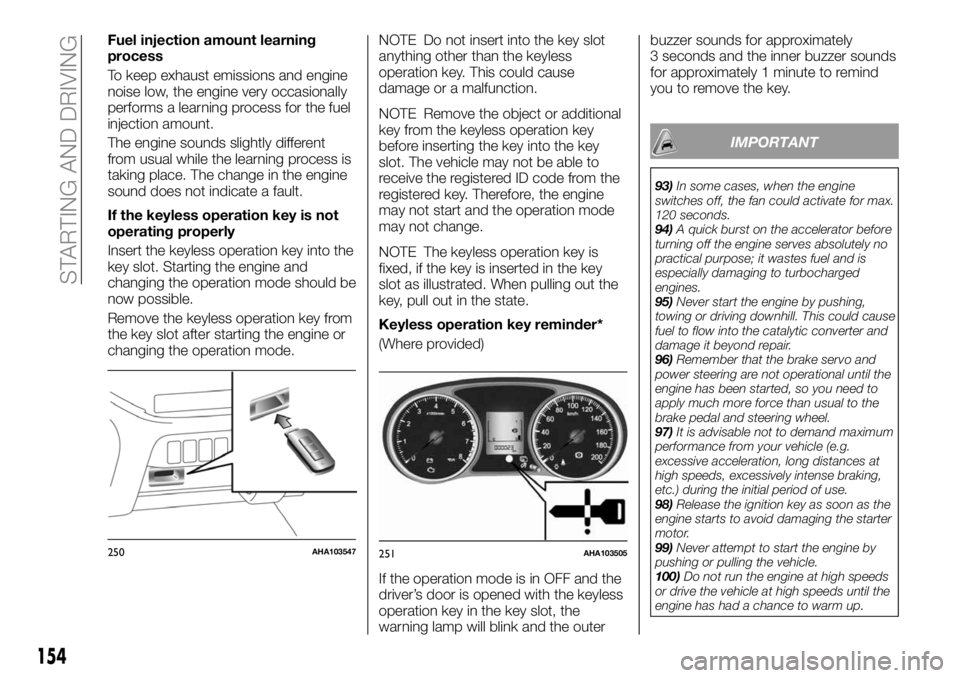
Insert the keyless operation key into the
key slot. Starting the engine and
changing the operation mode should be
now possible.
Remove the keyless operation key from
the key slot after starting the engine or
changing the operation mode.NOTE Do not insert into the key slot
anything other than the keyless
operation key. This could cause
damage or a malfunction.
NOTE Remove the object or additional
key from the keyless operation key
before inserting the key into the key
slot. The vehicle may not be able to
receive the registered ID code from the
registered key. Therefore, the engine
may not start and the operation mode
may not change.
NOTE The keyless operation key is
fixed, if the key is inserted in the key
slot as illustrated. When pulling out the
key, pull out in the state.
Keyless operation key reminder*
(Where provided)
If the operation mode is in OFF and the
driver’s door is opened with the keyless
operation key in the key slot, the
warning lamp will blink and the outerbuzzer sounds for approximately
3 seconds and the inner buzzer sounds
for approximately 1 minute to remind
you to remove the key.
IMPORTANT
93)In some cases, when the engine
switches off, the fan could activate for max.
120 seconds.
94)A quick burst on the accelerator before
turning off the engine serves absolutely no
practical purpose; it wastes fuel and is
especially damaging to turbocharged
engines.
95)Never start the engine by pushing,
towing or driving downhill. This could cause
fuel to flow into the catalytic converter and
damage it beyond repair.
96)Remember that the brake servo and
power steering are not operational until the
engine has been started, so you need to
apply much more force than usual to the
brake pedal and steering wheel.
97)It is advisable not to demand maximum
performance from your vehicle (e.g.
excessive acceleration, long distances at
high speeds, excessively intense braking,
etc.) during the initial period of use.
98)Release the ignition key as soon as the
engine starts to avoid damaging the starter
motor.
99)Never attempt to start the engine by
pushing or pulling the vehicle.
100)Do not run the engine at high speeds
or drive the vehicle at high speeds until the
engine has had a chance to warm up.
250AHA103547251AHA103505
154
STARTING AND DRIVING
Page 159 of 316
NOTE In the following cases, the
“Start&Stop” indicator lamp will turn off
and the engine will not stop
automatically.
After the engine restarts
automatically, the vehicle speed has not
exceeded approximately 5 km/h.
After the engine start, approximately
30 seconds or more have not elapsed.
After the engine restarts
automatically, the vehicle stops again
within 10 seconds.
Engine coolant temperature is low.
Ambient temperature is low.
When the heater is operated, vehicle
indicator temperature is not still hot
enough.
Air conditioner is operating and
passenger compartment has not
sufficiently cooled.
Demister switch is pressed. Refer to
“Demisting of the windscreen and door
windows: for quick demisting”.
When the air conditioner is operated
in AUTO mode where the temperature
control is set to the max. hot or the
max. cool (for vehicles with automatic
climate air conditioning).
When the diesel particulate filter
(DPF) automatically burns away trapped
particulate matter (PM).
Electric power consumption is high,
such as when the rear window demister
or other electrical components areoperating or the blower speed is set to
a high setting.
Battery voltage or battery
performance is low.
Check engine warning lamp is
illuminated or the
indicator lamp is
blinking.
On 4WD vehicles, the drive
mode-selector in “4H” or “4L” (Easy
select 4WD), “4HLc” or “4LLc” (Super
select 4WD II).
NOTE In the following cases, the
engine will not stop automatically even
if “Start&Stop” indicator lamp turn on.
Push the accelerator pedal
Brake booster vacuum pressure is
low
Operate the steering wheel
Parking on steep hill
NOTE Do not rest your foot on the
clutch pedal while driving because this
will cause detection of clutch pedal
switch malfunction and blinking of the
Start&Stop OFF indicator, and the
Start&Stop system will not operate.
NOTE If the Start&Stop system
operates while the air conditioner is
operating, both the engine and the air
conditioning compressor will stop.
Therefore, only the blower will operate,
the windows may start to fog up. If this
occurs, press the demister switch to
restart the engine. Refer to “Demister
switch”.NOTE If the windows become fogged
up each time the engine is stopped, we
recommend you to deactivate the
Start&Stop system by pressing the
“Start&Stop OFF” switch. Refer to “To
deactivate”.
NOTE If the air conditioner is operating,
set the temperature control higher to
lengthen the time that the engine is
stopped automatically.
Automatically restarting the engine
Depress the clutch pedal while the
gearshift lever is in the “N” (Neutral)
position. The indicator lamp turns off
and the engine restarts automatically.
NOTE Do not move the gearshift lever
to a position other than the “N” (Neutral)
position or do not release the clutch
pedal while the engine is restarting
automatically. The starter motor will
stop and the engine will not restart
automatically.
NOTE If the engine does not restart
automatically or if the engine stalls, the
charge warning lamp and check engine
warning lamp will illuminate. If this
occurs, the engine will not restart even
if the clutch pedal is depressed again.
While depressing the brake pedal, fully
depress the clutch pedal and turn the
ignition switch to the “START” position
or press the engine switch to start the
engine. For details, refer to “Starting
and stopping the engine”.
157
Page 161 of 316
108)In the following cases, the engine will
restart automatically even if the engine was
stopped by the Start&Stop system. Pay
careful attention, otherwise an unexpected
accident might occur when the engine
restarts.1—Vehicle speed is 3 km/h or
higher when coasting down a slope. 2 —
Brake booster vacuum pressure is low
because the brake pedal is depressed
repeatedly or depressed harder than usual.
3 — Engine coolant temperature is low. 4
— When the air conditioner is operated by
pressing the air conditioning switch. 5 —
When the preset temperature of the air
conditioner is changed significantly. 6 —
When the air conditioner is operated in
AUTO mode where the temperature control
is set to the max. hot or the max. cool (for
vehicles with automatic climate air
conditioning). 7 — When the air conditioner
is ON, the passenger compartment
temperature rises and the air conditioning
compressor operates to lower the
temperature. 8 — Demister switch is
pressed. Refer to “For quick demisting”. 9
— Electric power consumption is high,
such as when the rear window demister or
other electrical components are operating
or the blower speed is set to a high setting.
10 — Battery voltage or battery
performance is low. 11 — Operate the
steering wheel. 12 — Driver’s seat belt is
unfastened. 13 — Driver’s door is opened.MANUAL
TRANSMISSION
(Where provided)
The shift pattern is shown on the
gearshift lever knob. To start off,
depress the clutch pedal all the way
down and shift into 1st or “R” (Reverse)
position. Then operate the gearshift
lever slowly. Afterwards gradually
release the clutch pedal while
depressing the accelerator pedal.
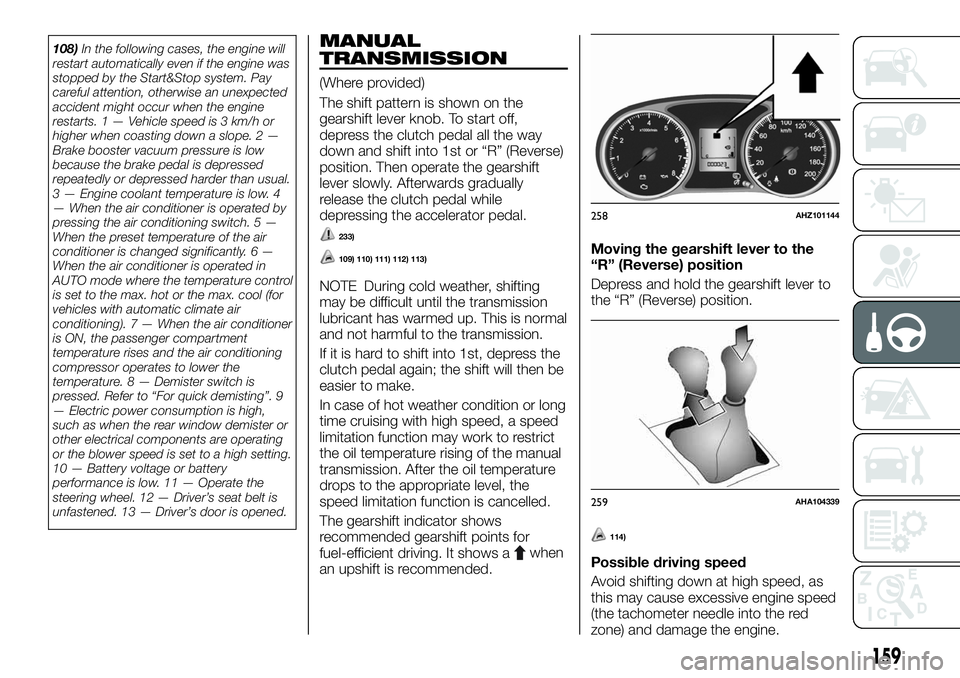
233)
109) 110) 111) 112) 113)
NOTE During cold weather, shifting
may be difficult until the transmission
lubricant has warmed up. This is normal
and not harmful to the transmission.
If it is hard to shift into 1st, depress the
clutch pedal again; the shift will then be
easier to make.
In case of hot weather condition or long
time cruising with high speed, a speed
limitation function may work to restrict
the oil temperature rising of the manual
transmission. After the oil temperature
drops to the appropriate level, the
speed limitation function is cancelled.
The gearshift indicator shows
recommended gearshift points for
fuel-efficient driving. It shows a
when
an upshift is recommended.Moving the gearshift lever to the
“R” (Reverse) position
Depress and hold the gearshift lever to
the “R” (Reverse) position.
114)
Possible driving speed
Avoid shifting down at high speed, as
this may cause excessive engine speed
(the tachometer needle into the red
zone) and damage the engine.
258AHZ101144
259AHA104339
159
Page 165 of 316
Selector lever positions
“P” PARK
This position locks the transmission to
prevent the vehicle from moving. The
engine can be started in this position.
“R” REVERSE
This position is to back up.
116)
“N” NEUTRAL
At this position the transmission is
disengaged. It is the same as the
neutral position on a manual
transmission, and should only be used
when the vehicle is stationary for an
extended length of time during driving,
such as in a traffic jam.
117) 118) 119)
“D” DRIVE
This position is used for most city and
highway driving. The transmission will
automatically change its gear
depending on road and driving
conditions.
120)
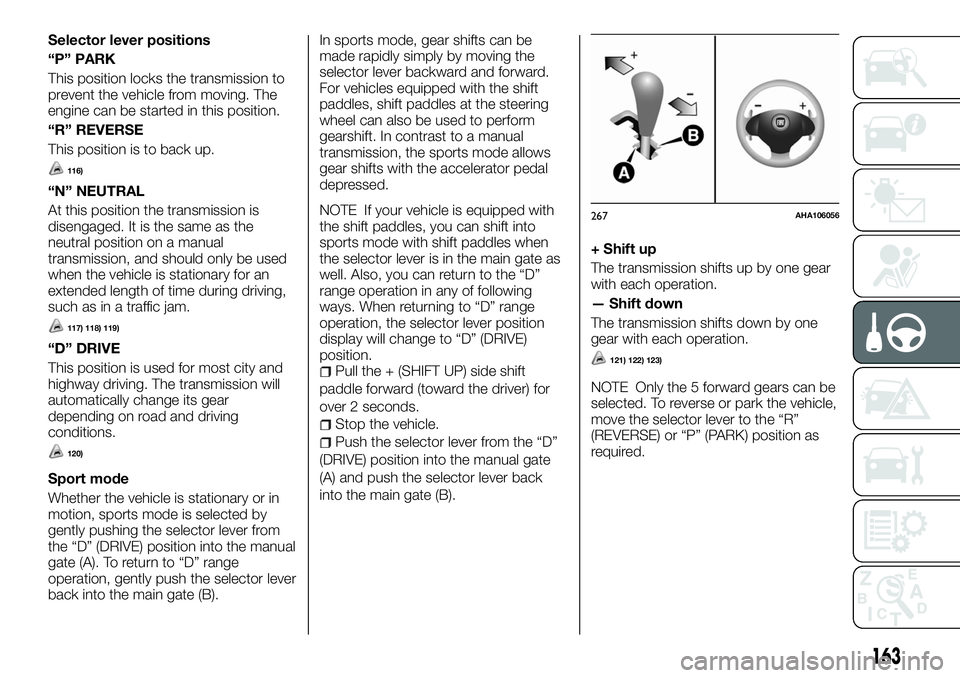
Sport mode
Whether the vehicle is stationary or in
motion, sports mode is selected by
gently pushing the selector lever from
the “D” (DRIVE) position into the manual
gate (A). To return to “D” range
operation, gently push the selector lever
back into the main gate (B).In sports mode, gear shifts can be
made rapidly simply by moving the
selector lever backward and forward.
For vehicles equipped with the shift
paddles, shift paddles at the steering
wheel can also be used to perform
gearshift. In contrast to a manual
transmission, the sports mode allows
gear shifts with the accelerator pedal
depressed.
NOTE If your vehicle is equipped with
the shift paddles, you can shift into
sports mode with shift paddles when
the selector lever is in the main gate as
well. Also, you can return to the “D”
range operation in any of following
ways. When returning to “D” range
operation, the selector lever position
display will change to “D” (DRIVE)
position.
Pull the + (SHIFT UP) side shift
paddle forward (toward the driver) for
over 2 seconds.
Stop the vehicle.
Push the selector lever from the “D”
(DRIVE) position into the manual gate
(A) and push the selector lever back
into the main gate (B).
+ Shift up
The transmission shifts up by one gear
with each operation.
— Shift down
The transmission shifts down by one
gear with each operation.
121) 122) 123)
NOTE Only the 5 forward gears can be
selected. To reverse or park the vehicle,
move the selector lever to the “R”
(REVERSE) or “P” (PARK) position as
required.
267AHA106056
163
Page 168 of 316
121)In sports mode, the driver must
execute upward shifts in accordance with
prevailing road conditions, taking care to
keep the engine speed below the red zone.
122)Repeated continuous operation of the
selector lever or the shift paddles will
continuously switch shift position.
123)For vehicles equipped with the shift
paddles, do not use the left- and right-hand
shift paddles at the same time. Doing so
could cause a shift of gear ratio that you do
not expect.
124)If the selector lever position display
blinks while you are driving, it is likely that a
safety device is operating because of a
malfunction in the automatic transmission.
Have the vehicle inspected by a Fiat
Dealership as soon as possible.
125)If the lamp comes on, reduce the
engine speed and stop the vehicle in a safe
area. Then set the selector lever to “P”
(PARK) position and idle the engine until the
warning lamp goes off. When the warning
lamp goes off, resume normal driving. If the
warning lamp does not go off, we
recommend you to have your vehicle
inspected by a Fiat Dealership.
126)Before selecting a gear with the
engine running and the vehicle stationary,
fully depress the brake pedal to prevent the
vehicle from creeping. The vehicle will begin
to move as soon as the gear is engaged,
especially when the engine speed is high,
at fast idle or with the air conditioner
operating, the brakes should only be
released when you are ready to drive away.
127)Depress the brake pedal with the right
foot at all times. Using the left foot could
cause driver movement delay in case of an
emergency.128)To prevent sudden acceleration, never
race the engine when shifting from the “P”
(PARK) or “N” (NEUTRAL) position.
129)Operating the accelerator pedal while
the other foot is resting on the brake pedal
will affect braking efficiency and may cause
premature wear of brake pads.
130)Use the selector lever in the correct
shift position in accordance with driving
conditions. Never coast downhill backward
with the selector lever in the {“D” (DRIVE) or
sports mode} or coast forward with the
selector lever in the “R” (REVERSE)
position. The engine may stop and the
unexpected increase in brake pedal effort
and steering wheel weight could lead to an
accident.
131)Do not race the engine with brake
pedal pressed when the vehicle is
stationary. This can damage the A/T. Also,
when you depress the accelerator pedal
while holding down the brake pedal with
the selector lever in the “P” (PARK), “N”
(NEUTRAL) or “D” (DRIVE) position, the
engine revolutions may not rise as high as
when performing the same operation with
the selector lever in the “N” (NEUTRAL)
position.
132)Never hold the vehicle stationary on a
hill using the accelerator pedal (without
using the brake pedal). Always apply the
parking brake and/or service brakes.EASY SELECT 4WD
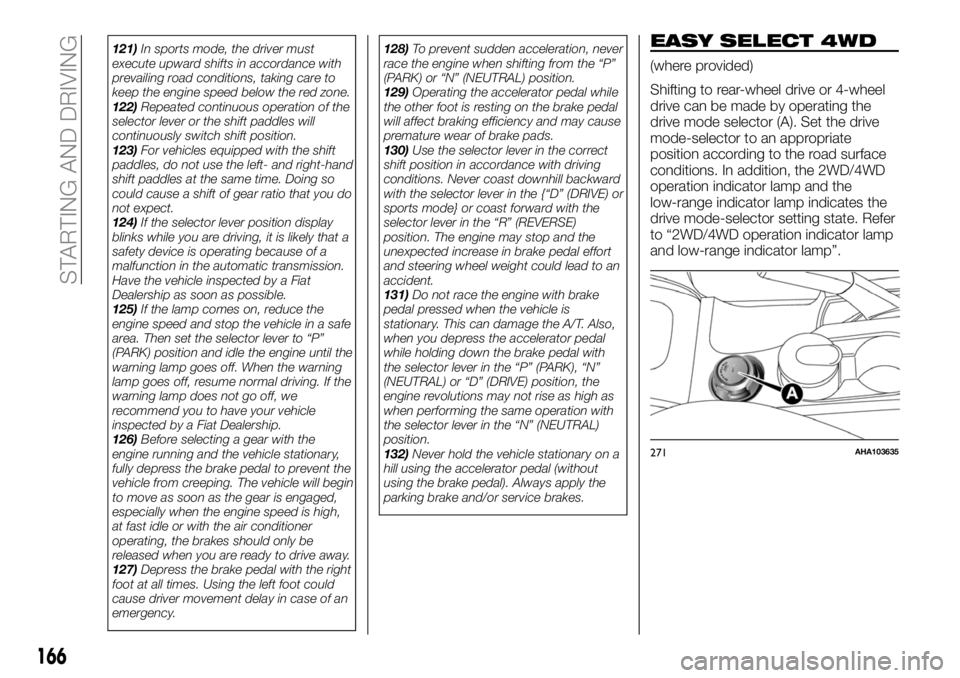
(where provided)
Shifting to rear-wheel drive or 4-wheel
drive can be made by operating the
drive mode selector (A). Set the drive
mode-selector to an appropriate
position according to the road surface
conditions. In addition, the 2WD/4WD
operation indicator lamp and the
low-range indicator lamp indicates the
drive mode-selector setting state. Refer
to “2WD/4WD operation indicator lamp
and low-range indicator lamp”.
271AHA103635
166
STARTING AND DRIVING
Page 171 of 316
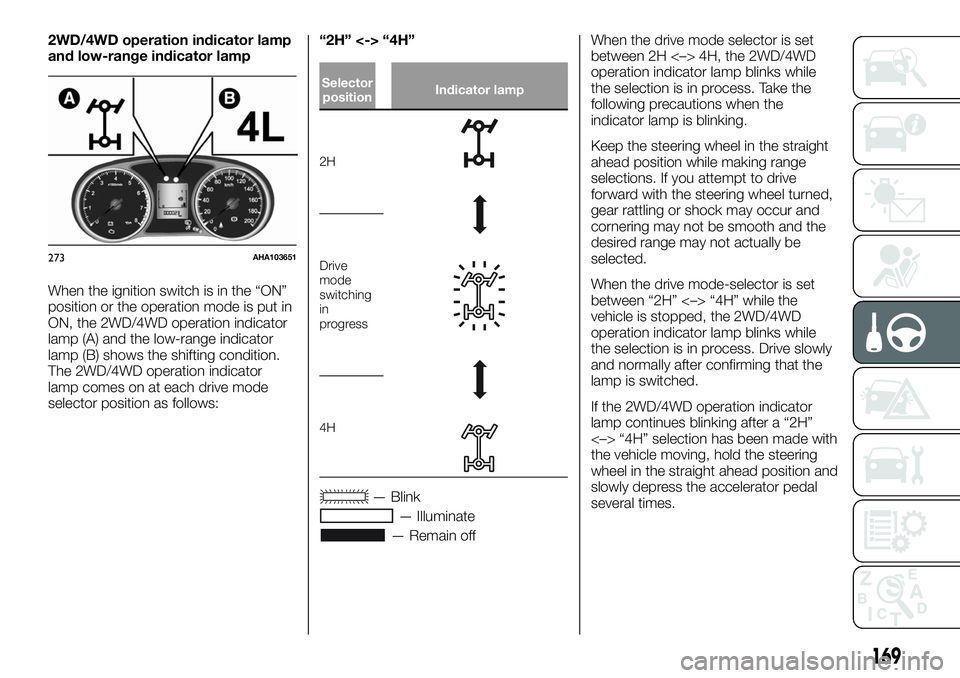
2WD/4WD operation indicator lamp
and low-range indicator lamp
When the ignition switch is in the “ON”
position or the operation mode is put in
ON, the 2WD/4WD operation indicator
lamp (A) and the low-range indicator
lamp (B) shows the shifting condition.
The 2WD/4WD operation indicator
lamp comes on at each drive mode
selector position as follows:“2H” <-> “4H”
Selector
positionIndicator lamp
2H
Drive
mode
switching
in
progress
4H
— Blink
— Illuminate
— Remain offWhen the drive mode selector is set
between 2H <–> 4H, the 2WD/4WD
operation indicator lamp blinks while
the selection is in process. Take the
following precautions when the
indicator lamp is blinking.
Keep the steering wheel in the straight
ahead position while making range
selections. If you attempt to drive
forward with the steering wheel turned,
gear rattling or shock may occur and
cornering may not be smooth and the
desired range may not actually be
selected.
When the drive mode-selector is set
between “2H” <–> “4H” while the
vehicle is stopped, the 2WD/4WD
operation indicator lamp blinks while
the selection is in process. Drive slowly
and normally after confirming that the
lamp is switched.
If the 2WD/4WD operation indicator
lamp continues blinking after a “2H”
<–> “4H” selection has been made with
the vehicle moving, hold the steering
wheel in the straight ahead position and
slowly depress the accelerator pedal
several times.
273AHA103651
169
Page 172 of 316
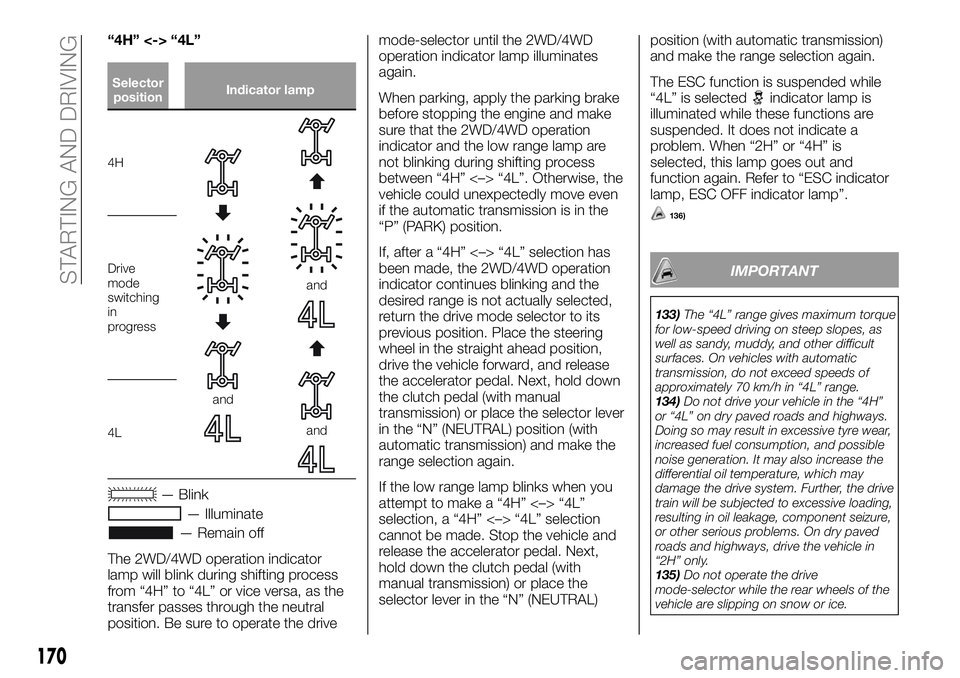
“4H” <-> “4L”
Selector
positionIndicator lamp
4H
and
and
and
Drive
mode
switching
in
progress
4L
— Blink
— Illuminate
— Remain off
The 2WD/4WD operation indicator
lamp will blink during shifting process
from “4H” to “4L” or vice versa, as the
transfer passes through the neutral
position. Be sure to operate the drivemode-selector until the 2WD/4WD
operation indicator lamp illuminates
again.
When parking, apply the parking brake
before stopping the engine and make
sure that the 2WD/4WD operation
indicator and the low range lamp are
not blinking during shifting process
between “4H” <–> “4L”. Otherwise, the
vehicle could unexpectedly move even
if the automatic transmission is in the
“P” (PARK) position.
If, after a “4H” <–> “4L” selection has
been made, the 2WD/4WD operation
indicator continues blinking and the
desired range is not actually selected,
return the drive mode selector to its
previous position. Place the steering
wheel in the straight ahead position,
drive the vehicle forward, and release
the accelerator pedal. Next, hold down
the clutch pedal (with manual
transmission) or place the selector lever
in the “N” (NEUTRAL) position (with
automatic transmission) and make the
range selection again.
If the low range lamp blinks when you
attempt to make a “4H” <–> “4L”
selection, a “4H” <–> “4L” selection
cannot be made. Stop the vehicle and
release the accelerator pedal. Next,
hold down the clutch pedal (with
manual transmission) or place the
selector lever in the “N” (NEUTRAL)position (with automatic transmission)
and make the range selection again.
The ESC function is suspended while
“4L” is selected
indicator lamp is
illuminated while these functions are
suspended. It does not indicate a
problem. When “2H” or “4H” is
selected, this lamp goes out and
function again. Refer to “ESC indicator
lamp, ESC OFF indicator lamp”.
136)
IMPORTANT
133)The “4L” range gives maximum torque
for low-speed driving on steep slopes, as
well as sandy, muddy, and other difficult
surfaces. On vehicles with automatic
transmission, do not exceed speeds of
approximately 70 km/h in “4L” range.
134)Do not drive your vehicle in the “4H”
or “4L” on dry paved roads and highways.
Doing so may result in excessive tyre wear,
increased fuel consumption, and possible
noise generation. It may also increase the
differential oil temperature, which may
damage the drive system. Further, the drive
train will be subjected to excessive loading,
resulting in oil leakage, component seizure,
or other serious problems. On dry paved
roads and highways, drive the vehicle in
“2H” only.
135)Do not operate the drive
mode-selector while the rear wheels of the
vehicle are slipping on snow or ice.
170
STARTING AND DRIVING