fuel FIAT FULLBACK 2018 Owner handbook (in English)
[x] Cancel search | Manufacturer: FIAT, Model Year: 2018, Model line: FULLBACK, Model: FIAT FULLBACK 2018Pages: 316, PDF Size: 10.52 MB
Page 179 of 316
NOTE If the low range lamp blinks
when you attempt to make a “4HLc” —
“4LLc” selection, a “4HLc” — “4LLc”
selection cannot be made. Stop the
vehicle and release the accelerator
pedal. Next, hold down the clutch pedal
(with manual transmission) or place the
selector lever in the “N” (NEUTRAL)
position (with automatic transmission)
and make the range selection again.
NOTE The ESC function is suspended
while “4LLc” is selected
indicator
lamp is illuminated while these functions
are suspended. It does not indicate a
problem. When “2H” or “4H” or “4HLc”
is selected, this lamp goes out and
function again. Refer to “ESC indicator
lamp, ESC OFF indicator lamp”.
140)
IMPORTANT
137)The “4LLc” range gives maximum
torque for low-speed driving on steep
slopes, as well as sandy, muddy, and other
difficult surfaces. On vehicles with
automatic transmission, do not exceed
speeds of approximately 70 km/h in “4LLc”
range.
138)Do not drive your vehicle in the
“4HLc” or “4LLc” position on dry paved
roads and highways. Doing so may result in
excessive tyre wear, increased fuel
consumption, and possible noise
generation. It may also increase the
differential oil temperature, which may
damage the drive system. Further, the drive
train will be subjected to excessive loading,
resulting in oil leakage, component seizure,
or other serious problems. On dry paved
roads and highways, drive the vehicle in
“2H” or “4H” only.
139)Do not operate the drive
mode-selector while the rear wheels of the
vehicle are slipping on snow or ice.
140)If a problem is detected in the transfer
system, a safety device will activate. The
front and rear wheel lamps will go out, the
centre differential lock lamp will blink rapidly
(twice per second), and transfer shifting will
become impossible fig. 277. Park your
vehicle in a safe place, turn off the engine
for a few moments. Restart the engine. The
lamp should resume normal operation. If
the lamps continue to blink, have the
vehicle checked by a Fiat Dealership as
soon as possible.
REAR DIFFERENTIAL
LOCK
(where provided)
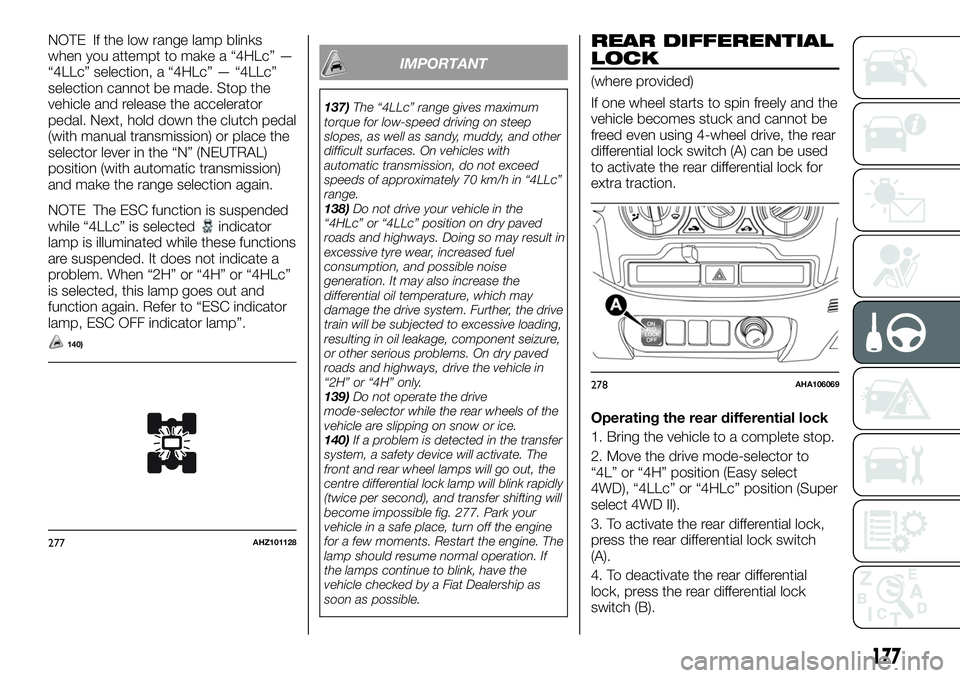
If one wheel starts to spin freely and the
vehicle becomes stuck and cannot be
freed even using 4-wheel drive, the rear
differential lock switch (A) can be used
to activate the rear differential lock for
extra traction.
Operating the rear differential lock
1. Bring the vehicle to a complete stop.
2. Move the drive mode-selector to
“4L” or “4H” position (Easy select
4WD), “4LLc” or “4HLc” position (Super
select 4WD II).
3. To activate the rear differential lock,
press the rear differential lock switch
(A).
4. To deactivate the rear differential
lock, press the rear differential lock
switch (B).
277AHZ101128
278AHA106069
177
Page 185 of 316
1 – Check depths of a stream and
geographical features before attempting
to cross a stream and ford the stream
where the water is as shallow as
practicable.
2 – Set the drive mode-selector to “4L”
position (Easy Select 4WD), “4LLc”
position (Super Select 4WD II).
3 – Drive slowly at a speed of
approximately 5 km/h to avoid
splashing too much water.
148) 149)
Inspection and maintenance
following rough road operation
After operating the vehicle in rough road
conditions, be sure to perform the
following inspection and maintenance
procedures:
Check that the vehicle has not been
damaged by rocks, gravel, etc.
Carefully wash the vehicle with water.
Drive the vehicle slowly while lightly
depressing the brake pedal in order to
dry out the brakes. If the brakes still do
not function properly, contact a Fiat
Dealership as soon as possible to have
the brakes checked.
Remove the insects, dried grass, etc.
clogging the radiator core and the A/T
oil cooler.
After crossing a stream, be sure to have
the following items inspected at a Fiat
Dealership and take the necessary
measures:
Check the brake system and, if
necessary, have it serviced.
Check the engine, transmission,
transfer, and differential oil or grease
level and turbidity. If the oil or grease is
milky, it indicates water contamination.
Replace it with new oil or grease.
Grease the propeller shaft.
Check the inside of the vehicle. If
ingress of water is found, dry the carpet
etc.
Inspect the headlamps. If the
headlamp bulb is flooded with water,
have the headlamp drained off.
IMPORTANT
144)Selecting “4H” or “4L” position (Easy
Select 4WD), “4HLc” or “4LLc” position
(Super Select 4WD II) to drive on dry paved
road will increase the fuel consumption with
possible noise generation and early tyre
wear. It may also increase the differential oil
temperature, resulting in possible damage
to the driving system. Further, the drive
train will be subjected to excessive loading,
possibly leading to oil leakage, component
seizure, or other serious faults.
145)Avoid sudden braking, sudden
acceleration, and sharp turning; such
operations could cause skidding and
spinouts.146)Do not force the vehicle or drive
recklessly on sandy surfaces. In
comparison with normal road surfaces, the
engine and other drive-system components
are put under excessive strain when driving
on such a surface, and this could lead to
accidents.
147)If any of following conditions occur
while the vehicle is being driven,
immediately park your vehicle in a safe
place and follow these procedures: the
needle in the temperature gauge
approaches the overheating zone. Refer to
“Engine overheating”; automatic
transmission fluid temperature warning
lamp comes on. Refer to “When the A/T
(automatic transmission) fluid temperature
warning lamp comes on”.
148)Never cross a stream where the water
is deep. Do not change gears while
crossing the stream. Frequent crossing of
streams can adversely affect the life span
of the vehicle; we recommend you to take
the necessary measures to prepare,
inspect, and repair the vehicle.
149)After crossing a stream, apply the
brakes to be sure they are functioning
properly. If the brakes are wet and not
functioning properly, dry them out by
driving slowly while lightly depressing the
brake pedal. Inspect each part of the
vehicle carefully.
183
Page 206 of 316
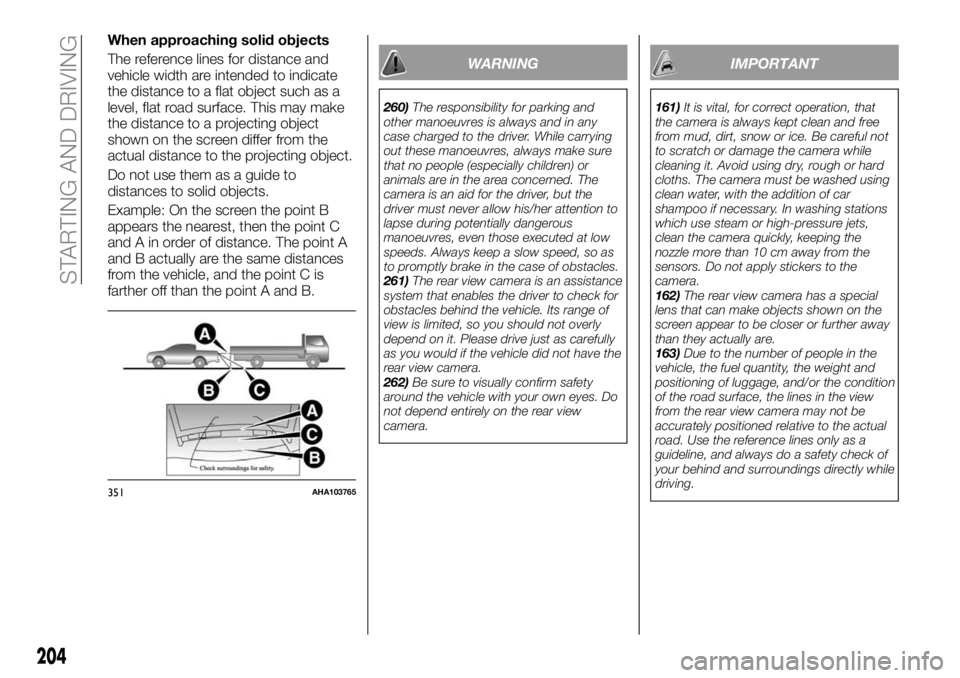
When approaching solid objects
The reference lines for distance and
vehicle width are intended to indicate
the distance to a flat object such as a
level, flat road surface. This may make
the distance to a projecting object
shown on the screen differ from the
actual distance to the projecting object.
Do not use them as a guide to
distances to solid objects.
Example: On the screen the point B
appears the nearest, then the point C
and A in order of distance. The point A
and B actually are the same distances
from the vehicle, and the point C is
farther off than the point A and B.
WARNING
260)The responsibility for parking and
other manoeuvres is always and in any
case charged to the driver. While carrying
out these manoeuvres, always make sure
that no people (especially children) or
animals are in the area concerned. The
camera is an aid for the driver, but the
driver must never allow his/her attention to
lapse during potentially dangerous
manoeuvres, even those executed at low
speeds. Always keep a slow speed, so as
to promptly brake in the case of obstacles.
261)The rear view camera is an assistance
system that enables the driver to check for
obstacles behind the vehicle. Its range of
view is limited, so you should not overly
depend on it. Please drive just as carefully
as you would if the vehicle did not have the
rear view camera.
262)Be sure to visually confirm safety
around the vehicle with your own eyes. Do
not depend entirely on the rear view
camera.
IMPORTANT
161)It is vital, for correct operation, that
the camera is always kept clean and free
from mud, dirt, snow or ice. Be careful not
to scratch or damage the camera while
cleaning it. Avoid using dry, rough or hard
cloths. The camera must be washed using
clean water, with the addition of car
shampoo if necessary. In washing stations
which use steam or high-pressure jets,
clean the camera quickly, keeping the
nozzle more than 10 cm away from the
sensors. Do not apply stickers to the
camera.
162)The rear view camera has a special
lens that can make objects shown on the
screen appear to be closer or further away
than they actually are.
163)Due to the number of people in the
vehicle, the fuel quantity, the weight and
positioning of luggage, and/or the condition
of the road surface, the lines in the view
from the rear view camera may not be
accurately positioned relative to the actual
road. Use the reference lines only as a
guideline, and always do a safety check of
your behind and surroundings directly while
driving.
351AHA103765
204
STARTING AND DRIVING
Page 207 of 316
IN AN EMERGENCY
A punctured tyre or a burnt-out bulb?
At times, a problem may interfere with
our journey.
The pages on emergencies can help
you to deal with critical situations
independently and with calm.
In an emergency we recommend that
you call the freephone number found in
the Warranty Booklet.
It is also possible to call the
00 800 3428 0000 freephone number
to search the nearest Fiat Dealership.ERA GLONASS.............206
IF THE VEHICLE BREAKS DOWN. .210
IF THE OPERATION MODE CANNOT
BE CHANGED TO OFF (VEHICLES
EQUIPPED WITH THE KEYLESS
OPERATION SYSTEM).........211
EMERGENCY STARTING.......211
ENGINE OVERHEATING........212
BLEEDING THE FUEL SYSTEM . . .213
REMOVAL OF WATER FROM THE
FUEL FILTER...............214
TOOLS, JACK AND JACK
HANDLE..................214
HOW TO CHANGE A TYRE.....219
TOWING..................226
OPERATION UNDER ADVERSE
DRIVING CONDITIONS........229
FUSIBLE LINKS.............230
FUSES...................230
REPLACEMENT OF LAMP BULBS .238
205
Page 211 of 316
WARNING
263)In the country or area where is no
available emergency call centre of the
ERA-GLONASS, or where the radio wave
of emergency call cannot be transmitted or
received normally, the system does not
operate. In this case, directly arrange an
emergency vehicle or road service with a
cellular phone, etc.
264)If an emergency occurs and you feel a
smell of the fuel or a bad smell, do not stay
inside the vehicle and escape to a safe
place immediately.
265)While waiting for the rescue after the
emergency call, take action to prevent
secondary accidents such as a rear end
collision with the following vehicle, and
escape to a safe place.
266)In the following cases, directly arrange
an emergency vehicle or road service with
a cellular phone, etc. 1 - When the system
does not operate by failing because of
collision, etc. 2 - When the vehicle is in the
place where radio waves cannot be
transmitted and received (for example,
indoor, a basement parking area,
mountainous area, inside a tunnel, etc.). 3 -
When the line to the emergency call centre
is busy and the call is not reachable to the
emergency call centre.
267)Do not remove or install the above
parts. This can cause failure of contact or
equipment, and the system may not
operate normally.268)If the red lamp and/or the green lamp
do not illuminate after setting the ignition
switch or the operation mode to “ON”,
there is a possible failure in the system.
Have the system inspected by a Fiat
Dealership.
269)If the red lamp remains illuminated or
illuminates again after approximately
20 seconds has elapsed after setting the
ignition switch or the operation mode to
“ON”, there is a possible failure in the
system or the battery for exclusive use of
the ERA-GLONASS may be exhausted.
The battery life is approximately 3 years.
Have the system immediately inspected or
replace the battery by a Fiat Dealership.
270)When the system is not in the
standby state, the system does not
operate. When you drive, make sure to
check that the system is in the standby
state.
271)Before pressing the SOS switch, stop
the vehicle in a safe place. If you operate it
while driving, your attention to the
surrounding circumstances becomes
insufficient enough to cause an
unexpected accident.
272)If the red lamp illuminates as follows,
directly arrange an emergency vehicle or
road service with a cellular phone, etc. 1 -
When the red lamp remains illuminated
(there is a possible failure in the system). 2
- When the red lamp illuminates for
60 seconds (the vehicle may be in the
place where radio waves cannot be
transmitted and received).273)Do not replace the speakers. If they
are replaced, the buzzer sound or the voice
of the operator at the emergency call
centre may not be audible. If the speakers
need to be replaced due to a failure etc.
we recommend you to consult a Fiat
Dealership.
274)An error may occur between the
actual report point and the point reported
to the emergency call centre. Mutually
confirm the report point and the object
through the phone call with the operator of
the emergency call centre.
275)If any of the check results are not
normal, the red lamp illuminates (for
approximately 5 seconds) and the buzzer
sounds 3 times. In this case, there is a
possible failure in the system. Have the
system immediately inspected at a Fiat
Dealership.
IMPORTANT
164)Do not open the cover except when
you press the SOS switch. You may press
the SOS switch by mistake. In addition, if
the cover is opened while driving, the cover
can cause injury in case of emergency.
209
Page 215 of 316
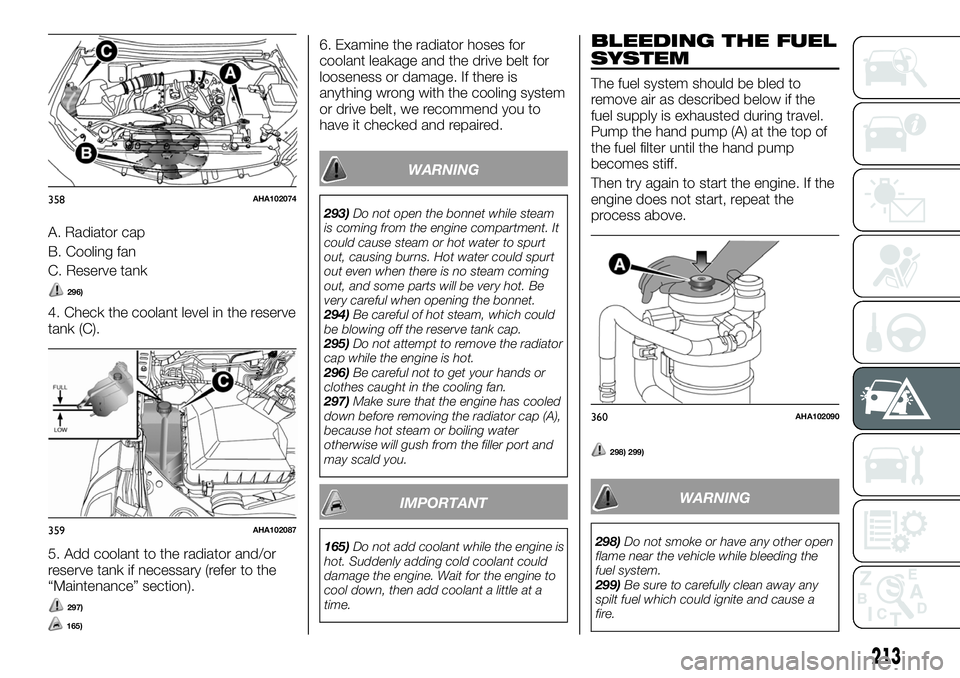
A. Radiator cap
B. Cooling fan
C. Reserve tank
296)
4. Check the coolant level in the reserve
tank (C).
5. Add coolant to the radiator and/or
reserve tank if necessary (refer to the
“Maintenance” section).
297)
165)
6. Examine the radiator hoses for
coolant leakage and the drive belt for
looseness or damage. If there is
anything wrong with the cooling system
or drive belt, we recommend you to
have it checked and repaired.
WARNING
293)Do not open the bonnet while steam
is coming from the engine compartment. It
could cause steam or hot water to spurt
out, causing burns. Hot water could spurt
out even when there is no steam coming
out, and some parts will be very hot. Be
very careful when opening the bonnet.
294)Be careful of hot steam, which could
be blowing off the reserve tank cap.
295)Do not attempt to remove the radiator
cap while the engine is hot.
296)Be careful not to get your hands or
clothes caught in the cooling fan.
297)Make sure that the engine has cooled
down before removing the radiator cap (A),
because hot steam or boiling water
otherwise will gush from the filler port and
may scald you.
IMPORTANT
165)Do not add coolant while the engine is
hot. Suddenly adding cold coolant could
damage the engine. Wait for the engine to
cool down, then add coolant a little at a
time.
BLEEDING THE FUEL
SYSTEM
The fuel system should be bled to
remove air as described below if the
fuel supply is exhausted during travel.
Pump the hand pump (A) at the top of
the fuel filter until the hand pump
becomes stiff.
Then try again to start the engine. If the
engine does not start, repeat the
process above.
298) 299)
WARNING
298)Do not smoke or have any other open
flame near the vehicle while bleeding the
fuel system.
299)Be sure to carefully clean away any
spilt fuel which could ignite and cause a
fire.
358AHA102074
359AHA102087
360AHA102090
213
Page 216 of 316
REMOVAL OF WATER
FROM THE FUEL
FILTER
(Diesel-powered vehicles)
If the fuel filter indicator lamp in the
instrument panel illuminates during
driving, it indicates that water has
accumulated in the fuel filter. If this
occurs, remove the water as described
below.
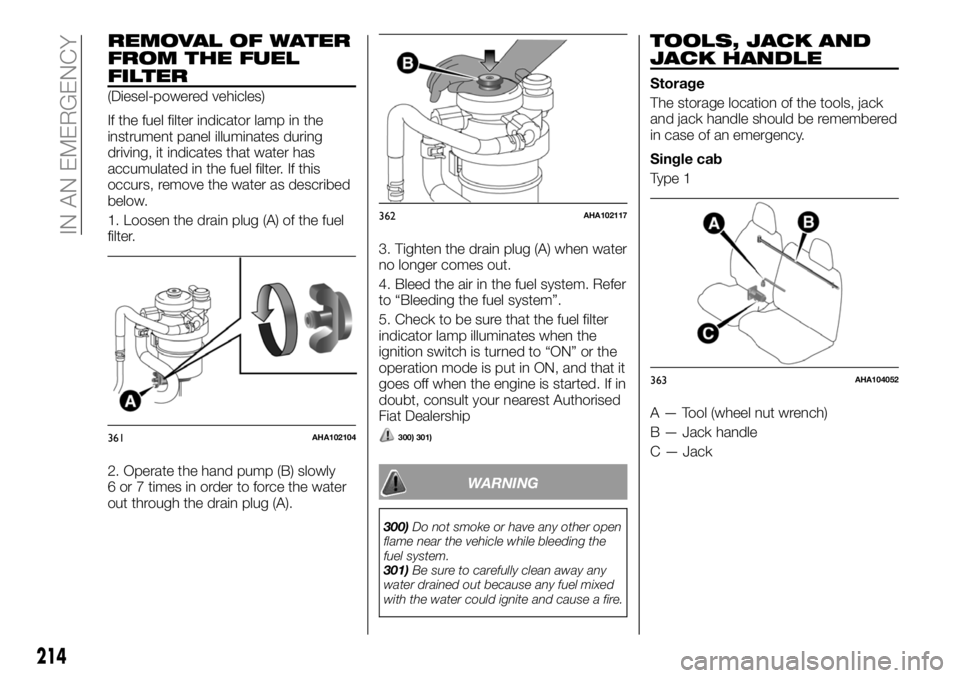
1. Loosen the drain plug (A) of the fuel
filter.
2. Operate the hand pump (B) slowly
6 or 7 times in order to force the water
out through the drain plug (A).3. Tighten the drain plug (A) when water
no longer comes out.
4. Bleed the air in the fuel system. Refer
to “Bleeding the fuel system”.
5. Check to be sure that the fuel filter
indicator lamp illuminates when the
ignition switch is turned to “ON” or the
operation mode is put in ON, and that it
goes off when the engine is started. If in
doubt, consult your nearest Authorised
Fiat Dealership
300) 301)
WARNING
300)Do not smoke or have any other open
flame near the vehicle while bleeding the
fuel system.
301)Be sure to carefully clean away any
water drained out because any fuel mixed
with the water could ignite and cause a fire.
TOOLS, JACK AND
JACK HANDLE
Storage
The storage location of the tools, jack
and jack handle should be remembered
in case of an emergency.
Single cab
Type 1
A — Tool (wheel nut wrench)
B — Jack handle
C — Jack
361AHA102104
362AHA102117
363AHA104052
214
IN AN EMERGENCY
Page 237 of 316
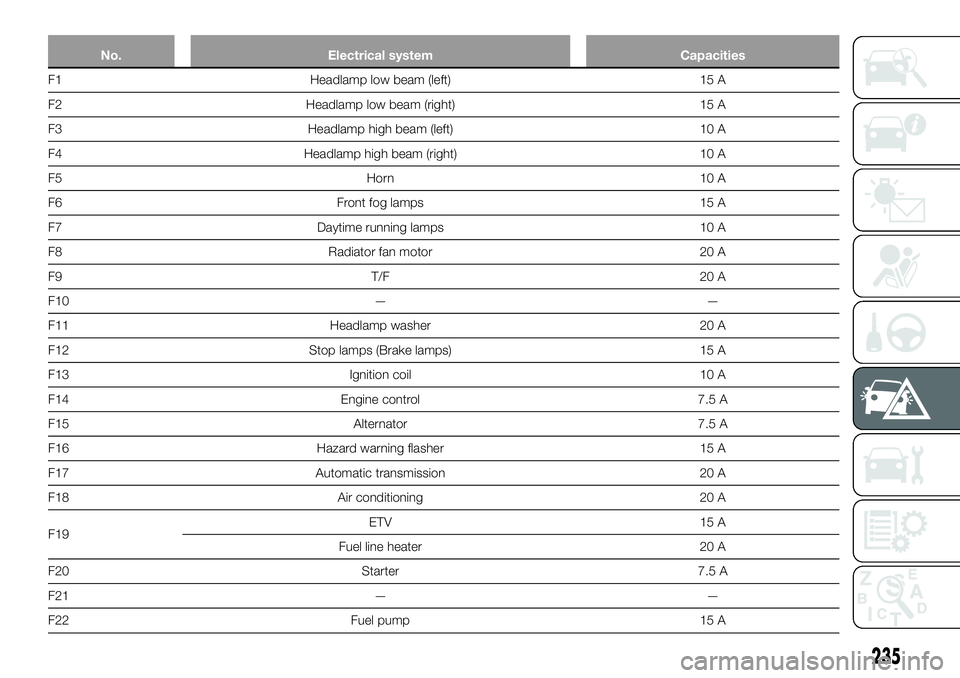
No. Electrical system Capacities
F1 Headlamp low beam (left) 15 A
F2 Headlamp low beam (right) 15 A
F3 Headlamp high beam (left) 10 A
F4 Headlamp high beam (right) 10 A
F5 Horn 10 A
F6 Front fog lamps 15 A
F7 Daytime running lamps 10 A
F8 Radiator fan motor 20 A
F9 T/F 20 A
F10 — —
F11 Headlamp washer 20 A
F12 Stop lamps (Brake lamps) 15 A
F13 Ignition coil 10 A
F14 Engine control 7.5 A
F15 Alternator 7.5 A
F16 Hazard warning flasher 15 A
F17 Automatic transmission 20 A
F18 Air conditioning 20 A
F19ETV 15 A
Fuel line heater 20 A
F20 Starter 7.5 A
F21 — —
F22 Fuel pump 15 A
235
Page 250 of 316
SERVICE
PRECAUTIONS
362) 363) 364) 365) 366) 367) 368) 369)
Adequate care of your vehicle at regular
intervals serves to preserve the value
and appearance as long as possible.
Maintenance items as described in this
owner’s manual can be performed by
the owner.
We recommend you to have the
periodic inspection and maintenance
performed by a Fiat Dealership.
In the event a malfunction or a problem
is discovered, we recommend you to
have it checked and repaired. This
section contains information on
inspection maintenance procedures
that you can do yourself. Follow the
instructions and cautions for each of
the various procedures.
IMPORTANT NOTE!
The customer can have servicing done
outside the authorised Fiat Dealership
without losing the warranty in force. The
warranty depends on carrying out the
scheduled servicing constantly, as
described in this Owner Handbook.
The customer can choose to have the
above mentioned servicing, and any
other repairs covered by the warranty,
carried out by any workshop (within or
outside the Fiat Dealership), as long as
it has suitable means and follows the
instructions described in this Owner
Handbook.
WARNING
362)When checking or servicing the inside
of the engine compartment, make sure the
engine is switched off and has had a
chance to cool down.
363)If it is necessary to do work in the
engine compartment with the engine
running, be especially careful that your
clothing, hair, etc., does not become
caught by the cooling fan, drive belts, or
other moving parts.
364)After performing the maintenance
work, make sure that no tools or cloths are
left behind in the engine compartment. If
they are left behind, a fire or damage to the
vehicle may occur.
365)The cooling fan can turn on
automatically even if the engine is not
running. Turn the ignition switch to “LOCK”
position or put the operation mode in OFF
to be safe while you work in the engine
compartment.
366)Do not smoke, cause sparks or allow
open flames around fuel or battery. The
fumes are flammable.
367)Be extremely cautious when working
around the battery. It contains poisonous
and corrosive sulphuric acid.
368)Do not get under your vehicle with
just the body jack supporting it. Always use
automotive jack stands.
369)Improper handling of components
and materials used in the vehicle can
endanger your personal safety. We
recommend you to consult a specialist for
necessary information.
248
SERVICING AND MAINTENANCE
Page 252 of 316
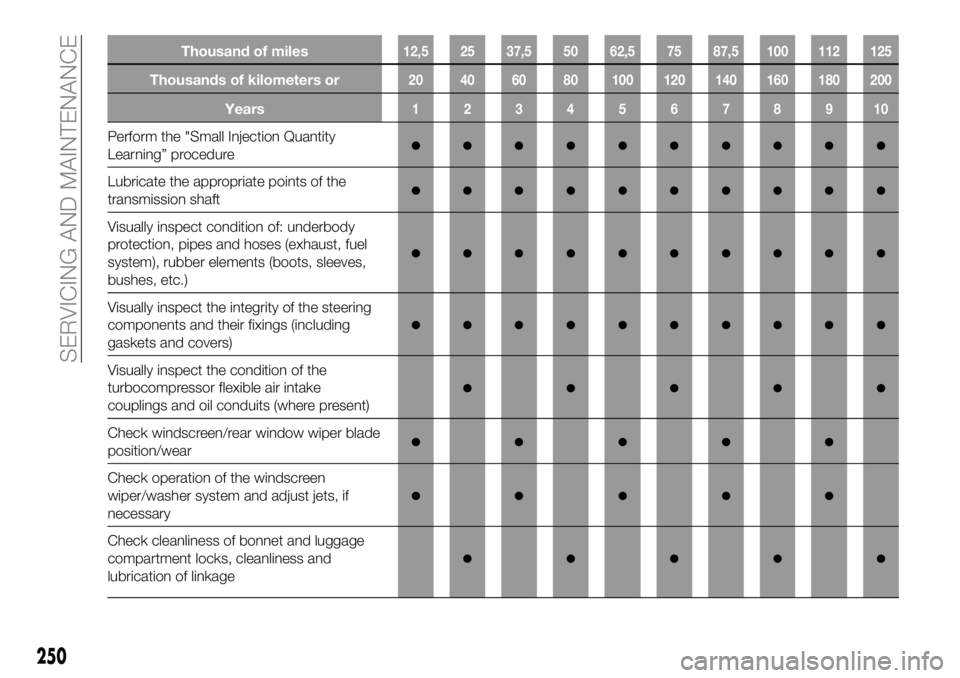
Thousand of miles12,5 25 37,5 50 62,5 75 87,5 100 112 125
Thousands of kilometers or20 40 60 80 100 120 140 160 180 200
Years12345678910
Perform the "Small Injection Quantity
Learning” procedure●●●●●●●●●●
Lubricate the appropriate points of the
transmission shaft●●●●●●●●●●
Visually inspect condition of: underbody
protection, pipes and hoses (exhaust, fuel
system), rubber elements (boots, sleeves,
bushes, etc.)
●●●●●●●●●●
Visually inspect the integrity of the steering
components and their fixings (including
gaskets and covers)
●●●●●●●●●●
Visually inspect the condition of the
turbocompressor flexible air intake
couplings and oil conduits (where present)
●●●●●
Check windscreen/rear window wiper blade
position/wear●●●●●
Check operation of the windscreen
wiper/washer system and adjust jets, if
necessary
●●●●●
Check cleanliness of bonnet and luggage
compartment locks, cleanliness and
lubrication of linkage
●●●●●
250
SERVICING AND MAINTENANCE