light FIAT FULLBACK 2018 Owner handbook (in English)
[x] Cancel search | Manufacturer: FIAT, Model Year: 2018, Model line: FULLBACK, Model: FIAT FULLBACK 2018Pages: 316, PDF Size: 10.52 MB
Page 251 of 316
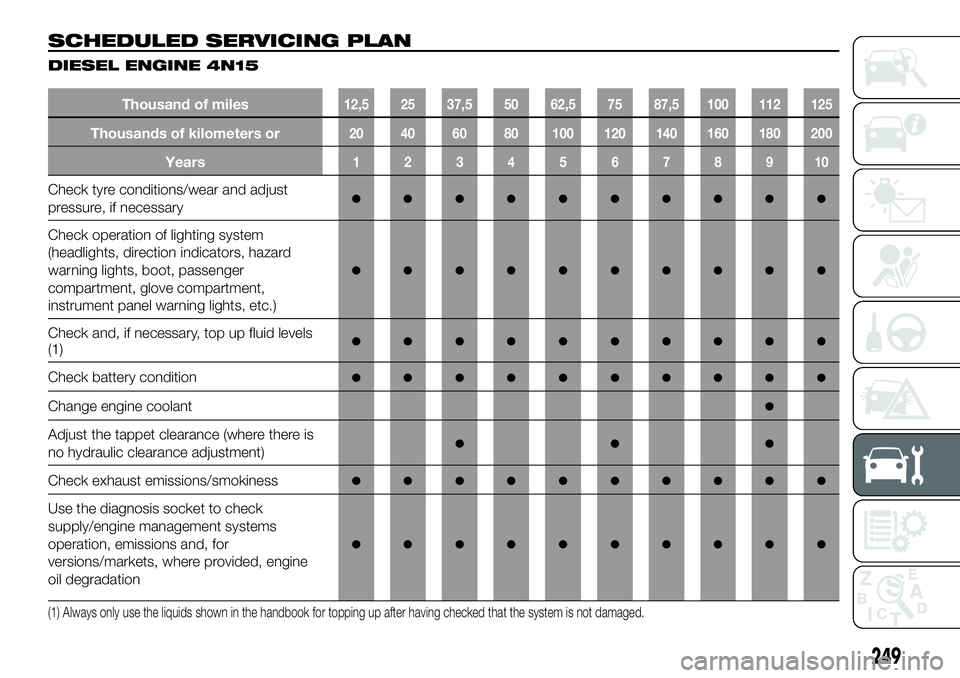
SCHEDULED SERVICING PLAN
DIESEL ENGINE 4N15
Thousand of miles12,5 25 37,5 50 62,5 75 87,5 100 112 125
Thousands of kilometers or20 40 60 80 100 120 140 160 180 200
Years12345678910
Check tyre conditions/wear and adjust
pressure, if necessary●●●●●●●●●●
Check operation of lighting system
(headlights, direction indicators, hazard
warning lights, boot, passenger
compartment, glove compartment,
instrument panel warning lights, etc.)
●●●●●●●●●●
Check and, if necessary, top up fluid levels
(1)●●●●●●●●●●
Check battery condition●●●●●●●●●●
Change engine coolant●
Adjust the tappet clearance (where there is
no hydraulic clearance adjustment)●●●
Check exhaust emissions/smokiness●●●●●●●●●●
Use the diagnosis socket to check
supply/engine management systems
operation, emissions and, for
versions/markets, where provided, engine
oil degradation
●●●●●●●●●●
(1) Always only use the liquids shown in the handbook for topping up after having checked that the system is not damaged.
249
Page 256 of 316
PERIODIC CHECKS
Before long journeys, check and, if
necessary, restore:
engine coolant level;
brake fluid level;
windscreen washer fluid level;
operation of lighting system
(headlamps, direction indicators, hazard
warning lights, etc.);
tyre inflation pressure and condition;
tyre alignment;
operation of screen washer/wiper
system and positioning/wear of
windscreen/rear window wiper blades.
To ensure that the vehicle is always
efficient and well maintained, it is
advisable to make sure that you carry
out the above operations regularly
(approximately every 1000 km and
every 3000 km for checking and
topping up engine oil is advisable).
DEMANDING
VEHICLE USE
If the vehicle is mostly used in one of
the following conditions:
towing a trailer or caravan;
dusty roads;
short, repeated journeys (less than
7-8 km) at sub-zero outside
temperatures;
engine often idling or driving long
distances at low speeds or long periods
of inactivity;
the following checks must be carried
out more often than indicated in the
Scheduled Servicing Plan:
check front disc brake pad
conditions and wear;
check cleanliness of bonnet and
boot locks, cleanliness and lubrication
of linkage;
visually inspect conditions of: engine,
gearbox, transmission, pipes and hoses
(exhaust - fuel system - brakes) and
rubber elements (boots - sleeves -
bushes - etc.);
check battery charge and battery
fluid level (electrolyte);
visually inspect condition of the
accessory drive belts;
check and, if necessary, change
engine oil and replace oil filter;
check and, if necessary, replace
pollen filter.
254
SERVICING AND MAINTENANCE
Page 260 of 316
To add coolant
The cooling system is a closed system
and normally the loss of coolant should
be very slight. A noticeable drop in the
coolant level could indicate leakage. If
this occurs, we recommend you to
have the system checked as soon as
possible. If the level should drop below
the “L” (LOW) level on the reserve tank,
open the lid and add coolant.
Also, if the reserve tank is completely
empty, remove the radiator cap (B) and
add coolant until the level reaches the
filler neck.
377) 378)
Anti-freeze
The engine coolant contains an
ethylene glycol anti-corrosion agent.
Some parts of the engine are cast
aluminium alloy, and periodic changing
of the engine coolant is necessary to
prevent corrosion of these parts.
Use the recommended coolant by Fiat
or equivalent (similar high quality
ethylene glycol based non-silicate,
non-amine, nonnitrate and nonborate
coolant with long life hybrid organic
acid technology).
Fiat genuine coolant has excellent
protection against corrosion and rust
formation of all metals including
aluminium and can avoid blockages in
the radiator, heater, cylinder head,
engine block, etc.Because of the necessity of this
anti-corrosion agent, the coolant must
not be replaced with plain water even in
summer. The required concentration of
anti-freeze differs depending on the
expected ambient temperature.
Above -35 °C: 50 % concentration of
antifreeze
Below -35 °C: 60 % concentration of
antifreeze
183) 184) 185) 186) 187)
During cold weather
If the temperatures in your area drop
below freezing, there is the danger that
the coolant in the engine or radiator
could freeze and cause severe damage
to the engine and/or radiator. Add a
sufficient amount of antifreeze to the
coolant to prevent it from freezing.
The concentration should be checked
before the start of cold weather and
anti-freeze added to the system if
necessary.
WARNING
377)The used engine oil and the filter that
has been replaced contain substances that
are harmful to the environment. To change
the oil and filters, we advise you to contact
a Fiat Dealership.
378)Do not open the radiator cap (B) while
the engine is hot. The coolant system is
under pressure and any hot coolant
escaping could cause severe burns.
IMPORTANT
183)Do not use alcohol or methanol
anti-freeze or any engine coolants mixed
with alcohol or methanol anti-freeze. The
use of an improper anti-freeze can cause
corrosion of the aluminium components.
184)Concentrations exceeding 60 % will
result in a reduction of both the anti-freeze
and cooling performance thus adversely
affecting the engine.
185)Do not top up with water only.
186)PARAFLU UP anti-freeze is used in
the engine cooling system. Use fluid of the
same type as that contained in the cooling
system for any top-ups. PARAFLU UP
cannot be mixed with any other type of
fluid. If this happens, do not start the
engine under any circumstances and
contact a Fiat Dealership.
187)Do not use water to adjust the
concentration of coolant.
258
SERVICING AND MAINTENANCE
Page 261 of 316
WASHER FLUID
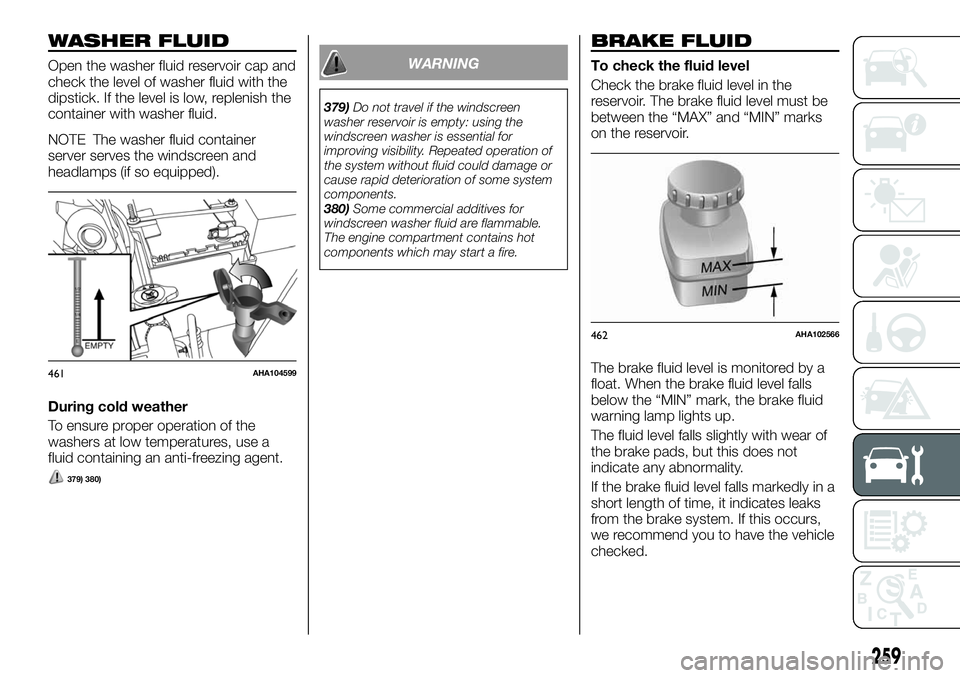
Open the washer fluid reservoir cap and
check the level of washer fluid with the
dipstick. If the level is low, replenish the
container with washer fluid.
NOTE The washer fluid container
server serves the windscreen and
headlamps (if so equipped).
During cold weather
To ensure proper operation of the
washers at low temperatures, use a
fluid containing an anti-freezing agent.
379) 380)
WARNING
379)Do not travel if the windscreen
washer reservoir is empty: using the
windscreen washer is essential for
improving visibility. Repeated operation of
the system without fluid could damage or
cause rapid deterioration of some system
components.
380)Some commercial additives for
windscreen washer fluid are flammable.
The engine compartment contains hot
components which may start a fire.
BRAKE FLUID
To check the fluid level
Check the brake fluid level in the
reservoir. The brake fluid level must be
between the “MAX” and “MIN” marks
on the reservoir.
The brake fluid level is monitored by a
float. When the brake fluid level falls
below the “MIN” mark, the brake fluid
warning lamp lights up.
The fluid level falls slightly with wear of
the brake pads, but this does not
indicate any abnormality.
If the brake fluid level falls markedly in a
short length of time, it indicates leaks
from the brake system. If this occurs,
we recommend you to have the vehicle
checked.
461AHA104599
462AHA102566
259
Page 268 of 316
CLEANING THE
INTERIOR OF YOUR
VEHICLE
After cleaning the interior of your vehicle
with water, cleaner or similar, wipe and
dry in a shady, well-ventilated area.
NOTE If your vehicle has the demister
heater element of the rear window, to
clean the inside of the rear window,
always use a soft cloth and wipe the
window glass along the demister heater
element so as not to cause damage.
400) 401)
201)
Plastic, fabric and flocked parts
1. Lightly wipe these off with a soft
cloth soaked in a mild soap and water
solution.
2. Dip cloth in fresh water and wring it
out well. Using this cloth, wipe off the
detergent thoroughly.
NOTE Do not use cleaners,
conditioners, and protectants
containing silicones or wax. Such
products, when applied to the
instrument panels or other parts, may
cause reflections on the windscreen
and obscure vision. Also, if such
products get on the switches of the
electrical accessories, it may lead to
failure of these accessories.Upholstery
1. To maintain the value of your new
vehicle, handle the upholstery carefully
and keep the interior clean. Use a
vacuum cleaner and brush to clean the
seats. If stained, synthetic leather
should be cleaned with an appropriate
cleaner. Cloth fabrics can be cleaned
with either upholstery cleaner or a mild
soap and water solution.
2. Clean the carpeting with a vacuum
cleaner and remove any stains with
carpet cleaner. Oil and grease can be
removed by lightly dabbing with a clean
colourfast cloth and stain remover.
Genuine leather (where provided)
1. To clean, lightly wipe the leather with
a soft cloth soaked in a mild soap and
water solution.
2. Dip cloth in fresh water and wring it
out well. Using this cloth, wipe off the
detergent thoroughly.
3. Apply leather protecting agent to the
genuine leather surface.
NOTE If genuine leather is wet with
water or is washed in water, wipe off
water as quickly as possible with a dry,
soft cloth. If left damp, mildew may
grow.
NOTE Organic solvents such as
benzine, kerosene, alcohol and petrol,
acid or alkaline solvents may discolour
the genuine leather surface. Be sure to
use neutral detergents.NOTE Remove oil substances quickly
as they can stain genuine leather.
NOTE The genuine leather surface may
harden and shrink if it is exposed to
direct rays of the sun for long hours.
When your vehicle is parked, place it in
the shade as much as possible.
NOTE When the temperature of the
vehicle interior rises in summer, vinyl
products left on the genuine leather
seat may deteriorate and stick to the
seat.
WARNING
400)Do not keep aerosol cans in the
vehicle: they might explode. Aerosol cans
must not be exposed to a temperature
exceeding 50°C. When the vehicle is
exposed to sunlight, the internal
temperature can greatly exceed this value.
401)Never use flammable products, such
as petrol ether or rectified petrol to clean
the inside of the car. The electrostatic
charges which are generated by rubbing
during the cleaning operation may cause a
fire.
266
SERVICING AND MAINTENANCE
Page 269 of 316
IMPORTANT
201)Do not use organic substances
(solvents, benzine, kerosene, alcohol,
petrol, etc.) or alkaline or acidic solutions.
These chemicals can cause discolouring,
staining or cracking of the surface. If you
use cleaners or polishing agents, make
sure their ingredients do not include the
substances mentioned above.
CLEANING THE
EXTERIOR OF YOUR
VEHICLE
If the following is left on your vehicle, it
may cause corrosion, discolouration
and stains, wash the vehicle as soon as
possible.
Seawater, road deicing products.
Soot and dust, iron powder from
factories, chemical substance (acids,
alkalis, coaltar, etc.).
Droppings from birds, carcasses of
insects, tree sap, etc.
Washing
Chemicals contained in the dirt and
dust picked up from the road surface
can damage the paint coat and body of
your vehicle if left in prolonged contact.
Frequent washing and waxing is the
best way to protect your vehicle from
this damage. This will also be effective
in protecting it from environmental
elements such as rain, snow, salt air,
etc.
Using an ample amount of clean water
and a car washing brush or sponge,
wash the vehicle from top to bottom.
Use a mild car washing soap if
necessary. Rinse thoroughly and wipe
dry with a soft cloth. After washing the
vehicle, carefully clean the joints and
flanges of the doors, bonnet and other
sections where dirt is likely to remain.
202) 203) 204) 205) 206) 207) 208) 209) 210)
6)
During cold weather
The salt and other chemicals spread on
the roads in some areas in winter can
have a harmful effect on the vehicle
body. You should therefore wash the
vehicle as often as possible in
accordance with our care-instructions.
It is recommended to have a
preservative applied and the underfloor
protection checked before and after the
cold weather season.
After washing your vehicle, wipe off all
water drops from the rubber parts
around the doors to prevent the doors
from freezing.
Waxing
Waxing the vehicle will help prevent the
adherence of dust and road chemicals
to the paintwork. Apply a wax solution
after washing the vehicle, or at least
once every three months to assist
displacing of water.
Do not wax your vehicle in direct
sunlight. You should wax after the
surfaces have cooled.
For information on how to use wax refer
to the instruction manual of the wax.
211)
Polishing
The vehicle should only be polished if
the paintwork has become stained or
lost its lustre. Do not polish parts with a
mat coating and the plastic bumpers.
267
Page 271 of 316
40 cm away from the bodywork to
avoid damage or alteration. It should be
remembered that the build up of water
can damage the car over a period of
time.
Wash the bodywork using a low
pressure jet of water.
Use a sponge to wipe a slightly
soapy solution over the bodywork,
frequently rinsing the sponge.
Rinse with plenty of water and dry
with a jet of air or a chamois leather. Dry
the less visible parts with special care,
such as the door frames, bonnet and
the headlight frames, where water may
stagnate more easily. The car should
not be taken to a closed area
immediately, but left outside so that
residual water can evaporate.
Do not wash the car after it has been
parked in the sun.
Exterior plastic parts must be
cleaned in the same way as the rest of
the vehicle.
Where possible, do not park under
trees: the resinous substances that
many species release give the paint a
dull appearance and increase the
possibility of triggering rusting
processes.NOTE Any stains (caused by water) on
the stickers or wrapping can be
removed by dampening the area again
and drying it with a soft, nonabrasive
cloth.
NOTE Bird droppings must be washed
off immediately and thoroughly as the
acid they contain is particularly
aggressive.
NOTE Avoid (if at all possible) parking
the car under trees; remove vegetable
resins immediately as, when dried, it
may only be possible to remove them
with abrasive products and/or polishes,
which is highly inadvisable as they
could alter the paint, the stickers or the
wrapping.
IMPORTANT
202)Avoid washing with rollers and/or
brushes in washing stations. Wash the
vehicle only by hand using neutral pH
detergents; dry it with a wet chamois
leather. Abrasive products and/or polishes
should not be used for cleaning the car.
Bird droppings must be washed off
immediately and thoroughly as the acid
they contain is particularly aggressive.
Avoid (if at all possible) parking the vehicle
under trees; remove vegetable resins
immediately as, when dried, it may only be
possible to remove them with abrasive
products and/or polishes, which is highly
inadvisable as they could alter the typical
opaqueness of the paint. Do not use pure
windscreen washer fluid for cleaning the
front windscreen and rear window; dilute it
min. 50% with water. Only use pure screen
washer fluid when strictly necessary due to
outside temperature conditions.
203)When washing the under side of your
vehicle or wheel, be careful not to injure
your hands.
204)If your vehicle is equipped with the
rear gate spoiler, consult a car wash
operator before using the car wash.
205)If your vehicle has rain sensor wipers,
place the wiper switch lever in the “OFF”
position to deactivate the rain sensor
before washing the vehicle. Otherwise, the
wipers will operate in the presence of water
spray on the windscreen and may get
damaged as a result.
269
Page 272 of 316
206)Refrain from excessively using a car
wash as its brushes may scratch the paint
surface, causing it to lose its gloss.
Scratches will be especially visible on
darker coloured vehicles.
207)Never spray or splash water on the
electrical components in the engine
compartment. Doing so could have an
adverse effect on the engine startability.
Exercise caution also when washing the
underbody; be careful not to spray water
into the engine compartment.
208)Some types of hot water washing
equipment apply high pressure and heat to
the vehicle. They may cause heat distortion
and damage to the vehicle resin parts and
may result in flooding of the vehicle interior.
Therefore maintain a good distance of
approx. 70 cm or more between the vehicle
body and the washing nozzle. Also, when
washing around the door glass, hold the
nozzle at a distance of more than 70 cm
and at right angles to the glass surface.
209)After washing the vehicle, drive the
vehicle slowly while lightly depressing the
brake pedal several times in order to dry
out the brakes. Leaving the brakes wet
could result in reduced braking
performance. Also, there is a possibility that
they could freeze up or become inoperative
due to rust, rendering the vehicle unable to
move.210)Using an automatic car wash, pay
attention to the following items, referring to
the operation manual or consulting a car
wash operator. If the following procedure is
not followed, it could result in damage to
your vehicle: 1 – the outside rear view
mirrors are retracted.2–Ifyour vehicle is
equipped with the pillar antenna, it can be
retracted. If your vehicle is equipped with
the roof antenna, it can be removed. 3 –
The wiper arms are secured in place with
tape.4–Ifyour vehicle has rain sensor
wipers, place the wiper switch lever in the
“OFF” position to deactivate the rain
sensor.
211)Waxes containing high abrasive
compounds should not be used.
212)Do not use a scrubbing brush or other
hard tools as they may damage the plastic
part surface.
213)Do not bring the plastic parts into
contact with petrol, light oil, brake fluids,
engine oils, greases, paint thinners and
sulphuric acid (battery electrolyte) which
may crack, stain or discolour the plastic
parts. If they touch the plastic parts, wipe
them off with soft cloth, chamois or the like
and an aqueous solution of neutral
detergent then immediately rinse the
affected parts with water.
214)Do not use a brush or other hard
implement on the wheels. Doing so could
scratch the wheels.
215)Do not use any cleaner that contains
an abrasive substance or is acidic or
alkaline. Doing so could cause the coating
on the wheels to peel or become
discoloured or stained.
216)Do not directly apply hot water using a
steam cleaner or by any other means.217)Contact with seawater and road
deicer can cause corrosion. Rinse off such
substances as soon as possible.
IMPORTANT
6)Detergents pollute the environment. Only
wash your vehicle in areas equipped to
collect and treat waste water from this type
of activity.
270
SERVICING AND MAINTENANCE
Page 313 of 316
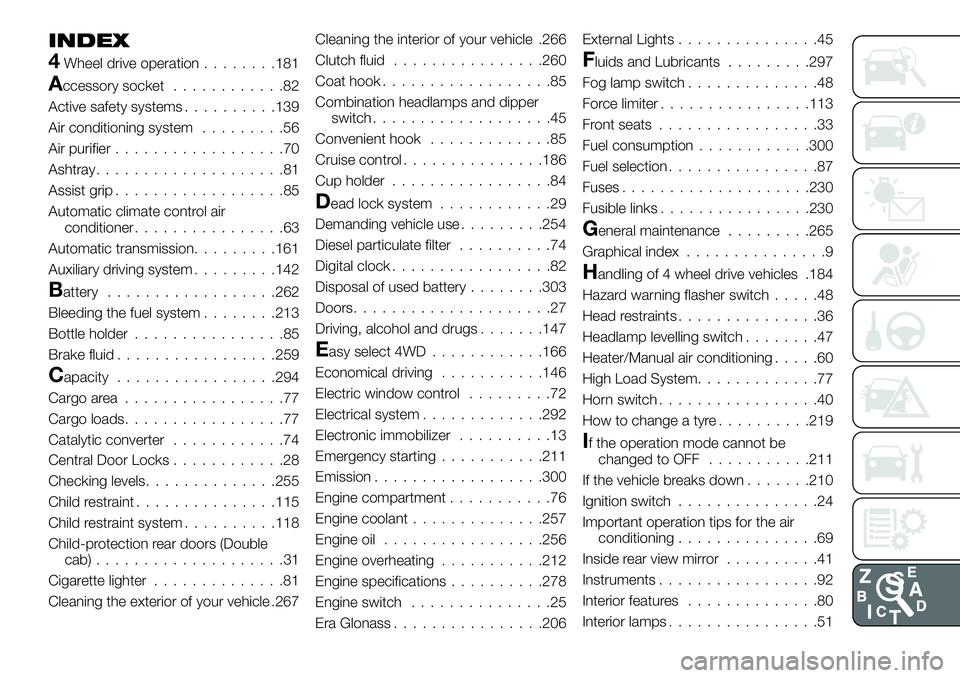
INDEX
4Wheel drive operation........181
Accessory socket............82
Active safety systems..........139
Air conditioning system.........56
Air purifier..................70
Ashtray....................81
Assist grip..................85
Automatic climate control air
conditioner................63
Automatic transmission.........161
Auxiliary driving system.........142
Battery..................262
Bleeding the fuel system........213
Bottle holder................85
Brake fluid.................259
Capacity.................294
Cargo area.................77
Cargo loads.................77
Catalytic converter............74
Central Door Locks............28
Checking levels..............255
Child restraint...............115
Child restraint system..........118
Child-protection rear doors (Double
cab)....................31
Cigarette lighter..............81
Cleaning the exterior of your vehicle .267Cleaning the interior of your vehicle .266
Clutch fluid................260
Coat hook..................85
Combination headlamps and dipper
switch...................45
Convenient hook.............85
Cruise control...............186
Cup holder.................84
Dead lock system............29
Demanding vehicle use.........254
Diesel particulate filter..........74
Digital clock.................82
Disposal of used battery........303
Doors.....................27
Driving, alcohol and drugs.......147
Easy select 4WD............166
Economical driving...........146
Electric window control.........72
Electrical system.............292
Electronic immobilizer..........13
Emergency starting...........211
Emission..................300
Engine compartment...........76
Engine coolant..............257
Engine oil.................256
Engine overheating...........212
Engine specifications..........278
Engine switch...............25
Era Glonass................206External Lights...............45
Fluids and Lubricants.........297
Fog lamp switch..............48
Force limiter................113
Front seats.................33
Fuel consumption............300
Fuel selection................87
Fuses....................230
Fusible links................230
General maintenance.........265
Graphical index...............9
Handling of 4 wheel drive vehicles .184
Hazard warning flasher switch.....48
Head restraints...............36
Headlamp levelling switch........47
Heater/Manual air conditioning.....60
High Load System.............77
Horn switch.................40
How to change a tyre..........219
If the operation mode cannot be
changed to OFF...........211
If the vehicle breaks down.......210
Ignition switch...............24
Important operation tips for the air
conditioning...............69
Inside rear view mirror..........41
Instruments.................92
Interior features..............80
Interior lamps................51