coolant level FIAT FULLBACK 2018 Owner handbook (in English)
[x] Cancel search | Manufacturer: FIAT, Model Year: 2018, Model line: FULLBACK, Model: FIAT FULLBACK 2018Pages: 316, PDF Size: 10.52 MB
Page 68 of 316
NOTE When the temperature is set to
the highest or the lowest, the air
selection and the air conditioner will be
automatically changed as follows. Also,
if the air selection is operated manually
after an automatic changeover, manual
operation will be selected.
Quick Heating(When the
temperature is set to the highest
setting): outside air will be introduced
and the air conditioner will stop.
Quick Cooling(When the
temperature is set to the lowest
setting): inside air will be recirculated
and the air conditioner will operate.
The settings described above are the
factory settings.
The air selection and air conditioning
switches can be customised (function
setting changed), and the automatic
switching of outside air and the air
conditioner according to operating
conditions can be changed as desired.
For further information, we recommend
you to consult a Fiat Dealership.
Refer to “Customising the air
conditioning switch” and to
“Customising the air selection”.
Synchronized mode and dual mode
The driver’s side and the passenger’s
side temperature can be controlled
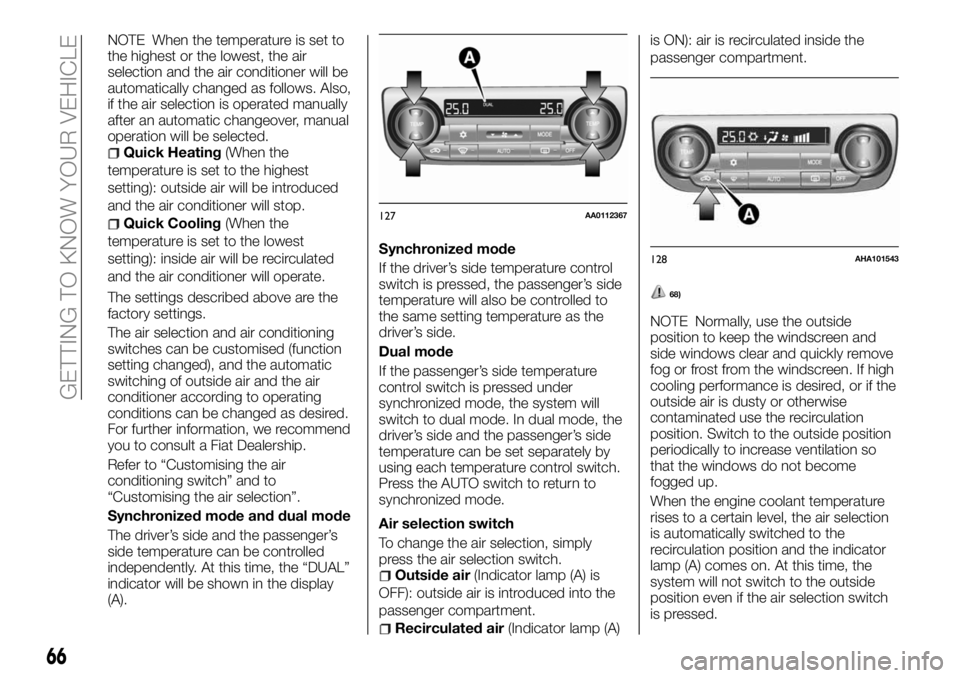
independently. At this time, the “DUAL”
indicator will be shown in the display
(A).Synchronized mode
If the driver’s side temperature control
switch is pressed, the passenger’s side
temperature will also be controlled to
the same setting temperature as the
driver’s side.
Dual mode
If the passenger’s side temperature
control switch is pressed under
synchronized mode, the system will
switch to dual mode. In dual mode, the
driver’s side and the passenger’s side
temperature can be set separately by
using each temperature control switch.
Press the AUTO switch to return to
synchronized mode.
Air selection switch
To change the air selection, simply
press the air selection switch.
Outside air(Indicator lamp (A) is
OFF): outside air is introduced into the
passenger compartment.
Recirculated air(Indicator lamp (A)is ON): air is recirculated inside the
passenger compartment.
68)
NOTE Normally, use the outside
position to keep the windscreen and
side windows clear and quickly remove
fog or frost from the windscreen. If high
cooling performance is desired, or if the
outside air is dusty or otherwise
contaminated use the recirculation
position. Switch to the outside position
periodically to increase ventilation so
that the windows do not become
fogged up.
When the engine coolant temperature
rises to a certain level, the air selection
is automatically switched to the
recirculation position and the indicator
lamp (A) comes on. At this time, the
system will not switch to the outside
position even if the air selection switch
is pressed.
127AA0112367
128AHA101543
66
GETTING TO KNOW YOUR VEHICLE
Page 97 of 316
NOTE The average fuel consumption
display can be reset separately for the
auto reset mode and for the manual
reset mode.
NOTE “---” is displayed when the
average fuel consumption cannot be
measured.
NOTE The initial (default) setting is
“Auto reset mode”.
NOTE The average fuel consumption
will depend on the driving conditions
(road conditions, how you drive, etc.).
The displayed fuel consumption may
vary from the actual fuel consumption.
Treat the fuel consumption displayed as
just a rough guideline.
NOTE The memory of the manual reset
mode or auto reset mode for the
average fuel consumption display is
erased if the battery is disconnected.
NOTE The display setting can be
changed to the preferred units {km/L,
L/100 km, mpg}. Refer to “Changing
the function settings”.
Start&Stop monitor (where
provided)
The accumulated time the engine has
been stopped by Start&Stop system is
displayed. Refer to Start&Stop system.
NOTE When the ignition switch or the
operation mode is ON again, the
accumulated time will be reset.Outside temperature display (if so
equipped)
This displays the temperature outside
the vehicle.
NOTE The display setting can be
changed to the preferred units (°C or
°F). Refer to “Changing the function
settings”.
NOTE Depending on factors such as
the driving conditions, the displayed
temperature may vary from the actual
outside temperature.
Frozen road warning (where
provided)
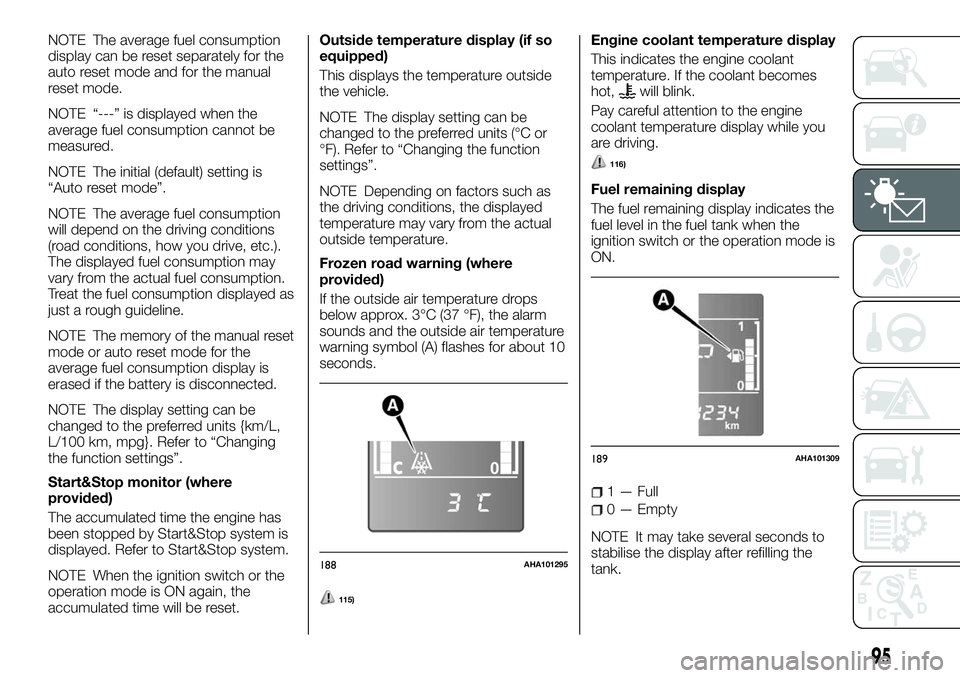
If the outside air temperature drops
below approx. 3°C (37 °F), the alarm
sounds and the outside air temperature
warning symbol (A) flashes for about 10
seconds.
115)
Engine coolant temperature display
This indicates the engine coolant
temperature. If the coolant becomes
hot,
will blink.
Pay careful attention to the engine
coolant temperature display while you
are driving.
116)
Fuel remaining display
The fuel remaining display indicates the
fuel level in the fuel tank when the
ignition switch or the operation mode is
ON.
1 — Full
0 — Empty
NOTE It may take several seconds to
stabilise the display after refilling the
tank.
188AHA101295
189AHA101309
95
Page 161 of 316
108)In the following cases, the engine will
restart automatically even if the engine was
stopped by the Start&Stop system. Pay
careful attention, otherwise an unexpected
accident might occur when the engine
restarts.1—Vehicle speed is 3 km/h or
higher when coasting down a slope. 2 —
Brake booster vacuum pressure is low
because the brake pedal is depressed
repeatedly or depressed harder than usual.
3 — Engine coolant temperature is low. 4
— When the air conditioner is operated by
pressing the air conditioning switch. 5 —
When the preset temperature of the air
conditioner is changed significantly. 6 —
When the air conditioner is operated in
AUTO mode where the temperature control
is set to the max. hot or the max. cool (for
vehicles with automatic climate air
conditioning). 7 — When the air conditioner
is ON, the passenger compartment
temperature rises and the air conditioning
compressor operates to lower the
temperature. 8 — Demister switch is
pressed. Refer to “For quick demisting”. 9
— Electric power consumption is high,
such as when the rear window demister or
other electrical components are operating
or the blower speed is set to a high setting.
10 — Battery voltage or battery
performance is low. 11 — Operate the
steering wheel. 12 — Driver’s seat belt is
unfastened. 13 — Driver’s door is opened.MANUAL
TRANSMISSION
(Where provided)
The shift pattern is shown on the
gearshift lever knob. To start off,
depress the clutch pedal all the way
down and shift into 1st or “R” (Reverse)
position. Then operate the gearshift
lever slowly. Afterwards gradually
release the clutch pedal while
depressing the accelerator pedal.
233)
109) 110) 111) 112) 113)
NOTE During cold weather, shifting
may be difficult until the transmission
lubricant has warmed up. This is normal
and not harmful to the transmission.
If it is hard to shift into 1st, depress the
clutch pedal again; the shift will then be
easier to make.
In case of hot weather condition or long
time cruising with high speed, a speed
limitation function may work to restrict
the oil temperature rising of the manual
transmission. After the oil temperature
drops to the appropriate level, the
speed limitation function is cancelled.
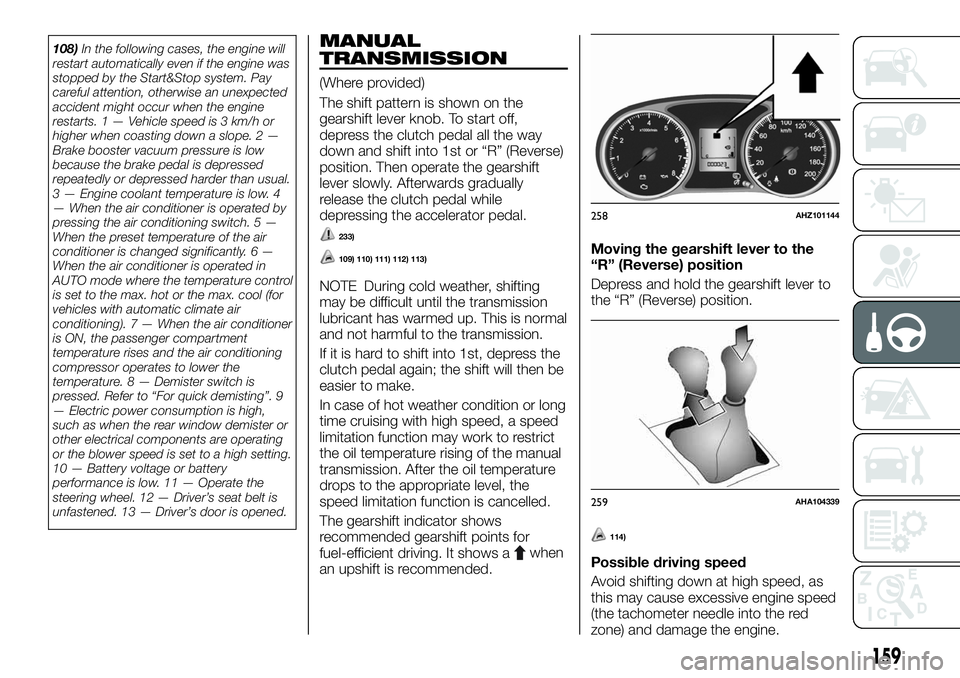
The gearshift indicator shows
recommended gearshift points for
fuel-efficient driving. It shows a
when
an upshift is recommended.Moving the gearshift lever to the
“R” (Reverse) position
Depress and hold the gearshift lever to
the “R” (Reverse) position.
114)
Possible driving speed
Avoid shifting down at high speed, as
this may cause excessive engine speed
(the tachometer needle into the red
zone) and damage the engine.
258AHZ101144
259AHA104339
159
Page 214 of 316
WARNING
276)To start the engine using jumper
cables from another vehicle, perform the
correct procedures according to the
instruction below. Incorrect procedures
could result in a fire or explosion or
damage to the vehicles.
277)Keep sparks, cigarettes and flames
away from the battery because the battery
may produce an explosion.
278)Do not attempt to start the engine by
pulling or pushing the vehicle. It could
damage your vehicle.
279)Check the other vehicle. It must have
a 12-volt battery. If the other system isn’t
12-volt, shorting can damage both
vehicles.
280)Use the proper cables suitable for the
battery size to prevent overheating of the
cables.
281)Check the jumper cables for damage
and corrosion before use.
282)Always wear protective eye goggles
when working near the battery.
283)Keep the battery out of the reach of
children.
284)Turn off the ignition on both vehicles
beforehand. Make sure that the cables or
your clothes cannot be caught by the fan
or drive belt. Personal injury could result.
285)If electrolyte fluid is not visible, or
appears to be frozen, Do Not Attempt
Jump Starting! A battery might rupture or
explode if the temperature is below the
freezing point or if it is not filled to the
proper level.286)Electrolyte is corrosive diluted
sulphuric acid. If electrolyte (battery acid)
comes into contact with your hands, eyes,
clothes or the painted surface of your
vehicle, it should be thoroughly flushed
with water. If electrolyte gets in your eyes,
flush them with water immediately and
thoroughly, and get prompt medical
attention.
287)Make sure that the connection is
made to the appointed position (shown in
the illustration). If the connection is made
directly to the negative (−) side of the
battery, the inflammable gases generated
from the battery might catch fire and
explode.
288)When connecting the jumper cables,
do not connect the positive (+) cable to the
negative (−) terminal. Otherwise sparks
might cause explosion of the battery.
289)Use care not to get the jumper cable
caught in the cooling fan or other rotating
part in the engine compartment.
290)Keep the engine of the vehicle giving
assistance running.
291)Battery fluid is poisonous and
corrosive: avoid contact with your skin and
eyes. The battery should be charged in a
well ventilated place, away from naked
flames or possible sources of sparks:
danger of explosion and fire.
292)Do not attempt to charge a frozen
battery: it must be thawed first, otherwise it
may explode. If freezing has occurred, the
battery should be checked by skilled
personnel to make sure that the internal
elements are not damaged and that the
body is not cracked, with the risk of leaking
poisonous and corrosive acid.
ENGINE
OVERHEATING
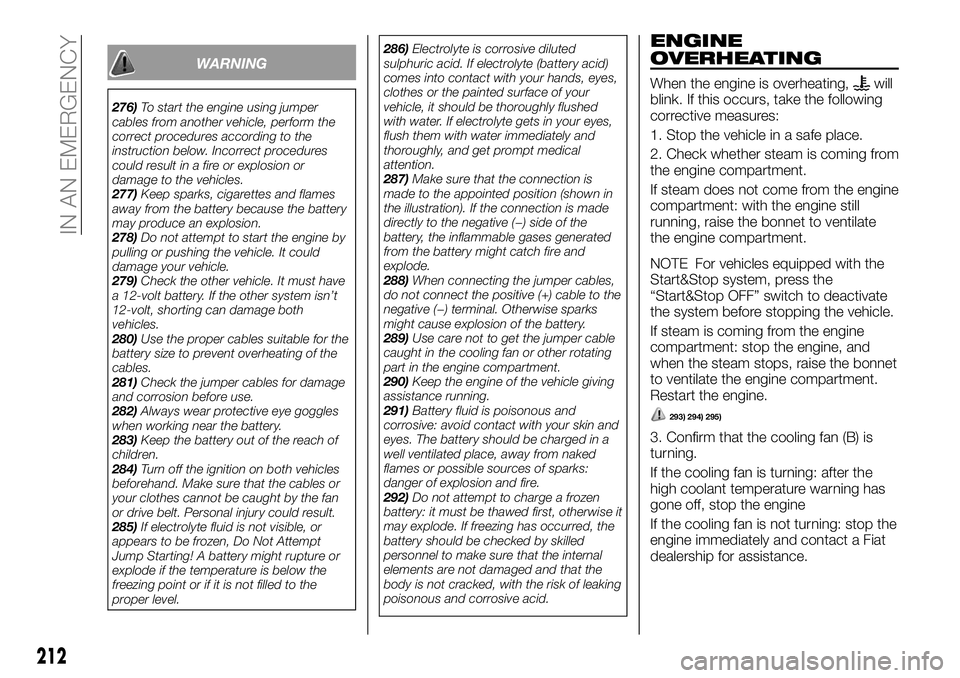
When the engine is overheating,will
blink. If this occurs, take the following
corrective measures:
1. Stop the vehicle in a safe place.
2. Check whether steam is coming from
the engine compartment.
If steam does not come from the engine
compartment: with the engine still
running, raise the bonnet to ventilate
the engine compartment.
NOTE For vehicles equipped with the
Start&Stop system, press the
“Start&Stop OFF” switch to deactivate
the system before stopping the vehicle.
If steam is coming from the engine
compartment: stop the engine, and
when the steam stops, raise the bonnet
to ventilate the engine compartment.
Restart the engine.
293) 294) 295)
3. Confirm that the cooling fan (B) is
turning.
If the cooling fan is turning: after the
high coolant temperature warning has
gone off, stop the engine
If the cooling fan is not turning: stop the
engine immediately and contact a Fiat
dealership for assistance.
212
IN AN EMERGENCY
Page 215 of 316
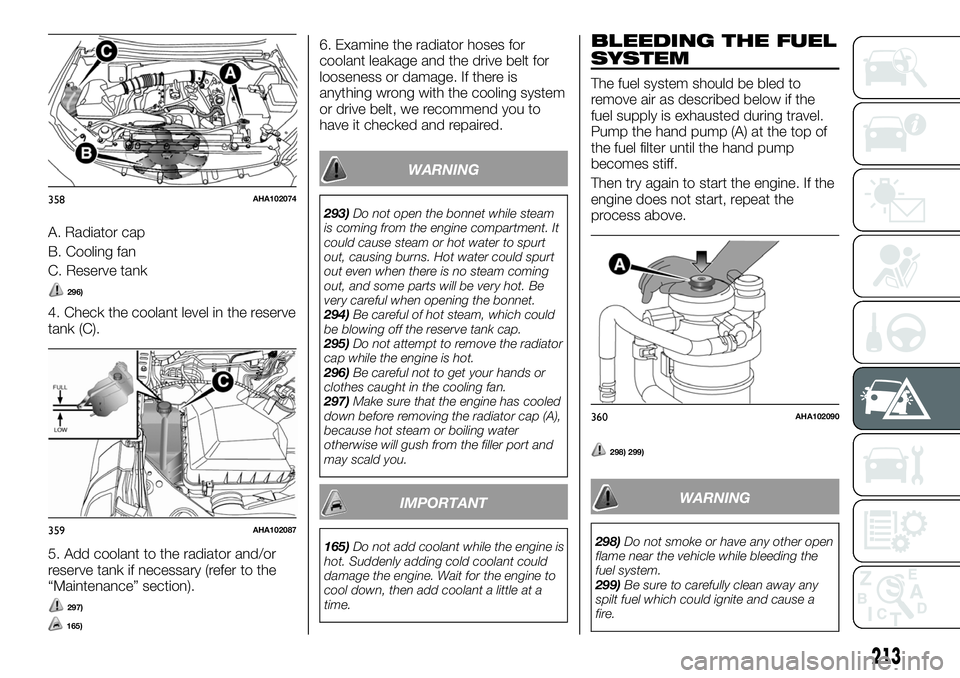
A. Radiator cap
B. Cooling fan
C. Reserve tank
296)
4. Check the coolant level in the reserve
tank (C).
5. Add coolant to the radiator and/or
reserve tank if necessary (refer to the
“Maintenance” section).
297)
165)
6. Examine the radiator hoses for
coolant leakage and the drive belt for
looseness or damage. If there is
anything wrong with the cooling system
or drive belt, we recommend you to
have it checked and repaired.
WARNING
293)Do not open the bonnet while steam
is coming from the engine compartment. It
could cause steam or hot water to spurt
out, causing burns. Hot water could spurt
out even when there is no steam coming
out, and some parts will be very hot. Be
very careful when opening the bonnet.
294)Be careful of hot steam, which could
be blowing off the reserve tank cap.
295)Do not attempt to remove the radiator
cap while the engine is hot.
296)Be careful not to get your hands or
clothes caught in the cooling fan.
297)Make sure that the engine has cooled
down before removing the radiator cap (A),
because hot steam or boiling water
otherwise will gush from the filler port and
may scald you.
IMPORTANT
165)Do not add coolant while the engine is
hot. Suddenly adding cold coolant could
damage the engine. Wait for the engine to
cool down, then add coolant a little at a
time.
BLEEDING THE FUEL
SYSTEM
The fuel system should be bled to
remove air as described below if the
fuel supply is exhausted during travel.
Pump the hand pump (A) at the top of
the fuel filter until the hand pump
becomes stiff.
Then try again to start the engine. If the
engine does not start, repeat the
process above.
298) 299)
WARNING
298)Do not smoke or have any other open
flame near the vehicle while bleeding the
fuel system.
299)Be sure to carefully clean away any
spilt fuel which could ignite and cause a
fire.
358AHA102074
359AHA102087
360AHA102090
213
Page 249 of 316
SERVICING AND MAINTENANCE
Correct maintenance permits the
performance of the car to be
maintained over time, as well as limited
running costs and safeguarding the
efficiency of the safety systems.
This chapter explains how.SERVICE PRECAUTIONS.......248
SCHEDULED SERVICING PLAN . .249
PERIODIC CHECKS..........254
DEMANDING VEHICLE USE.....254
CHECKING LEVELS..........255
CATALYTIC CONVERTER.......256
ENGINE OIL...............256
ENGINE COOLANT...........257
WASHER FLUID.............259
BRAKE FLUID..............259
CLUTCH FLUID.............260
POWER STEERING FLUID......261
BATTERY.................262
WIPER BLADE REPLACEMENT . . .264
GENERAL MAINTENANCE......265
VEHICLE CARE PRECAUTIONS. . .265
CLEANING THE INTERIOR OF YOUR
VEHICLE.................266
CLEANING THE EXTERIOR OF YOUR
VEHICLE.................267
TYRES...................271
247
Page 251 of 316
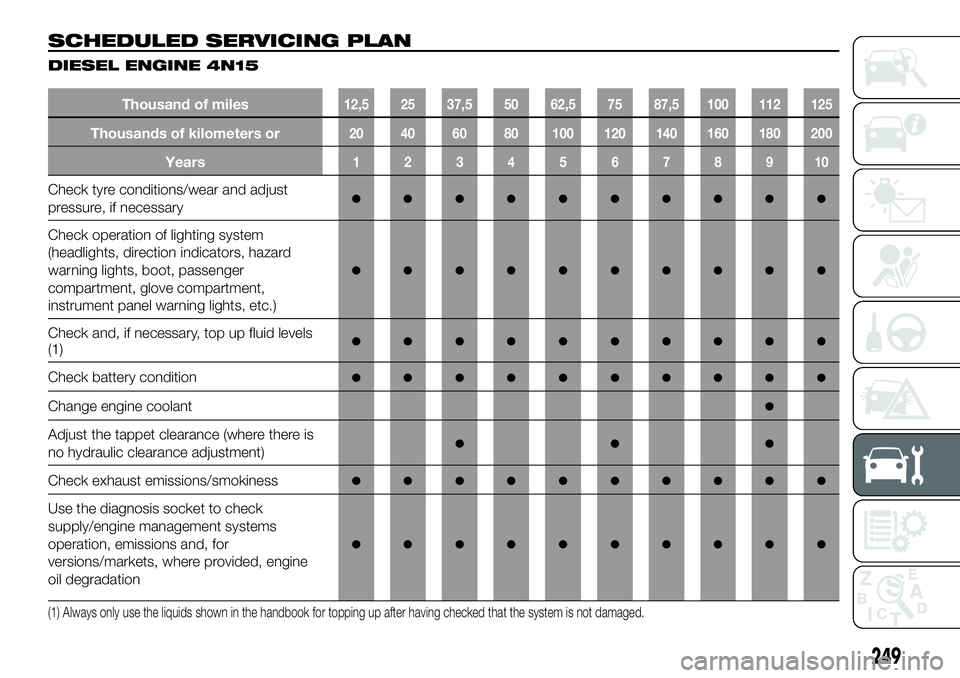
SCHEDULED SERVICING PLAN
DIESEL ENGINE 4N15
Thousand of miles12,5 25 37,5 50 62,5 75 87,5 100 112 125
Thousands of kilometers or20 40 60 80 100 120 140 160 180 200
Years12345678910
Check tyre conditions/wear and adjust
pressure, if necessary●●●●●●●●●●
Check operation of lighting system
(headlights, direction indicators, hazard
warning lights, boot, passenger
compartment, glove compartment,
instrument panel warning lights, etc.)
●●●●●●●●●●
Check and, if necessary, top up fluid levels
(1)●●●●●●●●●●
Check battery condition●●●●●●●●●●
Change engine coolant●
Adjust the tappet clearance (where there is
no hydraulic clearance adjustment)●●●
Check exhaust emissions/smokiness●●●●●●●●●●
Use the diagnosis socket to check
supply/engine management systems
operation, emissions and, for
versions/markets, where provided, engine
oil degradation
●●●●●●●●●●
(1) Always only use the liquids shown in the handbook for topping up after having checked that the system is not damaged.
249
Page 256 of 316
PERIODIC CHECKS
Before long journeys, check and, if
necessary, restore:
engine coolant level;
brake fluid level;
windscreen washer fluid level;
operation of lighting system
(headlamps, direction indicators, hazard
warning lights, etc.);
tyre inflation pressure and condition;
tyre alignment;
operation of screen washer/wiper
system and positioning/wear of
windscreen/rear window wiper blades.
To ensure that the vehicle is always
efficient and well maintained, it is
advisable to make sure that you carry
out the above operations regularly
(approximately every 1000 km and
every 3000 km for checking and
topping up engine oil is advisable).
DEMANDING
VEHICLE USE
If the vehicle is mostly used in one of
the following conditions:
towing a trailer or caravan;
dusty roads;
short, repeated journeys (less than
7-8 km) at sub-zero outside
temperatures;
engine often idling or driving long
distances at low speeds or long periods
of inactivity;
the following checks must be carried
out more often than indicated in the
Scheduled Servicing Plan:
check front disc brake pad
conditions and wear;
check cleanliness of bonnet and
boot locks, cleanliness and lubrication
of linkage;
visually inspect conditions of: engine,
gearbox, transmission, pipes and hoses
(exhaust - fuel system - brakes) and
rubber elements (boots - sleeves -
bushes - etc.);
check battery charge and battery
fluid level (electrolyte);
visually inspect condition of the
accessory drive belts;
check and, if necessary, change
engine oil and replace oil filter;
check and, if necessary, replace
pollen filter.
254
SERVICING AND MAINTENANCE
Page 257 of 316
CHECKING LEVELS
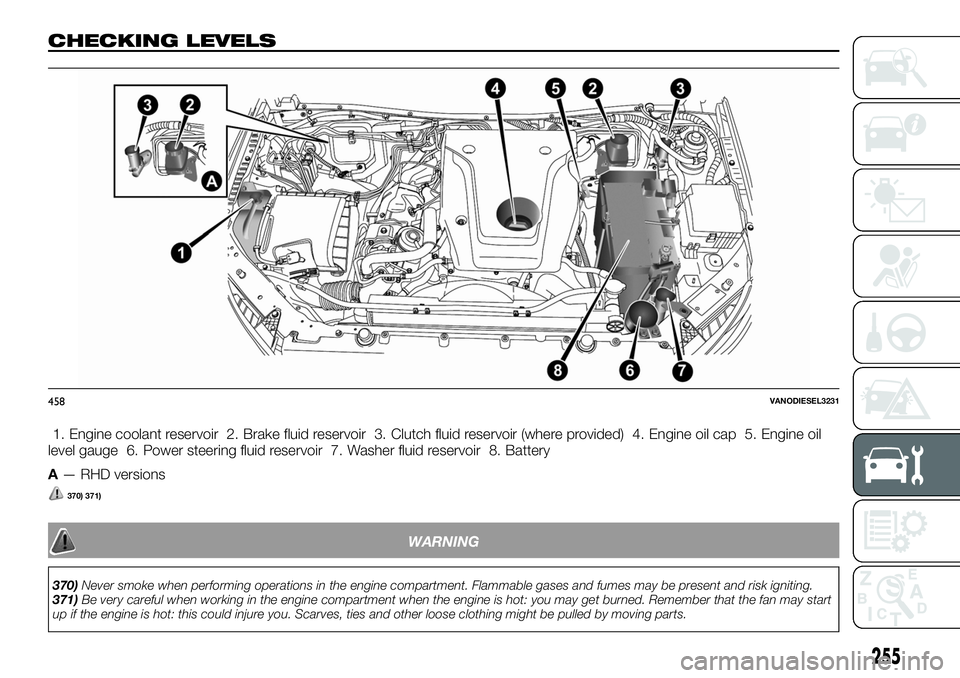
1. Engine coolant reservoir 2. Brake fluid reservoir 3. Clutch fluid reservoir (where provided) 4. Engine oil cap 5. Engine oil
level gauge 6. Power steering fluid reservoir 7. Washer fluid reservoir 8. Battery
A— RHD versions
370) 371)
WARNING
370)Never smoke when performing operations in the engine compartment. Flammable gases and fumes may be present and risk igniting.
371)Be very careful when working in the engine compartment when the engine is hot: you may get burned. Remember that the fan may start
up if the engine is hot: this could injure you. Scarves, ties and other loose clothing might be pulled by moving parts.
458VANODIESEL3231
255
Page 259 of 316
On vehicle with DPF, the engine oil
will be increased due to a few of the
fuel gets mixed in the engine oil when
the DPF regenerates to burn away the
PM (particulate matter). However, it
does not indicate a malfunction.
The engine oil level will be increased
due to an amount of the fuel being
mixed in the engine oil when the DPF
regenerates to burn away the PM
(particulate matter). It does not indicate
a malfunction. In the following
conditions, the engine oil level may
increase easily. We recommend you to
have it checked frequently.:
frequent driving at uphill and
downhill;
frequent driving at high altitudes;
frequent and extended idling;
frequent driving through a traffic jam.
NOTE The engine oil will deteriorate
rapidly if the vehicle is subjected to
severe conditions, requiring earlier oil
replacement. Please refer to the
maintenance schedule.
Selection of engine oil
Refer to “Refill Capacities” under
Technical Specifications.Safety and disposal information for
used engine oil
374) 375) 376)
Protect the environment
It is illegal to pollute drains, water
courses and soil. Use authorized waste
collection facilities, including civic
amenity sites and garages providing
facilities for disposal of used oil and
used oil filters. If in doubt, contact your
local authority for advice on disposal.
WARNING
373)If the engine oil is being topped up,
wait for the engine to cool down before
loosening the filler cap, particularly for
vehicles with aluminium cap (where
provided). WARNING: risk of burns!
374)Prolonged and repeated contact may
cause serious skin diorders, including
dermatitis and cancer.
375)Avoid contact with the skin as far as
possible and wash thoroughly after any
contact.
376)Keep use engine olis out of reach of
children.
ENGINE COOLANT
To check the coolant level
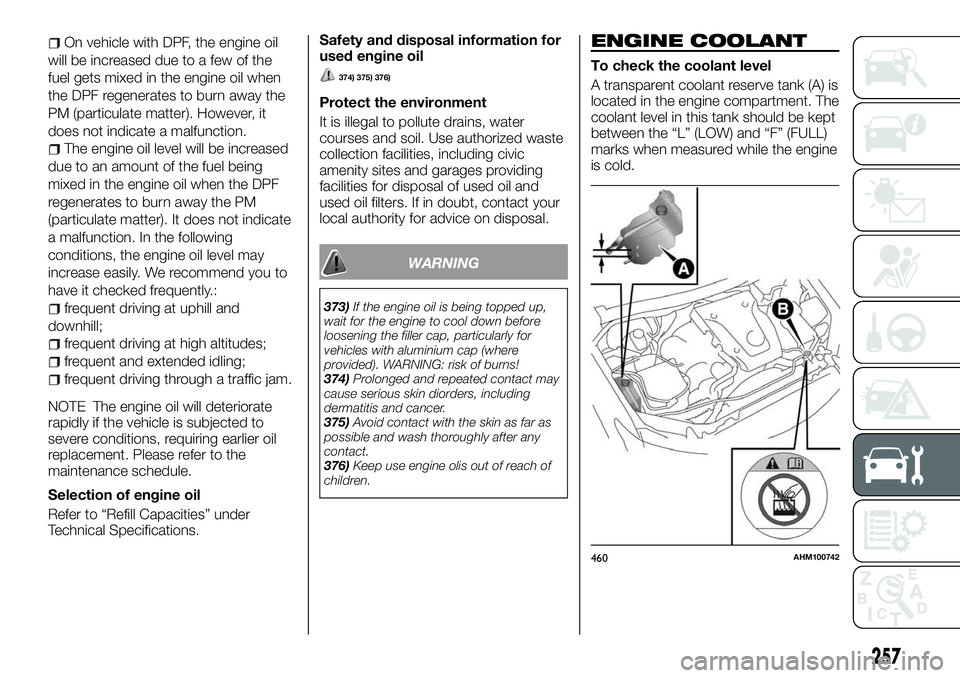
A transparent coolant reserve tank (A) is
located in the engine compartment. The
coolant level in this tank should be kept
between the “L” (LOW) and “F” (FULL)
marks when measured while the engine
is cold.
460AHM100742
257