lock FIAT IDEA 2007 1.G Repair Manual
[x] Cancel search | Manufacturer: FIAT, Model Year: 2007, Model line: IDEA, Model: FIAT IDEA 2007 1.GPages: 314, PDF Size: 4.78 MB
Page 230 of 314
229
SAFETY
DEVICES
CORRECT USE
OF THE CAR
WARNING
LIGHTS AND
MESSAGES
CAR
MAINTENANCE
TECHNICAL
SPECIFICATIONS
INDEX
DASHBOARD
AND CONTROLS
IN AN
EMERGENCY
It is of vital importance to communicate that the tyre has been repaired using the
quick tyre repair kit. Hand the instruction brochure to the personnel charged with
treating the tyre repaired with the kit.WARNING
❒if reaching the tyre pressure specified in paragraph “Inflation pressure”
in section “Technical Specifications”, start driving immediately;
❒after driving for about 10 minutes stop and check again the tyre pres-
sure; pull up the handbrake;
❒if at least 1.8 bar pressure is read, restore proper pressure (with engine
running and handbrake on) and restart;
❒drive with the utmost care to the nearest Fiat Dealership.
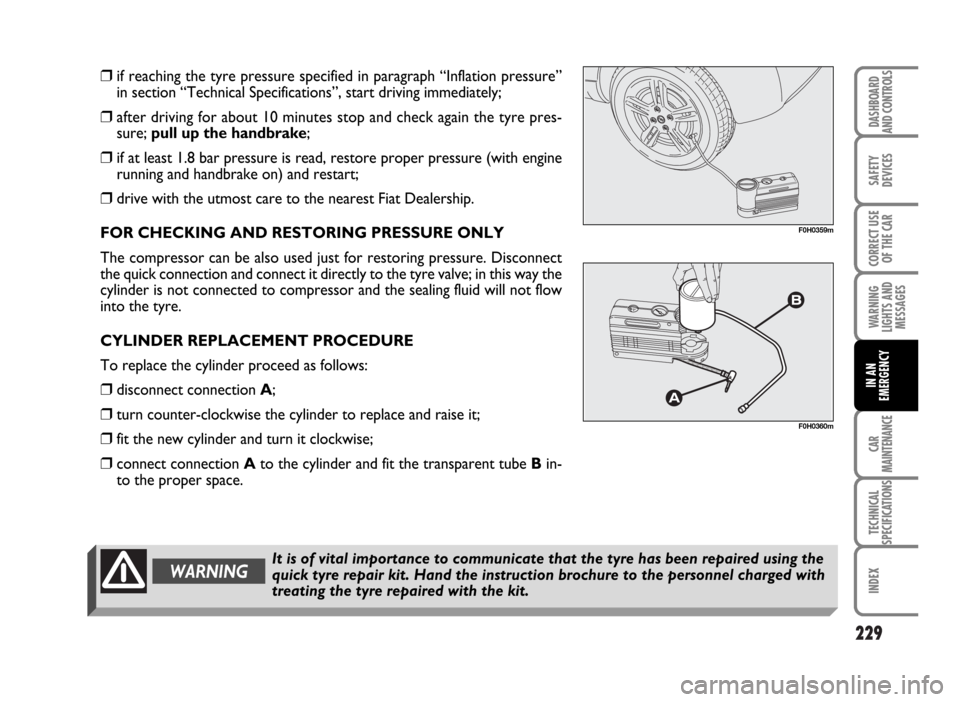
FOR CHECKING AND RESTORING PRESSURE ONLY
The compressor can be also used just for restoring pressure. Disconnect
the quick connection and connect it directly to the tyre valve; in this way the
cylinder is not connected to compressor and the sealing fluid will not flow
into the tyre.
CYLINDER REPLACEMENT PROCEDURE
To replace the cylinder proceed as follows:
❒disconnect connection A;
❒turn counter-clockwise the cylinder to replace and raise it;
❒fit the new cylinder and turn it clockwise;
❒connect connection Ato the cylinder and fit the transparent tube Bin-
to the proper space.
F0H0359m
F0H0360m
Page 239 of 314
238
SAFETY
DEVICES
CORRECT USE
OF THE CAR
WARNING
LIGHTS AND
MESSAGES
CAR
MAINTENANCE
TECHNICAL
SPECIFICATIONS
INDEX
DASHBOARD
AND CONTROLS
IN AN
EMERGENCY
IMPORTANT The headlight inner surface may be lightly misted over: this
is not a fault but a natural fact due to low temperature and the level of
air humidity. It will disappear as soon the headlights are turned on. The
presence of drops inside the headlights means water infiltration,
therefore contact Fiat Dealership.
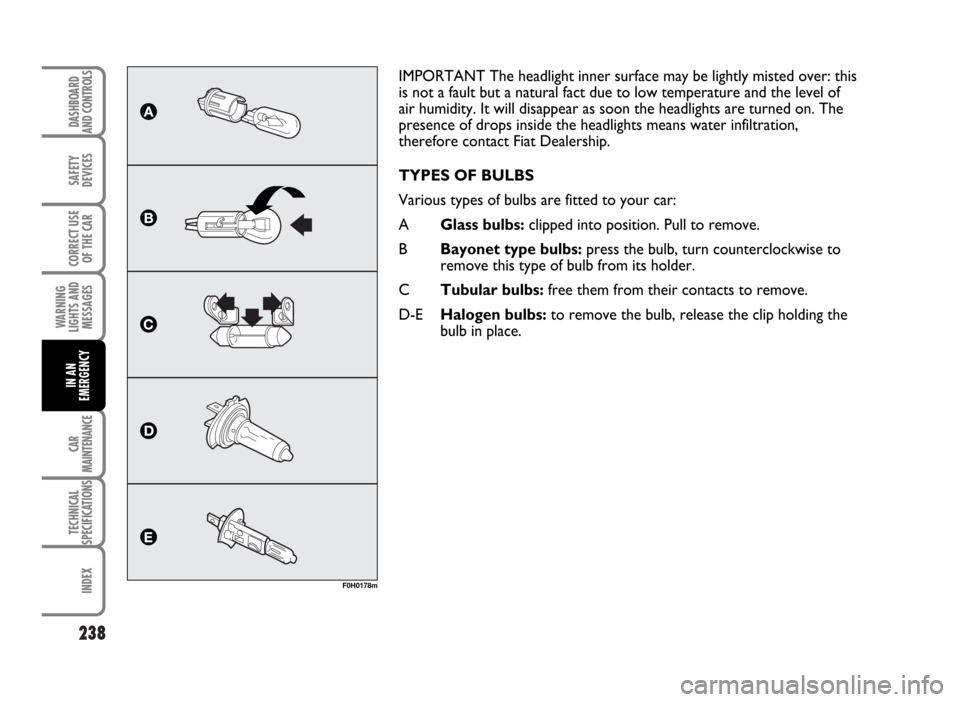
TYPES OF BULBS
Various types of bulbs are fitted to your car:
AGlass bulbs:clipped into position. Pull to remove.
BBayonet type bulbs:press the bulb, turn counterclockwise to
remove this type of bulb from its holder.
CTubular bulbs:free them from their contacts to remove.
D-EHalogen bulbs:to remove the bulb, release the clip holding the
bulb in place.
F0H0178m
Page 242 of 314
241
SAFETY
DEVICES
CORRECT USE
OF THE CAR
WARNING
LIGHTS AND
MESSAGES
CAR
MAINTENANCE
TECHNICAL
SPECIFICATIONS
INDEX
DASHBOARD
AND CONTROLS
IN AN
EMERGENCY
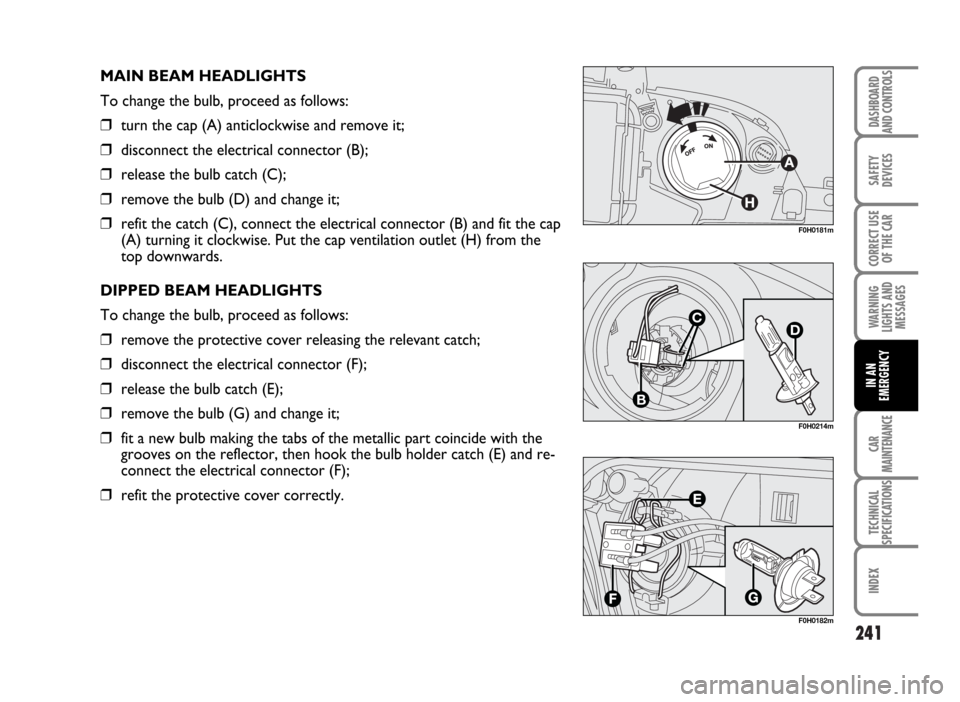
MAIN BEAM HEADLIGHTS
To change the bulb, proceed as follows:
❒turn the cap (A) anticlockwise and remove it;
❒disconnect the electrical connector (B);
❒release the bulb catch (C);
❒remove the bulb (D) and change it;
❒refit the catch (C), connect the electrical connector (B) and fit the cap
(A) turning it clockwise. Put the cap ventilation outlet (H) from the
top downwards.
DIPPED BEAM HEADLIGHTS
To change the bulb, proceed as follows:
❒remove the protective cover releasing the relevant catch;
❒disconnect the electrical connector (F);
❒release the bulb catch (E);
❒remove the bulb (G) and change it;
❒fit a new bulb making the tabs of the metallic part coincide with the
grooves on the reflector, then hook the bulb holder catch (E) and re-
connect the electrical connector (F);
❒refit the protective cover correctly.
F0H0181m
C
B
D
F0H0214m
F0H0182m
Page 243 of 314
242
SAFETY
DEVICES
CORRECT USE
OF THE CAR
WARNING
LIGHTS AND
MESSAGES
CAR
MAINTENANCE
TECHNICAL
SPECIFICATIONS
INDEX
DASHBOARD
AND CONTROLS
IN AN
EMERGENCY
F0H0183m
F0H0184m
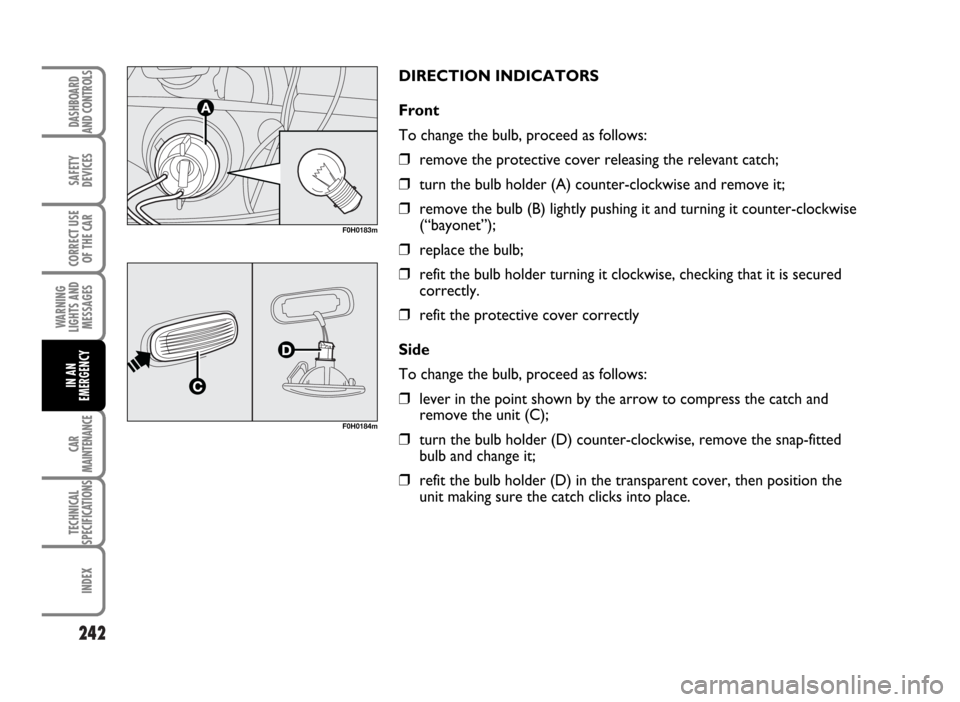
DIRECTION INDICATORS
Front
To change the bulb, proceed as follows:
❒remove the protective cover releasing the relevant catch;
❒turn the bulb holder (A) counter-clockwise and remove it;
❒remove the bulb (B) lightly pushing it and turning it counter-clockwise
(“bayonet”);
❒replace the bulb;
❒refit the bulb holder turning it clockwise, checking that it is secured
correctly.
❒refit the protective cover correctly
Side
To change the bulb, proceed as follows:
❒lever in the point shown by the arrow to compress the catch and
remove the unit (C);
❒turn the bulb holder (D) counter-clockwise, remove the snap-fitted
bulb and change it;
❒refit the bulb holder (D) in the transparent cover, then position the
unit making sure the catch clicks into place.
Page 245 of 314
244
SAFETY
DEVICES
CORRECT USE
OF THE CAR
WARNING
LIGHTS AND
MESSAGES
CAR
MAINTENANCE
TECHNICAL
SPECIFICATIONS
INDEX
DASHBOARD
AND CONTROLS
IN AN
EMERGENCY
F0H0187m
F0H0188m
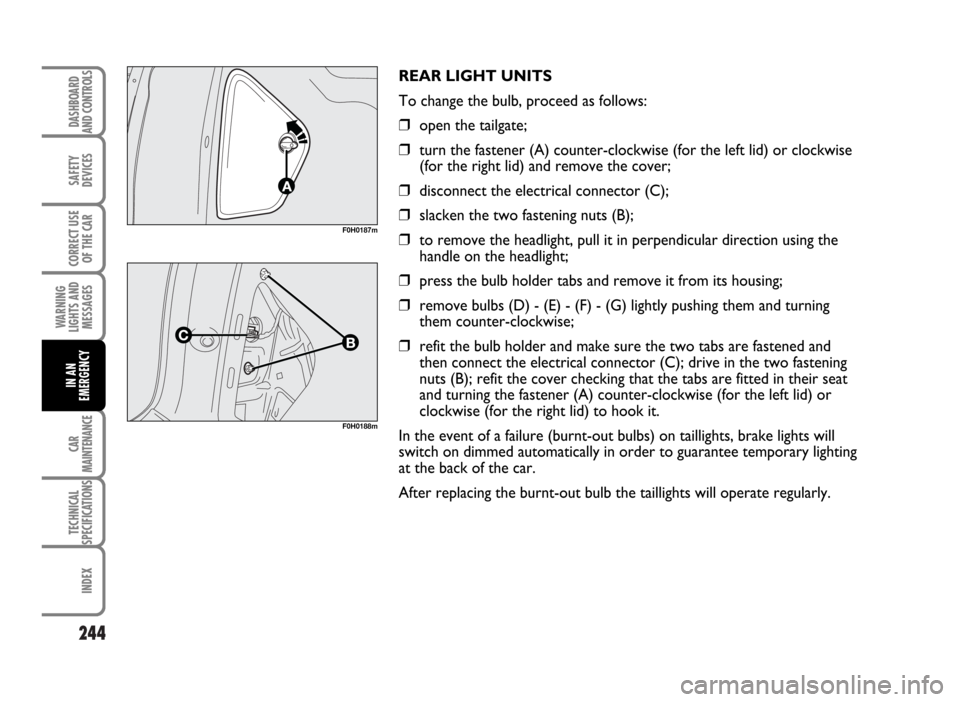
REAR LIGHT UNITS
To change the bulb, proceed as follows:
❒open the tailgate;
❒turn the fastener (A) counter-clockwise (for the left lid) or clockwise
(for the right lid) and remove the cover;
❒disconnect the electrical connector (C);
❒slacken the two fastening nuts (B);
❒to remove the headlight, pull it in perpendicular direction using the
handle on the headlight;
❒press the bulb holder tabs and remove it from its housing;
❒remove bulbs (D) - (E) - (F) - (G) lightly pushing them and turning
them counter-clockwise;
❒refit the bulb holder and make sure the two tabs are fastened and
then connect the electrical connector (C); drive in the two fastening
nuts (B); refit the cover checking that the tabs are fitted in their seat
and turning the fastener (A) counter-clockwise (for the left lid) or
clockwise (for the right lid) to hook it.
In the event of a failure (burnt-out bulbs) on taillights, brake lights will
switch on dimmed automatically in order to guarantee temporary lighting
at the back of the car.
After replacing the burnt-out bulb the taillights will operate regularly.
Page 252 of 314
251
SAFETY
DEVICES
CORRECT USE
OF THE CAR
WARNING
LIGHTS AND
MESSAGES
CAR
MAINTENANCE
TECHNICAL
SPECIFICATIONS
INDEX
DASHBOARD
AND CONTROLS
IN AN
EMERGENCY
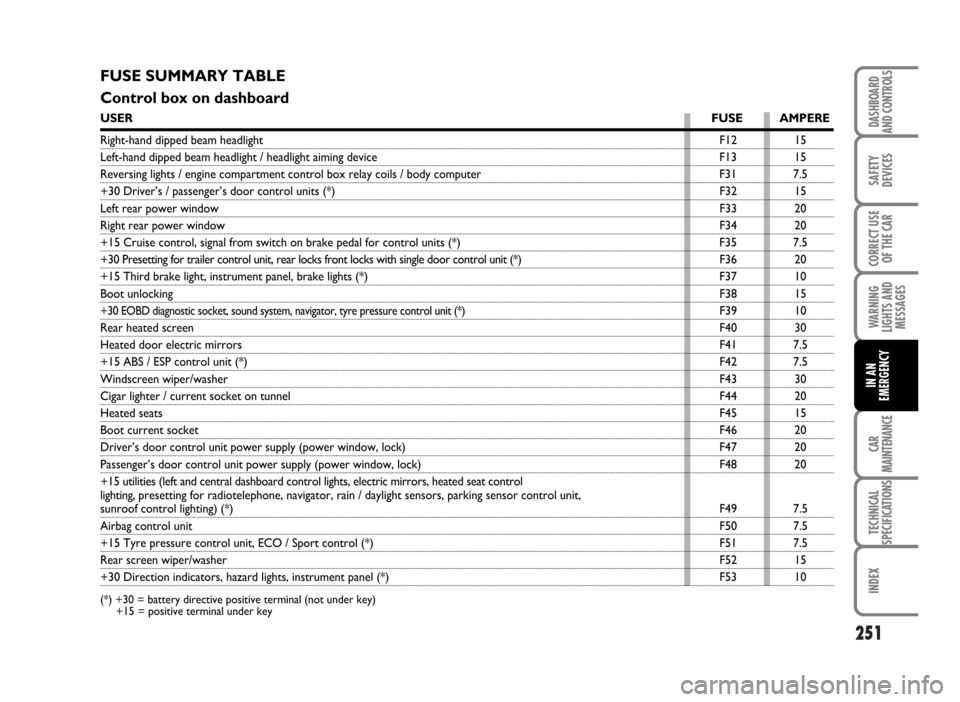
FUSE SUMMARY TABLE
Control box on dashboard
USERFUSE AMPERE
Right-hand dipped beam headlightF12 15
Left-hand dipped beam headlight / headlight aiming device F13 15
Reversing lights / engine compartment control box relay coils / body computer F31 7.5
+30 Driver’s / passenger’s door control units (*)F32 15
Left rear power windowF33 20
Right rear power windowF34 20
+15 Cruise control, signal from switch on brake pedal for control units (*) F35 7.5
+30 Presetting for trailer control unit, rear locks front locks with single door control unit (*) F36 20
+15 Third brake light, instrument panel, brake lights (*) F37 10
Boot unlockingF38 15
+30 EOBD diagnostic socket, sound system, navigator, tyre pressure control unit (*)F39 10
Rear heated screenF40 30
Heated door electric mirrorsF41 7.5
+15 ABS / ESP control unit (*)F42 7.5
Windscreen wiper/washerF43 30
Cigar lighter / current socket on tunnelF44 20
Heated seatsF45 15
Boot current socketF46 20
Driver’s door control unit power supply (power window, lock) F47 20
Passenger’s door control unit power supply (power window, lock) F48 20
+15 utilities (left and central dashboard control lights, electric mirrors, heated seat control
lighting,presetting for radiotelephone, navigator, rain / daylight sensors, parking sensor control unit,
sunroof control lighting) (*)F49 7.5
Airbag control unitF50 7.5
+15 Tyre pressure control unit, ECO / Sport control (*) F51 7.5
Rear screen wiper/washerF52 15
+30 Direction indicators, hazard lights, instrument panel (*) F53 10
(*) +30 = battery directive positive terminal (not under key)
+15 = positive terminal under key
Page 258 of 314

257
SAFETY
DEVICES
CORRECT USE
OF THE CAR
WARNING
LIGHTS AND
MESSAGES
CAR
MAINTENANCE
TECHNICAL
SPECIFICATIONS
INDEX
DASHBOARD
AND CONTROLS
IN AN
EMERGENCY
WARNING
WARNING
Do not start the engine when towing the car.
WARNINGWhile the car is being towed with the
engine off, remember that the brake
pedal and steering will require more
effort as you no longer have the benefit
of the brake booster and the electrical
power steering. Do not use flexible cables
to tow. Avoid jerking. Whilst towing,
ensure that the coupling to the car does
not damage the surrounding components.
When towing the car, you must comply
with the specific traffic regulations
regarding the tow hitch and how to tow
on the road. TOW RING HOOKING
Proceed as follows:
❒take the tow ring (B) from its support;
❒tighten the ring on the rear or front threaded pin.
F0H0204m
F0H0205m
Before starting to tow, turn the ignition
key to MAR and then to STOP. Do not
remove the key. If the key is removed, the
steering lock engages automatically which
prevents the wheels being turned.
Page 261 of 314
260
SAFETY
DEVICES
CORRECT USE
OF THE CAR
WARNING
LIGHTS AND
MESSAGES
IN AN
EMERGENCY
TECHNICAL
SPECIFICATIONS
INDEX
DASHBOARD
AND CONTROLS
CAR
MAINTENANCE
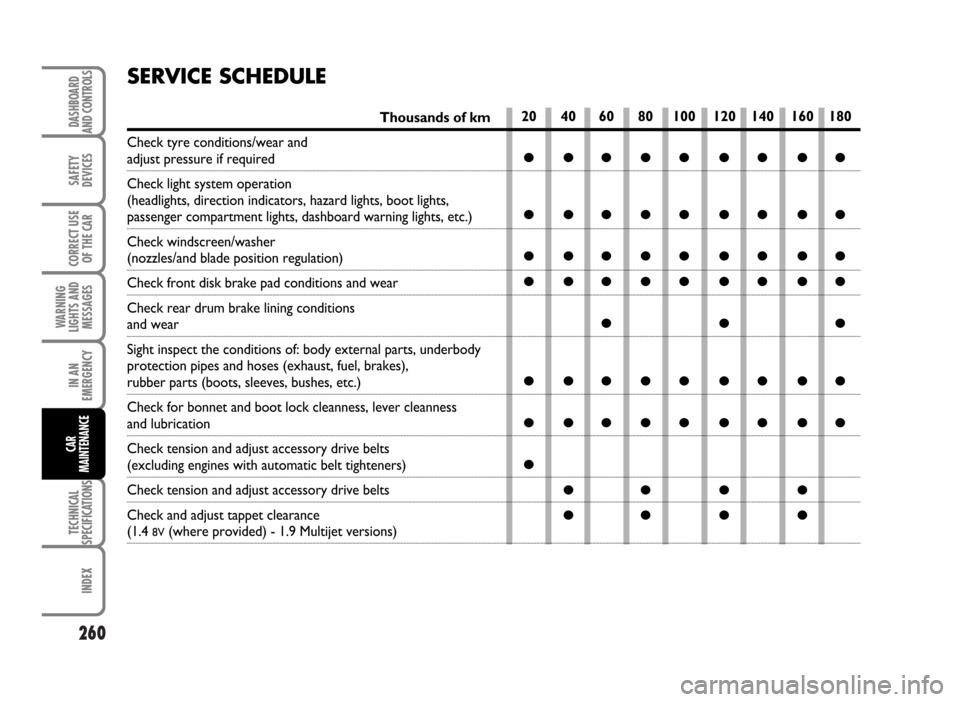
SERVICE SCHEDULE
Thousands of km
Check tyre conditions/wear and
adjust pressure if required
Check light system operation
(headlights, direction indicators, hazard lights, boot lights,
passenger compartment lights, dashboard warning lights, etc.)
Check windscreen/washer
(nozzles/and blade position regulation)
Check front disk brake pad conditions and wear
Check rear drum brake lining conditions
and wear
Sight inspect the conditions of: body external parts, underbody
protection pipes and hoses (exhaust, fuel, brakes),
rubber parts (boots, sleeves, bushes, etc.)
Check for bonnet and boot lock cleanness, lever cleanness
and lubrication
Check tension and adjust accessory drive belts
(excluding engines with automatic belt tighteners)
Check tension and adjust accessory drive belts
Check and adjust tappet clearance
(1.4 8V(where provided) - 1.9 Multijet versions)
20 40 60 80 100 120 140 160 180
●●●●● ●●●●
●●●●● ●●●●
●●●●● ●●●●
●●●●● ●●●●
●●●
●●●●● ●●●●
●●●●● ●●●●
●
●● ● ●
●● ● ●
Page 263 of 314
ANNUAL INSPECTION
SCHEDULE
For cars with an annual mileage of below 20,000 km
(for example about 15,000 km) the following yearly
inspection programme is provided:
❒check tyre conditions/wear and adjust pressure if
required (including the spare wheel);
❒check lighting system operation (headlights,
direction indicators, hazard lights, boot lights,
passenger compartment lights, warning lights, etc.);
❒check windscreen/washer
(nozzles/and blade position regulation)
❒check front disk brake pad conditions and wear;
❒sight inspect the conditions of: engine, gearbox,
transmission, pipes and hoses (exhaust - fuel -
brakes), rubber parts (boots, sleeves, bushes, etc;
❒check for bonnet and boot lock cleanness, lever
cleanness and lubrication;
❒check battery charge;
❒visual check on various drive belt conditions;
❒top up fluid levels (engine coolant, brakes,
windscreen washer, battery, etc.);
❒change engine oil;
❒change engine oil filter;
❒replace pollen filter (where provided).
ADDITIONAL CHECKS
Every 1,000 km or before long journeys, check and top
up if required:
❒engine coolant fluid level;
❒brake fluid level;
❒windscreen washer fluid level;
❒tyre pressure and conditions.
Every 3,000 km check and top up if required: engine
oil level.
You are recommended to use FL Selenia products,
designed and produced specifically for Fiat cars (see
table “Capacities” in section “Technical
specifications”).
262
SAFETY
DEVICES
CORRECT USE
OF THE CAR
WARNING
LIGHTS AND
MESSAGES
IN AN
EMERGENCY
TECHNICAL
SPECIFICATIONS
INDEX
DASHBOARD
AND CONTROLS
CAR
MAINTENANCE
Page 281 of 314
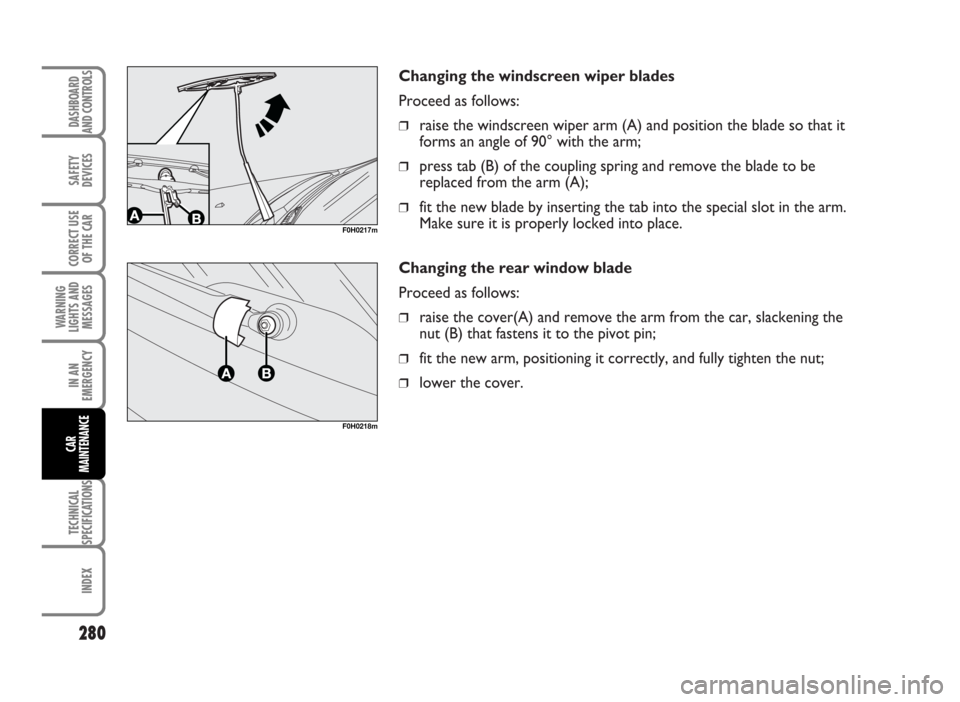
Changing the windscreen wiper blades
Proceed as follows:
❒raise the windscreen wiper arm (A) and position the blade so that it
forms an angle of 90° with the arm;
❒press tab (B) of the coupling spring and remove the blade to be
replaced from the arm (A);
❒fit the new blade by inserting the tab into the special slot in the arm.
Make sure it is properly locked into place.
Changing the rear window blade
Proceed as follows:
❒raise the cover(A) and remove the arm from the car, slackening the
nut (B) that fastens it to the pivot pin;
❒fit the new arm, positioning it correctly, and fully tighten the nut;
❒lower the cover.
280
SAFETY
DEVICES
CORRECT USE
OF THE CAR
WARNING
LIGHTS AND
MESSAGES
IN AN
EMERGENCY
TECHNICAL
SPECIFICATIONS
INDEX
DASHBOARD
AND CONTROLS
CAR
MAINTENANCE
F0H0217m
F0H0218m