boot FIAT IDEA 2008 1.G User Guide
[x] Cancel search | Manufacturer: FIAT, Model Year: 2008, Model line: IDEA, Model: FIAT IDEA 2008 1.GPages: 210, PDF Size: 3.64 MB
Page 79 of 210
78
SAFETY
DEVICES
CORRECT USE
OF THE CAR
WARNING
LIGHTS AND
MESSAGES
IN AN
EMERGENCY
CAR
MAINTENANCE
TECHNICAL
SPECIFICATIONS
INDEX
DASHBOARD
AND CONTROLS
To extend the boot totally
Proceed as follows:
❒remove the rear parcel and previ-
ously shown;
❒make sure the headrests are com-
pletely lowered;
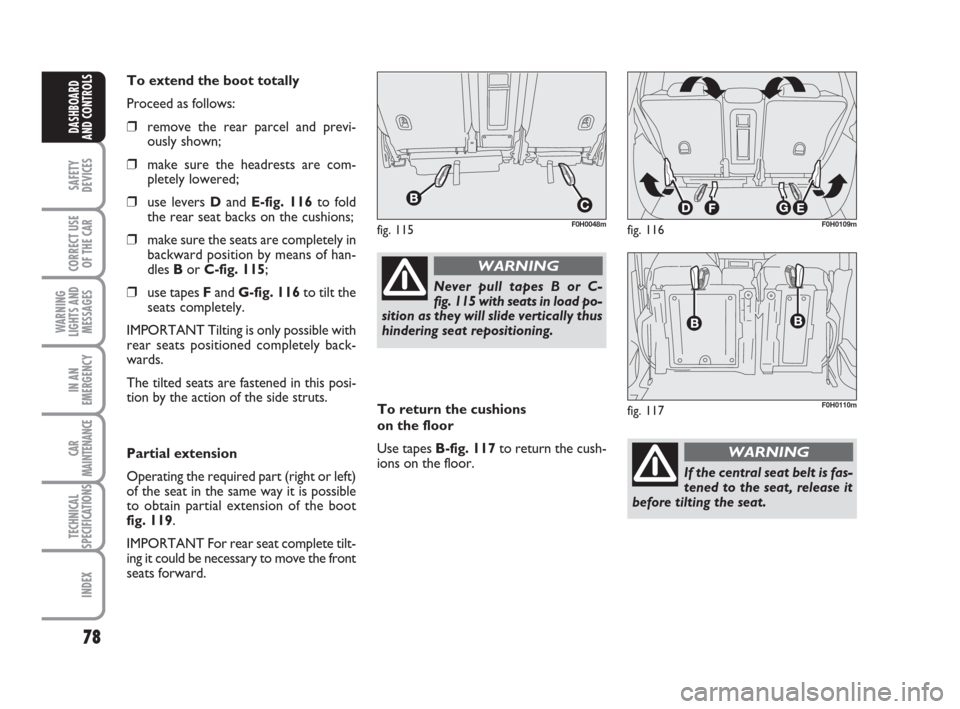
❒use levers Dand E-fig. 116to fold
the rear seat backs on the cushions;
❒make sure the seats are completely in
backward position by means of han-
dles Bor C-fig. 115;
❒use tapes Fand G-fig. 116to tilt the
seats completely.
IMPORTANT Tilting is only possible with
rear seats positioned completely back-
wards.
The tilted seats are fastened in this posi-
tion by the action of the side struts.
Partial extension
Operating the required part (right or left)
of the seat in the same way it is possible
to obtain partial extension of the boot
fig. 119.
IMPORTANT For rear seat complete tilt-
ing it could be necessary to move the front
seats forward.
fig. 115F0H0048mfig. 116F0H0109m
Never pull tapes B or C-
fig. 115 with seats in load po-
sition as they will slide vertically thus
hindering seat repositioning.
WARNING
fig. 117F0H0110mTo return the cushions
on the floor
Use tapes B-fig. 117to return the cush-
ions on the floor.
If the central seat belt is fas-
tened to the seat, release it
before tilting the seat.
WARNING
036-092 idea GB 1 ed 10-07-2008 16:12 Pagina 78
Page 80 of 210
79
SAFETY
DEVICES
CORRECT USE
OF THE CAR
WARNING
LIGHTS AND
MESSAGES
IN AN
EMERGENCY
CAR
MAINTENANCE
TECHNICAL
SPECIFICATIONS
INDEX
DASHBOARD
AND CONTROLS
With table folded seats, in
the event of a crash it can be
dangerous to carry heavy objects on
the rear seat back.
WARNING
The position of the rear seat
backs folded on the respec-
tive cushions shall not be considered
a loading position and therefore can-
not bear heavy weights.
WARNING
fig. 118F0H0111mfig. 119F0H0112m
EXTENDING THE BOOT
WITH FIXED SEAT
Proceed as follows:
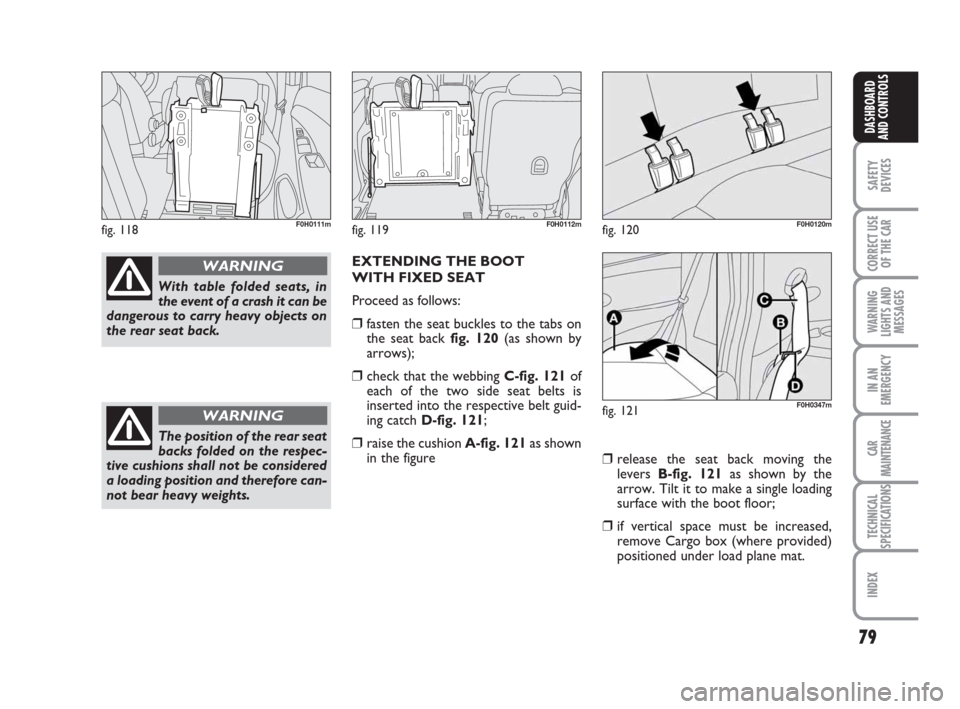
❒fasten the seat buckles to the tabs on
the seat back fig. 120(as shown by
arrows);
❒check that the webbing C-fig. 121of
each of the two side seat belts is
inserted into the respective belt guid-
ing catch D-fig. 121;
❒raise the cushion A-fig. 121as shown
in the figure
fig. 120F0H0120m
fig. 121F0H0347m
❒release the seat back moving the
levers B-fig. 121as shown by the
arrow. Tilt it to make a single loading
surface with the boot floor;
❒if vertical space must be increased,
remove Cargo box (where provided)
positioned under load plane mat.
036-092 idea GB 1 ed 10-07-2008 16:12 Pagina 79
Page 83 of 210
82
SAFETY
DEVICES
CORRECT USE
OF THE CAR
WARNING
LIGHTS AND
MESSAGES
IN AN
EMERGENCY
CAR
MAINTENANCE
TECHNICAL
SPECIFICATIONS
INDEX
DASHBOARD
AND CONTROLS
HEADLIGHTS
ADJUSTING THE HEADLIGHT
BEAM
Proper adjustment of the headlight beams
is of vital importance for your safety and
comfort and also for the other road users.
To ensure you and other drivers have the
best visibility conditions when travelling
with the headlights on, the headlights must
be set properly. Contact Fiat Dealership
to have the headlights properly adjusted.
Headlight aiming device
The device can be operated with the ig-
nition key at MARand dipped beam head-
lights on. When the car is loaded, it slopes
backwards. This means that the headlight
beam rises. In this case, it is necessary to
return it to the correct position.
To adjust the headlight slant
fig. 126
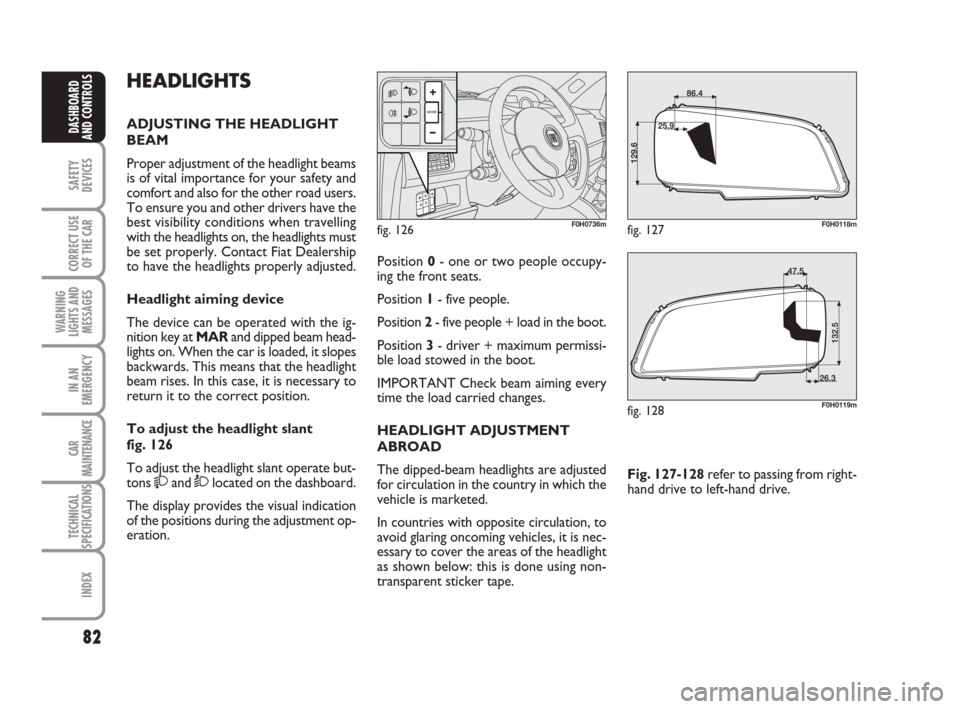
To adjust the headlight slant operate but-
tons
and Òlocated on the dashboard.
The display provides the visual indication
of the positions during the adjustment op-
eration.
fig. 126F0H0736m
Position 0- one or two people occupy-
ing the front seats.
Position 1- five people.
Position 2- five people + load in the boot.
Position 3- driver + maximum permissi-
ble load stowed in the boot.
IMPORTANT Check beam aiming every
time the load carried changes.
HEADLIGHT ADJUSTMENT
ABROAD
The dipped-beam headlights are adjusted
for circulation in the country in which the
vehicle is marketed.
In countries with opposite circulation, to
avoid glaring oncoming vehicles, it is nec-
essary to cover the areas of the headlight
as shown below: this is done using non-
transparent sticker tape.Fig. 127-128refer to passing from right-
hand drive to left-hand drive.
fig. 127F0H0118m
fig. 128F0H0119m
036-092 idea GB 1 ed 10-07-2008 16:12 Pagina 82
Page 117 of 210
116
WARNING
LIGHTS AND
MESSAGES
IN AN
EMERGENCY
CAR
MAINTENANCE
TECHNICAL
SPECIFICATIONS
INDEX
DASHBOARD
AND CONTROLS
SAFETY
DEVICES
CORRECT USE
OF THE CAR
CONTAINING
RUNNING COSTS
Here are some suggestions which may
help you to keep the running costs of your
car down and lower the amount of toxic
emissions released into the atmosphere.
GENERAL CONSIDERATIONS
Car maintenance
Have checks and adjustments carried out
in accordance with the “Service schedule”.
Tyres
Check the pressure of the tyres routine-
ly at an interval of no more than 4 weeks:
if the pressure is too low, consumption
levels increase as resistance to rolling is
higher.
Unnecessary loads
Do not travel with too much luggage
stowed in the boot. The weight of the car
(especially when driving in town) and its
trim greatly affects consumption and sta-
bility.Roof rack/ski rack
Remove the roof rack or the ski rack from
the roof as soon as they are no longer
used. These accessories lower air pene-
tration and adversely affect consumption
levels. When needing to carry particular-
ly voluminous objects, preferably use a
trailer.
Electric devices
Use electric devices only for the amount
of time needed. Rear heated window, ad-
ditional headlights, windscreen wipers and
heater fan need a considerable amount of
energy, therefore increasing the require-
ment of current increases fuel consump-
tion (up to +25% in the urban cycle).
Climate control
The air conditioner is an additional load
which greatly affects the engine leading to
higher consumption (on average up to
+20%). When the temperature outside
the vehicle permits it, use the air vents
where possible.
Spoilers
The use of non-certified aerodynamic
items may adversely affect air drag and
consumption levels.DRIVING STYLE
Starting
Do not warm the engine with the car at
a standstill or at idle or high speed: under
these conditions the engine warms up
much more slowly, increasing electrical
consumption and emissions. It is therefore
advisable to move off immediately, slow-
ly, avoiding high speeds. This way the en-
gine will warm faster.
Unnecessary actions
Avoid accelerating when waiting at traffic
lights or before switching off the engine.
This and also double declutching is ab-
solutely pointless on modern cars and al-
so increase consumption and pollution.
Gear selection
As soon as the conditions of the traffic and
road allow, use a higher gear. Using a low
gear to obtain brilliant performance in-
creases consumption.
In the same way improper use of a high
gear increases consumption, emissions an
engine wear.
111-122 idea GB 1 ed 10-07-2008 8:29 Pagina 116
Page 137 of 210
136
CAR
MAINTENANCE
TECHNICAL
SPECIFICATIONS
INDEX
DASHBOARD
AND CONTROLS
SAFETY
DEVICES
CORRECT USE
OF THE CAR
WARNING
LIGHTS AND
MESSAGES
IN AN
EMERGENCY
FIX & GO automatic
(QUICK TYRE REPAIR
KIT) (where provided)
The quick tyre repair kit Fix & Go auto-
matic is placed in the boot.
The kit includes:
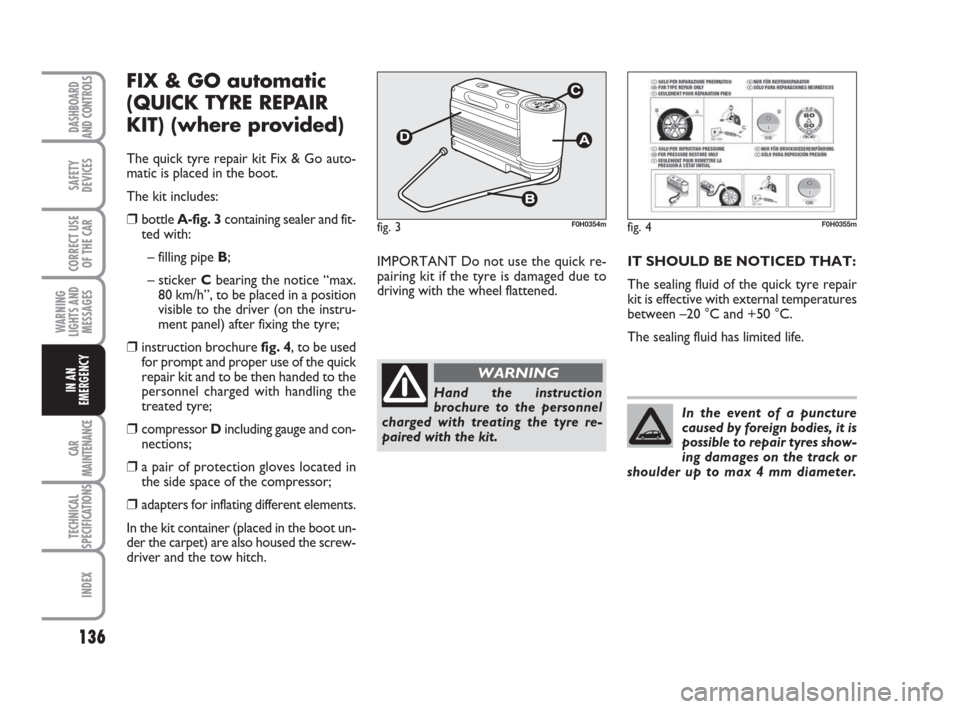
❒bottle A-fig. 3containing sealer and fit-
ted with:
– filling pipe B;
– sticker Cbearing the notice “max.
80 km/h”, to be placed in a position
visible to the driver (on the instru-
ment panel) after fixing the tyre;
❒instruction brochure fig. 4, to be used
for prompt and proper use of the quick
repair kit and to be then handed to the
personnel charged with handling the
treated tyre;
❒compressor Dincluding gauge and con-
nections;
❒a pair of protection gloves located in
the side space of the compressor;
❒adapters for inflating different elements.
In the kit container (placed in the boot un-
der the carpet) are also housed the screw-
driver and the tow hitch.IMPORTANT Do not use the quick re-
pairing kit if the tyre is damaged due to
driving with the wheel flattened.
fig. 3F0H0354mfig. 4F0H0355m
Hand the instruction
brochure to the personnel
charged with treating the tyre re-
paired with the kit.
WARNING
IT SHOULD BE NOTICED THAT:
The sealing fluid of the quick tyre repair
kit is effective with external temperatures
between –20 °C and +50 °C.
The sealing fluid has limited life.
In the event of a puncture
caused by foreign bodies, it is
possible to repair tyres show-
ing damages on the track or
shoulder up to max 4 mm diameter.
133-160 idea GB 1 ed 10-07-2008 8:30 Pagina 136
Page 145 of 210
144
CAR
MAINTENANCE
TECHNICAL
SPECIFICATIONS
INDEX
DASHBOARD
AND CONTROLS
SAFETY
DEVICES
CORRECT USE
OF THE CAR
WARNING
LIGHTS AND
MESSAGES
IN AN
EMERGENCY
WHEN NEEDING TO
CHANGE A BULB
GENERAL INSTRUCTIONS
❒When a light is not working, check
that it has not fused before changing
the bulb. For the location of the fuses,
refer to “If a fuse blows” in this chap-
ter;
❒Before replacing a bulb that does not
work, check that the contacts are not
oxidised;
❒Burnt bulbs must be replaced by oth-
ers of the same type and power;
❒Always check the height of the head-
light beam after changing a bulb. For versions with alloy rims
❒Make sure that hub contact surfaces
are clean;
❒Refit the standard wheel fitting it on
the pins, refit the fastening bolts and
tighten them using the wrench pro-
vided;
❒Lower the car and remove the jack;
❒Using the wrench provided, tighten
the bolts in the sequence shown pre-
viously for the space-saver spare
wheel fig. 16;
❒Refit the snap-fitted wheel hub cap.
When you have finished
❒Stow the spare wheel C-fig. 11in the
space provided in the boot;
❒Insert the jack partially open in its con-
tainer B-fig. 11forcing it lightly to
prevent it from vibrating when trav-
elling;
❒Put the tools back into their places in
the container;
❒Stow the container complete with
tools on the spare wheel and secure
everything with the clamping device
A-fig. 11;
❒Correctly re-position the stiff cover.
Modifications or repairs to
the electrical system carried
out incorrectly and without bearing
the features of the system in mind can
cause malfunctions with the risk of
fire.
WARNING
Halogen bulbs contain pres-
surised gas which, if broken,
may cause small fragments of glass to
be projected outwards.
WARNING
Only touch the metal part
when handling halogen bulbs.
If the transparent bulb is
touched it reduces the intesi-
ty of the light emitted and can also re-
duce the life of the bulb. If you touch
the bulb accidentally, rub it with a
cloth moistened with alcohol and leave
it to dry.
IMPORTANT The headlight inner surface
may be lightly misted over: this is not a
fault but a natural fact due to low tem-
perature and the level of air humidity. It
will disappear as soon the headlights are
turned on. The presence of drops inside
the headlights means water infiltration,
therefore contact Fiat Dealership.
133-160 idea GB 1 ed 10-07-2008 8:30 Pagina 144
Page 147 of 210
146
CAR
MAINTENANCE
TECHNICAL
SPECIFICATIONS
INDEX
DASHBOARD
AND CONTROLS
SAFETY
DEVICES
CORRECT USE
OF THE CAR
WARNING
LIGHTS AND
MESSAGES
IN AN
EMERGENCY
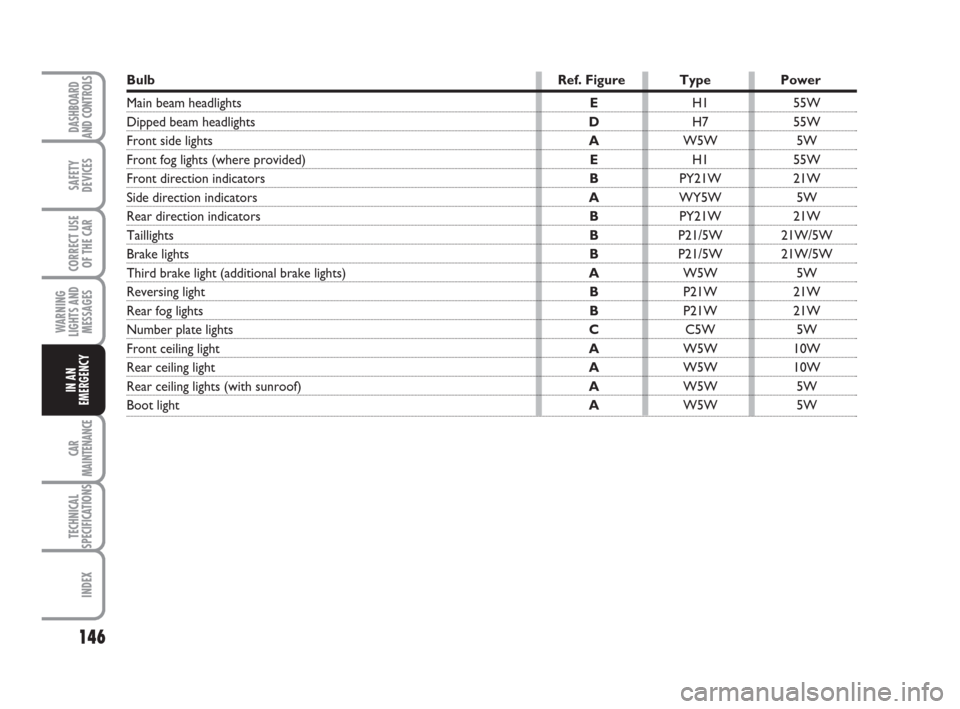
Bulb Ref. Figure Type Power
Main beam headlightsEH1 55W
Dipped beam headlights DH7 55W
Front side lights AW5W 5W
Front fog lights (where provided)EH1 55W
Front direction indicators BPY21W 21W
Side direction indicators AWY5W 5W
Rear direction indicators BPY21W 21W
Taillights BP21/5W 21W/5W
Brake lights BP21/5W 21W/5W
Third brake light (additional brake lights) AW5W 5W
Reversing light BP21W 21W
Rear fog lights BP21W 21W
Number plate lights CC5W 5W
Front ceiling lightAW5W 10W
Rear ceiling lightAW5W 10W
Rear ceiling lights (with sunroof)AW5W 5W
Boot light AW5W 5W
133-160 idea GB 1 ed 10-07-2008 8:30 Pagina 146
Page 153 of 210
152
CAR
MAINTENANCE
TECHNICAL
SPECIFICATIONS
INDEX
DASHBOARD
AND CONTROLS
SAFETY
DEVICES
CORRECT USE
OF THE CAR
WARNING
LIGHTS AND
MESSAGES
IN AN
EMERGENCY
IF AN INTERIOR LIGHT
BURNS OUT
For the type of bulb and power rating, see
“When needing to change a bulb”.
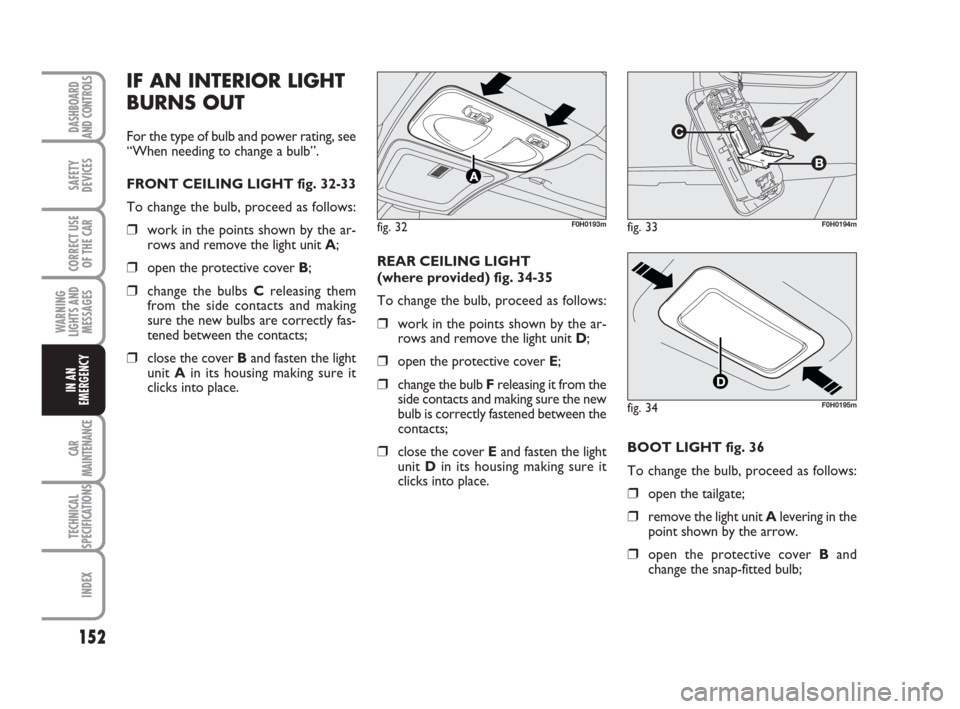
FRONT CEILING LIGHT fig. 32-33
To change the bulb, proceed as follows:
❒work in the points shown by the ar-
rows and remove the light unit A;
❒open the protective cover B;
❒change the bulbs Creleasing them
from the side contacts and making
sure the new bulbs are correctly fas-
tened between the contacts;
❒close the cover Band fasten the light
unit Ain its housing making sure it
clicks into place. REAR CEILING LIGHT
(where provided) fig. 34-35
To change the bulb, proceed as follows:
❒work in the points shown by the ar-
rows and remove the light unit D;
❒open the protective cover E;
❒change the bulb Freleasing it from the
side contacts and making sure the new
bulb is correctly fastened between the
contacts;
❒close the cover Eand fasten the light
unit Din its housing making sure it
clicks into place.
fig. 32F0H0193mfig. 33F0H0194m
fig. 34F0H0195m
BOOT LIGHT fig. 36
To change the bulb, proceed as follows:
❒open the tailgate;
❒remove the light unit Alevering in the
point shown by the arrow.
❒open the protective cover Band
change the snap-fitted bulb;
133-160 idea GB 1 ed 10-07-2008 8:30 Pagina 152
Page 157 of 210
156
CAR
MAINTENANCE
TECHNICAL
SPECIFICATIONS
INDEX
DASHBOARD
AND CONTROLS
SAFETY
DEVICES
CORRECT USE
OF THE CAR
WARNING
LIGHTS AND
MESSAGES
IN AN
EMERGENCY
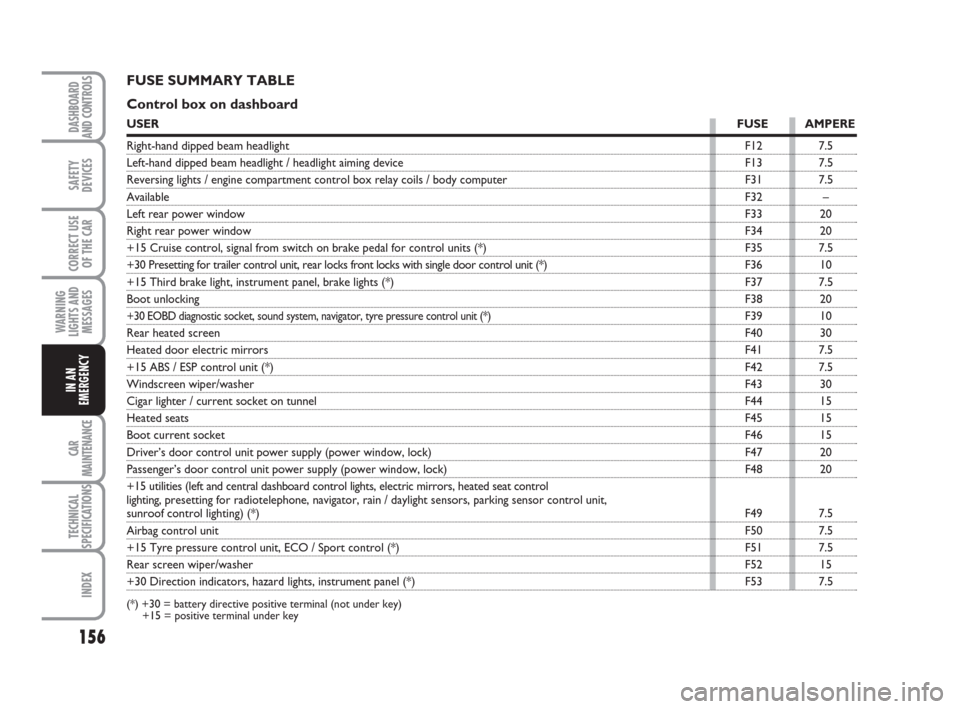
FUSE SUMMARY TABLE
Control box on dashboard
USERFUSE AMPERE
Right-hand dipped beam headlightF12 7.5
Left-hand dipped beam headlight / headlight aiming device F13 7.5
Reversing lights / engine compartment control box relay coils / body computer F31 7.5
AvailableF32 –
Left rear power windowF33 20
Right rear power windowF34 20
+15 Cruise control, signal from switch on brake pedal for control units (*) F35 7.5
+30 Presetting for trailer control unit, rear locks front locks with single door control unit (*) F36 10
+15 Third brake light, instrument panel, brake lights (*) F37 7.5
Boot unlockingF38 20
+30 EOBD diagnostic socket, sound system, navigator, tyre pressure control unit (*)F39 10
Rear heated screenF40 30
Heated door electric mirrorsF41 7.5
+15 ABS / ESP control unit (*)F42 7.5
Windscreen wiper/washerF43 30
Cigar lighter / current socket on tunnelF44 15
Heated seatsF45 15
Boot current socketF46 15
Driver’s door control unit power supply (power window, lock) F47 20
Passenger’s door control unit power supply (power window, lock) F48 20
+15 utilities (left and central dashboard control lights, electric mirrors, heated seat control
lighting,presetting for radiotelephone, navigator, rain / daylight sensors, parking sensor control unit,
sunroof control lighting) (*)F49 7.5
Airbag control unitF50 7.5
+15 Tyre pressure control unit, ECO / Sport control (*) F51 7.5
Rear screen wiper/washerF52 15
+30 Direction indicators, hazard lights, instrument panel (*) F53 7.5
(*) +30 = battery directive positive terminal (not under key)
+15 = positive terminal under key
133-160 idea GB 1 ed 10-07-2008 8:30 Pagina 156
Page 164 of 210
163
TECHNICAL
SPECIFICATIONS
INDEX
DASHBOARD
AND CONTROLS
SAFETY
DEVICES
CORRECT USE
OF THE CAR
WARNING
LIGHTS AND
MESSAGES
IN AN
EMERGENCY
CAR
MAINTENANCE
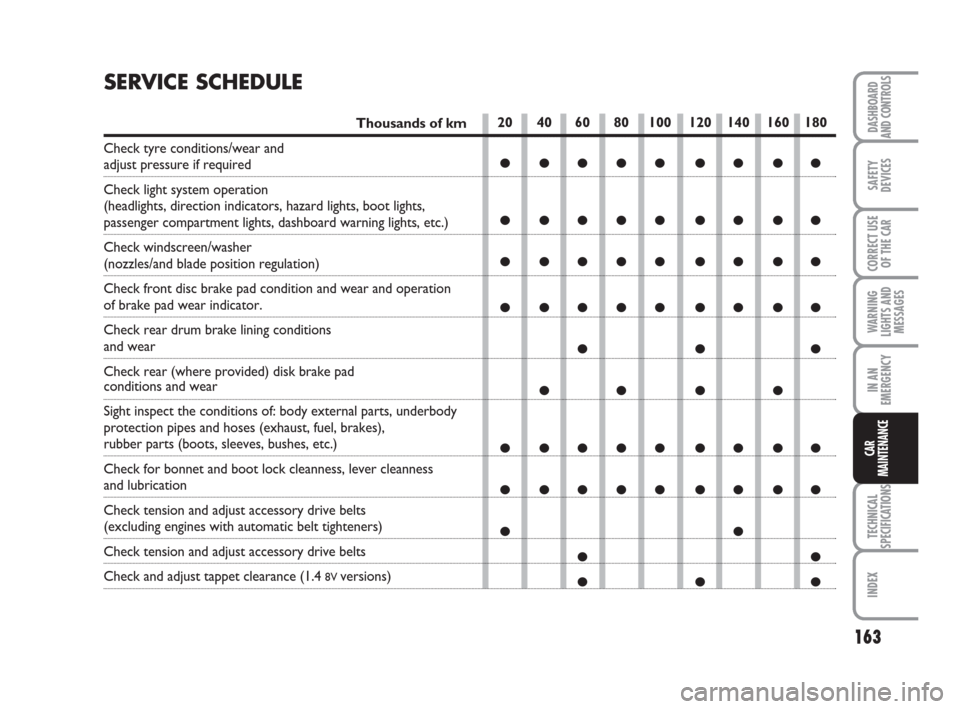
SERVICE SCHEDULE
Thousands of km
Check tyre conditions/wear and
adjust pressure if required
Check light system operation
(headlights, direction indicators, hazard lights, boot lights,
passenger compartment lights, dashboard warning lights, etc.)
Check windscreen/washer
(nozzles/and blade position regulation)
Check front disc brake pad condition and wear and operation
of brake pad wear indicator.
Check rear drum brake lining conditions
and wear
Check rear (where provided) disk brake pad
conditions and wear
Sight inspect the conditions of: body external parts, underbody
protection pipes and hoses (exhaust, fuel, brakes),
rubber parts (boots, sleeves, bushes, etc.)
Check for bonnet and boot lock cleanness, lever cleanness
and lubrication
Check tension and adjust accessory drive belts
(excluding engines with automatic belt tighteners)
Check tension and adjust accessory drive belts
Check and adjust tappet clearance (1.4 8V versions)
20 40 60 80 100 120 140 160 180
●●●●● ●●●●
●●●●● ●●●●
●●●●● ●●●●
●●●●● ●●●●
●●●
●● ● ●
●●●●● ●●●●
●●●●● ●●●●
●●
●●
●●●
161-180 idea GB 1 ed 10-07-2008 8:30 Pagina 163