climate control FIAT IDEA 2008 1.G User Guide
[x] Cancel search | Manufacturer: FIAT, Model Year: 2008, Model line: IDEA, Model: FIAT IDEA 2008 1.GPages: 210, PDF Size: 3.64 MB
Page 55 of 210
54
SAFETY
DEVICES
CORRECT USE
OF THE CAR
WARNING
LIGHTS AND
MESSAGES
IN AN
EMERGENCY
CAR
MAINTENANCE
TECHNICAL
SPECIFICATIONS
INDEX
DASHBOARD
AND CONTROLS
More particularly, max. fan speed will not
be immediately engaged if coolant is not
hot enough; this to prevent admitting air
that is not warm enough to the passenger
compartment.
All manual settings are however possible
with this function on.
To switch the function off, simply turn the
temperature knob counterclockwise and
set the required temperature.
❒LOfunction (highest cooling power):
this is activated by turning the tempera-
ture knob counterclockwise below the
min. value (16 °C). It can be activated in-
dependently from the driver’s or passen-
ger’s side or both (also selecting the
MONOfunction).
This function can be engaged when re-
quiring to cool the passenger compart-
ment as quickly as possible, exploiting the
maximum potential of the system. This
function engages inside air recirculation
and climate control compressor, while air
distribution and fan speed are controlled
according to environmental conditions. All manual settings are however possible
with this function on.
To switch the function off, simply turn the
temperature knob clockwise and set the
required temperature.
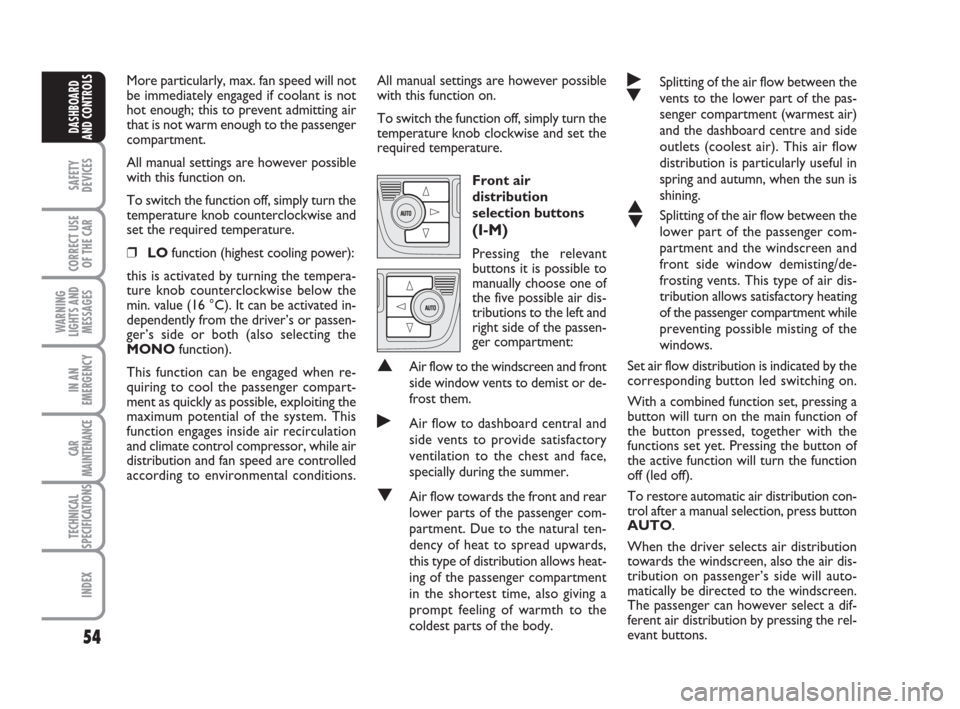
Front air
distribution
selection buttons
(I-M)
Pressing the relevant
buttons it is possible to
manually choose one of
the five possible air dis-
tributions to the left and
right side of the passen-
ger compartment:
▲Air flow to the windscreen and front
side window vents to demist or de-
frost them.
˙Air flow to dashboard central and
side vents to provide satisfactory
ventilation to the chest and face,
specially during the summer.
▼Air flow towards the front and rear
lower parts of the passenger com-
partment. Due to the natural ten-
dency of heat to spread upwards,
this type of distribution allows heat-
ing of the passenger compartment
in the shortest time, also giving a
prompt feeling of warmth to the
coldest parts of the body.
˙
▼Splitting of the air flow between the
vents to the lower part of the pas-
senger compartment (warmest air)
and the dashboard centre and side
outlets (coolest air). This air flow
distribution is particularly useful in
spring and autumn, when the sun is
shining.
▲
▼Splitting of the air flow between the
lower part of the passenger com-
partment and the windscreen and
front side window demisting/de-
frosting vents. This type of air dis-
tribution allows satisfactory heating
of the passenger compartment while
preventing possible misting of the
windows.
Set air flow distribution is indicated by the
corresponding button led switching on.
With a combined function set, pressing a
button will turn on the main function of
the button pressed, together with the
functions set yet. Pressing the button of
the active function will turn the function
off (led off).
To restore automatic air distribution con-
trol after a manual selection, press button
AUTO.
When the driver selects air distribution
towards the windscreen, also the air dis-
tribution on passenger’s side will auto-
matically be directed to the windscreen.
The passenger can however select a dif-
ferent air distribution by pressing the rel-
evant buttons.
036-092 idea GB 1 ed 10-07-2008 16:12 Pagina 54
Page 56 of 210
55
SAFETY
DEVICES
CORRECT USE
OF THE CAR
WARNING
LIGHTS AND
MESSAGES
IN AN
EMERGENCY
CAR
MAINTENANCE
TECHNICAL
SPECIFICATIONS
INDEX
DASHBOARD
AND CONTROLS
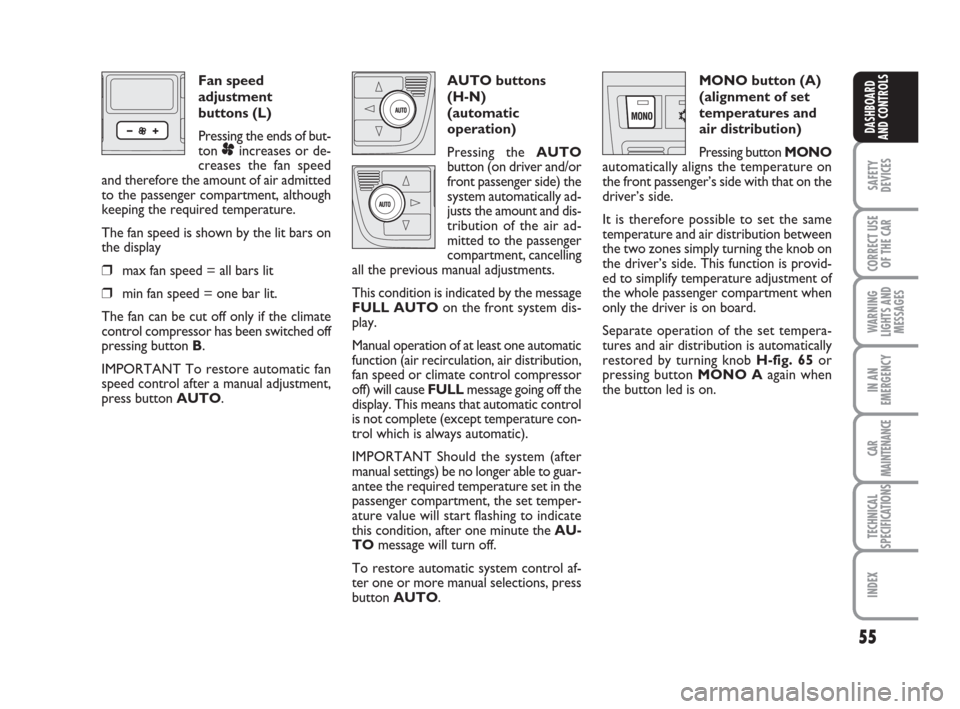
Fan speed
adjustment
buttons (L)
Pressing the ends of but-
ton
pincreases or de-
creases the fan speed
and therefore the amount of air admitted
to the passenger compartment, although
keeping the required temperature.
The fan speed is shown by the lit bars on
the display
❒max fan speed = all bars lit
❒min fan speed = one bar lit.
The fan can be cut off only if the climate
control compressor has been switched off
pressing button B.
IMPORTANT To restore automatic fan
speed control after a manual adjustment,
press button AUTO.AUTO buttons
(H-N)
(automatic
operation)
Pressing the AUTO
button (on driver and/or
front passenger side) the
system automatically ad-
justs the amount and dis-
tribution of the air ad-
mitted to the passenger
compartment, cancelling
all the previous manual adjustments.
This condition is indicated by the message
FULL AUTOon the front system dis-
play.
Manual operation of at least one automatic
function (air recirculation, air distribution,
fan speed or climate control compressor
off) will cause FULLmessage going off the
display. This means that automatic control
is not complete (except temperature con-
trol which is always automatic).
IMPORTANT Should the system (after
manual settings) be no longer able to guar-
antee the required temperature set in the
passenger compartment, the set temper-
ature value will start flashing to indicate
this condition, after one minute the AU-
TOmessage will turn off.
To restore automatic system control af-
ter one or more manual selections, press
button AUTO.MONO button (A)
(alignment of set
temperatures and
air distribution)
Pressing button MONO
automatically aligns the temperature on
the front passenger’s side with that on the
driver’s side.
It is therefore possible to set the same
temperature and air distribution between
the two zones simply turning the knob on
the driver’s side. This function is provid-
ed to simplify temperature adjustment of
the whole passenger compartment when
only the driver is on board.
Separate operation of the set tempera-
tures and air distribution is automatically
restored by turning knob H-fig. 65or
pressing button MONO Aagain when
the button led is on.
036-092 idea GB 1 ed 10-07-2008 16:12 Pagina 55
Page 57 of 210
56
SAFETY
DEVICES
CORRECT USE
OF THE CAR
WARNING
LIGHTS AND
MESSAGES
IN AN
EMERGENCY
CAR
MAINTENANCE
TECHNICAL
SPECIFICATIONS
INDEX
DASHBOARD
AND CONTROLS
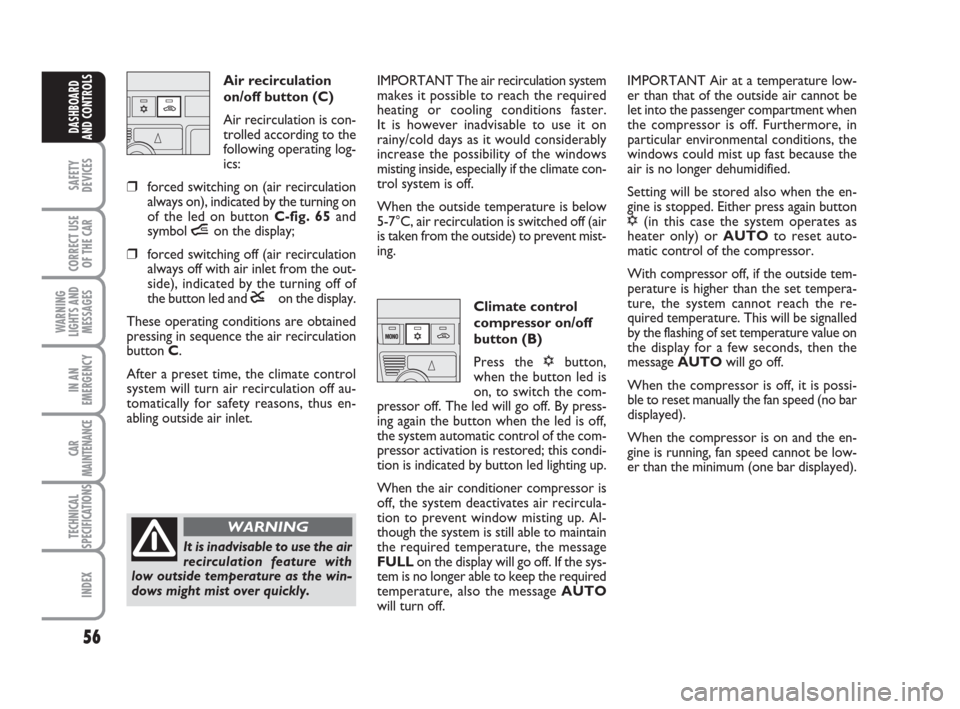
Air recirculation
on/off button (C)
Air recirculation is con-
trolled according to the
following operating log-
ics:
❒forced switching on (air recirculation
always on), indicated by the turning on
of the led on button C-fig. 65and
symbol íon the display;
❒forced switching off (air recirculation
always off with air inlet from the out-
side), indicated by the turning off of
the button led and êon the display.
These operating conditions are obtained
pressing in sequence the air recirculation
button C.
After a preset time, the climate control
system will turn air recirculation off au-
tomatically for safety reasons, thus en-
abling outside air inlet.IMPORTANT The air recirculation system
makes it possible to reach the required
heating or cooling conditions faster.
It is however inadvisable to use it on
rainy/cold days as it would considerably
increase the possibility of the windows
misting inside, especially if the climate con-
trol system is off.
When the outside temperature is below
5-7°C, air recirculation is switched off (air
is taken from the outside) to prevent mist-
ing.
Climate control
compressor on/off
button (B)
Press the √button,
when the button led is
on, to switch the com-
pressor off. The led will go off. By press-
ing again the button when the led is off,
the system automatic control of the com-
pressor activation is restored; this condi-
tion is indicated by button led lighting up.
When the air conditioner compressor is
off, the system deactivates air recircula-
tion to prevent window misting up. Al-
though the system is still able to maintain
the required temperature, the message
FULLon the display will go off. If the sys-
tem is no longer able to keep the required
temperature, also the message AUTO
will turn off.IMPORTANT Air at a temperature low-
er than that of the outside air cannot be
let into the passenger compartment when
the compressor is off. Furthermore, in
particular environmental conditions, the
windows could mist up fast because the
air is no longer dehumidified.
Setting will be stored also when the en-
gine is stopped. Either press again button
√(in this case the system operates as
heater only) or AUTOto reset auto-
matic control of the compressor.
With compressor off, if the outside tem-
perature is higher than the set tempera-
ture, the system cannot reach the re-
quired temperature. This will be signalled
by the flashing of set temperature value on
the display for a few seconds, then the
message AUTOwill go off.
When the compressor is off, it is possi-
ble to reset manually the fan speed (no bar
displayed).
When the compressor is on and the en-
gine is running, fan speed cannot be low-
er than the minimum (one bar displayed).
It is inadvisable to use the air
recirculation feature with
low outside temperature as the win-
dows might mist over quickly.
WARNING
036-092 idea GB 1 ed 10-07-2008 16:12 Pagina 56
Page 58 of 210
57
SAFETY
DEVICES
CORRECT USE
OF THE CAR
WARNING
LIGHTS AND
MESSAGES
IN AN
EMERGENCY
CAR
MAINTENANCE
TECHNICAL
SPECIFICATIONS
INDEX
DASHBOARD
AND CONTROLS
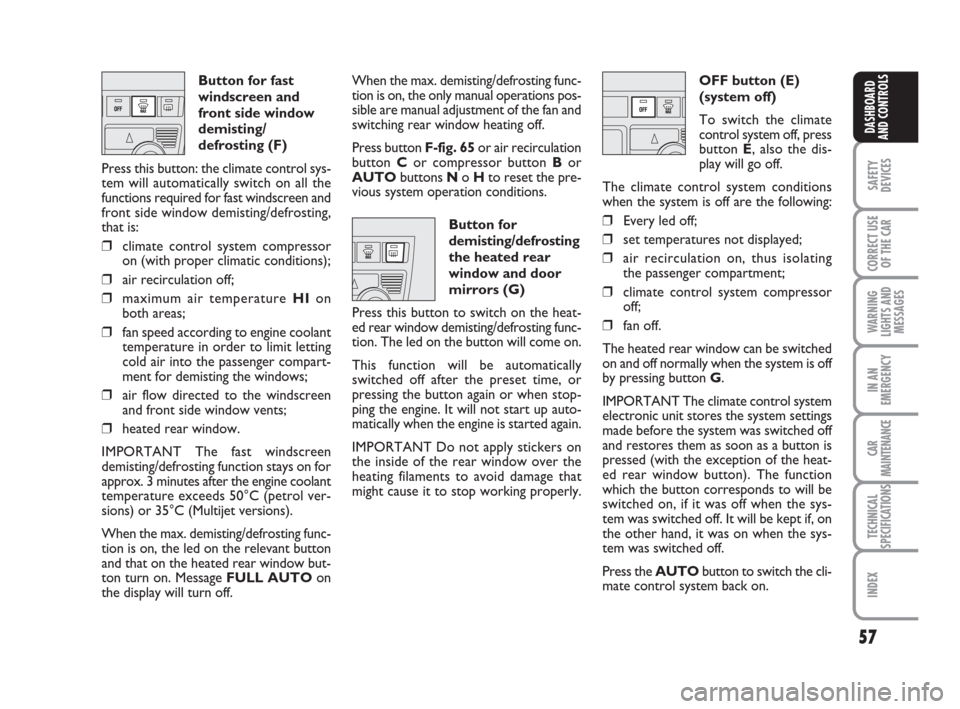
Button for fast
windscreen and
front side window
demisting/
defrosting (F)
Press this button: the climate control sys-
tem will automatically switch on all the
functions required for fast windscreen and
front side window demisting/defrosting,
that is:
❒climate control system compressor
on (with proper climatic conditions);
❒air recirculation off;
❒maximum air temperature HIon
both areas;
❒fan speed according to engine coolant
temperature in order to limit letting
cold air into the passenger compart-
ment for demisting the windows;
❒air flow directed to the windscreen
and front side window vents;
❒heated rear window.
IMPORTANT The fast windscreen
demisting/defrosting function stays on for
approx. 3 minutes after the engine coolant
temperature exceeds 50°C (petrol ver-
sions) or 35°C (Multijet versions).
When the max. demisting/defrosting func-
tion is on, the led on the relevant button
and that on the heated rear window but-
ton turn on. Message FULL AUTOon
the display will turn off.When the max. demisting/defrosting func-
tion is on, the only manual operations pos-
sible are manual adjustment of the fan and
switching rear window heating off.
Press button F-fig. 65or air recirculation
button Cor compressor button Bor
AUTObuttons No Hto reset the pre-
vious system operation conditions.
Button for
demisting/defrosting
the heated rear
window and door
mirrors (G)
Press this button to switch on the heat-
ed rear window demisting/defrosting func-
tion. The led on the button will come on.
This function will be automatically
switched off after the preset time, or
pressing the button again or when stop-
ping the engine. It will not start up auto-
matically when the engine is started again.
IMPORTANT Do not apply stickers on
the inside of the rear window over the
heating filaments to avoid damage that
might cause it to stop working properly.OFF button (E)
(system off)
To switch the climate
control system off, press
button E, also the dis-
play will go off.
The climate control system conditions
when the system is off are the following:
❒Every led off;
❒set temperatures not displayed;
❒air recirculation on, thus isolating
the passenger compartment;
❒climate control system compressor
off;
❒fan off.
The heated rear window can be switched
on and off normally when the system is off
by pressing button G.
IMPORTANT The climate control system
electronic unit stores the system settings
made before the system was switched off
and restores them as soon as a button is
pressed (with the exception of the heat-
ed rear window button). The function
which the button corresponds to will be
switched on, if it was off when the sys-
tem was switched off. It will be kept if, on
the other hand, it was on when the sys-
tem was switched off.
Press the AUTObutton to switch the cli-
mate control system back on.
036-092 idea GB 1 ed 10-07-2008 16:12 Pagina 57
Page 117 of 210
116
WARNING
LIGHTS AND
MESSAGES
IN AN
EMERGENCY
CAR
MAINTENANCE
TECHNICAL
SPECIFICATIONS
INDEX
DASHBOARD
AND CONTROLS
SAFETY
DEVICES
CORRECT USE
OF THE CAR
CONTAINING
RUNNING COSTS
Here are some suggestions which may
help you to keep the running costs of your
car down and lower the amount of toxic
emissions released into the atmosphere.
GENERAL CONSIDERATIONS
Car maintenance
Have checks and adjustments carried out
in accordance with the “Service schedule”.
Tyres
Check the pressure of the tyres routine-
ly at an interval of no more than 4 weeks:
if the pressure is too low, consumption
levels increase as resistance to rolling is
higher.
Unnecessary loads
Do not travel with too much luggage
stowed in the boot. The weight of the car
(especially when driving in town) and its
trim greatly affects consumption and sta-
bility.Roof rack/ski rack
Remove the roof rack or the ski rack from
the roof as soon as they are no longer
used. These accessories lower air pene-
tration and adversely affect consumption
levels. When needing to carry particular-
ly voluminous objects, preferably use a
trailer.
Electric devices
Use electric devices only for the amount
of time needed. Rear heated window, ad-
ditional headlights, windscreen wipers and
heater fan need a considerable amount of
energy, therefore increasing the require-
ment of current increases fuel consump-
tion (up to +25% in the urban cycle).
Climate control
The air conditioner is an additional load
which greatly affects the engine leading to
higher consumption (on average up to
+20%). When the temperature outside
the vehicle permits it, use the air vents
where possible.
Spoilers
The use of non-certified aerodynamic
items may adversely affect air drag and
consumption levels.DRIVING STYLE
Starting
Do not warm the engine with the car at
a standstill or at idle or high speed: under
these conditions the engine warms up
much more slowly, increasing electrical
consumption and emissions. It is therefore
advisable to move off immediately, slow-
ly, avoiding high speeds. This way the en-
gine will warm faster.
Unnecessary actions
Avoid accelerating when waiting at traffic
lights or before switching off the engine.
This and also double declutching is ab-
solutely pointless on modern cars and al-
so increase consumption and pollution.
Gear selection
As soon as the conditions of the traffic and
road allow, use a higher gear. Using a low
gear to obtain brilliant performance in-
creases consumption.
In the same way improper use of a high
gear increases consumption, emissions an
engine wear.
111-122 idea GB 1 ed 10-07-2008 8:29 Pagina 116
Page 165 of 210
164
TECHNICAL
SPECIFICATIONS
INDEX
DASHBOARD
AND CONTROLS
SAFETY
DEVICES
CORRECT USE
OF THE CAR
WARNING
LIGHTS AND
MESSAGES
IN AN
EMERGENCY
CAR
MAINTENANCE
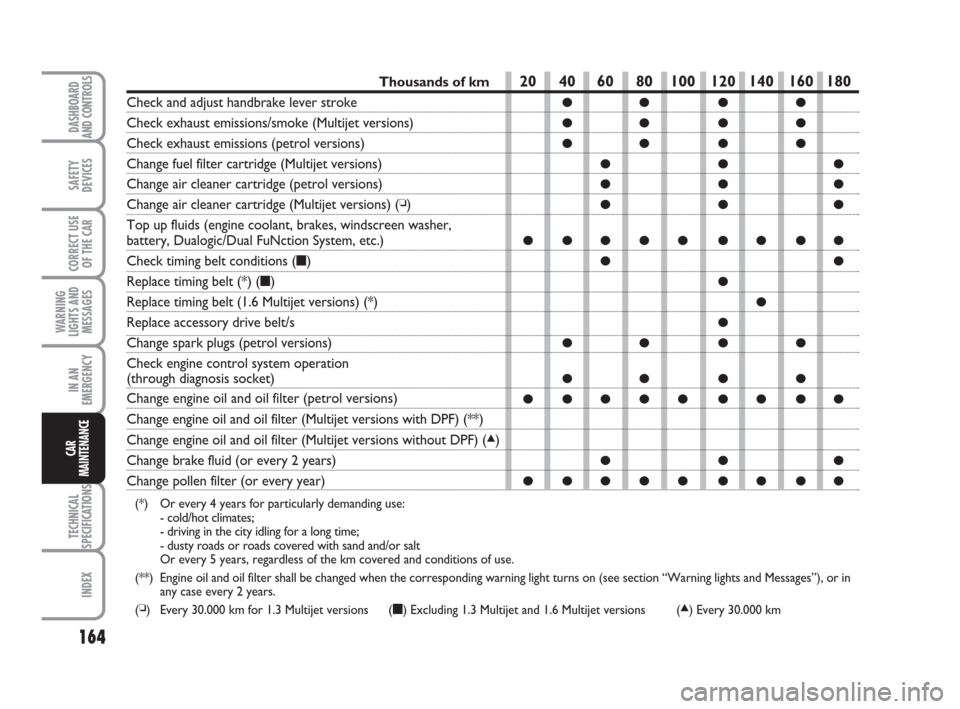
Thousands of km
Check and adjust handbrake lever stroke
Check exhaust emissions/smoke (Multijet versions)
Check exhaust emissions (petrol versions)
Change fuel filter cartridge (Multijet versions)
Change air cleaner cartridge (petrol versions)
Change air cleaner cartridge (Multijet versions) (❏)
Top up fluids (engine coolant, brakes, windscreen washer,
battery, Dualogic/Dual FuNction System, etc.)
Check timing belt conditions (■)
Replace timing belt (*) (■)
Replace timing belt (1.6 Multijet versions) (*)
Replace accessory drive belt/s
Change spark plugs (petrol versions)
Check engine control system operation
(through diagnosis socket)
Change engine oil and oil filter (petrol versions)
Change engine oil and oil filter (Multijet versions with DPF) (**)
Change engine oil and oil filter (Multijet versions without DPF) (▲)
Change brake fluid (or every 2 years)
Change pollen filter (or every year)
(*) Or every 4 years for particularly demanding use:
- cold/hot climates;
- driving in the city idling for a long time;
- dusty roads or roads covered with sand and/or salt
Or every 5 years, regardless of the km covered and conditions of use.
(**) Engine oil and oil filter shall be changed when the corresponding warning light turns on (see section “Warning lights and Messages”), or in
any case every 2 years.
(
❏) Every 30.000 km for 1.3 Multijet versions (■) Excluding 1.3 Multijet and 1.6 Multijet versions (▲) Every 30.000 km
20 40 60 80 100 120 140 160 180
●● ● ●
●● ● ●
●● ● ●
●●●
●●●
●●●
●●●●● ●●●●
●●
●
●
●
●● ● ●
●● ● ●
●●●●● ●●●●
●●●
●●●●● ●●●●
161-180 idea GB 1 ed 10-07-2008 8:30 Pagina 164
Page 167 of 210
166
TECHNICAL
SPECIFICATIONS
INDEX
DASHBOARD
AND CONTROLS
SAFETY
DEVICES
CORRECT USE
OF THE CAR
WARNING
LIGHTS AND
MESSAGES
IN AN
EMERGENCY
CAR
MAINTENANCE
IMPORTANT - Engine oil
Should prevailing use of the car be under
one of the following specially heavy con-
ditions:
❒trailer or caravan towing;
❒dusty roads;
❒short distances (less than 7-8 km) re-
peated and with external tempera-
tures below zero;
❒frequently idling engines or long dis-
tance low speed driving (e.g. taxis or
door-to-door deliveries) or in case of
a long term inactivity;
replace engine oil more frequently than
required on “Service schedule”.
IMPORTANT - Air cleaner
If the car is used on dusty roads change
the air cleaner more frequently than the
indications in the “Service schedule”.
If in doubt as to how often the engine oil
and air cleaner should be changed ac-
cording to how you use the car, contact
a Fiat Dealership.IMPORTANT - Pollen filter
If the vehicle is used frequently in dusty or
heavily polluted environments it is advis-
able to replace the filtering element more
frequently; in particular it should be re-
placed if a reduction of the amount of air
admitted to the passenger compartment
is noted.
IMPORTANT - Diesel filter
The possibility of topping up with diesel
fuel not complying with EN590 European
Norm might make it necessary to replace
the filter more frequently than indicated
in the “Service schedule”.IMPORTANT - Battery
The charge in the battery should be
checked at the start of winter to limit the
risk of electrolyte freezing.
This check should be carried out more
frequently if the car is used mainly for
short trips, or if it is fitted with accessories
that permanently absorb electricity even
with the ignition key removed, especially
in the case of after market accessories. If
the car is used in hot climates or particu-
larly harsh conditions it is wise to check
the level of the battery fluid (electrolyte)
more frequently than specified in the “Ser-
vice schedule” in this section.
Car maintenance should be
entrusted to Fiat Dealership.
For routine and minor main-
tenance operations you wish
to carry out yourself, always make sure
you have the proper equipment, gen-
uine Fiat spare parts and the necessary
fluids; do not however carry out these
operations if you have no experience.
161-180 idea GB 1 ed 10-07-2008 8:30 Pagina 166
Page 171 of 210
170
TECHNICAL
SPECIFICATIONS
INDEX
DASHBOARD
AND CONTROLS
SAFETY
DEVICES
CORRECT USE
OF THE CAR
WARNING
LIGHTS AND
MESSAGES
IN AN
EMERGENCY
CAR
MAINTENANCE
IMPORTANT The oil consumption de-
pends on driving style and the conditions
under which the car is used.
IMPORTANT Do not add oil with speci-
fications other than that already in the en-
gine.
When the engine is hot, take
care when working inside the
engine compartment to avoid burns.
Remember that when the engine is
hot, the fan may cut in: danger of in-
jury. Scarves, ties and other loose
clothing might be pulled by moving
parts.
WARNING
Used engine oil and filter con-
tain harmful substances for
the environment. Contact Fi-
at Dealership to have the oil
and filter changed.
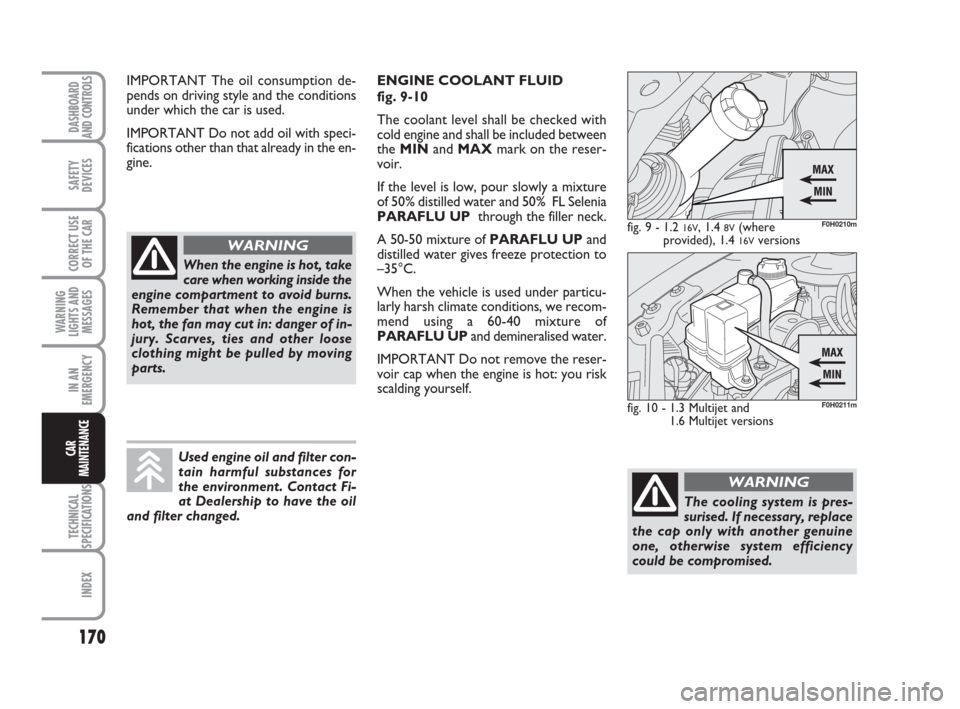
ENGINE COOLANT FLUID
fig. 9-10
The coolant level shall be checked with
cold engine and shall be included between
the MINand MAXmark on the reser-
voir.
If the level is low, pour slowly a mixture
of 50% distilled water and 50% FL Selenia
PARAFLU UPthrough the filler neck.
A 50-50 mixture of PARAFLU UPand
distilled water gives freeze protection to
–35°C.
When the vehicle is used under particu-
larly harsh climate conditions, we recom-
mend using a 60-40 mixture of
PARAFLU UPand demineralised water.
IMPORTANT Do not remove the reser-
voir cap when the engine is hot: you risk
scalding yourself.
fig. 9 - 1.2 16V, 1.4 8V(where
provided), 1.4 16Vversions
F0H0210m
fig. 10 - 1.3 Multijet and
1.6 Multijet versionsF0H0211m
The cooling system is pres-
surised. If necessary, replace
the cap only with another genuine
one, otherwise system efficiency
could be compromised.
WARNING
161-180 idea GB 1 ed 10-07-2008 8:30 Pagina 170
Page 179 of 210
178
TECHNICAL
SPECIFICATIONS
INDEX
DASHBOARD
AND CONTROLS
SAFETY
DEVICES
CORRECT USE
OF THE CAR
WARNING
LIGHTS AND
MESSAGES
IN AN
EMERGENCY
CAR
MAINTENANCE
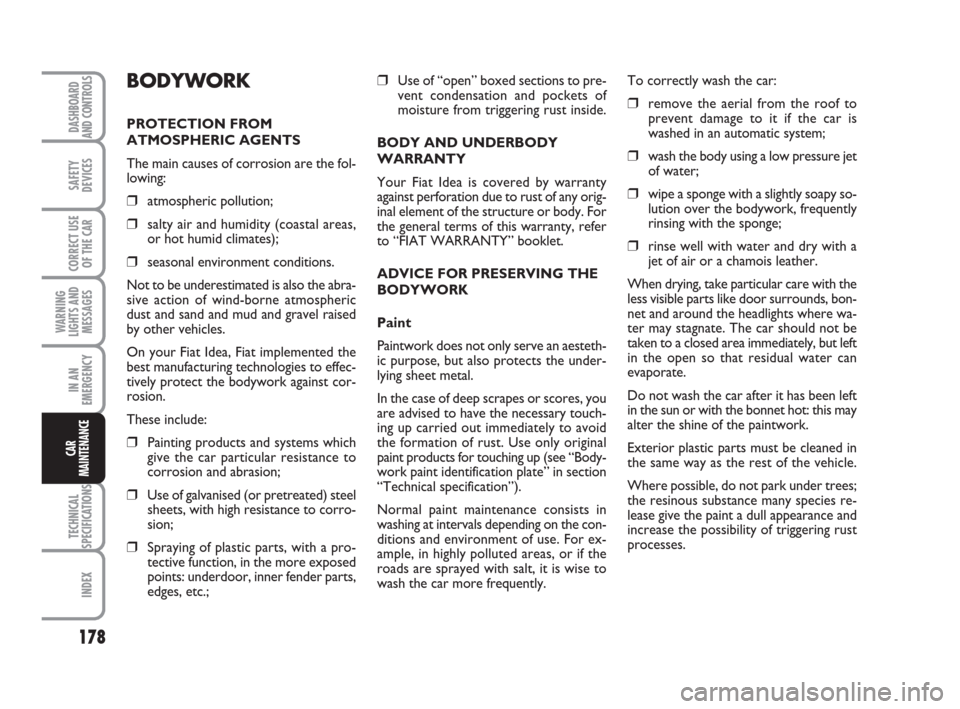
BODYWORK
PROTECTION FROM
ATMOSPHERIC AGENTS
The main causes of corrosion are the fol-
lowing:
❒atmospheric pollution;
❒salty air and humidity (coastal areas,
or hot humid climates);
❒seasonal environment conditions.
Not to be underestimated is also the abra-
sive action of wind-borne atmospheric
dust and sand and mud and gravel raised
by other vehicles.
On your Fiat Idea, Fiat implemented the
best manufacturing technologies to effec-
tively protect the bodywork against cor-
rosion.
These include:
❒Painting products and systems which
give the car particular resistance to
corrosion and abrasion;
❒Use of galvanised (or pretreated) steel
sheets, with high resistance to corro-
sion;
❒Spraying of plastic parts, with a pro-
tective function, in the more exposed
points: underdoor, inner fender parts,
edges, etc.;
❒Use of “open” boxed sections to pre-
vent condensation and pockets of
moisture from triggering rust inside.
BODY AND UNDERBODY
WARRANTY
Your Fiat Idea is covered by warranty
against perforation due to rust of any orig-
inal element of the structure or body. For
the general terms of this warranty, refer
to “FIAT WARRANTY” booklet.
ADVICE FOR PRESERVING THE
BODYWORK
Paint
Paintwork does not only serve an aesteth-
ic purpose, but also protects the under-
lying sheet metal.
In the case of deep scrapes or scores, you
are advised to have the necessary touch-
ing up carried out immediately to avoid
the formation of rust. Use only original
paint products for touching up (see “Body-
work paint identification plate” in section
“Technical specification”).
Normal paint maintenance consists in
washing at intervals depending on the con-
ditions and environment of use. For ex-
ample, in highly polluted areas, or if the
roads are sprayed with salt, it is wise to
wash the car more frequently.To correctly wash the car:
❒remove the aerial from the roof to
prevent damage to it if the car is
washed in an automatic system;
❒wash the body using a low pressure jet
of water;
❒wipe a sponge with a slightly soapy so-
lution over the bodywork, frequently
rinsing with the sponge;
❒rinse well with water and dry with a
jet of air or a chamois leather.
When drying, take particular care with the
less visible parts like door surrounds, bon-
net and around the headlights where wa-
ter may stagnate. The car should not be
taken to a closed area immediately, but left
in the open so that residual water can
evaporate.
Do not wash the car after it has been left
in the sun or with the bonnet hot: this may
alter the shine of the paintwork.
Exterior plastic parts must be cleaned in
the same way as the rest of the vehicle.
Where possible, do not park under trees;
the resinous substance many species re-
lease give the paint a dull appearance and
increase the possibility of triggering rust
processes.
161-180 idea GB 1 ed 10-07-2008 8:30 Pagina 178
Page 196 of 210
195
INDEX
DASHBOARD
AND CONTROLS
SAFETY
DEVICES
CORRECT USE
OF THE CAR
WARNING
LIGHTS AND
MESSAGES
IN AN
EMERGENCY
CAR
MAINTENANCE
TECHNICAL
SPECIFICATIONS
1.416V1.216V1.3 Multijet1.6 Multijet1.48V (◊)
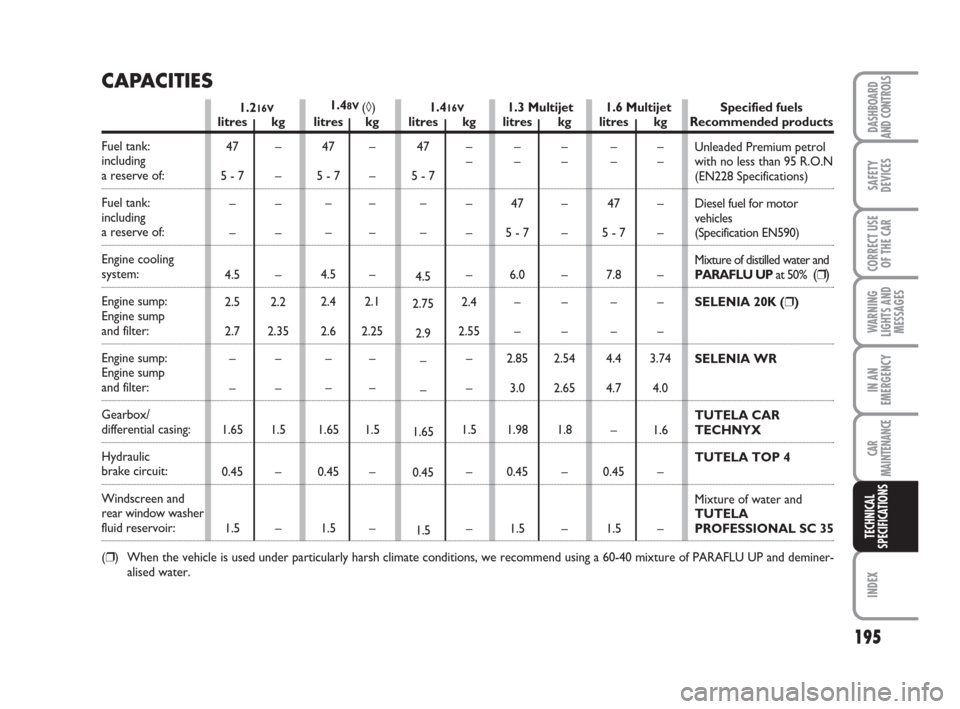
CAPACITIES
Fuel tank:
including
a reserve of:
Fuel tank:
including
a reserve of:
Engine cooling
system:
Engine sump:
Engine sump
and filter:
Engine sump:
Engine sump
and filter:
Gearbox/
differential casing:
Hydraulic
brake circuit:
Windscreen and
rear window washer
fluid reservoir:
(❒) When the vehicle is used under particularly harsh climate conditions, we recommend using a 60-40 mixture of PARAFLU UP and deminer-
alised water.Specified fuels
Recommended products
Unleaded Premium petrol
with no less than 95 R.O.N
(EN228 Specifications)
Diesel fuel for motor
vehicles
(Specification EN590)
Mixture of distilled water and
PARAFLU UPat 50%
(❒)
SELENIA 20K (❒)
SELENIA WR
TUTELA CAR
TECHNYX
TUTELA TOP 4
Mixture of water and
TUTELA
PROFESSIONAL SC 35 litres
–
–
47
5 - 7
7.8
–
–
4.4
4.7
–
0.45
1.5kg
–
–
–
–
–
–
–
3.74
4.0
1.6
–
– litres
47
5 - 7
–
–
4.5
2.75
2.9
–
–
1.65
0.45
1.5 kg
–
–
–
–
–
2.4
2.55
–
–
1.5
–
– litres
47
5 - 7
–
–
4.5
2.5
2.7
–
–
1.65
0.45
1.5kg
–
–
–
–
–
2.2
2.35
–
–
1.5
–
–litres
47
5 - 7
–
–
4.5
2.4
2.6
–
–
1.65
0.45
1.5kg
–
–
–
–
–
2.1
2.25
–
–
1.5
–
–litres
–
–
47
5 - 7
6.0
–
–
2.85
3.0
1.98
0.45
1.5kg
–
–
–
–
–
–
–
2.54
2.65
1.8
–
–
181-199 idea GB 1 ed 13-10-2008 12:12 Pagina 195