heating FIAT IDEA 2008 1.G User Guide
[x] Cancel search | Manufacturer: FIAT, Model Year: 2008, Model line: IDEA, Model: FIAT IDEA 2008 1.GPages: 210, PDF Size: 3.64 MB
Page 55 of 210
54
SAFETY
DEVICES
CORRECT USE
OF THE CAR
WARNING
LIGHTS AND
MESSAGES
IN AN
EMERGENCY
CAR
MAINTENANCE
TECHNICAL
SPECIFICATIONS
INDEX
DASHBOARD
AND CONTROLS
More particularly, max. fan speed will not
be immediately engaged if coolant is not
hot enough; this to prevent admitting air
that is not warm enough to the passenger
compartment.
All manual settings are however possible
with this function on.
To switch the function off, simply turn the
temperature knob counterclockwise and
set the required temperature.
❒LOfunction (highest cooling power):
this is activated by turning the tempera-
ture knob counterclockwise below the
min. value (16 °C). It can be activated in-
dependently from the driver’s or passen-
ger’s side or both (also selecting the
MONOfunction).
This function can be engaged when re-
quiring to cool the passenger compart-
ment as quickly as possible, exploiting the
maximum potential of the system. This
function engages inside air recirculation
and climate control compressor, while air
distribution and fan speed are controlled
according to environmental conditions. All manual settings are however possible
with this function on.
To switch the function off, simply turn the
temperature knob clockwise and set the
required temperature.
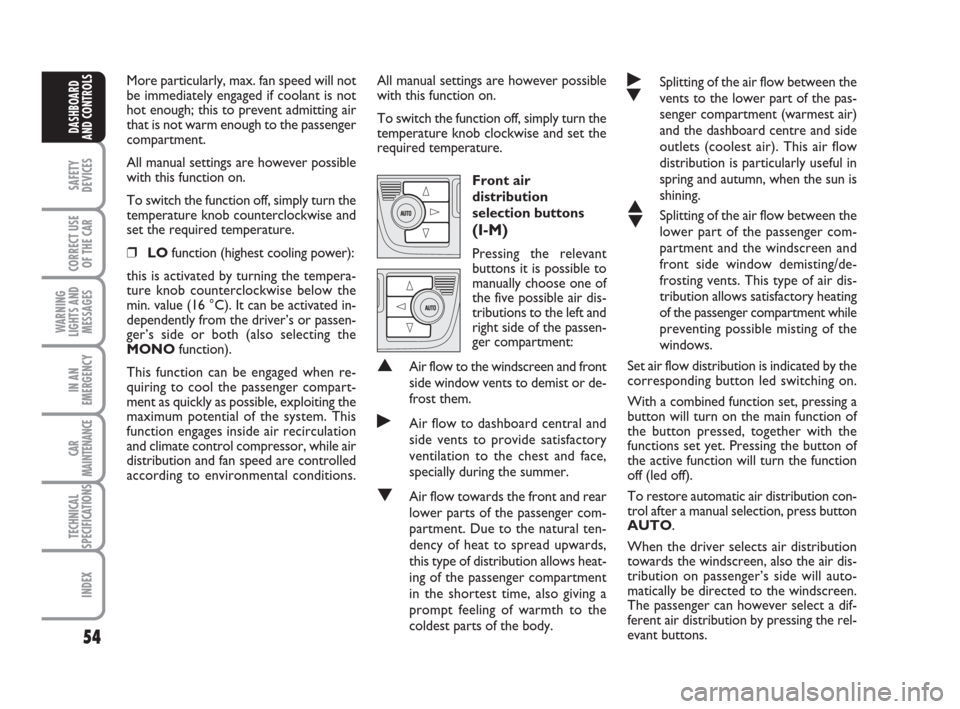
Front air
distribution
selection buttons
(I-M)
Pressing the relevant
buttons it is possible to
manually choose one of
the five possible air dis-
tributions to the left and
right side of the passen-
ger compartment:
▲Air flow to the windscreen and front
side window vents to demist or de-
frost them.
˙Air flow to dashboard central and
side vents to provide satisfactory
ventilation to the chest and face,
specially during the summer.
▼Air flow towards the front and rear
lower parts of the passenger com-
partment. Due to the natural ten-
dency of heat to spread upwards,
this type of distribution allows heat-
ing of the passenger compartment
in the shortest time, also giving a
prompt feeling of warmth to the
coldest parts of the body.
˙
▼Splitting of the air flow between the
vents to the lower part of the pas-
senger compartment (warmest air)
and the dashboard centre and side
outlets (coolest air). This air flow
distribution is particularly useful in
spring and autumn, when the sun is
shining.
▲
▼Splitting of the air flow between the
lower part of the passenger com-
partment and the windscreen and
front side window demisting/de-
frosting vents. This type of air dis-
tribution allows satisfactory heating
of the passenger compartment while
preventing possible misting of the
windows.
Set air flow distribution is indicated by the
corresponding button led switching on.
With a combined function set, pressing a
button will turn on the main function of
the button pressed, together with the
functions set yet. Pressing the button of
the active function will turn the function
off (led off).
To restore automatic air distribution con-
trol after a manual selection, press button
AUTO.
When the driver selects air distribution
towards the windscreen, also the air dis-
tribution on passenger’s side will auto-
matically be directed to the windscreen.
The passenger can however select a dif-
ferent air distribution by pressing the rel-
evant buttons.
036-092 idea GB 1 ed 10-07-2008 16:12 Pagina 54
Page 57 of 210
56
SAFETY
DEVICES
CORRECT USE
OF THE CAR
WARNING
LIGHTS AND
MESSAGES
IN AN
EMERGENCY
CAR
MAINTENANCE
TECHNICAL
SPECIFICATIONS
INDEX
DASHBOARD
AND CONTROLS
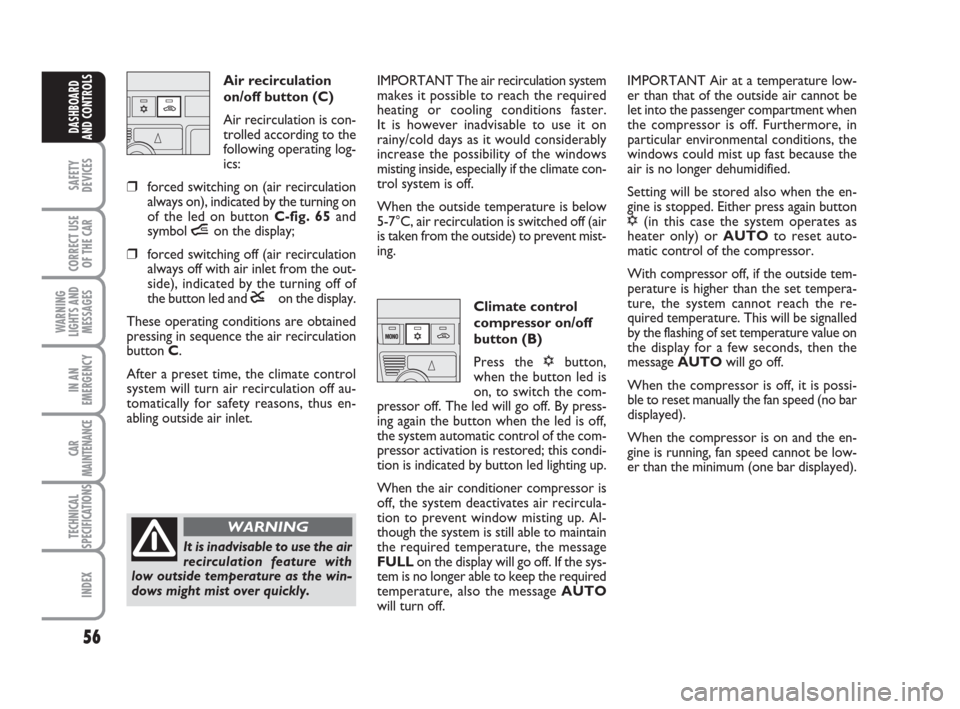
Air recirculation
on/off button (C)
Air recirculation is con-
trolled according to the
following operating log-
ics:
❒forced switching on (air recirculation
always on), indicated by the turning on
of the led on button C-fig. 65and
symbol íon the display;
❒forced switching off (air recirculation
always off with air inlet from the out-
side), indicated by the turning off of
the button led and êon the display.
These operating conditions are obtained
pressing in sequence the air recirculation
button C.
After a preset time, the climate control
system will turn air recirculation off au-
tomatically for safety reasons, thus en-
abling outside air inlet.IMPORTANT The air recirculation system
makes it possible to reach the required
heating or cooling conditions faster.
It is however inadvisable to use it on
rainy/cold days as it would considerably
increase the possibility of the windows
misting inside, especially if the climate con-
trol system is off.
When the outside temperature is below
5-7°C, air recirculation is switched off (air
is taken from the outside) to prevent mist-
ing.
Climate control
compressor on/off
button (B)
Press the √button,
when the button led is
on, to switch the com-
pressor off. The led will go off. By press-
ing again the button when the led is off,
the system automatic control of the com-
pressor activation is restored; this condi-
tion is indicated by button led lighting up.
When the air conditioner compressor is
off, the system deactivates air recircula-
tion to prevent window misting up. Al-
though the system is still able to maintain
the required temperature, the message
FULLon the display will go off. If the sys-
tem is no longer able to keep the required
temperature, also the message AUTO
will turn off.IMPORTANT Air at a temperature low-
er than that of the outside air cannot be
let into the passenger compartment when
the compressor is off. Furthermore, in
particular environmental conditions, the
windows could mist up fast because the
air is no longer dehumidified.
Setting will be stored also when the en-
gine is stopped. Either press again button
√(in this case the system operates as
heater only) or AUTOto reset auto-
matic control of the compressor.
With compressor off, if the outside tem-
perature is higher than the set tempera-
ture, the system cannot reach the re-
quired temperature. This will be signalled
by the flashing of set temperature value on
the display for a few seconds, then the
message AUTOwill go off.
When the compressor is off, it is possi-
ble to reset manually the fan speed (no bar
displayed).
When the compressor is on and the en-
gine is running, fan speed cannot be low-
er than the minimum (one bar displayed).
It is inadvisable to use the air
recirculation feature with
low outside temperature as the win-
dows might mist over quickly.
WARNING
036-092 idea GB 1 ed 10-07-2008 16:12 Pagina 56
Page 58 of 210
57
SAFETY
DEVICES
CORRECT USE
OF THE CAR
WARNING
LIGHTS AND
MESSAGES
IN AN
EMERGENCY
CAR
MAINTENANCE
TECHNICAL
SPECIFICATIONS
INDEX
DASHBOARD
AND CONTROLS
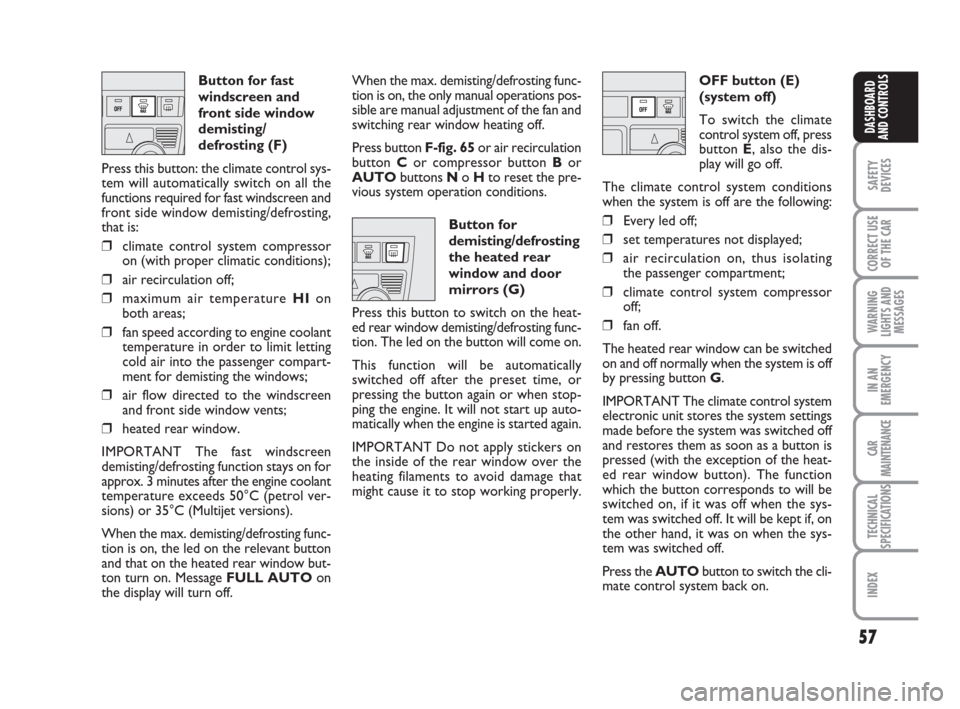
Button for fast
windscreen and
front side window
demisting/
defrosting (F)
Press this button: the climate control sys-
tem will automatically switch on all the
functions required for fast windscreen and
front side window demisting/defrosting,
that is:
❒climate control system compressor
on (with proper climatic conditions);
❒air recirculation off;
❒maximum air temperature HIon
both areas;
❒fan speed according to engine coolant
temperature in order to limit letting
cold air into the passenger compart-
ment for demisting the windows;
❒air flow directed to the windscreen
and front side window vents;
❒heated rear window.
IMPORTANT The fast windscreen
demisting/defrosting function stays on for
approx. 3 minutes after the engine coolant
temperature exceeds 50°C (petrol ver-
sions) or 35°C (Multijet versions).
When the max. demisting/defrosting func-
tion is on, the led on the relevant button
and that on the heated rear window but-
ton turn on. Message FULL AUTOon
the display will turn off.When the max. demisting/defrosting func-
tion is on, the only manual operations pos-
sible are manual adjustment of the fan and
switching rear window heating off.
Press button F-fig. 65or air recirculation
button Cor compressor button Bor
AUTObuttons No Hto reset the pre-
vious system operation conditions.
Button for
demisting/defrosting
the heated rear
window and door
mirrors (G)
Press this button to switch on the heat-
ed rear window demisting/defrosting func-
tion. The led on the button will come on.
This function will be automatically
switched off after the preset time, or
pressing the button again or when stop-
ping the engine. It will not start up auto-
matically when the engine is started again.
IMPORTANT Do not apply stickers on
the inside of the rear window over the
heating filaments to avoid damage that
might cause it to stop working properly.OFF button (E)
(system off)
To switch the climate
control system off, press
button E, also the dis-
play will go off.
The climate control system conditions
when the system is off are the following:
❒Every led off;
❒set temperatures not displayed;
❒air recirculation on, thus isolating
the passenger compartment;
❒climate control system compressor
off;
❒fan off.
The heated rear window can be switched
on and off normally when the system is off
by pressing button G.
IMPORTANT The climate control system
electronic unit stores the system settings
made before the system was switched off
and restores them as soon as a button is
pressed (with the exception of the heat-
ed rear window button). The function
which the button corresponds to will be
switched on, if it was off when the sys-
tem was switched off. It will be kept if, on
the other hand, it was on when the sys-
tem was switched off.
Press the AUTObutton to switch the cli-
mate control system back on.
036-092 idea GB 1 ed 10-07-2008 16:12 Pagina 57
Page 88 of 210
87
SAFETY
DEVICES
CORRECT USE
OF THE CAR
WARNING
LIGHTS AND
MESSAGES
IN AN
EMERGENCY
CAR
MAINTENANCE
TECHNICAL
SPECIFICATIONS
INDEX
DASHBOARD
AND CONTROLS
“DUALDRIVE” ELECTRIC
POWER STEERING
SYSTEM
The car is fitted with an electrically con-
trolled power steering called “Dualdrive”.
It only works when the ignition key is at
MARand the engine is running and it can
be customised by the driver according to
the driving conditions.
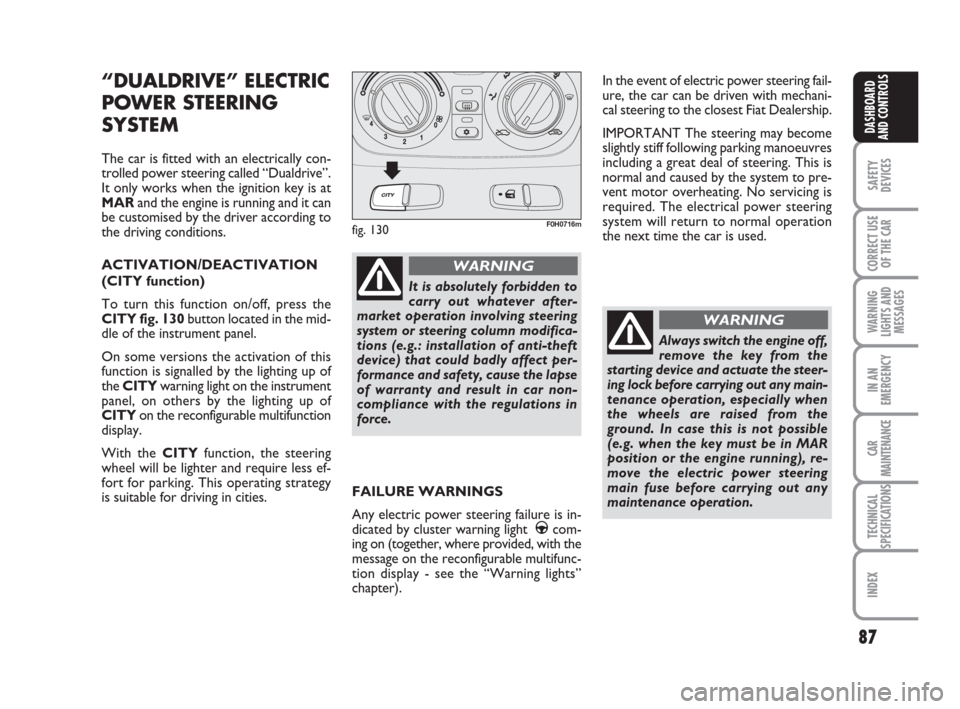
ACTIVATION/DEACTIVATION
(CITY function)
To turn this function on/off, press the
CITY fig. 130button located in the mid-
dle of the instrument panel.
On some versions the activation of this
function is signalled by the lighting up of
the CITYwarning light on the instrument
panel, on others by the lighting up of
CITYon the reconfigurable multifunction
display.
With the CITYfunction, the steering
wheel will be lighter and require less ef-
fort for parking. This operating strategy
is suitable for driving in cities.
fig. 130F0H0716m
It is absolutely forbidden to
carry out whatever after-
market operation involving steering
system or steering column modifica-
tions (e.g.: installation of anti-theft
device) that could badly affect per-
formance and safety, cause the lapse
of warranty and result in car non-
compliance with the regulations in
force.
WARNING
In the event of electric power steering fail-
ure, the car can be driven with mechani-
cal steering to the closest Fiat Dealership.
IMPORTANT The steering may become
slightly stiff following parking manoeuvres
including a great deal of steering. This is
normal and caused by the system to pre-
vent motor overheating. No servicing is
required. The electrical power steering
system will return to normal operation
the next time the car is used.
Always switch the engine off,
remove the key from the
starting device and actuate the steer-
ing lock before carrying out any main-
tenance operation, especially when
the wheels are raised from the
ground. In case this is not possible
(e.g. when the key must be in MAR
position or the engine running), re-
move the electric power steering
main fuse before carrying out any
maintenance operation.
WARNING
FAILURE WARNINGS
Any electric power steering failure is in-
dicated by cluster warning light
gcom-
ing on (together, where provided, with the
message on the reconfigurable multifunc-
tion display - see the “Warning lights”
chapter).
036-092 idea GB 1 ed 10-07-2008 16:12 Pagina 87
Page 98 of 210
97
CORRECT USE
OF THE CAR
WARNING
LIGHTS AND
MESSAGES
IN AN
EMERGENCY
CAR
MAINTENANCE
TECHNICAL
SPECIFICATIONS
INDEX
DASHBOARD
AND CONTROLS
SAFETY
DEVICES
PRETENSIONERS
To increase the efficiency of the seat belts,
the vehicle is fitted with pretensioners.
These devices, in the event of a violent
crash, rewind the seat belts a few cen-
timetres. In this way they ensure that the
seat belt adheres perfectly to the wearer
before the restraining action begins.
The seat belt locks to indicate that the de-
vice has intervened; the seat belt cannot
be drawn back up even when guiding it
manually.
IMPORTANT To obtain the highest de-
gree of protection from the action of the
pretensioning device, wear the seat belt
keeping it firmly close to the chest and
pelvis.
A small amount of smoke may be pro-
duced. This smoke is in no way toxic and
presents no fire hazard.
The pretensioner does not require any
maintenance or greasing.
Anything that modifies its original condi-
tions invalidates its efficiency.
If due to unusual natural events (floods,
sea storm, etc.) the device has been af-
fected by water and mud, it must neces-
sarily be replaced.LOAD LIMITERS
To increase passenger’s safety, the front
seat belt reels contain a load limiter which
allows controlled sag in such a way as to
dose the force acting on the chest and
shoulders during the belt restraining ac-
tion in case of front crash.
GENERAL INSTRUCTIONS
FOR USING THE SEAT BELTS
The driver must comply with (and have
the vehicle occupants follow) all the local
legal regulations concerning the use of seat
belts. Always fasten the seat belts before
starting.
Seat belts are also to be worn by expec-
tant mothers: the risk of injury in the case
of accident is greatly reduced for them and
the unborn child if they are wearing a seat
belt.The pretensioner can only
be used once. After a colli-
sion that has triggered it, have it re-
placed at a Fiat Dealership. Preten-
sioner validity is written on the plate
set on the upper oddment compart-
ment on passenger side. Pretension-
ers should be replaced at Fiat Deal-
ership as this date approaches.
WARNING
Operations which lead to
knocks, vibrations or localised
heating (over 100°C for a
maximum of 6 hours) in the
area around the pretensioners may
cause damage or trigger them. These
devices are not affected by vibrations
caused by irregularities of the road sur-
face or low obstacles such as kerbs, etc.
Contact a Fiat Dealership for any as-
sistance.
093-110 idea GB 1 ed 10-07-2008 8:28 Pagina 97
Page 114 of 210
113
WARNING
LIGHTS AND
MESSAGES
IN AN
EMERGENCY
CAR
MAINTENANCE
TECHNICAL
SPECIFICATIONS
INDEX
DASHBOARD
AND CONTROLS
SAFETY
DEVICES
CORRECT USE
OF THE CAR
❒Turn the ignition key to AVVas soon
as warning light m goes out. If you wait
too long you will lose the benefit of
the work done by the glow plugs. Re-
lease the key as soon as the engine
starts.
IMPORTANT With cold engine, the ac-
celerator pedal shall be completely re-
leased while turning the ignition key to
AVV.
If the engine does not start at the first at-
tempt, return the ignition key to STOP
before repeating starting.
If, when the ignition key is on MAR, warn-
ing light
Yremains lit, turn the key to
STOPand then back to MAR; if the
warning light remains on, try with the oth-
er keys provided with the car.
If you still cannot start the engine, contact
Fiat Dealership.
IMPORTANT Never leave the ignition key
at MARwhen the engine is off.The warning light
mwill
flash for 60 seconds at start-
up or during prolonged crank-
ing to signal a fault in the
glow plug heating system. You can use
the car as usual if the engine starts but
you should contact a Fiat Dealership
as soon as possible.
HOW TO WARM UP
THE ENGINE AFTER
IT HAS JUST STARTED
(petrol and Multijet versions)
Proceed as follows:
❒Drive off slowly, letting the engine turn
at medium revs. Do not accelerate
abruptly;
❒Do not drive at full performance for
the initial kilometres. Wait until the
coolant temperature gauge starts
moving.
STOPPING THE ENGINE
Turn the ignition to STOPwhile the en-
gine is idling.
IMPORTANT After a taxing drive, you
should allow the engine to “catch its
breath” before turning it off by letting it
idle to allow the temperature in the en-
gine compartment to fall.Never bump start the engine
by pushing, towing or coast-
ing downhill. This could cause
fuel to flow into the catalyt-
ic exhaust system and damage it be-
yond repair.
A quick burst on the acceler-
ator before turning off the en-
gine serves absolutely no
practical purpose, it wastes
fuel and is damaging especially to tur-
bocharged engines.
Remember that the servo-
brake and power steering
are not operational until the engine
has been started, therefore much ef-
fort than usual is required on the
brake pedal and steering wheel.
WARNING
111-122 idea GB 1 ed 10-07-2008 8:29 Pagina 113
Page 124 of 210
123
IN AN
EMERGENCY
CAR
MAINTENANCE
TECHNICAL
SPECIFICATIONS
INDEX
DASHBOARD
AND CONTROLS
SAFETY
DEVICES
CORRECT USE
OF THE CAR
WARNING
LIGHTS AND
MESSAGES
GENERAL WARNINGS ...................................................... 124
LOW BRAKE FLUID LEVEL .............................................. 124
HANDBRAKE ON ............................................................... 124
AIRBAG FAILURE ................................................................. 124
HOT ENGINE COOLANT ................................................ 125
LOW BATTERY CHARGE................................................. 125
LOW ENGINE OIL PRESSURE ......................................... 126
EXHAUSTED OIL ................................................................. 126
“DUALDRIVE” ELECTRIC POWER
STEERING FAILURE............................................................. 126
INCOMPLETE DOOR LOCKING ................................... 126
SEAT BELTS NOT FASTENED ......................................... 126
EBD FAILURE......................................................................... 127
INJECTION SYSTEM FAILURE ......................................... 127
EOBD ENGINE CONTROL SYSTEM FAILURE ........... 127
FRONT PASSENGER AIRBAG DISABLED .................... 128
ABS SYSTEM FAILURE ........................................................ 128
FUEL RESERVE....................................................................... 128
GLOW PLUG HEATING.................................................... 129
GLOW PLUG HEATING FAILURE.................................. 129
WATER IN DIESEL FUEL FILTER ..................................... 129
CAR PROTECTION SYSTEM FAULT - FIAT CODE .. 129
REAR FOG LIGHTS ............................................................. 129
GENERAL FAILURE INDICATION ................................. 130
WW W
A A
R R
N N
I I
N N
G G
L L
I I
G G
H H
T T
S S
A A
N N
D D
M M
E E
S S
S S
A A
G G
E E E
S S
BRAKE PAD WEAR ............................................................. 131
PARTICULATE FILTER CLOGGED................................. 131
SIDE/TAIL LIGHTS AND LOW BEAMS ......................... 131
FOLLOW ME HOME ......................................................... 131
FRONT FOG LIGHTS ......................................................... 131
LEFT-HAND DIRECTION INDICATOR ....................... 132
RIGHT-HAND DIRECTION INDICATOR ................... 132
“DUALDRIVE” ELECTRIC POWER STEERING
ACTIVATION ........................................................................ 132
CRUISE CONTROL SYSTEM ............................................ 132
MAIN BEAMS ......................................................................... 132
POSSIBLE ICE ON ROAD.................................................. 132
LIMITED RANGE .................................................................. 132
123-132 idea GB 1 ed 10-07-2008 8:29 Pagina 123
Page 130 of 210
129
IN AN
EMERGENCY
CAR
MAINTENANCE
TECHNICAL
SPECIFICATIONS
INDEX
DASHBOARD
AND CONTROLS
SAFETY
DEVICES
CORRECT USE
OF THE CAR
WARNING
LIGHTS AND
MESSAGES
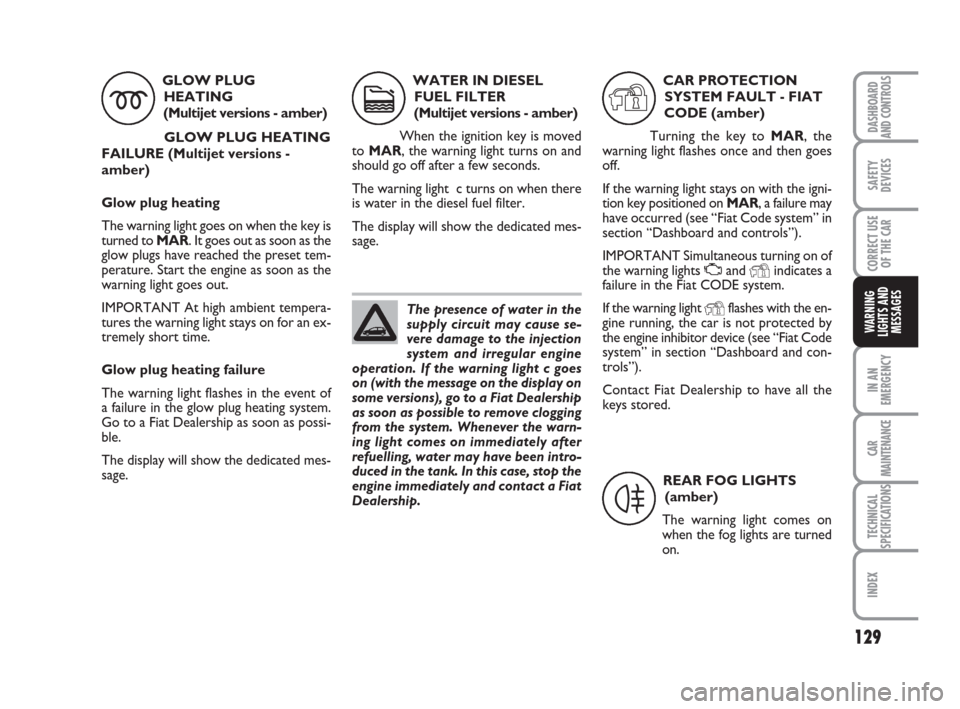
GLOW PLUG
HEATING
(Multijet versions - amber)
GLOW PLUG HEATING
FAILURE (Multijet versions -
amber)
Glow plug heating
The warning light goes on when the key is
turned to MAR. It goes out as soon as the
glow plugs have reached the preset tem-
perature. Start the engine as soon as the
warning light goes out.
IMPORTANT At high ambient tempera-
tures the warning light stays on for an ex-
tremely short time.
Glow plug heating failure
The warning light flashes in the event of
a failure in the glow plug heating system.
Go to a Fiat Dealership as soon as possi-
ble.
The display will show the dedicated mes-
sage.
m
WATER IN DIESEL
FUEL FILTER
(Multijet versions - amber)
When the ignition key is moved
to MAR, the warning light turns on and
should go off after a few seconds.
The warning light c turns on when there
is water in the diesel fuel filter.
The display will show the dedicated mes-
sage.
c
CAR PROTECTION
SYSTEM FAULT - FIAT
CODE (amber)
Turning the key to MAR, the
warning light flashes once and then goes
off.
If the warning light stays on with the igni-
tion key positioned on MAR, a failure may
have occurred (see “Fiat Code system” in
section “Dashboard and controls”).
IMPORTANT Simultaneous turning on of
the warning lights
Uand Yindicates a
failure in the Fiat CODE system.
If the warning light
Yflashes with the en-
gine running, the car is not protected by
the engine inhibitor device (see “Fiat Code
system” in section “Dashboard and con-
trols”).
Contact Fiat Dealership to have all the
keys stored.
Y
REAR FOG LIGHTS
(amber)
The warning light comes on
when the fog lights are turned
on.
4
The presence of water in the
supply circuit may cause se-
vere damage to the injection
system and irregular engine
operation. If the warning light c goes
on (with the message on the display on
some versions), go to a Fiat Dealership
as soon as possible to remove clogging
from the system. Whenever the warn-
ing light comes on immediately after
refuelling, water may have been intro-
duced in the tank. In this case, stop the
engine immediately and contact a Fiat
Dealership.
123-132 idea GB 1 ed 10-07-2008 8:29 Pagina 129
Page 138 of 210
137
CAR
MAINTENANCE
TECHNICAL
SPECIFICATIONS
INDEX
DASHBOARD
AND CONTROLS
SAFETY
DEVICES
CORRECT USE
OF THE CAR
WARNING
LIGHTS AND
MESSAGES
IN AN
EMERGENCY
Holes and damages on the
tyre side walls cannot be re-
paired. Do not use the quick tyre re-
pair kit if damaging is due to running
with flat tyre.
WARNING
Repairs are not possible in
case of damages on the
wheel rim (bad groove distortion
causing air loss). Do not remove for-
eign bodies (screws or nails) from the
tyre.
WARNING
The compressor shall not be
operated for more than 20
minutes. Risk of overheating!. Tyres
repaired with the quick tyre repair kit
shall be used temporarily only.
WARNING
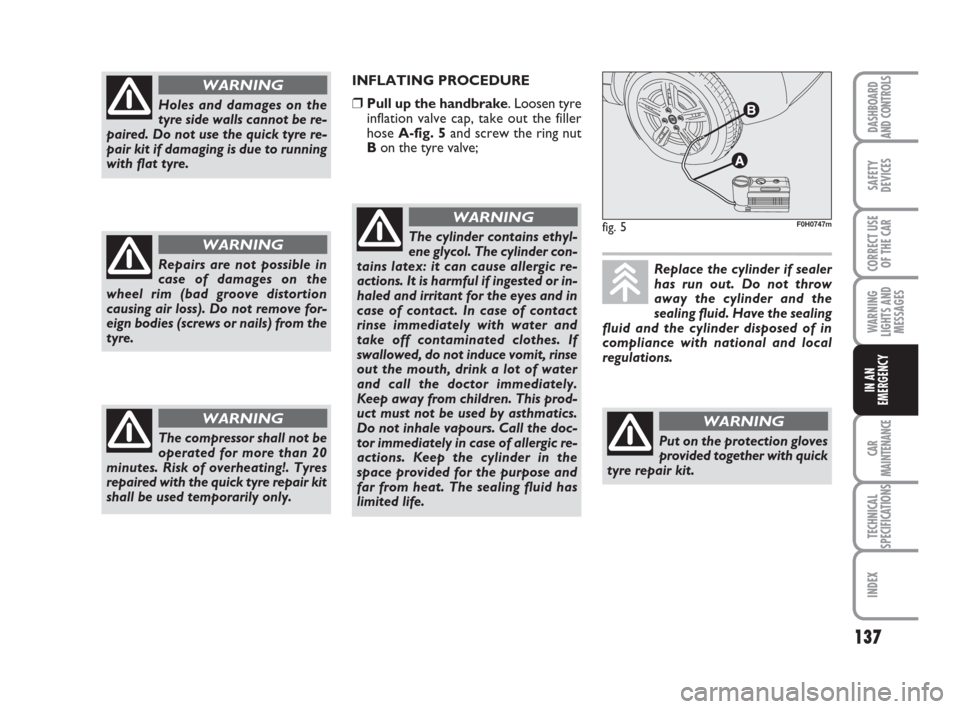
INFLATING PROCEDURE
❒Pull up the handbrake. Loosen tyre
inflation valve cap, take out the filler
hose A-fig. 5and screw the ring nut
Bon the tyre valve;
fig. 5F0H0747mThe cylinder contains ethyl-
ene glycol. The cylinder con-
tains latex: it can cause allergic re-
actions. It is harmful if ingested or in-
haled and irritant for the eyes and in
case of contact. In case of contact
rinse immediately with water and
take off contaminated clothes. If
swallowed, do not induce vomit, rinse
out the mouth, drink a lot of water
and call the doctor immediately.
Keep away from children. This prod-
uct must not be used by asthmatics.
Do not inhale vapours. Call the doc-
tor immediately in case of allergic re-
actions. Keep the cylinder in the
space provided for the purpose and
far from heat. The sealing fluid has
limited life.
WARNING
Replace the cylinder if sealer
has run out. Do not throw
away the cylinder and the
sealing fluid. Have the sealing
fluid and the cylinder disposed of in
compliance with national and local
regulations.
Put on the protection gloves
provided together with quick
tyre repair kit.
WARNING
133-160 idea GB 1 ed 10-07-2008 8:30 Pagina 137
Page 177 of 210
176
TECHNICAL
SPECIFICATIONS
INDEX
DASHBOARD
AND CONTROLS
SAFETY
DEVICES
CORRECT USE
OF THE CAR
WARNING
LIGHTS AND
MESSAGES
IN AN
EMERGENCY
CAR
MAINTENANCE
RUBBER HOSES
As far as the brake system and fuel rubber
hoses are concerned, carefully follow the
“Service schedule” in this section.
Indeed ozone, high temperatures and pro-
longed lack of fluid in the system may
cause hardening and cracking of the hoses,
with possible leaks. Careful control is
therefore necessary.
WINDSCREEN/
REAR WINDOW
WIPERS
BLADES
Periodically clean the rubber part using
special products; TUTELA PROFES-
SIONAL SC 35 is recommended.
If the rubber blades are bent or worn they
should be replaced. In any case they
should be changed once a year.
A few simple notions can reduce the pos-
sibility of damage to the blades:
❒if the temperature fall below zero,
make sure that ice has not frozen the
rubber against glass. If necessary, thaw
using an antifreeze product;
❒remove any snow from the glass: in ad-
dition to protecting the blades, this
prevents effort on the motor and
overheating;
❒do not operate the windscreen and
rear window wipers on dry glass.
Driving with worn wiper
blades is a serious hazard,
because visibility is reduced in bad
weather.
WARNING
Changing the windscreen wiper
blades fig. 14
Proceed as follows:
❒raise the windscreen wiper arm Aand
position the blade so that it forms an
angle of 90° with the arm;
❒press tab Bof the coupling spring and
remove the blade to be replaced from
the arm A;
❒fit the new blade by inserting the tab
into the special slot in the arm. Make
sure it is properly locked into place.
161-180 idea GB 1 ed 10-07-2008 8:30 Pagina 176