wheel FIAT IDEA 2009 1.G Owner's Manual
[x] Cancel search | Manufacturer: FIAT, Model Year: 2009, Model line: IDEA, Model: FIAT IDEA 2009 1.GPages: 210, PDF Size: 3.62 MB
Page 134 of 210
133
STARTING
AND DRIVING
MAINTENANCE
AND CARE
TECHNICAL
SPECIFICATIONS
ALPHABETICAL
INDEX
DASHBOARD
AND
CONTROLS
SAFETY
WARNING
LIGHTS AND
MESSAGES
IN AN
EMERGENCY
OPENING/CLOSING THE DOORS................................ 134
STARTING THE ENGINE ................................................. 134
FIX & GO AUTOMATIC
(QUICK TYRE REPAIR KIT) ............................................. 136
REPLACING A WHEEL ..................................................... 140
WHEN NEEDING TO CHANGE A BULB .................. 144
REPLACING EXTERIOR BULBS ...................................... 147
REPLACING AN INTERIOR BULB ................................. 152
REPLACING FUSES ............................................................. 153
IF THE BATTERY IS FLAT ................................................. 158
LIFTING THE CAR ............................................................. 158
TOWING THE CAR .......................................................... 159
I I
N N
A A
N N
E E
M M
E E
R R
G G
E E
N N
C C
Y Y
In an emergency we recommend that you call the toll-free number found on the
Warranty Booklet. You will go to our web site at www.fiat.com
to find the Fiat Dealership nearest to you.
Page 136 of 210
135
STARTING
AND DRIVING
MAINTENANCE
AND CARE
TECHNICAL
SPECIFICATIONS
ALPHABETICAL
INDEX
DASHBOARD
AND
CONTROLS
SAFETY
WARNING
LIGHTS AND
MESSAGES
IN AN
EMERGENCY
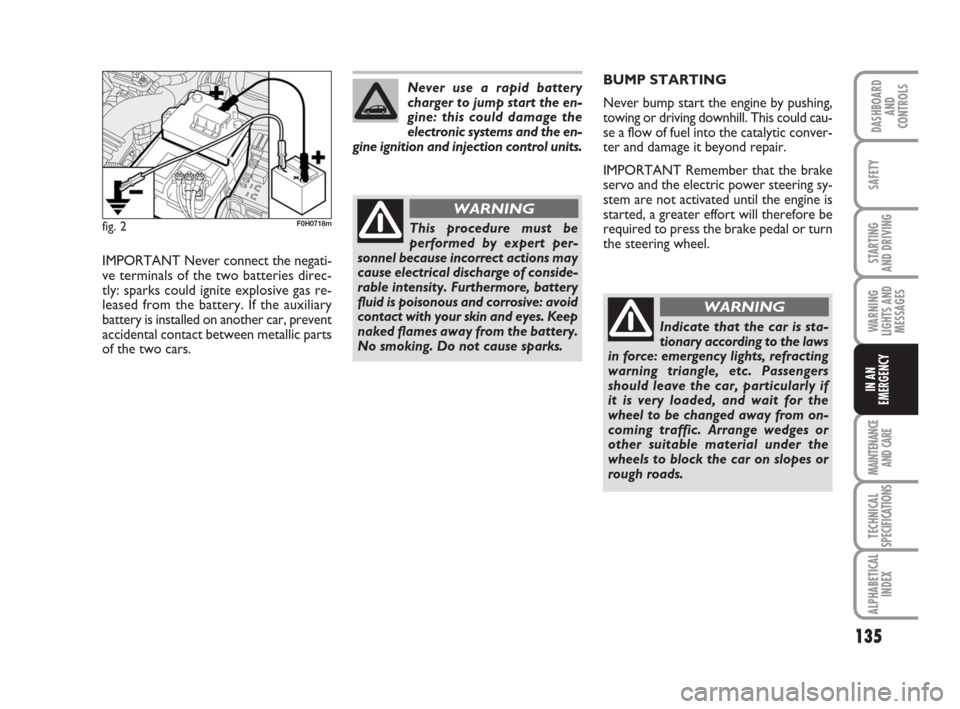
fig. 2F0H0718m
IMPORTANT Never connect the negati-
ve terminals of the two batteries direc-
tly: sparks could ignite explosive gas re-
leased from the battery. If the auxiliary
battery is installed on another car, prevent
accidental contact between metallic parts
of the two cars.
This procedure must be
performed by expert per-
sonnel because incorrect actions may
cause electrical discharge of conside-
rable intensity. Furthermore, battery
fluid is poisonous and corrosive: avoid
contact with your skin and eyes. Keep
naked flames away from the battery.
No smoking. Do not cause sparks.
WARNING
Never use a rapid battery
charger to jump start the en-
gine: this could damage the
electronic systems and the en-
gine ignition and injection control units.BUMP STARTING
Never bump start the engine by pushing,
towing or driving downhill. This could cau-
se a flow of fuel into the catalytic conver-
ter and damage it beyond repair.
IMPORTANT Remember that the brake
servo and the electric power steering sy-
stem are not activated until the engine is
started, a greater effort will therefore be
required to press the brake pedal or turn
the steering wheel.
Indicate that the car is sta-
tionary according to the laws
in force: emergency lights, refracting
warning triangle, etc. Passengers
should leave the car, particularly if
it is very loaded, and wait for the
wheel to be changed away from on-
coming traffic. Arrange wedges or
other suitable material under the
wheels to block the car on slopes or
rough roads.
WARNING
Page 138 of 210
137
STARTING
AND DRIVING
MAINTENANCE
AND CARE
TECHNICAL
SPECIFICATIONS
ALPHABETICAL
INDEX
DASHBOARD
AND
CONTROLS
SAFETY
WARNING
LIGHTS AND
MESSAGES
IN AN
EMERGENCY
The kit cannot be used to re-
pair damage to the tyre si-
dewall. Do not use the quick repair
kit if the tyre was damaged by run-
ning on a flat.
WARNING
The damage cannot be re-
paired with the kit if the
wheel rim is damaged (deformation
of the channel causing leakage of air).
Do not remove the foreign body
(screw or nail) from the tyre.
WARNING
Do not operate the com-
pressor for longer than 20
minutes consecutively. Risk of
overheating. The quick repair kit is
not suitable for definitive repairs. The
tyres may only be repaired tempora-
rily.
WARNING
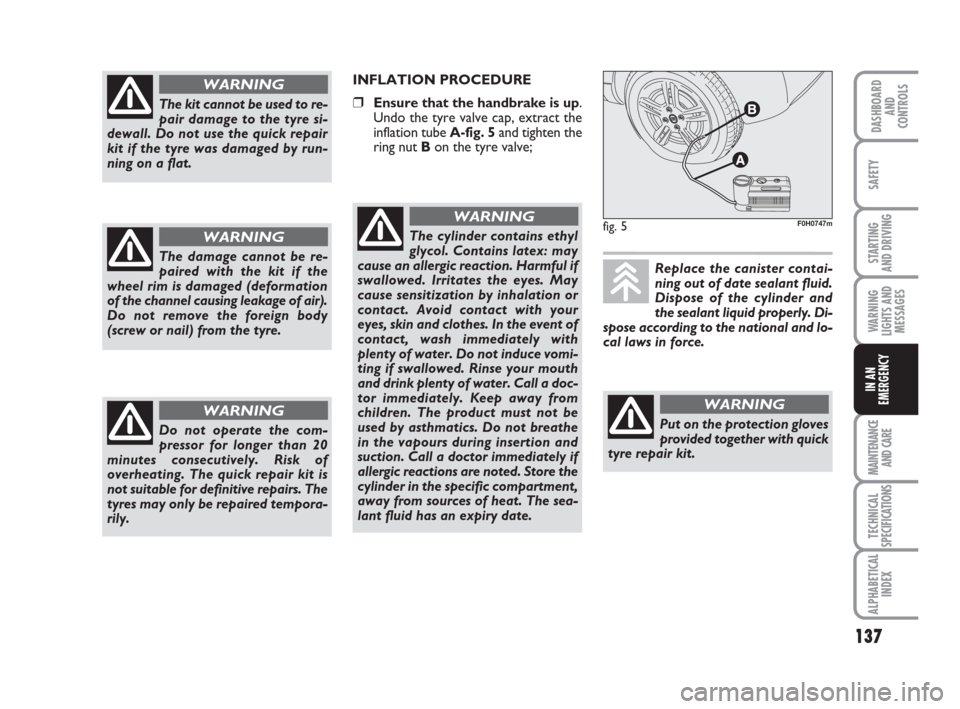
INFLATION PROCEDURE
❒Ensure that the handbrake is up.
Undo the tyre valve cap, extract the
inflation tube A-fig. 5and tighten the
ring nut Bon the tyre valve;
fig. 5F0H0747mThe cylinder contains ethyl
glycol. Contains latex: may
cause an allergic reaction. Harmful if
swallowed. Irritates the eyes. May
cause sensitization by inhalation or
contact. Avoid contact with your
eyes, skin and clothes. In the event of
contact, wash immediately with
plenty of water. Do not induce vomi-
ting if swallowed. Rinse your mouth
and drink plenty of water. Call a doc-
tor immediately. Keep away from
children. The product must not be
used by asthmatics. Do not breathe
in the vapours during insertion and
suction. Call a doctor immediately if
allergic reactions are noted. Store the
cylinder in the specific compartment,
away from sources of heat. The sea-
lant fluid has an expiry date.
WARNING
Replace the canister contai-
ning out of date sealant fluid.
Dispose of the cylinder and
the sealant liquid properly. Di-
spose according to the national and lo-
cal laws in force.
Put on the protection gloves
provided together with quick
tyre repair kit.
WARNING
Page 141 of 210
140
STARTING
AND DRIVING
MAINTENANCE
AND CARE
TECHNICAL
SPECIFICATIONS
ALPHABETICAL
INDEX
DASHBOARD
AND
CONTROLS
SAFETY
WARNING
LIGHTS AND
MESSAGES
IN AN
EMERGENCY
REPLACING A WHEEL
GENERAL INSTRUCTIONS
Wheel changing and correct use of the
jack and spare wheel call for some pre-
cautions as listed below.
IMPORTANT Refer to the instructions in
the previous chapter if the car is equipped
with “Fix&Go (quick tyre repair kit)”.
The spare wheel is specific
for your car. Do not use it on
cars of different models. Do not use
spare wheels of different models on
your car. The space saver spare wheel
must only be used in case of emer-
gency. Use only for as long as stric-
tly necessary and drive at a speed
slower than 80 km/h. An orange la-
bel is affixed on the spare wheel sum-
marising instructions and limitations
for use. Never remove or cover the la-
bel. Never apply a wheel cup on a
space saver spare. The following
information is provided in four lan-
guages on the label: W
ARNING! SUITA-BLE FOR TEMPORARY USE ONLY! 80 KM/H
MAX! REPLACE WITH A STANDARD WHEEL
AS SOON AS POSSIBLE. DO NOT COVER THIS
LABEL
.
WARNING
The driving features of the
car may change when a spa-
ce saver spare wheel is fitted. Avoid
sudden acceleration and braking, sud-
den steering and fast cornering. The
total life of a space saver spare wheel
is approximately 3000 km, after whi-
ch it must be replaced by another
wheel of the same type. Never install
a traditional tyre on a space saver
spare wheel rim. Repair and refit the
standard wheel as soon as possible.
Only one space saver spare can be
used at a time. Do not apply grease
to the bolt threads before assembly:
the bolts could come loose unexpec-
tedly.
WARNING
Page 142 of 210
141
STARTING
AND DRIVING
MAINTENANCE
AND CARE
TECHNICAL
SPECIFICATIONS
ALPHABETICAL
INDEX
DASHBOARD
AND
CONTROLS
SAFETY
WARNING
LIGHTS AND
MESSAGES
IN AN
EMERGENCY
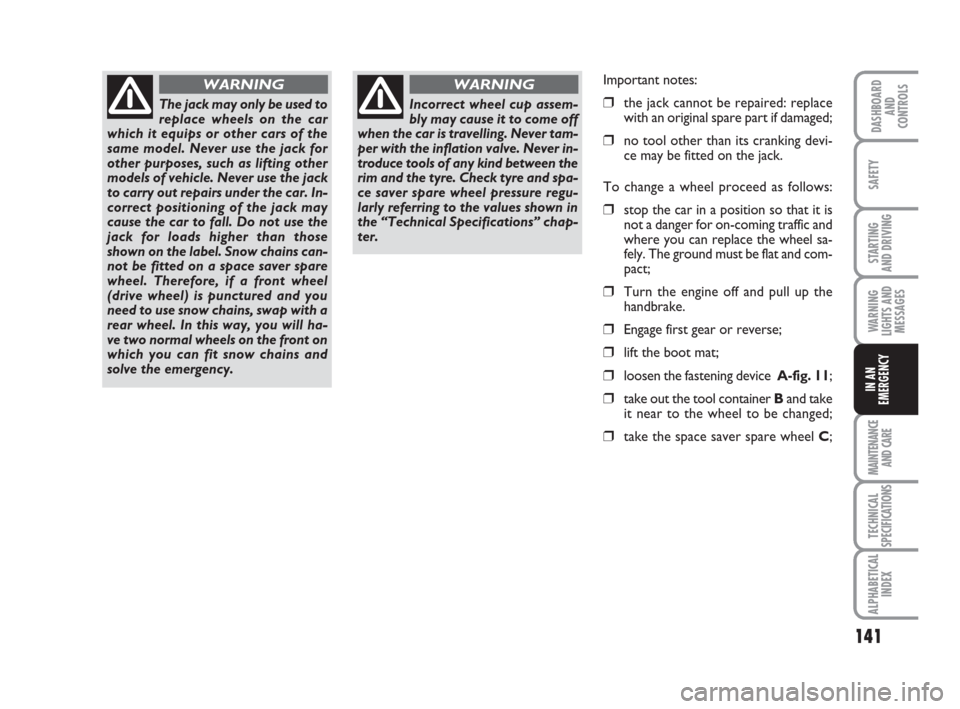
The jack may only be used to
replace wheels on the car
which it equips or other cars of the
same model. Never use the jack for
other purposes, such as lifting other
models of vehicle. Never use the jack
to carry out repairs under the car. In-
correct positioning of the jack may
cause the car to fall. Do not use the
jack for loads higher than those
shown on the label. Snow chains can-
not be fitted on a space saver spare
wheel. Therefore, if a front wheel
(drive wheel) is punctured and you
need to use snow chains, swap with a
rear wheel. In this way, you will ha-
ve two normal wheels on the front on
which you can fit snow chains and
solve the emergency.
WARNING
Incorrect wheel cup assem-
bly may cause it to come off
when the car is travelling. Never tam-
per with the inflation valve. Never in-
troduce tools of any kind between the
rim and the tyre. Check tyre and spa-
ce saver spare wheel pressure regu-
larly referring to the values shown in
the “Technical Specifications” chap-
ter.
WARNINGImportant notes:
❒the jack cannot be repaired: replace
with an original spare part if damaged;
❒no tool other than its cranking devi-
ce may be fitted on the jack.
To change a wheel proceed as follows:
❒stop the car in a position so that it is
not a danger for on-coming traffic and
where you can replace the wheel sa-
fely. The ground must be flat and com-
pact;
❒Turn the engine off and pull up the
handbrake.
❒Engage first gear or reverse;
❒lift the boot mat;
❒loosen the fastening device A-fig. 11;
❒take out the tool container Band take
it near to the wheel to be changed;
❒take the space saver spare wheel C;
Page 143 of 210
142
STARTING
AND DRIVING
MAINTENANCE
AND CARE
TECHNICAL
SPECIFICATIONS
ALPHABETICAL
INDEX
DASHBOARD
AND
CONTROLS
SAFETY
WARNING
LIGHTS AND
MESSAGES
IN AN
EMERGENCY
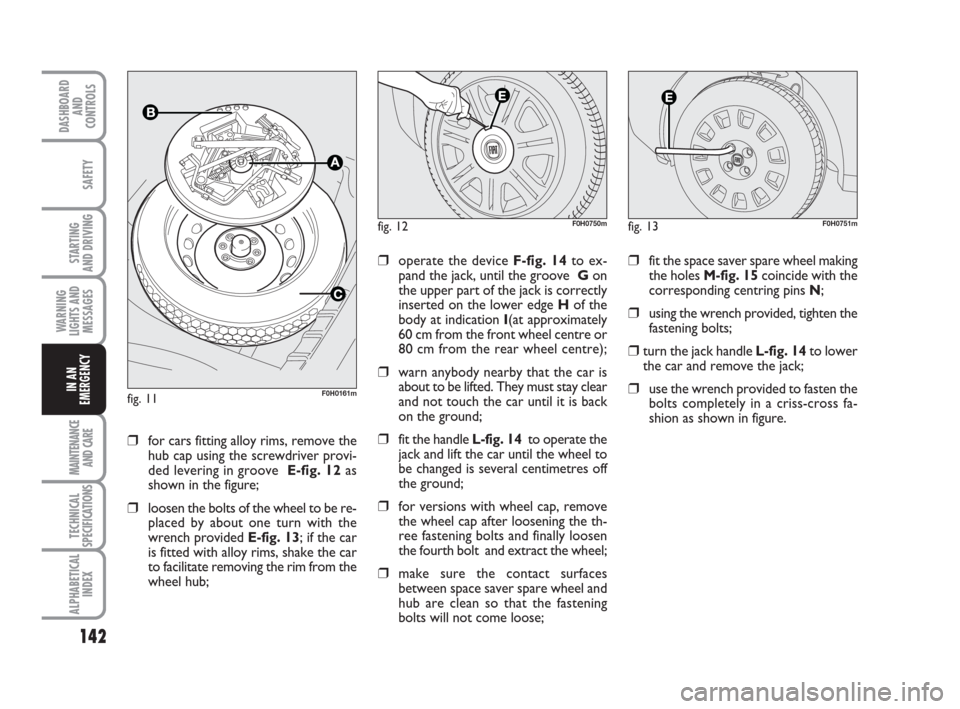
❒for cars fitting alloy rims, remove the
hub cap using the screwdriver provi-
ded levering in groove E-fig. 12as
shown in the figure;
❒loosen the bolts of the wheel to be re-
placed by about one turn with the
wrench provided E-fig. 13; if the car
is fitted with alloy rims, shake the car
to facilitate removing the rim from the
wheel hub;
fig. 12F0H0750m
❒operate the device F-fig. 14to ex-
pand the jack, until the groove Gon
the upper part of the jack is correctly
inserted on the lower edge Hof the
body at indication I(at approximately
60 cm from the front wheel centre or
80 cm from the rear wheel centre);
❒warn anybody nearby that the car is
about to be lifted. They must stay clear
and not touch the car until it is back
on the ground;
❒fit the handle L-fig. 14to operate the
jack and lift the car until the wheel to
be changed is several centimetres off
the ground;
❒for versions with wheel cap, remove
the wheel cap after loosening the th-
ree fastening bolts and finally loosen
the fourth bolt and extract the wheel;
❒make sure the contact surfaces
between space saver spare wheel and
hub are clean so that the fastening
bolts will not come loose;
fig. 13F0H0751m
❒fit the space saver spare wheel making
the holes M-fig. 15coincide with the
corresponding centring pins N;
❒using the wrench provided, tighten the
fastening bolts;
❒turn the jack handle L-fig. 14to lower
the car and remove the jack;
❒use the wrench provided to fasten the
bolts completely in a criss-cross fa-
shion as shown in figure.fig. 11F0H0161m
Page 144 of 210
143
STARTING
AND DRIVING
MAINTENANCE
AND CARE
TECHNICAL
SPECIFICATIONS
ALPHABETICAL
INDEX
DASHBOARD
AND
CONTROLS
SAFETY
WARNING
LIGHTS AND
MESSAGES
IN AN
EMERGENCY
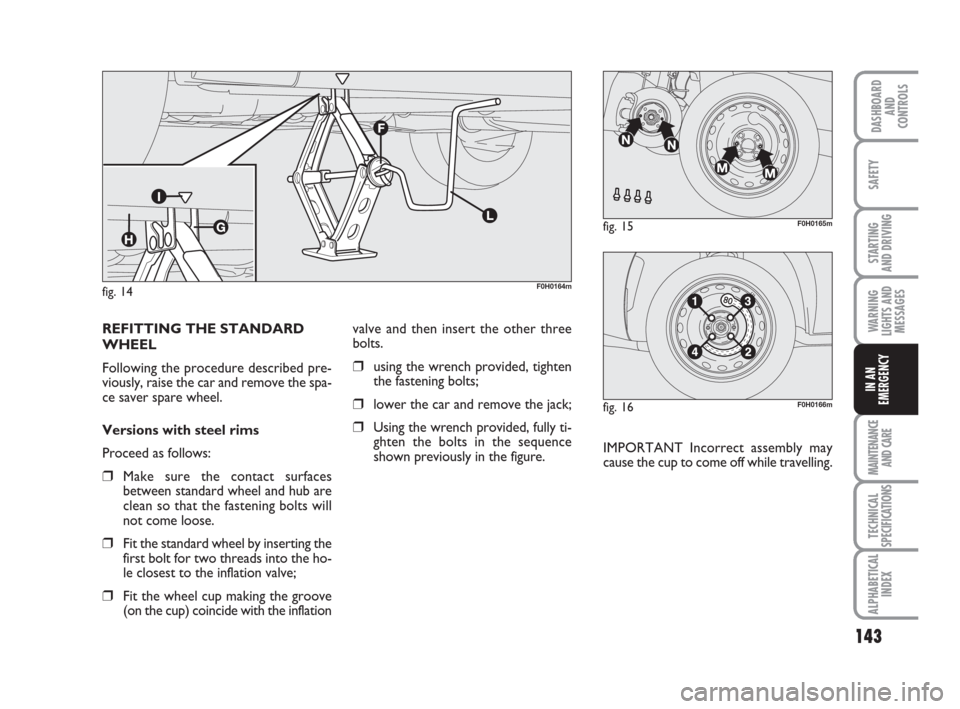
fig. 14F0H0164m
fig. 15F0H0165m
fig. 16F0H0166m
REFITTING THE STANDARD
WHEEL
Following the procedure described pre-
viously, raise the car and remove the spa-
ce saver spare wheel.
Versions with steel rims
Proceed as follows:
❒Make sure the contact surfaces
between standard wheel and hub are
clean so that the fastening bolts will
not come loose.
❒Fit the standard wheel by inserting the
first bolt for two threads into the ho-
le closest to the inflation valve;
❒Fit the wheel cup making the groove
(on the cup) coincide with the inflationvalve and then insert the other three
bolts.
❒using the wrench provided, tighten
the fastening bolts;
❒lower the car and remove the jack;
❒Using the wrench provided, fully ti-
ghten the bolts in the sequence
shown previously in the figure.IMPORTANT Incorrect assembly may
cause the cup to come off while travelling.
Page 145 of 210
144
STARTING
AND DRIVING
MAINTENANCE
AND CARE
TECHNICAL
SPECIFICATIONS
ALPHABETICAL
INDEX
DASHBOARD
AND
CONTROLS
SAFETY
WARNING
LIGHTS AND
MESSAGES
IN AN
EMERGENCY
WHEN NEEDING TO
CHANGE A BULB
GENERAL INSTRUCTIONS
❒When a bulb is not working, check
that the corresponding fuse is intact
before replacing it: refer to the “If a fu-
se blows” paragraph in this chapter for
fuse location.
❒before changing a bulb check the con-
tacts for oxidation;
❒Burnt bulbs must be replaced by
others of the same type and power.
❒Always check the height of the head-
light beam after changing a bulb. Versions with alloy rims
❒Check that the hub contact surfaces
are clean;
❒fit the normal wheel centring it on the
pins, lead in the fastening screws and
tighten them using the wrench provi-
ded;
❒lower the car and remove the jack;
❒using the wrench provided, fully tigh-
ten the bolts in the sequence shown
in fig. 16.
❒snap fit the wheel cup on the hub.
When you have finished
❒stow the spare wheel C-fig. 11 in the
space provided in the boot;
❒Fit the jack partially open in its box B-
fig. 11forcing it lightly to prevent it
from vibrating when travelling;
❒put the tools back into their places in
the container;
❒arrange the container and tools in the
spare wheel and secure the fastening
device A-fig. 11;
❒rearrange the preformed boot cover
correctly.
Modifications or repairs to
the electrical system (elec-
tronic control units) that are not car-
ried out properly or do not take the
technical specifications of the system
into account can cause malfunctions
leading to the risk of fire.
WARNING
Halogen bulbs contain pres-
surised gas which may cau-
se small fragments of glass to be
projected outwards if the bulb is
broken.
WARNING
Halogen lamps must be hand-
led holding the metallic part
only. Touching the transpa-
rent part of the bulb with
your fingers may reduce the intensity
of the emitted light and even compro-
mise duration of the lamp itself. In the
case of accidental contact, rub the
lamp with a cloth and spirit and leave
to dry.IMPORTANT A slight misting may appear
on the internal surface of the headlight:
this does not indicate a fault and is cau-
sed by low temperature and the degree of
humidity in the air. Misting will rapidly di-
sappear when the headlights are switched
on. The presence of drops inside the head-
lights indicates infiltration of water. Go to
a Fiat Dealership.
Page 161 of 210
160
STARTING
AND DRIVING
MAINTENANCE
AND CARE
TECHNICAL
SPECIFICATIONS
ALPHABETICAL
INDEX
DASHBOARD
AND
CONTROLS
SAFETY
WARNING
LIGHTS AND
MESSAGES
IN AN
EMERGENCY
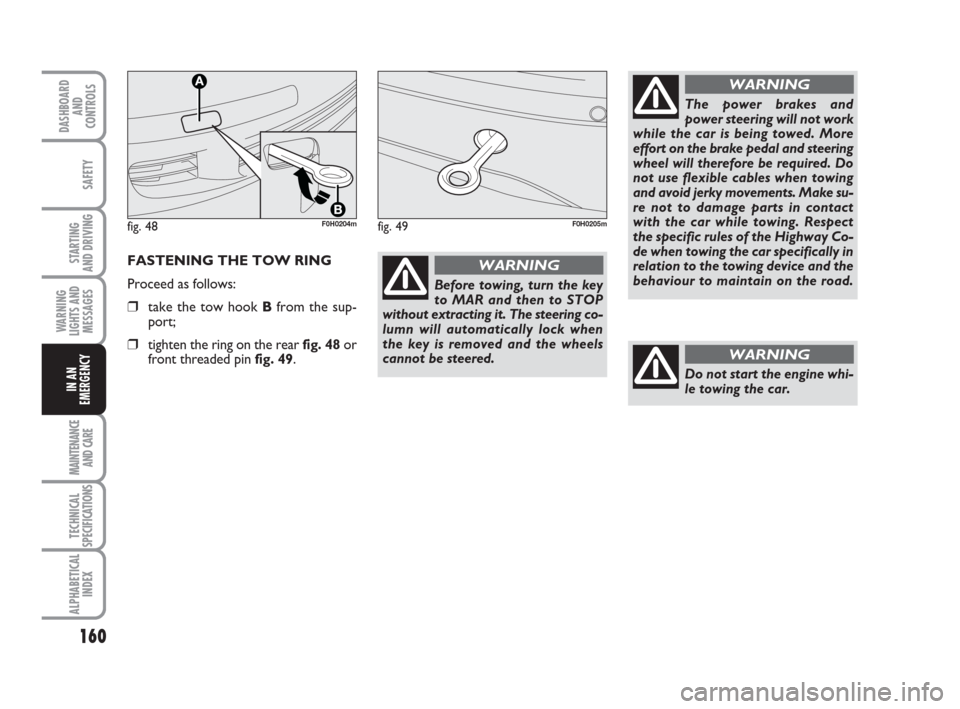
FASTENING THE TOW RING
Proceed as follows:
❒take the tow hook Bfrom the sup-
port;
❒tighten the ring on the rear fig. 48 or
front threaded pin fig. 49.
fig. 48F0H0204mfig. 49F0H0205m
Before towing, turn the key
to MAR and then to STOP
without extracting it. The steering co-
lumn will automatically lock when
the key is removed and the wheels
cannot be steered.
WARNING
The power brakes and
power steering will not work
while the car is being towed. More
effort on the brake pedal and steering
wheel will therefore be required. Do
not use flexible cables when towing
and avoid jerky movements. Make su-
re not to damage parts in contact
with the car while towing. Respect
the specific rules of the Highway Co-
de when towing the car specifically in
relation to the towing device and the
behaviour to maintain on the road.
WARNING
Do not start the engine whi-
le towing the car.
WARNING
Page 162 of 210
161
STARTING
AND DRIVING
IN AN
EMERGENCY
TECHNICAL
SPECIFICATIONS
ALPHABETICAL
INDEX
DASHBOARD
AND
CONTROLS
SAFETY
WARNING
LIGHTS AND
MESSAGES
MAINTENANCE
AND CARE
SCHEDULED SERVICING ................................................. 162
SERVICE SCHEDULE ......................................................... 163
YEARLY INSPECTION PLAN .......................................... 165
ADDITIONAL INTERVENTIONS .................................. 165
LEVELS CHECK ................................................................... 167
FUEL FILTER (GREEN FILTER) ........................................ 173
BATTERY ............................................................................... 173
WHEELS AND TYRES ....................................................... 175
RUBBER HOSES ................................................................... 176
WINDSCREEN/REAR WINDOW WIPER/WASHER 176
BODYWORK ....................................................................... 178
INTERIORS ........................................................................... 180
M M
A A
I I
N N
T T
E E
N N
A A
N N
C C
E E
A A
N N
D D
C C
A A
R R
E E