wheel FIAT IDEA 2009 1.G Owner's Guide
[x] Cancel search | Manufacturer: FIAT, Model Year: 2009, Model line: IDEA, Model: FIAT IDEA 2009 1.GPages: 210, PDF Size: 3.62 MB
Page 166 of 210
165
STARTING
AND DRIVING
IN AN
EMERGENCY
TECHNICAL
SPECIFICATIONS
ALPHABETICAL
INDEX
DASHBOARD
AND
CONTROLS
SAFETY
WARNING
LIGHTS AND
MESSAGES
MAINTENANCE
AND CARE
YEARLY INSPECTION
PLAN
The following yearly inspection plan is re-
commended for cars clocking less than
20,000 km a year (e.g. approximately
15.000 km):
❒check tyre conditions/wear and pres-
sure (included spare wheel)
❒check lighting system operation (head-
lights, direction indicators, hazard li-
ghts, boot, passenger compartment,
instrument panel warning lights, etc.)
❒check windscreen wiper/washer
(nozzle direction and blade wear)
❒check front disk brake pad conditions
and wear;
❒visually inspect the conditions of: en-
gine, gearbox, flexible and stiff piping
(exhaust, fuel feed, brakes), rubber
parts (boots, sleeves, bushings, etc.)
❒check cleanness of locks, bonnet and
boot and lever cleanness and lubrica-
tion
❒check battery charge;
❒visually check the various drive belt
conditions;
❒check and top up liquids if required
(engine coolant, brakes, windscreen
washer, battery, etc.)
❒change engine oil;
❒change engine oil filter;
❒change pollen filter (where provided).
ADDITIONAL
INTERVENTIONS
Every 1,000 km or before long journeys,
check and, if necessary, top up:
❒engine coolant fluid level;
❒brake fluid level;
❒windscreen washer fluid level;
❒tyre pressure and conditions.
Every 3,000 km check and, if necessary,
top up: engine oil level.
You are recommended to use FL Selenia
products, designed and produced specifi-
cally for Fiat cars (see table “Capacities”
in section “Technical specifications”).
Page 176 of 210
175
STARTING
AND DRIVING
IN AN
EMERGENCY
TECHNICAL
SPECIFICATIONS
ALPHABETICAL
INDEX
DASHBOARD
AND
CONTROLS
SAFETY
WARNING
LIGHTS AND
MESSAGES
MAINTENANCE
AND CARE
WHEELS AND TYRES
Check the pressure of each tyre, including
the spare wheel, approximately once
every two weeks and before setting off on
a long journey: this check must be perfor-
med with the tyre rested and cold.
It is normal for pressure to increase when
the car is used. For the correct tyre in-
flation pressure, see “Wheels” in “Tech-
nical specifications” section.
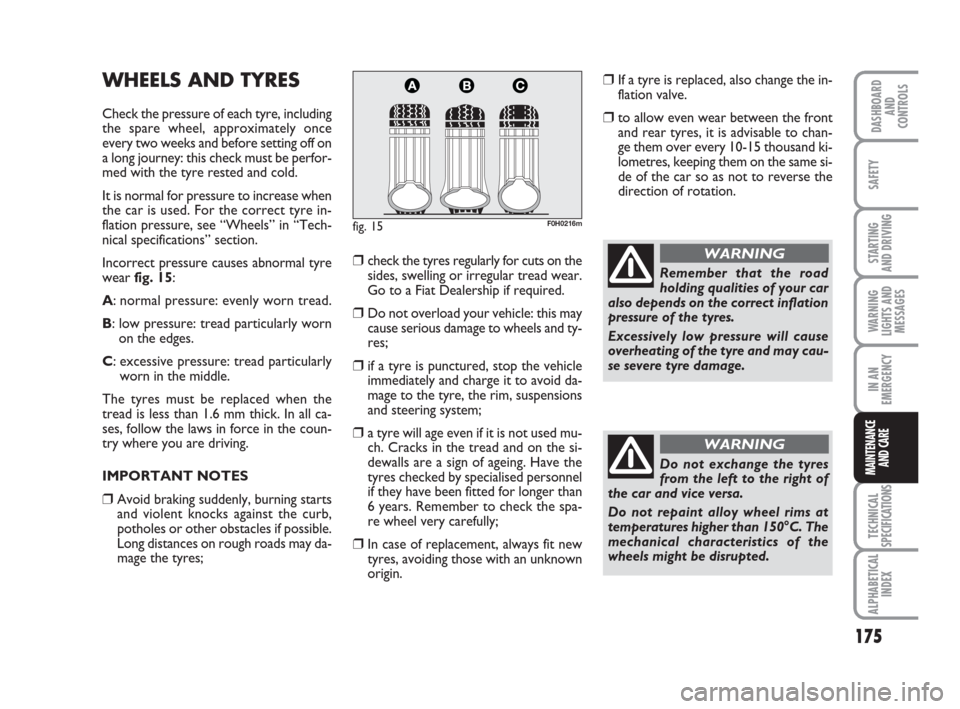
Incorrect pressure causes abnormal tyre
wearfig. 15:
A: normal pressure: evenly worn tread.
B: low pressure: tread particularly worn
on the edges.
C: excessive pressure: tread particularly
worn in the middle.
The tyres must be replaced when the
tread is less than 1.6 mm thick. In all ca-
ses, follow the laws in force in the coun-
try where you are driving.
IMPORTANT NOTES
❒Avoid braking suddenly, burning starts
and violent knocks against the curb,
potholes or other obstacles if possible.
Long distances on rough roads may da-
mage the tyres;
❒check the tyres regularly for cuts on the
sides, swelling or irregular tread wear.
Go to a Fiat Dealership if required.
❒Do not overload your vehicle: this may
cause serious damage to wheels and ty-
res;
❒if a tyre is punctured, stop the vehicle
immediately and charge it to avoid da-
mage to the tyre, the rim, suspensions
and steering system;
❒a tyre will age even if it is not used mu-
ch. Cracks in the tread and on the si-
dewalls are a sign of ageing. Have the
tyres checked by specialised personnel
if they have been fitted for longer than
6 years. Remember to check the spa-
re wheel very carefully;
❒In case of replacement, always fit new
tyres, avoiding those with an unknown
origin.
fig. 15F0H0216m
Remember that the road
holding qualities of your car
also depends on the correct inflation
pressure of the tyres.
Excessively low pressure will cause
overheating of the tyre and may cau-
se severe tyre damage.
WARNING
Do not exchange the tyres
from the left to the right of
the car and vice versa.
Do not repaint alloy wheel rims at
temperatures higher than 150°C. The
mechanical characteristics of the
wheels might be disrupted.
WARNING
❒If a tyre is replaced, also change the in-
flation valve.
❒to allow even wear between the front
and rear tyres, it is advisable to chan-
ge them over every 10-15 thousand ki-
lometres, keeping them on the same si-
de of the car so as not to reverse the
direction of rotation.
Page 181 of 210
180
STARTING
AND DRIVING
IN AN
EMERGENCY
TECHNICAL
SPECIFICATIONS
ALPHABETICAL
INDEX
DASHBOARD
AND
CONTROLS
SAFETY
WARNING
LIGHTS AND
MESSAGES
MAINTENANCE
AND CARE
INTERIORS
Periodically check that water is not trap-
ped under the mats (due to water drip-
ping off shoes, umbrellas, etc.) which could
cause oxidisation of the sheet metal.
CLEANING SEATS AND FABRIC
PARTS
Remove dust with a soft brush or a va-
cuum cleaner. It is advisable to use a moi-
st brush on velvet upholstery.
Rub the seats with a sponge moistened
with a solution of water and neutral de-
tergent.
LEATHER SEATS
Remove dry dirt with a moist chamois
leather or cloth without pressing too hard.
Remove stains of liquid or grease with a
dry absorbing cloth. Do not rub. Then wi-
pe with a soft cloth or chamois leather
dipped in water and mild soap.
Use specific products for persistent stains
paying attention to instructions for use.
IMPORTANT Never use alcohol. Make
sure that the products used do not con-
tain alcohol or derivates, even in low con-
centrations. INTERIOR PLASTIC PARTS
It is advisable to clean interior parts with
a moist cloth and a solution of water and
mild soap. Use specific products for clea-
ning plastic, without solvents and specifi-
cally designed to prevent damage to the
appearance and colour of the treated parts
to remove grease and tough stains.
IMPORTANT Never use spirit or petro-
leum to clean the instrument panel tran-
sparent cover or other plastic parts.
Do not keep aerosol cans in
the car: risk of explosion. Ae-
rosol cans must not be exposed to a
temperature exceeding 50°C. When
the vehicle is exposed to sunlight, in-
ner temperature can greatly exceed
this value.
WARNING
The fabric upholstery of your
car is designed to withstand
the normal wear and tear of
your car for a long time. So-
me precautions are however needed.
Avoid prolonged rubbing against
clothing accessories, such as metal
buckles, Velcro strips and the like, whi-
ch by applying a high pressure on the
fabric in a small area could cause the
breakage of some threads and damage
the upholstery.
LEATHER STEERING
WHEEL/GEAR KNOB
These components must be cleaned with
mild soap and water only. Never use spi-
rit and/or alcohol based products. Read
the product label carefully before using
specific products for cleaning the interiors:
make sure the product does not contain
alcohol or alcohol based substances.
If window cleaner accidentally drips onto
the steering wheel or gear lever knob, wi-
pe away immediately and then wash the
concerned area with mild soap and water.
IMPORTANT Be careful when arranging
a steering wheel lock device, where ap-
plicable, to prevent damaging the leather
upholstery by rubbing.
Page 182 of 210
181
STARTING
AND DRIVING
IN AN
EMERGENCY
MAINTENANCE
AND CARE
ALPHABETICAL
INDEX
DASHBOARD
AND
CONTROLS
SAFETY
WARNING
LIGHTS AND
MESSAGES
TECHNICAL
SPECIFICATIONS
IDENTIFICATION DATA ................................................. 182
ENGINE CODES - BODYWORK VERSIONS ............. 184
ENGINE ................................................................................. 185
FUEL FEED/IGNITION ....................................................... 187
TRANSMISSION UNIT ...................................................... 187
BRAKES .................................................................................. 188
SUSPENSIONS ..................................................................... 188
STEERING SYSTEM ............................................................. 188
WHEELS ................................................................................. 189
DIMENSIONS ....................................................................... 193
PERFORMANCE .................................................................. 193
WEIGHTS .............................................................................. 194
CAPACITIES ......................................................................... 195
FLUIDS AND LUBRICANTS ............................................ 196
FUEL CONSUMPTION ...................................................... 198
CO
2EMISSIONS .................................................................. 199
T T
E E
C C
H H
N N
I I
C C
A A
L L
S S
P P
E E
C C
I I
F F
I I
C C
A A
T T
I I
O O
N N
S S
Page 189 of 210
188
STARTING
AND DRIVING
IN AN
EMERGENCY
MAINTENANCE
AND CARE
ALPHABETICAL
INDEX
DASHBOARD
AND
CONTROLS
SAFETY
WARNING
LIGHTS AND
MESSAGES
TECHNICAL
SPECIFICATIONS
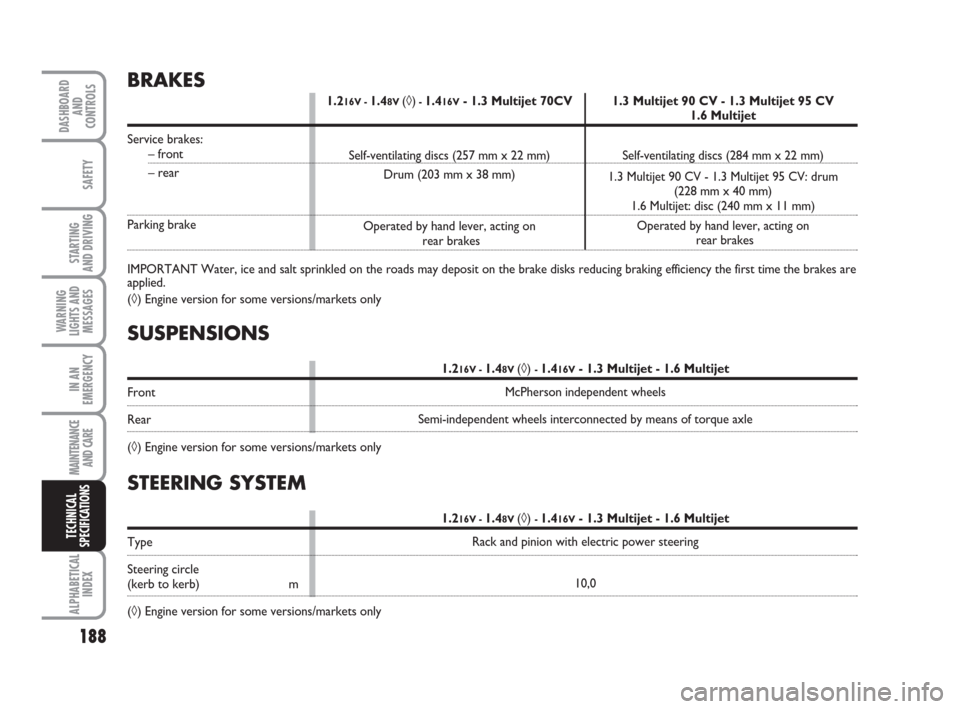
SUSPENSIONS
Front
Rear
(◊) Engine version for some versions/markets only1.2
16V - 1.48V (◊) - 1.416V- 1.3 Multijet - 1.6 Multijet
McPherson independent wheels
Semi-independent wheels interconnected by means of torque axle
STEERING SYSTEM
Type
Steering circle
(kerb to kerb) m
(◊) Engine version for some versions/markets only1.2
16V - 1.48V (◊) - 1.416V- 1.3 Multijet - 1.6 Multijet
Rack and pinion with electric power steering
10,0
BRAKES
Service brakes:– front
– rear
Parking brake
IMPORTANT Water, ice and salt sprinkled on the roads may deposit on the brake disks reducing braking efficiency the first time the brakes are
applied.
(◊) Engine version for some versions/markets only1.2
16V - 1.48V (◊)- 1.416V- 1.3 Multijet 70CV
Self-ventilating discs (257 mm x 22 mm)
Drum (203 mm x 38 mm)
Operated by hand lever, acting on
rear brakes1.3 Multijet 90 CV - 1.3 Multijet 95 CV
1.6 Multijet
Self-ventilating discs (284 mm x 22 mm)
1.3 Multijet 90 CV - 1.3 Multijet 95 CV: drum
(228 mm x 40 mm)
1.6 Multijet: disc (240 mm x 11 mm)
Operated by hand lever, acting on
rear brakes
Page 190 of 210
189
STARTING
AND DRIVING
IN AN
EMERGENCY
MAINTENANCE
AND CARE
ALPHABETICAL
INDEX
DASHBOARD
AND
CONTROLS
SAFETY
WARNING
LIGHTS AND
MESSAGES
TECHNICAL
SPECIFICATIONS
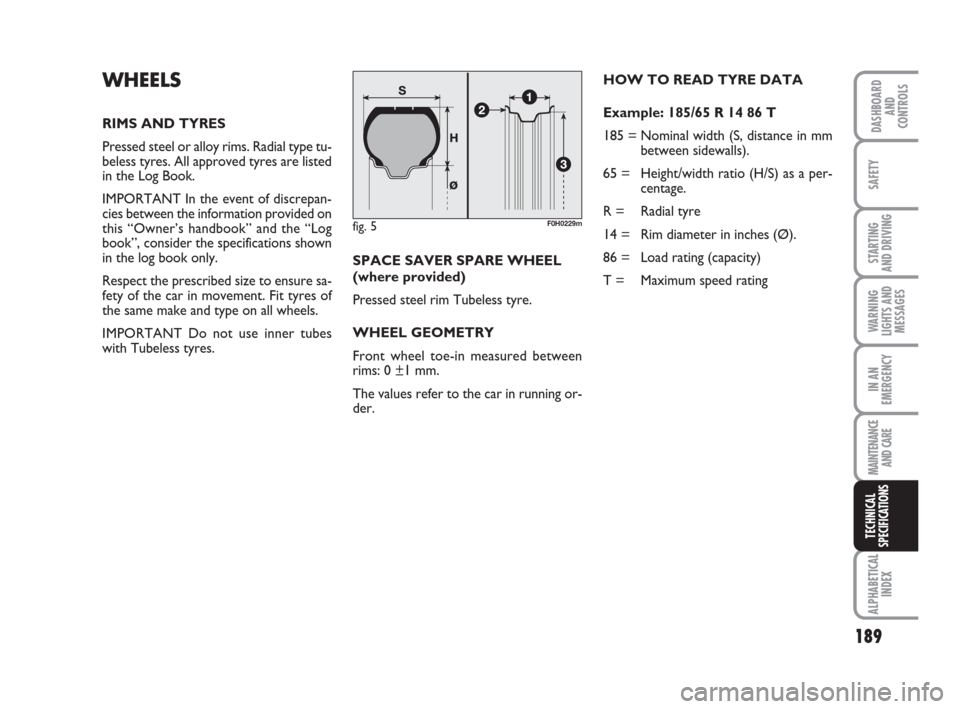
fig. 5F0H0229m
WHEELS
RIMS AND TYRES
Pressed steel or alloy rims. Radial type tu-
beless tyres. All approved tyres are listed
in the Log Book.
IMPORTANT In the event of discrepan-
cies between the information provided on
this “Owner’s handbook” and the “Log
book”, consider the specifications shown
in the log book only.
Respect the prescribed size to ensure sa-
fety of the car in movement. Fit tyres of
the same make and type on all wheels.
IMPORTANT Do not use inner tubes
with Tubeless tyres.HOW TO READ TYRE DATA
Example: 185/65 R 14 86 T
185 = Nominal width (S, distance in mm
between sidewalls).
65 = Height/width ratio (H/S) as a per-
centage.
R = Radial tyre
14 = Rim diameter in inches (Ø).
86 = Load rating (capacity)
T = Maximum speed rating SPACE SAVER SPARE WHEEL
(where provided)
Pressed steel rim Tubeless tyre.
WHEEL GEOMETRY
Front wheel toe-in measured between
rims: 0 ±1 mm.
The values refer to the car in running or-
der.
Page 191 of 210
190
STARTING
AND DRIVING
IN AN
EMERGENCY
MAINTENANCE
AND CARE
ALPHABETICAL
INDEX
DASHBOARD
AND
CONTROLS
SAFETY
WARNING
LIGHTS AND
MESSAGES
TECHNICAL
SPECIFICATIONS
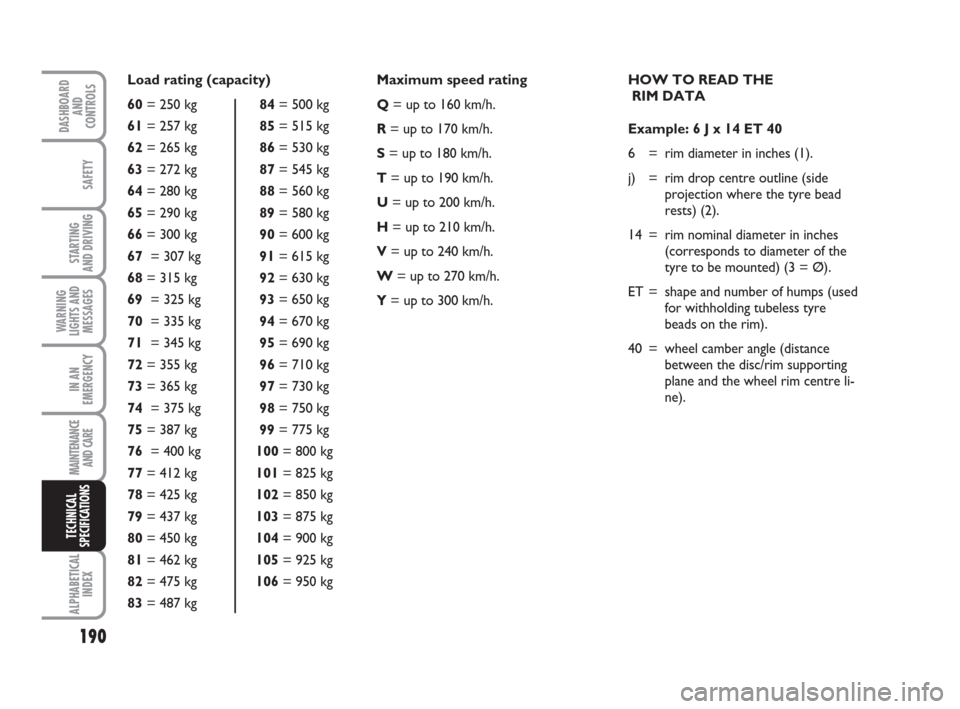
Maximum speed rating
Q= up to 160 km/h.
R= up to 170 km/h.
S= up to 180 km/h.
T= up to 190 km/h.
U= up to 200 km/h.
H= up to 210 km/h.
V= up to 240 km/h.
W= up to 270 km/h.
Y= up to 300 km/h.HOW TO READ THE
RIM DATA
Example: 6 J x 14 ET 40
6 = rim diameter in inches (1).
j) = rim drop centre outline (side
projection where the tyre bead
rests) (2).
14 = rim nominal diameter in inches
(corresponds to diameter of the
tyre to be mounted) (3 = Ø).
ET = shape and number of humps (used
for withholding tubeless tyre
beads on the rim).
40 = wheel camber angle (distance
between the disc/rim supporting
plane and the wheel rim centre li-
ne). Load rating (capacity)
60= 250 kg 84= 500 kg
61= 257 kg 85= 515 kg
62= 265 kg 86= 530 kg
63= 272 kg 87= 545 kg
64= 280 kg 88= 560 kg
65= 290 kg 89= 580 kg
66= 300 kg 90= 600 kg
67 = 307 kg 91= 615 kg
68= 315 kg 92= 630 kg
69 = 325 kg 93= 650 kg
70 = 335 kg 94= 670 kg
71 = 345 kg 95= 690 kg
72= 355 kg 96= 710 kg
73= 365 kg 97= 730 kg
74 = 375 kg 98= 750 kg
75= 387 kg 99= 775 kg
76 = 400 kg 100= 800 kg
77= 412 kg
101= 825 kg
78= 425 kg 102= 850 kg
79= 437 kg 103= 875 kg
80= 450 kg 104= 900 kg
81= 462 kg 105= 925 kg
82= 475 kg 106= 950 kg
83= 487 kg
Page 192 of 210
191
STARTING
AND DRIVING
IN AN
EMERGENCY
MAINTENANCE
AND CARE
ALPHABETICAL
INDEX
DASHBOARD
AND
CONTROLS
SAFETY
WARNING
LIGHTS AND
MESSAGES
TECHNICAL
SPECIFICATIONS
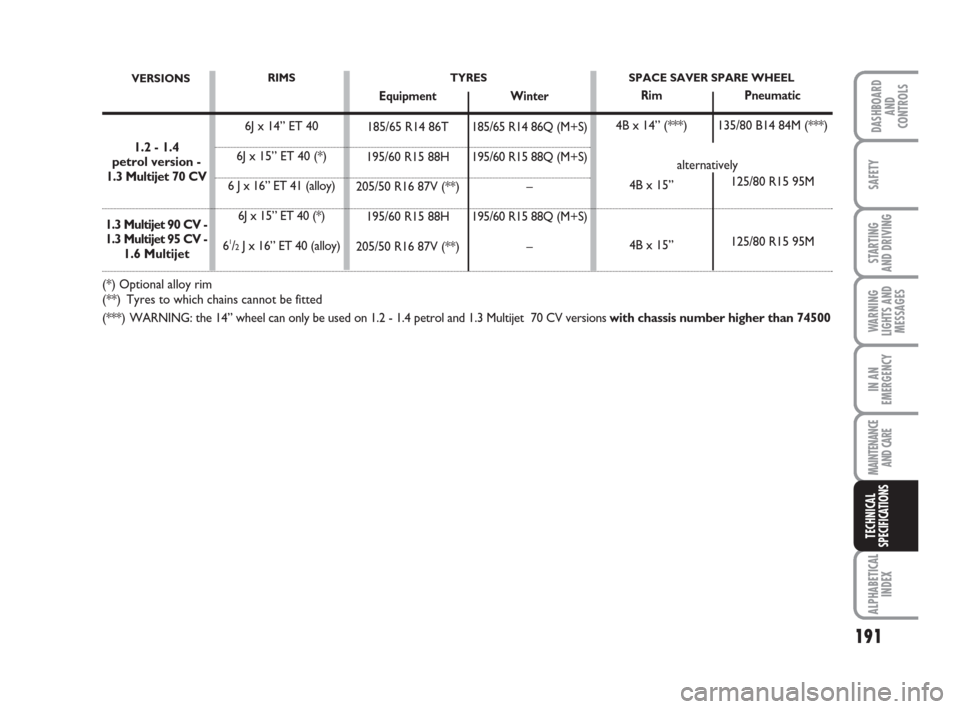
1.2 - 1.4
petrol version -
1.3 Multijet 70 CV
1.3 Multijet 90 CV -
1.3 Multijet 95 CV -
1.6 Multijet
(*) Optional alloy rim
(**) Tyres to which chains cannot be fitted
(***) WARNING: the 14” wheel can only be used on 1.2 - 1.4 petrol and 1.3 Multijet 70 CV versions with chassis number higher than 74500
RIMS
6J x 14” ET 40
6J x 15” ET 40 (*)
6 J x 16” ET 41 (alloy)
6J x 15” ET 40 (*)
6
1/2J x 16” ET 40 (alloy)
TYRES
Equipment
185/65 R14 86T
195/60 R15 88H
205/50 R16 87V (**)
195/60 R15 88H
205/50 R16 87V (**)
Winter
185/65 R14 86Q (M+S)
195/60 R15 88Q (M+S)
–
195/60 R15 88Q (M+S)
–
SPACE SAVER SPARE WHEEL
Rim
4B x 14” (***)
4B x 15”
4B x 15”
Pneumatic
135/80 B14 84M (***)
125/80 R15 95M
125/80 R15 95M
VERSIONS
alternatively
Page 193 of 210
192
STARTING
AND DRIVING
IN AN
EMERGENCY
MAINTENANCE
AND CARE
ALPHABETICAL
INDEX
DASHBOARD
AND
CONTROLS
SAFETY
WARNING
LIGHTS AND
MESSAGES
TECHNICAL
SPECIFICATIONS
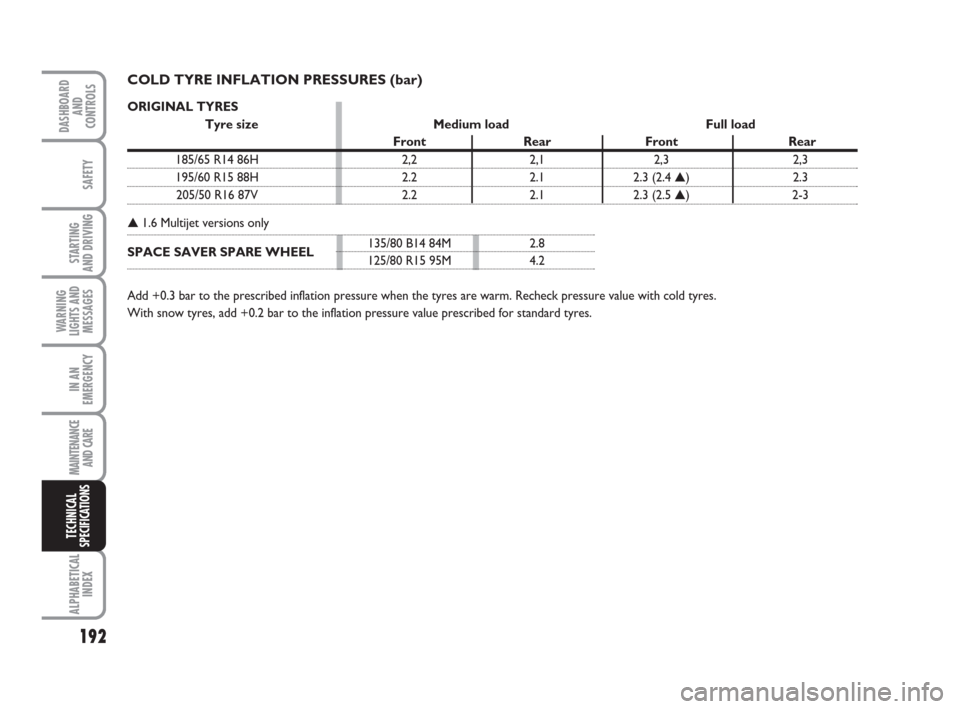
COLD TYRE INFLATION PRESSURES (bar)
ORIGINAL TYRES
Tyre size Medium load Full load
Front Rear Front Rear
185/65 R14 86H 2,2 2,1 2,3 2,3
195/60 R15 88H 2.2 2.1 2.3 (2.4 ▲) 2.3
205/50 R16 87V 2.2 2.1 2.3 (2.5 ▲) 2-3
▲1.6 Multijet versions only
SPACE SAVER SPARE WHEEL135/80 B14 84M 2.8125/80 R15 95M 4.2
Add +0.3 bar to the prescribed inflation pressure when the tyres are warm. Recheck pressure value with cold tyres.
With snow tyres, add +0.2 bar to the inflation pressure value prescribed for standard tyres.
Page 198 of 210
197
STARTING
AND DRIVING
IN AN
EMERGENCY
MAINTENANCE
AND CARE
ALPHABETICAL
INDEX
DASHBOARD
AND
CONTROLS
SAFETY
WARNING
LIGHTS AND
MESSAGES
TECHNICAL
SPECIFICATIONS
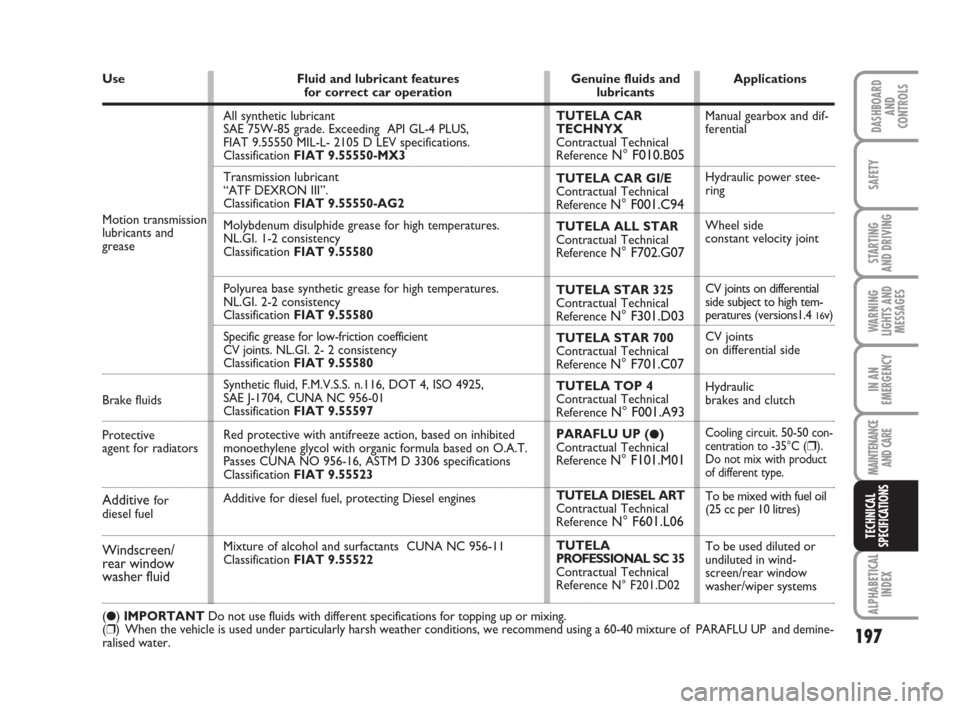
Use
Motion transmission
lubricants and
grease
Brake fluids
Protective
agent for radiators
Additive for
diesel fuel
Windscreen/
rear window
washer fluid
(●)IMPORTANT Do not use fluids with different specifications for topping up or mixing.
(❒) When the vehicle is used under particularly harsh weather conditions, we recommend using a 60-40 mixture of PARAFLU UP and demine-
ralised water.Fluid and lubricant features
for correct car operation
All synthetic lubricant
SAE 75W-85 grade. Exceeding API GL-4 PLUS,
FIAT 9.55550 MIL-L- 2105 D LEV specifications.
ClassificationFIAT 9.55550-MX3
Transmission lubricant
“ATF DEXRON III”.
ClassificationFIAT 9.55550-AG2
Molybdenum disulphide grease for high temperatures.
NL.GI. 1-2 consistency
ClassificationFIAT 9.55580
Polyurea base synthetic grease for high temperatures.
NL.GI. 2-2 consistency
ClassificationFIAT 9.55580
Specific grease for low-friction coefficient
CV joints. NL.GI. 2- 2 consistency
ClassificationFIAT 9.55580
Synthetic fluid, F.M.V.S.S. n.116, DOT 4, ISO 4925,
SAE J-1704, CUNA NC 956-01
Classification FIAT 9.55597
Red protective with antifreeze action, based on inhibited
monoethylene glycol with organic formula based on O.A.T.
Passes CUNA NO 956-16, ASTM D 3306 specifications
Classification FIAT 9.55523
Additive for diesel fuel, protecting Diesel engines
Mixture of alcohol and surfactants CUNA NC 956-11
Classification FIAT 9.55522Genuine fluids and
lubricants
TUTELA CAR
TECHNYX
Contractual Technical
Reference
N° F010.B05
TUTELA CAR GI/E
Contractual Technical
Reference
N° F001.C94
TUTELA ALL STAR
Contractual Technical
Reference
N° F702.G07
TUTELA STAR 325
Contractual Technical
Reference
N° F301.D03
TUTELA STAR 700
Contractual Technical
Reference
N° F701.C07
TUTELA TOP 4
Contractual Technical
Reference
N° F001.A93
PARAFLU UP (●)
Contractual Technical
Reference
N° F101.M01
TUTELA DIESEL ART
Contractual Technical
Reference
N° F601.L06
TUTELA
PROFESSIONAL SC 35
Contractual Technical
Reference N° F201.D02Applications
Manual gearbox and dif-
ferential
Hydraulic power stee-
ring
Wheel side
constant velocity joint
CV joints on differential
side subject to high tem-
peratures (versions1.4
16v)
CV joints
on differential side
Hydraulic
brakes and clutch
Cooling circuit. 50-50 con-
centration to -35°C (❒).
Do not mix with product
of different type.
To be mixed with fuel oil
(25 cc per 10 litres)
To be used diluted or
undiluted in wind-
screen/rear window
washer/wiper systems