air condition FIAT IDEA 2009 1.G Owners Manual
[x] Cancel search | Manufacturer: FIAT, Model Year: 2009, Model line: IDEA, Model: FIAT IDEA 2009 1.GPages: 210, PDF Size: 3.62 MB
Page 47 of 210
46
SAFETY
STARTING
AND DRIVING
WARNING
LIGHTS AND
MESSAGES
IN AN
EMERGENCY
MAINTENANCE
AND CARE
TECHNICAL
SPECIFICATIONS
ALPHABETICAL
INDEX
DASHBOARD
AND CONTROLS
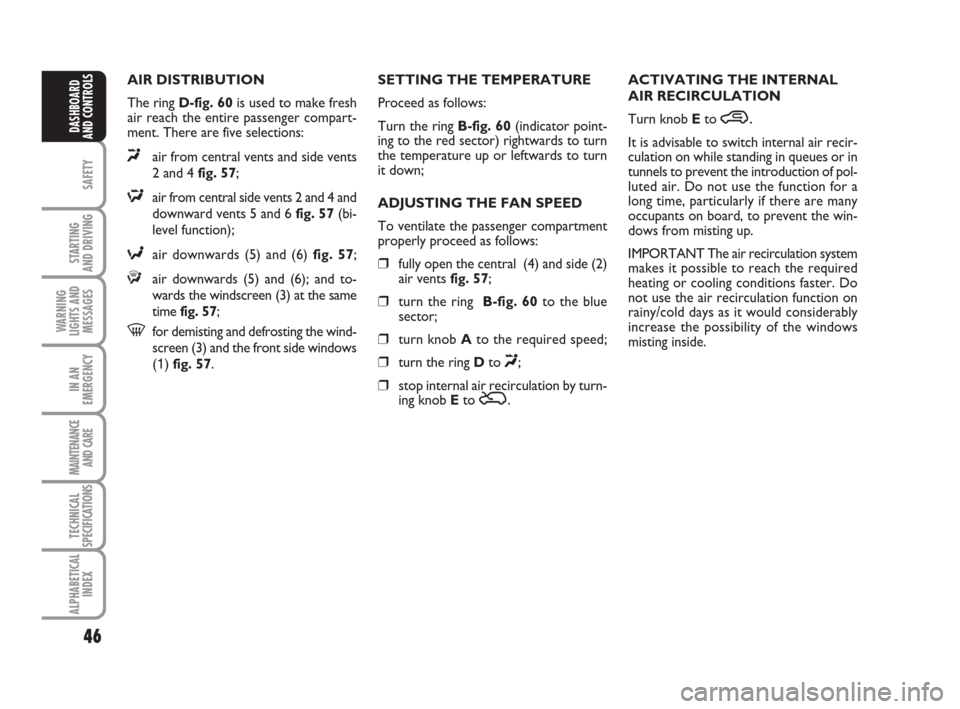
AIR DISTRIBUTION
The ring D-fig. 60is used to make fresh
air reach the entire passenger compart-
ment. There are five selections:
«air from central vents and side vents
2 and 4 fig. 57;
Δair from central side vents 2 and 4 and
downward vents 5 and 6 fig. 57 (bi-
level function);
≈air downwards (5) and (6) fig. 57;
ƒair downwards (5) and (6); and to-
wards the windscreen (3) at the same
time fig. 57;
-for demisting and defrosting the wind-
screen (3) and the front side windows
(1) fig. 57.SETTING THE TEMPERATURE
Proceed as follows:
Turn the ring B-fig. 60(indicator point-
ing to the red sector) rightwards to turn
the temperature up or leftwards to turn
it down;
ADJUSTING THE FAN SPEED
To ventilate the passenger compartment
properly proceed as follows:
❒fully open the central (4) and side (2)
air vents fig. 57;
❒turn the ring B-fig. 60to the blue
sector;
❒turn knob Ato the required speed;
❒turn the ring Dto «;
❒stop internal air recirculation by turn-
ing knob E to Ú.ACTIVATING THE INTERNAL
AIR RECIRCULATION
Turn knob Eto
….
It is advisable to switch internal air recir-
culation on while standing in queues or in
tunnels to prevent the introduction of pol-
luted air. Do not use the function for a
long time, particularly if there are many
occupants on board, to prevent the win-
dows from misting up.
IMPORTANT The air recirculation system
makes it possible to reach the required
heating or cooling conditions faster. Do
not use the air recirculation function on
rainy/cold days as it would considerably
increase the possibility of the windows
misting inside.
Page 50 of 210
49
SAFETY
STARTING
AND DRIVING
WARNING
LIGHTS AND
MESSAGES
IN AN
EMERGENCY
MAINTENANCE
AND CARE
TECHNICAL
SPECIFICATIONS
ALPHABETICAL
INDEX
DASHBOARD
AND CONTROLS
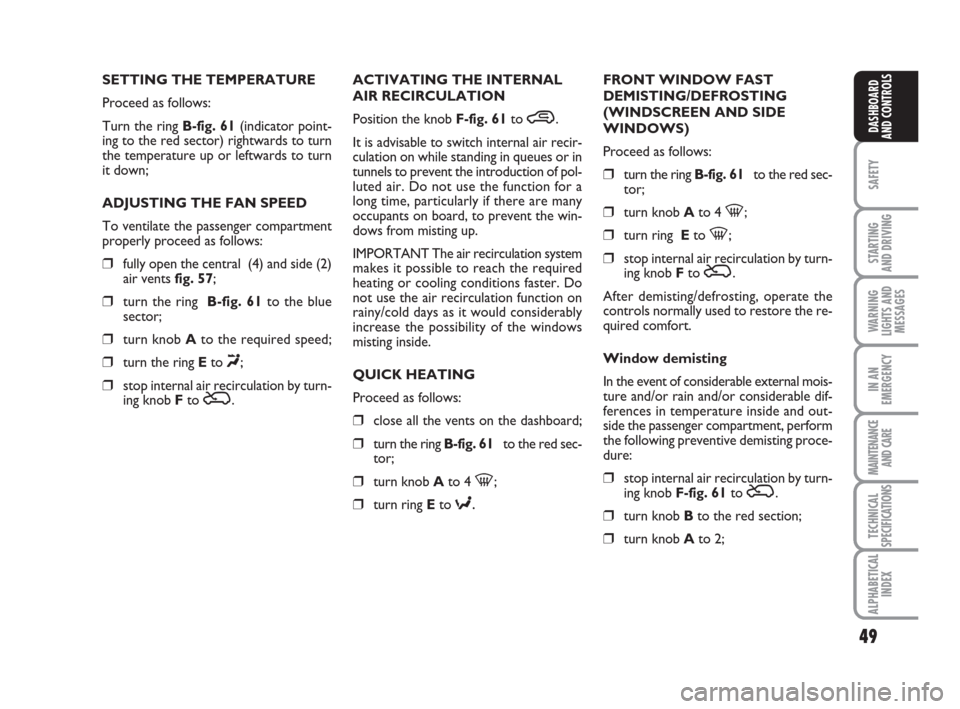
SETTING THE TEMPERATURE
Proceed as follows:
Turn the ring B-fig. 61(indicator point-
ing to the red sector) rightwards to turn
the temperature up or leftwards to turn
it down;
ADJUSTING THE FAN SPEED
To ventilate the passenger compartment
properly proceed as follows:
❒fully open the central (4) and side (2)
air vents fig. 57;
❒turn the ring B-fig. 61to the blue
sector;
❒turn knob Ato the required speed;
❒turn the ring Eto «;
❒stop internal air recirculation by turn-
ing knob Fto Ú.ACTIVATING THE INTERNAL
AIR RECIRCULATION
Position the knob F-fig. 61to
….
It is advisable to switch internal air recir-
culation on while standing in queues or in
tunnels to prevent the introduction of pol-
luted air. Do not use the function for a
long time, particularly if there are many
occupants on board, to prevent the win-
dows from misting up.
IMPORTANT The air recirculation system
makes it possible to reach the required
heating or cooling conditions faster. Do
not use the air recirculation function on
rainy/cold days as it would considerably
increase the possibility of the windows
misting inside.
QUICK HEATING
Proceed as follows:
❒close all the vents on the dashboard;
❒turn the ring B-fig. 61to the red sec-
tor;
❒turn knob Ato 4 -;
❒turn ring Eto ≈.
FRONT WINDOW FAST
DEMISTING/DEFROSTING
(WINDSCREEN AND SIDE
WINDOWS)
Proceed as follows:
❒turn the ring B-fig. 61to the red sec-
tor;
❒turn knob Ato 4 -;
❒turn ring Eto -;
❒stop internal air recirculation by turn-
ing knob Fto Ú.
After demisting/defrosting, operate the
controls normally used to restore the re-
quired comfort.
Window demisting
In the event of considerable external mois-
ture and/or rain and/or considerable dif-
ferences in temperature inside and out-
side the passenger compartment, perform
the following preventive demisting proce-
dure:
❒stop internal air recirculation by turn-
ing knob F-fig. 61to Ú.
❒turn knob Bto the red section;
❒turn knob Ato 2;
Page 51 of 210
50
SAFETY
STARTING
AND DRIVING
WARNING
LIGHTS AND
MESSAGES
IN AN
EMERGENCY
MAINTENANCE
AND CARE
TECHNICAL
SPECIFICATIONS
ALPHABETICAL
INDEX
DASHBOARD
AND CONTROLS
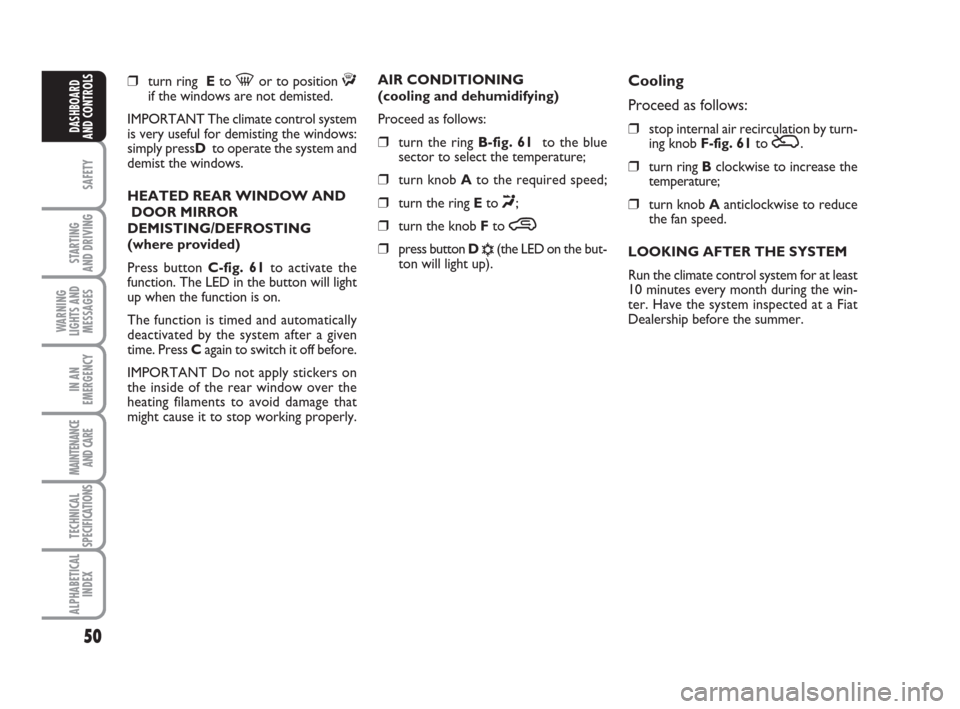
❒turn ring Eto -or to position ƒif the windows are not demisted.
IMPORTANT The climate control system
is very useful for demisting the windows:
simply pressDto operate the system and
demist the windows.
HEATED REAR WINDOW AND
DOOR MIRROR
DEMISTING/DEFROSTING
(where provided)
Press button C-fig. 61to activate the
function. The LED in the button will light
up when the function is on.
The function is timed and automatically
deactivated by the system after a given
time. Press Cagain to switch it off before.
IMPORTANT Do not apply stickers on
the inside of the rear window over the
heating filaments to avoid damage that
might cause it to stop working properly.AIR CONDITIONING
(cooling and dehumidifying)
Proceed as follows:
❒turn the ring B-fig. 61to the blue
sector to select the temperature;
❒turn knob Ato the required speed;
❒turn the ring Eto «;
❒turn the knob Fto …
❒press button D√(the LED on the but-
ton will light up).
Cooling
Proceed as follows:
❒stop internal air recirculation by turn-
ing knob F-fig. 61to
Ú.
❒turn ring Bclockwise to increase the
temperature;
❒turn knob Aanticlockwise to reduce
the fan speed.
LOOKING AFTER THE SYSTEM
Run the climate control system for at least
10 minutes every month during the win-
ter. Have the system inspected at a Fiat
Dealership before the summer.
Page 52 of 210
51
SAFETY
STARTING
AND DRIVING
WARNING
LIGHTS AND
MESSAGES
IN AN
EMERGENCY
MAINTENANCE
AND CARE
TECHNICAL
SPECIFICATIONS
ALPHABETICAL
INDEX
DASHBOARD
AND CONTROLS
AUTOMATIC TWO-
ZONE CLIMATE
CONTROL SYSTEM
(where provided)
GENERAL INFORMATION
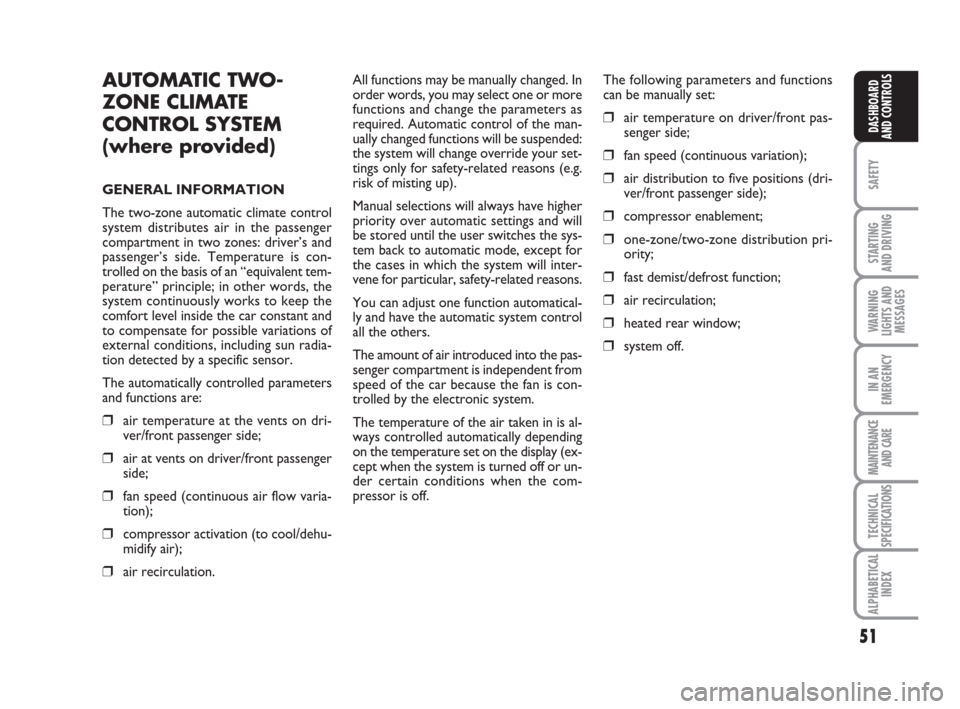
The two-zone automatic climate control
system distributes air in the passenger
compartment in two zones: driver’s and
passenger’s side. Temperature is con-
trolled on the basis of an “equivalent tem-
perature” principle; in other words, the
system continuously works to keep the
comfort level inside the car constant and
to compensate for possible variations of
external conditions, including sun radia-
tion detected by a specific sensor.
The automatically controlled parameters
and functions are:
❒air temperature at the vents on dri-
ver/front passenger side;
❒air at vents on driver/front passenger
side;
❒fan speed (continuous air flow varia-
tion);
❒compressor activation (to cool/dehu-
midify air);
❒air recirculation.All functions may be manually changed. In
order words, you may select one or more
functions and change the parameters as
required. Automatic control of the man-
ually changed functions will be suspended:
the system will change override your set-
tings only for safety-related reasons (e.g.
risk of misting up).
Manual selections will always have higher
priority over automatic settings and will
be stored until the user switches the sys-
tem back to automatic mode, except for
the cases in which the system will inter-
vene for particular, safety-related reasons.
You can adjust one function automatical-
ly and have the automatic system control
all the others.
The amount of air introduced into the pas-
senger compartment is independent from
speed of the car because the fan is con-
trolled by the electronic system.
The temperature of the air taken in is al-
ways controlled automatically depending
on the temperature set on the display (ex-
cept when the system is turned off or un-
der certain conditions when the com-
pressor is off. The following parameters and functions
can be manually set:
❒air temperature on driver/front pas-
senger side;
❒fan speed (continuous variation);
❒air distribution to five positions (dri-
ver/front passenger side);
❒compressor enablement;
❒one-zone/two-zone distribution pri-
ority;
❒fast demist/defrost function;
❒air recirculation;
❒heated rear window;
❒system off.
Page 55 of 210
54
SAFETY
STARTING
AND DRIVING
WARNING
LIGHTS AND
MESSAGES
IN AN
EMERGENCY
MAINTENANCE
AND CARE
TECHNICAL
SPECIFICATIONS
ALPHABETICAL
INDEX
DASHBOARD
AND CONTROLS
maximum coolant temperature while air
and fan speed distribution are managed
by the system according to conditions.
Specifically, if the heating fluid is not
warm enough, the fan will not start up at
the maximum speed immediately to limit
introducing excessively cool air into the
passenger compartment.
All manual settings will be allowed when
this function is on.
To switch the function off, simply turn
the temperature knob anticlockwise and
set the required temperature.
❒LOfunction (maximum cooling):
select by turning the temperature knob
anticlockwise beyond the minimum
value (16 °C). It can be operated from
either by the driver or by the front pas-
senger (by selecting the MONOfunc-
tion).
This function may be used to cool down
the passenger compartment as fast as
possible and exploit the system potential
to the maximum. The function activates
air recirculation and the climate control
compressor, air distribution and fan
speed are managed by the system
according to environmental conditions. All manual settings will be allowed when
this function is on.
To switch the function off, simply turn
the temperature knob clockwise and set
the required temperature.
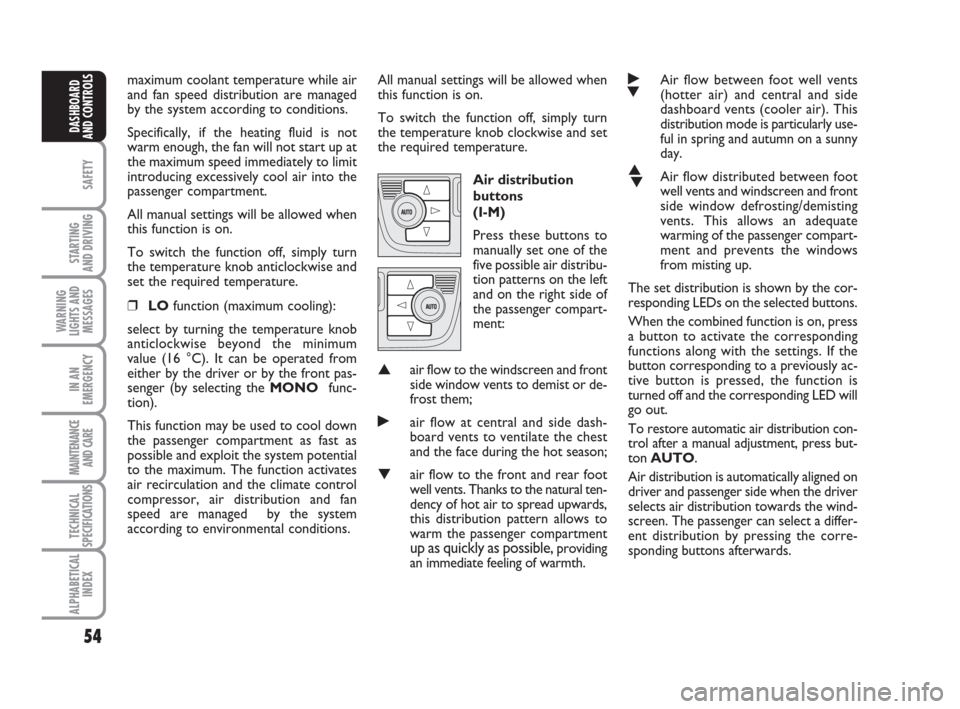
Air distribution
buttons
(I-M)
Press these buttons to
manually set one of the
five possible air distribu-
tion patterns on the left
and on the right side of
the passenger compart-
ment:
▲air flow to the windscreen and front
side window vents to demist or de-
frost them;
˙air flow at central and side dash-
board vents to ventilate the chest
and the face during the hot season;
▼air flow to the front and rear foot
well vents. Thanks to the natural ten-
dency of hot air to spread upwards,
this distribution pattern allows to
warm the passenger compartment
up as quickly as possible, providing
an immediate feeling of warmth.
˙
▼Air flow between foot well vents
(hotter air) and central and side
dashboard vents (cooler air). This
distribution mode is particularly use-
ful in spring and autumn on a sunny
day.
▲
▼Air flow distributed between foot
well vents and windscreen and front
side window defrosting/demisting
vents. This allows an adequate
warming of the passenger compart-
ment and prevents the windows
from misting up.
The set distribution is shown by the cor-
responding LEDs on the selected buttons.
When the combined function is on, press
a button to activate the corresponding
functions along with the settings. If the
button corresponding to a previously ac-
tive button is pressed, the function is
turned off and the corresponding LED will
go out.
To restore automatic air distribution con-
trol after a manual adjustment, press but-
ton AUTO.
Air distribution is automatically aligned on
driver and passenger side when the driver
selects air distribution towards the wind-
screen. The passenger can select a differ-
ent distribution by pressing the corre-
sponding buttons afterwards.
Page 56 of 210
55
SAFETY
STARTING
AND DRIVING
WARNING
LIGHTS AND
MESSAGES
IN AN
EMERGENCY
MAINTENANCE
AND CARE
TECHNICAL
SPECIFICATIONS
ALPHABETICAL
INDEX
DASHBOARD
AND CONTROLS
Fan speed
adjustment buttons
(L)
Press button pto
increase or to decrease
the fan speed and
therefore the amount of air admitted
into the passenger compartment,
although keeping the required tempera-
ture set.
The fan speed is shown by the lit bars on
the display:
❒Max. fan speed = all bars lit;
❒min fan speed = one bar lit.
The fan can be cut off only if the climate
control compressor has been switched
off pressing button B.
IMPORTANT To restore automatic fan
speed control after a manual adjustment,
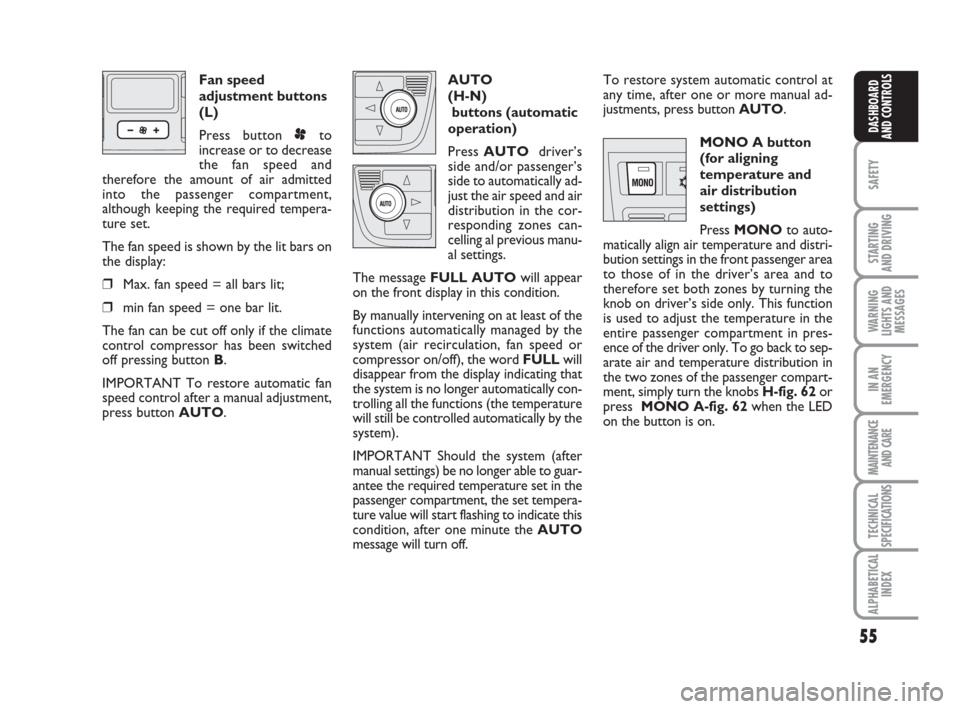
press button AUTO.AUTO
(H-N)
buttons (automatic
operation)
Press AUTOdriver’s
side and/or passenger’s
side to automatically ad-
just the air speed and air
distribution in the cor-
responding zones can-
celling al previous manu-
al settings.
The message FULL AUTOwill appear
on the front display in this condition.
By manually intervening on at least of the
functions automatically managed by the
system (air recirculation, fan speed or
compressor on/off), the word FULL will
disappear from the display indicating that
the system is no longer automatically con-
trolling all the functions (the temperature
will still be controlled automatically by the
system).
IMPORTANT Should the system (after
manual settings) be no longer able to guar-
antee the required temperature set in the
passenger compartment, the set tempera-
ture value will start flashing to indicate this
condition, after one minute the AUTO
message will turn off.To restore system automatic control at
any time, after one or more manual ad-
justments, press button AUTO.
MONO A button
(for aligning
temperature and
air distribution
settings)
Press MONOto auto-
matically align air temperature and distri-
bution settings in the front passenger area
to those of in the driver’s area and to
therefore set both zones by turning the
knob on driver’s side only. This function
is used to adjust the temperature in the
entire passenger compartment in pres-
ence of the driver only. To go back to sep-
arate air and temperature distribution in
the two zones of the passenger compart-
ment, simply turn the knobs H-fig. 62or
press MONO A-fig. 62when the LED
on the button is on.
Page 57 of 210
56
SAFETY
STARTING
AND DRIVING
WARNING
LIGHTS AND
MESSAGES
IN AN
EMERGENCY
MAINTENANCE
AND CARE
TECHNICAL
SPECIFICATIONS
ALPHABETICAL
INDEX
DASHBOARD
AND CONTROLS
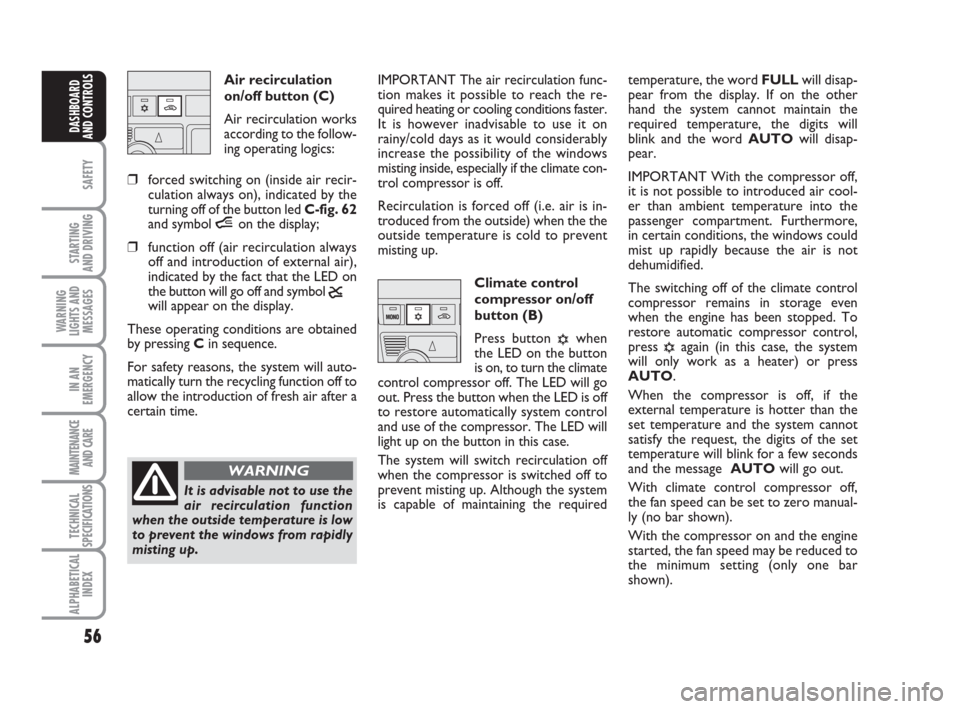
Air recirculation
on/off button (C)
Air recirculation works
according to the follow-
ing operating logics:
❒forced switching on (inside air recir-
culation always on), indicated by the
turning off of the button led C-fig. 62
and symbol íon the display;
❒function off (air recirculation always
off and introduction of external air),
indicated by the fact that the LED on
the button will go off and symbol
ê
will appear on the display.
These operating conditions are obtained
by pressing Cin sequence.
For safety reasons, the system will auto-
matically turn the recycling function off to
allow the introduction of fresh air after a
certain time.IMPORTANT The air recirculation func-
tion makes it possible to reach the re-
quired heating or cooling conditions faster.
It is however inadvisable to use it on
rainy/cold days as it would considerably
increase the possibility of the windows
misting inside, especially if the climate con-
trol compressor is off.
Recirculation is forced off (i.e. air is in-
troduced from the outside) when the the
outside temperature is cold to prevent
misting up.
Climate control
compressor on/off
button (B)
Press button
√when
the LED on the button
is on, to turn the climate
control compressor off. The LED will go
out. Press the button when the LED is off
to restore automatically system control
and use of the compressor. The LED will
light up on the button in this case.
The system will switch recirculation off
when the compressor is switched off to
prevent misting up. Although the system
is capable of maintaining the requiredtemperature, the word FULLwill disap-
pear from the display. If on the other
hand the system cannot maintain the
required temperature, the digits will
blink and the word AUTOwill disap-
pear.
IMPORTANT With the compressor off,
it is not possible to introduced air cool-
er than ambient temperature into the
passenger compartment. Furthermore,
in certain conditions, the windows could
mist up rapidly because the air is not
dehumidified.
The switching off of the climate control
compressor remains in storage even
when the engine has been stopped. To
restore automatic compressor control,
press √again (in this case, the system
will only work as a heater) or press
AUTO.
When the compressor is off, if the
external temperature is hotter than the
set temperature and the system cannot
satisfy the request, the digits of the set
temperature will blink for a few seconds
and the message AUTOwill go out.
With climate control compressor off,
the fan speed can be set to zero manual-
ly (no bar shown).
With the compressor on and the engine
started, the fan speed may be reduced to
the minimum setting (only one bar
shown).
It is advisable not to use the
air recirculation function
when the outside temperature is low
to prevent the windows from rapidly
misting up.
WARNING
Page 58 of 210
57
SAFETY
STARTING
AND DRIVING
WARNING
LIGHTS AND
MESSAGES
IN AN
EMERGENCY
MAINTENANCE
AND CARE
TECHNICAL
SPECIFICATIONS
ALPHABETICAL
INDEX
DASHBOARD
AND CONTROLS
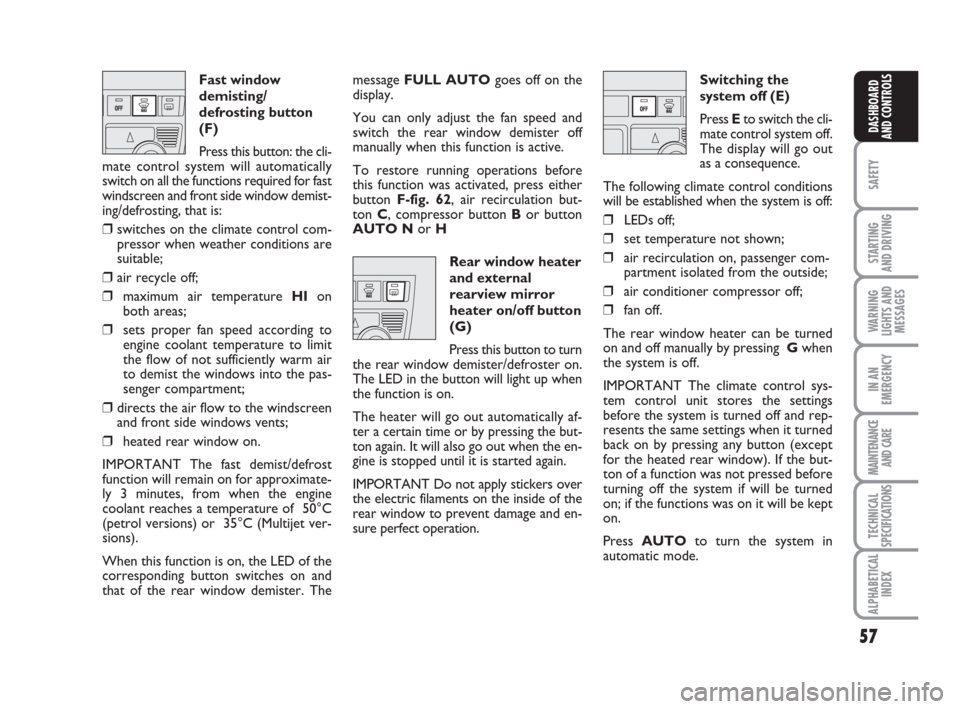
Fast window
demisting/
defrosting button
(F)
Press this button: the cli-
mate control system will automatically
switch on all the functions required for fast
windscreen and front side window demist-
ing/defrosting, that is:
❒switches on the climate control com-
pressor when weather conditions are
suitable;
❒air recycle off;
❒maximum air temperature HIon
both areas;
❒sets proper fan speed according to
engine coolant temperature to limit
the flow of not sufficiently warm air
to demist the windows into the pas-
senger compartment;
❒directs the air flow to the windscreen
and front side windows vents;
❒heated rear window on.
IMPORTANT The fast demist/defrost
function will remain on for approximate-
ly 3 minutes, from when the engine
coolant reaches a temperature of 50°C
(petrol versions) or 35°C (Multijet ver-
sions).
When this function is on, the LED of the
corresponding button switches on and
that of the rear window demister. Themessage FULL AUTOgoes off on the
display.
You can only adjust the fan speed and
switch the rear window demister off
manually when this function is active.
To restore running operations before
this function was activated, press either
button F-fig. 62, air recirculation but-
ton C, compressor button Bor button
AUTO Nor H
Rear window heater
and external
rearview mirror
heater on/off button
(G)
Press this button to turn
the rear window demister/defroster on.
The LED in the button will light up when
the function is on.
The heater will go out automatically af-
ter a certain time or by pressing the but-
ton again. It will also go out when the en-
gine is stopped until it is started again.
IMPORTANT Do not apply stickers over
the electric filaments on the inside of the
rear window to prevent damage and en-
sure perfect operation.Switching the
system off (E)
Press Eto switch the cli-
mate control system off.
The display will go out
as a consequence.
The following climate control conditions
will be established when the system is off:
❒LEDs off;
❒set temperature not shown;
❒air recirculation on, passenger com-
partment isolated from the outside;
❒air conditioner compressor off;
❒fan off.
The rear window heater can be turned
on and off manually by pressing Gwhen
the system is off.
IMPORTANT The climate control sys-
tem control unit stores the settings
before the system is turned off and rep-
resents the same settings when it turned
back on by pressing any button (except
for the heated rear window). If the but-
ton of a function was not pressed before
turning off the system if will be turned
on; if the functions was on it will be kept
on.
Press AUTOto turn the system in
automatic mode.
Page 93 of 210
92
SAFETY
STARTING
AND DRIVING
WARNING
LIGHTS AND
MESSAGES
IN AN
EMERGENCY
MAINTENANCE
AND CARE
TECHNICAL
SPECIFICATIONS
ALPHABETICAL
INDEX
DASHBOARD
AND CONTROLS
PROTECTING THE
ENVIRONMENT
The devices for curtailing petrol engine
emissions are the following:
❒three-way catalytic converter;
❒Lambda sensor;
❒fuel evaporation system.
In addition, do not let the engine run, even
for a test, with one or more spark plugs
disconnected.
The devices for reducing diesel fuel engine
emissions are the following:
❒oxidising catalytic converter;
❒exhaust gas recirculation system
(E.G.R.);
❒diesel particulate filter (DPF)DPF (DIESEL
PARTICULATE FILTER)
(for 1.3 Multijet 90 HP - 1.3
Multijet 95 HP versions)
The Diesel Particulate Filter is a mechan-
ical filter, integral with the exhaust system,
that physically traps particulates present
in the exhaust gases of Diesel engines. The
diesel particular filter has been adopted to
eliminate almost totally particulates in
compliance with current / future law reg-
ulations.
During normal use of the vehicle, the en-
gine control unit records a set of data (e.g.:
travel time, type of route, temperatures,
etc.) and it will then calculate how much
particulates has been trapped by the filter.
Since this filter physically traps particulate,
it should be regenerated (cleaned) at reg-
ular intervals by burning carbon particles.
The regeneration procedure is controlled
automatically by the engine management
control unit according to the filter condi-
tions and vehicle use conditions.
The catalytic converter de-
velops high temperature dur-
ing operation. Do not park
on grass, dry leaves, pine needles or
other flammable material: fire risk.
WARNING
During the regeneration procedure, the
following situations may occur: limited in-
crease of idle speed, activation of electric
fan, limited increase of smoke, high tem-
peratures at the exhaust.
These are not faults; they do not impair
vehicle performance or damage the envi-
ronment. If the dedicated message is dis-
played, refer to section “Warning lights
and messages”.
Page 100 of 210
99
STARTING
AND DRIVING
WARNING
LIGHTS AND
MESSAGES
IN AN
EMERGENCY
MAINTENANCE
AND CARE
TECHNICAL
SPECIFICATIONS
ALPHABETICAL
INDEX
DASHBOARD
AND
CONTROLS
SAFETY
HOW TO KEEP THE
SEAT BELTS ALWAYS IN
EFFICIENT CONDITIONS
❒always use the belt with the tap taut
and never twisted; make sure that it is
free to run without impediments;
❒Replace the belt after a serious acci-
dent even if it does not appear dama-
ged. Always replace the belt if the pre-
tensioners where deployed.
❒To clean the belt, wash by hand with
water and mild soap, rinse and leave
to dry in the shade. Do not use strong
detergents, bleach, paints or any other
substance which could damage the belt
fibres;
❒Keep the reels dry: correct operation
may only be ensured if the reels are
dry.
❒replace the seat belt when showing si-
gnificant wear or cut signs.
CARRYING CHILDREN
SAFELY
For optimum protection in the event of
a crash, all passengers must be seated and
wearing adequate restraint systems.
This is even more important for children.
This prescription is compulsory in all EC
countries according to EC Directive
2003/20/EC.
A child’s head is larger and heavier in pro-
portion to its body and the child’s mu-
scular and bone structures are not fully
developed. For this reason, they require
restraint systems which are different from
those used by adults to protect them in
the event of an accident. The research re-
sults in relation to the best protection for
children is illustrated in European Regu-
lation EEC-R44 which divides the restraint
systems into five groups in addition to
making their use compulsory:
Group 0 - up to 10 kg of weight
Group 0+ - up to 13 kg of weight
Group 1 9-18 kg of weight
Group 2 15-25 kg of weight
Group 3 22-36 kg of weightAs it may be noted, the groups overlap
partly and in fact, in commerce it is pos-
sible to find devices that cover more than
one weight group.
All child restraint devices must bear the
certification data, together with the con-
trol brand, on a solidly fixed label which
must absolutely never be removed.
When over 1.50 m in height, from the
point of view of restraint systems, children
are considered as adults and have to wear
the standard seat belts.
Lineaccessori Fiat includes child restraint
systems for each weight group. These de-
vices are recommended having been spe-
cifically designed for Fiat cars.
Do not place a cradle seat
facing backwards on the
front seat if the passenger side airbag
is on. Deployment of the airbag in an
accident could cause fatal injuries to
the baby regardless of the severity of
the collision. It is advisable to carry
children in an appropriate restraint
system on the rear seat which is the
most protected position in the event
of an accident.
WARNING