belt FIAT IDEA 2012 1.G User Guide
[x] Cancel search | Manufacturer: FIAT, Model Year: 2012, Model line: IDEA, Model: FIAT IDEA 2012 1.GPages: 210, PDF Size: 3.65 MB
Page 97 of 210
96
CORRECT USE
OF THE CAR
WARNING
LIGHTS AND
MESSAGES
IN AN
EMERGENCY
CAR
MAINTENANCE
TECHNICAL
SPECIFICATIONS
INDEX
DASHBOARD
AND CONTROL
SAFETY
DEVICES
fig. 5F0H0311m
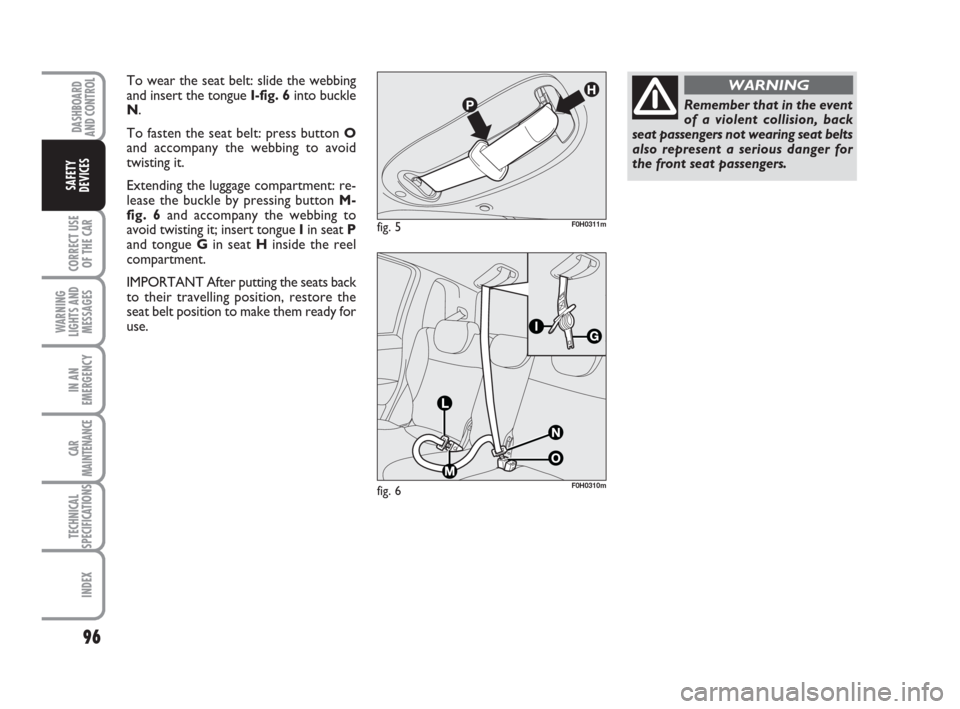
To wear the seat belt: slide the webbing
and insert the tongue I-fig. 6into buckle
N.
To fasten the seat belt: press button O
and accompany the webbing to avoid
twisting it.
Extending the luggage compartment: re-
lease the buckle by pressing button M-
fig. 6and accompany the webbing to
avoid twisting it; insert tongue Iin seat P
and tongue Gin seat Hinside the reel
compartment.
IMPORTANT After putting the seats back
to their travelling position, restore the
seat belt position to make them ready for
use.
fig. 6F0H0310m
Remember that in the event
of a violent collision, back
seat passengers not wearing seat belts
also represent a serious danger for
the front seat passengers.
WARNING
093-110 idea GB 1 ed 10-07-2008 8:28 Pagina 96
Page 98 of 210
97
CORRECT USE
OF THE CAR
WARNING
LIGHTS AND
MESSAGES
IN AN
EMERGENCY
CAR
MAINTENANCE
TECHNICAL
SPECIFICATIONS
INDEX
DASHBOARD
AND CONTROLS
SAFETY
DEVICES
PRETENSIONERS
To increase the efficiency of the seat belts,
the vehicle is fitted with pretensioners.
These devices, in the event of a violent
crash, rewind the seat belts a few cen-
timetres. In this way they ensure that the
seat belt adheres perfectly to the wearer
before the restraining action begins.
The seat belt locks to indicate that the de-
vice has intervened; the seat belt cannot
be drawn back up even when guiding it
manually.
IMPORTANT To obtain the highest de-
gree of protection from the action of the
pretensioning device, wear the seat belt
keeping it firmly close to the chest and
pelvis.
A small amount of smoke may be pro-
duced. This smoke is in no way toxic and
presents no fire hazard.
The pretensioner does not require any
maintenance or greasing.
Anything that modifies its original condi-
tions invalidates its efficiency.
If due to unusual natural events (floods,
sea storm, etc.) the device has been af-
fected by water and mud, it must neces-
sarily be replaced.LOAD LIMITERS
To increase passenger’s safety, the front
seat belt reels contain a load limiter which
allows controlled sag in such a way as to
dose the force acting on the chest and
shoulders during the belt restraining ac-
tion in case of front crash.
GENERAL INSTRUCTIONS
FOR USING THE SEAT BELTS
The driver must comply with (and have
the vehicle occupants follow) all the local
legal regulations concerning the use of seat
belts. Always fasten the seat belts before
starting.
Seat belts are also to be worn by expec-
tant mothers: the risk of injury in the case
of accident is greatly reduced for them and
the unborn child if they are wearing a seat
belt.The pretensioner can only
be used once. After a colli-
sion that has triggered it, have it re-
placed at a Fiat Dealership. Preten-
sioner validity is written on the plate
set on the upper oddment compart-
ment on passenger side. Pretension-
ers should be replaced at Fiat Deal-
ership as this date approaches.
WARNING
Operations which lead to
knocks, vibrations or localised
heating (over 100°C for a
maximum of 6 hours) in the
area around the pretensioners may
cause damage or trigger them. These
devices are not affected by vibrations
caused by irregularities of the road sur-
face or low obstacles such as kerbs, etc.
Contact a Fiat Dealership for any as-
sistance.
093-110 idea GB 1 ed 10-07-2008 8:28 Pagina 97
Page 99 of 210
98
CORRECT USE
OF THE CAR
WARNING
LIGHTS AND
MESSAGES
IN AN
EMERGENCY
CAR
MAINTENANCE
TECHNICAL
SPECIFICATIONS
INDEX
DASHBOARD
AND CONTROL
SAFETY
DEVICES
fig. 7F0H0133mfig. 8F0H0134mfig. 9F0H0135m
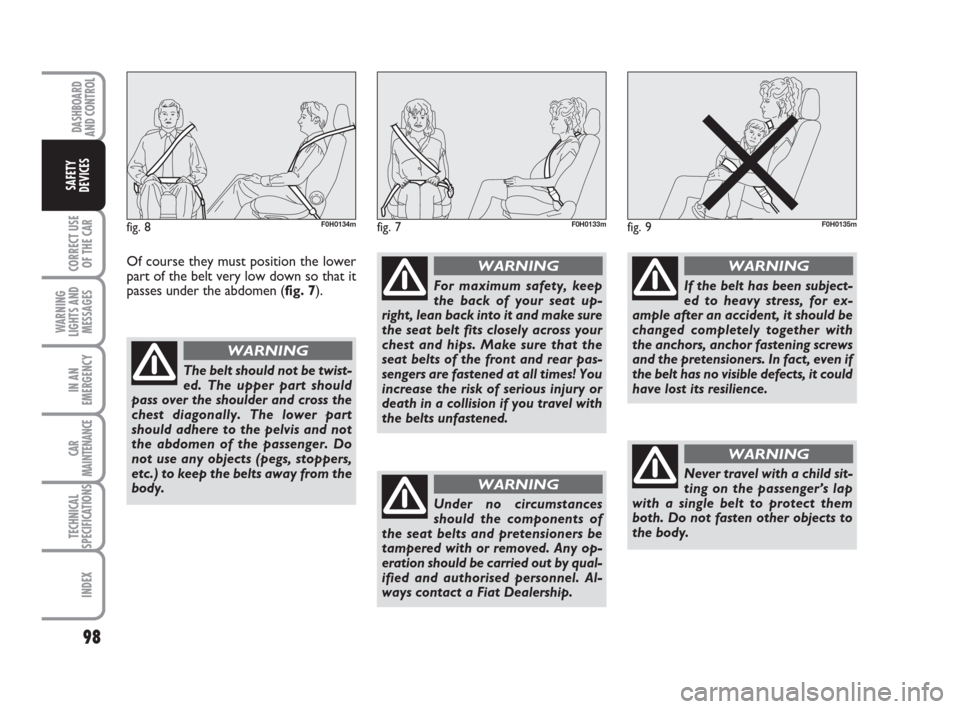
The belt should not be twist-
ed. The upper part should
pass over the shoulder and cross the
chest diagonally. The lower part
should adhere to the pelvis and not
the abdomen of the passenger. Do
not use any objects (pegs, stoppers,
etc.) to keep the belts away from the
body.
WARNING
For maximum safety, keep
the back of your seat up-
right, lean back into it and make sure
the seat belt fits closely across your
chest and hips. Make sure that the
seat belts of the front and rear pas-
sengers are fastened at all times! You
increase the risk of serious injury or
death in a collision if you travel with
the belts unfastened.
WARNING
Under no circumstances
should the components of
the seat belts and pretensioners be
tampered with or removed. Any op-
eration should be carried out by qual-
ified and authorised personnel. Al-
ways contact a Fiat Dealership.
WARNING
If the belt has been subject-
ed to heavy stress, for ex-
ample after an accident, it should be
changed completely together with
the anchors, anchor fastening screws
and the pretensioners. In fact, even if
the belt has no visible defects, it could
have lost its resilience.
WARNING
Never travel with a child sit-
ting on the passenger’s lap
with a single belt to protect them
both. Do not fasten other objects to
the body.
WARNING
Of course they must position the lower
part of the belt very low down so that it
passes under the abdomen (fig. 7).
093-110 idea GB 1 ed 10-07-2008 8:28 Pagina 98
Page 100 of 210
99
CORRECT USE
OF THE CAR
WARNING
LIGHTS AND
MESSAGES
IN AN
EMERGENCY
CAR
MAINTENANCE
TECHNICAL
SPECIFICATIONS
INDEX
DASHBOARD
AND CONTROLS
SAFETY
DEVICES
HOW TO KEEP
THE SEAT BELTS ALWAYS
IN EFFICIENT CONDITIONS
❒Always use the belt with the tape taut
and never twisted; make sure that it is
free to run without impediments.
❒After a serious accident, replace the
belt being worn at that time, even if
it does not appear damaged. Always
replace the seat belts if pretensioners
have been activated.
❒To clean the belts, wash by hand with
neutral soap, rinse and leave to dry in
the shade. Never use strong deter-
gents, bleach or dyes or other chem-
ical substance that might weaken the
fibres.
❒Prevent the reels from getting wet:
their correct operation is only guar-
anteed if water does not get inside.
❒Replace the seat belt when showing
significant wear or cut signs.
CARRYING CHILDREN
SAFELY
For optimal protection in the event of a
crash, all passengers must be seated and
wearing adequate restraint systems.
This is even more important for children.
According to 2003/20/EC Directive, this
prescription is compulsory for all Euro-
pean Community countries.
Compared with adults, their head is pro-
portionally larger and heavier than the rest
of the body, while the muscles and bone
structure are not completely developed.
Therefore, correct restraint systems are
necessary, other than adult seat belts. The
results of research on the best child re-
straint systems are contained in the Eu-
ropean Standard ECE-R44. This Standard
enforces the use of restraint systems clas-
sified in five groups:
Group 0 0-10 kg in weight
Group 0+ 0-13 kg in weight
Group 1 9-18 kg in weight
Group 2 15-25 kg in weight
Group 3 22-36 kg in weight
As it may be noted, the groups overlap
partly and in fact, in commerce it is pos-
sible to find devices that cover more than
one weight group.All restraint devices must bear the certi-
fication data, together with the control
brand, on a solidly fixed label which must
absolutely never be removed.
Over 1.50 m in height, from the point of
view of restraint systems, children are
considered as adults and wear the seat
belts normally.
Lineaccessori Fiat offers seats for each
weight group, which are the recommend-
ed choice, as they have been designed and
experimented specifically for Fiat cars.
With passenger’s air bag ac-
tive, never place child’s seats
with the cradle facing backwards
since the air bag activation could
cause to the child serious injuries,
even mortal, regardless of the seri-
ousness of the crash that triggered it.
You are advised to carry children al-
ways with proper restraint systems on
the rear seats, as this is the most pro-
tected position in the case of a crash.
WARNING
093-110 idea GB 1 ed 10-07-2008 8:28 Pagina 99
Page 101 of 210
100
CORRECT USE
OF THE CAR
WARNING
LIGHTS AND
MESSAGES
IN AN
EMERGENCY
CAR
MAINTENANCE
TECHNICAL
SPECIFICATIONS
INDEX
DASHBOARD
AND CONTROL
SAFETY
DEVICES
SIGNIFICANT DANGER If it
is necessary to carry a child
on the passenger side front
seat with a child seat facing
the back of the car, the pas-
senger airbags (front airbag,
where provided, and side airbag on
seat), must be disabled by means of
the menu of the reconfigurable mul-
tifunctional display, directly verifying
the actual disablement by means of
the light “ located on the dashboard
(see section “Manual disablement of
front and side passenger air bag”).
The passenger seat must be adjusted
in the rearmost position, to avoid any
contact of the child seat with the
dashboard.
WARNING
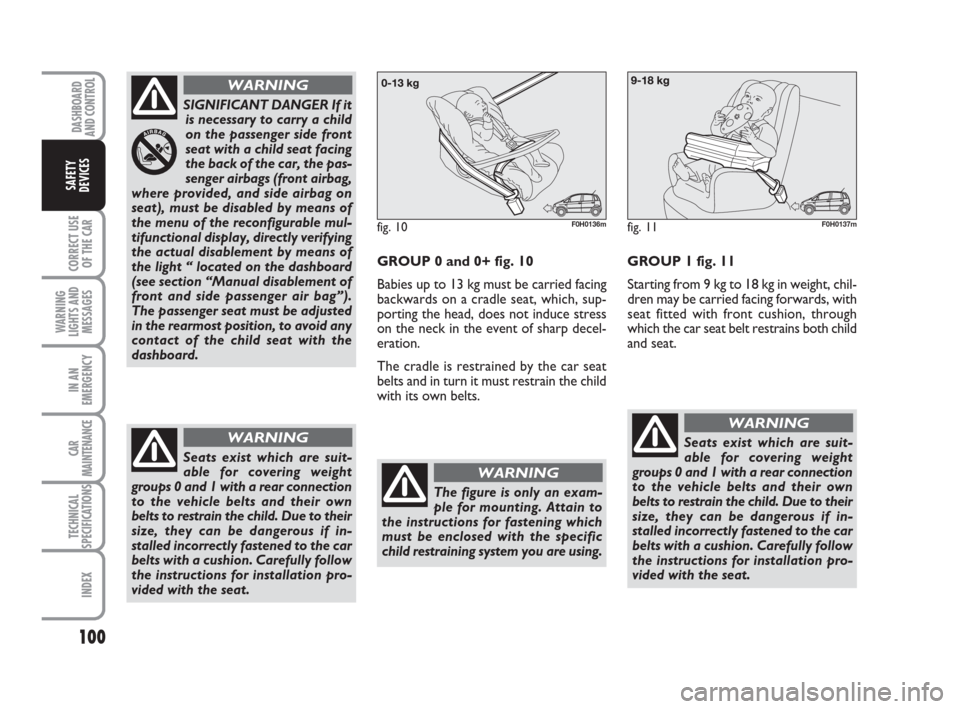
GROUP 0 and 0+ fig. 10
Babies up to 13 kg must be carried facing
backwards on a cradle seat, which, sup-
porting the head, does not induce stress
on the neck in the event of sharp decel-
eration.
The cradle is restrained by the car seat
belts and in turn it must restrain the child
with its own belts.
fig. 10F0H0136m
The figure is only an exam-
ple for mounting. Attain to
the instructions for fastening which
must be enclosed with the specific
child restraining system you are using.
WARNING
Seats exist which are suit-
able for covering weight
groups 0 and 1 with a rear connection
to the vehicle belts and their own
belts to restrain the child. Due to their
size, they can be dangerous if in-
stalled incorrectly fastened to the car
belts with a cushion. Carefully follow
the instructions for installation pro-
vided with the seat.
WARNING
fig. 11F0H0137m
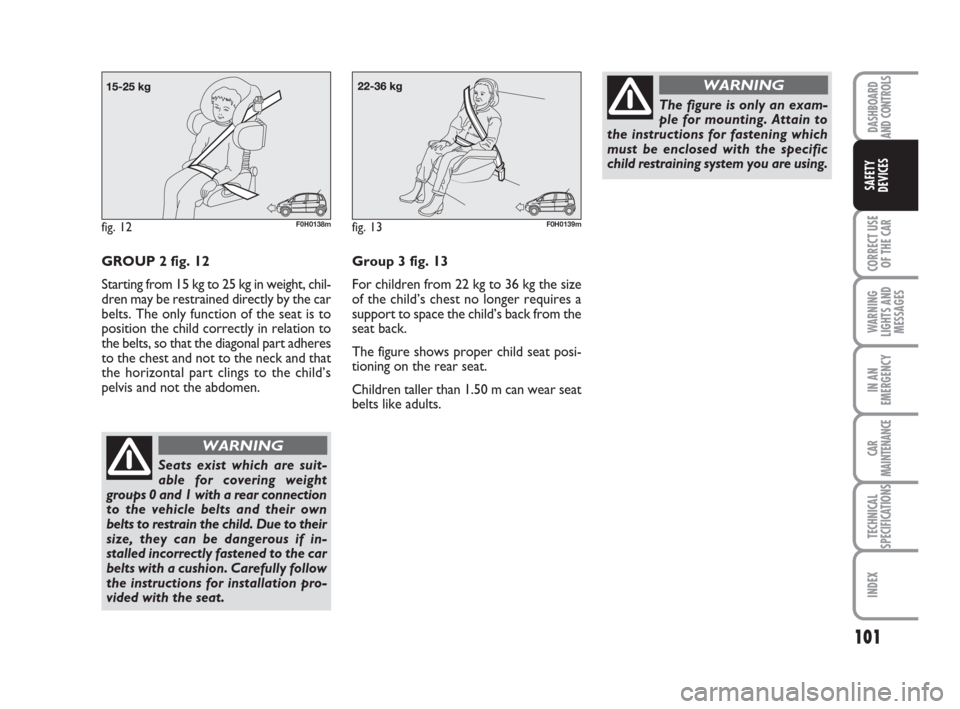
GROUP 1 fig. 11
Starting from 9 kg to 18 kg in weight, chil-
dren may be carried facing forwards, with
seat fitted with front cushion, through
which the car seat belt restrains both child
and seat.
Seats exist which are suit-
able for covering weight
groups 0 and 1 with a rear connection
to the vehicle belts and their own
belts to restrain the child. Due to their
size, they can be dangerous if in-
stalled incorrectly fastened to the car
belts with a cushion. Carefully follow
the instructions for installation pro-
vided with the seat.
WARNING
093-110 idea GB 1 ed 10-07-2008 8:28 Pagina 100
Page 102 of 210
101
CORRECT USE
OF THE CAR
WARNING
LIGHTS AND
MESSAGES
IN AN
EMERGENCY
CAR
MAINTENANCE
TECHNICAL
SPECIFICATIONS
INDEX
DASHBOARD
AND CONTROLS
SAFETY
DEVICES
fig. 12F0H0138m
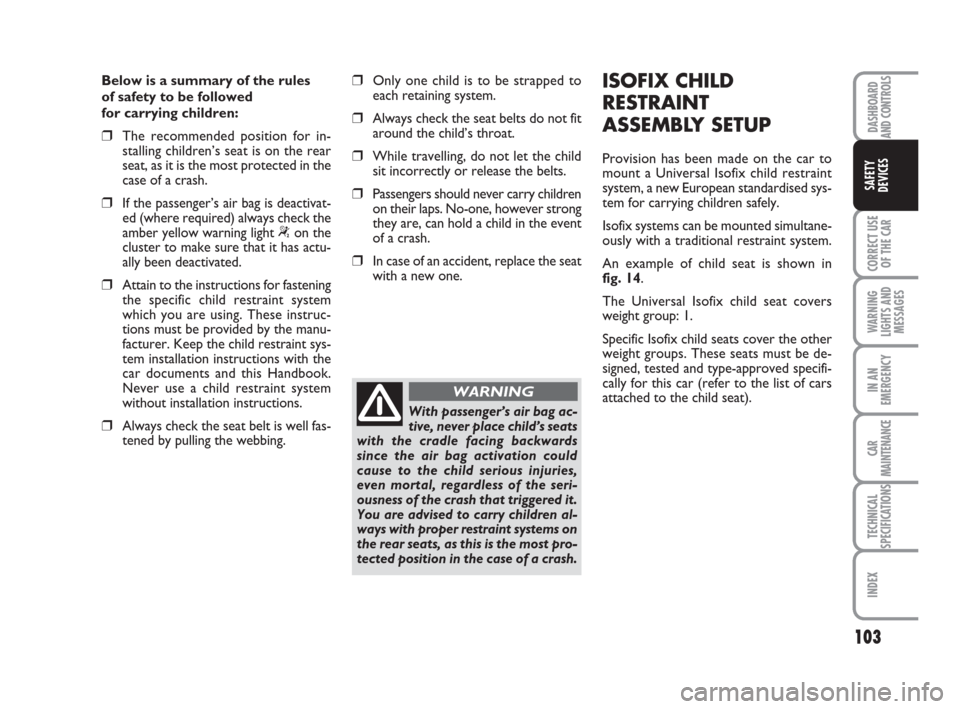
GROUP 2 fig. 12
Starting from 15 kg to 25 kg in weight, chil-
dren may be restrained directly by the car
belts. The only function of the seat is to
position the child correctly in relation to
the belts, so that the diagonal part adheres
to the chest and not to the neck and that
the horizontal part clings to the child’s
pelvis and not the abdomen.
Seats exist which are suit-
able for covering weight
groups 0 and 1 with a rear connection
to the vehicle belts and their own
belts to restrain the child. Due to their
size, they can be dangerous if in-
stalled incorrectly fastened to the car
belts with a cushion. Carefully follow
the instructions for installation pro-
vided with the seat.
WARNING
fig. 13F0H0139m
The figure is only an exam-
ple for mounting. Attain to
the instructions for fastening which
must be enclosed with the specific
child restraining system you are using.
WARNING
Group 3 fig. 13
For children from 22 kg to 36 kg the size
of the child’s chest no longer requires a
support to space the child’s back from the
seat back.
The figure shows proper child seat posi-
tioning on the rear seat.
Children taller than 1.50 m can wear seat
belts like adults.
093-110 idea GB 1 ed 10-07-2008 8:28 Pagina 101
Page 104 of 210
103
CORRECT USE
OF THE CAR
WARNING
LIGHTS AND
MESSAGES
IN AN
EMERGENCY
CAR
MAINTENANCE
TECHNICAL
SPECIFICATIONS
INDEX
DASHBOARD
AND CONTROLS
SAFETY
DEVICES
Below is a summary of the rules
of safety to be followed
for carrying children:
❒The recommended position for in-
stalling children’s seat is on the rear
seat, as it is the most protected in the
case of a crash.
❒If the passenger’s air bag is deactivat-
ed (where required) always check the
amber yellow warning light “on the
cluster to make sure that it has actu-
ally been deactivated.
❒Attain to the instructions for fastening
the specific child restraint system
which you are using. These instruc-
tions must be provided by the manu-
facturer. Keep the child restraint sys-
tem installation instructions with the
car documents and this Handbook.
Never use a child restraint system
without installation instructions.
❒Always check the seat belt is well fas-
tened by pulling the webbing.
❒Only one child is to be strapped to
each retaining system.
❒Always check the seat belts do not fit
around the child’s throat.
❒While travelling, do not let the child
sit incorrectly or release the belts.
❒Passengers should never carry children
on their laps. No-one, however strong
they are, can hold a child in the event
of a crash.
❒In case of an accident, replace the seat
with a new one.
With passenger’s air bag ac-
tive, never place child’s seats
with the cradle facing backwards
since the air bag activation could
cause to the child serious injuries,
even mortal, regardless of the seri-
ousness of the crash that triggered it.
You are advised to carry children al-
ways with proper restraint systems on
the rear seats, as this is the most pro-
tected position in the case of a crash.
WARNING
ISOFIX CHILD
RESTRAINT
ASSEMBLY SETUP
Provision has been made on the car to
mount a Universal Isofix child restraint
system, a new European standardised sys-
tem for carrying children safely.
Isofix systems can be mounted simultane-
ously with a traditional restraint system.
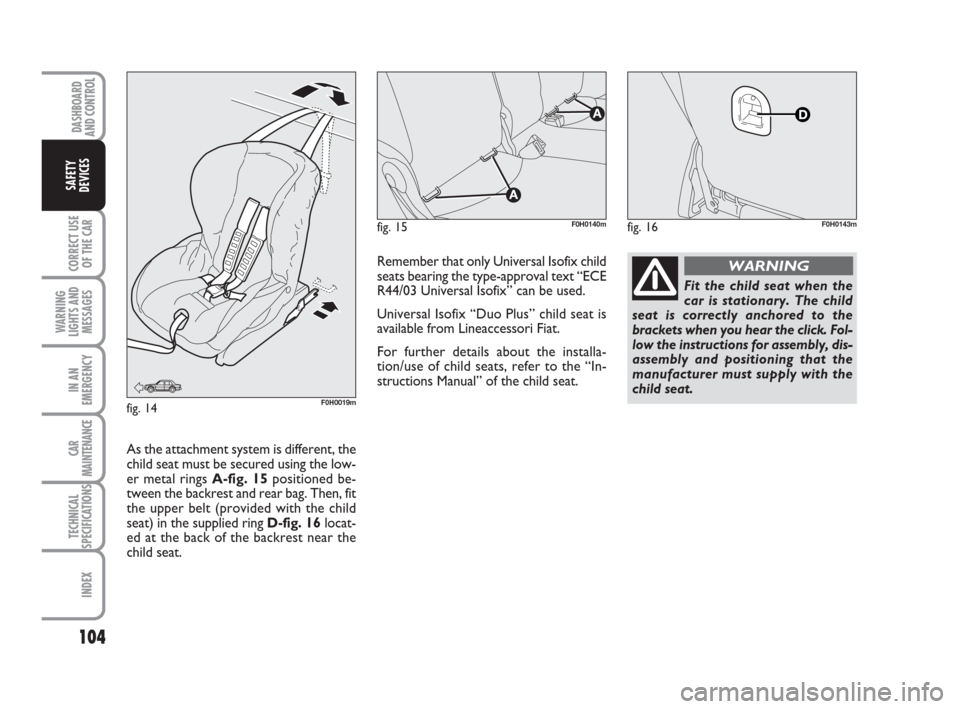
An example of child seat is shown in
fig. 14.
The Universal Isofix child seat covers
weight group: 1.
Specific Isofix child seats cover the other
weight groups. These seats must be de-
signed, tested and type-approved specifi-
cally for this car (refer to the list of cars
attached to the child seat).
093-110 idea GB 1 ed 10-07-2008 8:28 Pagina 103
Page 105 of 210
104
CORRECT USE
OF THE CAR
WARNING
LIGHTS AND
MESSAGES
IN AN
EMERGENCY
CAR
MAINTENANCE
TECHNICAL
SPECIFICATIONS
INDEX
DASHBOARD
AND CONTROL
SAFETY
DEVICES
fig. 15F0H0140m
Fit the child seat when the
car is stationary. The child
seat is correctly anchored to the
brackets when you hear the click. Fol-
low the instructions for assembly, dis-
assembly and positioning that the
manufacturer must supply with the
child seat.
WARNING
fig. 14F0H0019m
As the attachment system is different, the
child seat must be secured using the low-
er metal rings A-fig. 15positioned be-
tween the backrest and rear bag. Then, fit
the upper belt (provided with the child
seat) in the supplied ring D-fig. 16locat-
ed at the back of the backrest near the
child seat.
fig. 16F0H0143m
Remember that only Universal Isofix child
seats bearing the type-approval text “ECE
R44/03 Universal Isofix” can be used.
Universal Isofix “Duo Plus” child seat is
available from Lineaccessori Fiat.
For further details about the installa-
tion/use of child seats, refer to the “In-
structions Manual” of the child seat.
093-110 idea GB 1 ed 10-07-2008 8:28 Pagina 104
Page 107 of 210
106
CORRECT USE
OF THE CAR
WARNING
LIGHTS AND
MESSAGES
IN AN
EMERGENCY
CAR
MAINTENANCE
TECHNICAL
SPECIFICATIONS
INDEX
DASHBOARD
AND CONTROL
SAFETY
DEVICES
FRONT AND SIDE AIR
BAGS
The car is fitted with front air bags for the
driver and for the passenger, and window
bags (head protection system); upon re-
quest the car can be fitted also with front
side bags;
The front air bag (driver and passenger)
has been designed to protect the occu-
pants in the event of head-on crashes of
medium-high severity, by placing the cush-
ion between the occupant and the steer-
ing wheel or dashboard.
Front air bags are designed to protect
car’s occupants in front crashes and there-
fore non-activation in other types of col-
lisions (side collisions, rear shunts, roll-
overs, etc.) is not a system malfunction.
In case of crash, an electronic control unit,
when required, triggers the inflation of the
cushion.
The cushion immediately inflates, placing
itself as a protection between the body
of the front occupants and the structure
that could cause injuries. Immediately af-
ter, the cushion deflates.
The front air bag (driver and passenger) is
not a replacement of but complementary
to the use of belts, which should always
be worn, as specified by law in Europe and
most non European countries.In case of crash, a person not wearing the
seat belt moves forward and may come in-
to contact with the cushion while it is still
inflating. Under this circumstance the pro-
tection offered by the air bag is reduced.
Front air bag may not be activated in the
following situations:
❒in collisions against highly deformable
objects not affecting the vehicle front
surface (e.g. bumper collision against
guard rail, etc.);
❒in case of wedging under other vehi-
cles or protective barriers (for exam-
ple under a truck or guard rail), the air
bag is not triggered as it offers no ad-
ditional protection compared with the
seat belts, consequently it would be
pointless. Therefore, failure to come
into action in the above circumstance
does not mean that the system is not
working properly.
The driver’s and passenger’s front Air bags
have been designed and calibrated to im-
prove the protection of a person wear-
ing seat belts.
At its maximum inflation, its volume fills
most of the space between the dashboard
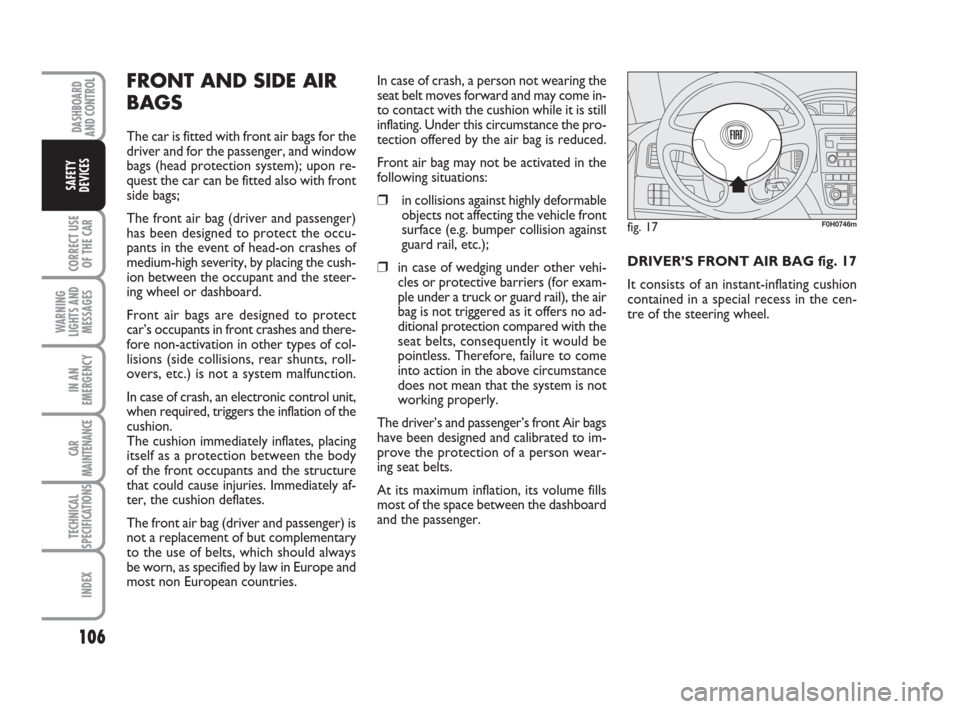
and the passenger.DRIVER’S FRONT AIR BAG fig. 17
It consists of an instant-inflating cushion
contained in a special recess in the cen-
tre of the steering wheel.
fig. 17F0H0746m
093-110 idea GB 1 ed 10-07-2008 8:28 Pagina 106
Page 108 of 210
107
CORRECT USE
OF THE CAR
WARNING
LIGHTS AND
MESSAGES
IN AN
EMERGENCY
CAR
MAINTENANCE
TECHNICAL
SPECIFICATIONS
INDEX
DASHBOARD
AND CONTROLS
SAFETY
DEVICES
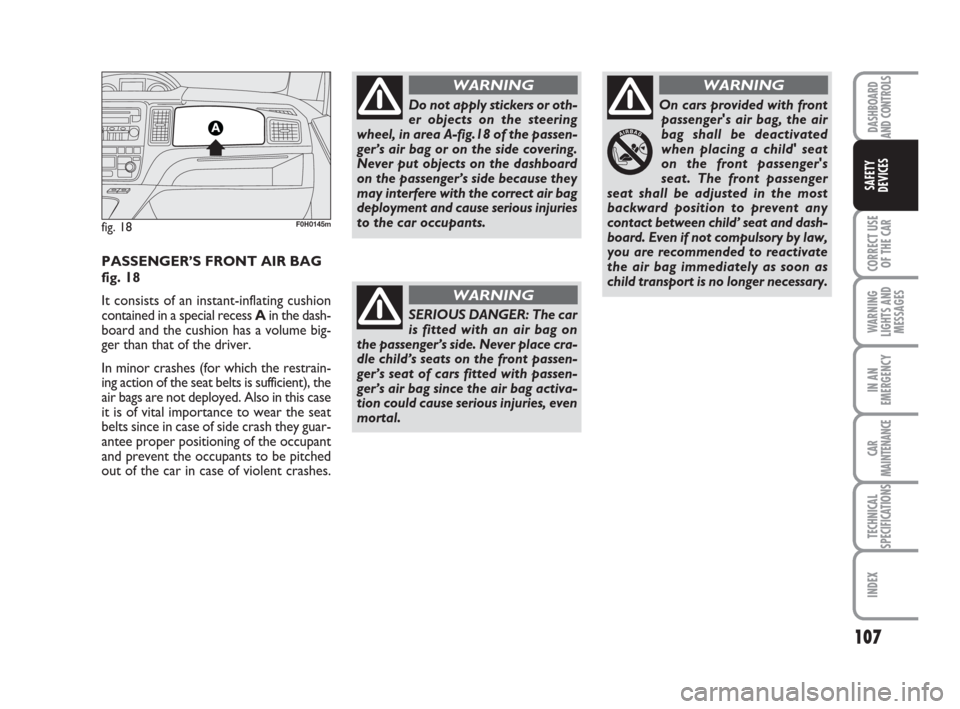
fig. 18F0H0145m
PASSENGER’S FRONT AIR BAG
fig. 18
It consists of an instant-inflating cushion
contained in a special recess Ain the dash-
board and the cushion has a volume big-
ger than that of the driver.
In minor crashes (for which the restrain-
ing action of the seat belts is sufficient), the
air bags are not deployed. Also in this case
it is of vital importance to wear the seat
belts since in case of side crash they guar-
antee proper positioning of the occupant
and prevent the occupants to be pitched
out of the car in case of violent crashes.
Do not apply stickers or oth-
er objects on the steering
wheel, in area A-fig.18 of the passen-
ger’s air bag or on the side covering.
Never put objects on the dashboard
on the passenger’s side because they
may interfere with the correct air bag
deployment and cause serious injuries
to the car occupants.
WARNING
SERIOUS DANGER: The car
is fitted with an air bag on
the passenger’s side. Never place cra-
dle child’s seats on the front passen-
ger’s seat of cars fitted with passen-
ger’s air bag since the air bag activa-
tion could cause serious injuries, even
mortal.
WARNING
On cars provided with front
passenger's air bag, the air
bag shall be deactivated
when placing a child' seat
on the front passenger's
seat. The front passenger
seat shall be adjusted in the most
backward position to prevent any
contact between child’ seat and dash-
board. Even if not compulsory by law,
you are recommended to reactivate
the air bag immediately as soon as
child transport is no longer necessary.
WARNING
093-110 idea GB 1 ed 10-07-2008 8:28 Pagina 107