Auto door FIAT LINEA 2007 1.G User Guide
[x] Cancel search | Manufacturer: FIAT, Model Year: 2007, Model line: LINEA, Model: FIAT LINEA 2007 1.GPages: 230, PDF Size: 3.31 MB
Page 75 of 230
74
SAFETY
DEVICES
CORRECT USE
OF THE
CAR
WARNING
LIGHTS AND
MESSAGES
IN AN
EMERGENCY
CAR
MAINTENANCE
TECHNICAL
SPECIFICATIONS
INDEX
DASHBOARD
AND CONTROLS
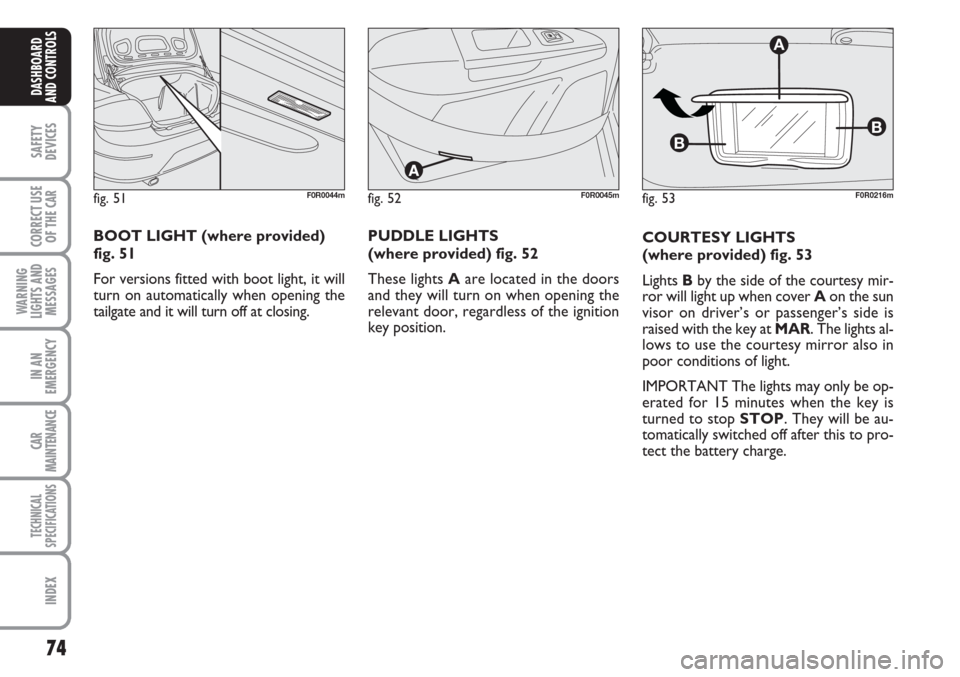
COURTESY LIGHTS
(where provided) fig. 53
Lights Bby the side of the courtesy mir-
ror will light up when cover Aon the sun
visor on driver’s or passenger’s side is
raised with the key at MAR. The lights al-
lows to use the courtesy mirror also in
poor conditions of light.
IMPORTANT The lights may only be op-
erated for 15 minutes when the key is
turned to stop STOP. They will be au-
tomatically switched off after this to pro-
tect the battery charge.
fig. 51F0R0044mfig. 53
B
B
A
F0R0216mfig. 52F0R0045m
BOOT LIGHT (where provided)
fig. 51
For versions fitted with boot light, it will
turn on automatically when opening the
tailgate and it will turn off at closing.PUDDLE LIGHTS
(where provided) fig. 52
These lights Aare located in the doors
and they will turn on when opening the
relevant door, regardless of the ignition
key position.
Page 77 of 230
76
SAFETY
DEVICES
CORRECT USE
OF THE
CAR
WARNING
LIGHTS AND
MESSAGES
IN AN
EMERGENCY
CAR
MAINTENANCE
TECHNICAL
SPECIFICATIONS
INDEX
DASHBOARD
AND CONTROLS
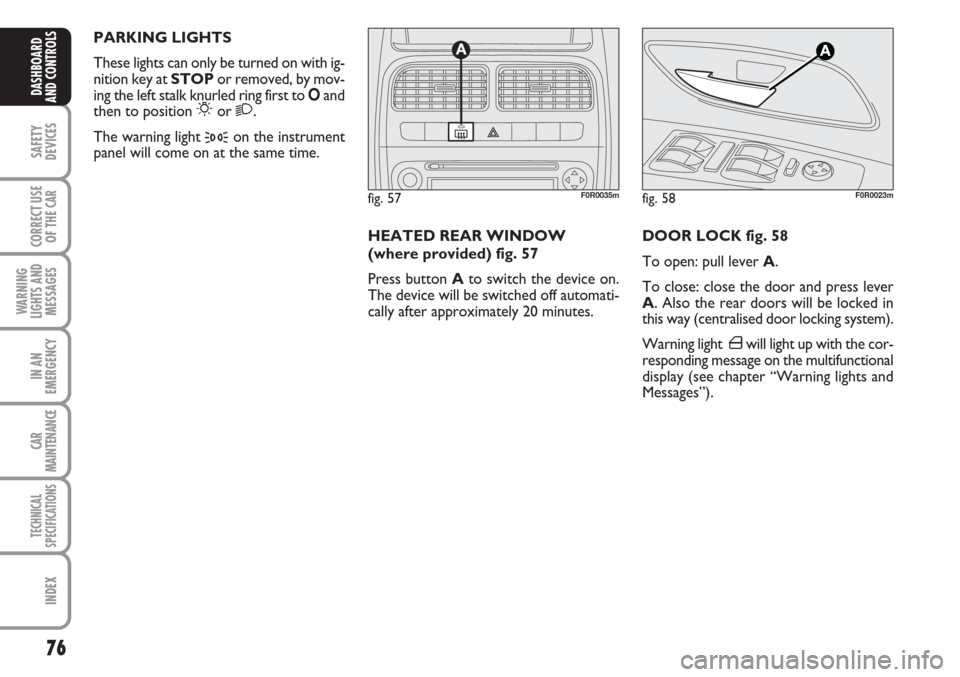
DOOR LOCK fig. 58
To open: pull lever A.
To close: close the door and press lever
A. Also the rear doors will be locked in
this way (centralised door locking system).
Warning light ´will light up with the cor-
responding message on the multifunctional
display (see chapter “Warning lights and
Messages”).
fig. 57F0R0035m
HEATED REAR WINDOW
(where provided) fig. 57
Press button Ato switch the device on.
The device will be switched off automati-
cally after approximately 20 minutes. PARKING LIGHTS
These lights can only be turned on with ig-
nition key at STOPor removed, by mov-
ing the left stalk knurled ring first to Oand
then to position
6or 2.
The warning light
3on the instrument
panel will come on at the same time.
fig. 58F0R0023m
Page 78 of 230
77
SAFETY
DEVICES
CORRECT USE
OF THE
CAR
WARNING
LIGHTS AND
MESSAGES
IN AN
EMERGENCY
CAR
MAINTENANCE
TECHNICAL
SPECIFICATIONS
INDEX
DASHBOARD
AND CONTROLS
Door unlocking in the event
of a crash
If the fuel cut-off switch trips following an
accident, the doors will be automatically
unlocked to let you leave the car and the
ceiling lights will be switched on at the
same time. The doors can always be
opened from the inside of the car by
means of the specific levers.
Proceed as follows if no fuel leakage is
found and and the car is in condition to be
driven to rearm the fuel cut-off switch.FUEL CUT-OFF SWITCH
The car is fitted with a safety switch that
in the event of a crash comes into opera-
tion by cutting off fuel and turning off the
engine as a consequence.
This device therefore prevents fuel leaks
due to fuel piping breaking.
IMPORTANT After the accident, re-
member to remove the electronic key
from the ignition device to prevent drain-
ing the battery.The message “FPS on” will appear on the
digital display when the switch trips. The
message “Inertia switch tripped. See hand-
book” will appear on the multifunctional
display.
If, after a crash, you smell fu-
el or see leaks from the fuel
system, do not reset the switch to
avoid fine risk.
WARNING
If the centralised door lock-
ing system was operated
from inside the car and the fuel cut-
off switch did not manage to auto-
matically release the doors, it will not
be possible to access the passenger
compartment from the outside after
an accident. The possibility of open-
ing the doors from the outside de-
pends on the conditions of the doors
themselves after the accident: if may
not be possible to open a damaged
door. In this case, try to open the oth-
er doors of the car.
WARNING
Page 83 of 230
82
SAFETY
DEVICES
CORRECT USE
OF THE
CAR
WARNING
LIGHTS AND
MESSAGES
IN AN
EMERGENCY
CAR
MAINTENANCE
TECHNICAL
SPECIFICATIONS
INDEX
DASHBOARD
AND CONTROLS
DOORS
CENTRAL DOOR
LOCKING/UNLOCKING SYSTEM
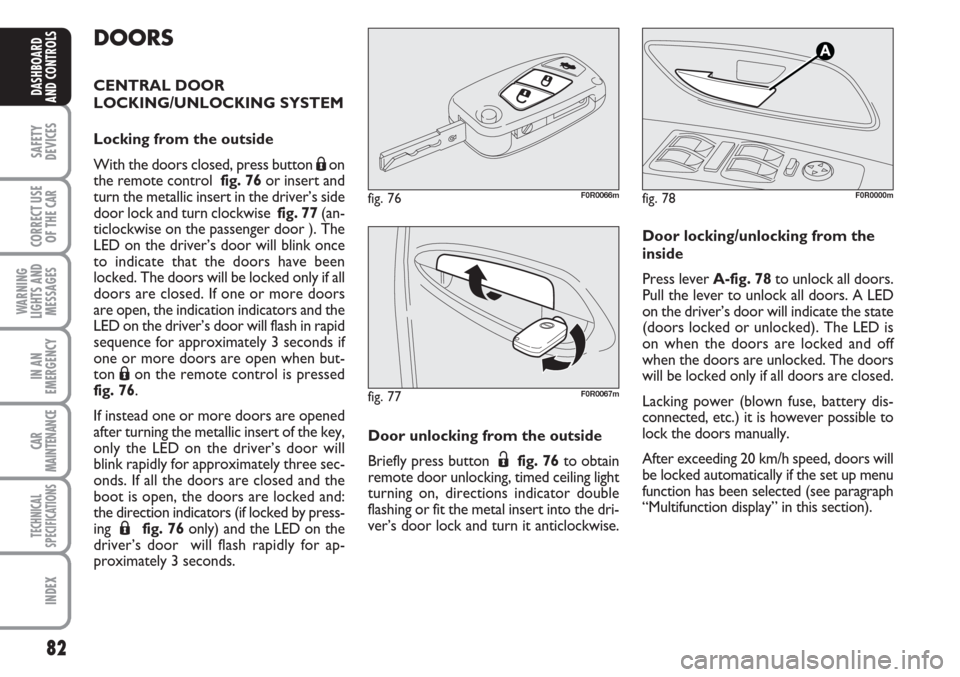
Locking from the outside
With the doors closed, press button
Áon
the remote control fig. 76or insert and
turn the metallic insert in the driver’s side
door lock and turn clockwise fig. 77(an-
ticlockwise on the passenger door ). The
LED on the driver’s door will blink once
to indicate that the doors have been
locked. The doors will be locked only if all
doors are closed. If one or more doors
are open, the indication indicators and the
LED on the driver’s door will flash in rapid
sequence for approximately 3 seconds if
one or more doors are open when but-
ton
Áon the remote control is pressed
fig. 76.
If instead one or more doors are opened
after turning the metallic insert of the key,
only the LED on the driver’s door will
blink rapidly for approximately three sec-
onds. If all the doors are closed and the
boot is open, the doors are locked and:
the direction indicators (if locked by press-
ing
Áfig. 76only) and the LED on the
driver’s door will flash rapidly for ap-
proximately 3 seconds.Door unlocking from the outside
Briefly press button
Ëfig. 76to obtain
remote door unlocking, timed ceiling light
turning on, directions indicator double
flashing or fit the metal insert into the dri-
ver’s door lock and turn it anticlockwise.
fig. 77F0R0067m
fig. 78F0R0000m
Door locking/unlocking from the
inside
Press lever A-fig. 78to unlock all doors.
Pull the lever to unlock all doors. A LED
on the driver’s door will indicate the state
(doors locked or unlocked). The LED is
on when the doors are locked and off
when the doors are unlocked. The doors
will be locked only if all doors are closed.
Lacking power (blown fuse, battery dis-
connected, etc.) it is however possible to
lock the doors manually.
After exceeding 20 km/h speed, doors will
be locked automatically if the set up menu
function has been selected (see paragraph
“Multifunction display” in this section).
fig. 76F0R0066m
Page 84 of 230
83
SAFETY
DEVICES
CORRECT USE
OF THE
CAR
WARNING
LIGHTS AND
MESSAGES
IN AN
EMERGENCY
CAR
MAINTENANCE
TECHNICAL
SPECIFICATIONS
INDEX
DASHBOARD
AND CONTROLS
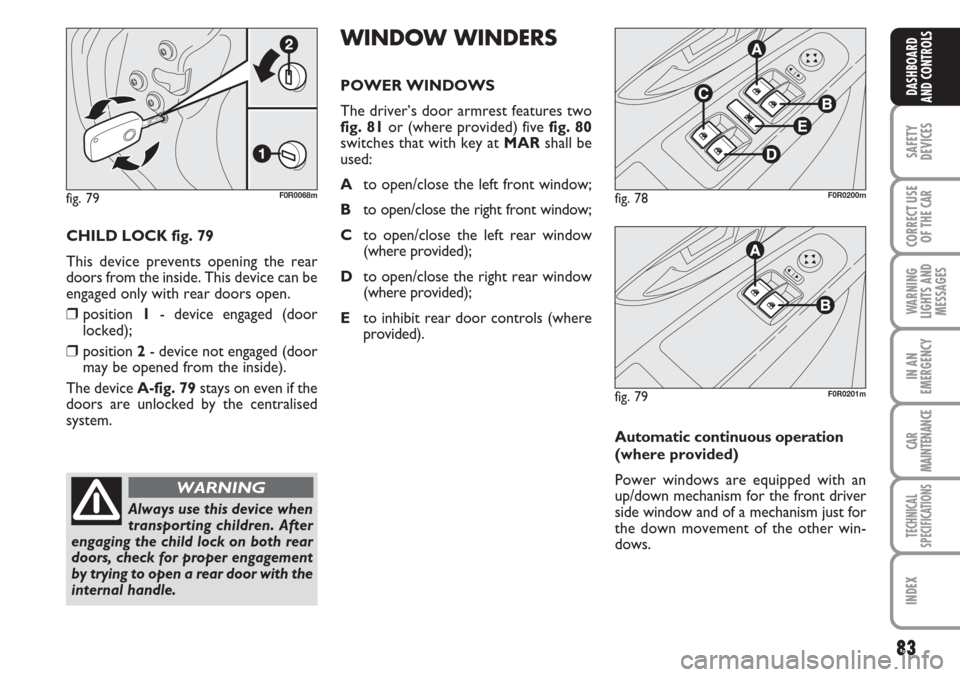
CHILD LOCK fig. 79
This device prevents opening the rear
doors from the inside. This device can be
engaged only with rear doors open.
❒position 1- device engaged (door
locked);
❒position 2- device not engaged (door
may be opened from the inside).
The device A-fig. 79stays on even if the
doors are unlocked by the centralised
system.
fig. 79F0R0068m
Always use this device when
transporting children. After
engaging the child lock on both rear
doors, check for proper engagement
by trying to open a rear door with the
internal handle.
WARNING
WINDOW WINDERS
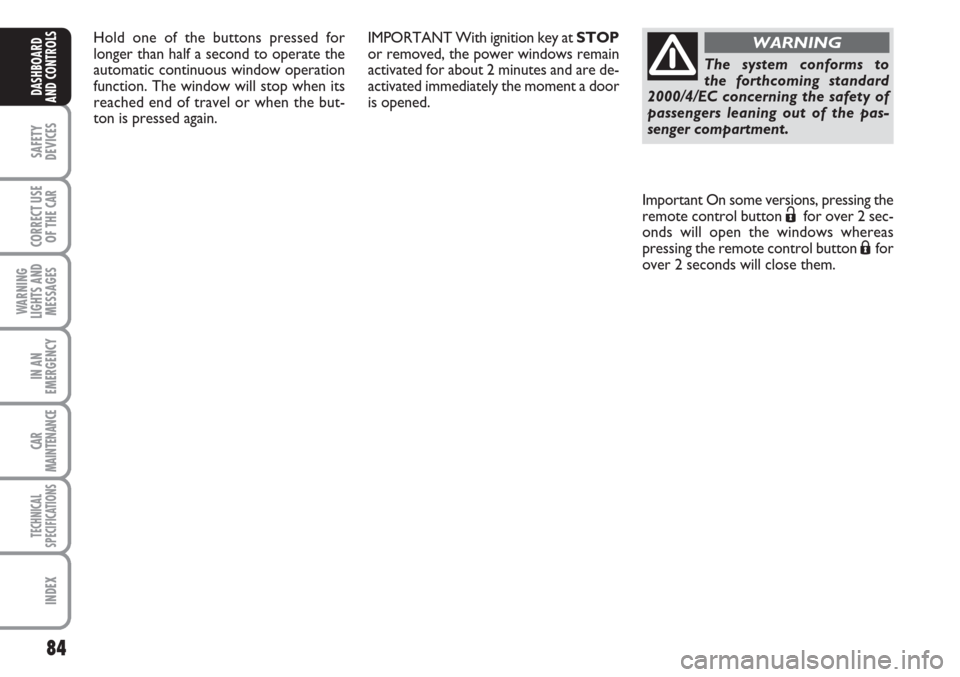
POWER WINDOWS
The driver’s door armrest features two
fig. 81or (where provided) five fig. 80
switches that with key at MARshall be
used:
Ato open/close the left front window;
Bto open/close the right front window;
Cto open/close the left rear window
(where provided);
Dto open/close the right rear window
(where provided);
Eto inhibit rear door controls (where
provided).
fig. 78F0R0200m
fig. 79F0R0201m
Automatic continuous operation
(where provided)
Power windows are equipped with an
up/down mechanism for the front driver
side window and of a mechanism just for
the down movement of the other win-
dows.
Page 85 of 230
84
SAFETY
DEVICES
CORRECT USE
OF THE
CAR
WARNING
LIGHTS AND
MESSAGES
IN AN
EMERGENCY
CAR
MAINTENANCE
TECHNICAL
SPECIFICATIONS
INDEX
DASHBOARD
AND CONTROLS
Hold one of the buttons pressed for
longer than half a second to operate the
automatic continuous window operation
function. The window will stop when its
reached end of travel or when the but-
ton is pressed again.
The system conforms to
the forthcoming standard
2000/4/EC concerning the safety of
passengers leaning out of the pas-
senger compartment.
WARNINGIMPORTANT With ignition key at STOP
or removed, the power windows remain
activated for about 2 minutes and are de-
activated immediately the moment a door
is opened.
Important On some versions, pressing the
remote control button
Ëfor over 2 sec-
onds will open the windows whereas
pressing the remote control button
Áfor
over 2 seconds will close them.
Page 197 of 230
196
WARNING
LIGHTS AND
MESSAGES
TECHNICAL
SPECIFICATIONS
INDEX
DASHBOARD
AND CONTROLS
SAFETY
DEVICES
CORRECT USE
OF THE CAR
IN AN
EMERGENCY
CAR
MAINTENANCE
Normal maintenance of paintwork consists
in washing the car: the frequency depends
on the conditions and environment where
the car is used. For example, it is advisable
to wash the car more often in areas with
a high environmental pollution or on roads
sprinkled with salt.
To correctly wash the car:
❒remove the aerial from the roof to pre-
vent damage to it if the car is washed in
an automatic system;
❒wash the body using a low pressure jet
of water;
❒wipe a sponge with a slightly soapy so-
lution over the bodywork, frequently
rinsing with the sponge;
❒rinse well with water and dry with a jet
of air or a chamois leather.
Dry the parts less in sight particularly care-
fully, such as the door frames and the
headlight frames, where water may stag-
nate more easily. It is a good idea to leave
the car in the open for a while after wash-
ing it to give time for the water to evap-
orate.Do not wash the car after it has been
parked in the sun or when the engine is
bonnet is hot: this could take the shine off
the paint.
Exterior plastic parts must be cleaned in
the same way as the rest of the car.
Where possible, do not park under trees;
the resinous substance many species re-
lease give the paint a dull appearance and
increase the possibility of triggering rust
processes.
IMPORTANT Bird droppings must be
washed off immediately and thoroughly as
the acid they contain is particularly ag-
gressive.
Detergents cause water pollu-
tion. The car should be washed
in areas equipped for collect-
ing and purifying the liquid
used in the washing process.
Windows
Use specific window cleaner products.
Use also clean cloths to avoid scratching
the glass or damaging the transparency.
IMPORTANT The inside of the rear win-
dow should be wiped gently with a cloth
in the direction of the filaments to avoid
damaging the heating device.
Engine compartment
Wash the engine compartment carefully
after the end of the winter. Be careful not
to direct the jet of water onto electronic
control units. Adequately protect the up-
per air vents to prevent damage to the
windscreen wiper motor. Have this op-
eration performed at a specialised work-
shop.
IMPORTANT Perform this operation on
a cold engine and with the key at STOP.
After the washing operation, make sure
that the various protections (e.g. rubber
caps and guards) have not removed or
damaged.
Front headlights
IMPORTANT Never use aromatic sub-
stances (e.g.: petrol) or ketenes (e.g.: ace-
tone) for cleaning front headlight plastic
lens.
Page 219 of 230
218
WARNING
LIGHTS AND
MESSAGES
DASHBOARD
AND CONTROLS
SAFETY
DEVICES
CORRECT USE
OF THE
CAR
IN AN
EMERGENCY
CAR
MAINTENANCE
TECHNICAL
SPECIFICATIONS
INDEX
Bonnet .................................................. 88
Boot ........................................................ 86
– extension........................................ 87
– opening/closing the tailgate ......... 86
– emergency opening....................... 83
Boot light............................................... 74
Brake assist .......................................... 92
Brakes
– fluid level ........................................ 188
– technical data ................................ 205
Bulb (replacement)
– general instructions ..................... 158
– types of bulbs ................................ 158
Capacities ............................................ 106
Car inactivity ....................................... 132
Car maintenance
– periodical checks........................... 183
– scheduled servicing ...................... 178
– service schedule ..................179-181
– use of the car under
heavy conditions............................ 183
Card box - CD box............................. 72
Carrying children safely ..................... 109
Ceiling lights.......................................... 72
– boot light ....................................... 66
– courtesy ......................................... 66– front ................................................ 64
– puddle/door .................................. 66
– rear ................................................. 65
Central console oddment
compartment..................................... 71
Chassis (marking) ............................... 201
Checking fluid....................................... 184
Child lock.............................................. 83
Child restraint systems
– “Universal Isofix” ......................... 114
– Passenger’s seat compliance ...... 115
Cigar lighter.......................................... 80
Clutch ................................................... 216
CO2emissions..................................... 217
Code Card ........................................... 6
Consumption
– engine oil ........................................ 186
– fuel ................................................... 216
Controls................................................ 75
Correct use of the car ...................... 127
Cruise Control..................................... 70
Courtesy lights ..................................... 74
– bulb replacement .......................... 174
– control button .............................. 74
Current outlet...................................... 73
ABS system.......................................... 92
Accessories purchased
by the owner .................................... 100
Additional heater................................. 56
Air bag
– front................................................. 115
– side .................................................. 118
Air cleaner............................................. 189
Adjustable Air vents ........................... 50
Alarm...................................................... 11
Armrest................................................. 71
Ashtray................................................... 81
ASR system........................................... 95
– activation/deactivation................. 95
At the filling station ............................ 101
Automatic climate
control system .................................. 59
Battery
– checking the charge ..................... 189
– jump starting ................................. 146
– recharging ...................................... 185
– replacing ......................................... 190
Bodywork
– maintenance .................................. 195
– version codes ............................... 202
II I
N N
D D
E E
X X
Page 220 of 230
219
WARNING
LIGHTS AND
MESSAGES
DASHBOARD
AND CONTROLS
SAFETY
DEVICES
CORRECT USE
OF THE
VEHICLE
IN AN
EMERGENCY
VEHICLE
MAINTENANCE
TECHNICAL
SPECIFICATIONS
INDEX
EOBD system ...................................... 96
ESP system............................................ 93
External lights ...................................... 66
Fiat CODE system ............................. 6
Fix & Go automatic ............................ 153
Flashing the headlights ....................... 66
Fluid levels ............................................ 196
Fluids and lubricants ........................... 214
Follow me home (device) ................. 67
Front ceiling lights
– bulb replacement........................... 165
– control ............................................ 72
Front fog lights
– bulb replacement .......................... 162
– control button .............................. 75
Fuel
– consumption................................... 229
– cut-off switch.................................. 69
– level gauge....................................... 17
Fuel cut-off switch............................... 77
Fuel filler cap ....................................... 102
Fuel level gauge ................................... 17
Fuses (replacement) ........................... 167
Gearbox
– using manual gearbox .................. 132
Glass holder - can holder................... 72
Glove box/oddment compartment .. 70
Handbrake .......................................... 125
Hazard lights ........................................ 75
Head restraints
– front ................................................ 45
– rear................................................... 46
Headlight washer
– control ............................................ 61
– fluid level ........................................ 200
Headlights.............................................. 91
– beam adjustment .......................... 89
– headlight slant adjusting device ... 89
Heated rear window ......................52-57
Heating and ventilation ...................... 49
Identification data .............................. 200
Ignition device....................................... 13
In an emergency .................................. 145
Instrument panel ................................. 14
Instruments .......................................... 16
Interior fittings .................................... 78
Interiors ................................................ 197
Isofix (child restraint system) .......... 114
Jack ........................................................ 148
Jacking the car ..................................... 186
Key with remote control ................ 8
Key without remote control ........... 11
Dashboard........................................... 5
– Left hand drive version ............... 5
Dashboard and controls..................... 4
Dead lock device................................. 77
Digital display ....................................... 18
Dimensions .......................................... 210
Dipped beam headlights
– control ............................................ 66
– bulb replacement........................... 161
Direction indicators
– control ............................................ 67
– front bulb replacement ............... 161
– rear bulb replacement ................. 162
– side bulb replacement ................. 162
Doors..................................................... 82
Electrical socket ................................ 73
Engine
– identification code ........................ 200
– marking ........................................... 202
– technical data ................................ 203
Engine compartment
– washing ........................................... 197
Engine coolant...................................... 187
Engine coolant temperature gauge .. 17
Engine oil
– consumption .................................. 186
– level check....................................... 186
– specifications ................................. 227