intake FIAT MAREA 2000 1.G User Guide
[x] Cancel search | Manufacturer: FIAT, Model Year: 2000, Model line: MAREA, Model: FIAT MAREA 2000 1.GPages: 330
Page 105 of 330
Marea- Marea Weekend 9 ™
2000 range (Q)
4F019XJ01
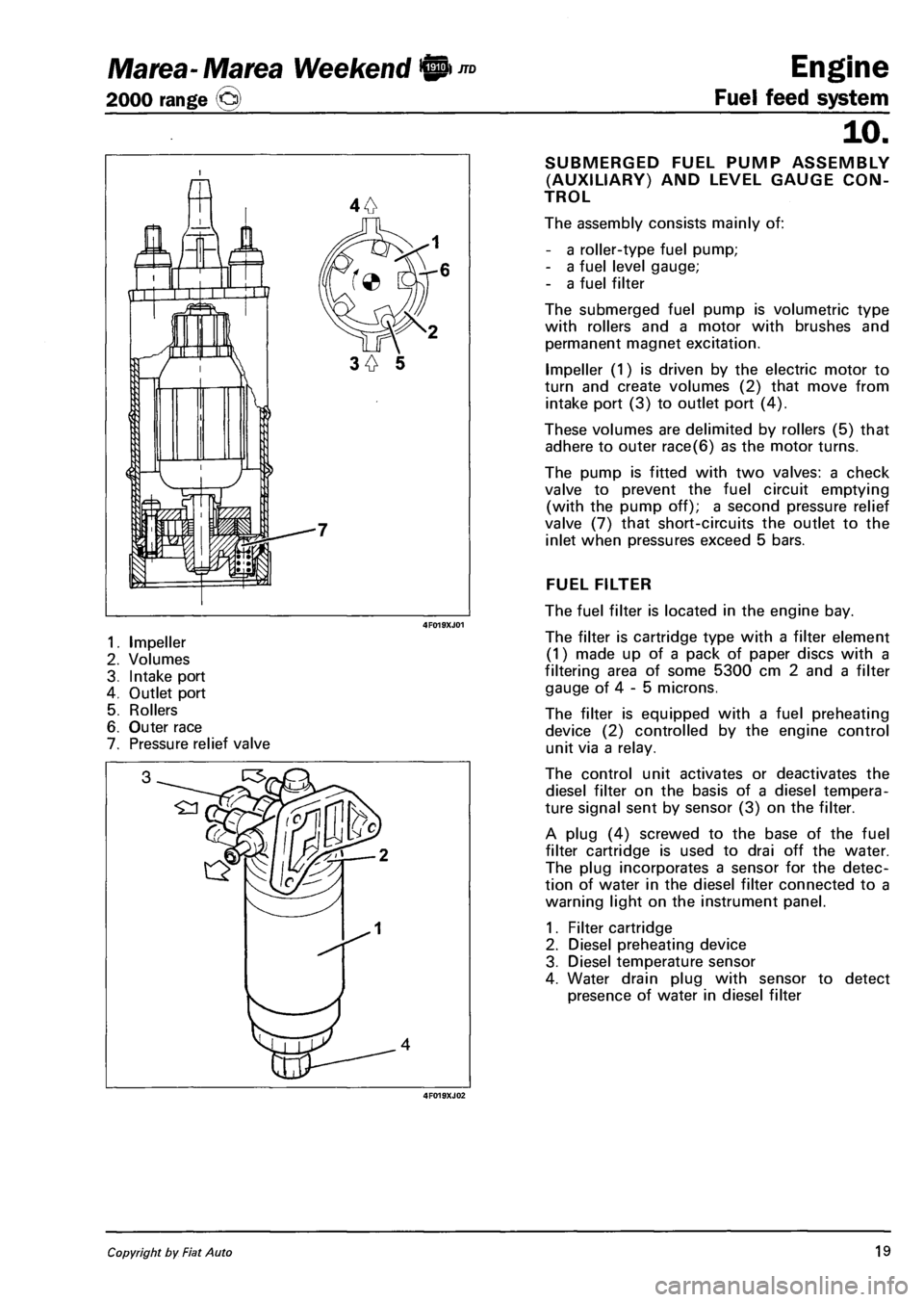
1. Impeller
2. Volumes
3. Intake port
4. Outlet port
5. Rollers
6. Outer race
7. Pressure relief valve
4F019XJ02
Engine
Fuel feed system
10.
SUBMERGED FUEL PUMP ASSEMBLY
(AUXILIARY) AND LEVEL GAUGE CON
TROL
The assembly consists mainly of:
- a roller-type fuel pump;
- a fuel level gauge;
- a fuel filter
The submerged fuel pump is volumetric type
with rollers and a motor with brushes and
permanent magnet excitation.
Impeller (1) is driven by the electric motor to
turn and create volumes (2) that move from
intake port (3) to outlet port (4).
These volumes are delimited by rollers (5) that
adhere to outer race(6) as the motor turns.
The pump is fitted with two valves: a check
valve to prevent the fuel circuit emptying
(with the pump off); a second pressure relief
valve (7) that short-circuits the outlet to the
inlet when pressures exceed 5 bars.
FUEL FILTER
The fuel filter is located in the engine bay.
The filter is cartridge type with a filter element
(1) made up of a pack of paper discs with a
filtering area of some 5300 cm 2 and a filter
gauge of 4 - 5 microns.
The filter is equipped with a fuel preheating
device (2) controlled by the engine control
unit via a relay.
The control unit activates or deactivates the
diesel filter on the basis of a diesel tempera
ture signal sent by sensor (3) on the filter.
A plug (4) screwed to the base of the fuel
filter cartridge is used to drai off the water.
The plug incorporates a sensor for the detec
tion of water in the diesel filter connected to a
warning light on the instrument panel.
1. Filter cartridge
2. Diesel preheating device
3. Diesel temperature sensor
4. Water drain plug with sensor to detect
presence of water in diesel filter
Copyright by Fiat Auto 19
Page 106 of 330
Engine
Fuel feed system
JTD Marea-Marea Weekend @
2000 range ©
10.
7^ £3
PRESSURE PUMP
The pressure pump is radialjet type with three
radial pistons (total capacity 0.657 cc). It is
controlled by a timing belt with or without
timing requirements.
Each pump unit consists of:
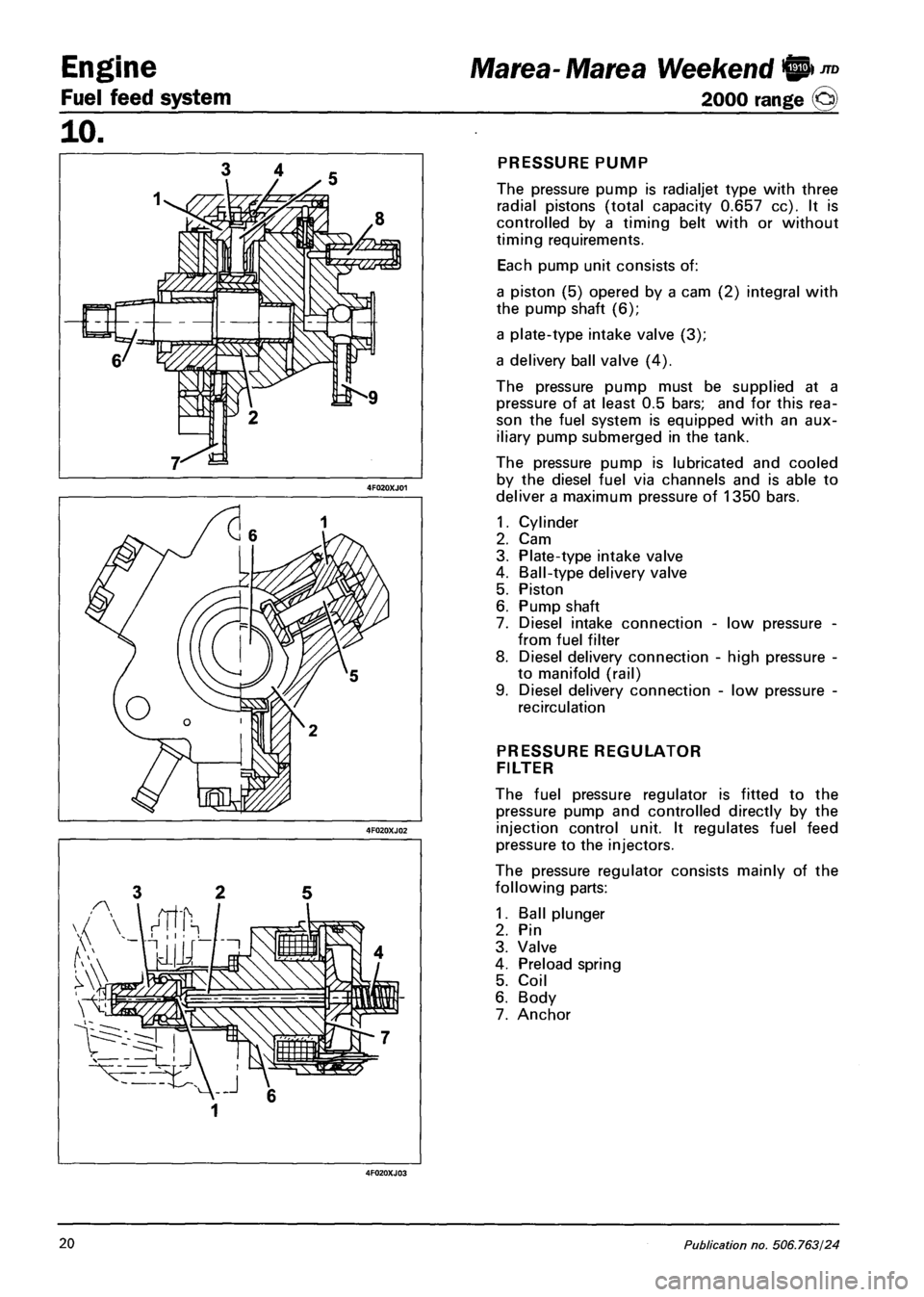
a piston (5) opered by a cam (2) integral with
the pump shaft (6);
a plate-type intake valve (3);
a delivery ball valve (4).
The pressure pump must be supplied at a
pressure of at least 0.5 bars; and for this rea
son the fuel system is equipped with an aux
iliary pump submerged in the tank.
The pressure pump is lubricated and cooled
by the diesel fuel via channels and is able to
deliver a maximum pressure of 1350 bars.
1.
2.
3.
4.
5.
6.
7.
8.
Cylinder
Cam
Plate-type intake valve
Ball-type delivery valve
Piston
Pump shaft
Diesel intake connection -
from fuel filter
Diesel delivery connection
to manifold (rail)
Diesel delivery connection
recirculation
low pressure
high pressure
low pressure
PRESSURE REGULATOR
FILTER
The fuel pressure regulator is fitted to the
pressure pump and controlled directly by the
injection control unit. It regulates fuel feed
pressure to the injectors.
The pressure regulator consists mainly of the
following parts:
1. Ball plunger
2. Pin
3. Valve
4. Preload spring
5. Coil
6. Body
7. Anchor
20 Publication no. 506.763/24
Page 107 of 330
Marea- Marea Weekend <§l ™
2000 range ©
Engine
Fuel feed system
TZZZZZZZZZZZZZZZZZZb
TZZZZZZZZZZZZZZ*
10.
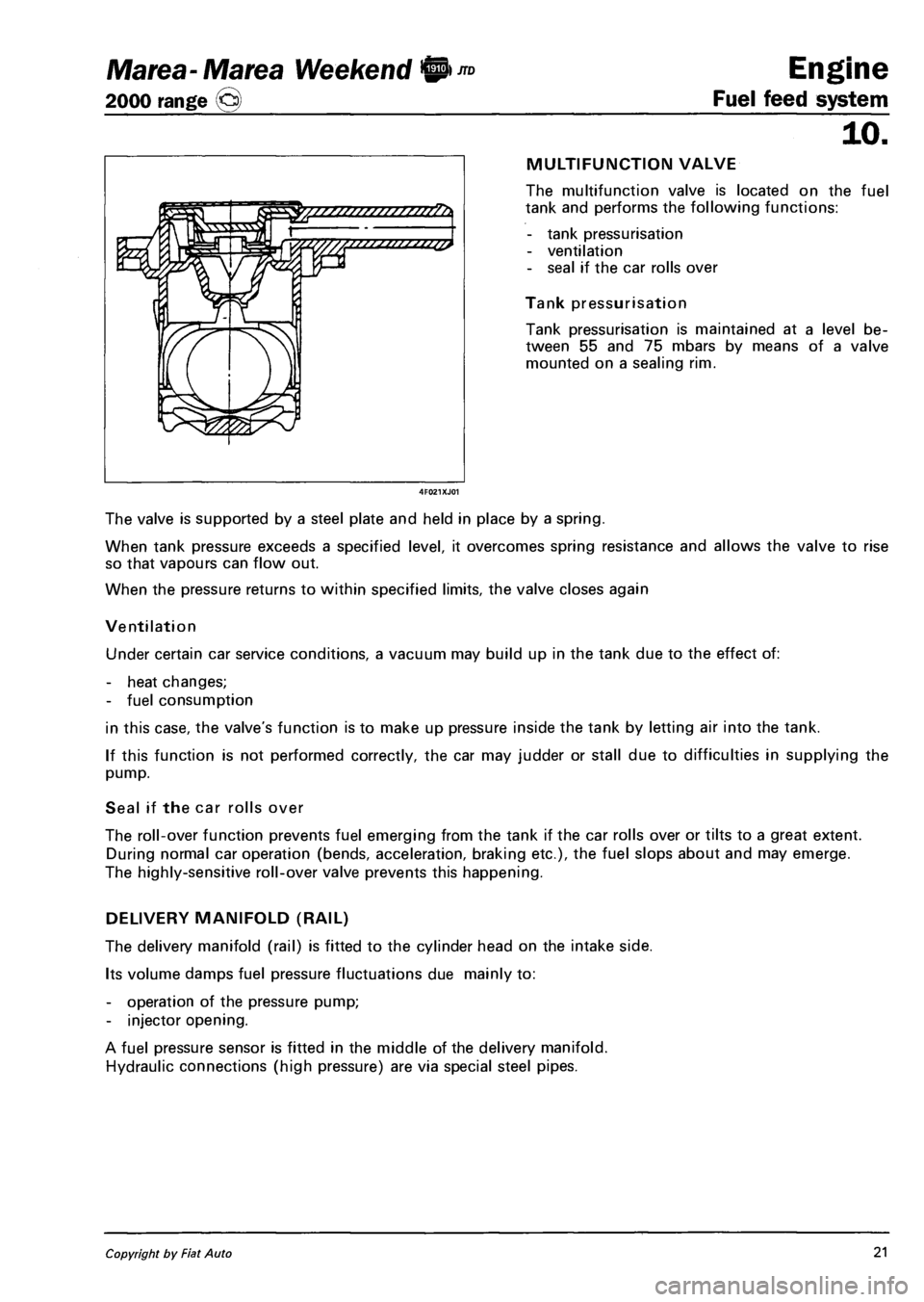
MULTIFUNCTION VALVE
The multifunction valve is located on the fuel
tank and performs the following functions:
- tank pressurisation
- ventilation
- seal if the car rolls over
Tank pressurisation
Tank pressurisation is maintained at a level be
tween 55 and 75 mbars by means of a valve
mounted on a sealing rim.
The valve is supported by a steel plate and held in place by a spring.
When tank pressure exceeds a specified level, it overcomes spring resistance and allows the valve to rise
so that vapours can flow out.
When the pressure returns to within specified limits, the valve closes again
Ventilation
Under certain car service conditions, a vacuum may build up in the tank due to the effect of:
- heat changes;
- fuel consumption
in this case, the valve's function is to make up pressure inside the tank by letting air into the tank.
If this function is not performed correctly, the car may judder or stall due to difficulties in supplying the
pump.
Seal if the car rolls over
The roll-over function prevents fuel emerging from the tank if the car rolls over or tilts to a great extent.
During normal car operation (bends, acceleration, braking etc.), the fuel slops about and may emerge.
The highly-sensitive roll-over valve prevents this happening.
DELIVERY MANIFOLD (RAIL)
The delivery manifold (rail) is fitted to the cylinder head on the intake side.
Its volume damps fuel pressure fluctuations due mainly to:
- operation of the pressure pump;
- injector opening.
A fuel pressure sensor is fitted in the middle of the delivery manifold.
Hydraulic connections (high pressure) are via special steel pipes.
Copyright by Fiat Auto 21
Page 109 of 330
Marea-Marea Weekend 9 Engine
2000 range ©) Fuel feed system
10.
AIR INTAKE CIRCUIT
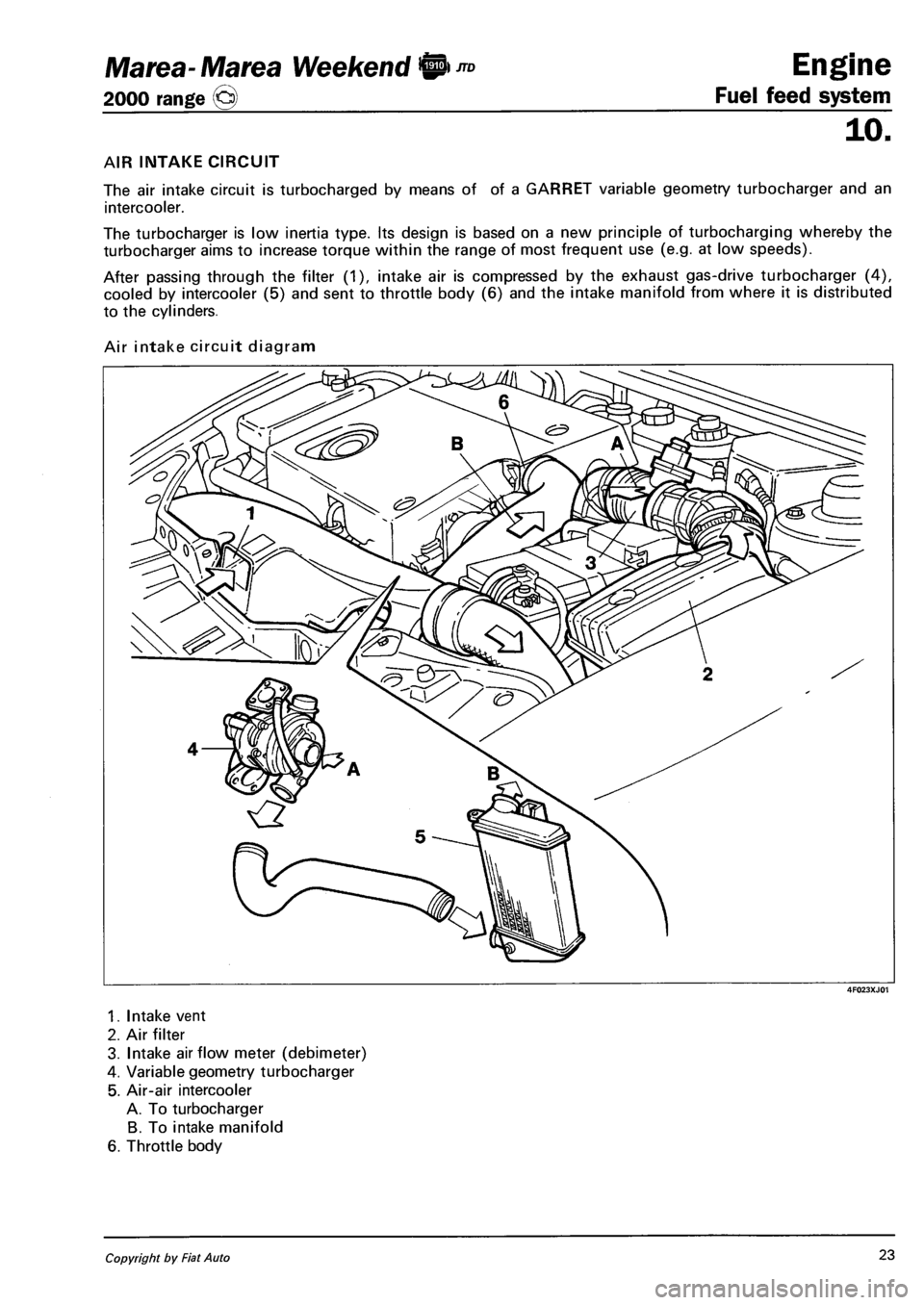
The air intake circuit is turbocharged by means of of a GARRET variable geometry turbocharger and an
intercooler.
The turbocharger is low inertia type. Its design is based on a new principle of turbocharging whereby the
turbocharger aims to increase torque within the range of most frequent use (e.g. at low speeds).
After passing through the filter (1), intake air is compressed by the exhaust gas-drive turbocharger (4),
cooled by intercooler (5) and sent to throttle body (6) and the intake manifold from where it is distributed
to the cylinders.
Air intake circuit diagram
4F023XJ01
1. Intake vent
2. Air filter
3. Intake airflow meter (debimeter)
4. Variable geometry turbocharger
5. Air-air intercooler
A. To turbocharger
B. To intake manifold
6. Throttle body
Copyright by Fiat Auto 23
Page 110 of 330
Engine Marea- Marea Weekend 9*nD
Fuel feed system 2000 range (§)
10.
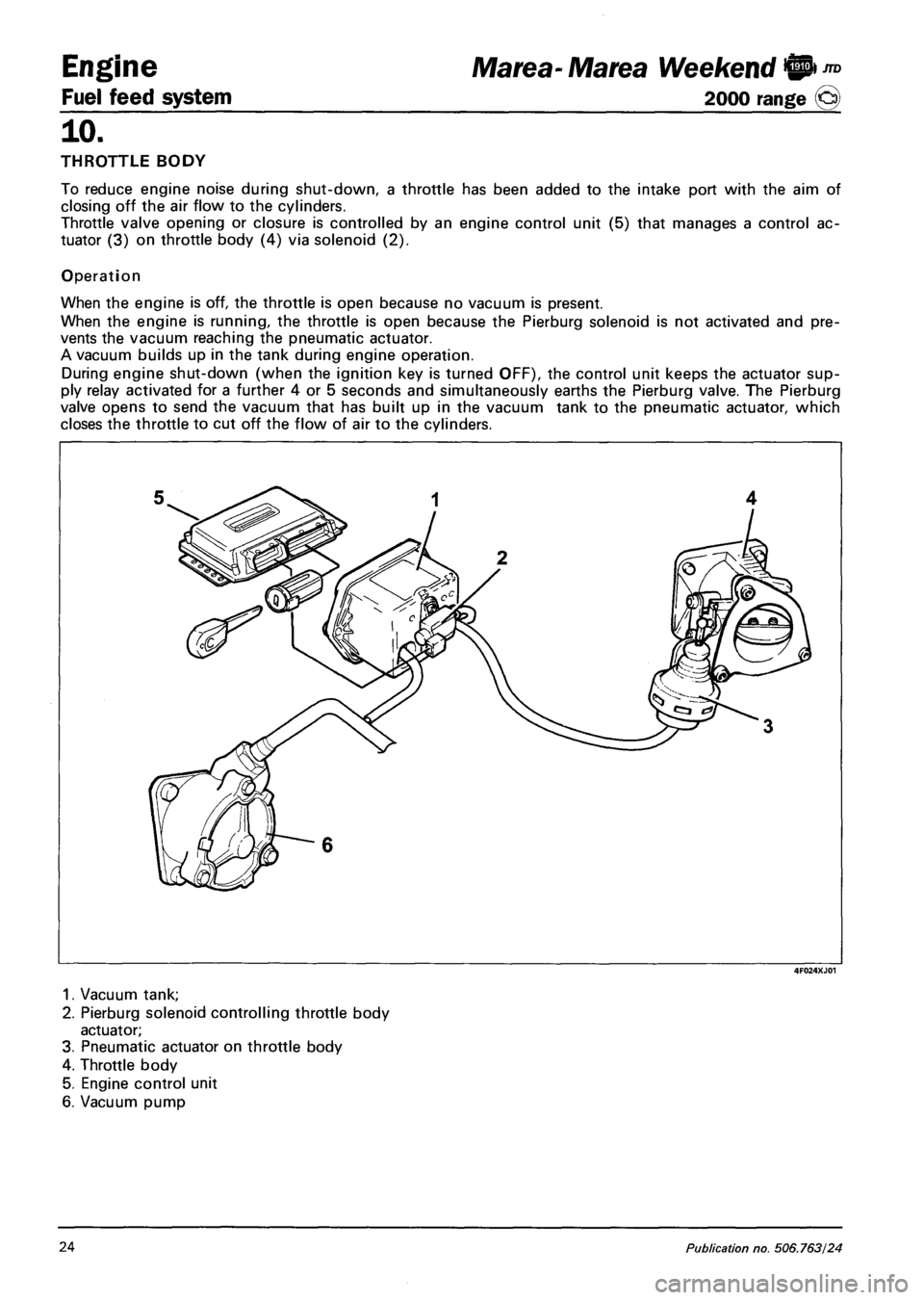
THROTTLE BODY
To reduce engine noise during shut-down, a throttle has been added to the intake port with the aim of
closing off the air flow to the cylinders.
Throttle valve opening or closure is controlled by an engine control unit (5) that manages a control ac
tuator (3) on throttle body (4) via solenoid (2).
Operation
When the engine is off, the throttle is open because no vacuum is present.
When the engine is running, the throttle is open because the Pierburg solenoid is not activated and pre
vents the vacuum reaching the pneumatic actuator.
A vacuum builds up in the tank during engine operation.
During engine shut-down (when the ignition key is turned OFF), the control unit keeps the actuator sup
ply relay activated for a further 4 or 5 seconds and simultaneously earths the Pierburg valve. The Pierburg
valve opens to send the vacuum that has built up in the vacuum tank to the pneumatic actuator, which
closes the throttle to cut off the flow of air to the cylinders.
4F024XJ01
1. Vacuum tank;
2. Pierburg solenoid controlling throttle body
actuator;
3. Pneumatic actuator on throttle body
4. Throttle body
5. Engine control unit
6. Vacuum pump
24 Publication no. 506.763/24
Page 111 of 330
Marea- Marea Weekend 9
2000 range ©
Engine
Fuel feed system
10.
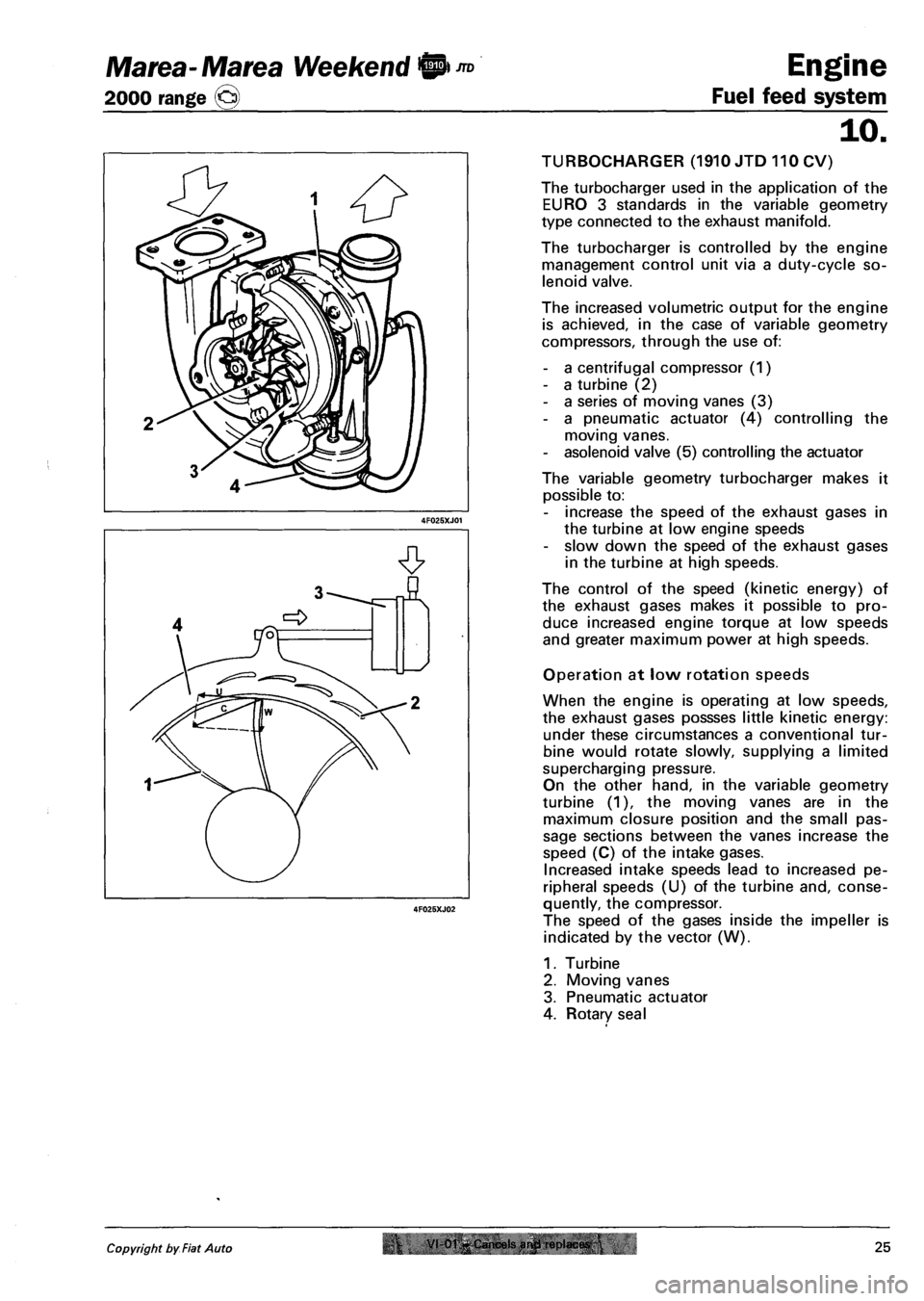
TURBOCHARGER (1910 JTD 110 CV)
The turbocharger used in the application of the
EURO 3 standards in the variable geometry
type connected to the exhaust manifold.
The turbocharger is controlled by the engine
management control unit via a duty-cycle so
lenoid valve.
The increased volumetric output for the engine
is achieved, in the case of variable geometry
compressors, through the use of:
- a centrifugal compressor (1)
- a turbine (2)
- a series of moving vanes (3)
- a pneumatic actuator (4) controlling the
moving vanes.
- asolenoid valve (5) controlling the actuator
The variable geometry turbocharger makes it
possible to:
- increase the speed of the exhaust gases in
the turbine at low engine speeds
- slow down the speed of the exhaust gases
in the turbine at high speeds.
The control of the speed (kinetic energy) of
the exhaust gases makes it possible to pro
duce increased engine torque at low speeds
and greater maximum power at high speeds.
Operation at low rotation speeds
When the engine is operating at low speeds,
the exhaust gases possses little kinetic energy:
under these circumstances a conventional tur
bine would rotate slowly, supplying a limited
supercharging pressure.
On the other hand, in the variable geometry
turbine (1), the moving vanes are in the
maximum closure position and the small pas
sage sections between the vanes increase the
speed (C) of the intake gases.
Increased intake speeds lead to increased pe
ripheral speeds (U) of the turbine and, conse
quently, the compressor.
The speed of the gases inside the impeller is
indicated by the vector (W).
1. Turbine
2. Moving vanes
3. Pneumatic actuator
4. Rotary seal
Copyright by Fiat Auto r VI-01-Cancels arwl replaces.25
Page 113 of 330
Marea- Marea Weekend 0 *° Engine
2000 range @ Fuel feed system
10.
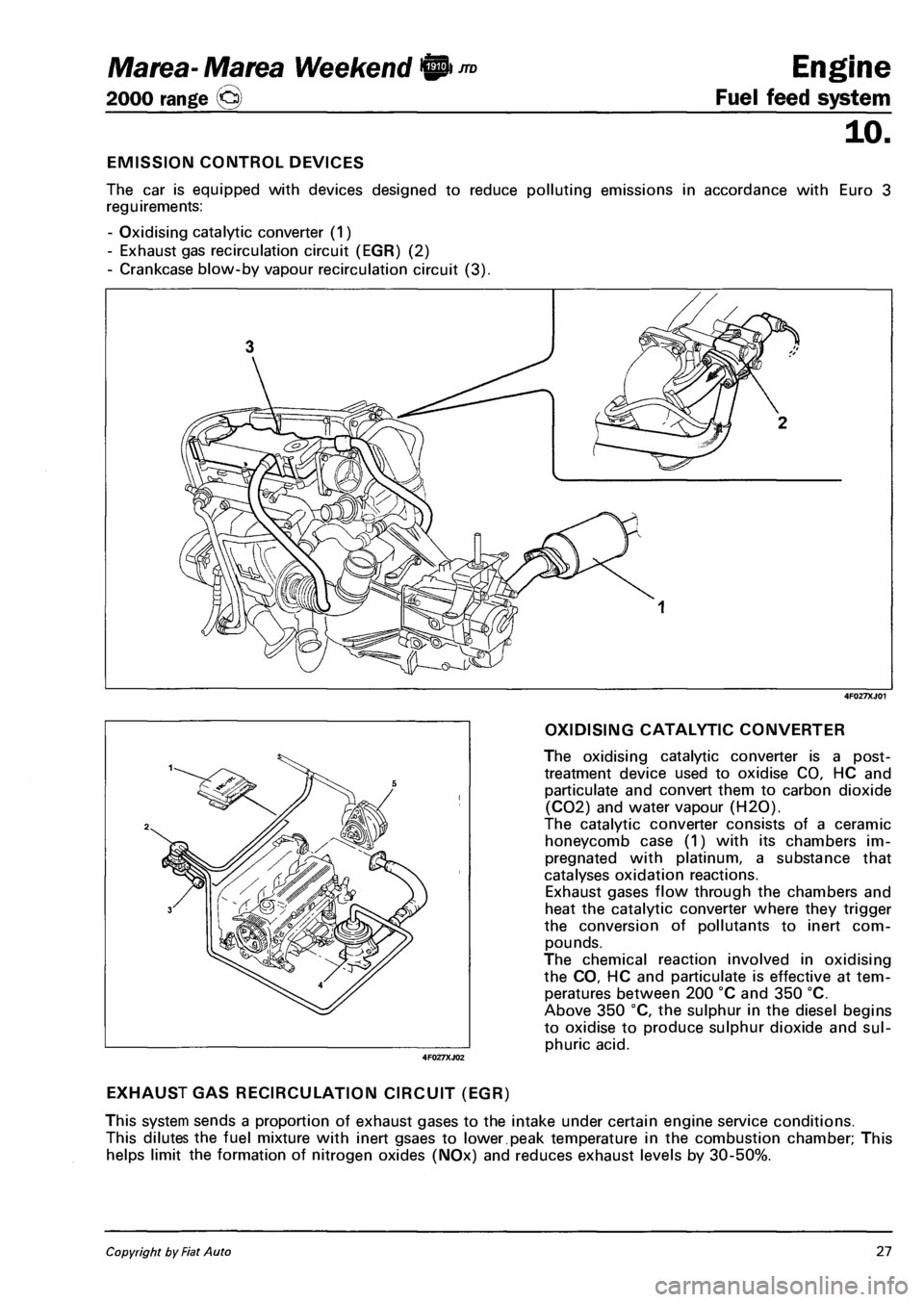
EMISSION CONTROL DEVICES
The car is equipped with devices designed to reduce polluting emissions in accordance with Euro 3
reguirements:
- Oxidising catalytic converter (1)
- Exhaust gas recirculation circuit (EGR) (2)
- Crankcase blow-by vapour recirculation circuit (3).
4F027XJ01
OXIDISING CATALYTIC CONVERTER
The oxidising catalytic converter is a post-
treatment device used to oxidise CO, HC and
particulate and convert them to carbon dioxide
(C02) and water vapour (H20).
The catalytic converter consists of a ceramic
honeycomb case (1) with its chambers im
pregnated with platinum, a substance that
catalyses oxidation reactions.
Exhaust gases flow through the chambers and
heat the catalytic converter where they trigger
the conversion of pollutants to inert com
pounds.
The chemical reaction involved in oxidising
the CO, HC and particulate is effective at tem
peratures between 200 °C and 350 °C.
Above 350 °C, the sulphur in the diesel begins
to oxidise to produce sulphur dioxide and sul
phuric acid.
EXHAUST GAS RECIRCULATION CIRCUIT (EGR)
This system sends a proportion of exhaust gases to the intake under certain engine service conditions.
This dilutes the fuel mixture with inert gsaes to lower.peak temperature in the combustion chamber; This
helps limit the formation of nitrogen oxides (NOx) and reduces exhaust levels by 30-50%.
4F027XJ02
Copyright by Fiat Auto 27
Page 114 of 330
Engine Marea- Marea Weekend IP ™
Fuel feed system 2000 range o
10.
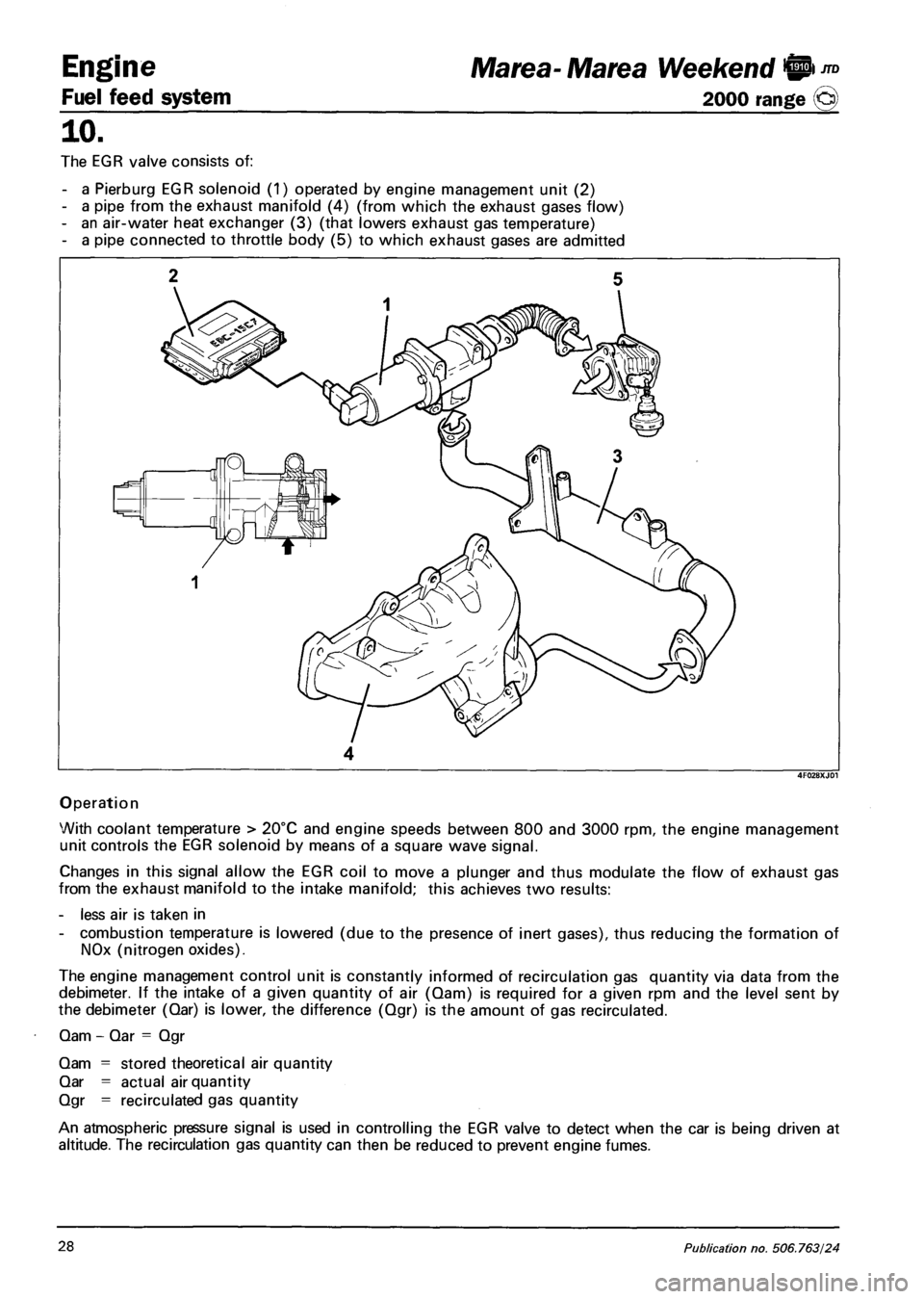
The EGR valve consists of:
- a Pierburg EGR solenoid (1) operated by engine management unit (2)
- a pipe from the exhaust manifold (4) (from which the exhaust gases flow)
- an air-water heat exchanger (3) (that lowers exhaust gas temperature)
- a pipe connected to throttle body (5) to which exhaust gases are admitted
4
Operation
With coolant temperature > 20°C and engine speeds between 800 and 3000 rpm, the engine management
unit controls the EGR solenoid by means of a square wave signal.
Changes in this signal allow the EGR coil to move a plunger and thus modulate the flow of exhaust gas
from the exhaust manifold to the intake manifold; this achieves two results:
- less air is taken in
- combustion temperature is lowered (due to the presence of inert gases), thus reducing the formation of
NOx (nitrogen oxides).
The engine management control unit is constantly informed of recirculation gas quantity via data from the
debimeter. If the intake of a given quantity of air (Qam) is required for a given rpm and the level sent by
the debimeter (Qar) is lower, the difference (Qgr) is the amount of gas recirculated.
Qam - Qar = Qgr
Qam = stored theoretical air quantity
Qar = actual air quantity
Qgr = recirculated gas quantity
An atmospheric pressure signal is used in controlling the EGR valve to detect when the car is being driven at
altitude. The recirculation gas quantity can then be reduced to prevent engine fumes.
28 Publication no. 506.763/24
Page 115 of 330
Marea-Marea Weekend
2000 range (j§)
1
4F029XJ02
Engine
Fuel feed system
10.
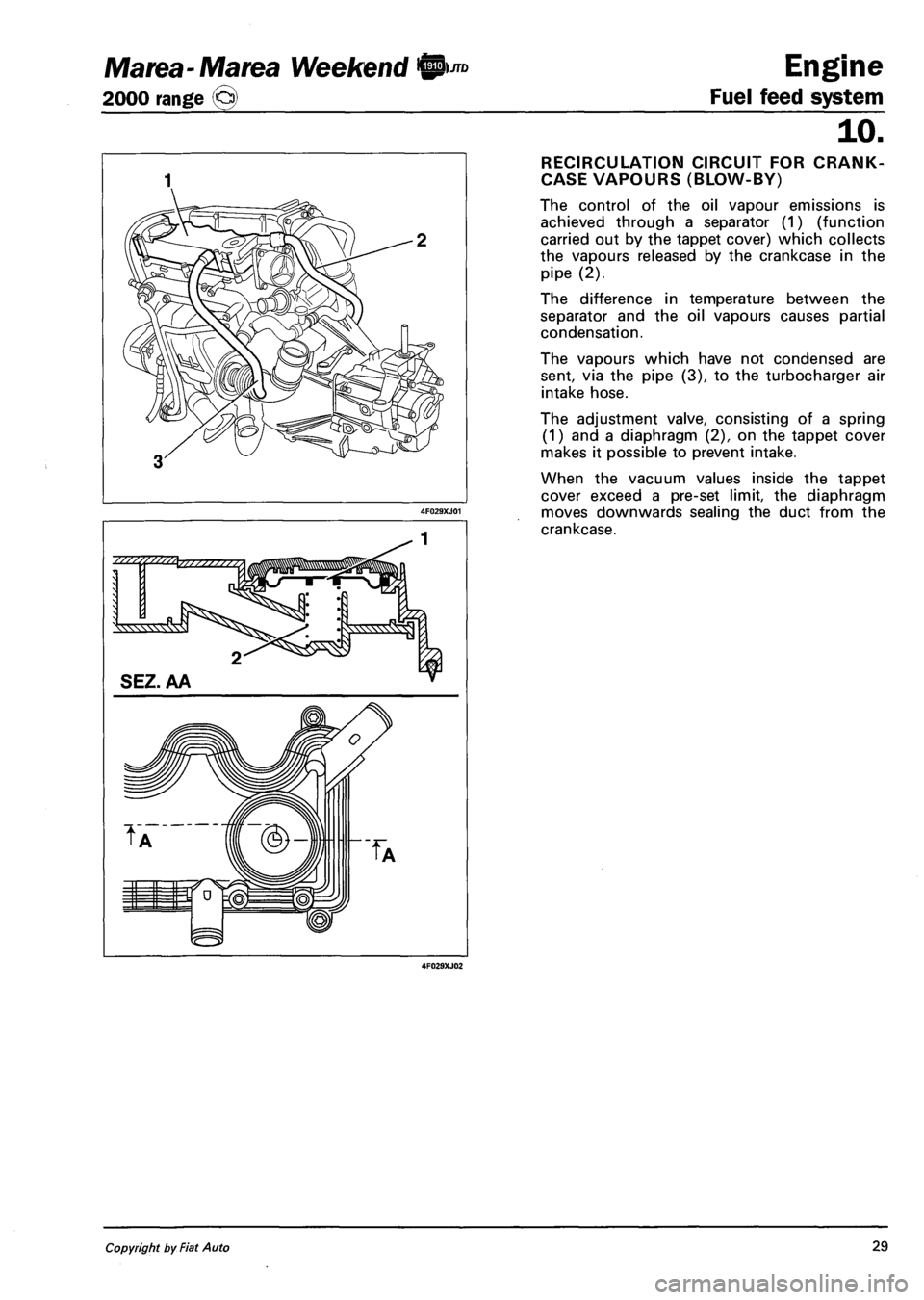
RECIRCULATION CIRCUIT FOR CRANK-
CASE VAPOURS (BLOW-BY)
The control of the oil vapour emissions is
achieved through a separator (1) (function
carried out by the tappet cover) which collects
the vapours released by the crankcase in the
pipe (2).
The difference in temperature between the
separator and the oil vapours causes partial
condensation.
The vapours which have not condensed are
sent, via the pipe (3), to the turbocharger air
intake hose.
The adjustment valve, consisting of a spring
(1) and a diaphragm (2), on the tappet cover
makes it possible to prevent intake.
When the vacuum values inside the tappet
cover exceed a pre-set limit, the diaphragm
moves downwards sealing the duct from the
crankcase.
Copyright by Fiat Auto 29
Page 116 of 330
Engine
Fuel feed system
Marea-Marea Weekend
2000 range ©
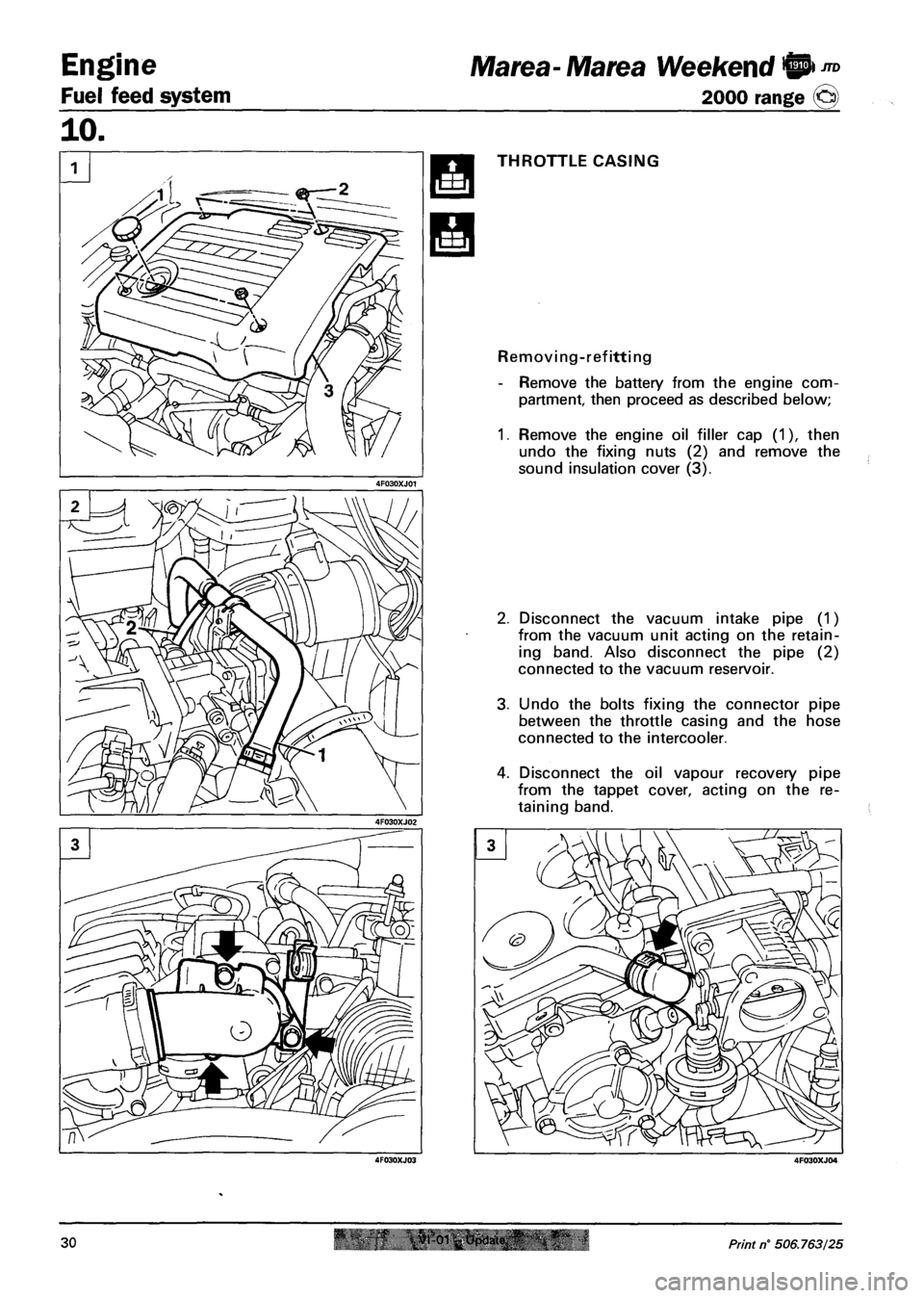
THROTTLE CASING
Removing-refitting
- Remove the battery from the engine com
partment, then proceed as described below;
1. Remove the engine oil filler cap (1), then
undo the fixing nuts (2) and remove the
sound insulation cover (3).
2. Disconnect the vacuum intake pipe (1)
from the vacuum unit acting on the retain
ing band. Also disconnect the pipe (2)
connected to the vacuum reservoir.
3. Undo the bolts fixing the connector pipe
between the throttle casing and the hose
connected to the intercooler.
4. Disconnect the oil vapour recovery pipe
from the tappet cover, acting on the re
taining band.
30 Print n° 506.763/25