intake FIAT MAREA 2000 1.G Workshop Manual
[x] Cancel search | Manufacturer: FIAT, Model Year: 2000, Model line: MAREA, Model: FIAT MAREA 2000 1.GPages: 330
Page 37 of 330
Technical Data Marea- Marea Weekend
Engine: cylinder head and valve gear components 2000 range (§)
OO.io
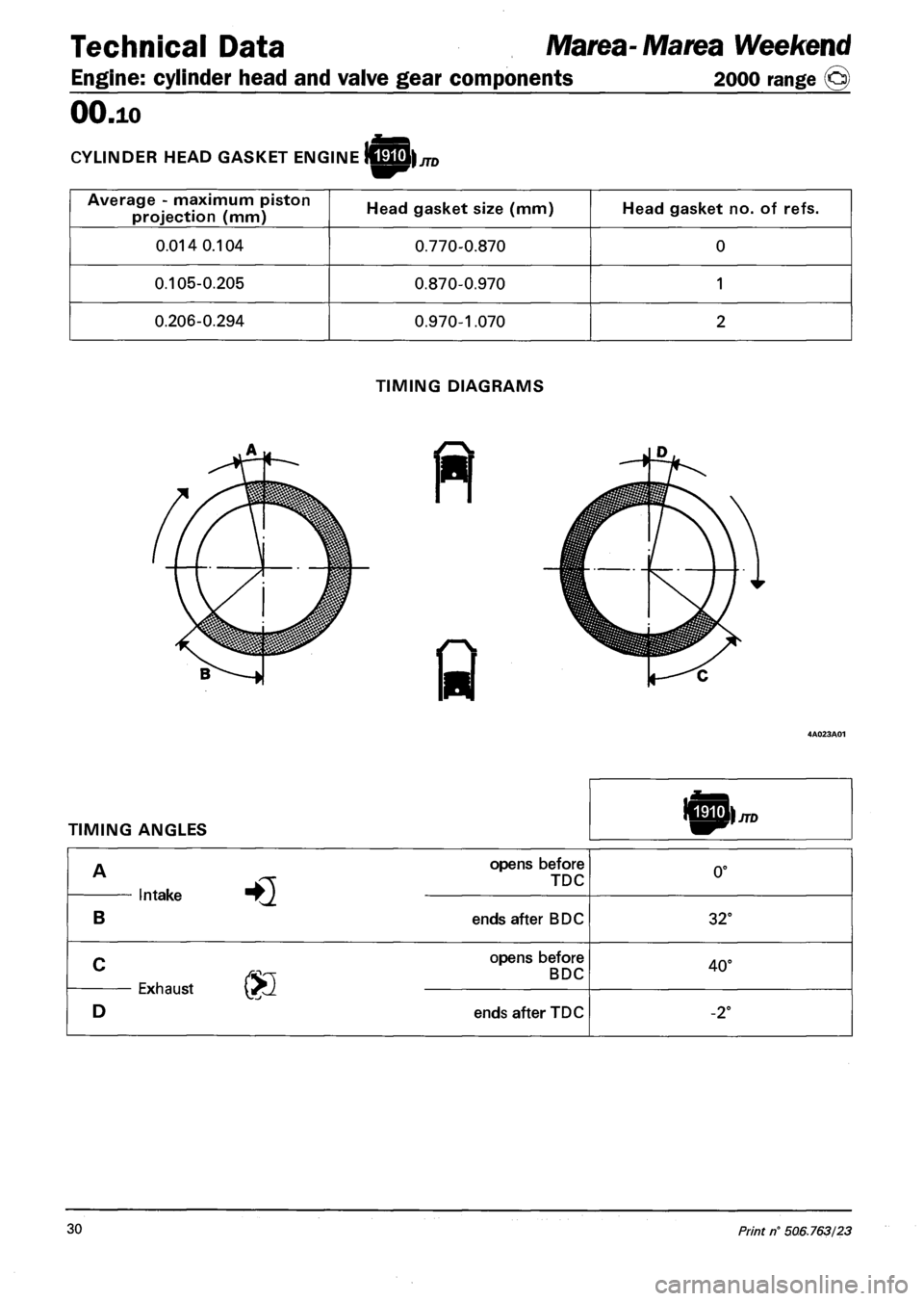
CYLINDER HEAD GASKET ENGINE ||£k JTD
Average - maximum piston
projection (mm) Head gasket size (mm) Head gasket no. of refs.
0.014 0.104 0.770-0.870 0
0.105-0.205 0.870-0.970 1
0.206-0.294 0.970-1.070 2
TIMING DIAGRAMS
ft
TIMING ANGLES JTD
Intake
B
opens before
TDC
ends after BDC
0°
32°
Exhaust ®
opens before
BDC
ends after TDC
40°
-2°
30 Print n° 506.763/23
Page 57 of 330
Technical Data Marea-Marea Weekend
Electrical equipment: electronic injection- ignition 2000 range ©)
00.55
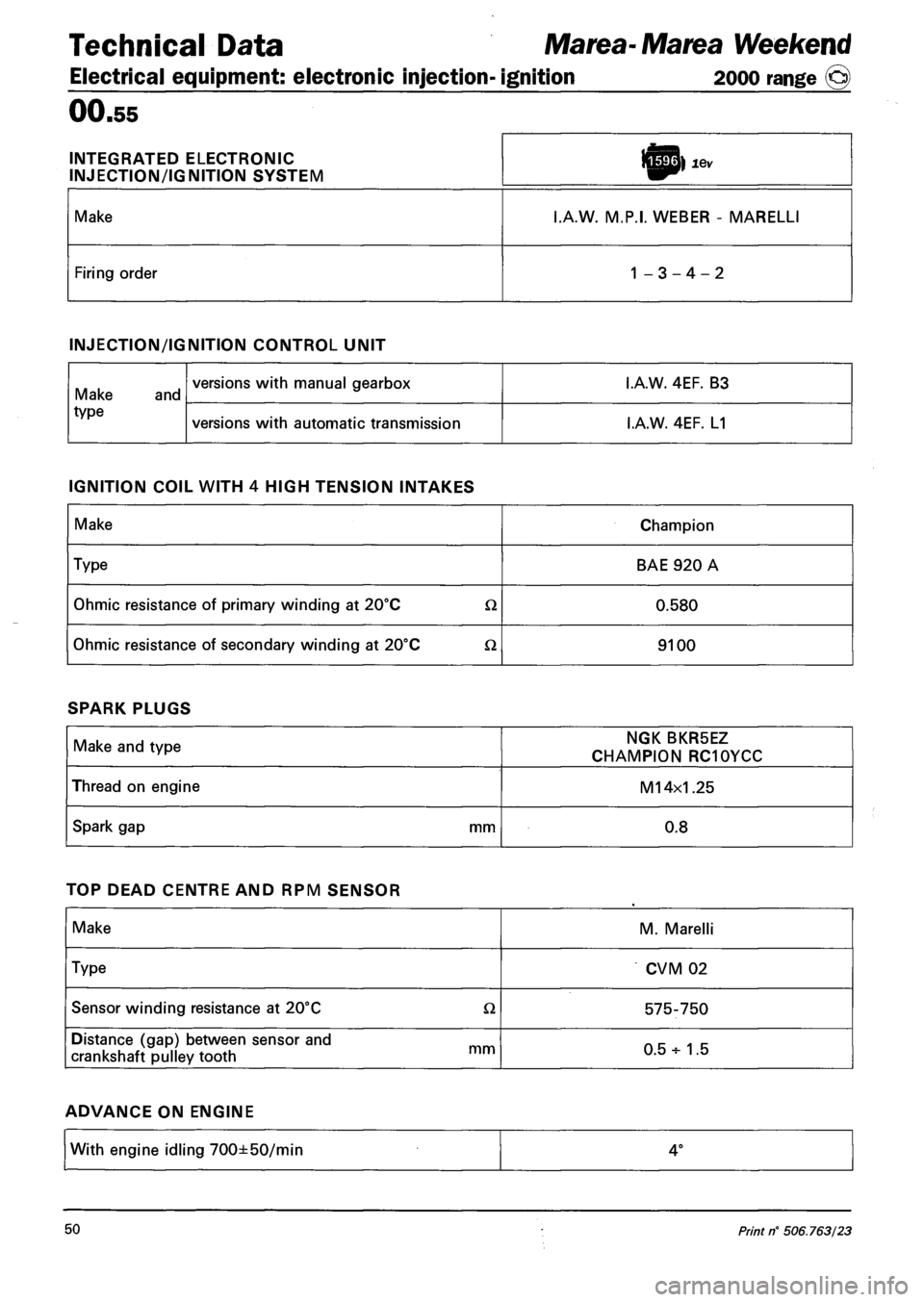
INTEGRATED ELECTRONIC
INJECTION/IGNITION SYSTEM r^p) lev
Make I.A.W. M.P.I. WEBER - MARELLI
Firing order 1-3-4-2
INJECTION/IGNITION CONTROL UNIT
Make and versions with manual gearbox I.A.W. 4EF. B3
type versions with automatic transmission I.A.W. 4EF. L1
IGNITION COIL WITH 4 HIGH TENSION INTAKES
Make Champion
Type BAE 920 A
Ohmic resistance of primary winding at 20°C Q 0.580
Ohmic resistance of secondary winding at 20°C Q 9100
SPARK PLUGS
Make and type NGK BKR5EZ
CHAMPION RC10YCC
Thread on engine M14x1.25
Spark gap mm 0.8
TOP DEAD CENTRE AND RPM SENSOR
Make M. Marelli
Type CVM 02
Sensor winding resistance at 20°C Q 575-750
Distance (gap) between sensor and
crankshaft pulley tooth 0.5 + 1.5
ADVANCE ON ENGINE
With engine idling 700±50/min 4°
50 Print n° 506.763/23
Page 70 of 330
Engine
Fuel feed system
Marea- Marea Weekend
2000 range @
10.
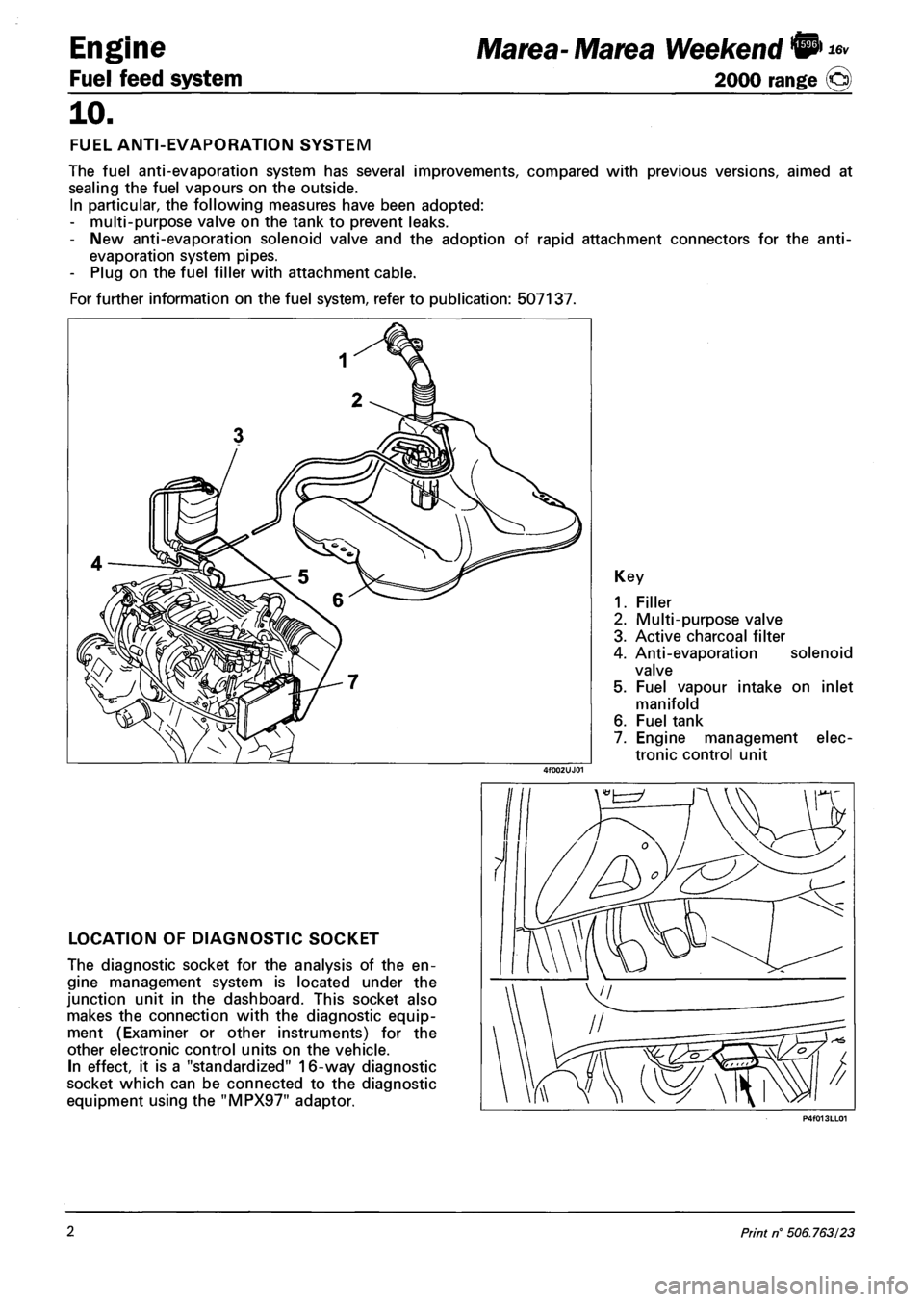
FUEL ANTI-EVAPORATION SYSTEM
The fuel anti-evaporation system has several improvements, compared with previous versions, aimed at
sealing the fuel vapours on the outside.
In particular, the following measures have been adopted:
- multi-purpose valve on the tank to prevent leaks.
- New anti-evaporation solenoid valve and the adoption of rapid attachment connectors for the anti-
evaporation system pipes.
- Plug on the fuel filler with attachment cable.
For further information on the fuel system, refer to publication: 507137.
Key
1. Filler
2. Multi-purpose valve
3. Active charcoal filter
4. Anti-evaporation solenoid
valve
5. Fuel vapour intake on inlet
manifold
6. Fuel tank
7. Engine management elec
tronic control unit
LOCATION OF DIAGNOSTIC SOCKET
The diagnostic socket for the analysis of the en
gine management system is located under the
junction unit in the dashboard. This socket also
makes the connection with the diagnostic equip
ment (Examiner or other instruments) for the
other electronic control units on the vehicle.
In effect, it is a "standardized" 16-way diagnostic
socket which can be connected to the diagnostic
equipment using the "MPX97" adaptor.
2 Print n° 506.763/23
Page 71 of 330
Marea- Marea Weekend 9* Engine
2000 range (Q) Fuel feed system
10.
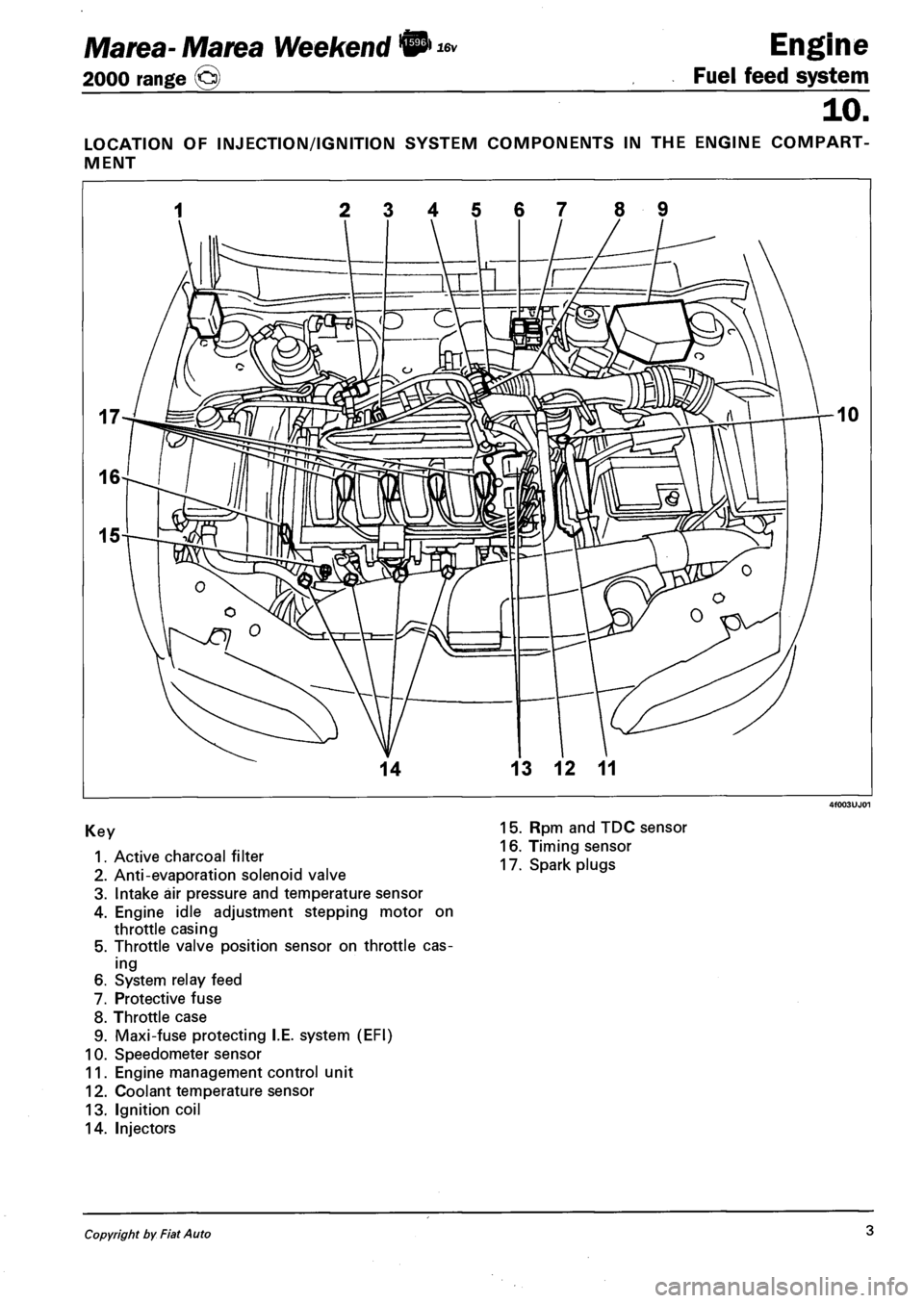
LOCATION OF INJECTION/IGNITION SYSTEM COMPONENTS IN THE ENGINE COMPART
MENT
1 2345678 9
Key
1. Active charcoal filter
2. Anti-evaporation solenoid valve
3. Intake air pressure and temperature sensor
4. Engine idle adjustment stepping motor on
throttle casing
5. Throttle valve position sensor on throttle cas
ing
6. System relay feed
7. Protective fuse
8. Throttle case
9. Maxi-fuse protecting I.E. system (EFI)
10. Speedometer sensor
11. Engine management control unit
12. Coolant temperature sensor
13. Ignition coil
14. Injectors
15. Rpm and TDC sensor
16. Timing sensor
17. Spark plugs
Copyright by Fiat Auto 3
Page 91 of 330
![FIAT MAREA 2000 1.G Workshop Manual Marea-Marea Weekend 9]
2000 range (j§)
I) JTD
Fuel feed system
Engine
10.
Exhaust fumes control
Through this function the injection control unit limits any exhaust fumes that could be produce](/img/10/4653/w960_4653-90.png "FIAT MAREA 2000 1.G Workshop Manual Marea-Marea Weekend 9]
2000 range (j§)
I) JTD
Fuel feed system
Engine
10.
Exhaust fumes control
Through this function the injection control unit limits any exhaust fumes that could be produce")
Marea-Marea Weekend 9]
2000 range (j§)
I) JTD
Fuel feed system
Engine
10.
Exhaust fumes control
Through this function the injection control unit limits any exhaust fumes that could be produced during
transition speeds.
To satisy these requirements the control unit processes the signals supplied by the accelerator pedal po
tentiometer, the rpm sensor and the air flow meter and controls the fuel pressure regulator and the injec
tors to meter the correct amount of fuel to inject.
Exhaust gas recirculation control
On the basis of the signals supplied by the rpm sensor, intake air quantity sensor, engine coolant tempe
rature sensor and accelerator pedal position sensor, the control unit calculates the operating times for the
EGR valve so that the exhaust gases are partly recirculated in certain engine operating conditions in line
with Euro 3 pollution control standards.
Air conditioning system engagement control
The injection control unit manages the operation of the air conditioning system compressor electro
magnet coupling following a logic aimed at preventing operating conditions that would adversely affect
engine performance.
- When the compressor is switched on the injection control unit increases the quantity of fuel during
idling to allow the engine to adjust to the increased power requirements and momentarily interrupts the
supply to the compressor in high engine power requirement conditions (strong acceleration).
Engine immobilizer function control
The system is equipped with an engine immobilizer function. This function is achieved through the pre
sence of a specific control unit (Fiat CODE), capable of conversing with the injection control unit and an
electronic key with a special transmitter for sending a recognition code.
Each time the key is turned to the OFF position, the Fiat CODE system completely deactivates the injecti
on control unit.
When the key is turned to the ON position the following operations take place, in order:
1. the injection control unit (whose memory contains a secret code) sends the Fiat CODE control unit a
request to send the secret code to deactivate the immobilizer functions;
2. the Fiat CODE control unit responds by only sending the secret code after, in turn, having received the
recognition code transmitted by the ignition key;
3. the recognition of the secret code allows the deactivation of the injection control unit immobilizer func
tion and its normal operation.
Autodiagnosis
The complete electronic fault diagnosis of the injection system is carried out by connecting the special
equipment (EXAMINER or EXAMINER PLUS) to the standardized diagnostic socket (EOBD).
The system is also equipped with a self-diagnostic function which recognizes, memorizes and signals any
faults.
If a fault is detected in the sensors or actuators, the recovery strategy is immediately activated in order to
ensure that the engine functions at an acceptable level. The vehicle can be driven to a service centre for
the appropriate repairs to be carried out.
Copyright by Fiat Auto 5
Page 92 of 330
Fuel feed system
Engine Marea- Marea Weekend © ™
2000 range @
10.
The control unit autodiagnostic system checks the signals coming from the sensors and compares them
with the figures allowed:
- signalling faults during starting
- warning light on for 4 seconds indicates test stage
- warning light off after 4 seconds indicates no fault with components that could alter the pollution con
trol standard figures
- warning light on after 4 seconds indicates fault.
- signalling faults during operation
- warning light on indicates fault
- warning light off indicates no fault with components that could alter the pollution control standard fig
ures.
- recovery
- from time to time, the control unit defines the type of recovery according to the components which are
faulty
- the recovery parameters are managed by components which are not faulty.
Control of cylinder balancing during idling
According to the signals coming from the sensors, the injection control unit controls the idle speed torque,
altering the injector operating times.
Control of irregular operation
Depending on the signals coming from the sensors, the injection control unit corrects the amount of fuel
to be injected in order to improve driveability and reduce jerking whilst driving.
The correction is achieved through the fuel pressure regulator and by varying the injector operating times.
Control of electrical balance
According to the battery voltage, the injection control unit alters the idle speed, to guarantee a sufficient
current supply from the alternator in situations where the consumers are absorbing a great deal of power.
The variation in the idle speed is achived by regulating the fuel pressure and altering the injector operat
ing times.
VGT variable geometry turbocharger control (1910 JTD 110 CV)
The injection control unit processes the signal coming from the supercharging sensor, at the various en
gine operating speeds, and determines the quantity of fuel to be injected, acting on the fuel pressure
regulator and the injector opening times.
In addition, through the solenoid valve, the control unit regulates the geometry of the turbine in order to
ensure optimum performance in all operating conditions.
Turbocharger waste gate valve control (1910 JTD 100 CV)
At the various engine operating speeds, the injection control unit processes the signal coming from the
supercharging sensor and determines the amount of fuel to inject, acting on the fuel pressure regulator
and the injector opening times.
In addition, the control unit controls the opening of the turbocharger waste gate valve, via the solenoid
valve, in order to ensure excellent performance in all operating conditions.
Control of throttle closing when engine is switched off
When the engine is switched off (ignition key in OFF position) the injection control unit closes the throt
tle valve located on the air intake duct via the special solenoid valve.
This action makes it possible to limit the tiresome shuddering of the engine whilst it is switching off.
6 .i. V!-01-.Cancelftand replaces Print n° 506.763/25
Page 93 of 330
Marea- Marea Weekend 9 ™
2000 range ©
Engine
Fuel feed system
10.
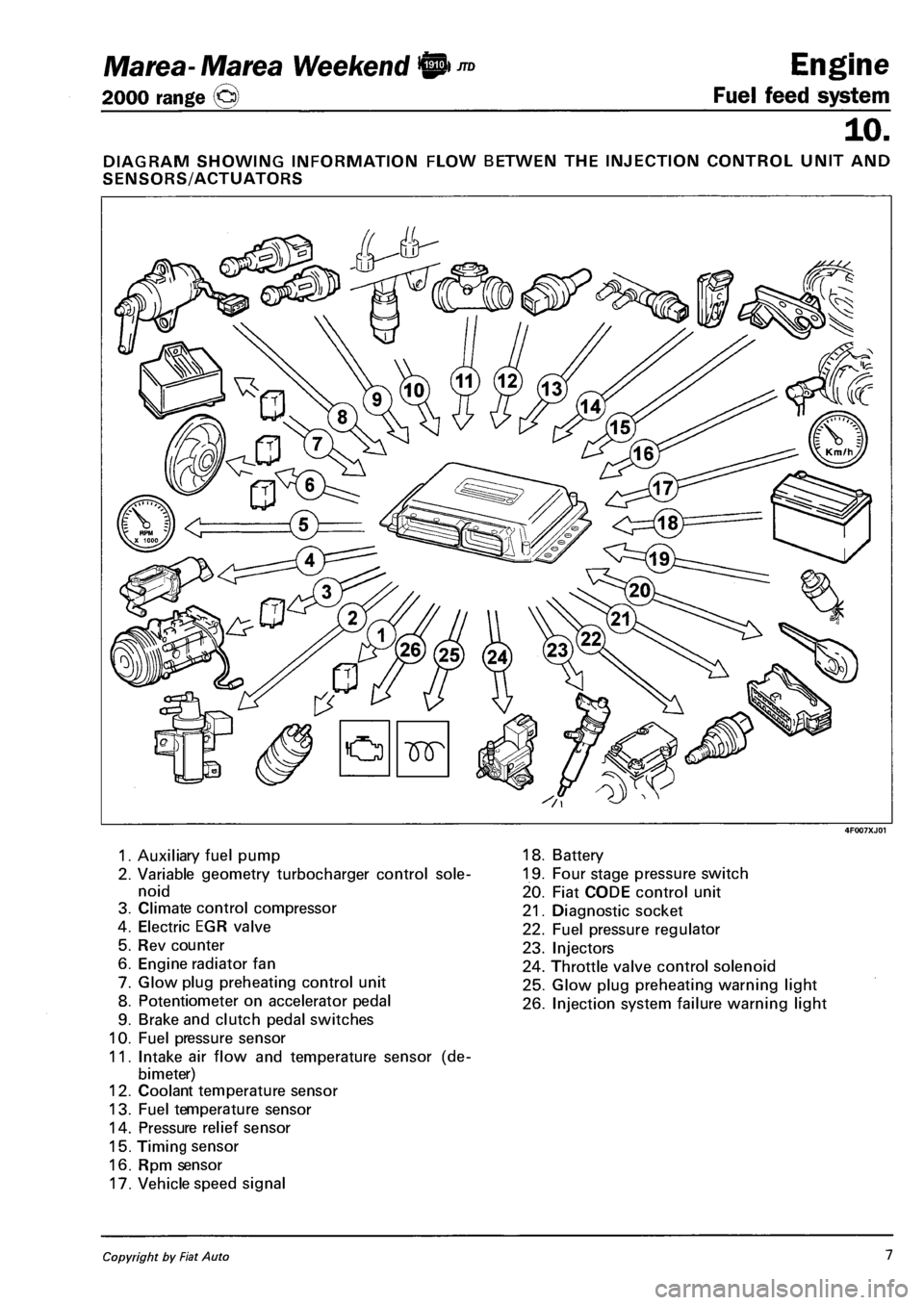
DIAGRAM SHOWING INFORMATION FLOW BETWEN THE INJECTION CONTROL UNIT AND
SENSORS/ACTUATORS
1. Auxiliary fuel pump
2. Variable geometry turbocharger control sole
noid
3. Climate control compressor
4. Electric EGR valve
5. Rev counter
6. Engine radiator fan
7. Glow plug preheating control unit
8. Potentiometer on accelerator pedal
9. Brake and clutch pedal switches
10. Fuel pressure sensor
11. Intake air flow and temperature sensor (de-
bimeter)
12. Coolant temperature sensor
13. Fuel temperature sensor
14. Pressure relief sensor
15. Timing sensor
16. Rpm sensor
17. Vehicle speed signal
18. Battery
19. Four stage pressure switch
20. Fiat CODE control unit
21. Diagnostic socket
22. Fuel pressure regulator
23. Injectors
24. Throttle valve control solenoid
25. Glow plug preheating warning light
26. Injection system failure warning light
Copyright by Fiat Auto 1
Page 95 of 330
Marea- Marea Weekend 9 ™
2000 range ©) Fuel feed system
Engine
10.
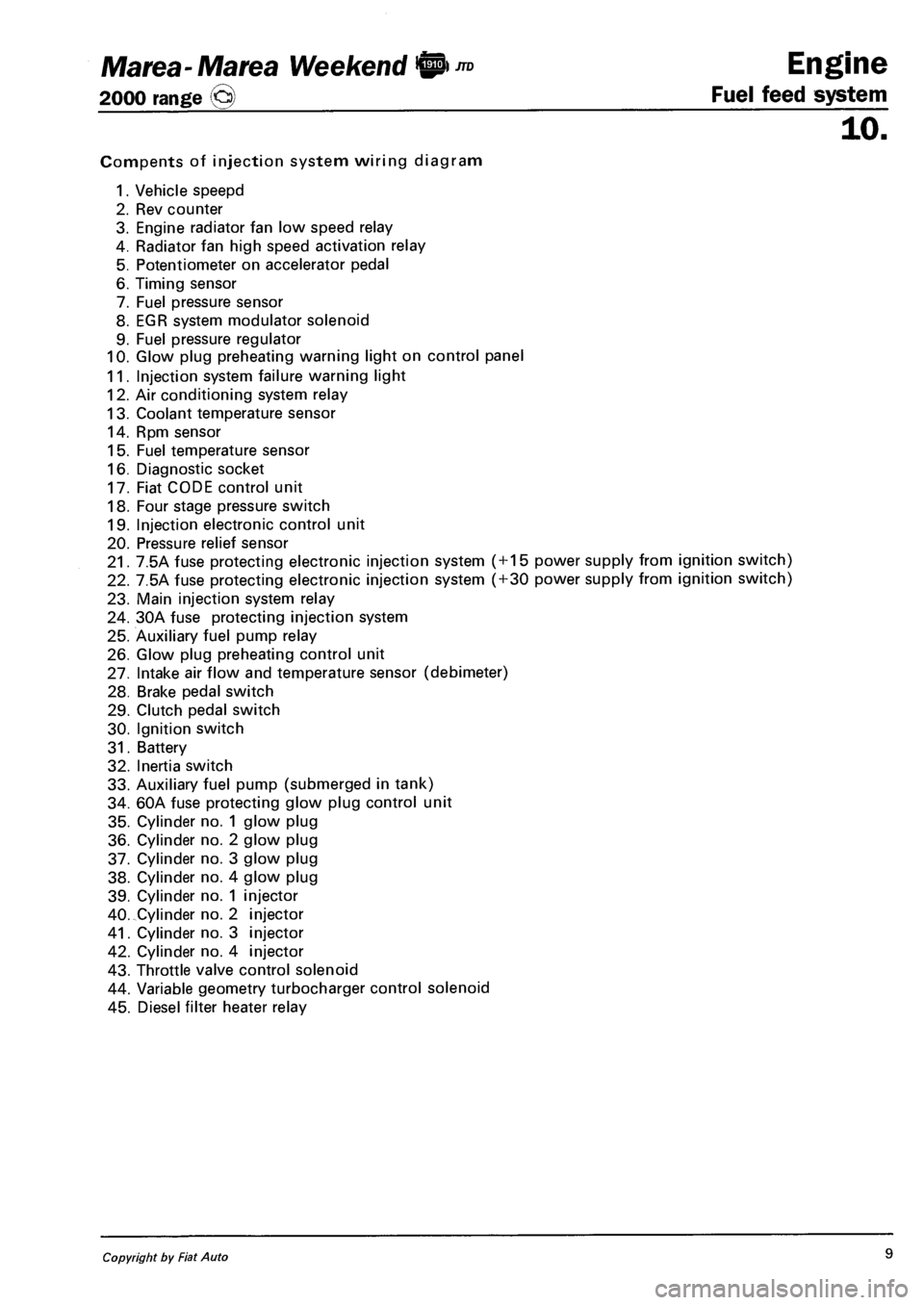
Compents of injection system wiring diagram
1. Vehicle speepd
2. Rev counter
3. Engine radiator fan low speed relay
4. Radiator fan high speed activation relay
5. Potentiometer on accelerator pedal
6. Timing sensor
7. Fuel pressure sensor
8. EGR system modulator solenoid
9. Fuel pressure regulator
10. Glow plug preheating warning light on control panel
11. Injection system failure warning light
12. Air conditioning system relay
13. Coolant temperature sensor
14. Rpm sensor
15. Fuel temperature sensor
16. Diagnostic socket
17. Fiat CODE control unit
18. Four stage pressure switch
19. Injection electronic control unit
20. Pressure relief sensor
21. 7.5A fuse protecting electronic injection system ( + 15 power supply from ignition switch)
22. 7.5A fuse protecting electronic injection system ( + 30 power supply from ignition switch)
23. Main injection system relay
24. 30A fuse protecting injection system
25. Auxiliary fuel pump relay
26. Glow plug preheating control unit
27. Intake air flow and temperature sensor (debimeter)
28. Brake pedal switch
29. Clutch pedal switch
30. Ignition switch
31. Battery
32. Inertia switch
33. Auxiliary fuel pump (submerged in tank)
34. 60A fuse protecting glow plug control unit
35. Cylinder no. 1 glow plug
36. Cylinder no. 2 glow plug
37. Cylinder no. 3 glow plug
38. Cylinder no. 4 glow plug
39. Cylinder no. 1 injector
40. Cylinder no. 2 injector
41. Cylinder no. 3 injector
42. Cylinder no. 4 injector
43. Throttle valve control solenoid
44. Variable geometry turbocharger control solenoid
45. Diesel filter heater relay
Copyright by Fiat Auto 9
Page 99 of 330
Marea- Marea Weekend 9"°
2000 range ©
Engine
Fuel feed system
10.
TIMING SENSOR
The Hall effect sensor is fitted to the cylinder head and faces the camshaft pulley.
An opening on the pulley allows the timing sensor to detect the engine timing position and indicate it to
the injection control unit.
The injection control unit uses the timing sensor signal to detect TDC at the end of compression.
Operation
A semi-condulator layer, through which a current passes, immersed in a magnetic field (lines of force per
pendicular to the direction of the current), produces a difference in power, known as Hall voltage.
If the intensity of the current remains constant, the voltage produced only depends on the intensity of the
magnetic field. The intensity of the field can simply be altered periodically to produce a modulated electri
cal signal. Signal frequency is proportional to the speed with which the magnetic field changes.
To achieve this change, the sensor is crossed by a metal ring (inner part of the pulley) with an opening.
When it moves, the metal part of the ring covers the sensor to magnetic field and the output signal is
therefore low; Conversely, the sensor generates a high signal at the opening when the magnetic field is
present.
This signal, together with the rpm and TDC signals, allows the injection control unit to identify piston po
sition and determine injection point.
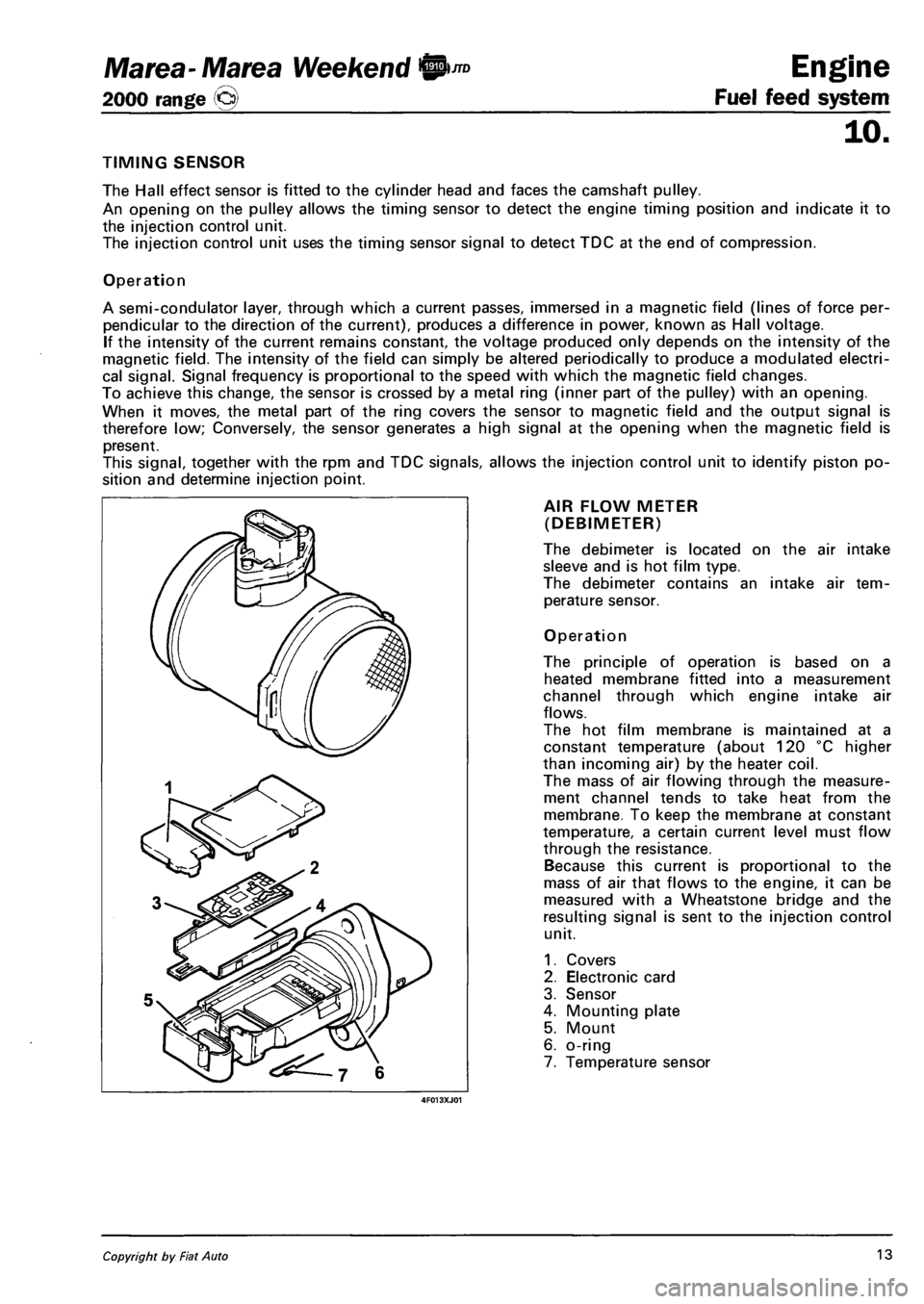
AIR FLOW METER
(DEBIMETER)
The debimeter is located on the air intake
sleeve and is hot film type.
The debimeter contains an intake air tem
perature sensor.
Operation
The principle of operation is based on a
heated membrane fitted into a measurement
channel through which engine intake air
flows.
The hot film membrane is maintained at a
constant temperature (about 120 °C higher
than incoming air) by the heater coil.
The mass of air flowing through the measure
ment channel tends to take heat from the
membrane. To keep the membrane at constant
temperature, a certain current level must flow
through the resistance.
Because this current is proportional to the
mass of air that flows to the engine, it can be
measured with a Wheatstone bridge and the
resulting signal is sent to the injection control
unit.
1. Covers
2. Electronic card
3. Sensor
4. Mounting plate
5. Mount
6. o-ring
7. Temperature sensor
Copyright by Fiat Auto 13
Page 103 of 330
Marea-Marea Weekend 9 -™ Engine
2000 range (j§) Fuel feed system
10.
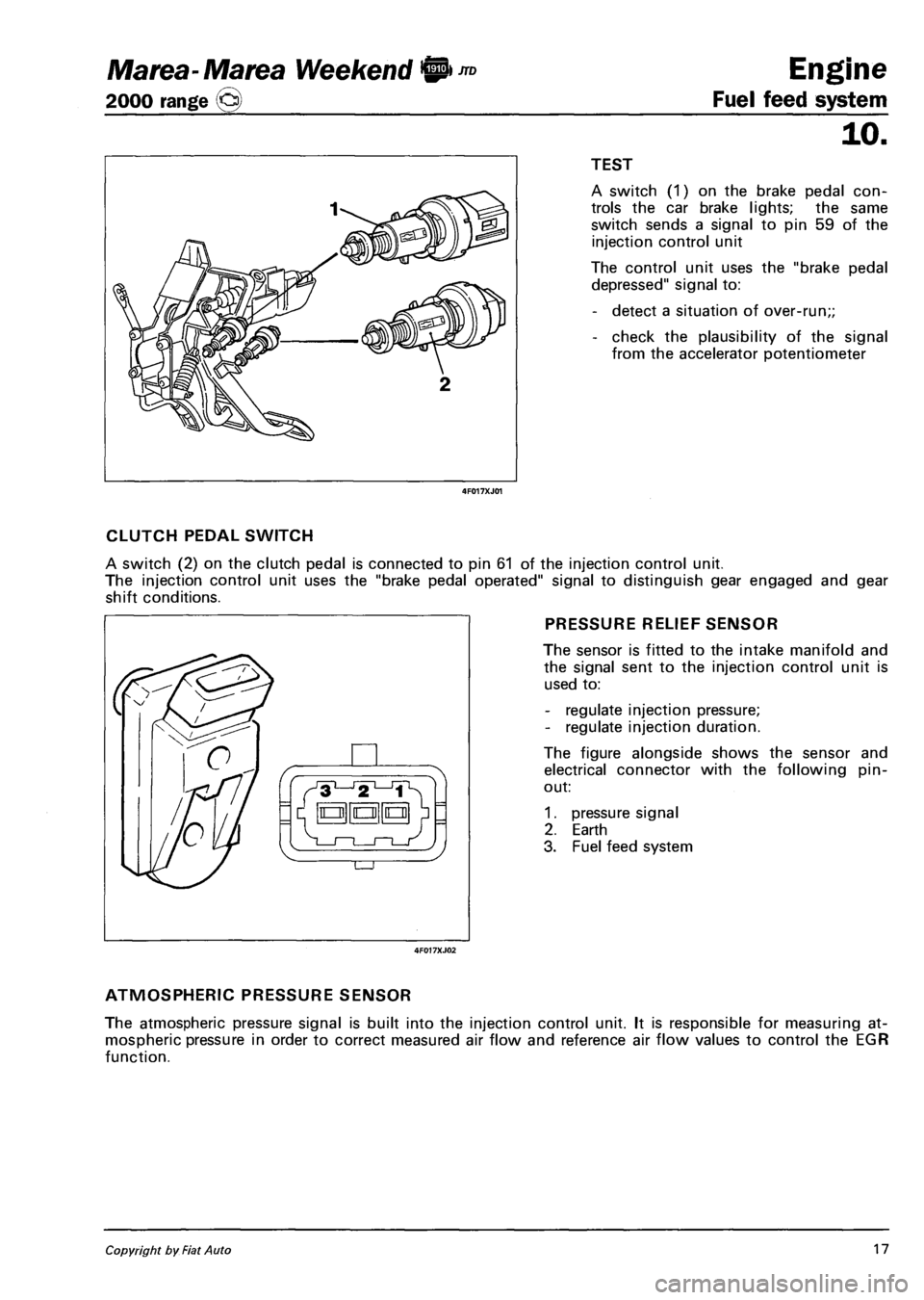
I I TEST
4F017XJ01
A switch (1) on the brake pedal con
trols the car brake lights; the same
switch sends a signal to pin 59 of the
injection control unit
The control unit uses the "brake pedal
depressed" signal to:
- detect a situation of over-run;;
- check the plausibility of the signal
from the accelerator potentiometer
CLUTCH PEDAL SWITCH
A switch (2) on the clutch pedal is connected to pin 61 of the injection control unit.
The injection control unit uses the "brake pedal operated" signal to distinguish gear engaged and gear
shift conditions.
PRESSURE RELIEF SENSOR
The sensor is fitted to the intake manifold and
the signal sent to the injection control unit is
used to:
- regulate injection pressure;
- regulate injection duration.
The figure alongside shows the sensor and
electrical connector with the following pin-
out:
1. pressure signal
2. Earth
3. Fuel feed system
ATMOSPHERIC PRESSURE SENSOR
The atmospheric pressure signal is built into the injection control unit. It is responsible for measuring at
mospheric pressure in order to correct measured air flow and reference air flow values to control the EGR
function.
Copyright by Fiat Auto 17