exhaust FIAT MAREA 2000 1.G Owner's Manual
[x] Cancel search | Manufacturer: FIAT, Model Year: 2000, Model line: MAREA, Model: FIAT MAREA 2000 1.GPages: 330
Page 112 of 330
Engine
Fuel feed system
JTD Marea- Marea Weekend 9
2000 range @
10.
Operation at high rotation speeds
When the engine speed is increased, the ki
netic energy of the exhaust gases increases
gradually.
As a result, the speed of the turbine (5) in
creases and consequently the supercharging
pressure.
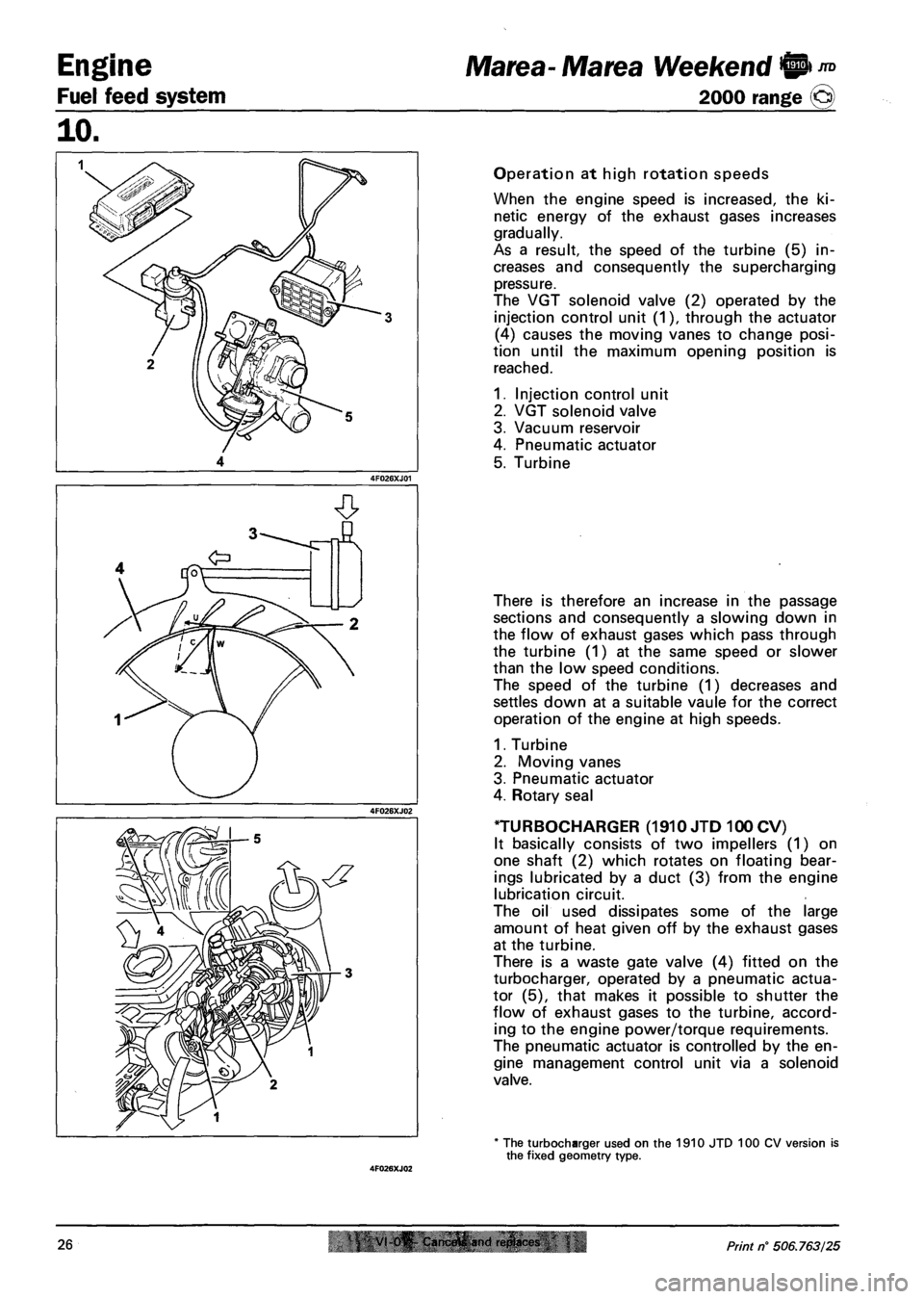
The VGT solenoid valve (2) operated by the
injection control unit (1), through the actuator
(4) causes the moving vanes to change posi
tion until the maximum opening position is
reached.
1. Injection control unit
2. VGT solenoid valve
3. Vacuum reservoir
4. Pneumatic actuator
5. Turbine
There is therefore an increase in the passage
sections and consequently a slowing down in
the flow of exhaust gases which pass through
the turbine (1) at the same speed or slower
than the low speed conditions.
The speed of the turbine (1) decreases and
settles down at a suitable vaule for the correct
operation of the engine at high speeds.
1. Turbine
2. Moving vanes
3. Pneumatic actuator
4. Rotary seal
TURBOCHARGER (1910 JTD 100 CV)
It basically consists of two impellers (1) on
one shaft (2) which rotates on floating bear
ings lubricated by a duct (3) from the engine
lubrication circuit.
The oil used dissipates some of the large
amount of heat given off by the exhaust gases
at the turbine.
There is a waste gate valve (4) fitted on the
turbocharger, operated by a pneumatic actua
tor (5), that makes it possible to shutter the
flow of exhaust gases to the turbine, accord
ing to the engine power/torque requirements.
The pneumatic actuator is controlled by the en
gine management control unit via a solenoid
valve.
* The turbocharger used on the 1910 JTD 100 CV version is the fixed geometry type.
26 VI 0^ Cam.frtfi and ri!plact<& Print n° 506.763/25
Page 113 of 330
Marea- Marea Weekend 0 *° Engine
2000 range @ Fuel feed system
10.
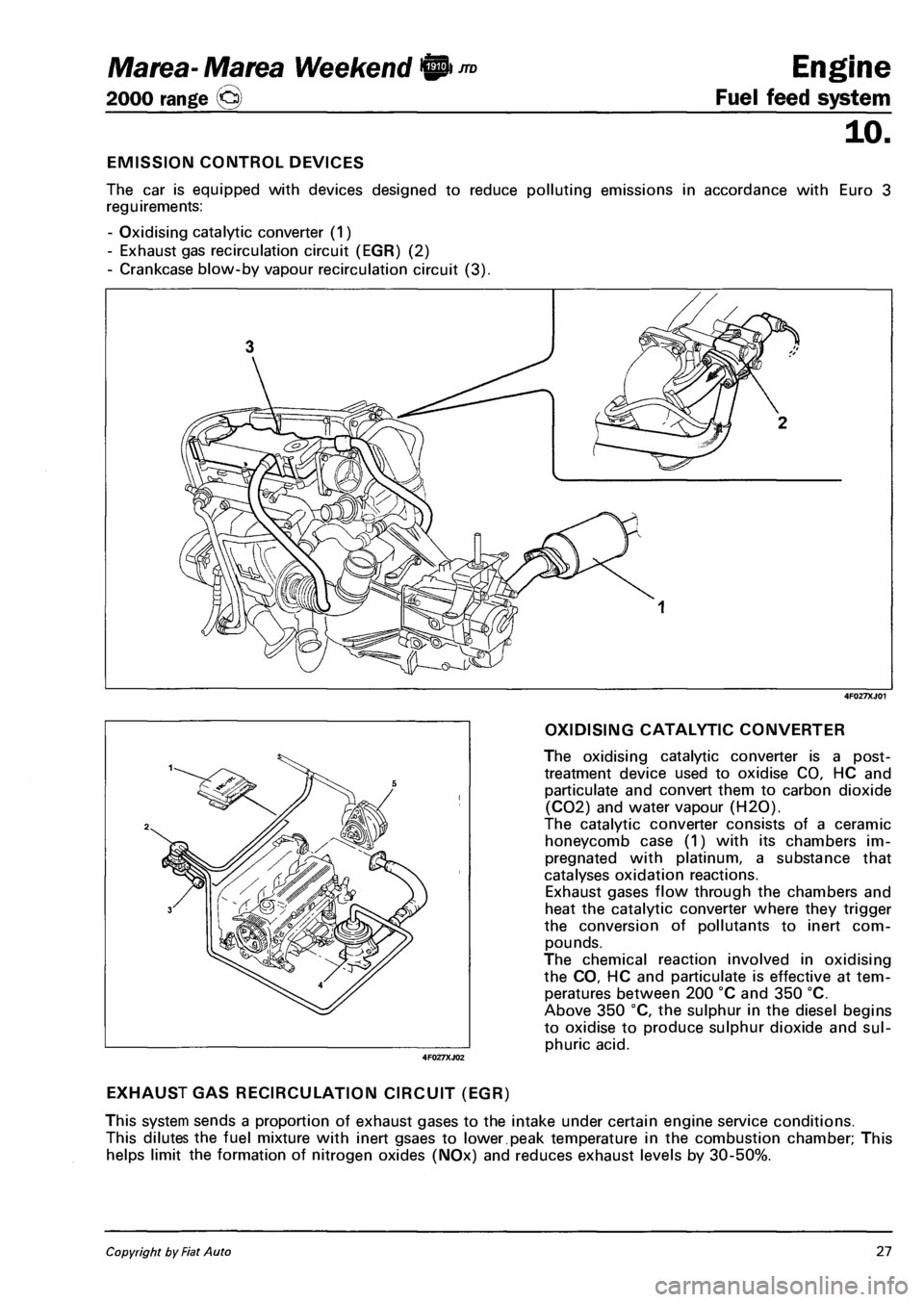
EMISSION CONTROL DEVICES
The car is equipped with devices designed to reduce polluting emissions in accordance with Euro 3
reguirements:
- Oxidising catalytic converter (1)
- Exhaust gas recirculation circuit (EGR) (2)
- Crankcase blow-by vapour recirculation circuit (3).
4F027XJ01
OXIDISING CATALYTIC CONVERTER
The oxidising catalytic converter is a post-
treatment device used to oxidise CO, HC and
particulate and convert them to carbon dioxide
(C02) and water vapour (H20).
The catalytic converter consists of a ceramic
honeycomb case (1) with its chambers im
pregnated with platinum, a substance that
catalyses oxidation reactions.
Exhaust gases flow through the chambers and
heat the catalytic converter where they trigger
the conversion of pollutants to inert com
pounds.
The chemical reaction involved in oxidising
the CO, HC and particulate is effective at tem
peratures between 200 °C and 350 °C.
Above 350 °C, the sulphur in the diesel begins
to oxidise to produce sulphur dioxide and sul
phuric acid.
EXHAUST GAS RECIRCULATION CIRCUIT (EGR)
This system sends a proportion of exhaust gases to the intake under certain engine service conditions.
This dilutes the fuel mixture with inert gsaes to lower.peak temperature in the combustion chamber; This
helps limit the formation of nitrogen oxides (NOx) and reduces exhaust levels by 30-50%.
4F027XJ02
Copyright by Fiat Auto 27
Page 114 of 330
Engine Marea- Marea Weekend IP ™
Fuel feed system 2000 range o
10.
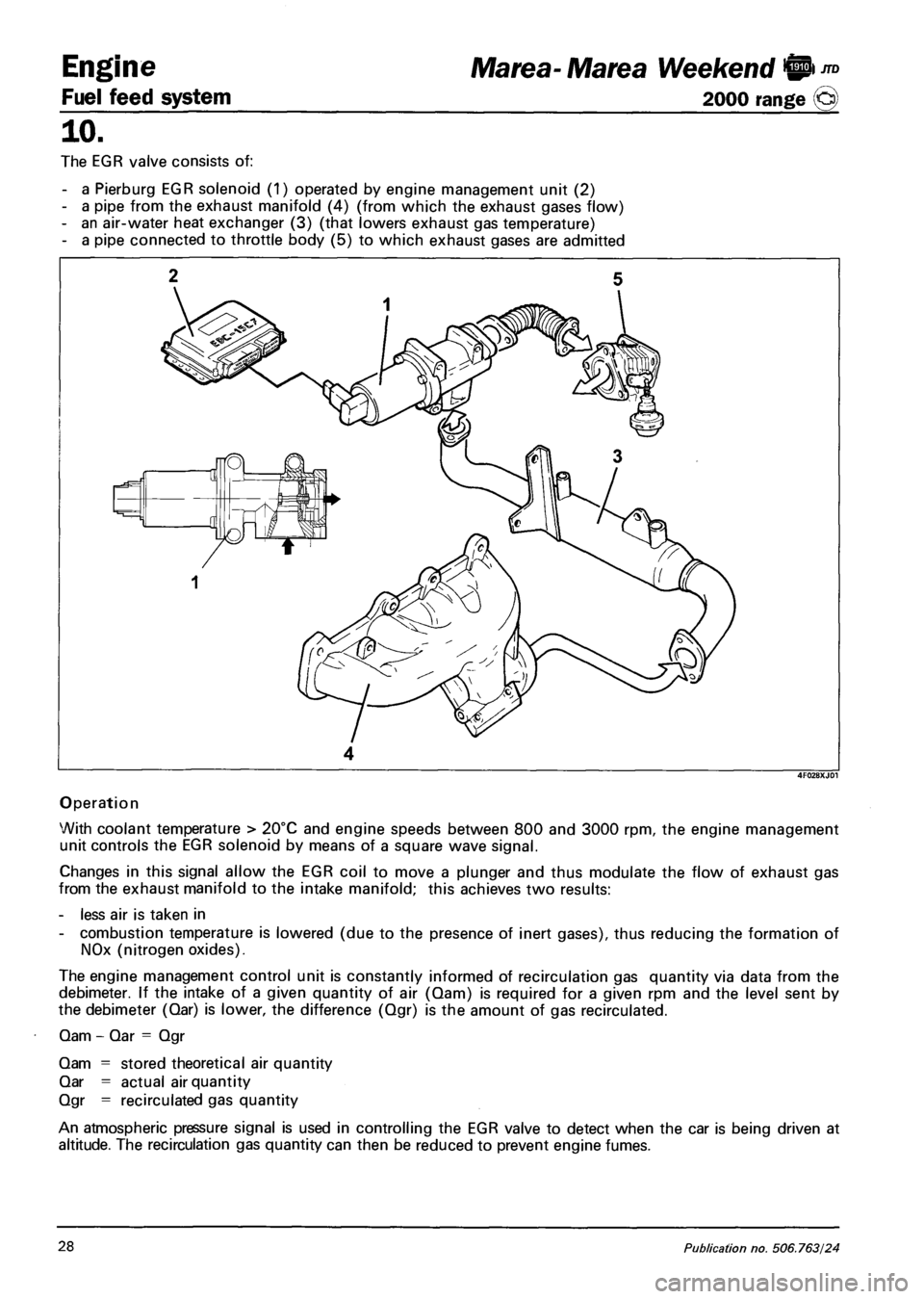
The EGR valve consists of:
- a Pierburg EGR solenoid (1) operated by engine management unit (2)
- a pipe from the exhaust manifold (4) (from which the exhaust gases flow)
- an air-water heat exchanger (3) (that lowers exhaust gas temperature)
- a pipe connected to throttle body (5) to which exhaust gases are admitted
4
Operation
With coolant temperature > 20°C and engine speeds between 800 and 3000 rpm, the engine management
unit controls the EGR solenoid by means of a square wave signal.
Changes in this signal allow the EGR coil to move a plunger and thus modulate the flow of exhaust gas
from the exhaust manifold to the intake manifold; this achieves two results:
- less air is taken in
- combustion temperature is lowered (due to the presence of inert gases), thus reducing the formation of
NOx (nitrogen oxides).
The engine management control unit is constantly informed of recirculation gas quantity via data from the
debimeter. If the intake of a given quantity of air (Qam) is required for a given rpm and the level sent by
the debimeter (Qar) is lower, the difference (Qgr) is the amount of gas recirculated.
Qam - Qar = Qgr
Qam = stored theoretical air quantity
Qar = actual air quantity
Qgr = recirculated gas quantity
An atmospheric pressure signal is used in controlling the EGR valve to detect when the car is being driven at
altitude. The recirculation gas quantity can then be reduced to prevent engine fumes.
28 Publication no. 506.763/24
Page 118 of 330
Engine
Fuel feed system
JTD Marea-Marea Weekend 9
2000 range ©
E.G.R.
TOR
VALVE SELF-ADJUSTMENT MO-
Removing-refitting
- Disconnect the negative battery lead, then
remove the sound insulation shield follow
ing the instructions in the previous para
graphs.
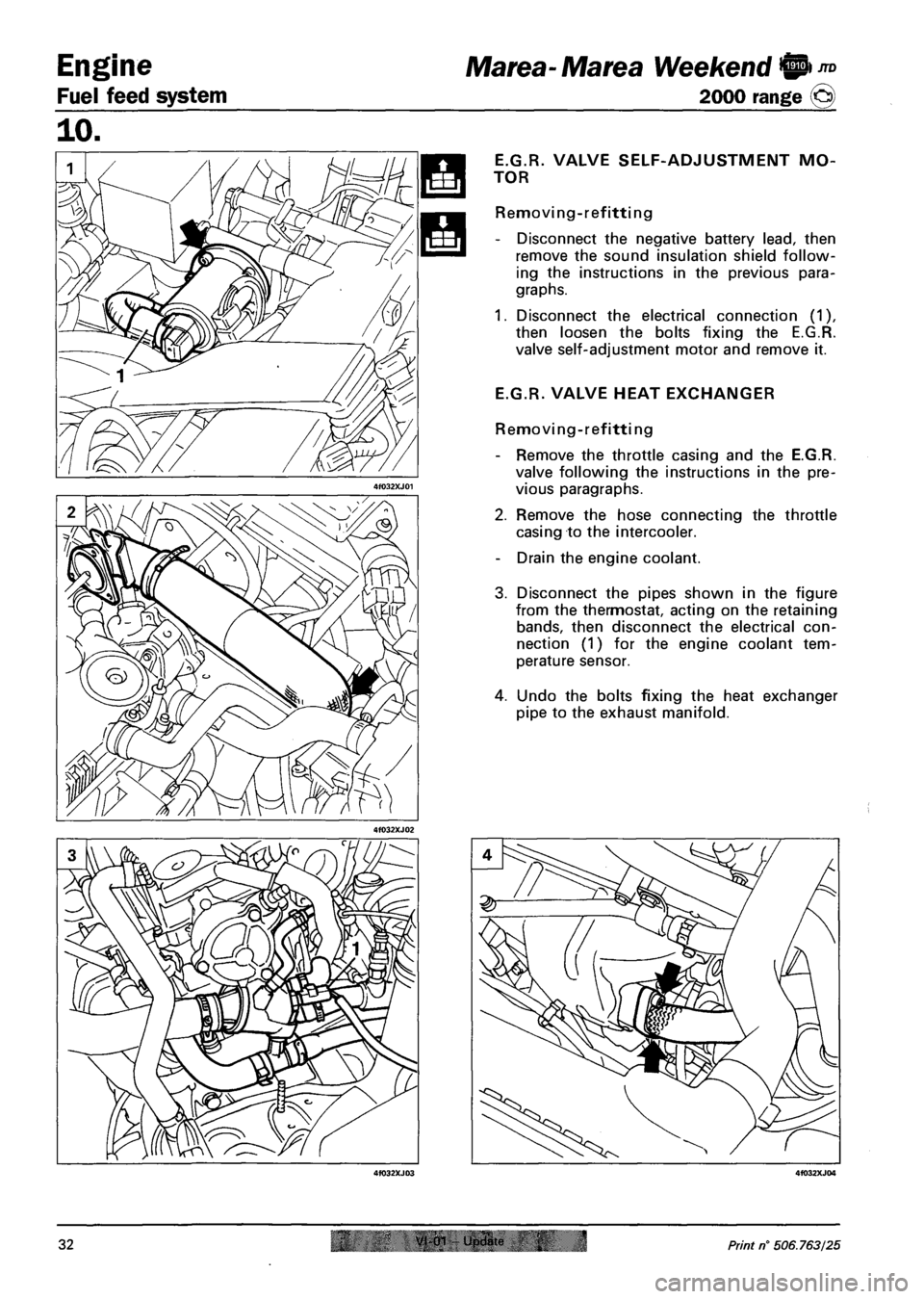
1. Disconnect the electrical connection (1),
then loosen the bolts fixing the E.G.R.
valve self-adjustment motor and remove it.
E.G.R. VALVE HEAT EXCHANGER
Removi ng - ref itti ng
- Remove the throttle casing and the E.G.R.
valve following the instructions in the pre
vious paragraphs.
2. Remove the hose connecting the throttle
casing to the intercooler.
- Drain the engine coolant.
3. Disconnect the pipes shown in the figure
from the thermostat, acting on the retaining
bands, then disconnect the electrical con
nection (1) for the engine coolant tem
perature sensor.
4. Undo the bolts fixing the heat exchanger
pipe to the exhaust manifold.
32 0"" Und«r 4 Print n° 506.763/25