fuel FIAT MULTIPLA 2006 1.G Owner's Manual
[x] Cancel search | Manufacturer: FIAT, Model Year: 2006, Model line: MULTIPLA, Model: FIAT MULTIPLA 2006 1.GPages: 266, PDF Size: 4.61 MB
Page 208 of 266
207
SAFETY
DEVICES
CORRECT USE
OF THE CAR
WARNING
LIGHTS AND
MESSAGES
TECHNICAL
SPECIFICATIONS
INDEX
DASHBOARD
AND CONTROLS
IN AN
EMERGENCY
CAR
MAINTENANCE
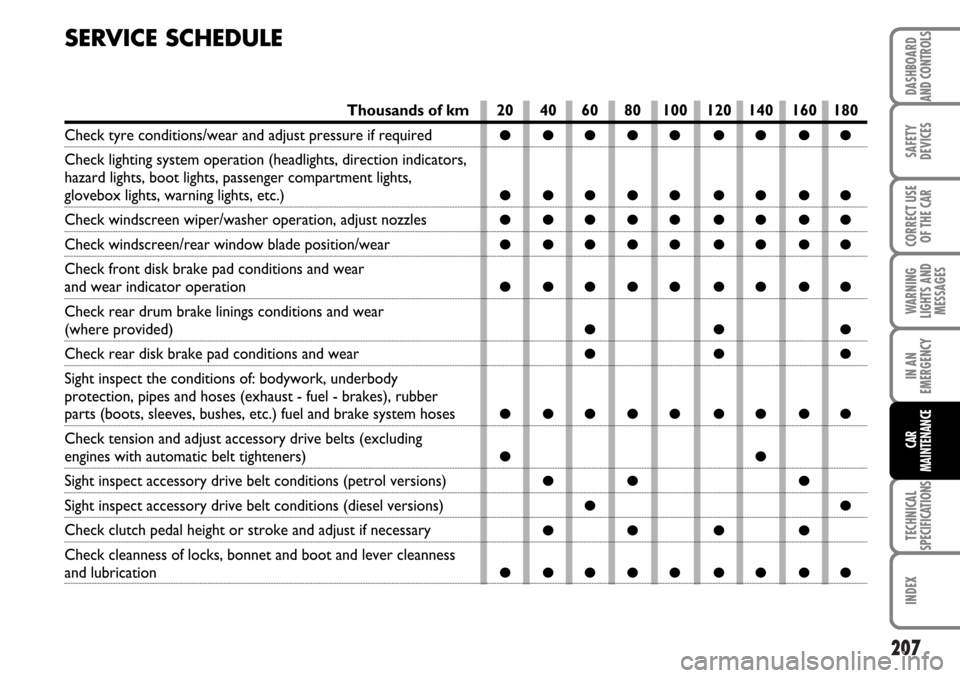
SERVICE SCHEDULE
20 40 60 80 100 120 140 160 180
●●●●● ●●●●
●●●●● ●●●●
●●●●● ●●●●
●●●●● ●●●●
●●●●● ●●●●
●●●
●●●
●●●●● ●●●●
●●
●● ●
●●
●● ● ●
●●●●● ●●●●
Thousands of km
Check tyre conditions/wear and adjust pressure if required
Check lighting system operation (headlights, direction indicators,
hazard lights, boot lights, passenger compartment lights,
glovebox lights, warning lights, etc.)
Check windscreen wiper/washer operation, adjust nozzles
Check windscreen/rear window blade position/wear
Check front disk brake pad conditions and wear
and wear indicator operation
Check rear drum brake linings conditions and wear
(where provided)
Check rear disk brake pad conditions and wear
Sight inspect the conditions of: bodywork, underbody
protection, pipes and hoses (exhaust - fuel - brakes), rubber
parts (boots, sleeves, bushes, etc.) fuel and brake system hoses
Check tension and adjust accessory drive belts (excluding
engines with automatic belt tighteners)
Sight inspect accessory drive belt conditions (petrol versions)
Sight inspect accessory drive belt conditions (diesel versions)
Check clutch pedal height or stroke and adjust if necessary
Check cleanness of locks, bonnet and boot and lever cleanness
and lubrication
Page 209 of 266
208
SAFETY
DEVICES
CORRECT USE
OF THE CAR
WARNING
LIGHTS AND
MESSAGES
IN AN
EMERGENCY
TECHNICAL
SPECIFICATIONS
INDEX
DASHBOARD
AND CONTROLS
CAR
MAINTENANCE
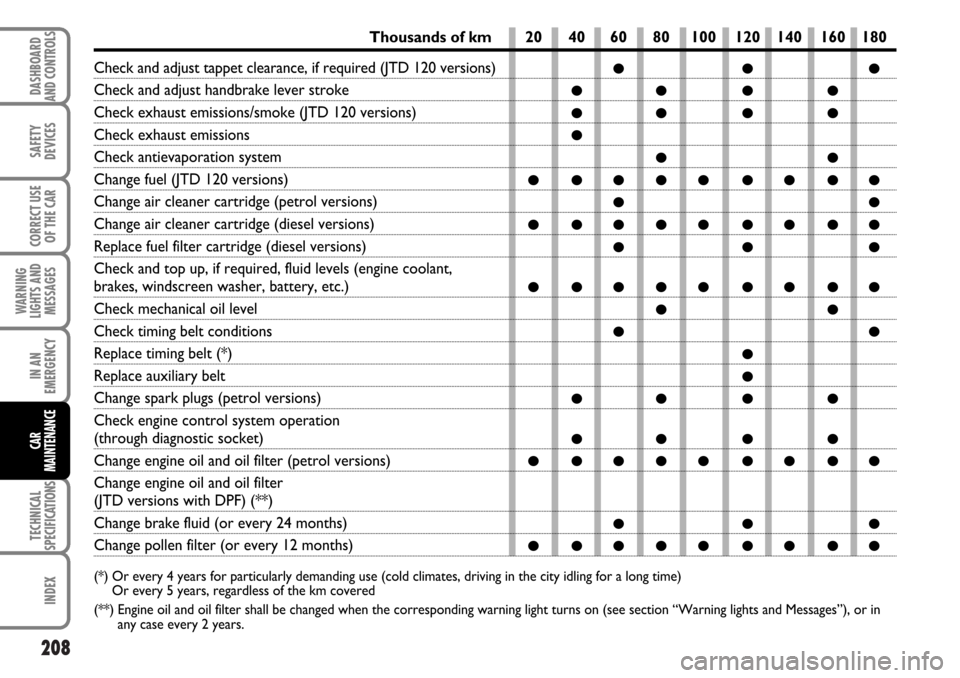
Thousands of km
●●●
●● ● ●
●● ● ●
●
●●
●●●●● ●●●●
●●
●●●●● ●●●●
●●●
●●●●● ●●●●
●●
●●
●
●
●● ● ●
●● ● ●
●●●●● ●●●●
●●●
●●●●● ●●●●
20 40 60 80 100 120 140 160 180
(*) Or every 4 years for particularly demanding use (cold climates, driving in the city idling for a long time)
Or every 5 years, regardless of the km covered
(**) Engine oil and oil filter shall be changed when the corresponding warning light turns on (see section “Warning lights and Messages”), or in
any case every 2 years.
Check and adjust tappet clearance, if required (JTD 120 versions)
Check and adjust handbrake lever stroke
Check exhaust emissions/smoke (JTD 120 versions)
Check exhaust emissions
Check antievaporation system
Change fuel (JTD 120 versions)
Change air cleaner cartridge (petrol versions)
Change air cleaner cartridge (diesel versions)
Replace fuel filter cartridge (diesel versions)
Check and top up, if required, fluid levels (engine coolant,
brakes, windscreen washer, battery, etc.)
Check mechanical oil level
Check timing belt conditions
Replace timing belt (*)
Replace auxiliary belt
Change spark plugs (petrol versions)
Check engine control system operation
(through diagnostic socket)
Change engine oil and oil filter (petrol versions)
Change engine oil and oil filter
(JTD versions with DPF) (**)
Change brake fluid (or every 24 months)
Change pollen filter (or every 12 months)
Page 211 of 266

210
SAFETY
DEVICES
CORRECT USE
OF THE CAR
WARNING
LIGHTS AND
MESSAGES
IN AN
EMERGENCY
TECHNICAL
SPECIFICATIONS
INDEX
DASHBOARD
AND CONTROLS
CAR
MAINTENANCE
USE OF THE CAR UNDER
HEAVY CONDITIONS
Should prevailing use of the car be under one of the
following specially heavy conditions:
❒trailer or caravan towing;
❒dusty roads;
❒short distances (less than 7-8 km) and repeated
with external temperatures below zero;
❒frequently idling engines or long distance low
speed driving (e.g.: door-to-door deliveries) or in
case of a long term inactivity;
❒urban routes;carry out checks more frequently than required on
Service Schedule:
❒check front disk brake pad conditions and wear;
❒check cleanness of bonnet and boot locks and
lever cleanness and lubrication;
❒sight inspect the conditions of: engine, gearbox,
transmission, pipes and hoses (exhaust - fuel -
brakes), rubber parts (boots, sleeves, bushes, etc.);
❒check battery charge and fluid level (electrolyte);
❒visual check on various drive belt conditions;
❒check and replace pollen filter, if required;
❒check and replace air cleaner, if required.
Page 222 of 266
221
SAFETY
DEVICES
CORRECT USE
OF THE CAR
WARNING
LIGHTS AND
MESSAGES
TECHNICAL
SPECIFICATIONS
INDEX
DASHBOARD
AND CONTROLS
IN AN
EMERGENCY
CAR
MAINTENANCE
DIESEL FUEL FILTER
DRAINING THE CONDENSE (diesel versions)
IMPORTANT The presence of water in the fuel circuit
can severely damage the injection system and make
the engine misfire. If the warning light
cturns on,
contact a Fiat Dealership as soon as possible to have
the bleeding operation carried out.
If the warning light comes on immediately after
refuelling, water is probably present in the tank: turn
the engine off immediately and contact Fiat Dealership.
BATTERY
Fiat Multipla battery is of the “Limited maintenance”
type: under normal conditions of use it does not
require topping up with distilled water.
CHECKING THE BATTERY FLUID LEVEL
(electrolyte)
Check the electrolyte level (and top up if required) at
the intervals shown in the Service Schedule in this
section. Have this operation carried out at Fiat
Dealership.
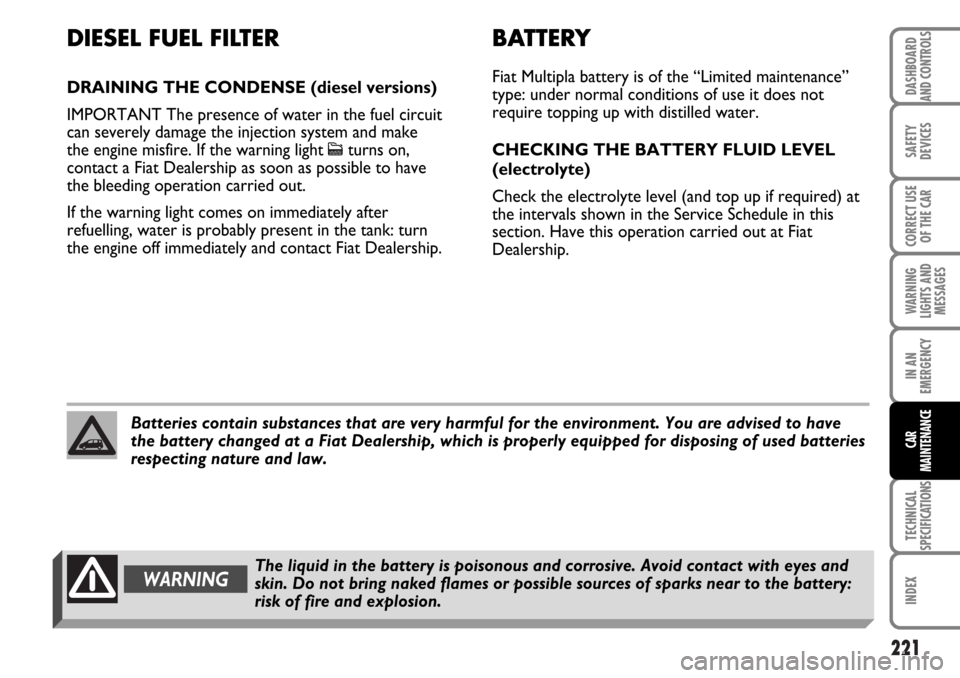
Batteries contain substances that are very harmful for the environment. You are advised to have
the battery changed at a Fiat Dealership, which is properly equipped for disposing of used batteries
respecting nature and law.
The liquid in the battery is poisonous and corrosive. Avoid contact with eyes and
skin. Do not bring naked flames or possible sources of sparks near to the battery:
risk of fire and explosion.WARNING
Page 227 of 266
226
SAFETY
DEVICES
CORRECT USE
OF THE CAR
WARNING
LIGHTS AND
MESSAGES
IN AN
EMERGENCY
TECHNICAL
SPECIFICATIONS
INDEX
DASHBOARD
AND CONTROLS
CAR
MAINTENANCE
RUBBER TUBING
As far as the brake system and fuel rubber hoses are
concerned, carefully follow the Service Schedule in this
section. Indeed ozone, high temperatures and
prolonged lack of fluid in the system may cause
hardening and cracking of the hoses, with possible
leaks. Careful control is therefore necessary.
WINDSCREEN/
REAR WINDOW WIPERS
BLADES
Periodically clean the rubber part using special
products; TUTELA PROFESSIONAL SC 35 is
recommended.
If the rubber blades are bent or worn they should be
replaced. In any case they should be changed once a
year.
A few simple notions can reduce the possibility of
damage to the blades:
❒if the temperature fall below zero, make sure that
ice has not frozen the rubber against glass. If
necessary, thaw using an antifreeze product;
❒remove any snow from the glass: in addition to
protecting the blades, this prevents effort on the
motor and overheating;
❒do not operate the windscreen and rear window
wipers on dry glass.
WARNINGDriving with worn wiper blades is a serious hazard, because visibility is reduced in
bad weather.
Page 233 of 266
232
SAFETY
DEVICES
CORRECT USE
OF THE CAR
WARNING
LIGHTS AND
MESSAGES
IN AN
EMERGENCY
TECHNICAL
SPECIFICATIONS
INDEX
DASHBOARD
AND CONTROLS
CAR
MAINTENANCE
STEERING WHEEL / GEAR LEVER KNOB
WITH GENUINE LEATHER COVERING
These components shall only be cleaned with water
and neutral soap.
Never use spirit or alcohol-based products.
Before using special products for cleaning interiors,
read carefully label instructions and indications to
make sure they are free from spirit and/or alcohol-
based substances.If when cleaning the windscreen with special glass
products, some drops fall on the leather covering of
the steering wheel/gear lever knob remove them
immediately and then clean with water and neutral
soap.
IMPORTANT Take the utmost care when engaging
the steering lock to prevent scratching the leather
covering.
Never use inflammable products like fuel oil ether or rectified petrol for cleaning
inside the car. The electrostatic discharges generated when rubbing to clean may
cause fire.WARNING
Do not keep aerosol cans in the car. They might explode. Aerosol cans must never
be exposed to a temperature above 50°C. The temperature inside the car exposed
to the sun may go well beyond that figure. WARNING
Page 234 of 266
233
SAFETY
DEVICES
CORRECT USE
OF THE CAR
WARNING
LIGHTS AND
MESSAGES
CAR
MAINTENANCE
INDEX
DASHBOARD
AND CONTROLS
IN AN
EMERGENCY
TECHNICAL
SPECIFICATIONS
T T
E E
C C
H H
N N
I I
C C
A A
L L
S S
P P
E E
C C
I I
F F
I I
C C
A A
T T
I I
O O
N N
S S
IDENTIFICATION DATA ................................................. 234
ENGINE CODES - BODYWORK VERSIONS .............. 236
ENGINE ................................................................................. 237
FUEL FEED/IGNITION ....................................................... 238
TRANSMISSION .................................................................. 238
BRAKES .................................................................................. 239
SUSPENSIONS ..................................................................... 239
STEERING ............................................................................. 239
WHEELS ................................................................................. 240
DIMENSIONS ....................................................................... 244
PERFORMANCE ................................................................... 246
WEIGHTS ............................................................................... 247
CAPACITIES ......................................................................... 249
FLUIDS AND LUBRICANTS ........................................... 250
FUEL CONSUMPTION ....................................................... 252
CO
2EMISSIONS .................................................................. 253
RADIOFREQUENCY REMOTE CONTROL
MINISTERIAL HOMOLOGATION ................................. 254
Page 238 of 266

237
SAFETY
DEVICES
CORRECT USE
OF THE CAR
WARNING
LIGHTS AND
MESSAGES
CAR
MAINTENANCE
INDEX
DASHBOARD
AND CONTROLS
IN AN
EMERGENCY
TECHNICAL
SPECIFICATIONS
ENGINE
JTD 120
186A9.000
Diesel
4 in line
2
82 x 90.4
1910
18 : 1
88
120
4000
206
21.0
1450/3000
–
–
Diesel fuel for motor
vehicles (Specification
EN590) JTD 115 (*)
186A8.000
Diesel
4 in line
2
82 x 90.4
1910
18 : 1
85
115
4000
203
20.7
1500
–
–
Diesel fuel for motor
vehicles (Specification
EN590) 100 16V
182B6.000
Otto
4 in line
4
80.5 x 78.4
1596
10.5 : 1
76
103
5750
145
14.8
4000
NGK BKR5EZ
CHAMPION RC10YCC
Unleaded petrol
95 RON
(Specification EN228)
GENERAL FEATURES
Engine code
Cycle
Number and layout of cylinders
Number of valves per cylinder
Piston bore and stroke mm
Total displacement cm3
Compression ratio
kW
Maximum power (EEC) HP
corresponding ratio rpm
Nm
Torque (EEC) kgm
corresponding ratio/s rpm
Spark plugs
Fuel
(*) Engine model provided for certain versions/markets only
Page 239 of 266
238
SAFETY
DEVICES
CORRECT USE
OF THE CAR
WARNING
LIGHTS AND
MESSAGES
CAR
MAINTENANCE
INDEX
DASHBOARD
AND CONTROLS
IN AN
EMERGENCY
TECHNICAL
SPECIFICATIONS
Modifications or repairs to the fuel system that are not carried out properly or do not take the
system technical specifications into account can cause malfunctions leading to the risk of fire.
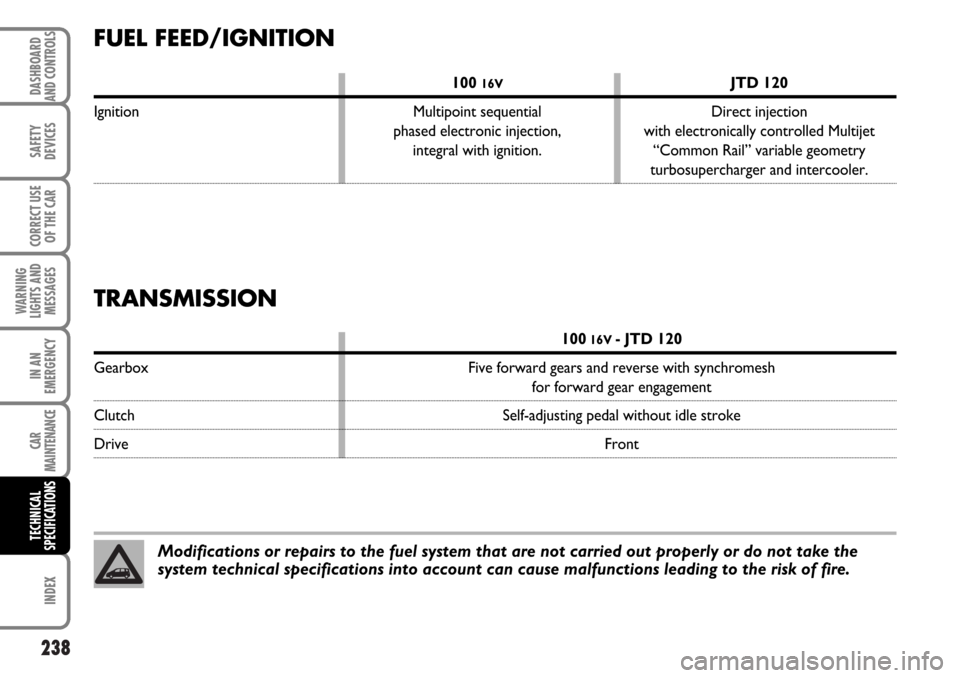
FUEL FEED/IGNITION
JTD 120
Direct injection
with electronically controlled Multijet
“Common Rail” variable geometry
turbosupercharger and intercooler.100 16V
Multipoint sequential
phased electronic injection,
integral with ignition.
TRANSMISSION
10016V - JTD 120
Gearbox Five forward gears and reverse with synchromesh
for forward gear engagement
Clutch Self-adjusting pedal without idle stroke
Drive Front
Ignition
Page 248 of 266

247
SAFETY
DEVICES
CORRECT USE
OF THE CAR
WARNING
LIGHTS AND
MESSAGES
CAR
MAINTENANCE
INDEX
DASHBOARD
AND CONTROLS
IN AN
EMERGENCY
TECHNICAL
SPECIFICATIONS
JTD 120
1370
680
1100
1050
2050
1300 (900)•
560
80
70
(*) If special equipment is fitted (sunroof, tow hitch, etc.) the unladen car weight increases thus reducing the payload as specified in the maximum
loads allowed.
(**) Loads not to be exceeded. The driver is responsible for arranging the loads in the boot an/or on the roof so that they comply with these lim-
its.
With headlights turned on, load must not exceed the values indicated in paragraph “Headlights” in section “Dashboard and controls”.
(•) For specific markets.
WEIGHTS
Weights (kg)
Empty weight
(including all fluids, fuel tank at 90 % and with no optional):
Payload (*) including
the driver:
Maximum admitted loads (**)
– front axle:
– rear axle:
– total:
Towable loads
– trailer with brakes:
– trailer without brakes:
Maximum load on roof:
Maximum load on tow hitch (trailer with brakes):100
16V
1300
690
1050
1050
2025
1200 (900)•
560
80
70