steering wheel FIAT MULTIPLA 2007 1.G User Guide
[x] Cancel search | Manufacturer: FIAT, Model Year: 2007, Model line: MULTIPLA, Model: FIAT MULTIPLA 2007 1.GPages: 266, PDF Size: 4.66 MB
Page 135 of 266
134
CORRECT USE
OF THE CAR
WARNING
LIGHTS AND
MESSAGES
IN AN
EMERGENCY
CAR
MAINTENANCE
TECHNICAL
SPECIFICATIONS
INDEX
DASHBOARD
AND CONTROLS
SAFETY
DEVICES
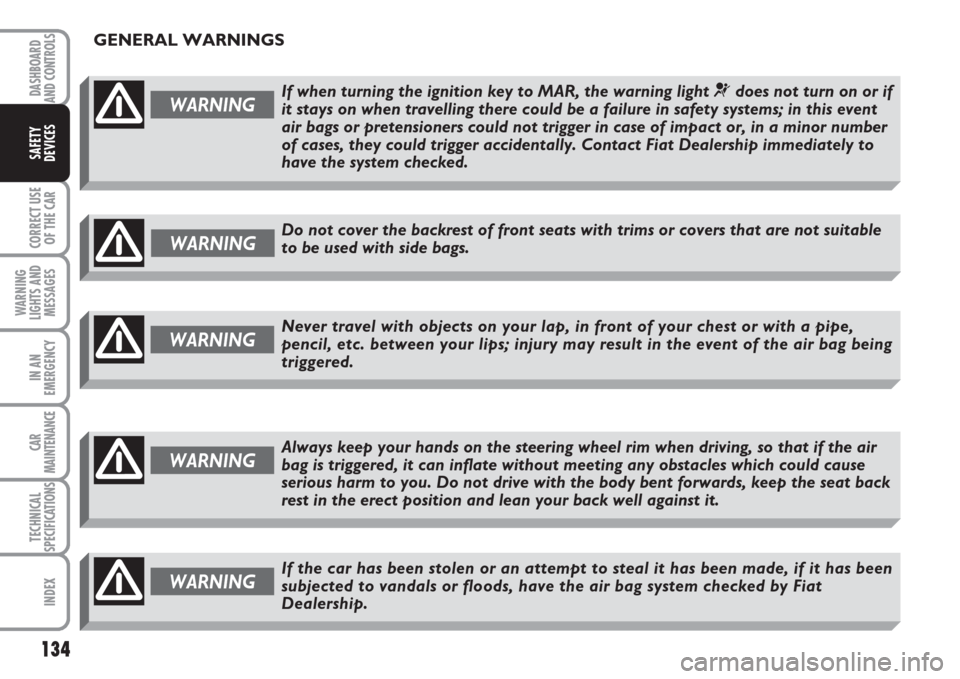
GENERAL WARNINGS
WARNING
Never travel with objects on your lap, in front of your chest or with a pipe,
pencil, etc. between your lips; injury may result in the event of the air bag being
triggered.WARNING
Do not cover the backrest of front seats with trims or covers that are not suitable
to be used with side bags.
If the car has been stolen or an attempt to steal it has been made, if it has been
subjected to vandals or floods, have the air bag system checked by Fiat
Dealership.WARNING
WARNINGAlways keep your hands on the steering wheel rim when driving, so that if the air
bag is triggered, it can inflate without meeting any obstacles which could cause
serious harm to you. Do not drive with the body bent forwards, keep the seat back
rest in the erect position and lean your back well against it.
WARNINGIf when turning the ignition key to MAR, the warning light ¬does not turn on or if
it stays on when travelling there could be a failure in safety systems; in this event
air bags or pretensioners could not trigger in case of impact or, in a minor number
of cases, they could trigger accidentally. Contact Fiat Dealership immediately to
have the system checked.
Page 140 of 266
139
WARNING
LIGHTS AND
MESSAGES
IN AN
EMERGENCY
CAR
MAINTENANCE
TECHNICAL
SPECIFICATIONS
INDEX
DASHBOARD
AND CONTROLS
SAFETY
DEVICES
CORRECT USE
OF THE CAR
If the engine does not start at the first attempt, return
the ignition key to STOP before trying to start the
engine again.
If, when the ignition key is at MAR, warning light
¢
remains lit, turn the key to STOP and then back to
MAR; if the warning light remains on, try with the
other keys provided with the car.
If you still cannot start the engine, contact Fiat
Dealership.
IMPORTANT When the outside temperature is very
low, the use of a fluid oil facilitates cold starting.
During winter it is therefore recommended to
observe the specifications contained in section
“Technical specifications” at paragraph “Fluids and
lubricants”.
IMPORTANT Never leave the ignition key at MAR
when the engine is off.
HOW TO WARM UP THE ENGINE
AFTER IT HAS JUST STARTED
(petrol and diesel versions)
Proceed as follows:
❒drive off slowly, letting the engine turn at medium
revs. Do not accelerate abruptly.
❒do not drive at full performance for the initial
kilometres.
EMERGENCY START-UP
If the Fiat CODE system fails to recognise the code
transmitted by the ignition key (warning light
¢on
instrument panel lit with fixed light) you can start the
engine by following the emergency procedure using
the code written on the CODE card.
See section “In an emergency”.
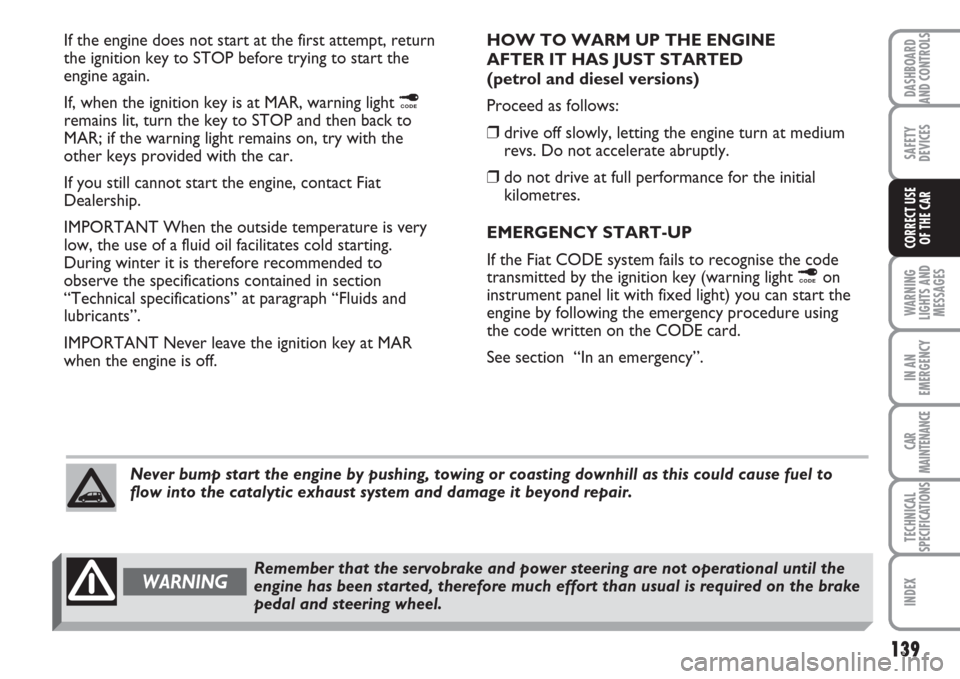
Never bump start the engine by pushing, towing or coasting downhill as this could cause fuel to
flow into the catalytic exhaust system and damage it beyond repair.
Remember that the servobrake and power steering are not operational until the
engine has been started, therefore much effort than usual is required on the brake
pedal and steering wheel.WARNING
Page 168 of 266
167
SAFETY
DEVICES
CORRECT USE
OF THE CAR
WARNING
LIGHTS AND
MESSAGES
CAR
MAINTENANCE
TECHNICAL
SPECIFICATIONS
INDEX
DASHBOARD
AND CONTROLS
IN AN
EMERGENCY
BUMP STARTING
Never bump start the engine by pushing, towing or
coasting downhill.
This could cause fuel to flow into the catalytic
converter and damage it beyond repair.
IMPORTANT Remember that the servobrake and
electrical power steering system are not operating
until the engine is started, a greater effort will
therefore be required to press the brake pedal or turn
the steering wheel.IF A TYRE IS PUNCTURED
GENERAL INSTRUCTIONS
For versions/markets where applicable, the car can be
fitted with a quick tyre repair kit called FIX & GO,
replacing the usual tool fitting, the spare wheel lifting
winch and the space-saver spare wheel.
Normal spare small wheel, or (where provided)
normal size spare wheel, can be supplied on request;
for its use, follow what indicated below.
VAN versions are fitted as standard with a spare
wheel with steel rim of the same type and size as the
standard wheels mounted on the car.
Wheel changing and correct use of the jack and space-
saver spare wheel call for some precautions as listed
below.
WARNINGAlert other drivers that the car is stationary in compliance with local regulations:
hazard warning lights, warning triangle, etc. Any passengers on board should leave the
car, especially if it is heavily laden. Passengers should stay away from oncoming traffic
while the wheel is being changed. If parked on a slope or rough surface, chock the
wheels with wedges or other suitable devices to prevent the car from rolling.
Page 205 of 266
204
SAFETY
DEVICES
CORRECT USE
OF THE CAR
WARNING
LIGHTS AND
MESSAGES
CAR
MAINTENANCE
TECHNICAL
SPECIFICATIONS
INDEX
DASHBOARD
AND CONTROLS
IN AN
EMERGENCY
WARNINGDo not start the engine when towing the vehicle.
Before starting to tow, turn the ignition key to MAR and then to STOP. Do not
remove the key. If the key is removed, the steering lock engages automatically
resulting in the impossibility to steer the wheels. WARNING
WARNINGWhen towing, remember that without the help of the servobrake and power
steering, a greater effort is required on the pedal and steering wheel. Do not use
flexible cables for towing and avoid jerks. During towing operations make sure that
fastening the joint to the car does not damage the components in contact with it.
When towing the car, you must comply with the specific traffic regulations
regarding the tow ring and how to tow on the road.
Page 226 of 266

225
SAFETY
DEVICES
CORRECT USE
OF THE CAR
WARNING
LIGHTS AND
MESSAGES
TECHNICAL
SPECIFICATIONS
INDEX
DASHBOARD
AND CONTROLS
IN AN
EMERGENCY
CAR
MAINTENANCE
❒if a tyre is punctured, stop immediately and change
it to avoid damage to the tyre, the rim, suspensions
and steering system.
❒tyres age even if they are not used much. Cracks in
the tread rubber are a sign of ageing. In any case, if
the tyres have been on the car for over 6 years,
they should be checked by specialised personnel, to
see if they can still be used. Also remember to
check the space-saver spare wheel.
❒in the case of replacement, always fit new tyres,
avoiding those of dubious origin.
WARNINGRemember that road holding depends also on the correct tyre inflating pressure.
WARNINGIf the pressure is too low the tyre overheats and this can cause it serious damage.❒if a tyre is changed, also change the inflation valve.
❒to allow even wear between the front and rear
tyres, it is advisable to change them over every 10-
15 thousand kilometres, keeping them on the same
side of the car so as to not reverse the direction of
rotation.
WARNINGDo not cross switch the tyres, moving them from the right of the car to the left and
vice versa.
Never submit alloy rims to repainting treatments requiring to use temperatures
exceeding 150°C since the mechanical properties of the wheels could be
impaired.WARNING
Page 233 of 266
232
SAFETY
DEVICES
CORRECT USE
OF THE CAR
WARNING
LIGHTS AND
MESSAGES
IN AN
EMERGENCY
TECHNICAL
SPECIFICATIONS
INDEX
DASHBOARD
AND CONTROLS
CAR
MAINTENANCE
STEERING WHEEL / GEAR LEVER KNOB
WITH GENUINE LEATHER COVERING
These components shall only be cleaned with water
and neutral soap.
Never use spirit or alcohol-based products.
Before using special products for cleaning interiors,
read carefully label instructions and indications to
make sure they are free from spirit and/or alcohol-
based substances.If when cleaning the windscreen with special glass
products, some drops fall on the leather covering of
the steering wheel/gear lever knob remove them
immediately and then clean with water and neutral
soap.
IMPORTANT Take the utmost care when engaging
the steering lock to prevent scratching the leather
covering.
Never use inflammable products like fuel oil ether or rectified petrol for cleaning
inside the car. The electrostatic discharges generated when rubbing to clean may
cause fire.WARNING
Do not keep aerosol cans in the car. They might explode. Aerosol cans must never
be exposed to a temperature above 50°C. The temperature inside the car exposed
to the sun may go well beyond that figure. WARNING
Page 234 of 266
233
SAFETY
DEVICES
CORRECT USE
OF THE CAR
WARNING
LIGHTS AND
MESSAGES
CAR
MAINTENANCE
INDEX
DASHBOARD
AND CONTROLS
IN AN
EMERGENCY
TECHNICAL
SPECIFICATIONS
TT T
E E
C C
H H
N N
I I
C C
A A
L L
S S
P P
E E
C C
I I
F F
I I
C C
A A
T T
I I
O O
N N
S S
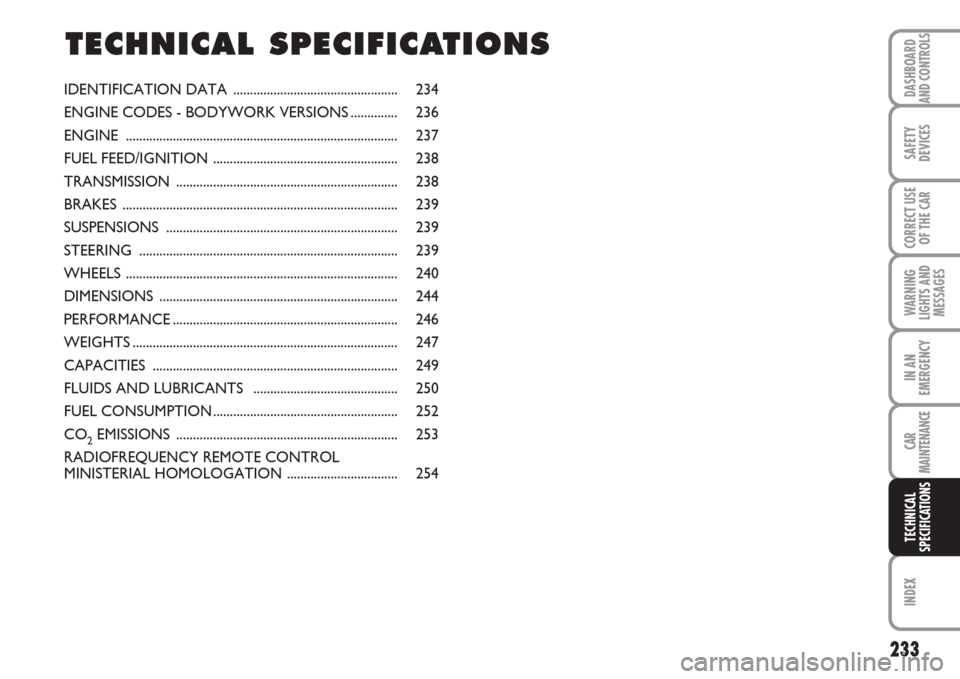
IDENTIFICATION DATA ................................................. 234
ENGINE CODES - BODYWORK VERSIONS .............. 236
ENGINE ................................................................................. 237
FUEL FEED/IGNITION ....................................................... 238
TRANSMISSION .................................................................. 238
BRAKES .................................................................................. 239
SUSPENSIONS ..................................................................... 239
STEERING ............................................................................. 239
WHEELS ................................................................................. 240
DIMENSIONS ....................................................................... 244
PERFORMANCE ................................................................... 246
WEIGHTS ............................................................................... 247
CAPACITIES ......................................................................... 249
FLUIDS AND LUBRICANTS ........................................... 250
FUEL CONSUMPTION ....................................................... 252
CO
2EMISSIONS .................................................................. 253
RADIOFREQUENCY REMOTE CONTROL
MINISTERIAL HOMOLOGATION ................................. 254
Page 240 of 266
239
SAFETY
DEVICES
CORRECT USE
OF THE CAR
WARNING
LIGHTS AND
MESSAGES
CAR
MAINTENANCE
INDEX
DASHBOARD
AND CONTROLS
IN AN
EMERGENCY
TECHNICAL
SPECIFICATIONS
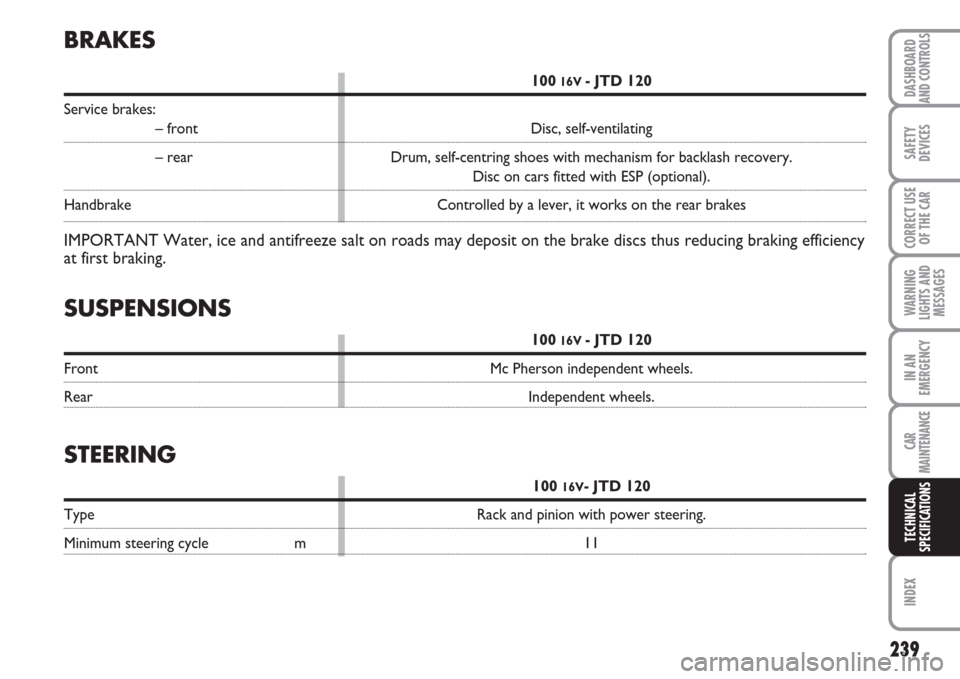
BRAKES
10016V - JTD 120
Service brakes:
– front Disc, self-ventilating
– rear Drum, self-centring shoes with mechanism for backlash recovery.
Disc on cars fitted with ESP (optional).
Handbrake Controlled by a lever, it works on the rear brakes
IMPORTANT Water, ice and antifreeze salt on roads may deposit on the brake discs thus reducing braking efficiency
at first braking.
SUSPENSIONS
10016V - JTD 120
Front Mc Pherson independent wheels.
Rear Independent wheels.
STEERING
100 16V- JTD 120
Type Rack and pinion with power steering.
Minimum steering cycle m 11
Page 252 of 266
251
SAFETY
DEVICES
CORRECT USE
OF THE CAR
WARNING
LIGHTS AND
MESSAGES
CAR
MAINTENANCE
INDEX
DASHBOARD
AND CONTROLS
IN AN
EMERGENCY
TECHNICAL
SPECIFICATIONS
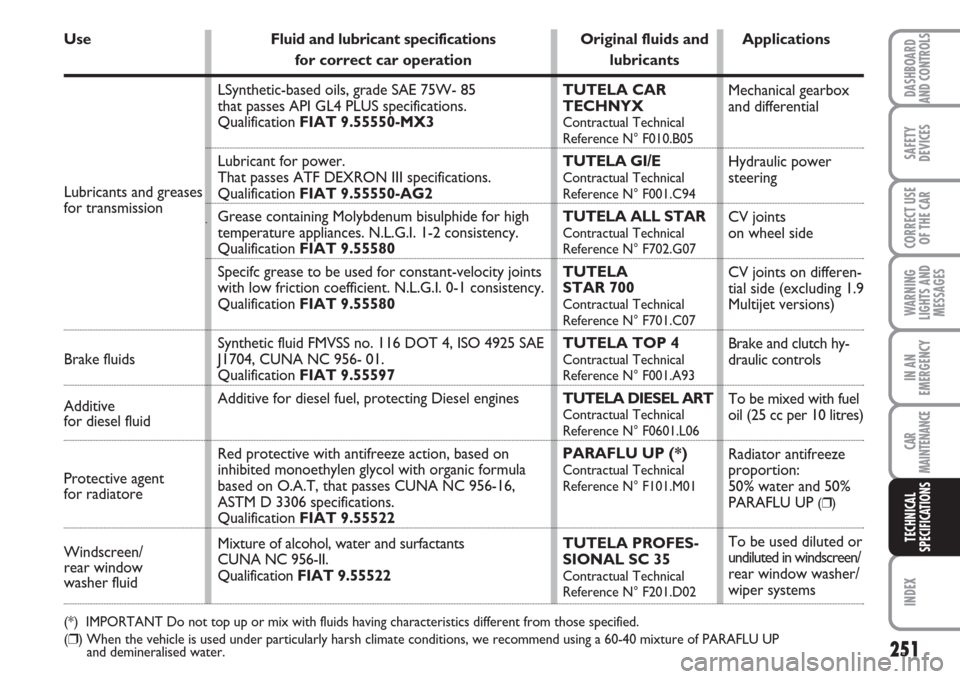
Lubricants and greasesfor transmissionLSynthetic-based oils, grade SAE 75W- 85
that passes API GL4 PLUS specifications.
Qualification FIAT 9.55550-MX3
Lubricant for power.
That passes ATF DEXRON III specifications.
Qualification FIAT 9.55550-AG2
Grease containing Molybdenum bisulphide for high
temperature appliances. N.L.G.I. 1-2 consistency.
Qualification FIAT 9.55580
Specifc grease to be used for constant-velocity joints
with low friction coefficient. N.L.G.I. 0-1 consistency.
Qualification FIAT 9.55580
Synthetic fluid FMVSS no. 116 DOT 4, ISO 4925 SAE
J1704, CUNA NC 956- 01.
Qualification FIAT 9.55597
Additive for diesel fuel, protecting Diesel engines
Red protective with antifreeze action, based on
inhibited monoethylen glycol with organic formula
based on O.A.T, that passes CUNA NC 956-16,
ASTM D 3306 specifications.
Qualification FIAT 9.55522
Mixture of alcohol, water and surfactants
CUNA NC 956-II.
Qualification FIAT 9.55522TUTELA CAR
TECHNYX
Contractual Technical
Reference N° F010.B05
TUTELA GI/EContractual Technical
Reference N° F001.C94
TUTELA ALL STARContractual Technical
Reference N° F702.G07
TUTELA
STAR 700
Contractual Technical
Reference N° F701.C07
TUTELA TOP 4Contractual Technical
Reference N° F001.A93
TUTELA DIESEL ARTContractual Technical
Reference N° F0601.L06
PARAFLU UP (*)Contractual Technical
Reference N° F101.M01
TUTELA PROFES-
SIONAL SC 35
Contractual Technical
Reference N° F201.D02
Mechanical gearbox
and differential
Hydraulic power
steering
CV joints
on wheel side
CV joints on differen-
tial side (excluding 1.9
Multijet versions)
Brake and clutch hy-
draulic controls
To be mixed with fuel
oil (25 cc per 10 litres)
Radiator antifreeze
proportion:
50% water and 50%
PARAFLU UP
(❒)
To be used diluted or
undiluted in windscreen/
rear window washer/
wiper systems Brake fluids
Protective agent
for radiatore
Windscreen/
rear window
washer fluid
(*) IMPORTANT Do not top up or mix with fluids having characteristics different from those specified.
(❒) When the vehicle is used under particularly harsh climate conditions, we recommend using a 60-40 mixture of PARAFLU UP
and demineralised water.
Additive
for diesel fluid Use Fluid and lubricant specificationsOriginal fluids and Applications
for correct car operation lubricants
Page 257 of 266

TECHNICAL
SPECIFICATIONS
256
SAFETY
DEVICES
CORRECT USE
OF THE CAR
WARNING
LIGHTS AND
MESSAGES
CAR
MAINTENANCE
INDEX
DASHBOARD
AND CONTROLS
IN AN
EMERGENCY
I I
N N
D D
E E
X X
– Isofix type child restraint
system .......................................... 126
Ceiling lights
– front ............................................. 63
– front bulb replacement ............ 192
– rear .............................................. 64
– rear bulb replacement ............. 193
Cellular phone set-up ..................... 106
Changing a wheel ............................ 167
Chassis marking .............................. 235
Checking fluid levels
– brake fluid ................................... 219
– engine oil ..................................... 214
– engine oil consumption............ 215
– power steering fluid ................. 218
– windscreen/rear window
washer fluid ................................ 217
Cigar lighter ...................................... 69
Clock .................................................. 21
Clutch ................................................ 238
CO
2emissions ................................ 253
Controls
– front fog lights............................ 65
– fuel cut-off switch ..................... 66 – advice for preserving
the bodywork ............................ 230
– headlights .................................... 231
– identification plate..................... 234
– paint.............................................. 230
– versions ...................................... 236
– warranty ..................................... 229
– windows ...................................... 231
Bonnet ............................................... 85
Boot.................................................... 78
– anchoring the load .................... 80
– extending the boot .................. 81
– opening/closing .......................... 78
Brake fluid level ............................... 219
Brake light (replacement) .............. 190
Brakes ................................................ 239
– fluid level ..................................... 219
– service and emergency brake .. 239
Bulb replacement ............................ 183
Bulb types.......................................... 184
Capacities......................................... 249
Car maintenance ............................. 205
Carrying children safely ................. 120
ABS system...................................... 90
Additional checks ............................ 210
Adjusting the headlight beam ....... 88
Aerial ................................................. 103
Airbags ............................................... 129
– deactivation ................................ 131
– description and operation ..... 129
– front ............................................. 129
– general warnings........................ 134
– side ............................................... 132
Air cleaner ........................................ 220
Air vents
(directional and adjustable) ........ 49
Annual inspection plan ................... 209
Ashtray .............................................. 69
Automatic climate control system 54
Battery
– changing ....................................... 222
– fluid level .................................... 221
– recharging ................................... 202
– useful advice for lengthening
the life of your battery............. 223
Bodywork